鼻
| ||||||||
| ||||||||
| ||||||||
Translingual[edit]
| Stroke order | |||
|---|---|---|---|

| |||
| Japanese | 鼻 |
|---|---|
| Simplified | 鼻 |
| Traditional | 鼻 |
Alternative forms[edit]
The form of this character differs slightly between China and Japan:
- in China: 鼻,
- in Japan: 鼻
That is, in China the bottom is 丌 (strokes T-junction), while in Japan the bottom is 廾 (strokes cross).
Due to Han unification, they share the same codepoint.
Han character[edit]

鼻 (Kangxi radical 209, 鼻+0, 14 strokes, cangjie input 竹山田一中 (HUWML), four-corner 26446, composition ⿱自畀)
- Kangxi radical #209, ⿐.
Derived characters[edit]
References[edit]
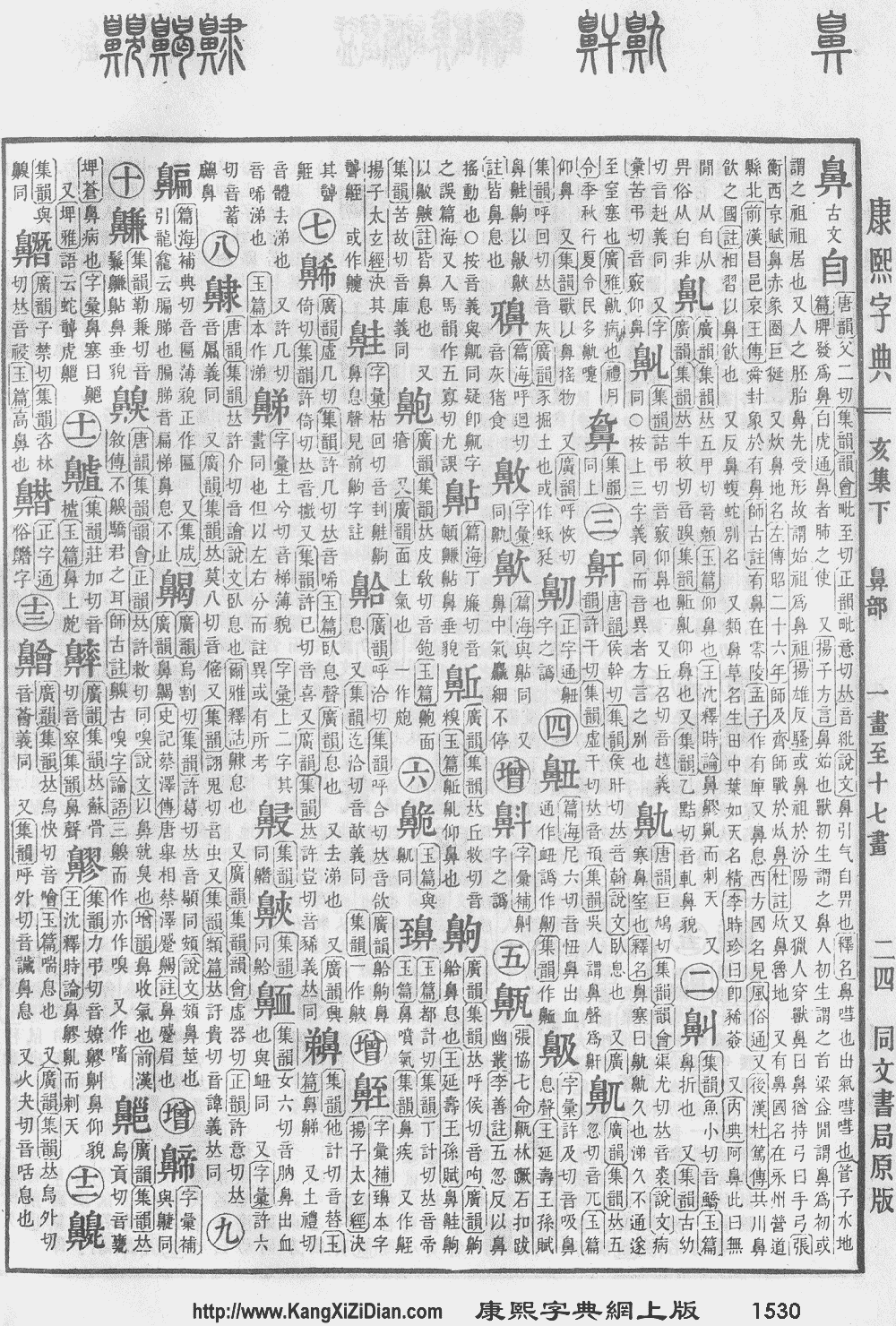
- Kangxi Dictionary: page 1530, character 1
- Dai Kanwa Jiten: character 48498
- Dae Jaweon: page 2066, character 15
- Hanyu Da Zidian (first edition): volume 7, page 4779, character 1
- Unihan data for U+9F3B
Chinese[edit]
| simp. and trad. |
鼻 | |
|---|---|---|
| 2nd round simp. | 𢍂 | |
Glyph origin[edit]
| Historical forms of the character 鼻 |
|---|
| Shuowen Jiezi (compiled in Han) |
| Small seal script |

|
Phono-semantic compound (形聲/形声, OC *blids) : semantic 自 (“nose”) + phonetic 畀 (OC *pids).
自 (OC *ɦljids) originally meant “nose” but came to be used to mean “self”, so the sense of “nose” has been replaced by 鼻 (OC *blids). Some scholars interpret 鼻 (OC *blids) as a combination of a nose (自 (OC *ɦljids)) and two lungs (畀 (OC *pids)).
Etymology[edit]
From Proto-Sino-Tibetan *bi (“nose”); compare Nuosu ꅳꁖ (hnap bbit, “nose; snot”).
Alternatively, it may be from Proto-Sino-Tibetan *s-brit (“sneeze; nose; swallow”), whence Tibetan སྦྲིད (sbrid, “sneeze”), but there is no trace of r in Chinese (Schuessler, 2007).
In some modern lects, including Mandarin, Gan, Jin, Wu, and Xiang, and even in the literary layer of some Min dialects, the word reflects a form with final *-t. For example, in standard Mandarin, the word is pronounced bí (implying an old entering tone) instead of bì (the expected reflex from the departing tone in Middle Chinese). This is due to a phonological phenomenon in the northwest, either an early loss of *-s in the *-ts cluster before regular final cluster simplification occurred (Baxter, 1992), or a dialectal change from *-s to *-t (Pulleybank, 1998).
Pronunciation[edit]
Definitions[edit]
鼻
- (anatomy) nose (Classifier: 個/个 c; 支 mn)
- nose-like object, protruding part
- initial; founding; beginning; original
- 鼻祖 ― bízǔ ― forefather; initiator
- (dialectal) nasal mucus; snot
- (archaic or Hakka, Min) to smell
- (Northern Min, including Songxi Northern Min, Shibei) to kiss
Synonyms[edit]
| Variety | Location | Words |
|---|---|---|
| Formal (Written Standard Chinese) | 吻, 親, 親吻 | |
| Mandarin | Beijing | 吻, 親 |
| Taiwan | 吻, 親 | |
| Yantai (Muping) | 親 | |
| Wanrong | 親 | |
| Xi'an | 親 | |
| Yangzhou | 親 | |
| Singapore | 吻, 親 | |
| Cantonese | Guangzhou | 惜, 啜, 痛 |
| Hong Kong | 惜, 啜, 嘴 | |
| Taishan | 啜 | |
| Dongguan | 啜 | |
| Singapore (Guangfu) | 惜 | |
| Hakka | Meixian | 唚 |
| Miaoli (N. Sixian) | 唚 | |
| Pingtung (Neipu; S. Sixian) | 唚 | |
| Hsinchu County (Zhudong; Hailu) | 唚 | |
| Taichung (Dongshi; Dabu) | 唚 | |
| Hsinchu County (Qionglin; Raoping) | 唚 | |
| Yunlin (Lunbei; Zhao'an) | 唚 | |
| Jin | Taiyuan | 親 |
| Xinzhou | 親 | |
| Northern Min | Jian'ou | 蜜 |
| Songxi | 鼻 | |
| Zhenghe | 蜜 | |
| Jianyang | 蜜 | |
| Wuyishan | 敕 | |
| Pucheng (Shibei) | 鼻 | |
| Eastern Min | Fuzhou | 唚 |
| Southern Min | Xiamen | 唚 |
| Xiamen (Tong'an) | 唚 | |
| Quanzhou | 唚 | |
| Shishi | 唚 | |
| Zhangzhou | 唚 | |
| Tainan | 唚 | |
| Penang (Hokkien) | 唚 | |
| Singapore (Hokkien) | 唚 | |
| Manila (Hokkien) | 唚 | |
| Chaozhou | 唚 | |
| Shantou | 唚 | |
| Singapore (Teochew) | 唚 | |
| Haikou | 惜 | |
| Wu | Shanghai | 香, 親 |
| Shanghai (Chongming) | 香 | |
| Shanghai (Zhoupu, Pudong) | 香 | |
| Suzhou | 香 | |
| Hangzhou | 香 | |
| Ningbo | 親 | |
Compounds[edit]
- 一鼻子灰
- 串鼻子
- 仰人鼻息
- 作鼻子頭/作鼻子头
- 冷鼻凹
- 刺鼻 (cìbí)
- 副鼻腔炎 (fùbíqiāngyán)
- 匠石斫鼻
- 嗤之以鼻 (chīzhīyǐbí)
- 嗆鼻/呛鼻
- 噴鼻/喷鼻
- 噴鼻香/喷鼻香
- 回回鼻子
- 塌鼻
- 塌鼻子 (tābízi)
- 好鼻獅/好鼻狮 (hó-phīⁿ-sai) (Min Nan)
- 寒心酸鼻
- 屩鼻/𪨗鼻
- 巴鼻
- 廣鼻類/广鼻类
- 把鼻
- 抽鼻兒/抽鼻儿
- 挑鼻子
- 捏著鼻子
- 捉鼻
- 捏鼻
- 捻著鼻子
- 捻鼻
- 掩鼻
- 掩鼻偷香
- 掐鼻皺眉/掐鼻皱眉
- 掩鼻而過/掩鼻而过
- 掩鼻蹙頞/掩鼻蹙𱂨
- 撲人鼻子/扑人鼻子
- 撲鼻/扑鼻 (pūbí)
- 擁鼻/拥鼻
- 擁鼻吟/拥鼻吟
- 攢眉蹙鼻/攒眉蹙鼻
- 斫鼻
- 新聞鼻/新闻鼻
- 斲鼻
- 曷鼻
- 有鼻
- 楯鼻
- 沒巴沒鼻/没巴没鼻
- 沒巴鼻/没巴鼻
- 沒把鼻/没把鼻
- 沖鼻/冲鼻
- 牛鼻子 (niúbízi)
- 牽鼻子/牵鼻子
- 犢鼻褌/犊鼻裈
- 異香撲鼻/异香扑鼻
- 白鼻心 (báibíxīn)
- 直鼻權腮/直鼻权腮
- 碰鼻
- 穿鼻
- 穿鼻草約/穿鼻草约
- 綜鼻兒/综鼻儿
- 縮鼻/缩鼻
- 耳滿鼻滿/耳满鼻满
- 耳鼻喉科 (ěrbíhóukē)
- 聽人穿鼻/听人穿鼻
- 舌尖鼻音
- 舌根鼻音
- 落鼻祖
- 蟻鼻錢/蚁鼻钱
- 觜鼻
- 觸鼻/触鼻
- 豁鼻子
- 象鼻蟲/象鼻虫 (xiàngbíchóng)
- 貓鼻頭/猫鼻头 (Māobítóu)
- 趴鼻子
- 通關鼻子/通关鼻子
- 酒渣鼻 (jiǔzhābí)
- 酒糟鼻 (jiǔzāobí)
- 酸鼻
- 針鼻兒/针鼻儿 (zhēnbír)
- 長鼻目/长鼻目
- 門鼻兒/门鼻儿 (ménbír)
- 開山鼻祖/开山鼻祖
- 阿鼻 (ābí)
- 阿鼻地獄/阿鼻地狱 (ābí dìyù)
- 隆鼻 (lóngbí)
- 難捉鼻/难捉鼻
- 露一鼻子
- 鞍鼻
- 馬鼻/马鼻 (Mǎbí)
- 馬鼻疽/马鼻疽
- 鵝鑾鼻/鹅銮鼻 (Éluánbí)
- 鷹勾鼻/鹰勾鼻
- 鷹鼻鷂眼/鹰鼻鹞眼
- 鼻丘
- 鼻中出火
- 鼻中隔 (bízhōnggé)
- 鼻仔
- 鼻偃齒露/鼻偃齿露
- 鼻兒/鼻儿
- 鼻凹
- 鼻凹糖
- 鼻化 (bíhuà)
- 鼻化元音 (bíhuà yuányīn)
- 鼻咽癌 (bíyān'ái)
- 鼻咽道
- 鼻塌嘴歪
- 鼻塞聲重/鼻塞声重
- 鼻子
- 鼻子一酸
- 鼻子眼兒/鼻子眼儿 (bíziyǎnr)
- 鼻子裡笑/鼻子里笑
- 鼻子頭/鼻子头
- 鼻孔 (bíkǒng)
- 鼻尖 (bíjiān)
- 鼻尖兒/鼻尖儿
- 鼻息 (bíxī)
- 鼻托 (bítuō)
- 鼻敏感 (bímǐngǎn)
- 鼻旁竇/鼻旁窦 (bípángdòu)
- 鼻根 (bígēn)
- 鼻梁 (bíliáng)
- 鼻梁兒/鼻梁儿 (bíliángr)
- 鼻涕 (bítì)
- 鼻涕蟲/鼻涕虫 (bítìchóng)
- 鼻淵/鼻渊
- 鼻淚管/鼻泪管 (bílèiguǎn)
- 鼻準/鼻准 (bízhǔn)
- 鼻炎 (bíyán)
- 鼻無梁柱/鼻无梁柱
- 鼻煙/鼻烟 (bíyān)
- 鼻煙兒/鼻烟儿
- 鼻煙壺/鼻烟壶 (bíyānhú)
- 鼻煙盒/鼻烟盒 (bíyānhé)
- 鼻牛兒/鼻牛儿
- 鼻甲 (bíjiǎ)
- 鼻病毒 (bíbìngdú)
- 鼻破裂音
- 鼻祖 (bízǔ)
- 鼻窩/鼻窝
- 鼻窪子/鼻洼子
- 鼻竇/鼻窦 (bídòu)
- 鼻竇炎/鼻窦炎 (bídòuyán)
- 鼻笛
- 鼻紋/鼻纹
- 鼻翅兒/鼻翅儿 (bíchìr)
- 鼻翼 (bíyì)
- 鼻腔 (bíqiāng)
- 鼻血 (bíxuè)
- 鼻衄 (bínǜ)
- 鼻觀/鼻观
- 鼻輪/鼻轮
- 鼻道 (bídào)
- 鼻酸 (bísuān)
- 鼻青臉腫/鼻青脸肿 (bíqīngliǎnzhǒng)
- 鼻音 (bíyīn)
- 鼻韻母/鼻韵母 (bíyùnmǔ)
- 鼻頭/鼻头 (bítóu)
- 鼻頭出火/鼻头出火
- 鼻飼/鼻饲 (bísì)
- 鼻骨 (bígǔ)
- 鼻黏膜
- 鼻鼾如雷
- 鼾鼻
- 齆鼻兒/齆鼻儿
- 齉鼻兒/齉鼻儿
References[edit]
- “Entry #10972”, in 臺灣閩南語常用詞辭典 (overall work in Mandarin and Hokkien), Ministry of Education, R.O.C., 2023.
Japanese[edit]
| Shinjitai | 鼻 | |
| Kyūjitai [1] |
鼻󠄁 鼻+ 󠄁?(Adobe-Japan1) |

|
| 鼻󠄃 鼻+ 󠄃?(Hanyo-Denshi) (Moji_Joho) | ||
| The displayed kanji may be different from the image due to your environment. See here for details. | ||
Kanji[edit]
Readings[edit]
Compounds[edit]
Etymology[edit]
| Kanji in this term |
|---|
| 鼻 |
| はな Grade: 3 |
| kun’yomi |
From Proto-Japonic *pana. The sense as a pronoun is from pointing to one's nose to refer to oneself.
Pronunciation[edit]
Audio (file)
Noun[edit]
Pronoun[edit]
Derived terms[edit]
References[edit]
- ^ “鼻”, in 漢字ぺディア (Kanjipedia)[1] (in Japanese), 日本漢字能力検定協会, 2015–2024
- ^ NHK Broadcasting Culture Research Institute, editor (1998), NHK日本語発音アクセント辞典 (in Japanese), Tōkyō: NHK Publishing, →ISBN
Korean[edit]
Etymology[edit]
From Middle Chinese 鼻 (MC bjijH).
| Historical Readings | ||
|---|---|---|
| Dongguk Jeongun Reading | ||
| Dongguk Jeongun, 1448 | 삥〮 (Yale: ppí) | |
| Middle Korean | ||
| Text | Eumhun | |
| Gloss (hun) | Reading | |
| Hunmong Jahoe, 1527[2] | 고〮 (Yale: kwó) | 비〯 (Yale: pǐ) |
Pronunciation[edit]
- (SK Standard/Seoul) IPA(key): [pi(ː)]
- Phonetic hangul: [비(ː)]
- Though still prescribed in Standard Korean, most speakers in both Koreas no longer distinguish vowel length.
Hanja[edit]

- Hanja form? of 비 (“nose; nasal; rhino-”).
- 비호흡(鼻呼吸) ― bihoheup( 鼻 呼吸) ― nasal respiration
- 비음(鼻音) ― bieum( 鼻 音) ― a nasal sound
- 비모음(鼻母音) ― bimo'eum( 鼻 母音) ― nasal vowel
- 부비강(副鼻腔) ― bubigang(副 鼻 腔) ― sinus
- 비염(鼻炎) ― biyeom( 鼻 炎) ― rhinitis
- 이비인후과(耳鼻咽喉科) ― ibiinhugwa(耳 鼻 咽喉科) ― otorhinolaryngology
Compounds[edit]
References[edit]
- 국제퇴계학회 대구경북지부 (國際退溪學會 大邱慶北支部) (2007). Digital Hanja Dictionary, 전자사전/電子字典. [3]
Kunigami[edit]
Kanji[edit]
Readings[edit]
Pronunciation[edit]
Noun[edit]
鼻 (phanā)
Miyako[edit]
Kanji[edit]
Readings[edit]
Pronunciation[edit]
Noun[edit]
鼻 (pana)
Okinawan[edit]
Kanji[edit]
Readings[edit]
Pronunciation[edit]
Noun[edit]
鼻 (hana)
References[edit]
- “ハナ” in Okinawa Center of Language Study, Shuri-Naha Dialect Dictionary (archived; reopens 2024).
Vietnamese[edit]
Han character[edit]
- This term needs a translation to English. Please help out and add a translation, then remove the text
{{rfdef}}.
Yaeyama[edit]
Kanji[edit]
Readings[edit]
Pronunciation[edit]
Noun[edit]
鼻 (pana)
Yonaguni[edit]
Kanji[edit]
Readings[edit]
- CJK Unified Ideographs block
- Han script characters
- Kangxi Radicals block
- CJK Compatibility Ideographs Supplement block
- Han character radicals
- Translingual lemmas
- Translingual symbols
- Han phono-semantic compounds
- Chinese terms inherited from Proto-Sino-Tibetan
- Chinese terms derived from Proto-Sino-Tibetan
- Mandarin terms with audio links
- Cantonese terms with audio links
- Middle Chinese lemmas
- Old Chinese lemmas
- Chinese lemmas
- Mandarin lemmas
- Sichuanese lemmas
- Cantonese lemmas
- Taishanese lemmas
- Gan lemmas
- Hakka lemmas
- Jin lemmas
- Northern Min lemmas
- Eastern Min lemmas
- Hokkien lemmas
- Teochew lemmas
- Wu lemmas
- Xiang lemmas
- Chinese nouns
- Mandarin nouns
- Sichuanese nouns
- Cantonese nouns
- Taishanese nouns
- Gan nouns
- Hakka nouns
- Jin nouns
- Northern Min nouns
- Eastern Min nouns
- Hokkien nouns
- Teochew nouns
- Wu nouns
- Xiang nouns
- Chinese adjectives
- Mandarin adjectives
- Sichuanese adjectives
- Cantonese adjectives
- Taishanese adjectives
- Gan adjectives
- Hakka adjectives
- Jin adjectives
- Northern Min adjectives
- Eastern Min adjectives
- Hokkien adjectives
- Teochew adjectives
- Wu adjectives
- Xiang adjectives
- Chinese verbs
- Mandarin verbs
- Sichuanese verbs
- Cantonese verbs
- Taishanese verbs
- Gan verbs
- Hakka verbs
- Jin verbs
- Northern Min verbs
- Eastern Min verbs
- Hokkien verbs
- Teochew verbs
- Wu verbs
- Xiang verbs
- Chinese terms with IPA pronunciation
- Chinese Han characters
- zh:Anatomy
- Chinese nouns classified by 個/个
- Chinese nouns classified by 支
- zh:Geography
- Mandarin terms with usage examples
- Chinese dialectal terms
- Chinese terms with archaic senses
- Hakka Chinese
- Min Chinese
- Northern Min Chinese
- Songxi Northern Min
- Japanese Han characters
- Grade 3 kanji
- Japanese kanji with goon reading び
- Japanese kanji with kan'on reading ひ
- Japanese kanji with kun reading はな
- Japanese kanji with kun reading はじ-め
- Japanese terms spelled with 鼻 read as はな
- Japanese terms read with kun'yomi
- Japanese terms derived from Proto-Japonic
- Japanese terms inherited from Proto-Japonic
- Japanese terms with IPA pronunciation
- Japanese terms with audio links
- Japanese lemmas
- Japanese nouns
- Japanese terms spelled with third grade kanji
- Japanese terms written with one Han script character
- Japanese terms spelled with 鼻
- Japanese single-kanji terms
- Japanese pronouns
- ja:Anatomy
- Korean terms derived from Middle Chinese
- Korean terms with long vowels in the first syllable
- Korean lemmas
- Korean Han characters
- Korean terms with usage examples
- Kunigami Han characters
- Kunigami kanji with kun reading ぱなー
- Kunigami terms with IPA pronunciation
- Kunigami lemmas
- Kunigami nouns
- Kunigami terms spelled with third grade kanji
- Kunigami terms written with one Han script character
- Kunigami terms spelled with 鼻
- Kunigami single-kanji terms
- xug:Anatomy
- Miyako Han characters
- Miyako kanji with kun reading ぱな
- Miyako terms with IPA pronunciation
- Miyako lemmas
- Miyako nouns
- Miyako terms spelled with third grade kanji
- Miyako terms written with one Han script character
- Miyako terms spelled with 鼻
- Miyako single-kanji terms
- mvi:Anatomy
- Okinawan Han characters
- Okinawan kanji with kun reading はな
- Okinawan terms with IPA pronunciation
- Okinawan lemmas
- Okinawan nouns
- Okinawan terms spelled with third grade kanji
- Okinawan terms written with one Han script character
- Okinawan terms spelled with 鼻
- Okinawan single-kanji terms
- ryu:Anatomy
- Vietnamese lemmas
- Vietnamese Han characters
- CJKV radicals
- Yaeyama Han characters
- Yaeyama kanji with kun reading ぱな
- Yaeyama terms with IPA pronunciation
- Yaeyama lemmas
- Yaeyama nouns
- Yaeyama terms spelled with third grade kanji
- Yaeyama terms written with one Han script character
- Yaeyama terms spelled with 鼻
- Yaeyama single-kanji terms
- rys:Anatomy
- Yonaguni Han characters
- Yonaguni kanji with kun reading はな-ぶる