


bai
Basque • Borôro • Catalan • French • Gothic • Iban • Italian • Jamaican Creole • Japanese • Kabuverdianu • Mandarin • Palauan • Pangasinan • Papiamentu • Polish • Pumpokol • Rennellese • Rohingya • Romanian • Sakizaya • Sika • Sranan Tongo • Tày • Ternate • Tok Pisin • Tyap • Vietnamese • Volapük • Welsh
Page categories
Translingual
[edit]Symbol
[edit]bai
English
[edit]Etymology 1
[edit](This etymology is missing or incomplete. Please add to it, or discuss it at the Etymology scriptorium.)

Noun
[edit]bai (plural bais)
- A marshy meadow in sub-Saharan Africa.
- 2012 August 23, Nick Middleton, Surviving Extremes: Ice, Jungle, Sand and Swamp, Pan Macmillan, →ISBN, page 84:
- One thing about the bais that I hadn't fully taken on board while reading about them was that they tend to be waterlogged because they are usually associated with marshes, streams or springs. […] venturing into the bai, but […] plunging into the bai because […]
- 2012, David Quammen, Spillover, →ISBN, page 64:
- Gorillas (and other wildlife) frequent such bais, which are waterlogged and sunny, because of the sodium-rich sedges and asters that grow beneath the open sky.
Etymology 2
[edit]Interjection
[edit]bai
- (Internet slang) Eye dialect spelling of bye.
Etymology 3
[edit]Borrowed from Japanese 霾 (bai). First recorded in English in the 1910s.[1]
Noun
[edit]bai (plural bais)
- A yellow mist occurring in spring and fall in China and Japan, caused by yellow dust blown from central China.[2][1]
References
[edit]- ↑ 1.0 1.1 “Word of the Day: Bai”, in Dictionary.com, 26 May 2023 (last accessed)
- ^ “Bai: A mist that occurs in China...”, in Chicago Tribune[1], 27 September 1999, retrieved 26 May 2023
See also
[edit]Anagrams
[edit]Basque
[edit] | This entry is part of the phrasebook project, which presents criteria for inclusion based on utility, simplicity and commonness. |
Pronunciation
[edit]Interjection
[edit]bai
Further reading
[edit]- “bai”, in Euskaltzaindiaren Hiztegia [Dictionary of the Basque Academy] (in Basque), Euskaltzaindia [Royal Academy of the Basque Language]
- “bai”, in Orotariko Euskal Hiztegia [General Basque Dictionary], Euskaltzaindia, 1987–2005
Borôro
[edit]Pronunciation
[edit]Noun
[edit]bai
Catalan
[edit]Etymology
[edit]Inherited from Latin badius, possibly via Spanish bayo.
Pronunciation
[edit]Adjective
[edit]bai (feminine baia, masculine plural bais, feminine plural baies)
- bay (colour)
Related terms
[edit]Further reading
[edit]- “bai”, in Diccionari de la llengua catalana [Dictionary of the Catalan Language] (in Catalan), second edition, Institute of Catalan Studies [Catalan: Institut d'Estudis Catalans], April 2007
- “bai”, in Gran Diccionari de la Llengua Catalana, Grup Enciclopèdia Catalana, 2026
- “bai” in Diccionari normatiu valencià, Acadèmia Valenciana de la Llengua.
- Alcover, Antoni Maria; Moll, Francesc de Borja (1963), “bai”, in Diccionari català-valencià-balear (in Catalan)
French
[edit]Etymology
[edit]Inherited from Old French bai, from Latin badius.
Pronunciation
[edit]Adjective
[edit]bai (feminine baie, masculine plural bais, feminine plural baies)
- bay (of a reddish-brown colour)
Derived terms
[edit]Further reading
[edit]- “bai”, in Trésor de la langue française informatisé [Digitized Treasury of the French Language], 2012
Gothic
[edit]Romanization
[edit]bai
- romanization of 𐌱𐌰𐌹
Iban
[edit]Pronunciation
[edit]Verb
[edit]bai
- to bring
Italian
[edit]Adjective
[edit]bai
Jamaican Creole
[edit]Etymology 1
[edit]Preposition
[edit]bai
- by
- 2023, Yuunivorshal Deklarieshan a Yuuman Raits, United Nations, Aatikl 17:
- Evribadi av di rait fi uon prapati bai demself ar wid ada piipl.
- Everyone has the right to own property alone as well as in association with others.
- (literally, “Everybody have the right to own property by themselves with other people.”)
Etymology 2
[edit]Verb
[edit]bai
- buy
- 2012, Di Jamiekan Nyuu Testiment, Edinburgh: DJB, published 2012, →ISBN, Matyu 13:46:
- Wen im fain wan we wot uol iip a moni, im sel evriting we im uon an go bai it.
- When he found the most expensive pearl ever he went and sold all he had and bought it.
- (literally, “When [a pearl trader] found one worth a whole heap of money, he sold everything he owned and went to buy it.”)
Further reading
[edit]- bai at majstro.com
Japanese
[edit]Romanization
[edit]bai
Kabuverdianu
[edit]Alternative forms
[edit]- bá (Barlavento)
Etymology
[edit]From Portuguese vai (the third-person singular of ir (to go).
Verb
[edit]bai
References
[edit]- Gonçalves, Manuel (2015), Capeverdean Creole-English dictionary (overall work in English), Mili Mila, →ISBN
- Veiga, Manuel (2012), Dicionário Caboverdiano-Português, Instituto da Biblioteca Nacional e do Livro
Mandarin
[edit]Romanization
[edit]- Hanyu Pinyin reading of 㗑
Romanization
[edit]bai
- nonstandard spelling of bāi
- nonstandard spelling of bái
- nonstandard spelling of bǎi
- nonstandard spelling of bài
Usage notes
[edit]- Transcriptions of Mandarin into the Latin script often do not distinguish between the critical tonal differences employed in the Mandarin language, using words such as this one without indication of tone.
Palauan
[edit]
Etymology
[edit]From Pre-Palauan *baye, from Proto-Malayo-Polynesian *balay. Doublet of blai.
Pronunciation
[edit]Noun
[edit]bai
- house (abode)
- community meetinghouse
References
[edit]- bai in Palauan Language Online: Palauan-English Dictionary, at tekinged.com.
- bai in Palauan-English Dictionary, at trussel2.com.
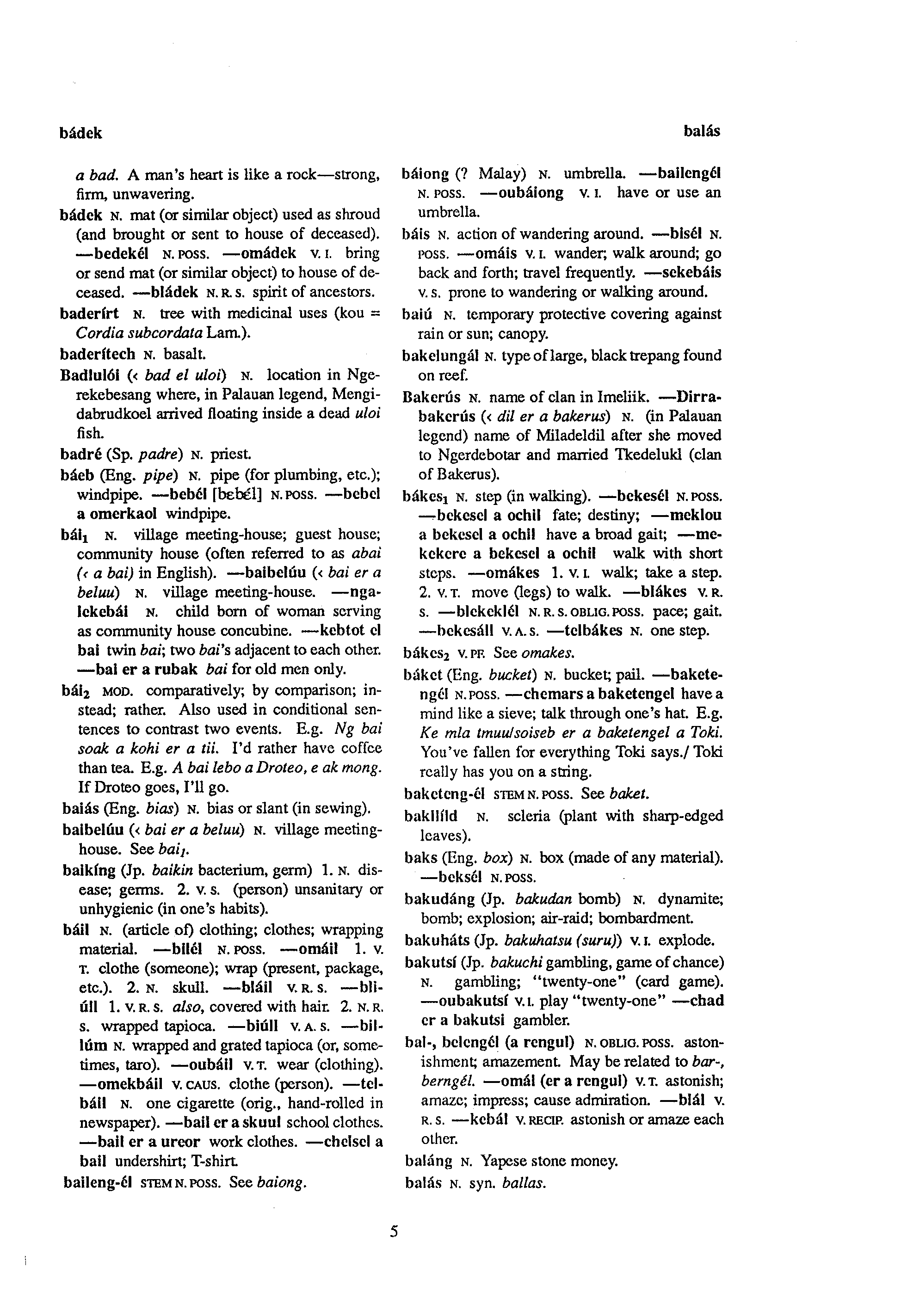
- bai in Lewis S. Josephs; Edwin G. McManus; Masa-aki Emesiochel (1977), Palauan-English Dictionary, University Press of Hawaii, →ISBN, page 5.
Pangasinan
[edit]Etymology
[edit]Inherited from Proto-Philippine *bahi, from Proto-Malayo-Polynesian *bahi, from Proto-Austronesian *bahi.
Noun
[edit]bai
- grandmother
- Coordinate term: laki
Papiamentu
[edit]Alternative forms
[edit]- bay (Aruba)
Etymology
[edit]From Portuguese vai (the third-person singular of ir (to go) and Spanish vaya and Kabuverdianu bai.
Verb
[edit]bai
Derived terms
[edit]Polish
[edit]Pronunciation
[edit]Noun
[edit]bai f
Pumpokol
[edit]Etymology
[edit]Inherited from Proto-Yeniseian *bej (“wind”).[1]
Pronunciation
[edit]Noun
[edit]bai (plural unknown)
References
[edit]- ^ Vajda, Edward; Werner, Heinrich (2022), Comparative-Historical Yeniseian Dictionary (Languages of the World/Dictionaries; 79, 80), Muenchen: LINCOM GmbH, →ISBN, page 120
Further reading
[edit]- Портфель Миллера in Russian state archives, foilo 199.
- Werner, Heinrich K. (2005), Die Jenissej-Sprachen des 18. Jahrhunderts (in German), Wiesbaden: Otto Harrassowitz KG, →ISBN, page 179
Rennellese
[edit]Etymology
[edit]From Proto-Polynesian *wai, from Proto-Oceanic *waiʀ, from Proto-Central-Eastern Malayo-Polynesian *waiʀ, from Proto-Eastern Malayo-Polynesian *waiʀ, from Proto-Malayo-Polynesian *wahiʀ.
Noun
[edit]bai
- water (clear liquid H₂O)
References
[edit]- Samuel H. Elbert (1975), Dictionary of the Language of Rennell and Bellona, Copenhagen: National Museum of Denmark, →ISBN, page 31
Rohingya
[edit]Pronunciation
[edit]Preposition
[edit]bai
Romanian
[edit]Etymology
[edit]Borrowed from Hungarian baj, from Serbo-Croatian boj (“battle”), from Proto-Slavic *bojь.
Noun
[edit]bai n (plural baiuri)
Declension
[edit]| singular | plural | |||
|---|---|---|---|---|
| indefinite | definite | indefinite | definite | |
| nominative-accusative | bai | baiul | baiuri | baiurile |
| genitive-dative | bai | baiului | baiuri | baiurilor |
| vocative | baiule | baiurilor | ||
Sakizaya
[edit]Pronunciation
[edit]Noun
[edit]bai
Sika
[edit]Noun
[edit]bai
References
[edit]- Austronesian Comparative Dictionary: bai
- ABVD: wai
Sranan Tongo
[edit]Etymology
[edit]Pronunciation
[edit]Verb
[edit]bai
- to buy
Derived terms
[edit]- baiman (“buyer”)
Tày
[edit]Pronunciation
[edit]- (Thạch An – Tràng Định) IPA(key): [ɓaːj˧˧]
- (Trùng Khánh) IPA(key): [ɓaːj˦˥]
Etymology 1
[edit]Noun
[edit]bai
- a type of hoe
- au bai bjai nhả ― use the hoe to cut grass
- bai xu ― pickaxe
Verb
[edit]bai
- to hoe
- bai đin ― to hoe dirt
Etymology 2
[edit]Noun
[edit]bai
Etymology 3
[edit]Verb
[edit]bai
- to mix
- khẩu nua bai thúa ― sticky riced mixed with beans
Etymology 4
[edit]Verb
[edit]bai
References
[edit]- Lương Bèn (2011), Từ điển Tày-Việt [Tay-Vietnamese dictionary][2][3] (in Vietnamese), Thái Nguyên: Nhà Xuất bản Đại học Thái Nguyên
- Léopold Michel Cadière (1910), Dictionnaire Tày-Annamite-Français [Tày-Vietnamese-French Dictionary][4] (in French), Hanoi: Impressions d'Extrême-Orient
Ternate
[edit]Etymology 1
[edit]Pronunciation
[edit]Verb
[edit]bai
- (transitive) to show
Conjugation
[edit]| singular | plural | |||
|---|---|---|---|---|
| inclusive | exclusive | |||
| 1st person | tobai | fobai | mibai | |
| 2nd person | nobai | nibai | ||
| 3rd person |
masculine | obai | ibai yobai (archaic) | |
| feminine | mobai | |||
| neuter | ibai | |||
Etymology 2
[edit]
Pronunciation
[edit]Noun
[edit]bai
- any member of the species Etelis carbunculus and Etelis radiosus of snappers
References
[edit]- Rika Hayami-Allen (2001), A descriptive study of the language of Ternate, the northern Moluccas, Indonesia, University of Pittsburgh
Tok Pisin
[edit]Alternative forms
[edit]Etymology
[edit]From English by and by. Cognate with Bislama and Pijin bai.
Particle
[edit]bai
- will; to be going (to do something); marks future tense.
- 1989, Buk Baibel long Tok Pisin, Port Moresby: Bible Society of Papua New Guinea, Jenesis 1:26:
- Bihain God i tok olsem, “Nau yumi wokim ol manmeri bai ol i kamap olsem yumi yet. Bai yumi putim ol i stap bos bilong ol pis na ol pisin na bilong olgeta kain animal na bilong olgeta samting bilong graun.”
- Then God said, "Now let us make people who will become like us. We'll put them in charge of the fish and the birds, of all kinds of animals and of all things on the ground."
- so that; to; introducing purposive clauses with a different subject from the matrix clause.
- Mi laik bai yu stap bel isi.
- I want you to feel safe/relaxed.
- Na ol i save askim mi long mekim stretpela pasin long ol na stap klostu long ol, bai em i ken amamas.
- And they always ask me to treat them justly and stay close to them so that they may feel secure.
See also
[edit]Tok Pisin tense and aspect markers:
- pinis (completive aspect)
- bin (past tense)
- stap (progressive aspect or durative aspect)
- save (habitual aspect)
- bai/baimbai (future tense)
References
[edit]- Volker, C. A. (general editor), et al. (2008), Papua New Guinea Tok Pisin English Dictionary, Oxford University Press in association with Wantok Niuspepa, →ISBN, page 6
Tyap
[edit]Pronunciation
[edit]Verb
[edit]bai
- to come
Vietnamese
[edit]Etymology
[edit]Pronunciation
[edit]Phrase
[edit]bai
Synonyms
[edit]Derived terms
[edit]Volapük
[edit]Preposition
[edit]bai
Derived terms
[edit]Welsh
[edit]Pronunciation
[edit]Noun
[edit]bai m (plural beiau)
- blame
- Synonym: methiant
- Arnat ti roedd y bai.
- You were to blame.
- (literally, “The blame was upon you.”)
Derived terms
[edit]- ar fai (“to blame”)
- beius (“defective”)
- syrthio ar ei fai (“to acknowledge fault”)
- taro'r bai ar (“to put the blame on, to blame”)
- difai (“blameless”)
Verb
[edit]bai
Mutation
[edit]| radical | soft | nasal | aspirate |
|---|---|---|---|
| bai | fai | mai | unchanged |
Note: Certain mutated forms of some words can never occur in standard Welsh.
All possible mutated forms are displayed for convenience.
Further reading
[edit]- D. G. Lewis, N. Lewis, editors (2005–present), “bai”, in Gweiadur: the Welsh–English Dictionary, Gwerin
- R. J. Thomas, G. A. Bevan, P. J. Donovan, A. Hawke, et al., editors (1950–present), “bai”, in Geiriadur Prifysgol Cymru Online (in Welsh), University of Wales Centre for Advanced Welsh & Celtic Studies
- Translingual lemmas
- Translingual symbols
- ISO 639-2
- ISO 639-5
- English lemmas
- English nouns
- English countable nouns
- English terms with quotations
- English interjections
- English internet slang
- English eye dialect
- English terms borrowed from Japanese
- English terms derived from Japanese
- en:Wetlands
- Basque phrasebook
- Basque 1-syllable words
- Basque terms with IPA pronunciation
- Basque terms with audio pronunciation
- Rhymes:Basque/ai̯
- Rhymes:Basque/ai̯/1 syllable
- Basque lemmas
- Basque interjections
- Borôro terms with IPA pronunciation
- Borôro lemmas
- Borôro nouns
- Catalan terms inherited from Latin
- Catalan terms derived from Latin
- Catalan terms with IPA pronunciation
- Rhymes:Catalan/aj
- Rhymes:Catalan/aj/1 syllable
- Catalan lemmas
- Catalan adjectives
- ca:Colors
- French terms inherited from Old French
- French terms derived from Old French
- French terms inherited from Latin
- French terms derived from Latin
- French 1-syllable words
- French terms with IPA pronunciation
- French lemmas
- French adjectives
- Gothic non-lemma forms
- Gothic romanizations
- Iban terms with IPA pronunciation
- Rhymes:Iban/aiʔ
- Rhymes:Iban/aiʔ/2 syllables
- Iban lemmas
- Iban verbs
- Italian non-lemma forms
- Italian adjective forms
- Jamaican Creole terms derived from English
- Jamaican Creole lemmas
- Jamaican Creole prepositions
- Jamaican Creole terms with quotations
- Jamaican Creole verbs
- Japanese non-lemma forms
- Japanese romanizations
- Kabuverdianu terms derived from Portuguese
- Kabuverdianu lemmas
- Kabuverdianu verbs
- Sotavento Kabuverdianu
- Hanyu Pinyin
- Mandarin non-lemma forms
- Mandarin nonstandard forms
- Palauan terms inherited from Proto-Malayo-Polynesian
- Palauan terms derived from Proto-Malayo-Polynesian
- Palauan doublets
- Palauan terms with IPA pronunciation
- Palauan lemmas
- Palauan nouns
- pau:Buildings
- Pangasinan terms derived from Proto-Philippine
- Pangasinan terms inherited from Proto-Philippine
- Pangasinan terms derived from Proto-Austronesian
- Pangasinan terms inherited from Proto-Austronesian
- Pangasinan terms derived from Proto-Malayo-Polynesian
- Pangasinan terms inherited from Proto-Malayo-Polynesian
- Pangasinan lemmas
- Pangasinan nouns
- pag:Female family members
- Papiamentu terms derived from Portuguese
- Papiamentu terms derived from Spanish
- Papiamentu terms derived from Kabuverdianu
- Papiamentu lemmas
- Papiamentu verbs
- Papiamentu terms with usage examples
- Polish 2-syllable words
- Polish terms with IPA pronunciation
- Rhymes:Polish/ai
- Rhymes:Polish/ai/2 syllables
- Polish non-lemma forms
- Polish noun forms
- Pumpokol terms inherited from Proto-Yeniseian
- Pumpokol terms derived from Proto-Yeniseian
- Pumpokol terms with IPA pronunciation
- Pumpokol lemmas
- Pumpokol nouns
- Rennellese terms inherited from Proto-Polynesian
- Rennellese terms derived from Proto-Polynesian
- Rennellese terms inherited from Proto-Oceanic
- Rennellese terms derived from Proto-Oceanic
- Rennellese terms derived from Proto-Central-Eastern Malayo-Polynesian
- Rennellese terms inherited from Proto-Eastern Malayo-Polynesian
- Rennellese terms derived from Proto-Eastern Malayo-Polynesian
- Rennellese terms inherited from Proto-Malayo-Polynesian
- Rennellese terms derived from Proto-Malayo-Polynesian
- Rennellese lemmas
- Rennellese nouns
- mnv:Water
- Rohingya terms with IPA pronunciation
- Rohingya lemmas
- Rohingya prepositions
- Romanian terms derived from Proto-Slavic
- Romanian terms derived from Proto-Balto-Slavic
- Romanian terms derived from the Proto-Indo-European root *bʰeyh₂- (strike)
- Romanian terms derived from Serbo-Croatian
- Romanian terms derived from Hungarian
- Romanian terms borrowed from Hungarian
- Romanian terms derived from Proto-Indo-European
- Romanian lemmas
- Romanian nouns
- Romanian countable nouns
- Romanian neuter nouns
- Transylvanian Romanian
- Sakizaya 2-syllable words
- Sakizaya terms with IPA pronunciation
- Sakizaya lemmas
- Sakizaya nouns
- szy:Female family members
- Sika lemmas
- Sika nouns
- ski:Female people
- Sranan Tongo terms derived from English
- Sranan Tongo terms with IPA pronunciation
- Sranan Tongo lemmas
- Sranan Tongo verbs
- Tày terms with IPA pronunciation
- Tày lemmas
- Tày nouns
- Tày terms with usage examples
- Tày verbs
- tyz:Cutlery
- Ternate terms with IPA pronunciation
- Ternate lemmas
- Ternate verbs
- Ternate transitive verbs
- Ternate nouns
- tft:Snappers
- Tok Pisin terms derived from English
- Tok Pisin lemmas
- Tok Pisin particles
- Tok Pisin terms with quotations
- Tok Pisin terms with usage examples
- Tyap terms with IPA pronunciation
- Tyap lemmas
- Tyap verbs
- Vietnamese terms borrowed from English
- Vietnamese terms derived from English
- Vietnamese terms with IPA pronunciation
- Vietnamese lemmas
- Vietnamese phrases
- Vietnamese informal terms
- Vietnamese slang
- Volapük lemmas
- Volapük prepositions
- Welsh terms with IPA pronunciation
- Rhymes:Welsh/ai̯
- Rhymes:Welsh/ai̯/1 syllable
- Welsh lemmas
- Welsh nouns
- Welsh countable nouns
- Welsh masculine nouns
- Welsh terms with usage examples
- Welsh non-lemma forms
- Welsh verb forms