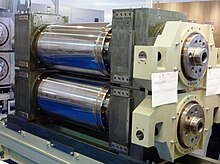
Calander machine A machine, used for the purpose of giving cloth, paper etc., a smooth, even, and glossy or glazed surface, by cold or hot pressure, or for watering them and giving them a wavy appearance; it consists of two or more cylindersrevolving nearly in contact, with the necessary apparatus for moving and regulating.
He brought out the placard, which was quite a work of art. It was nearly two feet long, printed on calendered paper, with a selection of colors so bright that they shone even in the moonlight.
1594, Rob[ert] Abbot, A Mirrour of Popish Subtilties:[…], London: […]Thomas Creede, for Thomas Woodcocke,[…], page 104:
[…]and maruell it is, that for this cauſe he was not ſainted in the Roman Calender.
1602, Simon Patrike, transl., The Estate of the Church, with the Discourse of Times, from the Apostles vntill This Present:[…], London: […]Thomas Creede, page 648:
To theſe the D. of Wittenberge and the Senate of Ulme ioyned their Embaſſadors, who the 4. day of Iune, which according to the GregorianCalender was the 14. doo ſo arbitrate the matter, that al faults remitted, they after that throghout the whole Citie, ſhould follow the new Calender, which ſhould be kept in policies, and both the Churches of Religion.
1653, Jeremy Shakerley, Tabulæ Britannicæ: The British Tables:[…], London: […]R[obert] and W[illiam] Leybourn, for Robert Boydell,[…], page 21:
The other two we ſearch not by Calculation, but Tables, and this two wayes, viz that we may ſatisfie both the Calenders, as well Julian as Gregorian, which as they do not altogether partake of one forme of year; ſo do they neceſſarily varie in their Indiecs of week dayes, and feaſts. The Tables ſhew how in both the Calenders the Dominicall letters anſwer to the Cycle of the Sun, and the Epacts to the golden number in the old Calender perpetually, but in the new one to the year 1700 excluſive, and in the new Calender to the year 1900 excluſive. Nor will it be difficult, by the help of the Table of anticipation to extend theſe Tables further, if the way how the Calender was corrected be fully known.