∞
Jump to navigation
Jump to search
 | ||||||||
Translingual[edit]


Alternative forms[edit]
Early forms (e.g. in Euler's texts) may approach a 'lazy S', ∾. It has also been attributed to John Wallis and conjectured to originate from ↀ, since 1,000 was hyperbolically used to represent very large numbers.
Symbol[edit]
∞
- A symbol representing infinity.
- ∞ + ∞ = ∞
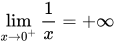
Usage notes[edit]
This symbol is called the "infinity symbol". It is also called a lemniscate and a "lazy eight".
Synonyms[edit]
- (symbol): infinity symbol, infinity sign, lemniscate