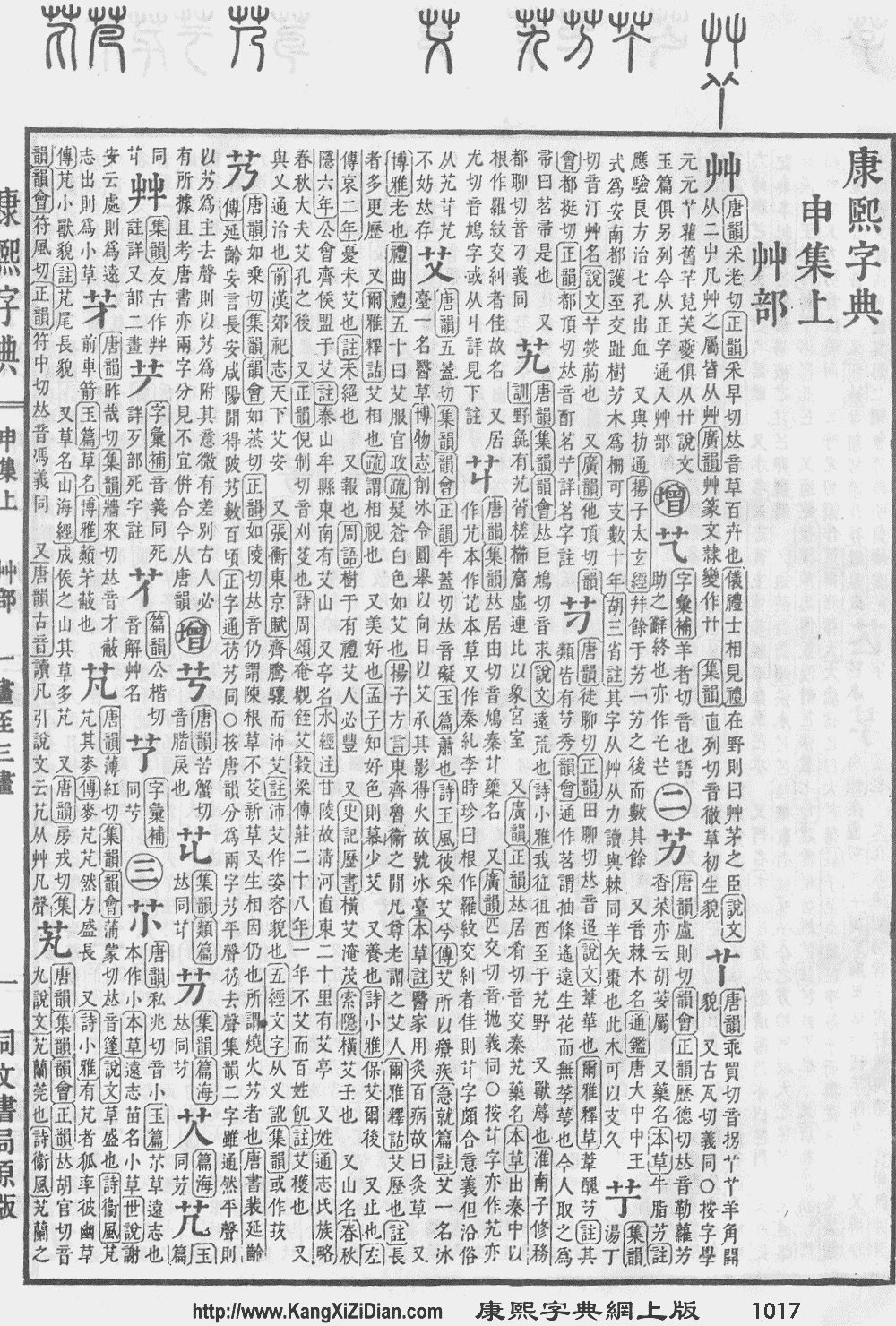
The non-radical form of this character is 艸, with six strokes, and that appears as a radical in a few characters (芔, 茻, and stacked vertically in 芻).
In almost all other characters, however, the radical is a simplified top form. This top form is traditionally written as two separated crosses, 艹, with four strokes (like 十 十, separation may not be visible at small font size). In its modern form, it is a single unit of 艹 (or in some character styles 䒑), with three strokes. Traditional Chinese characters today use either the traditional or modern radical form, while simplified Chinese characters, Japanese shinjitai, and Korean Hanja use the modern radical. All this can lead to the grass radical being counted as three (艹), four (艹), or six (艸) strokes.
Additionally, the four stroke radical ⻀ (two separated sideways T's) has also been simplified as the three stroke 艹 radical, even though it is not a radical form of 艸. A few characters using ⻀ include 茍, 蘷, and 虁.
The Unicode encodings for the different forms are:
normal character (艸) U+8278 in the CJK Unified Ideographs block
full radical form (⾋) U+2F8B in the Kangxi Radicals block
modern 3-stroke top radical (艹) U+8279 in the CJK Unified Ideographs block
alternate 3-stroke top radical (䒑) U+4491 in the CJK Unified Ideographs block
traditional 4-stroke double-cross top radical (艹) U+FA5E in the CJK Compatibility Ideographs block
4-stroke T-shape top radical (艹) U+FA5D in the CJK Compatibility Ideographs block
In Hong Kong, the stroke order for the traditional top radical of two crosses, is vertical, horizontal, vertical, horizontal, rather than the usual order of vertical, horizontal, horizontal, vertical.
In Hong Kong and Taiwan, characters not listed under radical 140 in the Kangxi dictionary such as 夢 (belonging to radical 夕) and 寬 (containing the component 卝 below the radical 宀) are written with the component 卝 (ore) instead of 艹 (grass).