antisymmetric
Jump to navigation
Jump to search
English
[edit]
Etymology
[edit]Adjective
[edit]antisymmetric (not comparable)
- (set theory, order theory, of a binary relation R on a set S) Having the property that, for any two distinct elements of S, at least one is not related to the other via R; equivalently, having the property that, for any x, y ∈ S, if both xRy and yRx then x=y.
- 1987, David C. Buchthal, Douglas E. Cameron, Modern Abstract Algebra, Prindle, Weber & Schmidt, page 479,
- The standard example for an antisymmetric relation is the relation less than or equal to on the real number system.
- 2006, S. C. Sharma, Metric Space, Discovery Publishing House, page 73:
- (i) The identity relation on a set A is an antisymmetric relation.
(ii) Let R be a relation on the set N of natural numbers defined by
x R y 'x divides y' for all x, y ∈ N.
This relation is an antisymmetric relation on N.
- 1987, David C. Buchthal, Douglas E. Cameron, Modern Abstract Algebra, Prindle, Weber & Schmidt, page 479,
- (linear algebra, of certain mathematical objects) Whose sign changes on the application of a matrix transpose or some generalisation thereof:
- (of a matrix) Whose transpose equals its negative (i.e., MT = −M);
- 1974, Robert McCredie May, Stability and Complexity in Model Ecosystems, Princeton University Press, page 193:
- The eigenvalues of an antisymmetric matrix are all purely imaginary numbers, and occur as conjugate pairs, and . As a corollary it follows that an antisymmetric matrix of odd order necessarily has one eigenvalue equal to zero; antisymmetric matrices of odd order are singular.
- (of a tensor) That changes sign when any two indices are interchanged (e.g., Tijk = -Tjik);
- 1986, Millard F. Beatty Jr., Principles of Engineering Mechanics, Volume 1: Kinematics - The Geometry of Motion, Plenum Press, page 163:
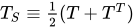
- Notice that the tensors defined by:
, (3.47)
are the symmetric and antisymmetric parts, respectively; they are known as the symmetric and antisymmetric parts of T.
- (of a bilinear form) For which B(w,v) = -B(v,w).
- 2012, Stephanie Frank Singer, Symmetry in Mechanics: A Gentle, Modern Introduction, Springer, page 28:
- Antisymmetric bilinear forms and wedge products are defined exactly as above, only now they are functions from to . […]
Exercise 21 Show that every antisymmetric bilinear form on is a wedge product of two covectors.
- (of a matrix) Whose transpose equals its negative (i.e., MT = −M);





Synonyms
[edit]- (linear algebra): skew-symmetric
Derived terms
[edit]Related terms
[edit]Translations
[edit](order theory; of a binary relation on a set)
|
(linear algebra)
|
See also
[edit]Further reading
[edit] Antisymmetric relation on Wikipedia.Wikipedia
 - Asymmetric relation on Wikipedia.Wikipedia
- Symmetric relation on Wikipedia.Wikipedia
- Antisymmetric matrix on Wikipedia.Wikipedia
- Antisymmetric tensor on Wikipedia.Wikipedia
