world
English[edit]

Alternative forms[edit]
Etymology[edit]
From Middle English world, weoreld, from Old English weorold (“world”), from Proto-West Germanic *weraldi, from Proto-Germanic *weraldiz (“lifetime, human existence, world”, literally “age/era of man”), equivalent to wer (“man”) + eld (“age”).
Cognate with Scots warld (“world”), Saterland Frisian Waareld (“world”), West Frisian wrâld (“world”), Afrikaans wêreld (“world”), Dutch wereld (“world”), Low German Werld (“world”), German Welt (“world”), Norwegian Bokmål verden (“(the) world”), Norwegian Nynorsk verd (“world”), Swedish värld (“world”), Icelandic veröld (“world”).
Pronunciation[edit]
- (Received Pronunciation) IPA(key): /wɜːld/
- (General American) enPR: wûrld, IPA(key): /wɜɹld/
Audio (GA) (file) - (Canada) IPA(key): /wərld/, [wɚːɫd]
Audio (CA) (file) - (New Zealand) enPR: wûrld, IPA(key): /wɵːld/, [wɵːɯ̯d̥]
- Rhymes: -ɜː(ɹ)ld
- Homophones: whirled, whorled (both only in accents with the wine–whine merger and the fern–fir-fur merger)
Noun[edit]
world (countable and uncountable, plural worlds)
- (with "the" or a plural possessive pronoun) The subjective human experience, regarded collectively; human collective existence; existence in general.
- In retrospect, the process of economic globalization has meant the end of the world as we knew it.
- There will always be lovers, till the world’s end.
- Synonym: (proper noun with alternative capitalization) World
- (with "the" or a singular possessive pronoun) The subjective human experience, regarded individually.
- The period immediately following my divorce seemed like the end of my world.
- He was my world! [said of a slain companion]
- 1922, Michael Arlen, “Ep./4/2”, in “Piracy”: A Romantic Chronicle of These Days:
- The world was awake to the 2nd of May, but Mayfair is not the world, and even the menials of Mayfair lie long abed. As they turned into Hertford Street they startled a robin from the poet's head on a barren fountain, and he fled away with a cameo note.
- 1963, Margery Allingham, chapter 9, in The China Governess: A Mystery, London: Chatto & Windus, →OCLC:
- Eustace gaped at him in amazement. When his urbanity dropped away from him, as now, he had an innocence of expression which was almost infantile. It was as if the world had never touched him at all.
- 2013 June 1, “Towards the end of poverty”, in The Economist, volume 407, number 8838, page 11:
- America’s poverty line is $63 a day for a family of four. In the richer parts of the emerging world $4 a day is the poverty barrier. But poverty’s scourge is fiercest below $1.25 ([…]): people below that level live lives that are poor, nasty, brutish and short.
- (metonymically, with "the") A majority of people.
- Running after God is the only life worth living. Even though the world believes that living for God is boring, we believe that there is nothing more exciting.
- The Universe.
- (uncountable, with "the") The Earth, especially in a geopolitical or cultural context.
- Synonyms: the earth, Earth, the globe, God's green earth, Sol III
- People are dying of starvation all over the world.
- “As the world turns, we know the bleakness of winter, the promise of spring, the fullness of summer and the harvest of autumn–the cycle of life is complete.” - quotation attributed to Irna Phillips.
- 1910, Emerson Hough, chapter I, in The Purchase Price: Or The Cause of Compromise, Indianapolis, Ind.: The Bobbs-Merrill Company, →OCLC:
- Serene, smiling, enigmatic, she faced him with no fear whatever showing in her dark eyes. […] She put back a truant curl from her forehead where it had sought egress to the world, and looked him full in the face now, drawing a deep breath which caused the round of her bosom to lift the lace at her throat.
- 2013 May-June, William E. Conner, “An Acoustic Arms Race”, in American Scientist, volume 101, number 3, pages 206–7:
- Earless ghost swift moths become “invisible” to echolocating bats by forming mating clusters close […] above vegetation and effectively blending into the clutter of echoes that the bat receives from the leaves and stems around them. Many insects probably use this strategy, which is a close analogy to crypsis in the visible world—camouflage and other methods for blending into one’s visual background.
- 2018, VOA Learning English > China's Melting Glacier Brings Visitors, Adds to Climate Concerns[1]:
- She says the Third Pole is one of the world’s largest sources of fresh drinking water.
- (countable) A planet, especially one which is inhabited or inhabitable.
- Our mission is to travel the galaxy and find new worlds.
- 1850, [Alfred, Lord Tennyson], In Memoriam, London: Edward Moxon, […], →OCLC, Canto XXI, page 35:
- A third is wroth: ‘Is this an hour […]
A time to sicken and to swoon,
When Science reaches forth her arms
To feel from world to world, and charms
Her secret from the latest moon?’
- 1905, Lord Dunsany [i.e., Edward Plunkett, 18th Baron of Dunsany], The Gods of Pegāna, London: [Charles] Elkin Mathews, […], →OCLC:
- And They said to Kib: “What are these things that move upon The Earth yet move not in circles like the Worlds, that regard like the Moon and yet they do not shine?”
- 1970, Larry Niven, Ringworld, page 118:
- Yet every world should have at least one unclimbable mountain.
- 2007 September 27, Marc Rayman (interviewee), “NASA's Ion-Drive Asteroid Hunter Lifts Off”, National Public Radio:
- I think many people think of asteroids as kind of little chips of rock. But the places that Dawn is going to really are more like worlds.
- (by extension) Any other astronomical body which may be inhabitable, such as a natural satellite.
- A very large extent of country.
- the New World
- In various mythologies, cosmologies, etc., one of a number of separate realms or regions having different characteristics and occupied by different types of inhabitants.
- 2017, Neil Gaiman, Norse Mythology, Bloomsbury Publishing, page 182:
- Frey [...] clambered up on to the Hildskjalf, the throne from which Odin could see everything that happened across the nine worlds.
- A fictional realm, such as a planet, containing one or multiple societies of beings, especially intelligent ones.
- the world of Narnia; the Wizarding World of Harry Potter; a zombie world
- An individual or group perspective or social setting.
- Synonym: circle
- In the world of boxing, good diet is all-important.
- Welcome to my world.
- 2013 June 8, “Obama goes troll-hunting”, in The Economist, volume 407, number 8839, page 55:
- According to this saga of intellectual-property misanthropy, these creatures [patent trolls] roam the business world, buying up patents and then using them to demand extravagant payouts from companies they accuse of infringing them. Often, their victims pay up rather than face the costs of a legal battle.
- (computing) The part of an operating system distributed with the kernel, consisting of the shell and other programs.
- (video games) A subdivision of a game, consisting of a series of stages or levels that usually share a similar environment or theme.
- Have you reached the boss at the end of the ice world?
- There's a hidden warp to the next world down this pipe.
- (tarot) The twenty-second trump or major arcana card of the tarot.
- (informal, singular or plural, followed by "of") A great amount.
- Taking a break from work seems to have done her a world of good.
- You're going to be in a world of trouble when your family finds out.
- That new wallpaper has made worlds of difference downstairs.
- This movie isn't even billed as a comedy, but it's worlds funnier than the comedy I saw last month.
- (archaic) Age, era.
- 1610, The Second Tome of the Holie Bible, […] (Douay–Rheims Bible), Doway: Lavrence Kellam, […], →OCLC, Psalmes 144:13, page 257:
- Thy kingdom is a kingdom of al worldes: and thy domnion in al generation and generation.
Hyponyms[edit]
Derived terms[edit]
- after-world
- afterworld
- against the world
- all the world
- all the world and his wife
- all the world and Little Billing
- an eye for an eye makes the whole world blind
- antiworld
- aquaworld
- around the world
- artworld
- art world
- beforehand in the world
- beforehand with the world
- best of both worlds
- Bidenworld
- book world
- braneworld
- brave new world
- carry the world before one
- citizen of the world
- Clintonworld
- clown world
- come into the world
- coming into the world
- conworld
- counterworld
- court of world opinion
- cumberworld
- cumber-world
- cyberworld
- dead to the world
- dreamworld
- dream-world
- dream world
- edge of the world
- elseworld
- end of the world
- ends of the world
- e-world
- eWorld
- external world
- fantasy world
- first-world problem
- first world problem
- follow someone to the ends of the world
- for all the world
- for all the world to see
- for the world
- for worlds
- futureworld
- gameworld
- globe of the world
- go to the ends of the world
- half-world
- have the world by the bag
- have the world by the balls
- have the world by the neck
- have the world by the nuts
- have the world by the tail
- have the world by the tail on a downhill pull
- have the world by the testicles
- have the world on a string
- hub world
- hyperworld
- in another world
- in a world of hurt
- in a world of one's own
- in a world of pain
- in a world of trouble
- in a world of trouble
- in one's own little world
- in one's own world
- interworld
- in the world
- in what world
- in-world
- inworld
- it's a man's world
- it's a small world
- it takes all kinds to make a world
- it takes all sorts to make a world
- just-world fallacy
- just-world hypothesis
- leader of the free world
- lost to the world
- lost world
- macroworld
- make a noise in the world
- make the world go around
- make the world go round
- make this world go around
- make this world go round
- man of the world
- many-worlds interpretation
- McWorld
- mean the whole world to
- mean the world to
- mean world syndrome
- merworld
- microworld
- money makes the world go around
- mother world
- move up in the world
- multi-world
- multiworld
- nanoworld
- nether world
- netherworld
- new world order
- next world
- nonworld
- not for the world
- not have a care in the world
- not long for this world
- not the end of the world
- Obamaworld
- object world
- ocean world
- off-world
- offworld
- of the world
- oldest profession in the world
- old-world
- on top of the world
- open world
- other world
- Otherworld
- otherworld
- out of this world
- outside world
- outworld
- overworld
- parallel world
- phenomenal world
- playworld
- possible world
- primary world
- promise the world
- Proto-World
- put the world to rights
- real-world
- real world
- renounce the world
- reworld
- ringworld
- RNA world
- rock someone's world
- Russian world
- secondary world
- see the world
- set the world ablaze
- set the world afire
- set the world aflame
- set the world alight
- set the world on fire
- set the world to rights
- shot heard 'round the world
- shot heard round the world
- simworld
- singleworld
- small world
- small-world network
- small-world phenomenon
- soundworld
- spiritual world
- spirit world
- storyworld
- subworld
- sure as the world
- the hand that rocks the cradle is the hand that rules the world
- the hand that rocks the cradle rules the world
- the whole world
- the whole world and his dog
- the world and his wife
- the world is one's lobster
- the world is one's oyster
- the world is someone's oyster
- the world is too much with someone
- the world over
- the world owes one a living
- think the world of
- think the world revolves around one
- third world
- third-world
- thought-world
- throneworld
- too good for this world
- transworld
- Trumpworld
- Turd World
- turd world
- turn one's world upside down
- umbworld
- underworld
- watch the world go by
- waterworld
- way of the world
- weight of the world
- welcome to my world
- western world
- what a small world
- what color is the sun in your world
- what in the world
- whole wide world
- why in the world
- window on the world
- with the best will in the world
- woman of the world
- wonder of the world
- wonderworld
- world-ash
- world ash
- world beat
- worldbeat
- world-beater
- world-beating
- worldbound
- worldbreaking
- worldbuilder
- world building
- worldbuilding
- world-building
- world capital
- world car
- world champion
- world-class
- world clock
- world cup
- world egg
- world ending
- world-ending
- world-endingly
- world English
- worlder
- world-famous
- worldful
- world-historical
- world-historically
- world history
- worldhood
- worldhouse
- worldie
- worldish
- world island
- worldizing
- worldkin
- world language
- world leader
- worldless
- worldlet
- worldlike
- world line
- worldling
- world literature
- worldly
- worldmaker
- worldmaking
- world map
- worldmate
- world music
- worldness
- world of difference
- World of Warcrack
- world-old
- world order
- world peace
- world phone
- world picture
- world policeman
- world power
- worldproof
- world record
- world religion
- world-renowned
- world riddle
- world's end, World's End
- World Series
- world-shaking
- worldsheet
- world song
- world soul
- world-soul
- world state
- world-system
- world to come
- world trade center
- world tree
- world-view
- worldview
- world view
- worldvolume
- world war
- world-war
- worldward
- worldwards
- World War I
- World War II
- world-wearied
- world-weariness
- world-weary
- world weary
- world-wide
- worldwide
- World Wide Web
- worldwisdom
- worldwise
- world-wise
- world without end
- worldy
- Wormworld
- worst of both worlds
- zombie world
Translations[edit]
|
|
|
|
|
- The translations below need to be checked and inserted above into the appropriate translation tables. See instructions at Wiktionary:Entry layout § Translations.
|
Verb[edit]
world (third-person singular simple present worlds, present participle worlding, simple past and past participle worlded)
- To consider or cause to be considered from a global perspective; to consider as a global whole, rather than making or focussing on national or other distinctions; compare globalise.
- 1996, Jan Jindy Pettman, Worlding Women: A feminist international politics, page ix-x:
- There are by now many feminisms (Tong, 1989; Humm, 1992). [...] They are in shifting alliance or contest with postmodern critiques, which at times seem to threaten the very category 'women' and its possibilities for a feminist politics. These debates inform this attempt at worlding women—moving beyond white western power centres and their dominant knowledges (compare Spivak, 1985), while recognising that I, as a white settler-state woman, need to attend to differences between women, too.
- 2005, James Phillips, Heidegger's Volk: Between National Socialism and Poetry, Stanford University Press, →ISBN:
- In a sense, the dictatorship was a failure of failure and, on that account, it was perhaps the exemplary system of control. Having in 1933 wagered on the worlding of the world in the regime's failure, Heidegger after the war can only rue his opportunistic hopes for an exposure of the ontological foundations of control.
- To make real; to make worldly.
See also[edit]
Further reading[edit]
- “world”, in OneLook Dictionary Search.
- world in Britannica Dictionary
- world in Sentence collocations by Cambridge Dictionary
- world in Ozdic collocation dictionary
- world in WordReference English Collocations
Anagrams[edit]
Middle English[edit]
Alternative forms[edit]
Etymology[edit]
Inherited from Old English woruld, worold, from Proto-West Germanic *weraldi, from Proto-Germanic *weraldiz.
Pronunciation[edit]
Noun[edit]
world (plural worldes)
- The world, the planet (i.e., Earth)
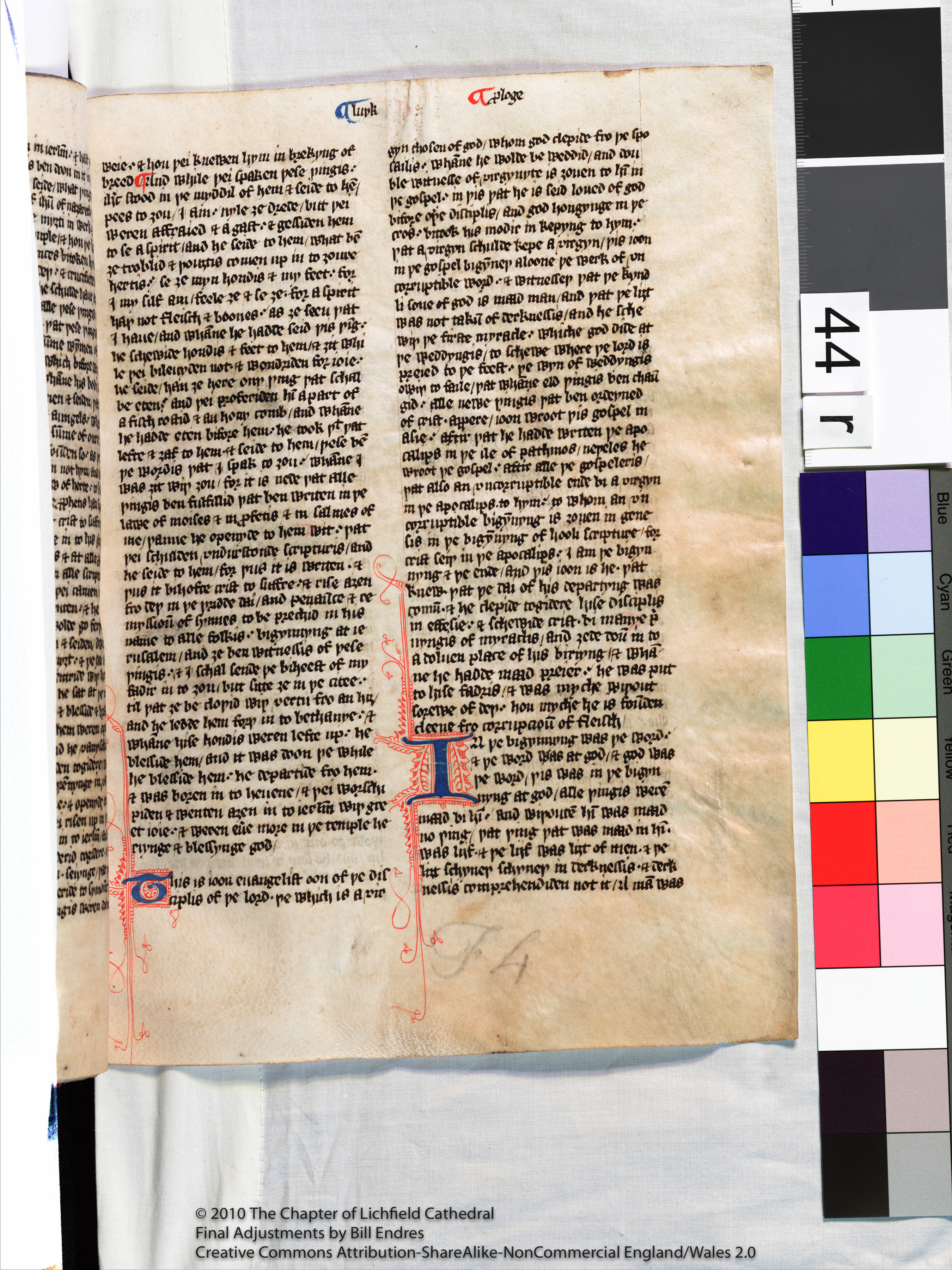
- c. 1395, John Wycliffe, John Purvey [et al.], transl., Bible (Wycliffite Bible (later version), MS Lich 10.)[2], published c. 1410, Joon 1:10, page 44r, column 2; republished as Wycliffe's translation of the New Testament, Lichfield: Bill Endres, 2010:
- He was in þe woꝛld · ⁊ þe woꝛld was maad bi him .· ⁊ þe woꝛld knew him not
- He was in the world and the world was made by him, but the world didn't know him.
- A dimension, realm, or existence, especially human existence.
- The trappings and features of human life.
- c. 1340, Dan Michel, “Vridom”, in Ayenbite of Inwyt[3], page 86:
- Ac hy habbeþ hire heꝛten zuo areꝛed ine god: þet hi ne pꝛayſeþ þe woꝛdle: bote ane botoun. and hi ne dredeþ kyng. ne eꝛl. […]
- But those who have their hearts inspired by God, who don't praise the world('s ways) even a bit and who don't fear kings, earls, […]
- The political entities of the world.
- The people of the world, especially when judging someone.
- An age, era or epoch.
- The universe, the totality of existence.
Related terms[edit]
Descendants[edit]
References[edit]
- “world, n.”, in MED Online, Ann Arbor, Mich.: University of Michigan, 2007, retrieved 2018-03-20.
- English terms derived from Proto-Indo-European
- English terms derived from the Proto-Indo-European root *h₂el- (grow)
- English terms inherited from Middle English
- English terms derived from Middle English
- English terms inherited from Old English
- English terms derived from Old English
- English terms inherited from Proto-West Germanic
- English terms derived from Proto-West Germanic
- English terms inherited from Proto-Germanic
- English terms derived from Proto-Germanic
- English 1-syllable words
- English terms with IPA pronunciation
- English terms with audio links
- Rhymes:English/ɜː(ɹ)ld
- Rhymes:English/ɜː(ɹ)ld/1 syllable
- English terms with homophones
- English lemmas
- English nouns
- English uncountable nouns
- English countable nouns
- English terms with usage examples
- English terms with quotations
- English metonyms
- English terms with collocations
- en:Computing
- en:Video games
- en:Cartomancy
- English informal terms
- English terms with archaic senses
- English verbs
- en:Collectives
- Middle English terms inherited from Old English
- Middle English terms derived from Old English
- Middle English terms inherited from Proto-West Germanic
- Middle English terms derived from Proto-West Germanic
- Middle English terms inherited from Proto-Germanic
- Middle English terms derived from Proto-Germanic
- Middle English terms with IPA pronunciation
- Middle English lemmas
- Middle English nouns
- Middle English terms with quotations
- enm:Collectives
- enm:Earth
- enm:Government
- enm:Space
- enm:Time