body
English[edit]

Alternative forms[edit]
Etymology[edit]
From Middle English bodi, bodiȝ, from Old English bodiġ (“body, trunk, chest, torso, height, stature”), from Proto-West Germanic *bodag (“body, trunk”), from Proto-Indo-European *bʰewdʰ- (“to be awake, observe”). Cognate with Old High German botah (whence Swabian Bottich (“body, torso”)).
Pronunciation[edit]
- (Received Pronunciation) IPA(key): /ˈbɒdi/
Audio (UK) (file) - (General American) IPA(key): /ˈbɑdi/, [ˈbɑɾi]
Audio (US) (file) - Homophone: bawdy (in accents with the cot-caught merger)
- Hyphenation: bod‧y
- Rhymes: -ɒdi
Noun[edit]
| Picture dictionary | |
|---|---|
|
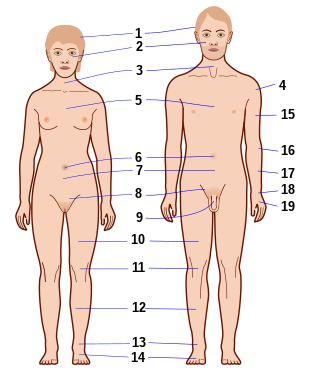
body (countable and uncountable, plural bodies)
- Physical frame.
- The physical structure of a human or animal seen as one single organism. [from 9th c.]
- I saw them walking from a distance, their bodies strangely angular in the dawn light.
- 1611, The Holy Bible, […] (King James Version), London: […] Robert Barker, […], →OCLC, 1 Corinthians 12:15–20:
- If the foot shall say, Because I am not the hand, I am not of the body: is it therefore not of the body?
And if the eare shall say, Because I am not the eye, I am not of the body: is it therefore not of the body?
If the whole body were an eye, where were the hearing? If the whole were hearing, where were the smelling?
But now hath God set the members, euery one of them in the body, as it hath pleased him.
And if they were all one member, where were the body?
But now are they many members, yet but one body.
- The fleshly or corporeal nature of a human, as opposed to the spirit or soul. [from 13th c.]
- The body is driven by desires, but the soul is at peace.
- A corpse. [from 13th c.]
- Her body was found at four o'clock, just two hours after the murder.
- (archaic or informal except in compounds) A person. [from 13th c.]
- 1749, Henry Fielding, The History of Tom Jones, a Foundling, volumes (please specify |volume=I to VI), London: A[ndrew] Millar, […], →OCLC:Folio Society 1973, page 463:
- Indeed, if it belonged to a poor body, it would be another thing; but so great a lady, to be sure, can never want it […]
- 1876, Mark Twain [pseudonym; Samuel Langhorne Clemens], chapter 28, in The Adventures of Tom Sawyer, Hartford, Conn.: The American Publishing Company, →OCLC:
- Sometime I've set right down and eat WITH him. But you needn't tell that. A body's got to do things when he's awful hungry he wouldn't want to do as a steady thing.
- 1913, Joseph C[rosby] Lincoln, chapter V, in Mr. Pratt’s Patients, New York, N.Y., London: D[aniel] Appleton and Company, →OCLC:
- “Well,” I says, “I cal'late a body could get used to Tophet if he stayed there long enough.” ¶ She flared up; the least mite of a slam at Doctor Wool was enough to set her going.
- What's a body gotta do to get a drink around here?
- (sociology) A human being, regarded as marginalized or oppressed.
- 1999, Devon Carbado, Black Men on Race, Gender, and Sexuality: A Critical Reader, page 87:
- This, of course, was not about the State, but it was certainly an invasion: black bodies acting out in a public domain circumscribed by a racist culture. The Garvey movement presents an example of black bodies transgressing racialized spatial boundaries.
- 2012, Trystan T. Cotten, Transgender Migrations, page 3:
- In doing so, Haritaworn also rethinks the marginality of transgender bodies and practices in queer movements and spaces.
- 2016, Laura Harrison, Brown Bodies, White Babies, page 5:
- As the title suggests, this project is particularly interested in how race intersects with reproductive technologies—how brown bodies are deployed in the creation of white babies.
- The physical structure of a human or animal seen as one single organism. [from 9th c.]
- Main section.
- The torso, the main structure of a human or animal frame excluding the extremities (limbs, head, tail). [from 9th c.]
- The boxer took a blow to the body.
- The largest or most important part of anything, as distinct from its appendages or accessories. [from 11th c.]
- The bumpers and front tyres were ruined, but the body of the car was in remarkable shape.
- (archaic) The section of a dress extending from the neck to the waist, excluding the arms. [from 16th c.]
- Penny was in the scullery, pressing the body of her new dress.
- The content of a letter, message, or other printed or electronic document, as distinct from signatures, salutations, headers, and so on. [from 17th c.]
- (The addition of quotations indicative of this usage is being sought:) A bodysuit. [from 19th c.]
- (programming) The code of a subroutine, contrasted to its signature and parameters. [from 20th c.]
- In many programming languages, the method body is enclosed in braces.
- (architecture, of a church) nave.
- The torso, the main structure of a human or animal frame excluding the extremities (limbs, head, tail). [from 9th c.]
- Coherent group.
- A group of people having a common purpose or opinion; a mass. [from 16th c.]
- I was escorted from the building by a body of armed security guards.
- An organisation, company or other authoritative group. [from 17th c.]
- The local train operating company is the managing body for this section of track.
- A unified collection of details, knowledge or information. [from 17th c.]
- We have now amassed a body of evidence which points to one conclusion.
- A group of people having a common purpose or opinion; a mass. [from 16th c.]
- Material entity.
- Any physical object or material thing. [from 14th c.]
- All bodies are held together by internal forces.
- (uncountable) Substance; physical presence. [from 17th c.]
- 1922 October 26, Virginia Woolf, chapter 1, in Jacob’s Room, Richmond, London: […] Leonard & Virginia Woolf at the Hogarth Press, →OCLC; republished London: The Hogarth Press, 1960, →OCLC:
- The voice had an extraordinary sadness. Pure from all body, pure from all passion, going out into the world, solitary, unanswered, breaking against rocks—so it sounded.
- We have given body to what was just a vague idea.
- (uncountable) Comparative viscosity, solidity or substance (in wine, colours etc.). [from 17th c.]
- 1989 August 12, Caroline Foty, “Hindsights”, in Gay Community News, volume 17, number 5, page 7:
- "I'd Be Lost Without You" seems somewhat out of place from a vocal viewpoint — Lewis's slightly reedy middle soprano is very expressive and absolutely true, but doesn't have enough dark body to fully deal with the torchy melody.
- The red wine, sadly, lacked body.
- An agglomeration of some substance, especially one that would be otherwise uncountable.
- 1806 June 26, Thomas Paine, “The cause of Yellow Fever and the means of preventing it, in places not yet infected with it, addressed to the Board of Health in America”, in The political and miscellaneous works of Thomas Paine, page 179:
- In a gentle breeze, the whole body of air, as far as the breeze extends, moves at the rate of seven or eight miles an hour; in a high wind, at the rate of seventy, eighty, or an hundred miles an hour […]
- 2012 March 19, Helge Løseth, Nuno Rodrigues, Peter R. Cobbold, “World's largest extrusive body of sand?”, in Geology, volume 40, number 5:
- Using three-dimensional seismic and well data from the northern North Sea, we describe a large (10 km3) body of sand and interpret it as extrusive.
- 2018, VOA Learning English > China's Melting Glacier Brings Visitors, Adds to Climate Concerns[1]:
- The huge body of ice is in the southeastern edge of a Central Asian region called the Third Pole.
- The English Channel is a body of water lying between Great Britain and France.
- Any physical object or material thing. [from 14th c.]
- (printing) The shank of a type, or the depth of the shank (by which the size is indicated).
- a nonpareil face on an agate body
- 1992, Mary Kay Duggan, Italian Music Incunabula: Printers and Type, page 99:
- The stemless notes could have been cast on a body as short as 4 mm but were probably cast on bodies of the standard 14 mm size for ease of composition.
- (geometry) A three-dimensional object, such as a cube or cone.
Synonyms[edit]
- See also Thesaurus:body
- See also Thesaurus:corpse
Derived terms[edit]
- able-bodyist
- acetone body
- administrative body
- advisory body
- afterbody
- after body
- a healthy body is a healthy mind
- amygaloid body
- anococcygeal body
- antibody
- anti-shock body
- anybody
- appendant body
- Aschoff body
- asteroid body
- astral body
- auto body
- Barr body
- basal body
- beach body
- Beccarian body
- Beltian body
- bikini body
- black body
- bodice
- bodikin
- bodiless
- bodily
- body and soul
- body armour
- body art
- body bag
- body-blow
- body blow
- bodyboard
- bodyboarder
- body broker
- body-build
- bodybuilder
- body-builder
- body-building
- bodybuilding
- body butter
- bodycam
- body cam
- body camera
- bodycare
- body catch
- body cavity
- body cavity search
- body-centered
- body-check
- body check
- body clock
- body coat
- bodycolor
- bodycolour
- body-con
- body con
- body conscious
- body contact
- body control module
- body cord
- body corporate
- body count
- body double
- body English
- body farm
- body fascism
- bodyfat
- body fat
- body fluid
- body fossil
- bodyful
- bodyfur
- bodygasm
- body gear
- bodyguard
- bodyhacker
- bodyhacking
- body hair
- body heat
- bodyhood
- body horror
- body-hugging
- body image
- body in black
- body integrity identity disorder
- body in white
- bodyism
- bodyjack
- body jacket
- body kit
- body language
- bodylike
- body line
- body linen
- body lotion
- body louse (Pediculus humanus)
- body man
- body mass
- body mass index
- bodymaster
- body matter
- body mechanics
- body mic
- bodymind
- body-mind
- body modification
- Bodymore
- bodynet
- body odor
- body odour
- body of Christ
- body of me
- body of water
- body of work
- bodypack
- body-paint
- bodypaint
- body paint
- body painting
- body part
- body-part
- body piercing
- body pillow
- body plan
- bodyplate
- body politic
- body politique
- body-positive
- body positivity
- body press
- body pump
- body scan
- bodyscape
- body servant
- body-shame
- body-shamer
- body-shaming
- body shaming
- body shape
- bodyshell
- bodyship
- body shop
- body shopping
- body shot
- bodyside
- body slam
- bodyslam
- body-slam
- body-snatcher
- body snatcher
- bodysnatching
- body soap
- body spray
- body stocking
- bodystocking
- bodystyle
- bodysuit
- bodysurf
- body-surf
- body surf
- bodysurfer
- bodyswap
- body swerve
- body temperature
- body text
- body throw
- body-to-body massage
- bodywarmer
- body wash
- body wave
- bodywear
- body weight, bodyweight
- bodywide
- body wire
- bodywork
- bodyworker
- body-worn, bodyworn
- body-worn camera
- body-worn video
- body wrap
- bog body
- bone in one's body
- busy body
- busybody
- Cajal body
- car body
- car-body van
- celestial body
- cell body
- ciliary body
- Cowdry body
- crossbody
- dead body
- dogsbody
- Döhle body
- Donovan body
- Dorito body
- dorsal body hormone
- Dutcher body
- electronic body music
- everybody
- every body
- fat body
- fluorobody
- forebody
- foreign body
- foreign body
- free body
- free body diagram
- free-body diagram
- fruit body
- fruitbody
- fruiting body
- full-body
- full body scanner
- Golgi body
- Goodbody
- graybody
- green body
- greybody
- habit of body
- handlebody
- hardbody
- heavenly body
- Heinz body
- hemibody
- Herring body
- hollow body
- hollow body position
- homebody
- housebody
- interbody
- intrabody
- keep body and soul together
- keep soul and body together
- ketone body
- know where the bodies are buried
- legislative body
- Lewy body
- lower body
- lower body day
- Malpighian body
- mamillary body
- mammillary body
- many-body problem
- microbody
- midbody
- middle body
- mind-body
- minibody
- monobody
- move one's body
- multibody
- mushroom body
- my body is ready
- narrowbody
- n-body problem
- Nissl body
- nobody
- no body, no crime
- nonbody
- nosybody
- nu body
- nuclear body
- occlusion body
- Odland body
- oligobody
- olivary body
- ore body
- orebody
- out-of-body
- out-of-body experience
- out-of-the-body
- out-of-the-body experience
- overbody
- over my dead body
- Pappenheimer body
- parasporal body
- Peabody
- peak body
- pearl body
- pentabody
- Pick body
- pineal body
- pituitary body
- planetary body
- polar body
- public body
- rainbow body
- real body
- rebody
- rigid body
- rigid body dynamics
- Russell body
- Sears-Haack body
- sell one's body
- sense body
- small Solar System body
- solidbody
- some body
- somebody
- some-body
- stakebody
- student body
- subtile body
- subtle body
- swap body, swapbody
- the other body
- three body problem
- throttle body
- total body day
- traybody
- two-body problem
- unbody
- underbody
- unibody
- upper body
- upper body day
- vitreous body
- warm body
- waterbody
- water body
- wide-body
- with every bone in one's body
- Wolffian body
- zebra body
Translations[edit]
|
|
|
|
|
|
|
|
- The translations below need to be checked and inserted above into the appropriate translation tables. See instructions at Wiktionary:Entry layout § Translations.
|
See also[edit]
Verb[edit]
body (third-person singular simple present bodies, present participle bodying, simple past and past participle bodied)
- (transitive, often with forth) To give body or shape to something.
- c. 1595–1596 (date written), William Shakespeare, “A Midsommer Nights Dreame”, in Mr. William Shakespeares Comedies, Histories, & Tragedies: Published According to the True Originall Copies (First Folio), London: […] Isaac Iaggard, and Ed[ward] Blount, published 1623, →OCLC, (please specify the act number in uppercase Roman numerals, and the scene number in lowercase Roman numerals):
- And as imagination bodies forth / The forms of things unknown, the poet's pen / Turns them to shapes and gives to airy nothing / A local habitation and a name.
- 1851 March 22, “The Foreign Country at Home. IV. Abergavenny to Swansea.”, in Leigh Hunt, editor, Leigh Hunt’s Journal; a Miscellany for the Cultivation of the Memorable, the Progressive, and the Beautiful, volume I, number 16, London: […] Stewart & Murray, […], →OCLC, page 255:
- [A]s you stand on the steps of the Castle Green in this strange place, you feel quite floaty. This you are told is the scene of the Merthyr riots; and you feel still floatier as you body forth before your eyes a picture like the following— […]
- 1981, William Irwin Thompson, The Time Falling Bodies Take to Light: Mythology, Sexuality and the Origins of Culture, London: Rider/Hutchinson & Co., page 175:
- The drama of the storehouse on earth has its counterpart in Heaven, and if we accept the insights of both Jacobsen and von Dechend, we can see that the myth is bodying forth a principle which will later be expressed in the Hermetic axiom, "As above, so below." In fact, it is precisely this relationship between above and below that the myth explores.
- To construct the bodywork of a car.
- (transitive) To embody.
- 1955, Philip Larkin, Toads:
- I don't say, one bodies the other / One's spiritual truth; / But I do say it's hard to lose either, / When you have both.
- (transitive, slang, African-American Vernacular) To murder someone.
References[edit]
- Jonathon Green (2024) “body v.”, in Green’s Dictionary of Slang
Anagrams[edit]
Czech[edit]
Pronunciation[edit]
Etymology 1[edit]
Borrowed from English body, bodysuit.
Noun[edit]
body n (indeclinable)
Etymology 2[edit]
See the etymology of the corresponding lemma form.
Noun[edit]
body
Anagrams[edit]
Dutch[edit]
Etymology[edit]
Pronunciation[edit]
Noun[edit]
body m (plural body's, diminutive body'tje n)
Finnish[edit]
Etymology[edit]
Pronunciation[edit]
- IPA(key): /ˈbody/, [ˈbo̞dy]
- IPA(key): /ˈbodi/, [ˈbo̞di]
- Rhymes: -ody
- Homophone: bodi
- Syllabification(key): bo‧dy
Noun[edit]
body
- snapsuit, diaper shirt, onesies (infant bodysuit)
- Synonym: potkupuku
- bodystocking (one-piece article of lingerie)
- Synonyms: bodi, body stocking
Declension[edit]
Pronunciation ˈbody:
| Inflection of body (Kotus type 1/valo, no gradation) | ||||
|---|---|---|---|---|
| nominative | body | bodyt | ||
| genitive | bodyn | bodyjen | ||
| partitive | bodya | bodyja | ||
| illative | bodyyn | bodyihin | ||
| singular | plural | |||
| nominative | body | bodyt | ||
| accusative | nom. | body | bodyt | |
| gen. | bodyn | |||
| genitive | bodyn | bodyjen | ||
| partitive | bodya | bodyja | ||
| inessive | bodyssa | bodyissa | ||
| elative | bodysta | bodyista | ||
| illative | bodyyn | bodyihin | ||
| adessive | bodylla | bodyilla | ||
| ablative | bodylta | bodyilta | ||
| allative | bodylle | bodyille | ||
| essive | bodyna | bodyina | ||
| translative | bodyksi | bodyiksi | ||
| abessive | bodytta | bodyitta | ||
| instructive | — | bodyin | ||
| comitative | See the possessive forms below. | |||
Further reading[edit]
- “body”, in Kielitoimiston sanakirja [Dictionary of Contemporary Finnish][3] (in Finnish) (online dictionary, continuously updated), Kotimaisten kielten keskuksen verkkojulkaisuja 35, Helsinki: Kotimaisten kielten tutkimuskeskus (Institute for the Languages of Finland), 2004–, retrieved 2023-07-02
Italian[edit]
Etymology[edit]
Pseudo-anglicism, a clipping of English bodysuit.
Pronunciation[edit]
Noun[edit]
body m (invariable)
- leotard
- Synonym: calzamaglia
Further reading[edit]
- body in Treccani.it – Vocabolario Treccani on line, Istituto dell'Enciclopedia Italiana
Polish[edit]
Etymology[edit]
Pseudo-anglicism, derived from bodysuit.
Pronunciation[edit]
Noun[edit]
body n (indeclinable)
Further reading[edit]
- body in Wielki słownik języka polskiego, Instytut Języka Polskiego PAN
- body in Polish dictionaries at PWN
Romanian[edit]
Etymology[edit]
Unadapted borrowing from English body.
Noun[edit]
body n (plural body-uri)
Declension[edit]
| singular | plural | |||
|---|---|---|---|---|
| indefinite articulation | definite articulation | indefinite articulation | definite articulation | |
| nominative/accusative | (un) body | body-ul | (niște) body-uri | body-urile |
| genitive/dative | (unui) body | body-ului | (unor) body-uri | body-urilor |
| vocative | body-ule | body-urilor | ||
Scots[edit]
Alternative forms[edit]
Etymology[edit]
From Middle English body, bodiȝ, from Old English bodiġ, bodeġ (“body, trunk, chest, torso, height, stature”).
Noun[edit]
body (plural bodies)
Spanish[edit]
Noun[edit]
body m (plural bodys or bodies)
- Alternative spelling of bodi
Further reading[edit]
- “body”, in Diccionario de la lengua española, Vigésima tercera edición, Real Academia Española, 2014
- English terms inherited from Middle English
- English terms derived from Middle English
- English terms inherited from Old English
- English terms derived from Old English
- English terms inherited from Proto-West Germanic
- English terms derived from Proto-West Germanic
- English terms derived from Proto-Indo-European
- English 2-syllable words
- English terms with IPA pronunciation
- English terms with audio links
- English terms with homophones
- Rhymes:English/ɒdi
- Rhymes:English/ɒdi/2 syllables
- Visual dictionary
- English lemmas
- English nouns
- English uncountable nouns
- English countable nouns
- English terms with quotations
- English terms with archaic senses
- English informal terms
- en:Sociology
- en:Programming
- en:Architecture
- English terms with usage examples
- en:Printing
- en:Geometry
- English verbs
- English transitive verbs
- English slang
- African-American Vernacular English
- en:Anatomy
- en:Body parts
- en:Collectives
- en:Wine
- Czech terms with IPA pronunciation
- Rhymes:Czech/odɪ
- Rhymes:Czech/odɪ/2 syllables
- Czech terms borrowed from English
- Czech terms derived from English
- Czech lemmas
- Czech nouns
- Czech indeclinable nouns
- Czech neuter nouns
- Czech non-lemma forms
- Czech noun forms
- cs:Clothing
- Dutch terms borrowed from English
- Dutch terms derived from English
- Dutch terms with IPA pronunciation
- Dutch terms with audio links
- Dutch lemmas
- Dutch nouns
- Dutch nouns with plural in -s
- Dutch masculine nouns
- nl:Clothing
- Finnish terms borrowed from English
- Finnish terms derived from English
- Finnish 2-syllable words
- Finnish terms with IPA pronunciation
- Rhymes:Finnish/ody
- Rhymes:Finnish/ody/2 syllables
- Finnish terms with homophones
- Finnish lemmas
- Finnish nouns
- Finnish valo-type nominals
- fi:Clothing
- Italian pseudo-loans from English
- Italian terms derived from English
- Italian 2-syllable words
- Italian terms with IPA pronunciation
- Rhymes:Italian/ɔdi
- Rhymes:Italian/ɔdi/2 syllables
- Italian lemmas
- Italian nouns
- Italian indeclinable nouns
- Italian countable nouns
- Italian terms spelled with Y
- Italian masculine nouns
- it:Clothing
- Polish pseudo-loans from English
- Polish terms derived from English
- Polish 2-syllable words
- Polish terms with IPA pronunciation
- Polish terms with audio links
- Rhymes:Polish/ɔdɨ
- Rhymes:Polish/ɔdɨ/2 syllables
- Polish lemmas
- Polish nouns
- Polish indeclinable nouns
- Polish neuter nouns
- pl:Clothing
- Romanian terms borrowed from English
- Romanian unadapted borrowings from English
- Romanian terms derived from English
- Romanian lemmas
- Romanian nouns
- Romanian countable nouns
- Romanian terms spelled with Y
- Romanian neuter nouns
- Scots terms inherited from Middle English
- Scots terms derived from Middle English
- Scots terms inherited from Old English
- Scots terms derived from Old English
- Scots lemmas
- Scots nouns
- sco:People
- Spanish lemmas
- Spanish nouns
- Spanish countable nouns
- Spanish nouns with multiple plurals
- Spanish masculine nouns