main
English[edit]
Pronunciation[edit]
- (Received Pronunciation, General American) enPR: mān, IPA(key): /meɪn/
Audio (GA) (file) Audio (AU) (file) - Rhymes: -eɪn
- Homophones: mane, Maine
Etymology 1[edit]
From Middle English mayn, main, maine, mæin, meyn, from main (noun) (see further at etymology 2); compare Old English mægen- (“strong, main, principal”) (used in combination)[1] and Old Norse megn, megenn (“strong, main”).
The word is cognate with Old High German megīn (“strong, mighty”) (modern German Möge, Vermögen (“power, wealth”)), and also akin to Old English magan (“to be able to”). See also may.
Adjective[edit]
main (not comparable)
- Of chief or leading importance; prime, principal. [from 15th c.]
- 1664, John Tillotson, “Sermon I. The Wisdom of Being Religious. Job XXVIII. 28.”, in The Works of the Most Reverend Dr. John Tillotson, Late Lord Archbishop of Canterbury: […], 8th edition, London: […] T. Goodwin, B[enjamin] Tooke, and J. Pemberton, […]; J. Round […], and J[acob] Tonson] […], published 1720, →OCLC:
- Religion direct us rather to ſecure inward peace than outward eaſe, to be more careful to avoid everlaſting and intolerable torment than ſhort and light afflictions which are but for a moment; […] In a word, our main intereſt is to be as happy as we can, and as long as is poſſible; and if we be caſt into ſuch circumſtances, that we muſt be either in part and for a time or elſe wholly and always miſerable, the beſt wiſdom is to chuſe the greateſt and moſt laſting happiness, but the leaſt and ſhorteſt miſery.
- 1918, W[illiam] B[abington] Maxwell, chapter VII, in The Mirror and the Lamp, Indianapolis, Ind.: The Bobbs-Merrill Company, →OCLC, page 77:
- With some of it on the south and more of it on the north of the great main thoroughfare that connects Aldgate and the East India Docks, St. Bede's at this period of its history was perhaps the poorest and most miserable parish in the East End of London.
- 1935, [George Goodchild], chapter 5, in Death on the Centre Court; a McLean Mystery, London: Hodder and Stoughton, →OCLC:
- By one o'clock the place was choc-a-bloc. […] The restaurant was packed, and the promenade between the two main courts and the subsidiary courts was thronged with healthy-looking youngish people, drawn to the Mecca of tennis from all parts of the country.
- Chief, most important, or principal in extent, size, or strength; consisting of the largest part.
- Synonym: largest
- main timbers
- main branch of a river
- main body of an army
- 1667, John Milton, “Book VI”, in Paradise Lost. […], London: […] [Samuel Simmons], […], →OCLC; republished as Paradise Lost in Ten Books: […], London: Basil Montagu Pickering […], 1873, →OCLC, lines 470–471:
- Not uninvented that, which thou aright / Beleivſt ſo main to our ſucceſs, I bring; […]
- 2013 August 3, “The Future of Oil: Yesterday’s fuel”, in The Economist[1], volume 408, number 8847, archived from the original on 1 August 2013:
- The dawn of the oil age was fairly recent. Although the stuff was used to waterproof boats in the Middle East 6,000 years ago, extracting it in earnest began only in 1859 after an oil strike in Pennsylvania. […] It was used to make kerosene, the main fuel for artificial lighting after overfishing led to a shortage of whale blubber. Other liquids produced in the refining process, too unstable or smoky for lamplight, were burned or dumped.
- (archaic, of force, strength, etc.) Full, sheer, undivided. [from 16th c.]
- 1817 December 31 (indicated as 1818), [Walter Scott], chapter XII, in Rob Roy. […], volume I, Edinburgh: […] James Ballantyne and Co. for Archibald Constable and Co. […]; London: Longman, Hurst, Rees, Orme, and Brown, →OCLC, page 281:
- […] I shall never forget the diabolical sneer which writhed Rashleigh's wayward features, as I was forced from the apartment by the main strength of two of these youthful Titans.
- 1825 June 22, [Walter Scott], chapter IV, in Tales of the Crusaders. […], volume I (The Betrothed), Edinburgh: […] [James Ballantyne and Co.] for Archibald Constable and Co.; London: Hurst, Robinson, and Co., →OCLC, page 71:
- Wounded and overthrown, the Britons continued their resistance, clung round the legs of the Norman steeds, and cumbered their advance; while their brethren, thrusting with pikes, proved every joint and crevice of the plate and mail, or grappling with the men-at-arms, strove to pull them from their horses by main force, or beat them down with their bills and Welch hooks.
- (dialectal) Big; angry.
- (nautical) Belonging to or connected with the principal mast in a vessel.
- (obsolete) Great in size or degree; important, powerful, strong, vast.
- 1718, Samuel Daniel, “The History of the Civil War. Book V.”, in The Poetical Works of Mr. Samuel Daniel, Author of the English History. […], volume II, London: Printed for R. Gosling, […] W. Mears, […] and J. Browne […], →OCLC, stanza LXXXIX, page 167:
- And now that Current with main Fury ran / (The Stop remov'd that did the Courſe defend) / Unto the full of Miſchief, that began / T' an univerſal Ruin to extend; […]
Derived terms[edit]
- drain the main vein
- in-mast
- left main
- main asteroid belt
- main battle tank
- main belt
- main bitch
- mainboard
- main building
- mainchain
- main chance
- main character
- main character syndrome
- main clause
- main contractor
- main course
- maincrop
- main curtain
- main deck
- main diagonal
- main dish
- main drag
- main drape
- main earth
- main frame
- mainframe
- main gear
- main group
- main group element
- main guard
- main house
- mainly
- main market
- main memory
- main menu
- main page
- mainpin
- main pot
- main rag
- main road
- mainsail
- main sequence
- main-sequence
- main sheet
- mainshock
- mainspace
- mainspan
- mainstage
- main stage
- mainstay
- mainstem
- mainstream
- main thing
- main verb
- main wheel
- nonmain
- on main
- Percy Main
Translations[edit]
|
Adverb[edit]
main (comparative more main, superlative most main)
- (British, dialectal) Exceedingly, extremely, greatly, mightily, very, very much.
- 1754, Samuel Foote, “The Knights”, in The Knights. A Comedy, in Two Acts. […], Dublin: Printed by Richard James, […], →OCLC, act II, page 35:
- Suck[y]. A Draught of Ale, Friend, for I'm main dry. / Pen[elope]. Fie! fie! Niece! Is that Liquor for a young Lady? Don't disparage your Family and Breeding!
- 1778, Richard Brinsley Sheridan, “The Camp: A Musical Entertainment”, in The Dramatic Works of Richard Brinsley Sheridan. With a Memoir of the Author (Dove’s English Classics), London: Printed and published by J. F. Dove, […], published c. 1813–1828, →OCLC, act I, scene ii, page 309:
- Why, it's main jolly to be sure, and all that so fair.
- 1881–1882, Robert Louis Stevenson, Treasure Island, London, Paris: Cassell & Company, published 14 November 1883, →OCLC:
- It was main hot, and the windy was open, and I hear that old song comin’ out as clear as clear […]
Verb[edit]
main (third-person singular simple present mains, present participle maining, simple past and past participle mained)
- (transitive, slang) Short for mainline (“to inject (a drug) directly into a vein”).
- (transitive, gaming) To mainly play a specific character or side, or with specific equipment, during a game.
- He mains the same character as me in that game.
- What race do you main and what is your favourite race to beat?
- For new players, I recommend maining the dagger and using the axe as a backup weapon.
- 2017 January 25, Dave Smith, “After Weeks of Bugging Him on Twitter, Elon Musk just Told Me His ‘Dark Secret’”, in Business Insider[2], archived from the original on 30 March 2017:
- Now, full disclosure: I too main Soldier 76 in "Overwatch" (by the way, the term "maining" is parlance for the most-often used character you play in a given game).
- (obsolete) To convert (a road) into a main or primary road.
- 1904, Arthur Underhill, Charles Otto Blagden, et al., editors, An Encyclopaedia of Forms and Precedents Other than Court Forms, volume 6, London: Butterworth, →OCLC:
- When a rural district council considers that a highway in its district ought to become a main road by reason of its being a medium of communication between great towns, or a thoroughfare to a railway station, or otherwise, it may apply to the county council for an order "maining" the road under s. 15 of the Highways and Locomotives (Amendment) Act, 1878 (41 & 42 Vict. c. 77), as amended by s. 3 (viii.) of the Local Government Act, 1888 (51 & 52 Vict. c. 41), and the county council may make an order accordingly.
- 1927, The Municipal Journal and Public Works Engineer, volume XXXVI, London: Municipal Journal, →OCLC:
- The borough did not have an opportunity of conferring with the County Council, but the County Council requested particulars of district roads in the borough which the Council suggested should be mained.
Etymology 2[edit]
From Middle English mayn, main, maine, mæine, mæȝen, from Old English mæġen (“strength”),[2] from Proto-Germanic *maginą (“strength, power, might”), *maginaz (“strong”), from Proto-Indo-European *megʰ- (“be able”).
The word is cognate with Old High German magen, megin, Old Norse magn, megn, megin, Old Saxon megin.[3] More recent senses are derived from the adjective.
Noun[edit]
main (plural mains)
- That which is chief or principal; the chief or main portion; the bulk, the greater part, gross.
- 1718, Humphrey Prideaux, The Old and New Testaments Connected in the History of the Jews and Neighbouring Nations, from the Declension of the Kingdoms of Israel and Judah to the Time of Christ, 3rd edition, volume II, part I, London: Printed for R. Knaplock […] and J[acob] Tonson […], →OCLC, part II, book II, page 96:
- Antiochus […] thought it a proper time for him to attempt the recovery of Syria; and Hermias his prime Miniſter preſſed hard for his going in perſon to this war, contrary to the Opinion of Epigenes his General; who thought it chiefly concerned him to ſuppreſs the Rebellion of Alexander and Molon in the East; and therefore adviſed him to march immediately in perſon with the main of his Army for the ſubduing of thoſe Rebels, before they ſhould gather greater ſtrength in the revolted Provinces againſt him.
- 1803, Francis Bacon, “The History of the Reign of King Henry the Seventh”, in The Works of Francis Bacon, Baron of Verulam, Viscount St. Alban, and Lord High Chancellor of England. In Ten Volumes, volume V, London: Printed for J. Johnson [et al.]; […], →OCLC, page 8:
- But the King [Henry VII of England], […] preferring his affection to his own line and blood, […] resolved to rest upon the title of Lancaster as the main, and to use the other two, that of marriage, and that of battle, but as supporters, the one to appease secret discontents, and the other to beat down open murmur and dispute; […]
- (video games) The primary character that one plays in a video game in which one can play more than one character.
- A large cable or pipe providing utility service to an area or a building, such as a water main or electric main. [from 17th c.]
- 1778 April 3, “Appendix. Report from the Committee on the State of the Pavements, &c. in the Streets of Dublin”, in The Journals of the House of Commons, of the Kingdom of Ireland, […], volume XX, Dublin: Printed by Abraham Bradley and Abraham Bradley King, […], published 1782, →OCLC, page 539:
- [T]he Contract with the Pipe-water Pavior was, as he recollects, to keep the Pavement in Repair for ſix Weeks; did oblige the Contractor to repair many Places in that ſix Weeks; there was a Part of the new Main failed in Dame-ſtreet; was obliged to take up three or four Pieces in Length, in conſequence of a Sewer being made there, which undermined the Main, and put it out of its Place; […]
- 1876 June 19, Guildford Barker Richardson (interviewee), “Mr. Guildford Barker Richardson, Called in; and further Examined”, in Report from the Select Committee on the Metropolis Gas (Surrey Side) Bill; together with the Proceedings of the Committee, and Minutes of Evidence (Reports from Committees: Seven Volumes; 4), volume XI, [London]: Ordered, by the House of Commons, to be printed, published 28 July 1876, →OCLC, paragraph 4780, page 335:
- [T]he Board would have put down, and indeed have ordered, hydrants where the water companies have put down new mains, or at all events are quite prepared upon those new mains to fix hydrants.
- (informal) Short for main course (“the principal dish of a meal”).
- I had scampi and chips for my main and a slice of cheesecake for dessert.
- (now poetic) The high seas. [from 16th c.]
- 1590, Edmund Spenser, “Book II, Canto VI”, in The Faerie Queene. […], London: […] [John Wolfe] for William Ponsonbie, →OCLC, stanza 17, page 261:
- 1697, Virgil, “The Fifth Book of the Æneis”, in John Dryden, transl., The Works of Virgil: Containing His Pastorals, Georgics, and Æneis. […], London: […] Jacob Tonson, […], →OCLC, page 360, lines 1115–1119:
- The God, inſulting with ſuperiour Strength, / Fell heavy on him, plung'd him in the Sea, / And, with the Stern, the Rudder tore away, / Headlong he fell, and, ſtrugling in the Main, / Cry'd out for helping hands, but cry'd in vain: […]
- c. 1744, Thomas Broughton (libretto), George Frideric Handel (music), “Hercules: An Oratorio”, in The Miscellaneous Pieces, as Set to Music, of Geo. Fred. Handel. […], part II, London: Printed for T. Heptinstall, […], published 1799, →OCLC, part the second [Act II, scene iv], page 53:
- Wanton god of am'rous fires, / Wishes, sighs and soft desires, / All nature's sons thy laws maintain; / O'er liquid air, firm land, and swelling main, / Extend thy uncontroul'd and boundless reign.
- 1796, “It Was A' For Our Rightful King”, Robert Burns (lyrics):
- My love, and native land, fareweel! / For I maun cross the main...
- 1907, Rudyard Kipling, “The Sons of Martha”, in Rudyard Kipling’s Verse: Inclusive Edition 1885–1918, London: Hodder and Stoughton Ltd., published 1927, →OCLC, pages 436–437:
- The Sons of Mary seldom bother, for they have inherited that good part; / But the Sons of Martha favour their Mother of the careful soul and the troubled heart, / […] / It is their care that the wheels run truly; it is their care to embark and entrain, / Tally, transport, and deliver duly the Sons of Mary by land and main.
- (now archaic, US dialectal) The mainland. [from 16th c.]
- 1624, Francis Bacon, “Considerations Touching a War with Spain. Inscribed to Prince Charles, An. 1624.”, in The Works of Francis Bacon, Baron of Verulam, Viscount St. Alban, and Lord High Chancellor of England, volume III, London: Printed for J[ohn] Walthoe, […], published 1740, →OCLC, page 526:
- In the year that followed of 1589, we gave the Spaniards no breath, but turned challengers, invaded the main of Spain. In which enterprize, although we failed of our end, which was to ſettle Don Antonio in the kingdom of Portugal, yet a man ſhall hardly meet with an action that doth better reveal the great ſecret of the power of Spain: […]
- 1624, John Donne, “17. Meditation”, in Deuotions upon Emergent Occasions, and Seuerall Steps in My Sicknes: […], London: Printed by A[ugustine] M[atthews] for Thomas Iones, →OCLC; republished as Geoffrey Keynes, edited by John Sparrow, Devotions upon Emergent Occasions: […], Cambridge: At the University Press, 1923, →OCLC, page 98, lines 2–3:
- No man is an Iland, intire of it selfe; every man is a peece of the Continent, a part of the maine; […]
- 1624, Anthony Bagnall, Nathanaell Powell, Anas Todkill, “Chapter V. The Accidents that Hapned in the Discovery of the Bay of Chisapeack”, in John Smith, The Generall Historie of Virginia, New-England, and the Summer Isles: […], London: […] I[ohn] D[awson] and I[ohn] H[aviland] for Michael Sparkes, →OCLC, book 3; reprinted in The Generall Historie of Virginia, [...] (Bibliotheca Americana), Cleveland, Oh.: The World Publishing Company, 1966, →OCLC, page 56:
- The higheſt land on the mayne, yet it was but low, we called Keales hill, and theſe vninhabited Iſles, Ruſſels Iſles.
- 1851 November 14, Herman Melville, “Knights and Squires”, in Moby-Dick; or, The Whale, 1st American edition, New York, N.Y.: Harper & Brothers; London: Richard Bentley, →OCLC, page 131:
- Tashtego's long, lean, sable hair, his high cheek bones, and black rounding eyes— […] all this sufficiently proclaimed him an inheritor of the unvitiated blood of those proud warrior hunters, who, in quest of the great New England moose, had scoured, bow in hand, the aboriginal forests of the main.
- (nautical) Short for mainsail. [from 17th c.]
- (obsolete, except in might and main) Force, power, strength, violent effort. [from 9th c.]
- 1590, Edmund Spenser, “Book II, Canto IX”, in The Faerie Queene. […], London: […] [John Wolfe] for William Ponsonbie, →OCLC, stanza 14, page 311:
- For with ſuch puiſſance and impetuous maine / Thoſe Champions broke on them, that forſt the fly, / Like ſcattered Sheepe, whenas the Shepherds ſwaine / A Lyon and a Tigre doth eſpye, / With greedy pace forth ruſhing from the foreſt nye.
Derived terms[edit]
- amain
- fire main
- for the main
- gas main
- in the main
- main brace, mainbrace
- maincrop
- main drag
- mainer
- mainframe
- mainful
- mainland
- mainline, main line
- main man
- mainmast
- mainplane
- mains
- mainsail
- mainsheet
- mainspring
- main street, Main Street, mainstreet
- maintop
- maintopmast
- main-truck
- mainyard
- midmain
- might and main
- rising main
- Spanish Main
- water main
Translations[edit]
|
|
Etymology 3[edit]
Uncertain; probably from the adjective main. Evidence is lacking for a derivation from French main (“hand”).[4]
Noun[edit]
main (plural mains)
- (obsolete, gaming) A hand or match in a game of dice.
- 1689 May 14, Mr. Prior [Matthew Prior?], “Epistle to Fleetwood Shephard, Esq.”, in “Mr. Gentleman” [pseudonym], The New Pleasing Instructor: Or, Entertaining Moralist. […], York, Yorkshire: Printed by C. Etherington, for John Bell, […] and C. Etherington, […], published 1772, →OCLC, page 370:
- That writing is but juſt like dice, / And lucky mains make people wiſe: / That jumbled words, if fortune throw 'em, / Shall, well as Dryden, form a poem; […]
- 1876, Charles Dickens, All the Year Round
- That no minute might be wasted, the gay gallants of the time generally had a dice-box and a cast of dice in their pockets. This was convenient in the extreme, as, in the intervals of racing, a main could be thrown […]
- (obsolete, gaming) The largest throw in a match at dice; in the game of hazard, a number from one to nine called out by a person before the dice are thrown.
- 1598, Richard Barckley, “To the Reader”, in A Discourse of the Felicitie of Man: Or His Summum Bonum, London: Printed [by Richard Field] for VVilliam Ponsonby, →OCLC; republished as “To the Reader”, in A Discovrse of the Felicite of Man. Or His Summum Bonum, newly corrected and augmented edition, London: Printed [by James Roberts] for VVilliam Ponsonby, 1603, →OCLC:
- Euery man hath not beene brought vp in the knowledge of toungs. And it chanceth often to the reader, as it doth to diceplayers, that gaine more by the bye then by the maine.
- 1848 November – 1850 December, William Makepeace Thackeray, chapter 44, in The History of Pendennis. […], volumes (please specify |volume=I or II), London: Bradbury and Evans, […], published 1849–1850, →OCLC:
- I had such a run of luck last night, with five for the main, and seven to five all night, until those ruffians wanted to pay me with Altamont’s bill upon me. The luck turned from that minute. Never held the box again for three mains, and came away cleared out, leaving that infernal cheque behind me.
- (obsolete, gaming) A stake played for at dice.
- c. 1597 (date written), [William Shakespeare], The History of Henrie the Fourth; […], quarto edition, London: […] P[eter] S[hort] for Andrew Wise, […], published 1598, →OCLC, [Act IV, scene i]:
- [W]ere it good / To ſet the exact wealth of al our ſtates / Al at one caſt? to ſet ſo rich a maine / On the nice hazard of one doubtfull houre?
- Is it good / To bet all of our wealth / On one throw of the dice? To place so high a stake / On the risky hazard of one doubtful hour?
- (obsolete, gaming, sports) A sporting contest or match, especially a cockfighting match.
- 1852, William Makepeace Thackeray, “After Good Fortune Comes Evil”, in The History of Henry Esmond, Esq. […] , volume I, London: […] Smith, Elder, & Company, […], →OCLC, page 171:
- My lord was hunting all day when the ſeaſon admitted; he frequented all the cockfights and fairs in the country, and would ride twenty miles to ſee a main fought, or two clowns break their heads at a cudgelling match; […]
- A banker's shovel for coins.
Etymology 4[edit]
Uncertain, possibly from French main (“hand”).
Noun[edit]
main (plural mains)
- (obsolete, rare) A basket for gathering grapes.
- [1751, Robert Ainsworth, Samuel Patrick, “A main”, in Thesaurus Linguæ Latinæ Compendiarius: Or, A Compendious Dictionary of the Latin Tongue: […], 3rd edition, London: Printed by C. and J. Ackers, for W[illiam] Mount and T[homas] Page [et al.], →OCLC, column 1:
- A main [hamper] Corbis vindemiatorius]
References[edit]
- ^ “main, adj.”, in MED Online, Ann Arbor, Mich.: University of Michigan, 2007, retrieved 3 June 2018.
- ^ “main, n.”, in MED Online, Ann Arbor, Mich.: University of Michigan, 2007, retrieved 3 June 2018.
- ^ John A. Simpson and Edmund S. C. Weiner, editors (1989), “main, sb.1”, in The Oxford English Dictionary, 2nd edition, Oxford: Clarendon Press, →ISBN, page 216, columns 1–2.
- ^ John A. Simpson and Edmund S. C. Weiner, editors (1989), “main, sb.3”, in The Oxford English Dictionary, 2nd edition, Oxford: Clarendon Press, →ISBN, page 217, column 1.
Further reading[edit]
 main (disambiguation) on Wikipedia.Wikipedia
  Main (power) in the Encyclopædia Britannica (11th edition, 1911)


See also[edit]
Anagrams[edit]
Cimbrian[edit]
Alternative forms[edit]
Etymology[edit]
From Middle High German mīn, form Old High German mīn, from Proto-West Germanic *mīn, from Proto-Germanic *mīnaz (“my, mine”). Cognate with German mein, English mine.
Determiner[edit]
main (plural main, bon/dar maindarn) (Sette Comuni)
- (attributive) my
- De main muutar ist noch jung. ― My mother is still young.
- An zun bon maindarn ghéet noch suul. ― My son still goes to school. (literally, “A son of mine still goes to school.”)
- Maina muutar! ― My mother!
- (predicative) mine
- De khua ist main. ― The cow is mine.
Usage notes[edit]
The following rules apply to all Sette Comuni Cimbrian possessive determiners:
- They are inflected by number and gender in only exclamations (i.e. vocative case).
- Before nouns, they are inflected for number only and follow the corresponding definite article (a form of dar).
- The plural ending is -en, or -∅ when the pronoun itself ends in -n.
- Predicatively, they are uninflected and the definite article is not used.
- Following bon (“of”) or dar (the only surviving trace of a genitive definite article; used for all numbers and genders) they end in -darn.
Inflection[edit]
| Inflection of main | ||||
|---|---|---|---|---|
| masculine | feminine | neuter | plural | |
| maindar | maina | maines | maine | |
| These inflections are only used in exclamations. | ||||
See also[edit]
| Possessive determiners | ||
|---|---|---|
| singular | plural | |
| 1st person | main | ögnar |
| 2nd person | dain | ôar |
| 3rd person | zain | |
References[edit]
- “main” in Martalar, Umberto Martello, Bellotto, Alfonso (1974) Dizionario della lingua Cimbra dei Sette Communi vicentini, 1st edition, Roana, Italy: Instituto di Cultura Cimbra A. Dal Pozzo
Dalmatian[edit]
Etymology[edit]
From Latin mēne, from mē. Compare Romanian mine.
Pronoun[edit]
main
- (first-person singular pronoun, oblique case) me
Related terms[edit]
Finnish[edit]
Noun[edit]
main
- instructive plural of maa
See also[edit]
Further reading[edit]
- “main”, in Kielitoimiston sanakirja [Dictionary of Contemporary Finnish][3] (in Finnish) (online dictionary, continuously updated), Kotimaisten kielten keskuksen verkkojulkaisuja 35, Helsinki: Kotimaisten kielten tutkimuskeskus (Institute for the Languages of Finland), 2004–, retrieved 2023-12-01
Anagrams[edit]
French[edit]
| Picture dictionary | ||
|---|---|---|
| ||
|
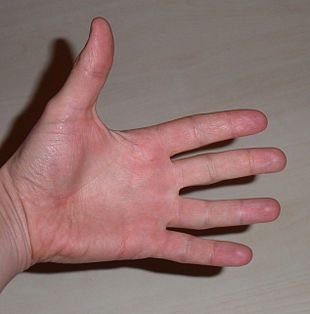

Etymology[edit]
Inherited from Middle French main, Old French main, mein, man, from Latin manus (“hand”), from Proto-Italic *manus, perhaps from Proto-Indo-European *méh₂-r̥ ~ *mh₂-én-, derived from Proto-Indo-European *(s)meh₂- (“to beckon”), or perhaps from a Proto-Indo-European *mon-u- (see the Proto-Italic entry). Compare Spanish mano.
Pronunciation[edit]
Noun[edit]
main f (plural mains)
Synonyms[edit]
Meronyms[edit]
Holonyms[edit]
Derived terms[edit]
- à la main
- à main armée
- à mains nues
- avoir deux mains gauches
- avoir du sang sur les mains
- avoir la main lourde
- avoir le cœur sur la main
- avoir les mains liées
- avoir un poil dans la main
- baisemain
- changer de mains
- cheval de main
- comme les doigts de la main
- compter sur les doigts de la main
- compter sur les doigts d’une main
- coup de main
- de longue main
- de main de maître
- de seconde main
- en bonnes mains
- en main propre
- en mains propres
- en venir aux mains
- entre de bonnes mains
- faire des pieds et des mains
- faire main basse
- forcer la main
- frein à main
- haut la main
- haut les mains
- homme de main
- jeu de main, jeu de vilain
- la main sur le cœur
- léger de main
- les mains dans les poches
- les mains vides
- main courante
- main dans la main
- main invisible
- main verte
- mainlevée
- mainmettre
- mainmortable
- mainmorte
- mainmuable
- mettre la main
- mettre la main à la pâte
- mettre la main sur
- mettre les mains dans le cambouis
- mettre sa main à couper
- mettre sa main au feu
- montre en main
- parle à ma main
- passer la main
- passer par les mains
- perdre la main
- petite main
- poignée de main
- prendre en main
- prendre la main dans le sac
- prendre ses couilles en main
- prendre son courage à deux mains
- reprendre en main
- sac à main
- se faire la main
- se frotter les mains
- se laver les mains
- se salir les mains
- serrer la main
- sous la main
- tournemain
- vol à main armée
- vote à main levée
Related terms[edit]
Descendants[edit]
- →? English: main
- →⇒ German: Lamäng
- Haitian Creole: men
- Louisiana Creole: men
- ⇒ Mauritian Creole: lame
Further reading[edit]
- “main”, in Trésor de la langue française informatisé [Digitized Treasury of the French Language], 2012.
Anagrams[edit]
Indonesian[edit]
Etymology[edit]
From Malay main, from Proto-Malayic *maim, a reduction from Pre-Proto-Malayic *q-um-ayam, from Proto-Malayo-Polynesian *qayam (“domesticated animal, toy”).[1] Doublet of ayam (“chicken”).
Pronunciation[edit]
Verb[edit]
main (bermain)
- to play
Derived terms[edit]
References[edit]
- ^ Adelaar, K.A. "The history of thing, animal, person and related concepts in Malay". In Pawley, A.K. and Ross, M.D. editors, Austronesian Terminologies: Continuity and Change. C-127:1-20. Pacific Linguistics, The Australian National University, 1994.
Further reading[edit]
- “main” in Kamus Besar Bahasa Indonesia, Jakarta: Agency for Language Development and Cultivation — Ministry of Education, Culture, Research, and Technology of the Republic Indonesia, 2016.
Javanese[edit]
Verb[edit]
main
- to gamble
Kaiep[edit]
Noun[edit]
main
Further reading[edit]
- Malcolm Ross, Proto Oceanic and the Austronesian Languages of Western Melanesia, Pacific Linguistics, series C-98 (1988)
- Stephen Adolphe Wurm, New Guinea Area Languages and Language Study (1976)
Malay[edit]
Etymology[edit]
A phonemical reduction from Pre-Proto-Malayic *q-um-ayam, from Proto-Malayo-Polynesian *qayam.[1] The Buku Katan alternatively proposes it as a product of suffixing maya + -an.[2]
Pronunciation[edit]
- (Johor-Selangor) IPA(key): /maen/
- (Riau-Lingga) IPA(key): /maɪn/
- Rhymes: -aen, -en
Audio (MY, Johor-Selangor) (file) - Rhymes: -in
Verb[edit]
main (Jawi spelling ماءين, used in the form bermain)
- to play
Derived terms[edit]
Regular affixed derivations:
- pemain (“player”) [agentive / qualitative / instrumental / abstract / measure] (peN-)
- mainan [resultative / locative / collective / variety / verbal noun / fruit] (-an)
- main-main [reduplication] (redup)
- permain [causative passive] (peR-)
- permainkan [causative passive + causative benefactive] (peR- + -kan)
- mainkan [causative benefactive] (-kan)
- maini [causative (locative) benefactive] (-i)
- memain [agent focus] (meN-)
- memainkan [agent focus + causative benefactive] (meN- + -kan)
- dimain [patient focus] (di-)
- dimainkan [patient focus + causative benefactive] (di- + -kan)
- termain [agentless action] (teR-)
- bermain [stative / habitual] (beR-)
Descendants[edit]
References[edit]
- ^ Adelaar, K.A. "The history of thing, animal, person and related concepts in Malay". In Pawley, A.K. and Ross, M.D. editors, Austronesian Terminologies: Continuity and Change. C-127:1-20. Pacific Linguistics, The Australian National University, 1994.
- ^ Mohd. Said bin Haji Sulaiman (1936) Buku Katan, romanized, 2002 edition, Pakatan Bahasa Melayu Persuratan Buku Diraja Johor (original), Dewan Bahasa dan Pustaka Malaysia, →ISBN, page 626
Further reading[edit]
- “main” in Pusat Rujukan Persuratan Melayu | Malay Literary Reference Centre, Kuala Lumpur: Dewan Bahasa dan Pustaka, 2017.
Middle English[edit]
Noun[edit]
main
- Alternative form of mayn
Adjective[edit]
main
- Alternative form of mayn
Middle French[edit]
Etymology[edit]
From Old French main, mein, man, from Latin manus.
Noun[edit]
main f (plural mains)
Descendants[edit]
- French: main
Norman[edit]

Alternative forms[edit]
Etymology[edit]
From Old French main, mein, man, from Latin manus (“hand”).
Pronunciation[edit]
Audio (Jersey) (file)
Noun[edit]
main f (plural mains)
Derived terms[edit]
- brînge à main f (“brush”)
- marté à deux mains m (“sledgehammer”)
Related terms[edit]
- dé (“finger”)
Northern Sami[edit]
Pronoun[edit]
main
Old French[edit]
Alternative forms[edit]
Etymology[edit]
Noun[edit]
main oblique singular, f (oblique plural mainz, nominative singular main, nominative plural mainz)
Descendants[edit]
Old Irish[edit]
Noun[edit]
main
- Alternative spelling of mainn
Mutation[edit]
| Old Irish mutation | ||
|---|---|---|
| Radical | Lenition | Nasalization |
| main also mmain after a proclitic |
main pronounced with /ṽ(ʲ)-/ |
unchanged |
| Note: Some of these forms may be hypothetical. Not every possible mutated form of every word actually occurs. | ||
Tok Pisin[edit]
Etymology[edit]
Verb[edit]
main
Welsh[edit]
Etymology[edit]
Perhaps ultimately from the root of mwyn (“mild, tender”). Cognate with Breton moan, Cornish moon.
Pronunciation[edit]
Adjective[edit]
main (feminine singular main, plural meinion, equative meined, comparative meinach, superlative meinaf)
Mutation[edit]
| Welsh mutation | |||
|---|---|---|---|
| radical | soft | nasal | aspirate |
| main | fain | unchanged | unchanged |
| Note: Some of these forms may be hypothetical. Not every possible mutated form of every word actually occurs. | |||
- English 1-syllable words
- English terms with IPA pronunciation
- English terms with audio links
- Rhymes:English/eɪn
- Rhymes:English/eɪn/1 syllable
- English terms with homophones
- English terms derived from Proto-Indo-European
- English terms derived from the Proto-Indo-European root *megʰ-
- English terms inherited from Middle English
- English terms derived from Middle English
- English terms inherited from Old English
- English terms derived from Old English
- English terms derived from Old Norse
- English lemmas
- English adjectives
- English uncomparable adjectives
- English terms with quotations
- English terms with usage examples
- English terms with archaic senses
- English dialectal terms
- en:Nautical
- English terms with obsolete senses
- English adverbs
- British English
- English verbs
- English transitive verbs
- English slang
- English short forms
- en:Gaming
- English terms inherited from Proto-Germanic
- English terms derived from Proto-Germanic
- English nouns
- English countable nouns
- en:Video games
- English informal terms
- English poetic terms
- American English
- English terms with unknown etymologies
- en:Sports
- English terms derived from French
- English terms with rare senses
- en:Foods
- Cimbrian terms inherited from Middle High German
- Cimbrian terms derived from Middle High German
- Cimbrian terms inherited from Old High German
- Cimbrian terms derived from Old High German
- Cimbrian terms inherited from Proto-West Germanic
- Cimbrian terms derived from Proto-West Germanic
- Cimbrian terms inherited from Proto-Germanic
- Cimbrian terms derived from Proto-Germanic
- Cimbrian lemmas
- Cimbrian determiners
- Cimbrian possessive determiners
- Sette Comuni Cimbrian
- Cimbrian terms with usage examples
- Dalmatian terms inherited from Latin
- Dalmatian terms derived from Latin
- Dalmatian lemmas
- Dalmatian pronouns
- Finnish non-lemma forms
- Finnish noun forms
- Visual dictionary
- French terms inherited from Middle French
- French terms derived from Middle French
- French terms inherited from Old French
- French terms derived from Old French
- French terms inherited from Latin
- French terms derived from Latin
- French terms inherited from Proto-Italic
- French terms derived from Proto-Italic
- French terms derived from Proto-Indo-European
- French 1-syllable words
- French terms with IPA pronunciation
- French terms with audio links
- French terms with homophones
- French lemmas
- French nouns
- French countable nouns
- French feminine nouns
- fr:Football (soccer)
- fr:Poker
- fr:Units of measure
- fr:Paper
- fr:Anatomy
- Indonesian terms inherited from Malay
- Indonesian terms derived from Malay
- Indonesian terms inherited from Proto-Malayic
- Indonesian terms derived from Proto-Malayic
- Indonesian terms inherited from Proto-Malayo-Polynesian
- Indonesian terms derived from Proto-Malayo-Polynesian
- Indonesian 2-syllable words
- Indonesian terms with IPA pronunciation
- Indonesian lemmas
- Indonesian verbs
- Javanese lemmas
- Javanese verbs
- Kaiep lemmas
- Kaiep nouns
- Malay terms inherited from Proto-Malayo-Polynesian
- Malay terms derived from Proto-Malayo-Polynesian
- Malay terms suffixed with -an
- Malay 2-syllable words
- Malay terms with IPA pronunciation
- Rhymes:Malay/aen
- Rhymes:Malay/en
- Malay terms with audio links
- Rhymes:Malay/in
- Rhymes:Malay/in/2 syllables
- Malay lemmas
- Malay verbs
- Middle English lemmas
- Middle English nouns
- Middle English adjectives
- Middle French terms inherited from Old French
- Middle French terms derived from Old French
- Middle French terms inherited from Latin
- Middle French terms derived from Latin
- Middle French lemmas
- Middle French nouns
- Middle French feminine nouns
- Middle French countable nouns
- frm:Anatomy
- Norman terms derived from Proto-Italic
- Norman terms inherited from Proto-Italic
- Norman terms derived from Proto-Indo-European
- Norman terms inherited from Proto-Indo-European
- Norman terms inherited from Old French
- Norman terms derived from Old French
- Norman terms inherited from Latin
- Norman terms derived from Latin
- Norman terms with audio links
- Norman lemmas
- Norman nouns
- Norman feminine nouns
- Jersey Norman
- nrf:Anatomy
- Northern Sami non-lemma forms
- Northern Sami pronoun forms
- Old French terms inherited from Latin
- Old French terms derived from Latin
- Old French lemmas
- Old French nouns
- Old French feminine nouns
- fro:Anatomy
- Old Irish non-lemma forms
- Old Irish noun forms
- Tok Pisin terms borrowed from Malay
- Tok Pisin terms derived from Malay
- Tok Pisin lemmas
- Tok Pisin verbs
- Welsh terms with IPA pronunciation
- Rhymes:Welsh/ai̯n
- Welsh terms with homophones
- Welsh lemmas
- Welsh adjectives