fish
Jump to navigation
Jump to search
Languages (2)
English
[edit]
| Picture dictionary | |||||||||||
|---|---|---|---|---|---|---|---|---|---|---|---|
|
| |||||||||||
|




Pronunciation
[edit]- (Received Pronunciation, General American) enPR: fĭsh, IPA(key): /fɪʃ/
Audio (Received Pronunciation): (file) Audio (General American): (file) - (New Zealand) IPA(key): /fɘʃ/
Audio (General Australian): (file) - Homophones: phish, ghoti
- Rhymes: -ɪʃ
Etymology 1
[edit]From Middle English fisch, from Old English fisċ (“fish”), from Proto-West Germanic *fisk, from Proto-Germanic *fiskaz (“fish”) (compare West Frisian fisk, Dutch vis, German Fisch, Danish fisk, Norwegian fisk, Swedish fisk, Icelandic fiskur), from Proto-Indo-European *peysk- (“fish”) (compare Irish iasc, Latin piscis).
Noun
[edit]fish (countable and uncountable, plural fish or fishes)
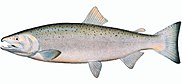
- (countable) A cold-blooded vertebrate animal that lives in water, moving with the help of fins and breathing with gills.
- Salmon is a fish.
- The fishmonger sells fishes from all over the world.
- Ichthyologists study the fish of the world.
- We have many fish in our aquarium.
- (archaic or loosely) Any animal (or any vertebrate) that lives exclusively in water.
- 1774, Oliver Goldsmith, History of the Earth and Animated Nature, volume IV:
- The whale, the limpet, the tortoise and the oyster… as men have been willing to give them all the name of fishes, it is wisest for us to conform.
- 1851, Herman Melville, Moby-Dick[1]:
- Be it known that, waiving all argument, I take the good old fashioned ground that the whale is a fish, and call upon holy Jonah to back me.
- (Newfoundland) Cod; codfish.
- (uncountable) The flesh of the fish used as food.
- 2012 March, “Flexing your brain”, in Consumer Reports on Health, volume 24, number 3, page 9:
- Include low-mercury fish in your diet (such as salmon) and eat at least five servings a day of fruit and vegetables, especially dark leafy greens, broccoli, and cauliflower. Avoid saturated and trans fats, which may hasten brain aging.
- The seafood pasta had lots of fish but not enough pasta.
- Though Lena is a vegetarian, she doesn't have any problem with eating fish.
- (uncountable) A card game in which the object is to obtain cards in pairs or sets of four (depending on the variation), by asking the other players for cards of a particular rank.
- (uncountable, derogatory, slang) A woman.[1]
- (countable, slang) An easy victim for swindling.
- (countable, poker slang) A bad poker player. Compare shark (a good poker player).
- (countable, nautical) A makeshift overlapping longitudinal brace, originally shaped roughly like a fish, used to temporarily repair or extend a spar or mast of a ship.
- (nautical) A purchase used to fish the anchor.
- (countable, nautical, military, slang) A torpedo (self-propelled explosive device).
- 1977, Richard O'Kane, Clear the Bridge: The War Patrols of the U.S.S. Tang, Ballantine Books, published 2003, page 344:
- The second and third fish went to the middle of her long superstructure and under her forward deck.
- 1999, John Winton, The Submariners: Life in British Submarines 1901-1999, page 114:
- As we came off patrol we had some torpedoes fired at us by an enemy submarine but we dived out of the way. About April 10 we fired our fish in two salvoes at a convoy.
- (zoology) A paraphyletic grouping of the following extant taxonomic groups:
- Class Myxini, the hagfish (no vertebrae)
- Class Petromyzontida, the lampreys (no jaw)
- Within infraphylum Gnathostomata (jawed vertebrates (also including Tetrapoda))
- Class Chondrichthyes, cartilaginous fish such as sharks and rays
- Superclass Osteichthyes, bony fish.
- (cartomancy) The thirty-fourth Lenormand card.
- (prison slang) A new (usually vulnerable) prisoner.
- (Jamaica, offensive, derogatory) A male homosexual; a gay man.
- 1986 April 19, Michael Rathbone, “Tell Someone”, in Gay Community News, page 4:
- When a young male enters the prison system he is looked over and is labeled a FISH.
- 2007, “Touch The Road” (track 18), in Gangsta for Life: The Symphony of David Brooks, performed by Mavado (singer):
- Him father is a fish so mi know say it's sprat dat
- His father is a homosexual, so I know that he is too.
- 2021 August 4, “Street Cred”[2]performed by Skeng:
- Bere gunman deh ya we nuh fren fish (hey bwoy)
- Lots of gunmen are here, we don't befriend gay men (hey boy)
Usage notes
[edit]- The collective plural of fish is normally fish in the UK, except in archaic texts where fishes may be encountered; in the US, fishes is encountered as well, but much less commonly. When referring to two or more kinds of fish, the plural is fishes.
Synonyms
[edit]Hyponyms
[edit]- (aquatic cold-blooded vertabrae with gills): Cephalaspidomorphi, Chondrichthyes, Osteichthyes
- (food): seafood
- abyssal fish
- alligator fish
- angel fish
- angler fish
- auger-fish
- backspot flying fish
- basa fish
- blowfish, blow fish
- bluefish
- bony fish
- buffalo fish
- butterfly fish
- chalk fish
- cleaner fish
- clown fish
- coarse fish
- cucumber fish
- Darwin fish
- date fish
- dingo fish
- discus fish
- dogfish
- dolphin fish
- dragonfish
- electric fish
- elephantnose fish
- ex-lax fish
- feeder fish
- fighting fish
- flashlight fish
- flying fish
- food fish
- foul fish
- four-eyed fish
- game fish
- gefilte fish, gefullte fish, gefulte fish, gefüllte fish, gefülte fish
- goatfish
- goldfish
- headlight fish
- Jesus fish
- jewfish, jew-fish
- labyrinth fish
- lantern fish
- line fish
- lion fish
- lumpfish
- mandarin fish
- Margaret fish
- Margate fish
- margate fish
- Mexican walking fish
- midshipman fish
- millions fish
- neon fish
- nettle-fish
- nibble fish
- nigger-fish
- onion fish
- peacock fish
- penis fish
- Peters's elephantnose fish
- pilot fish
- pinecone fish
- pleco fish
- pompadour fish
- porcupine fish
- rapier-fish
- rifle fish
- rock-fish
- rose fish
- rough fish
- royal fish
- sabertooth fish
- sailfish
- samson fish
- sargassum fish
- saucepan fish
- sea fish
- Siamese fighting fish
- singing fish
- sport fish
- squaw fish
- St. Peter's fish
- sucking-fish
- Suleah fish
- surgeonfish
- tamarind fish
- tapioca fish
- trash fish
- tropical fish
- tuna fish
- urchin fish
- walking fish
- wet fish
- white-fish
- wolf-fish
- X-ray fish
- zebra fish
Derived terms
[edit]- African fish eagle
- alligatorfish
- all is fish that comes to the net
- amberfish
- anemone fish
- anemonefish
- angelfish
- anglerfish
- antifish
- archerfish
- assfish
- a woman needs a man like a fish needs a bicycle, a woman without a man is like a fish without a bicycle
- baitfish
- balloonfish
- bandfish
- bannerfish
- barberfish
- barfish
- barrelfish
- batfish
- beakfish
- beardfish
- bellowfish
- bellowsfish
- beltfish
- big fish
- big fish in a little pond
- big fish in a small pond
- big-fish-little-pond effect
- bigger fish in the sea
- bigger fish to fry
- billfish
- blackfish
- blindfish
- blobfish
- boarfish
- bonefish
- bottlefish
- boxfish
- broodfish
- buffy fish owl
- bumperfish
- burfish
- burrfish
- butterfish
- butterflyfish
- candlefish
- cardinalfish
- catfish
- cavefish
- clingfish
- clownfish
- coalfish
- cobblerfish
- cockfish
- cofferfish
- cold fish
- combfish
- coralfish
- cornetfish
- cowfish
- crabfish
- crampfish
- creekfish
- crestfish
- crooked as a barrel of fish hooks
- crossfish
- cry stinking fish
- cucumberfish
- cutlassfish
- cutlass fish
- cuttlefish
- damselfish
- dartfish
- dead fish
- defish
- dither fish
- doctorfish
- dollarfish
- dolphinfish
- dreamfish
- dried-fish woman
- driftfish
- drink like a fish
- drumfish
- dull fish
- dumb as a fish
- dunfish
- electrofish
- elephantfish
- filefish
- firefish
- fishability
- fish and brewis
- fish-and-chipper
- fish and chippery
- fish and chips, fish 'n' chips
- fish and company stink after three days
- fishapod
- fishbait
- fishball
- fish ball, fish-ball
- fish-basket
- fish beam
- fish-bellied
- fishbelly
- fishberry
- fish-blooded
- fishboat
- fishbolt
- fishbone
- fishborne
- fishbowl, fish bowl
- fish-brain
- fish-brained
- fishburger
- fish cage
- fishcake, fish-cake, fish cake
- fishcam
- fish camp
- fishcatcher
- fish coop
- fish cop
- fish corral
- fish crow
- fishculture
- fish eagle
- fish-eating
- fish-eating grin
- fish-eating rat
- fishen
- fisher
- fisher cat
- fisherman
- fishetarian
- fisheye
- fish eye
- fish-eyed
- fish-eye lens
- fishfag
- fish-fag
- fish farm
- fish farmer
- fish farming
- fish feed
- fish-filled
- fishfinder
- fishfinding
- fish finger
- fishfly
- fish food
- fish fork
- fish fry
- fishful
- fish fur
- fish garth
- fishgarth
- fishgig, fish gig
- fish glue
- fishhawk
- fish-hawk, fish hawk
- fishhead
- fish-head, fish head
- fishhook, fish hook
- fish-hook theory
- fish-horn, fish horn
- fishhouse
- fish-house, fish house
- fish hurricane
- fishie
- fishify
- fish in troubled waters
- fishish
- fishjoint
- fishkeeper
- fishkeeping
- fish kettle
- fishkill, fish kill
- fishkind
- fish-knife, fish knife
- fish kropeck
- fish ladder
- fishless
- fishlet
- fishlife
- fishlike
- fishling
- fish lips
- fish louse
- fishlouse
- fishly
- fish malodor syndrome
- fishman
- fishmarket
- fishmeal, fish meal
- fishmonger
- fish-mongress, fish mongress
- fish moon
- fishmoth
- fishmouth
- fisho
- fish odor syndrome
- fish oil
- fish or cut bait
- fish-out-of-water, fish out of water
- fish owl
- fish paper
- fish pass
- fishpaste, fish paste
- fishplate
- fish poison tree
- fishpole
- fishpond, fish-pond, fish pond
- fishpool
- fishpot
- fishpound, fish pound
- fishpox
- fishroom
- fish sauce
- fishscale, fish-scale, fish scale
- fish science
- fish sciences
- fish scrap
- fishseller
- fishsicle
- fishskin
- fishskin disease
- fish slice
- fish soup
- fishspear
- fish steps
- fish stick
- fish stock
- fish storm
- fish story
- fish strainer
- fish supper
- fishtail, fish-tail, fish tail
- fish tale
- fishtank, fish tank
- fish tape
- Fishtar
- fish tea
- fish therapy
- fish to fry
- fish-trap, fish trap
- fish trowel
- fishway
- fishweir
- fish wheel
- fishwich
- fishwife
- fishwoman
- fishworker
- fishworks
- fishworm
- fishwort
- fish wrap, fish-wrap
- fish wrapper
- fishy
- fishyback
- flagfish
- flatfish
- fly-fish
- flyfish
- footballfish
- foxfish
- Frankenfish
- frogfish
- frostfish
- gamefish
- garfish
- gemfish
- ghostfish
- give a man a fish, give a man a fish and you feed him for a day; teach a man to fish and you feed him for a lifetime
- glassfish
- globefish
- go fish
- goosefish
- greenfish
- groundfish
- ground fish
- guardfish
- guitarfish
- hairyfish
- half-fish
- hammerfish
- handfish
- harvestfish
- hatchetfish
- hatfish
- have other fish to fry
- headfish
- henfish
- hogfish
- horsefish
- houndfish
- ice fish
- icefish
- I don't eat fish
- inkfish
- jackfish
- jawfish
- jellyfish, jelly-fish, jelly fish
- jewelfish
- jugfish
- kelpfish
- kettle of fish
- kingfish
- knifefish
- ladyfish
- lancefish
- lancetfish
- lanternfish
- leaffish
- lemonfish
- like shooting fish in a barrel
- line fisher
- line fishing
- lionfish
- lizardfish
- loose fish
- lungfish
- lutefish
- Madagascan fish eagle, Madagascar fish eagle
- mad as a fish
- make fish of one and flesh of another, make fish of one and fowl of another
- marblefish
- mayfish
- medusafish
- megafish
- milkfish
- mock fish
- moonfish
- more important fish to fry
- mosquito fish
- mosquitofish
- mousefish
- mudfish
- muttonfish
- needlefish
- neither fish, flesh, nor fowl
- neither fish, flesh, nor good red herring, neither fish nor flesh, nor good red herring
- neither fish nor flesh
- neither fish nor fowl
- nonfish
- noodlefish
- numbfish
- nurseryfish
- oarfish
- odd fish
- oilfish
- one man's fish is another man's poison, one man's fish is another man's poisson
- other fish in the sea
- outfish
- overfish
- oysterfish
- paddlefish
- paleofish
- panfish
- pan fish
- paradisefish
- parrotfish
- pearlfish
- penfish
- pigfish
- pinfish
- pipefish
- platyfish
- plunderfish
- pondfish
- poolfish
- porcupinefish
- pricklefish
- pufferfish
- puff-fish
- pupfish
- purple-fish
- queenfish
- queer fish
- quillfish
- rabbitfish
- ragfish
- rainbowfish
- ratfish
- razorfish
- redfish
- reedfish
- ribbonfish
- ricefish
- robofish
- rockfish
- roosterfish
- ropefish
- roundfish
- rudderfish
- sablefish
- sabrefish
- salamanderfish
- saltfish
- sandfish
- sawfish
- scabbardfish
- scabbard fish
- scalefish
- scorpionfish
- sheathfish
- shellfish
- shorefish
- shovelfish
- shrimpfish
- silver dollar fish
- silverfish
- skatefish
- skullfish
- skyfish
- sleep with the fishes
- snailfish
- snakefish
- snipefish
- soapfish
- soldierfish
- so long, and thanks for all the fish
- soup and fish, soup-and-fish
- soup-and-fish suit
- spadefish
- spearfish
- spikefish
- spookfish
- sportfish
- spoutfish
- squawfish
- squirefish
- squirrelfish
- starfish
- steakfish
- stingfish
- stockfish
- stonefish
- strange fish
- studfish
- suckerfish
- suckfish
- sunfish
- swallowfish
- swellfish
- swim like a fish
- swordfish
- telescopefish
- the cat would eat fish but would not wet her feet
- the fish rots from the head
- there are plenty more fish in the sea, there are plenty of fish in the sea
- there's always a bigger fish
- there's plenty more fish in the sea
- thornfish
- threadfish
- Threefish
- tigerfish
- tilefish
- tinfish, tin fish
- toadfish
- tofish
- tonguefish
- toothfish
- torrentfish
- towfish
- treefish
- triggerfish
- trumpetfish
- trunkfish
- tunnyfish
- turbofish
- turkeyfish
- underfish
- unfishiness
- unfishy
- unicornfish
- velvetfish
- viperfish
- wallfish
- weakfish
- weatherfish
- wedgefish
- weedfish
- weeverfish
- whalefish
- what does that have to do with the price of fish
- whistlefish
- whitefish
- wingfish
- wolffish
- wooden fish
- wormfish
- wreckfish
- yellowfish
- yellowtail reef fish
- zebrafish
Related terms
[edit]- (adj): fishly, piscine, fishy (inf.)
- (astronomical): The Fish, Pisces
- (collective): piscifauna
- (combinatorial form): pisci- (Latinate, general)
- (fish-catcher): See fisher
- (fish-eater): piscivore
- (fish-infesting): piscolous
- (fish-killing): piscicidal
- (fish-like): fishly, piscose (culinary), fishy, fishlike (inf.)
- (fish science): fishlore, piscatology (irreg.)
- (fish-shaped): pisciform
- (fish vendor): fishmonger, piscitarian
- (full of fish): fishful, pisculent
- (skin disorder): fish-skin disease
- (state of being a fish): fishdom, fishhood (formal), piscinity (formal), fishiness (inf.)
- (taxonomical): Actinopterygii, bony fish, cartilaginous fish, finned fish, finfish, Osteichthyes, Sarcopterygii
Descendants
[edit]Translations
[edit]Etymology 2
[edit]Deverbal from to fish (etymology 3).
Noun
[edit]fish (plural fishes)
- A period of time spent fishing.
- The fish at the lake didn't prove successful.
- An instance of seeking something.
- Merely two fishes for information told the whole story.
Etymology 3
[edit]From Old English fiscian, from Proto-West Germanic *fiskōn, from Proto-Germanic *fiskōną.
Verb
[edit]fish (third-person singular simple present fishes, present participle fishing, simple past and past participle fished)
- (intransitive) To hunt fish or other aquatic animals in a body of water.
- We went fishing for crabs by the pier.
- She went to the river to fish for trout.
- 19th c., anonymous, "The Bonny Ship the 'Diamond'"
- It's cheer up, my lads, let your hearts never fail,
- For the bonny ship the Diamond goes a-fishing for the whale.
- (transitive) To search (a body of water) for something other than fish.
- They fished the surrounding lakes for the dead body.
- (fishing, transitive) To use as bait when fishing.
- 1983, The Fisherman Who Laughed, page 40:
- `What you need are frogs,' said the veteran. `Fish them at night. There's nothing like them on big cork floats.'
- (intransitive) To (attempt to) find or get hold of an object by searching among other objects.
- Synonym: rummage
- Why are you fishing through my things?
- He was fishing for the keys in his pocket.
- (intransitive, followed by "for" or "around for") To talk to people in an attempt to get them to say something, or seek to obtain something by artifice.
- The detective visited the local pubs fishing around for more information.
- The actors loitered at the door, fishing for compliments.
- 1820, Percy Bysshe Shelley, Oedipus Tyrannus; Or, Swellfoot The Tyrant: A Tragedy in Two Acts:
- Laoctonos is fishing for a compliment,
But ’tis his due. Yes, you have drunk more wine,
And shed more blood, than any man in Thebes.
- (intransitive, cricket) Of a batsman, to attempt to hit a ball outside off stump and miss it.
- (nautical, transitive) To repair (a spar or mast) by fastening a beam or other long object (often called a fish) over the damaged part (see Noun above).
- 1970, James Henderson, The Frigates, an account of the lesser warships of the wars from 1793 to 1815, Wordsworth, published 1998, page 143:
- […] the crew were set to replacing and splicing the rigging and fishing the spars.
- (nautical, transitive) To hoist the flukes of.
- 1860, Accounts and Papers of the House of Commons, page 214:
- Found that the cause of the ship's having drifted on the night of the 19th, was from the bight of the chain span (used to fish the anchor,) having slipped between the shank and upper fluke, thereby preventing the lower fluke from opening […]
Synonyms
[edit]- (try to catch a fish): angle, drop in a line
- (try to find something): rifle, rummage
- (attempt to gain (compliments, etc)): angle
Derived terms
[edit]Translations
[edit]intransitive: to try to catch fish
| ||||||||


transitive: to try to find something in a body of water
to attempt to find by searching among other objects
to attempt to obtain information by talking to people
cricket: to attempt to hit outside off stump and miss
to attempt to gain something
|
nautical: to repair by beam or similar long object
Etymology 4
[edit]Borrowed from French fiche (“peg, mark”).
Noun
[edit]fish (plural fishes)
References
[edit]- “fish”, in Webster’s Revised Unabridged Dictionary, Springfield, Mass.: G. & C. Merriam, 1913, →OCLC.
Further reading
[edit] fish (disambiguation) on Wikipedia.Wikipedia
 - fish on Wikipedia.Wikipedia
- fish (food) on Wikipedia.Wikipedia
- fishing on Wikipedia.Wikipedia

Middle English
[edit]Noun
[edit]fish (plural fishes or fish)
- Alternative form of fisch
Categories:
- Visual dictionary
- English 1-syllable words
- English terms with IPA pronunciation
- English terms with audio links
- English terms with homophones
- Rhymes:English/ɪʃ
- Rhymes:English/ɪʃ/1 syllable
- English terms derived from Proto-Indo-European
- English terms derived from the Proto-Indo-European root *peysk-
- English terms inherited from Middle English
- English terms derived from Middle English
- English terms inherited from Old English
- English terms derived from Old English
- English terms inherited from Proto-West Germanic
- English terms derived from Proto-West Germanic
- English terms inherited from Proto-Germanic
- English terms derived from Proto-Germanic
- English terms inherited from Proto-Indo-European
- English lemmas
- English nouns
- English uncountable nouns
- English countable nouns
- English nouns with irregular plurals
- English indeclinable nouns
- English terms with usage examples
- English terms with archaic senses
- English terms with quotations
- Newfoundland English
- English derogatory terms
- English slang
- en:Poker
- en:Nautical
- en:Military
- en:Zoology
- en:Cartomancy
- English prison slang
- Jamaican English
- English offensive terms
- English verbs
- English intransitive verbs
- English transitive verbs
- en:Fishing
- en:Cricket
- English terms borrowed from French
- English terms derived from French
- English terms with obsolete senses
- en:Fish
- Middle English lemmas
- Middle English nouns