呆
Jump to navigation
Jump to search
| ||||||||
Translingual[edit]
| Stroke order | |||
|---|---|---|---|

| |||
Han character[edit]
呆 (Kangxi radical 30, 口+4, 7 strokes, cangjie input 口木 (RD), four-corner 60904, composition ⿱口木)
Derived characters[edit]
References[edit]
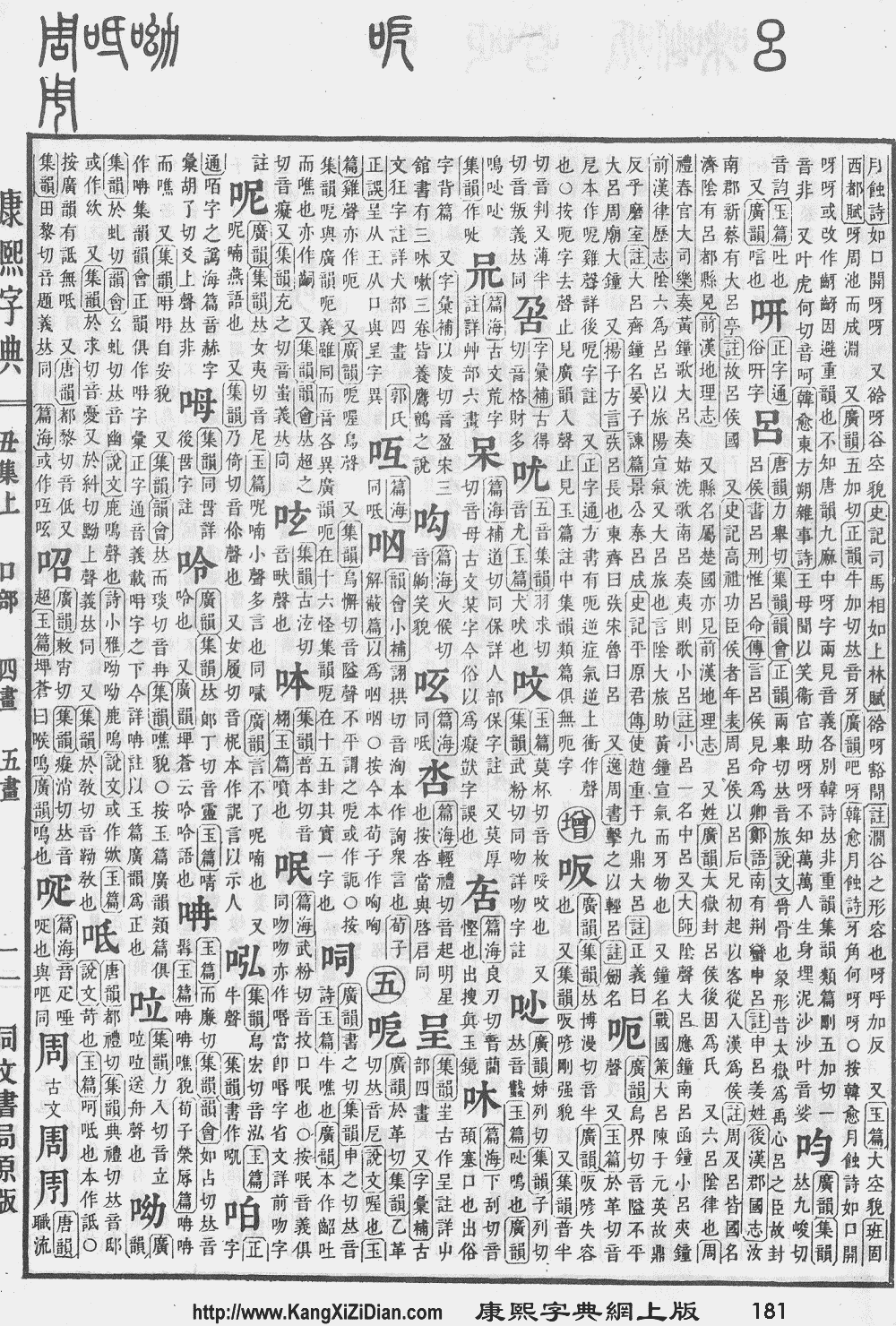
- Kangxi Dictionary: page 181, character 11
- Dai Kanwa Jiten: character 3395
- Dae Jaweon: page 399, character 10
- Hanyu Da Zidian (first edition): volume 1, page 585, character 11
- Unihan data for U+5446
Chinese[edit]
Glyph origin[edit]
- Etymology 1
- Ideogrammic compound (會意/会意) : 口 (“mouth”) + 木 (“wood”) – dull; wooden.
- Etymology 2
- See 保.
- Etymology 3
- Simplified from 槑.
Etymology 1[edit]
| trad. | 呆 | |
|---|---|---|
| simp. # | 呆 | |
| alternative forms | 獃 騃/𫘤 𤶗 | |
Pronunciation[edit]
Definitions[edit]
呆
- dull; wooden
- dull-minded; simple; stupid
- (Eastern Min) bad
- (chiefly Mainland China) Alternative form of 待 (“to stay”)
- a surname: Dai
Synonyms[edit]
- (bad):
| Variety | Location | Words |
|---|---|---|
| Classical Chinese | 惡 | |
| Formal (Written Standard Chinese) | 壞 | |
| Mandarin | Beijing | 壞, 賴 |
| Taiwan | 壞 | |
| Jinan | 壞, 孬, 賴 | |
| Xi'an | 瞎, 壞 | |
| Wuhan | 壞, 拐 | |
| Chengdu | 壞 | |
| Yangzhou | 壞 | |
| Hefei | 壞 | |
| Malaysia | 壞 | |
| Singapore | 壞 | |
| Cantonese | Guangzhou | 壞, 弊, 衰 |
| Hong Kong | 壞, 衰 | |
| Zhongshan (Shiqi) | 衰 | |
| Yangjiang | 壞 | |
| Kuala Lumpur (Guangfu) | 衰 | |
| Singapore (Guangfu) | 衰 | |
| Gan | Nanchang | 壞 |
| Hakka | Meixian | 壞 |
| Wuhua (Meilin) | 衰 | |
| Jin | Taiyuan | 賴, 壞 |
| Northern Min | Jian'ou | 壞, 獰 |
| Eastern Min | Fuzhou | 呆, 否 |
| Southern Min | Xiamen | 歹, 䆀 |
| Xiamen (Tong'an) | 歹 | |
| Quanzhou | 歹 | |
| Jinjiang | 歹 | |
| Nan'an | 歹 | |
| Shishi | 歹 | |
| Zhangzhou | 䆀 | |
| Zhao'an | 䆀, 孬 | |
| Tainan | 歹 | |
| Penang (Hokkien) | 䆀, 歹 | |
| Singapore (Hokkien) | 歹 | |
| Manila (Hokkien) | 歹 | |
| Datian | 歹 | |
| Chaozhou | 孬 | |
| Shantou | 孬 | |
| Jieyang | 孬, 歹 | |
| Singapore (Teochew) | 歹, 孬 | |
| Leizhou | 㾀 | |
| Wenchang | 㾀 | |
| Haikou | 㾀 | |
| Singapore (Hainanese) | 㾀 | |
| Wu | Shanghai | 壞, 恘 |
| Suzhou | 壞, 恘 | |
| Ningbo | 歪, 推扳, 嘸做 | |
| Wenzhou | 毛 | |
| Xiang | Changsha | 壞, 拐 |
| Shuangfeng | 壞, 拐 | |
- (stupid):
- 呆傻 (dāishǎ)
- 呆痴 (dāichī)
- 𡳞面 (Hokkien, vulgar)
- 𡳞鳥面/𡳞鸟面 (Hokkien, vulgar)
- 愚戇/愚戆 (Hokkien)
- 愚昧 (yúmèi)
- 愚笨 (yúbèn)
- 愚蠢 (yúchǔn)
- 愚鈍/愚钝 (yúdùn)
- 拙 (zhuō) (literary, or in compounds)
- 拙笨 (zhuōbèn)
- 撚樣/撚样 (lan2 joeng6-2) (Cantonese, vulgar)
- 暗昧 (ànmèi)
- 梢跤 (Zhangzhou Hokkien)
- 梢跤軟蹄/梢跤软蹄 (Zhangzhou Hokkien)
- 梢蹬 (Zhangzhou Hokkien)
- 棒槌 (bàngchuí)
- 海鱟/海鲎 (Hokkien)
- 混鈍/混钝 (Hokkien)
- 痴呆
- 發踱/发踱 (7faq 8doq) (Wu)
- 笨 (bèn)
- 笨拙 (bènzhuō)
- 笨車車/笨车车 (Hokkien)
- 臭笨 (Hokkien)
- 菜瓜 (Quanzhou Hokkien)
- 蠢 (chǔn)
- 蠢氣/蠢气 (qyn3 qi4) (Xiang)
- 蠢笨 (chǔnbèn)
- 袋屎 (Hokkien)
- 袋屎袋尿 (Hokkien)
- 跤梢 (Xiamen Hokkien)
- 遲鈍/迟钝 (chídùn)
- 阿西 (Hokkien)
- 頇顢/顸颟 (Hokkien)
- 鱟/鲎 (Hokkien)
- 鳩拙/鸠拙 (jiūzhuó) (literary)
Compounds[edit]
- 口舌呆鈍/口舌呆钝
- 呆不龍咚/呆不龙咚
- 呆了一呆
- 呆住 (dāizhù)
- 呆似木雞/呆似木鸡
- 呆僗/呆𫢬
- 呆呆地
- 呆呆掙掙/呆呆挣挣
- 呆呆鄧鄧/呆呆邓邓
- 呆坐
- 呆子 (dāizi)
- 呆小症
- 呆帳/呆帐
- 呆想
- 呆打頦/呆打颏
- 呆掙/呆挣
- 呆木大
- 呆板
- 呆水位
- 呆漢/呆汉
- 呆滯/呆滞 (dāizhì)
- 呆滯物料/呆滞物料
- 呆瓜 (dāiguā)
- 呆登登
- 呆立
- 呆笑
- 呆答孩
- 呆答答
- 呆緻緻/呆致致
- 呆老漢/呆老汉
- 呆腦呆頭/呆脑呆头
- 呆若木雞/呆若木鸡 (dāiruòmùjī)
- 呆著臉/呆著脸
- 呆裡撒奸
- 呆貨/呆货
- 呆鄧鄧/呆邓邓
- 呆頭呆腦/呆头呆脑 (dāitóudāinǎo)
- 呆頭木腦/呆头木脑
- 呆鳥/呆鸟
- 嚇呆/吓呆 (xiàdāi)
- 孝呆 (hàu-tai) (Min Nan)
- 干呆
- 懵懂痴呆
- 打呆歌
- 撇呆打墮/撇呆打堕
- 書呆子/书呆子 (shūdāizi)
- 痴呆
- 痴呆懵懂
- 痴呆症
- 發呆/发呆 (fādāi)
- 目呆口咂
- 目定口呆
- 目睜口呆/目睁口呆
- 目瞪口呆 (mùdèngkǒudāi)
- 目瞪神呆
- 看呆
- 老伯呆
- 老阿呆
- 裝憨打呆/装憨打呆
- 賣呆/卖呆
- 賣呆兒/卖呆儿
- 鄧鄧呆呆/邓邓呆呆
Etymology 2[edit]
| For pronunciation and definitions of 呆 – see 保 (“to raise; to rear; to keep; to maintain; etc.”). (This character is a variant form of 保). |
Etymology 3[edit]
| For pronunciation and definitions of 呆 – see 梅. (This character is a variant form of 梅). |
Japanese[edit]
Kanji[edit]
呆
Readings[edit]
- Go-on: ほ (ho); がい (gai)
- Kan-on: ほう (hō); がい (gai)
- Kan’yō-on: ぼう (bō); たい (tai)
- Kun: あきる (akiru, 呆る); あきれる (akireru, 呆れる); ほける (hokeru, 呆ける); ほうける (hōkeru, 呆ける); ぼける (bokeru, 呆ける)
Korean[edit]
Hanja[edit]
呆 (eumhun 어리석을 매 (eoriseogeul mae))
Compounds[edit]
Vietnamese[edit]
Han character[edit]
- stupid, naive, foolish
Categories:
- CJK Unified Ideographs block
- Han script characters
- Translingual lemmas
- Translingual symbols
- Han ideogrammic compounds
- CJKV simplified characters
- Mandarin terms with audio links
- Mandarin terms with multiple pronunciations
- Old Chinese lemmas
- Chinese lemmas
- Mandarin lemmas
- Cantonese lemmas
- Hakka lemmas
- Eastern Min lemmas
- Hokkien lemmas
- Teochew lemmas
- Wu lemmas
- Chinese adjectives
- Mandarin adjectives
- Cantonese adjectives
- Hakka adjectives
- Eastern Min adjectives
- Hokkien adjectives
- Teochew adjectives
- Wu adjectives
- Chinese verbs
- Mandarin verbs
- Cantonese verbs
- Hakka verbs
- Eastern Min verbs
- Hokkien verbs
- Teochew verbs
- Wu verbs
- Chinese proper nouns
- Mandarin proper nouns
- Cantonese proper nouns
- Hakka proper nouns
- Eastern Min proper nouns
- Hokkien proper nouns
- Teochew proper nouns
- Wu proper nouns
- Chinese terms with IPA pronunciation
- Chinese Han characters
- Eastern Min Chinese
- Mainland China Chinese
- Mandarin terms with usage examples
- Chinese surnames
- Elementary Mandarin
- Northern Min lemmas
- Northern Min verbs
- Chinese nouns
- Mandarin nouns
- Cantonese nouns
- Hakka nouns
- Northern Min nouns
- Eastern Min nouns
- Hokkien nouns
- Teochew nouns
- Wu nouns
- Northern Min proper nouns
- Chinese variant forms
- zh:Prunus genus plants
- zh:Laurel family plants
- Taishanese lemmas
- Taishanese nouns
- Taishanese proper nouns
- Japanese Han characters
- Uncommon kanji
- Japanese kanji with goon reading ほ
- Japanese kanji with goon reading がい
- Japanese kanji with kan'on reading ほう
- Japanese kanji with kan'on reading がい
- Japanese kanji with kan'yōon reading ぼう
- Japanese kanji with kan'yōon reading たい
- Japanese kanji with kun reading あき-る
- Japanese kanji with kun reading あき-れる
- Japanese kanji with kun reading ほ-ける
- Japanese kanji with kun reading ほう-ける
- Japanese kanji with kun reading ぼ-ける
- Korean lemmas
- Korean Han characters
- Vietnamese lemmas
- Vietnamese Han characters