rote
English
[edit]Pronunciation
[edit]- (Received Pronunciation) IPA(key): /ɹəʊt/
- (US) IPA(key): /ɹoʊt/
Audio (Southern England): (file) - Rhymes: -əʊt
- Homophone: wrote
Etymology 1
[edit]From Middle English rote (“custom, habit, wont, condition, state”), further origin unknown. Found in the Middle English phrase bi rote (“by heart, according to form, expertly”), c. 1300. Some have proposed a relationship either with Old French rote/rute (“route”), or Latin rota (“wheel”) (see rotary), but the OED calls both suggestions groundless. Another explanation might be the metaphorical comparison between anything repetitive and playing the rote.
Noun
[edit]rote (uncountable)
- Mechanical routine; a fixed, habitual, repetitive, or mechanical course of procedure.
- The pastoral scenes from those commercials don’t bear too much resemblance to the rote of daily life on a farm.
- He could perform by rote any of his roles in Shakespeare.
Usage notes
[edit]- Commonly found in the phrase “by rote” and in attributive use: “rote learning”, “rote memorization”, and so on.
- Often used pejoratively in comparison with “deeper” learning that leads to “understanding”.
Synonyms
[edit]- roteness (uncommon)
Derived terms
[edit]Translations
[edit]
|
See also
[edit]Adjective
[edit]rote (comparative more rote, superlative most rote)
- By repetition or practice.
- 2000, Ami Klin with Fred R. Volkmar and Sara S. Sparrow, Asperger syndrome, page 316:
- The former may be seen as a more rote form of learning, contrasting with the latter which appears to include "executive" aspects
Translations
[edit]
|
Verb
[edit]rote (third-person singular simple present rotes, present participle roting, simple past and past participle roted)
- (obsolete) To go out by rotation or succession; to rotate.
- 1744, Zachary Grey, ann., Hudibras, in Three Parts, Written in the Time of the Late Wars: Corrected and Amended. With Large Annotations, and a Preface, by Zachary Grey, LL.D., vol. 2. Dublin: […] Robert Owen […] and William Brien […]. page 92:
- The Model of it was, That a third Part of the Senate or Parliament, ſhould rote out by Ballot every Year; […].
- 1744, Zachary Grey, ann., Hudibras, in Three Parts, Written in the Time of the Late Wars: Corrected and Amended. With Large Annotations, and a Preface, by Zachary Grey, LL.D., vol. 2. Dublin: […] Robert Owen […] and William Brien […]. page 92:
- (transitive) To learn or repeat by rote.
- [Volumnia to Corolianus] "Because that it lies you on to speak/ to th' people, not by your own instruction,/ Nor by th' matter which your heart prompts you,/ But with such words that are but roted in/ your tongue,..." Coriolanus III.ii.52-55
Etymology 2
[edit]From Old Norse rót n (“tossing, pitching (of sea)”), perhaps related to rauta (“to roar”); see hrjóta. Compare Middle English routen (“to roar, bellow, storm, rage, howl”).
Noun
[edit]rote (uncountable)
Translations
[edit]
|
Etymology 3
[edit]From Middle English rote, from Old French rote, probably of German origin; compare Middle High German rotte, and English crowd (“a kind of violin”).
Noun
[edit]rote (plural rotes)
- (music) A kind of guitar, the notes of which were produced by a small wheel or wheel-like arrangement; an instrument similar to the hurdy-gurdy.
- 1819 December 20 (indicated as 1820), Walter Scott, Ivanhoe; a Romance. […], volume (please specify |volume=I to III), Edinburgh: […] Archibald Constable and Co.; London: Hurst, Robinson, and Co. […], →OCLC:
- extracting mistuned dirges from their harps, crowds, and rotes
- Synonym of crowd.
References
[edit]- “rote”, in OneLook Dictionary Search.
Anagrams
[edit]French
[edit]Pronunciation
[edit]Etymology 1
[edit]Inherited from Old French rote, Middle High German rotte.
Noun
[edit]rote f (plural rotes)
- rote (musical instrument)
Etymology 2
[edit]See the etymology of the corresponding lemma form.
Verb
[edit]rote
- inflection of roter:
Further reading
[edit]- “rote”, in Trésor de la langue française informatisé [Digitized Treasury of the French Language], 2012.
Anagrams
[edit]Gallo
[edit]Etymology
[edit]From Old French rote, from Latin rupta [via].
Noun
[edit]rote f (plural rotes)
German
[edit]Pronunciation
[edit]Adjective
[edit]rote
- inflection of rot:
Italian
[edit]Noun
[edit]rote f
Anagrams
[edit]Middle English
[edit]Etymology 1
[edit]From Late Old English rōt, rōte, from Old Norse rót, from Proto-Germanic *wrōts, from Proto-Indo-European *wréh₂ds. Doublet of wort (“plant”). See more at English root.
Alternative forms
[edit]Pronunciation
[edit]Noun
[edit]- The root (submerged part of a plant):
- 1387–1400, [Geoffrey] Chaucer, “Here Bygynneth the Book of the Tales of Caunt́burẏ”, in The Tales of Caunt́bury (Hengwrt Chaucer; Peniarth Manuscript 392D), Aberystwyth, Ceredigion: National Library of Wales, published [c. 1400–1410], →OCLC, folio 2, recto:
- Whan that Auerill wt his shoures soote / The droghte of march hath ꝑced to the roote / And bathed euery veyne in swich lycour / Of which v̄tu engendred is the flour […]
- When that April, with its sweet showers / Has pierced March's drought to the root / And bathed every vein in fluid such that / with its power, the flower is made […]
- A root used as food; a root vegetable or tuber.
- A root employed for supposed curative or medical properties.
- The foundation or base of a protuberance or extension of the body:
- Something which generates, creates, or emanates something:
- The origin of an abstract quality; that which something originally came from.
- c. 1395, John Wycliffe, John Purvey [et al.], transl., Bible (Wycliffite Bible (later version), MS Lich 10.)[1], published c. 1410, Tymothe ·i· 6:10, page 84r; republished as Wycliffe's translation of the New Testament, Lichfield: Bill Endres, 2010:
- foꝛ þe roote of alle yuelis is coueitiſe / whiche ſummen coueitynge .· erriden fro þe feiþ. / ⁊ biſettiden hem wiþ manye ſoꝛewis
- And the root of all wrongs is covetousness, which some yearned for and strayed from the faith; they've unleashed many sorrows upon themselves.
- A wellspring or exemplar of an abstract quality that which something comes from.
- The offspring of a certain individual or nation as a progenitor; a lineage or descent.
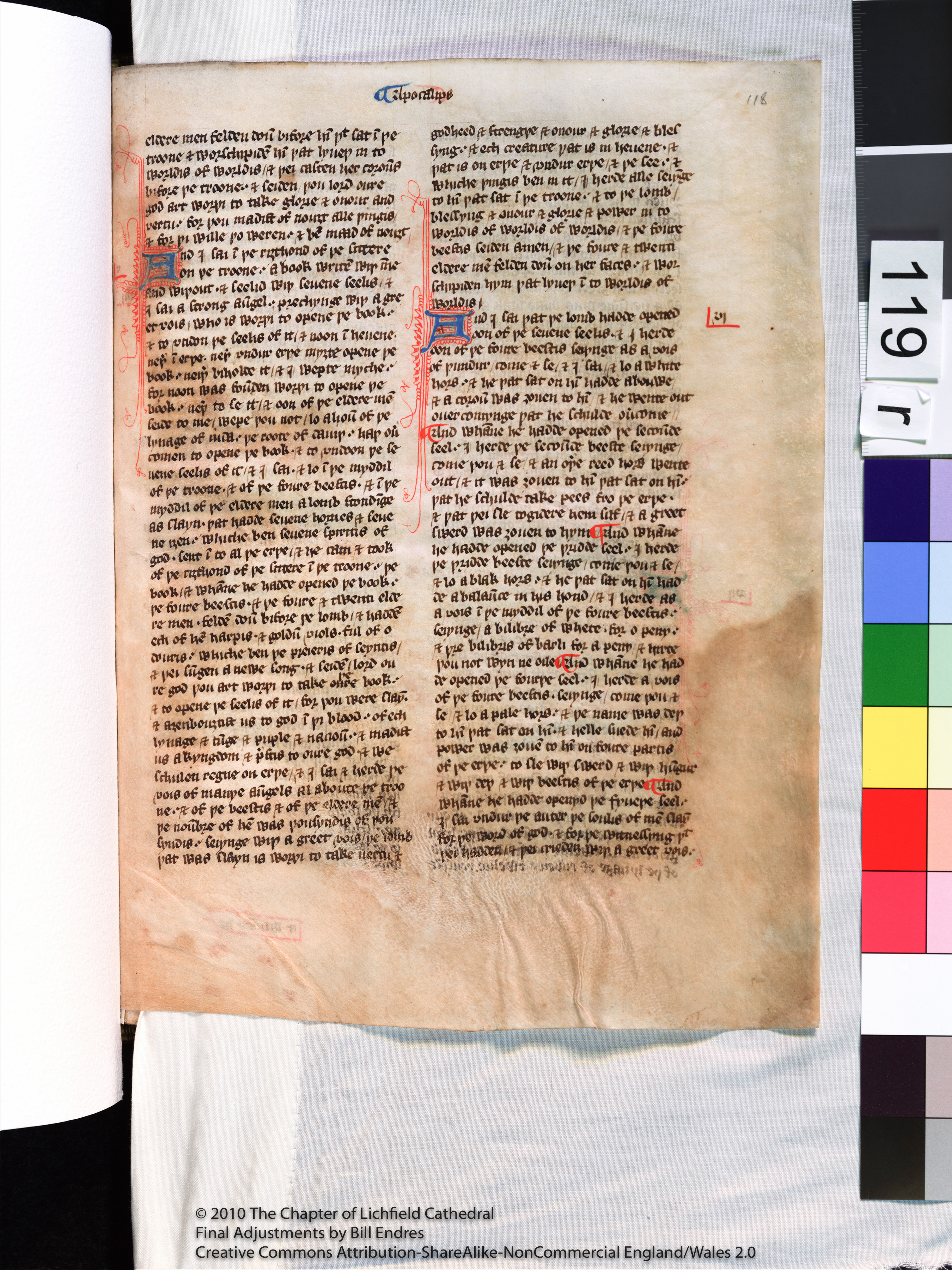
- c. 1395, John Wycliffe, John Purvey [et al.], transl., Bible (Wycliffite Bible (later version), MS Lich 10.)[2], published c. 1410, Apocalips 5:5, page 119r; republished as Wycliffe's translation of the New Testament, Lichfield: Bill Endres, 2010:
- ⁊ oon of the eldere men ſeide to me / wepe þou not / lo! a lioun of the lynage of iuda .· þe roote of dauiþ haþ ouercomen to opene þe book · ⁊ to vndoon þe ſeuene ſeelis of it
- And one of the elders said to me: "Don't weep. Look, a lion of the people of Judah and the stock of David has arrived to open the book and undo its seven seals."
- The origin of an abstract quality; that which something originally came from.
- The foundation of a tall structure (e.g. a trunk, pole, turret)
- The (or a key) foundational or core condition, essence or portion of something.
- One who descends from another; a member of an individual's lineage or stock.
- c. 1395, John Wycliffe, John Purvey [et al.], transl., Bible (Wycliffite Bible (later version), MS Lich 10.)[3], published c. 1410, Apocalips 22:16, page 118v; republished as Wycliffe's translation of the New Testament, Lichfield: Bill Endres, 2010:
- I iheſus ſente min aungel to witneſſe. to ȝou þeſe þingis in chirchis I am þe roote ⁊ þe kyn of Dauid .· ⁊ þe ſchynynge moꝛewe ſterre
- "I, Jesus, sent my angel to deliver all of you these things in churches. I'm the scion and descendant of David and (I'm) the shining morning star."
- The base of a peak or mount; the beginning of an elevation.
- A protuberance resembling or functioning like a root.
- The most inner, central, or deepest part of something.
- (rare, astronomy) Data used for astronomical purposes.
- (rare, mathematics) A mathematical root.


Related terms
[edit]Descendants
[edit]References
[edit]- “rọ̄te, n.(4).”, in MED Online, Ann Arbor, Mich.: University of Michigan, 2007, retrieved 2019-02-23.
Etymology 2
[edit]Unknown. Sometimes connected to Old French route (“route”) or Latin rota (“wheel”), but OED rejects both comparisons.
Alternative forms
[edit]Pronunciation
[edit]Noun
[edit]rote (uncountable)
- Traditional, customary, usual, or habitual behaviour or procedure.
Descendants
[edit]- English: rote
References
[edit]- “rōte, n.(2).”, in MED Online, Ann Arbor, Mich.: University of Michigan, 2007, retrieved 2019-02-22.
Etymology 3
[edit]Borrowed from Old French rote, from Latin chrotta, borrowed from a Germanic form such as Old High German hruoza, borrowed itself from a Celtic term deriving from Proto-Celtic *kruttos; compare Welsh crwth. A doublet of crowde.
Alternative forms
[edit]Pronunciation
[edit]Noun
[edit]rote (plural rotys)
- A musical instrument having strings and similar to a harp.
Descendants
[edit]References
[edit]- “rōte, n.(1).”, in MED Online, Ann Arbor, Mich.: University of Michigan, 2007, retrieved 2019-02-22.
Etymology 4
[edit]Verb
[edit]rote
- Alternative form of roten (“to rot”)
Etymology 5
[edit]Verb
[edit]rote
- Alternative form of roten (“to root”)
Etymology 6
[edit]Adjective
[edit]rote
- Alternative form of roten (“rotten”)
Etymology 7
[edit]Noun
[edit]rote
- Alternative form of rot
Neapolitan
[edit]Noun
[edit]rote
Norwegian Bokmål
[edit]Etymology
[edit]Pronunciation
[edit]Verb
[edit]rote (present tense roter, past tense rota or rotet, past participle rota or rotet)
- to untidy, to make a mess
- (slang) to fool around (engage in casual or flirtatious sexual acts)
Derived terms
[edit]Related terms
[edit]References
[edit]- “rote” in The Bokmål Dictionary.
Norwegian Nynorsk
[edit]Etymology 1
[edit]Alternative forms
[edit]- rota (a-infinitive)
Verb
[edit]rote (present tense rotar, past tense rota, past participle rota, passive infinitive rotast, present participle rotande, imperative rote/rot)
- to untidy
Related terms
[edit]Etymology 2
[edit]Alternative forms
[edit]- ròte (alternative spelling)
Noun
[edit]rote m (definite singular roten, indefinite plural rotar, definite plural rotane)
Related terms
[edit]Etymology 3
[edit]From Old Norse roti, from Middle Low German rote from Old French rote, from Medieval Latin rota, rotta, ruta, rutta (“a rout”).
Noun
[edit]rote f (definite singular rota, indefinite plural roter or rotor, definite plural rotene or rotone)
References
[edit]- “rote” in The Nynorsk Dictionary.
Old English
[edit]Pronunciation
[edit]Adjective
[edit]rōte
- inflection of rōt:
Old French
[edit]Etymology 1
[edit]Inherited from Latin rupta [via].
Alternative forms
[edit]Noun
[edit]rote oblique singular, f (oblique plural rotes, nominative singular rote, nominative plural rotes)
Descendants
[edit]References
[edit]- “rote2”, in DEAF: Dictionnaire Étymologique de l'Ancien Français, Heidelberg: Heidelberger Akademie der Wissenschaften, 1968-.
Etymology 2
[edit]Of Celtic origin, from Welsh crwth.
Noun
[edit]rote oblique singular, f (oblique plural rotes, nominative singular rote, nominative plural rotes)
- rote (musical instrument)
References
[edit]- “rote1”, in DEAF: Dictionnaire Étymologique de l'Ancien Français, Heidelberg: Heidelberger Akademie der Wissenschaften, 1968-.
Descendants
[edit]Portuguese
[edit]Verb
[edit]rote
- inflection of rotar:
Spanish
[edit]Verb
[edit]rote
- inflection of rotar:
Swedish
[edit]Etymology
[edit]Old Swedish rote, from Middle French route, roupte (“disorderly flight of troops”), literally "a breaking off, rupture," from Vulgar Latin *rupta (“a dispersed group”), literally "a broken group," from Latin rupta. Related to English rout.
Noun
[edit]rote c
- a district (of a parish or town, for the purpose of fire fighting, road maintenance, mail forwarding, social care, etc.)
- a file, a section, a squad, a pair (of soldiers, of aircraft)
- 20 rotar
- twenty file
- med utryckta rotar
- four deep
- indelning av rotar!
- squad-number!
- 20 rotar
Declension
[edit]| Declension of rote | ||||
|---|---|---|---|---|
| Singular | Plural | |||
| Indefinite | Definite | Indefinite | Definite | |
| Nominative | rote | roten | rotar | rotarna |
| Genitive | rotes | rotens | rotars | rotarnas |
Related terms
[edit]See also
[edit]References
[edit]- rote in Svenska Akademiens ordlista (SAOL)
- rote in Svenska Akademiens ordbok (SAOB)
- rote in Walter E. Harlock, Svensk-engelsk ordbok : skolupplaga (1964)
Anagrams
[edit]- English 1-syllable words
- English terms with IPA pronunciation
- English terms with audio links
- Rhymes:English/əʊt
- Rhymes:English/əʊt/1 syllable
- English terms with homophones
- English terms inherited from Middle English
- English terms derived from Middle English
- English terms with unknown etymologies
- English lemmas
- English nouns
- English uncountable nouns
- English terms with usage examples
- English adjectives
- English terms with quotations
- English verbs
- English terms with obsolete senses
- English transitive verbs
- English terms derived from Old Norse
- English terms with rare senses
- English terms derived from Old French
- English terms derived from German
- English countable nouns
- en:Musical instruments
- French 1-syllable words
- French terms with IPA pronunciation
- Rhymes:French/ɔt
- Rhymes:French/ɔt/1 syllable
- French terms inherited from Old French
- French terms derived from Old French
- French terms derived from Middle High German
- French lemmas
- French nouns
- French countable nouns
- French feminine nouns
- French non-lemma forms
- French verb forms
- Gallo terms inherited from Old French
- Gallo terms derived from Old French
- Gallo terms inherited from Latin
- Gallo terms derived from Latin
- Gallo lemmas
- Gallo nouns
- Gallo feminine nouns
- German 2-syllable words
- German terms with IPA pronunciation
- German terms with audio links
- German non-lemma forms
- German adjective forms
- Italian non-lemma forms
- Italian noun forms
- Middle English terms inherited from Old English
- Middle English terms derived from Old English
- Middle English terms derived from Old Norse
- Middle English terms derived from Proto-Germanic
- Middle English terms derived from Proto-Indo-European
- Middle English doublets
- Middle English terms with IPA pronunciation
- Middle English lemmas
- Middle English nouns
- Middle English terms with quotations
- Middle English terms with rare senses
- enm:Astronomy
- enm:Mathematics
- Middle English terms with unknown etymologies
- Middle English terms derived from Old French
- Middle English terms derived from Latin
- Middle English uncountable nouns
- Middle English terms borrowed from Old French
- Middle English terms derived from Germanic languages
- Middle English terms derived from Celtic languages
- Middle English terms derived from Proto-Celtic
- Middle English verbs
- Middle English adjectives
- enm:Anatomy
- enm:Botany
- enm:Hair
- enm:Landforms
- enm:Limbs
- enm:Musical instruments
- enm:Organs
- Neapolitan non-lemma forms
- Neapolitan noun forms
- Norwegian Bokmål terms derived from Old Norse
- Norwegian Bokmål terms with IPA pronunciation
- Norwegian Bokmål lemmas
- Norwegian Bokmål verbs
- Norwegian Bokmål slang
- Norwegian Nynorsk terms inherited from Old Norse
- Norwegian Nynorsk terms derived from Old Norse
- Norwegian Nynorsk lemmas
- Norwegian Nynorsk verbs
- Norwegian Nynorsk weak verbs
- Norwegian Nynorsk nouns
- Norwegian Nynorsk masculine nouns
- Norwegian Nynorsk terms derived from Middle Low German
- Norwegian Nynorsk terms derived from Old French
- Norwegian Nynorsk terms derived from Medieval Latin
- Norwegian Nynorsk feminine nouns
- Norwegian Nynorsk pre-2012 forms
- Old English terms with IPA pronunciation
- Old English non-lemma forms
- Old English adjective forms
- Old French terms inherited from Latin
- Old French terms derived from Latin
- Old French lemmas
- Old French nouns
- Old French feminine nouns
- Old French terms derived from Celtic languages
- Old French terms derived from Welsh
- Portuguese non-lemma forms
- Portuguese verb forms
- Spanish non-lemma forms
- Spanish verb forms
- Swedish terms inherited from Old Swedish
- Swedish terms derived from Old Swedish
- Swedish terms derived from Middle French
- Swedish terms derived from Vulgar Latin
- Swedish terms derived from Latin
- Swedish lemmas
- Swedish nouns
- Swedish common-gender nouns