en
Translingual[edit]
Etymology[edit]
Symbol[edit]
en
English[edit]
Etymology 1[edit]
Abbreviation.
Pronunciation[edit]
Noun[edit]
en
- Abbreviation of English.
Etymology 2[edit]
The name of the letter comes from Latin en. The typographic sense dates to 1793.
Pronunciation[edit]
- (UK, US) enPR: ĕn, IPA(key): /ˈɛn/
Audio (Southern England) (file) - Rhymes: -ɛn
- (pin–pen merger) IPA(key): /ɪn/
- Homophones: in, inn
Noun[edit]
en (plural ens)
- The name of the Latin-script letter N.
- The ems and ens at the beginnings and ends.
- 1773 October, The Monthly Review Or Literary Journal Enlarged:
- The word length, which contains only four sounds l e ng th, is usually spell'd thus, el ee en gee tee aitch.
- 2004, Will Rogers, The Stonking Steps, page 170:
- I have drunk en-ee-cee-tee-ay-ar from the ef-ell-oh-doubleyou-ee-ar-ess in his gee-ay-ar-dee-ee-en many a time.
- (typography) A unit of measurement equal to half an em (half the height of the type in use).
Derived terms[edit]
(letter):
(typography, printing):
Translations[edit]
See also[edit]
- (Latin-script letter names) letter; a, bee, cee, dee, e, ef, gee, aitch, i, jay, kay, el, em, en, o, pee, cue, ar, ess, tee, u, vee, double-u, ex, wye, zee / zed
Etymology 3[edit]
From French.
Pronunciation[edit]
- (imitating the French pronunciation) IPA(key): [ɑ̃], [õ]
- (anglicised) IPA(key): /ɒn/, /ɑn/
Audio (Southern England) (file)
Preposition[edit]
en
- Used in various phrases borrowed from French or formed as if borrowed from French (see "Derived terms" below).
Derived terms[edit]
Etymology 4[edit]
From Old English hine.
Pronunciation[edit]
Pronoun[edit]
en
- (dialectal, Newfoundland) him
- 1895, Thomas Hardy, A Pair of Blue Eyes[3], page 236:
- Such a strappen fine gentleman as he was, too. Yes, I rather like en sometimes.
- (dialectal, Newfoundland) it (when the thing being referred to is masculine)
Etymology 5[edit]
Noun[edit]
en (plural ens)
- The name of the Cyrillic script letter Н / н.
Anagrams[edit]
Afar[edit]
Pronunciation[edit]
Verb[edit]
én
- (intransitive) be, exist
Conjugation[edit]
| Conjugation of en (highly irregular) | ||||||||
|---|---|---|---|---|---|---|---|---|
| 1st singular | 2nd singular | 3rd singular | 1st plural | 2nd plural | 3rd plural | |||
| m | f | |||||||
| perfective | V-affirmative | enéh | tenéh | yenéh | tenéh | nenéh | teneeníh | yeneeníh |
| N-affirmative | én | tén | yén | tén | nén | tenén | yenén | |
| negative | mánanniyo | mánannito | mánanna | mánanna | mánannino | mánanniton | mánannon | |
| imperfective (I) | V-affirmative | aníh | taníh | yaníh | taníh | naníh | taniiníh | yaniiníh |
| N-affirmative | án | tán | yán | tán | nán | tanín | yanín | |
| negative | máan | mátan | máyan | mátan | mánan | mátanin | máyanin | |
| imperfective (II) | V-affirmative | aniyóh | tanitóh | yaníh | taníh | naninóh | tanitoonúh | yaniiníh |
| N-affirmative | aniyó | tanitó | yán | tán | naninó | tanitón | yanín | |
References[edit]
- E. M. Parker, R. J. Hayward (1985) An Afar-English-French dictionary (with Grammatical Notes in English), University of London, →ISBN, page 283
- Mohamed Hassan Kamil (2015) L’afar: description grammaticale d’une langue couchitique (Djibouti, Erythrée et Ethiopie)[4], Paris: Université Sorbonne Paris Cité (doctoral thesis)
Afrikaans[edit]
Etymology[edit]
Pronunciation[edit]
Conjunction[edit]
en
Ainu[edit]
Pronunciation[edit]
Pronoun[edit]
en= (Kana spelling エン)
- me (first-person singular object pronoun)
See also[edit]
| person | isolated form | affix form | ||
|---|---|---|---|---|
| nominative | objective | |||
| first | singular | kuani, kani1 | ku=, k=1 (before vowels) | en= |
| exclusive plural | ciokay, coka1, ciutari | ci=, c=1 =as | un= | |
| inclusive plural | anokay, aoka1, anutari | a=, =an | i= | |
| second | singular | eani | e= | |
| plural | eciokay, ecioka1, eciutari | eci= | ||
| singular (polite) | anokay, aoka1 | a=, =an | i= | |
| plural (polite) | anokay, aoka1, anutari | |||
| third | singular | sinuma, anihi | ∅= | |
| plural | okay, oka1 | |||
| indefinite | singular | asinuma | a=, =an | i= |
| plural | anokay, aoka1, anutari | |||
| 1. Saru dialect | ||||
Alemannic German[edit]
Etymology[edit]
From Middle High German ein, from Old High German ein, from Proto-Germanic *ainaz, from Proto-Indo-European *óynos. Cognate with German ein, German Low German en, ein, Dutch een, English one, Icelandic einn, Swedish en.
Pronunciation[edit]
Article[edit]
en
- (indefinite) a, an
- 1835, Jakob Stutz, Gemälde aus dem Volksleben nach der Natur aufgenommen und treu dargestellt in gereimten Gesprächen Zürcherischer Mundart, first part, 2nd ed., pp. 27, 49, 97, 109:
- Ih wött dih jetz nu duße möge-n-
Auh noh en einzigs Wörtli fröge. - [...] as en einzigs Mol, [...]
- Denn ist er si Lebtig e stills Büebli gsi.
- Aber es wot e chüels Windli goh.
- Ih wött dih jetz nu duße möge-n-
- 1864, J. C. Ott, Rosen und Dornen. Gedichte und Gerichte, gewachsen auf Bernerboden, 1st small volume, 2nd ed., pp. 53, 57:
- „„Nu, wenn i öppis by d'r gilte,““
Seit Franz, – „„so mach en End myr Qual!
[...]““ - „[...]
O, schenk-mer, Herr, es gnädig's End,
Nimm uf my Geist i dyni Händ!“
- „„Nu, wenn i öppis by d'r gilte,““
- 1864, J. C. Ott, Rosen und Dornen. Gedichte und Gerichte, gewachsen auf Bernerboden, 1st small volume, 2nd ed., pp. 43, 76, 106, 186:
- E Mezgerbursch i syne schönste Jahre
Mit rothe Backe, schwarze, chruse Haare,
Chunt spät am Aabe ganz allei
Vom Erlebacher-Märit hei. - Im Berner Alpeg'länd sitzt vor sym chlyne Hüsi
[...]
En alte Veteran vom Cheiserrych
Na Dörflerg'wohnheit i d'r Gartenlaube. - [...] Da villicht en alte Jud, [...]
- En Ehrebrecher isch sy Kamerad, [...]
- E Mezgerbursch i syne schönste Jahre
- Joh. Schönauer, Beschreibung miner Heimat, in: 1876, Volksthümliches aus dem Kanton Bern. Localsagen und Satzungen des Aberglaubens. Gesammelt von Heinrich Grunholzer durch seine Seminarzöglinge. Zusammengestellt und herausgegeben von J. E. Rothenbach. Separat-Abdruck aus der „Neuen Alpenpost“, p. 5:
- Vor zwei Jahra ist z' Höchstetta, das 20 Minuta vo Zäziwyl ist, emene Länder-Güterfuhrma der Waga verbrönnt worda.
- 1835, Jakob Stutz, Gemälde aus dem Volksleben nach der Natur aufgenommen und treu dargestellt in gereimten Gesprächen Zürcherischer Mundart, first part, 2nd ed., pp. 27, 49, 97, 109:
Declension[edit]
Zürich:
| Singular | |||
|---|---|---|---|
| Masculine | Feminine | Neuter | |
| Nominative | en | e | e (before a consonant) en (before a vowel) |
| Dative | eme | ene | eme |
| Accusative | en | e | e (before a consonant) en (before a vowel) |
Bern:
| Singular | |||
|---|---|---|---|
| Masculine | Feminine | Neuter | |
| Nominative | e (before a consonant) en (before a vowel) |
e (before a consonant) en (before a vowel) |
es (before a consonant) |
| Dative | emene | ||
| Accusative | e (before a consonant) | e (before a consonant) en (before a vowel) |
es (before a consonant) en (before a vowel) |
Asturian[edit]
Alternative forms[edit]
- in (Paḷḷuezu)
Etymology[edit]
From Latin in, from Proto-Italic *en, from Proto-Indo-European *h₁én (“in”).
Pronunciation[edit]
Preposition[edit]
en
Usage notes[edit]
- The preposition en contracts to n' before a word beginning with a vowel or h-: n'Asturies (in Asturias), n'honor (in honor)
Derived terms[edit]
Aukan[edit]
Etymology[edit]
Noun[edit]
en
Azerbaijani[edit]
Etymology[edit]
From Proto-Turkic *ēn.[1]
Pronunciation[edit]
Noun[edit]
en (definite accusative eni, plural enlər)
Declension[edit]
| Declension of en | ||||||||
|---|---|---|---|---|---|---|---|---|
| singular | plural | |||||||
| nominative | en |
enlər | ||||||
| definite accusative | eni |
enləri | ||||||
| dative | enə |
enlərə | ||||||
| locative | endə |
enlərdə | ||||||
| ablative | endən |
enlərdən | ||||||
| definite genitive | enin |
enlərin | ||||||
Derived terms[edit]
- en dairəsi (“latitude”)
References[edit]
- ^ Starostin, Sergei, Dybo, Anna, Mudrak, Oleg (2003) “*ēn”, in Etymological dictionary of the Altaic languages (Handbuch der Orientalistik; VIII.8)[1], Leiden, New York, Köln: E.J. Brill
- “en” in Obastan.com.
Breton[edit]
Contraction[edit]
en
- e (preposition "in") + un (indefinite article "a(n)")
- e (preposition "in") + an (definite article "the")
Catalan[edit]
Etymology 1[edit]
From the final syllable of Latin domine (“Mister”).
Pronunciation[edit]
Article[edit]
en m sg (elided n', feminine na)
- (Eastern) Personal article used before masculine given names instead of the definite article el.
- En Pau i na Maria arribaran demà.
- Pau and Maria will be arriving tomorrow.
Usage notes[edit]
- While this article (and its feminine counterpart na) is standard in Balearic Catalan, in other Eastern Catalan dialects its use is waning, and the elided of the definite article, l', is used before names beginning with vowels. There is no plural personal article, so the plural definite article els is used in all dialects.
Derived terms[edit]
- can (contraction of ca and ne)
Etymology 2[edit]
From Latin in (“in, inside”), from Proto-Italic *en, from Proto-Indo-European *h₁én (“in”).
Pronunciation[edit]
Preposition[edit]
en
Etymology 3[edit]
Inherited from Latin inde (“thence”). Compare French en, Italian ne.
Pronunciation[edit]
Pronoun[edit]
en (proclitic, contracted n', enclitic ne, contracted enclitic 'n)
- Represents an indeterminate number or quantity of a given noun.
- Represents a place (associated with the action described by the verb) that would be introduced by the preposition de.
- Replaces a phrase introduced by the preposition de.
- Replaces the object of a causative verb.
Usage notes[edit]
- en cannot be used more than once as the object of a given verb.
- While en is usually used to replace phrases beginning with the preposition de, adverbial phrases (e.g., de pressa) are replaced with hi.
- en is sometimes used instead of ho to replace an adjective or indefinite noun as the predicate of a verb.
- en is sometimes used popularly to add emphasis to a sentence: in this sense, it has no translation in English.
- en is the reinforced (reforçada) form of the pronoun. It is used before verbs beginning with a consonant.
Declension[edit]
See also[edit]
Further reading[edit]
- “en” in Diccionari de la llengua catalana, segona edició, Institut d’Estudis Catalans.
- “en” in Diccionari català-valencià-balear, Antoni Maria Alcover and Francesc de Borja Moll, 1962.
Etymology 4[edit]
Pronunciation[edit]
Noun[edit]
en f (plural ens)
- (traditional) Alternative form of ena (“the letter N”)
Central Franconian[edit]
Etymology 1[edit]
From Old High German in.
Alternative forms[edit]
Pronunciation[edit]
Preposition[edit]
en
Adverb[edit]
en
- (most dialects) in
Etymology 2[edit]
From Old High German indi.
Alternative forms[edit]
Pronunciation[edit]
Conjunction[edit]
en
- (some western dialects) and
Etymology 3[edit]
From Old High German ein.
Alternative forms[edit]
- e (neuter and in some dialects masculine, before non-dental consonants)
Pronunciation[edit]
Article[edit]
en (indefinite)
- (most dialects) feminine nominative and accusative
- (most dialects) neuter nominative and accusative, used before vowels and alternatively before h and dental consonants
- (some dialects) masculine nominative, used before vowels and alternatively before h and dental consonants
- (some dialects) masculine accusative, used before vowels and alternatively before h and dental consonants
Etymology 4[edit]
Pronunciation[edit]
Pronoun[edit]
en (personal, reduced)
- (most dialects) him; masculine accusative
- (some dialects) he; masculine nominative
- (most dialects) them; plural dative
Chamorro[edit]
Pronunciation[edit]
Pronoun[edit]
en
Usage notes[edit]
- en is used as a subject of a transitive verb in realis mood, and as a subject with all verbs in irrealis mood. It is in complementary distribution with hamyo, which is generally used as an object of a transitive verb, and also as a subject of an intransitive verb in realis mood.
See also[edit]
| hu-type pronouns | |||
|---|---|---|---|
| singular | plural inclusive | plural exclusive | |
| 1st person | hu | ta | in |
| 2nd person | un | en | |
| 3rd person | ha | ma | |
| yoʼ-type pronouns | |||
| singular | plural inclusive | plural exclusive | |
| 1st person | yoʼ | hit | ham |
| 2nd person | hao | hamyo | |
| 3rd person | gueʼ | siha | |
| emphatic pronouns | |||
| singular | plural inclusive | plural exclusive | |
| 1st person | guahu | hita | hami |
| 2nd person | hagu | hamyo | |
| 3rd person | guiya | siha | |
References[edit]
- Donald M. Topping (1973) Chamorro Reference Grammar[5], Honolulu: University of Hawaii Press.
Chuukese[edit]
Pronoun[edit]
en
- Second-person singular pronoun; you
See also[edit]
Determiner[edit]
en (plural ekkan)
- this (not in possession of the speaker)
Cimbrian[edit]
Pronoun[edit]
en
- Alternative form of in (“him”)
Further reading[edit]
- “en” in Martalar, Umberto Martello, Bellotto, Alfonso (1974) Dizionario della lingua Cimbra dei Sette Communi vicentini, 1st edition, Roana, Italy: Instituto di Cultura Cimbra A. Dal Pozzo
Crimean Tatar[edit]
Noun[edit]
en
Czech[edit]
Pronunciation[edit]
Noun[edit]
en n (indeclinable)
- The name of the Latin-script letter N.
Further reading[edit]
- en in Příruční slovník jazyka českého, 1935–1957
- en in Slovník spisovného jazyka českého, 1960–1971, 1989
Dalmatian[edit]
Alternative forms[edit]
Etymology[edit]
Preposition[edit]
en
Related terms[edit]
Danish[edit]
| < 0 | 1 | 2 > |
|---|---|---|
| Cardinal : en Ordinal : første | ||
Etymology[edit]
From Old Norse einn, from Proto-Germanic *ainaz (“one, some”), from Proto-Indo-European *óynos (“one”).
Pronunciation[edit]
Article[edit]
en (neuter et)
Numeral[edit]
en (neuter et)
Pronoun[edit]
en or én (neuter et or ét, definite ene)
Usage notes[edit]
- Used as the oblique form of the generic pronoun man:[1]
- Hvis ens lærer behandler en uretfærdigt, kan man klage til skolens leder
- If one's teacher treats one unfairly, one can complain to the head of the school
References[edit]
- ^ Erik Hansen & Lars Hedtoft, Grammatik over det Danske Sprog (Odense 2011), vol. 2, 557.
Dutch[edit]
Pronunciation[edit]
Etymology 1[edit]
From Middle Dutch ende, from Old Dutch ande, inde, from Proto-Germanic *andi, from Proto-Indo-European *h₂entí.
Conjunction[edit]
en
- and
- De oude man en de zee. ― The Old Man and the Sea.
- well, so
- En, hoe gaat het ermee? ― Well, how're you doing?
- En? ― Well?
- En, wat zou dat? ― So what?
- (mathematics) plus, and
- Drie en vier is zeven. ― Three plus four is seven.
Alternative forms[edit]
- ende (archaic)
Derived terms[edit]
Descendants[edit]
- Afrikaans: en
- Berbice Creole Dutch: an
- Jersey Dutch: en
- Negerhollands: en, an
- Petjo: en
- Sranan Tongo: èn
See also[edit]
Etymology 2[edit]
From Middle Dutch ne, en, from Old Dutch ne, from Proto-Germanic *ne, from Proto-Indo-European *ne.
Adverb[edit]
en
- (colloquial or dialectal in Belgium, obsolete elsewhere) not (often with another negator, see usage notes)
- 1544, "Van proper Janneken" (song 123), in Dieuwke E. van der Poel, Dirk Geirnaert, Hermina Joldersma, J.B. Oosterman & Louis Peter Grijp (eds.) Het Antwerps liedboek, vol. 1, Lannoo (publ. 2004), page 283.
- Schoon soete lief, waert u bequame / Dat ghi mi gaeft een troostelijc woort, / Ic en soude certeyn geen ander boelken kiesen, / Al sout mi oock aen mijn leven gaen.
- Beautiful sweet darling, if it were pleasing to you / that you gave me a word of consolation, / I would certainly choose no other girlfriend, / even if it were to put my life at risk.
- 1632, Jacob Cats, Spiegel van den ouden ende nieuwen tijt, bestaende uyt spreeckwoorden ende sinspreucken, "Een rotten appel in de mande, maeckt oock het gave fruyt te schande.", in J. van Vloten (ed.), Alle de werken, vol. 1, 1862, page 649.
- Daer magh geen rotte peer in onse manden wesen, / En wat'er niet en deught, dat dient'er uyt gelesen;
- There should not be any rotten pear in our baskets, / and what is not of decent quality, that ought be taken out of it;
- "Herr Halewyn", A.H. Hoffmann von Fallersleben, Horae Belgicae, page 41.
- ‘Uw zoon heer Halewyn is gaen jagen, / g’ en ziet hem weêr uw levens dagen.’
- 'Your son Lord Halewyn has gone hunting / you won't see him again for the rest of your life.'
- c. 1860, Guido Gezelle, Gij zegt dat 't vlaamsch te niet zal gaan:
- Gij zegt dat 't vlaamsch te niet zal gaan: / 't en zal! / dat 't waalsch gezwets zal boven slaan: / 't en zal!
- You say that Flemish will go extinct: / no, it won't! / That Walloon banter [i.e. Belgian French, not the Walloon language] will gain the upper hand: / No, it won't!
- ...dat aldaer binnen Utrecht niet meer geacht ende respecteert en wordt, ... ― that in Utrecht is no longer valued and respected...
- 1544, "Van proper Janneken" (song 123), in Dieuwke E. van der Poel, Dirk Geirnaert, Hermina Joldersma, J.B. Oosterman & Louis Peter Grijp (eds.) Het Antwerps liedboek, vol. 1, Lannoo (publ. 2004), page 283.
- (obsolete) only, merely, no other than, none other than (together with maar)
Usage notes[edit]
- In historical usage, en is always used directly before the finite verb. When used to negate it is commonly accompanied by another negator: gij en zult niet stelen (“thou shalt not steal”), en wat er niet en deugt (“and what is not of decent quality”), ik en zoude certein geen ander boelken kiezen (“I would certainly not choose another girlfriend”). Also when used as a stand-alone negator or when combined with maar, it still stands directly before the finite verb. Use of the particle does not trigger a change in the word order.
- In Belgian Dutch it is still sometimes used in certain regional lects and in the tussentaal (“informal registers influenced by both Standard Belgian Dutch and the regional lects”). Details and frequency of use depend on what regional language variety influences a given speaker's idiom, as well as on the speaker's preferences.
- In West Flemish usage broadly conforms to historical use: the negation particle may be used along with other negators, independentely or it may be omitted. It is also used as a stand-alone negator to contradict a previous statement that was phrased with positive polarity: Gij zegt dat 't Vlaams te niet zal gaan: / 't en zal! (“You say that Flemish will go extinct: / no, it won't!”)
- In Belgian Brabantian it is frequently omitted, but it may also be used directly before another negator rather than before the finite verb: en niet.
- In contemporary Netherlands Dutch the use of the particle is limited to old proverbs, such as wat baten kaars en bril als de uil niet zien en wil.
Anagrams[edit]
Esperanto[edit]
Etymology[edit]
Pronunciation[edit]
Preposition[edit]
en
- in, within, inside
- Ĝi estas en la domo. ― It is in (within, inside) the house.
- into (when followed by a noun or phrase in the accusative case)
- Li iras en la domon. ― He goes into the house.
Derived terms[edit]
Fala[edit]
Alternative forms[edit]
- in (Valverdeñu)
Etymology[edit]
From Old Galician-Portuguese en, from Latin in (“in”), from Proto-Indo-European *h₁én.
Preposition[edit]
en
- in
- 2000, Domingo Frades Gaspar, Vamus a falal: Notas pâ coñocel y platical en nosa fala, Editora regional da Extremadura, Chapter 2: Númerus:
- Cumu to é custión de proporciós, sin que sirva de argumentu por nun fel falta, poemus vel que en a misma Europa hai Estaus Soberarius con menus territoriu que os tres lugaris nossus, cumu: […]
- As everything is a matter of proportions, without its presence being an argument, we can see that even in Europe there are Sovereign States with less territory than our three places, such as: […]
Usage notes[edit]
- When followed by the articles u/o, a, us/os, as; it contracts to nu/no, na, nus/nos, nas respectively.
- The form in is more common in Valverdeñu.
References[edit]
- Valeš, Miroslav (2021) Diccionariu de A Fala: lagarteiru, mañegu, valverdeñu (web)[6], 2nd edition, Minde, Portugal: CIDLeS, published 2022, →ISBN
Finnish[edit]
Etymology[edit]
See the etymology of the corresponding lemma form.
Pronunciation[edit]
Verb[edit]
en
Derived terms[edit]
Anagrams[edit]
French[edit]
Pronunciation[edit]
Etymology 1[edit]
From Middle French en, from Old French en, from Latin in, from Proto-Italic *en, from Proto-Indo-European *h₁én (“in”).
Preposition[edit]
en
- in (used to indicate space, also see usage notes)
- J’habite en Angleterre. ― I live in England.
- to (indicates direction towards certain very large locations, see usage notes)
- Il est allé en France. ― He went to France.
- by (used to indicate means)
- aller en bus ― go by bus
- partir en voiture ― leave by car
- as
- Il me traite en ami. ― He treats me as a friend.
- habillé en père Noël ― dressed as Father Christmas
- at (used to describe an ability)
- fort en histoire ― good at history
- of, made of (used to describe composition)
- une chaise en hêtre ― a chair made of beech/a beech chair
- une fourchette en métal ― a fork made of metal/a metal fork
- in (during the following time (used for months and years))
- en 1993 ― in 1993
- en janvier ― in January
- en septembre 2001 ― in September 2001
- (followed by a gerund) while
- (followed by a gerund) by, in (describing a way of getting something)
- C’est en trichant qu’il est devenu champion. ― It was by cheating that he became champion.
- in (used to describe color)
- une photo en noir et blanc ― a photo in black and white
- in (used to describe feelings)
- en détresse ― in distress
- in (as part of something)
- en équipe ― on a team
Usage notes[edit]
- En in the sense of while is often not translated into English.
- When referring to location in countries, provinces, or similar subdivisions in sense 1 and direction in sense 2, en must be used when the name for that very large location is either a feminine singular noun or a vowel-initial masculine singular noun. If the name for the very large location is a consonant-initial masculine singular noun, au is used, while if the name of the very large location is plural, aux is used.
Derived terms[edit]
Further reading[edit]
- “en”, in Trésor de la langue française informatisé [Digitized Treasury of the French Language], 2012.
Etymology 2[edit]
From Latin inde (“thence”). Compare Catalan en, Italian ne.
Pronoun[edit]
en
- Used as the object of a verb to indicate an indefinite quantity; of it, of them. Replaces the partitive article (du, de la, etc.)
- Essaies-en !
- Try some (of it / them)!
- Tu as combien de livres ? J’en ai trois.
- How many books do you have? I have three (of them).
- Y a-t-il beaucoup de pièces ? Oui. Il y en a beaucoup.
- Are there many rooms? Yes, there are many (of them).
- Martin a trois sandwichs, mais j’en ai seulement deux.
- Martin has three sandwiches, but I have only two (of them).
- Il y en a combien ?
- How many of them are there?
- Je bois de l’alcool parce que j’en ai besoin
- I drink alcohol because I need it.
- 1654, Blaise Pascal, Traité du triangle arithmétique :
- J'en donnerai ici la méthode, que je poursuivrai seulement en deux ou trois exemples, qui seront si aisés à continuer qu'il ne sera pas nécessaire d'en donner davantage.
- I shall give (of it) here the method that I shall pursue only in two or three examples, which will be so easy to continue that it will not be necessary to give more of them.
- J'en donnerai ici la méthode, que je poursuivrai seulement en deux ou trois exemples, qui seront si aisés à continuer qu'il ne sera pas nécessaire d'en donner davantage.
- Adverbial preposition indicating movement away from a place already mentioned; from there, from it. Replaces the phrase de là or d’ici.
- Est-ce qu’elle vient de Barcelone ? Oui, elle en vient.
- Does she come from Barcelona? Yes, she comes from there.
Related terms[edit]
| Number | Person | Gender | Nominative (subject) |
Accusative (direct complement) |
Dative (indirect complement) |
Disjunctive (tonic) |
|---|---|---|---|---|---|---|
| Singular | First | — | je, j’ | me, m’ | moi | |
| Second | — | tu | te, t’ | toi | ||
| Third | Masculine | il | le, l’ | lui | lui | |
| Feminine | elle | la, l’ | elle | |||
| Gender neutral5 | iel | lea | ellui | |||
| Indeterminate | on1 | — | — | — | ||
| Reflexive | — | se, s’4 | soi4 | |||
| Plural | First | — | nous | nous | nous | |
| Second | — | vous2 | vous2,3 | vous2 | ||
| Third | Masculine | ils3 | les | leur | eux | |
| Feminine | elles | elles | ||||
| Gender neutral5 | iels | elleux | ||||
- 1 Also used as the first person plural.
- 2 Also used as the polite singular form.
- 3 Also used when a group has both men and women.
- 4 Also used as third person plural reflexive.
- 5 Colloquial, and not in popular use.
Anagrams[edit]
Fula[edit]
Pronoun[edit]
en
- first person plural inclusive pronoun;short form we
Usage notes[edit]
See also[edit]
References[edit]
- Oumar Bah, Dictionnaire Pular-Français, Avec un index français-pular, Webonary.org, SIL International, 2014.
- Ritsuko Miyamoto (1993) “A Study of Fula Dialects : Examining the Continuous/Stative Constructions”, in Senri Ethnological Studies[7], volume 35, , pages 215-230
Galician[edit]
Etymology 1[edit]
From Old Galician-Portuguese en, from Latin in, from Proto-Italic *en, from Proto-Indo-European *h₁én (“in”).
Pronunciation[edit]
Preposition[edit]
en
- in
- when preceding a verb or a complement of a verb it can denote an unfinished or continued action:
- O Manuel vai na casa ― Manuel went home (implying that eventually he'll be back)
- María beberrica no licor ― María is sipping the liquor
- 1822, anonymous author, A Parola Polêteca:
- En escoitalo, señor tio Calacú, xà o peléxo do meu corpo tembra. Sei que á tanta agua que acarrexóu amolentoulle os miolos, é por eso louquéa
- While listening to you, my sir uncle Pumpkin, my body's skin trembles. Perhaps the much water you have carried softened you brain, and therefore you are going insane
- 1853, Xosé Manuel Pintos, A Gaita Gallega:
Usage notes[edit]
- The preposition en contracts to n- before articles, before third-person tonic pronouns, and before the determiners algún and outro.
Derived terms[edit]
| - | Singular | Plural |
|---|---|---|
| Masculine | no | nos |
| Feminine | na | nas |
- nalgún, nalgunha, nalgunhas, nalgúns
- nel, nela, nelas, neles
- nese, nesa, neses, nesas, niso
- neste, nesta, nestes, nestas, nisto
- noutra, noutras, noutro, noutros
- nestoutro, nestoutra, nestoutros, nestoutras
| - | Singular a |
Plural some |
|---|---|---|
| Masculine | nun | nuns |
| Feminine | nunha | nunhas |
Etymology 2[edit]
Probably from Old Galician-Portuguese en, from Latin inde.
Alternative forms[edit]
- ende (now literary)
Pronunciation[edit]
Adverb[edit]
en
- while; as soon as (followed by the gerund of a verb, expresses immediacy or simultaneity)
- En chegando mudas a roupa mollada ― As soon as you arrive change your wet clothes
- 1295, R. Lorenzo, editor, La traducción gallega de la Crónica General y de la Crónica de Castilla., Ourense: I. E. O. P. F, page 111:
- Et o conde, en chegando et ferindo logo ẽnos mouros, todo en hũu o fezo
- And the count, [just] arriving, and hurting promptly the Moors, all in one he did that
- 1460, Rui Vasques, Corónica de Iria:
- en leendo perlos llibros algũus de canõicas antijgas, et preujlegios goticos dos santos catholicos et deuotos bispos de Yria et porla Escriptura, achey o fundamento para rreduzir aa memoria dos homes quanto durarõ çertas ydades
- [while/after] reading books, some of them of ancient canons, and Gothic privileges of the saint Catholic and devout bishops of Iria, and through the Bible, I found the foundation for reducing to the mind of men for how long some ages lasted
- 1461, X. Ferro Couselo (ed.), A vida e a fala dos devanceiros. Escolma de documentos en galego dos séculos XIII ao XVI. 2 vols. Vigo: Galaxia, page 141:
- dito testigo en seendo moço pequeno con seu tyo Afonso Dominges, guardando o gaando en Curro do Moyño, que le dixera o dito Afonso Domingees "bees, por aquy se parte ho término do conde do de Juan d'Estúñiga
- said witness [while/when] being a young boy and together with his uncle Afonso Domínguez, watching the cattle in Curro do Muíño, he was told by said Afonso Domínguez: "you see, here the term of the count limits with that of Xoán de Estúñiga"
- 1858, Francisco María de la Iglesia, O orfiño da arquiña:
- Que pan e insinanza
Pardiola has de ter,
Roupiña e oficio
Para deprender;
E ende sendo grande
Si es home de ben,
Na Seña Duquesa
Madriña tamén- Such bread and teaching
By gosh you'll have!
Clothes and office
to learn;
And them when you're big
If you're a good man
our Lady the Duchess
will be also your protector
- Such bread and teaching
References[edit]
- “en” in Dicionario de Dicionarios do galego medieval, SLI - ILGA 2006–2022.
- “en” in Dicionario de Dicionarios da lingua galega, SLI - ILGA 2006–2013.
- “en” in Tesouro informatizado da lingua galega. Santiago: ILG.
- “en” in Álvarez, Rosario (coord.): Tesouro do léxico patrimonial galego e portugués, Santiago de Compostela: Instituto da Lingua Galega.
German Low German[edit]
Alternative forms[edit]
- 'n, -'n
- (in other dialects, including Low Prussian) een
- (in some dialects) ein
- (East Pomeranian) ain
Etymology[edit]
From Middle Low German ên, from Old Saxon ēn. Compare Dutch een, German ein, West Frisian ien, English one.
Pronunciation[edit]
Article[edit]
en m or n (indefinite article)
Numeral[edit]
en
- (in some dialects, including Low Prussian) one (1)
See also[edit]
Haitian Creole[edit]
Etymology[edit]
From French un (“one”), from Latin ūnus (“one”).
Pronunciation[edit]
Numeral[edit]
en
Synonyms[edit]
See also[edit]
Hunsrik[edit]
Pronunciation[edit]
Determiner[edit]
en (indefinite)
Pronoun[edit]
en
- unstressed accusative of er: him.
Inflection[edit]
| nominative | accusative | dative | ||||
|---|---|---|---|---|---|---|
| Proclitic | Enclitic | str. | unstr. | str. | unstr. | |
| 1st person singular | ich | -ich | mich | meer | mer | |
| 2nd person singular (informal) |
du | -du, -de | dich | deer | der | |
| 3rd person singular (m.) | er; där | -er | ihn | en | ihm | em |
| 3rd person singular (f.) | sie; die | -se | sie / ihns | se | eer | re |
| 3rd person singular (n.) | es; das | 's | es | ihm | em | |
| 1st person plural | meer | mer | uns | |||
| 2nd person plural | deer | der | eich | |||
| 3rd person plural | sie; die | -se | sie | se | denne | |
Declension[edit]
Further reading[edit]
Icelandic[edit]
Etymology[edit]
From Old Norse en. the comparative superior conjunction & the hesitational cunjunction have developed seperately into the same form. the comparative cunjunction is -an in the old language, -þan on runestone probably is related to -then, while the other form (hesitational) has formed from the augmentive.
Pronunciation[edit]

Adverb[edit]
en
- how
- Nei, Elín? En gaman að sjá þig! ― Elín? How good to see you!
Conjunction[edit]
en
- but
- than (with an adjective in the comparative)
- (formal written language) used to join closely linked sentences, similar to a semicolon in English
- Rannsókn embættis sérstaks saksóknara á meintum innherjasvikum Baldurs Guðlaugssonar stóð yfir í rúmlega ár, en FME kærði málið með bréfi til embættisins hinn 9. júlí á síðasta ári.[1]
- conjunction similar to and
- Sonur hans hét Jón, en dóttir hans Ása. ― His son was named John and his daughter was named Ása.
- Veðrið var ekki gott framan af: rigning á fjallinu, en þoka í byggð. ― The weather was not good to begin with: rain in the mountains, and fog in the countryside.
Derived terms[edit]
References[edit]
- ^ “Baldur ákærður fyrir innherjasvik og brot í opinberu starfi”, in Vísir[2], 2019 April 25 (last accessed), archived from the original on 19 September 2016
Ido[edit]
Etymology[edit]
From French en, Spanish en, from Latin in, inde from Proto-Indo-European *én (“in”).
Pronunciation[edit]
Preposition[edit]
en
Indonesian[edit]
Etymology[edit]
Pronunciation[edit]
Noun[edit]
èn
- The name of the Latin-script letter N/n.
See also[edit]
- (Latin-script letter names) huruf; a, be, ce, de, e, ef, ge, ha, i, je, ka, el, em, en, o, pe, ki, er, es, te, u, ve, we, eks, ye, zet
Further reading[edit]
- “en” in Kamus Besar Bahasa Indonesia, Jakarta: Agency for Language Development and Cultivation — Ministry of Education, Culture, Research, and Technology of the Republic Indonesia, 2016.
Ingrian[edit]
Pronunciation[edit]
- (Ala-Laukaa) IPA(key): /ˈen/, [ˈe̞n]
- (Soikkola) IPA(key): /ˈen/, [ˈe̞n]
- (Hevaha) IPA(key): /ˈen/, [ˈe̞n]
- Rhymes: -en
- Hyphenation: en
Verb[edit]
en
References[edit]
- Ruben E. Nirvi (1971) Inkeroismurteiden Sanakirja, Helsinki: Suomalais-Ugrilainen Seura, page 29
- Arvo Laanest (1997) Isuri keele Hevaha murde sõnastik, Eesti Keele Instituut, page 24
Anagrams[edit]
Japanese[edit]
Romanization[edit]
en
Jersey Dutch[edit]
Etymology 1[edit]
From Dutch een (“a”). Cognates include Afrikaans 'n.
Alternative forms[edit]
Pronunciation[edit]
Article[edit]
en
- (indefinite article) Placed before a singular noun, indicating a general case of a person or thing: a, an.
Etymology 2[edit]
From Dutch en. Cognates include Afrikaans en.
Pronunciation[edit]
Conjunction[edit]
en
- and
- 1912, Tijdschrift voor Nederlandsche taal— en letterkunde, volumes 31-32, page 309:
- Hai waz nît tevrêde täus en […]
- He was not content at home and […]
Kabuverdianu[edit]
Etymology[edit]
From Portuguese em.
Preposition[edit]
en
Kott[edit]
Etymology[edit]
From Proto-Yeniseian *ʔäń (˜x-) ("wave").
Noun[edit]
en (plural ēnaŋ)
Noun[edit]
en
Kriol[edit]
Etymology[edit]
Conjunction[edit]
en
Ladino[edit]
Preposition[edit]
en (Latin spelling, Hebrew spelling אין)
- in
- 2000, David Altabé, “Ay koza triste en ser Sefaradi”, in Esther Benbassa, editor, Les Sépharades en littérature, page 164:
- En todas partes del mundo bivi,
i pedasos de mi alma abandoni- I've lived in all parts of the world,
and abandoned pieces of my soul
- I've lived in all parts of the world,
- 2014, Şeli GAON, “La solidaridad”, in Şalom Gazetesi[8]:
- Deke la solidaridad es emportante? Porke la solidaridad es lo djusto. Porke; todos bivimos en una sosyetad...
- Why is solidarity important? Because solidarity is what is right. Because we all live in a society...
Latin[edit]
Etymology 1[edit]
Pronunciation[edit]
Interjection[edit]
ēn
- lookǃ beholdǃ (presenting something in a lively or indignant manner)
- reallyǃ? (surprise or anger in questions)
- come onǃ (exhortation to action in imperatives)
Etymology 2[edit]
Pronunciation[edit]
Noun[edit]
en f (indeclinable)
- The name of the letter N.
Usage notes[edit]
- Multiple Latin names for the letter N, n have been suggested. The most common is en or a syllabic n, although there is some evidence which also supports, as names for the letter, nē, ən, nə, and even (in the fourth- or fifth-century first Antinoë papyrus, which gives Greek transliterations of the Latin names of the Roman alphabet’s letters) ιννε (inne).
Coordinate terms[edit]
- (Latin-script letter names) littera; ā, bē, cē, dē, ē, ef, gē, hā / *acca, ī, kā, el, em, en, ō, pē, kū, er, es, tē, ū, ix / īx / ex, ȳ / ī graeca / ȳpsīlon, zēta
References[edit]
- en in Charlton T. Lewis and Charles Short (1879) A Latin Dictionary, Oxford: Clarendon Press
- en in Gaffiot, Félix (1934) Dictionnaire illustré latin-français, Hachette.
- Arthur E. Gordon, The Letter Names of the Latin Alphabet (University of California Press, 1973; volume 9 of University of California Publications: Classical Studies), especially pages 30–31, 42–44, and 63
Etymology 3[edit]
Preposition[edit]
en
Latvian[edit]
Pronunciation[edit]
| (file) |
Noun[edit]
en m (invariable)
- The Latvian name of the Latin script letter N/n.
See also[edit]
- Latvian letter names:
Leonese[edit]
Etymology[edit]
Preposition[edit]
en
Usage notes[edit]
When followed by an article, en is combined with the next word to give the following combined forms:
| en + article | Combined form |
|---|---|
| en + el | nel |
| en + la | na |
| en + lu | nu |
| en + los | nos |
| en + las | nas |
| en + article | Combined form |
|---|---|
| en + un | nun |
| en + una | nuna |
| en + unos | nunos |
| en + unas | nunas |
| en + pronoun | Combined form |
|---|---|
| en + el | nél |
| en + eilla | neilla |
| en + eillu | neillu |
| en + eillos | neillos |
| en + eillas | neillas |
| en + dem. adjective | Combined form | en + dem. pronoun | Combined form |
|---|---|---|---|
| en + esti | nesti | en + ésti | nésti |
| en + esta | nesta | en + ésta | nésta |
| en + estu | nestu | en + éstu | néstu |
| en + estos | nestos | en + éstos | néstos |
| en + estas | nestas | en + éstas | néstas |
| en + dem. adjective | Combined form | en + dem. pronoun | Combined form |
|---|---|---|---|
| en + esi | nesi | en + ési | nési |
| en + esa | nesa | en + ésa | nésa |
| en + esu | nesu | en + ésu | nésu |
| en + esos | nesos | en + ésos | nésos |
| en + esas | nesas | en + ésas | nésas |
| en + dem. adjective | Combined form | en + dem. pronoun | Combined form |
|---|---|---|---|
| en + aquel | naquel | en + aquél | naquél |
| en + aqueilla | naqueilla | en + aquéilla | naquéilla |
| en + aqueillu | naqueillu | en + aquéillu | naquéillu |
| en + aqueillos | naqueillos | en + aquéillos | naquéillos |
| en + aqueillas | naqueillas | en + aquéillas | naquéillas |
References[edit]
Livvi[edit]
Pronunciation[edit]
Verb[edit]
en
References[edit]
- N. Gilojeva, S. Rudakova (2009) Karjalan kielen Livvin murdehen algukursu [Beginners' course of Karelian language's Livvi dialect][9] (in Livvi), Petrozavodsk, →ISBN, page 20
- Olga Žarinova (2012) Pagizemmo Karjalakse [Let's speak Karelian], St Petersburg, →ISBN, page 142
- Tatjana Boiko (2019) “ei”, in Suuri Karjal-Venʹalaine Sanakniigu (livvin murreh) [The Big Karelian-Russian dictionary (Livvi dialect)], 2nd edition, →ISBN, page 38
Lower Sorbian[edit]
Pronunciation[edit]
Noun[edit]
en m inan
- The name of the Latin-script letter n.
See also[edit]
- (Latin-script letter names) a, bej, cej, čet, ćej, dej, ej, ět, ef, gej, ha, cha, i, jot, ka, eł, el, em, en, ejn, o, pej, er, ejŕ, es, eš, śej, tej, u, wej, y, zet, žet, źej
Lule Sami[edit]
Verb[edit]
en
Luxembourgish[edit]
Etymology[edit]
From Old High German ein, from Proto-Germanic *ainaz.
Pronunciation[edit]
Article[edit]
en m or n
- Indefinite article; a, an
- Ech droen en Hutt wann et reent. ― I wear a hat when it rains.
- Hues du e bloe Stëft? ― Do you have a blue pen?
Declension[edit]
| Luxembourgish indefinite articles | |||||
|---|---|---|---|---|---|
| masculine | feminine | neuter | plural | ||
| nom./acc. | en | eng | en | (eng) | |
| dative | engem | enger | engem | (engen) | |
| Plural forms indicate a vague number (before numerals and certain adjectives). | |||||
Pronoun[edit]
en
- unstressed form of hien
- Hues de n e gefrot? ― Have you asked him?
- unstressed form of hinnen
- Ech hunn et e gesot. ― I told it them
Usage notes[edit]
- Due to the Eifel Rule, the final -n is lost when the following word begins with a consonant other than <d>, <h>, <n>, <t> or <z>.
Declension[edit]
| nominative | accusative | dative | reflexive | ||||||
|---|---|---|---|---|---|---|---|---|---|
| str. | unstr. | str. | unstr. | str. | unstr. | ||||
| 1st person singular | ech | — | mech | — | mir | mer | like dat. and acc. | ||
| 2nd person singular (informal) |
du | de | dech | — | dir | der | like dat. and acc. | ||
| 2nd person singular (formal) |
Dir | Der | Iech | Iech [əɕ] | Iech | Iech [əɕ] | Iech | ||
| 3rd person singular | m | hien | en | hien | en | him | em | sech | |
| f | si | se | si | se | hir | er | sech | ||
| n | hatt | et ('t) | hatt | et ('t) | him | em | sech | ||
| 1st person plural | mir | mer | eis (ons) | — | eis (ons) | — | eis (ons) | ||
| 2nd person plural | dir | der | iech | iech [əɕ] | iech | iech [əɕ] | iech | ||
| 3rd person plural | si | se | si | se | hinnen | en | sech | ||
Mandarin[edit]
Romanization[edit]
- Hanyu Pinyin reading of 嗯
Romanization[edit]
en
- Nonstandard spelling of ēn.
- Nonstandard spelling of én.
- Nonstandard spelling of ěn.
- Nonstandard spelling of èn.
Usage notes[edit]
- Transcriptions of Mandarin into the Latin script often do not distinguish between the critical tonal differences employed in the Mandarin language, using words such as this one without indication of tone.
Middle Dutch[edit]
Pronunciation[edit]
Adverb[edit]
en
- Alternative form of ne (“not”)
Conjunction[edit]
en
- Alternative form of ende (“and”)
Middle English[edit]
Preposition[edit]
en
- Alternative form of in (“in”)
Middle French[edit]
Etymology[edit]
From Old French en, from Latin in.
Preposition[edit]
en
Descendants[edit]
- French: en
Middle Low German[edit]
Etymology[edit]
From Proto-Germanic *ne (“not”).
Pronunciation[edit]
Unknown, possibly IPA(key): /ɛn/ or /ən/.
Particle[edit]
en m
- not; negates a verb, usage is facultative if it leads to a double negative
- unless
Alternative forms[edit]
- ne (older, Eastphalian)
Movima[edit]
Verb[edit]
en
- to stand
Further reading[edit]
- http://webdoc.ubn.ru.nl/mono/h/haude_k/gramofmo.pdf
- https://web.archive.org/web/20170516185108/http://www.ioling.org/booklets/iol-2007-indiv-prob.en.pdf
Norwegian Bokmål[edit]
| < 0 | 1 | 2 > |
|---|---|---|
| Cardinal : en Ordinal : første | ||
Etymology[edit]
From Old Norse einn, from Proto-Germanic *ainaz (“one, some”), from Proto-Indo-European *óynos (“one”).
Pronunciation[edit]
- IPA(key): /eːn/ (stressed)
- IPA(key): /ən/ (unstressed)
Audio (file) Audio (file) - Rhymes: -eːn, -ən
- Hyphenation: en
- Homophone: -en
Article[edit]
en m (feminine ei or (non-standard since 1938) e, neuter et)
Numeral[edit]
en m (feminine ei, neuter ett, stressed én)
Derived terms[edit]
See also[edit]
- ein (Nynorsk)
References[edit]
- “en” in The Bokmål Dictionary.
Norwegian Nynorsk[edit]
Etymology 1[edit]
Conjunction[edit]
en
Etymology 2[edit]
Article[edit]
en
- (dialectal, nonstandard) Alternative form of ein
Etymology 3[edit]
Preposition[edit]
en
- Used as part of set phrases from French
Etymology 4[edit]
Conjunction[edit]
en
- Used as part of the expression stopp en hal
Old French[edit]
Alternative forms[edit]
- in (10th century)
Etymology[edit]
Pronunciation[edit]
Preposition[edit]
en
- in; inside
- 1377, Bernard de Gordon, Fleur de lis de medecine (a.k.a. lilium medicine):
- Et pour ce qu’il se complaint moult de froit et horipilacion, pour ce au commencement on luy doit mettre les piés et les mains en eaue chaulde
- And if he complains about cold and shivers, to start with one must put his feet and is hands in hot water
- on; upon
- 12th Century, Unknown, Raoul de Cambrai:
- qi en la crois fu mis
- [He] who was put on the cross
- in (experiencing an emotion, a feeling, etc.)
- en paine ― in pain
- in (indicates a language)
- en latin ― in Latin
Descendants[edit]
Old Frisian[edit]
| < 0 | 1 | 2 > |
|---|---|---|
| Cardinal : ēn Ordinal : ērest | ||
Alternative forms[edit]
Etymology[edit]
From Proto-West Germanic *ain. Cognates include Old English ān and Old Saxon ēn.
Pronunciation[edit]
Numeral[edit]
ēn m or n
- one
- ēn skilling ― one shilling
Article[edit]
ēn m or n
Declension[edit]
Descendants[edit]
References[edit]
- Bremmer, Rolf H. (2009) An Introduction to Old Frisian: History, Grammar, Reader, Glossary, Amsterdam: John Benjamins Publishing Company, →ISBN
Old Galician-Portuguese[edit]
Etymology[edit]
From Latin in (“in”), from Proto-Italic *en, from Proto-Indo-European *h₁én (“in”).
Pronunciation[edit]
Preposition[edit]
en
- in
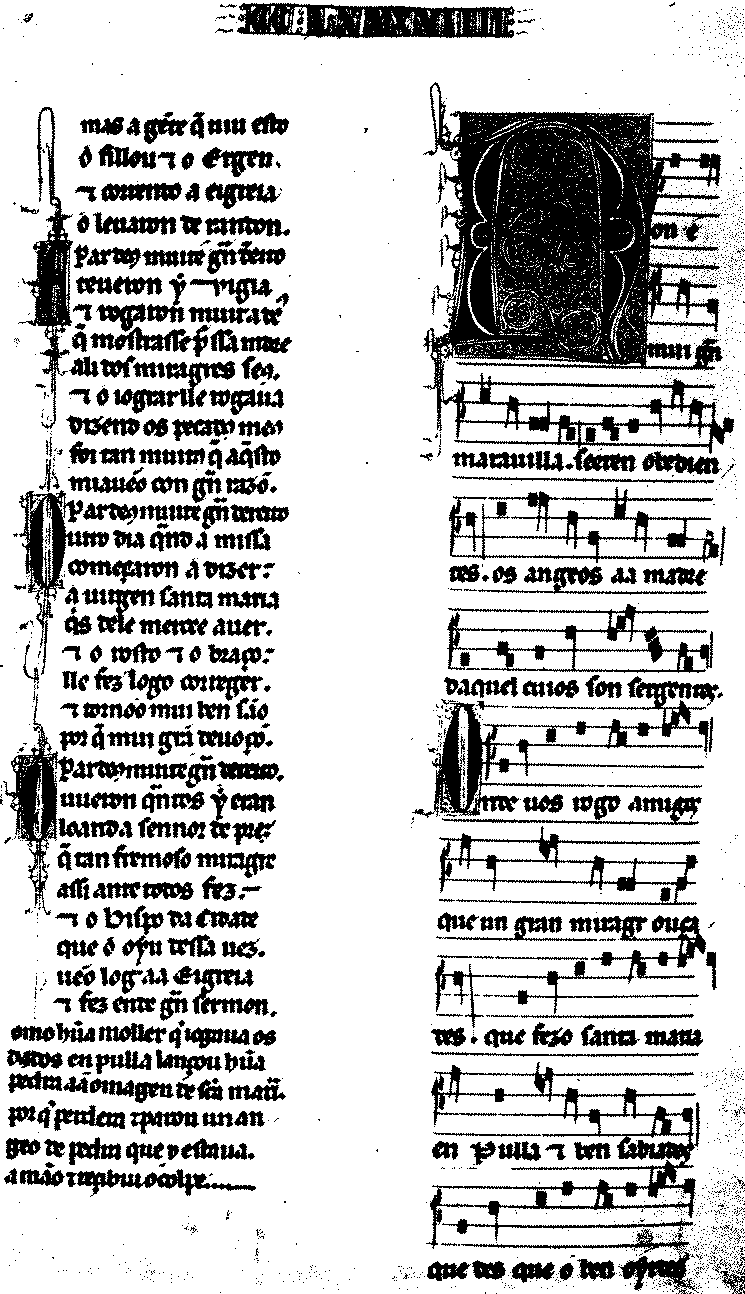
- 13th century CE, Alfonso X of Castile, Cantigas de Santa Maria, E codex, cantiga 294 (facsimile):
- [C]omo hũa moller q̇ iogaua os dados en pulla lançou hũa pedra aa omagen de ſṫa maṙi[a] poꝛ q̇ perdera ⁊ parou un angeo de pedra que y eſtaua a mão ⁊ reçibiu o colpe.
- How a woman who was playing dice in Apulia threw a stone at the statue of Holy Mary because she had lost, and an angel of stone which was there reached out its hand and received the blow.
- [C]omo hũa moller q̇ iogaua os dados en pulla lançou hũa pedra aa omagen de ſṫa maṙi[a] poꝛ q̇ perdera ⁊ parou un angeo de pedra que y eſtaua a mão ⁊ reçibiu o colpe.
Descendants[edit]
Old Norse[edit]
Etymology 1[edit]
From Proto-Germanic *anþi, *andi. Unstressed doublet of enn (“yet, still”).
Conjunction[edit]
en
- but
- (as a copulative): and
- Synonym: ok
Descendants[edit]
Etymology 2[edit]
From earlier an (“than”). Ultimately from Proto-Germanic *þan, possibly through *þannai, whence cognate with Old English þonne (“than”). For similar loss of þ- compare at from earlier Proto-Norse ᚦᚨᛏ (þat), ᚦᛡᛏ (þᴀt).
Conjunction[edit]
en
Descendants[edit]
References[edit]
- en in Geir T. Zoëga (1910) A Concise Dictionary of Old Icelandic, Oxford: Clarendon Press
Old Occitan[edit]
Pronoun[edit]
en
- of it; of them
- 12th century, Bernard de Ventadour, Can vei la lauzeta mover
- Ailas! Tan cuidava saber
D'amor, e tan petit en sai,- Alas! I thought I knew so much
about love, and I know so little [of it]!
- Alas! I thought I knew so much
- 12th century, Bernard de Ventadour, Can vei la lauzeta mover
Old Saxon[edit]
| < 0 | 1 | 2 > |
|---|---|---|
| Cardinal : ēn | ||
Etymology[edit]
From Proto-West Germanic *ain.
Pronunciation[edit]
Numeral[edit]
en m
- one
- thoh uui hēr te meti habdin garu im te geƀanne sō uui mahtin fargelden mēst tueho uuāri is noh than that iro ēnig thar ēnes gināmi(Heliand, verse 2637)
- Though we had food that we should buy to give him. The most doubt is still there that anyone once felt
Article[edit]
en m
Declension[edit]
| Masculine | Neuter | Feminine | |
|---|---|---|---|
| nominative | ēn | ēn | ēn |
| accusative | ēnana | ēn | ēna |
| genitive | ēnes | ēnes | ēnaro |
| dative | ēnumu | ēnumu | ēnaro |
Descendants[edit]
Old Swedish[edit]
Etymology[edit]
From Old Norse einn, from Proto-Germanic *ainaz, from Proto-Indo-European *óynos.
Numeral[edit]
ēn m or f
Pennsylvania German[edit]
Etymology[edit]
Pronunciation[edit]
Article[edit]
en
Declension[edit]
| Declension of en | ||||
|---|---|---|---|---|
| masculine | feminine | neuter | plural | |
| nominative | en | en | en | – |
| dative | emme me |
re | emme me |
– |
| accusative | en | en | en | – |
Pronoun[edit]
en
- accusative of er: him
Declension[edit]
| singular | plural | ||||||||
|---|---|---|---|---|---|---|---|---|---|
| 1st person | 2nd person familiar |
2nd person polite/formal |
3rd person | 1st person | 2nd person | 3rd person | |||
| m | f | n | |||||||
| nominative | ich | du de1 |
dihr der1 Sie |
er | sie se1 |
es | mir mer1 |
dihr der1 |
sie |
| dative | mir mer1 |
dir der1 |
eich Ihne Ne1 |
ihm em1 |
ihre re1 |
ihm em1 |
uns | eich | ihne ne1 |
| accusative | mich | dich | eich Sie |
ihn en1 |
sie se1 |
es | sie | ||
1unstressed
Slovene[edit]
| 10 | ||||
| ← 0 | 1 | 2 → | 10 → | |
|---|---|---|---|---|
| Cardinal: en Nominalized cardinal: eden Cardinal prefix: eno- Ordinal: prvi Fixed ordinal: prvoten Latinate ordinal: primaren Ordinal prefix: prvo- Number: ena Digit: enka Digit place: enica Adverbial: prvič Krat adverbial: prvikrat Multiplier: enojen Krat multiplier: enkrat Fixed multiplier: enkraten Adverbial multiplier: enojno Latinate multiplier: singleten Multiplier verb: poeniti Multiplier prefix: enojn- Krat multiplier prefix: enkratn- Krat adverbial multiplier: enkratno Collective: enoje Separable collective: enoj Greek or Latinate collective: monada Greek collective prefix: mono- Latinate collective prefix: uni- Fractional: enina Greek prefix: proto- Number of musicians: solo | ||||
Etymology[edit]
Contraction of earlier êden, from Proto-Slavic *(j)edinъ.
Pronunciation 1[edit]
Numeral[edit]
ȅn
Usage notes[edit]
The form éden is used when the word does not modify a noun directly, but stands in predicate position. When counting or reciting numbers, the feminine form éna is normally used (see the number box).
Declension[edit]
| First declension (hard), fixed accent | |||
|---|---|---|---|
| masculine | feminine | neuter | |
| nom sg | ȅn | éna | éno |
| singular | |||
| masculine | feminine | neuter | |
| nominative imenovȃlnik |
ȅn | éna | éno |
| genitive rodȋlnik |
énega | éne | énega |
| dative dajȃlnik |
énemu | éni | énemu |
| accusative tožȋlnik |
nominanim genanim |
éno | éno |
| locative mẹ̑stnik |
énem | éni | énem |
| instrumental orọ̑dnik |
énim | éno | énim |
| (vocative) (ogȏvorni imenovȃlnik) |
ȅn | ȇna | ȇno |
| Other forms | |||
|---|---|---|---|
| positive | comparative | superlative | |
| accusative singular masculine isolated form | énega | – | – |
| accusative singular neuter isolated form | éno, énega | – | – |
| adverb | – | – | – |
Derived terms[edit]
Determiner[edit]
ȅn
- (colloquial) some (someone/something – indefinite determiner)
- (colloquial, also unstressed) some (someone/something arbitrary – unspecified determiner)
Declension[edit]
| First declension (hard), fixed accent | |||
|---|---|---|---|
| masculine | feminine | neuter | |
| nom sg | én | éna | éno |
| singular | |||
| masculine | feminine | neuter | |
| nominative imenovȃlnik |
én | éna | éno |
| genitive rodȋlnik |
énega | éne | énega |
| dative dajȃlnik |
énemu | éni | énemu |
| accusative tožȋlnik |
nominanim genanim |
éno | éno |
| locative mẹ̑stnik |
énem, énemu | éni | énem, énemu |
| instrumental orọ̑dnik |
énim | éno | énim |
| (vocative) (ogȏvorni imenovȃlnik) |
ȇn | ȇna | ȇno |
| dual | |||
| masculine | feminine | neuter | |
| nominative imenovȃlnik |
éna | éni | éni |
| genitive rodȋlnik |
énih | énih | énih |
| dative dajȃlnik |
énima | énima | énima |
| accusative tožȋlnik |
éna | éni | éni |
| locative mẹ̑stnik |
énih | énih | énih |
| instrumental orọ̑dnik |
énima | énima | énima |
| (vocative) (ogȏvorni imenovȃlnik) |
ȇna | éni | éni |
| plural | |||
| masculine | feminine | neuter | |
| nominative imenovȃlnik |
éni | éne | éna |
| genitive rodȋlnik |
énih | énih | énih |
| dative dajȃlnik |
énim | énim | énim |
| accusative tožȋlnik |
éne | éne | éna |
| locative mẹ̑stnik |
énih | énih | énih |
| instrumental orọ̑dnik |
énimi | énimi | énimi |
| (vocative) (ogȏvorni imenovȃlnik) |
ȇni | ȇne | ȇna |
| Positive definite forms | |||
|---|---|---|---|
| singular | |||
| masculine | feminine | neuter | |
| nominative imenovȃlnik |
éni | éna | éno |
| genitive rodȋlnik |
énega | éne | énega |
| dative dajȃlnik |
énemu | éni | énemu |
| accusative tožȋlnik |
nominanim genanim |
éno | éno |
| locative mẹ̑stnik |
énem, énemu | éni | énem, énemu |
| instrumental orọ̑dnik |
énim | éno | énim |
| (vocative) (ogȏvorni imenovȃlnik) |
ȇni | ȇna | ȇno |
| dual | |||
| masculine | feminine | neuter | |
| nominative imenovȃlnik |
éna | éni | éni |
| genitive rodȋlnik |
énih | énih | énih |
| dative dajȃlnik |
énima | énima | énima |
| accusative tožȋlnik |
éna | éni | éni |
| locative mẹ̑stnik |
énih | énih | énih |
| instrumental orọ̑dnik |
énima | énima | énima |
| (vocative) (ogȏvorni imenovȃlnik) |
ȇna | ȇni | ȇni |
| plural | |||
| masculine | feminine | neuter | |
| nominative imenovȃlnik |
éni | éne | éna |
| genitive rodȋlnik |
énih | énih | énih |
| dative dajȃlnik |
énim | énim | énim |
| accusative tožȋlnik |
éne | éne | éna |
| locative mẹ̑stnik |
énih | énih | énih |
| instrumental orọ̑dnik |
énimi | énimi | énimi |
| (vocative) (ogȏvorni imenovȃlnik) |
ȇni | ȇne | ȇna |
| Other forms | |||
|---|---|---|---|
| positive | comparative | superlative | |
| accusative singular masculine isolated form | énega | – | – |
| accusative singular neuter isolated form | éno, énega | – | – |
| adverb | – | – | – |
Noun[edit]
ȅn m anim
Pronunciation 2[edit]
Article[edit]
en
- (colloquial, regional) a
- To je ena velika izmišljotina! ― This is a big made-up story.
Further reading[edit]
- “en”, in Slovarji Inštituta za slovenski jezik Frana Ramovša ZRC SAZU, portal Fran
- “en”, in Termania, Amebis
- See also the general references
Spanish[edit]
Etymology[edit]
From Old Spanish en, from Latin in, from Proto-Italic *en, from Proto-Indo-European *h₁én (“in”). Cognate with Old English in and English in.
Pronunciation[edit]
Preposition[edit]
en
- in, at, on
- Estoy en casa. ― I'm at home.
- Estoy sentado en la computadora. ― I'm sitting at the computer.
- en esta página ― on this page
- en la caja en la mesa ― in the box on the table
- in (a time)
- en la antigüedad ― in antiquity
- en 1999 ― in 1999
- in (a language)
- No conozco esta palabra en francés.
- I don't know this word in French.
- en todos los idiomas ― in all languages
- used after some verbs and translated by various prepositions in English
- Pienso en ti. ― I'm thinking of you.
- in (in various expressions)
- en el sentido ― in the sense
- en nuestro afán ― in our eagerness
Further reading[edit]
- “en”, in Diccionario de la lengua española, Vigésima tercera edición, Real Academia Española, 2014
Sranan Tongo[edit]
Alternative forms[edit]
- hem (obsolete)
Etymology[edit]
From older hem, from English him.
Pronoun[edit]
en
Pronoun[edit]
en
Sumerian[edit]
Romanization[edit]
en
- Romanization of 𒂗 (en)
Swedish[edit]
Etymology 1[edit]
From Old Swedish ēn, æn, from Old Norse einn, from Proto-Germanic *ainaz (“one, some”), from Proto-Indo-European *óynos (“one”).
Pronunciation 1[edit]
Pronoun[edit]
en (genitive ens)
- one; object form of man (=one)
- Det man inte vet skadar en inte
- What one doesn’t know doesn’t hurt one.
- one (see usage notes)
Usage notes[edit]
En has in recent years been used as a more gender-conscious alternative to the impersonal pronoun man. The development is in some ways parallel to the gender-neutral pronoun hen. Usage is common among certain speaker groups, but not universally acknowledged in the standard language.[10] Previously it has also been used in some dialects.
Declension[edit]
| Number | Person | Type | Nominative | Oblique | Possessive | ||
|---|---|---|---|---|---|---|---|
| common | neuter | plural | |||||
| singular | first | — | jag | mig, mej3 | min | mitt | mina |
| second | — | du | dig, dej3 | din | ditt | dina | |
| third | masculine (person) | han | honom, han2, en5 | hans | |||
| feminine (person) | hon | henne, na5 | hennes | ||||
| gender-neutral (person)1 | hen | hen, henom7 | hens | ||||
| common (noun) | den | den | dess | ||||
| neuter (noun) | det | det | dess | ||||
| indefinite | man or en4 | en | ens | ||||
| reflexive | — | sig, sej3 | sin | sitt | sina | ||
| plural | first | — | vi | oss | vår, våran2 | vårt, vårat2 | våra |
| second | — | ni | er | er, eran2, ers6 | ert, erat2 | era | |
| archaic | I | eder | eder, eders6 | edert | edra | ||
| third | — | de, dom3 | dem, dom3 | deras | |||
| reflexive | — | sig, sej3 | sin | sitt | sina | ||
Pronunciation 2[edit]
Numeral[edit]
| < 0 | 1 | 2 > |
|---|---|---|
| Cardinal : en Ordinal : första | ||
en (neuter ett)
Coordinate terms[edit]
- 100: hundra
- 103: tusen
- 104: tiotusen (myriad)
- 106: miljon
- 109: miljard
- 1012: biljon
- 1015: biljard
- 1018: triljon
- 1021: triljard
- 1024: kvadriljon
- 1027: kvadriljard
- 1030: kvintiljon
- 1033: kvintiljard
- 1036: sextiljon
- 1039: sextiljard
- 1042: septiljon
- 1045: septiljard
- 1048: oktiljon
- 1051: oktiljard
- 1054: noniljon
- 1057: noniljard
- 1060: deciljon
- 1063: deciljard
- 1066: undeciljon
- 1069: undeciljard
- 1072: duodeciljon
- 1075: duodeciljard
- 1078: tredeciljon
- 1081: tredeciljard
- 1084: quattuordeciljon
- 1087: quattuordeciljard
…
- 10100: googol
…
- 10120: vigintiljon
- 10123: vigintiljard
…
Related terms[edit]
- ena
- enahanda
- enaktare
- enande
- enare
- enarmad
- enarmslyft
- enarådande
- enas
- enastående
- enbarnsfamilj
- enbart
- enbo
- enbyggare
- enbäddsrum
- encellig
- endagskonferens
- endagsstrejk
- endera
- endimensionell
- endräkt
- endräktig
- eneggad
- enfald
- enfaldig
- enfaldighet
- enfamiljshus
- enfamiljsvilla
- enfas
- enfasig
- enfilig
- enformig
- enformighet
- enfrågeparti
- enfröig
- enfärgad
- enfödd
- enföräldersfamilj
- engifte
- engradig
- engångs-
- enhandsräddning
- enhet
- enhetlig
- enhetlighet
- enhjuling
- enhjärtbladig
- enhällig
- enhänt
- enhörning
- enig
- enighet
- ening
- enkammarriksdag
- enkammarsystem
- enkilosburk
- enklang
- enkornsfrö
- enkrona
- enkönad
- enlighet
- enligt
- enlitersflaska
- enlitersförpackning
- enläkarstation
- enmans
- enmastad
- enmastare
- enmotorig
- enpartiregering
- enpartistat
- enpartisystem
- enpartivälde
- enpersonshushåll
- enplans
- enplanshus
- enplansvilla
- enprocentig
- enpucklig
- enradig
- enrum
- enrummare
- enrummig
- enrums
- enrumslägenhet
- enrådig
- enrådighet
- ens
- ensa
- ensak
- ensam
- ensamhet
- ensamt
- ensartad
- ense
- ensidig
- ensidighet
- ensiffrig
- enskifte
- enskild
- enskildhet
- enslig
- enslighet
- ensling
- enspaltig
- enspråkig
- enspråkighet
- enspårig
- enstaka
- enstavig
- enstavighet
- enstensmur
- enstjärnig
- enstrofig
- ensträngad
- enstämmig
- enstämmighet
- enständig
- enstörig
- enstörighet
- enstöring
- ental
- entimmesparkering
- entonig
- entonighet
- entonnare
- enträgen
- entums
- entumsbräda
- entydig
- entydighet
- entypsbåt
- envar
- enveten
- envetenhet
- envetnas
- envig
- envis
- envisas
- envishet
- envåldshärskare
- envånings
- envåningshus
- envägs
- envälde
- enväldig
- envärd
- enäggig
- enäggstvilling
- enögd
- enögdhet
Article[edit]
en c (neuter ett)
Declension[edit]
- en and ett are invariable in the singular, as nominative en konung (a king) and genitive en konungs (a king's).
- The genitive enes and the dative enom are dated.
Etymology 2[edit]
From earlier ene (sometimes also ener), from Old Norse einir.
Pronunciation[edit]
Noun[edit]
en c
Declension[edit]
| Declension of en | ||||
|---|---|---|---|---|
| Singular | Plural | |||
| Indefinite | Definite | Indefinite | Definite | |
| Nominative | en | enen | enar | enarna |
| Genitive | ens | enens | enars | enarnas |
Related terms[edit]
Descendants[edit]
- ⇒ Middle Low German: eynholz, eynholcz, eynberen holt, eynberenboem, einbeeren struke, enekenbehren, eynikenstrucke
- German Low German: Ênbêrnstrûk, Eenberen, Ehmkenstruk, Eenkenstruk, Euwerbush (Mecklenburg, Pommern, Rügen as of late 19th c.)
References[edit]
- en in Svensk ordbok (SO)
- en in Svenska Akademiens ordlista (SAOL)
- en in Svenska Akademiens ordbok (SAOB)
- han in Elof Hellquist, Svensk etymologisk ordbok (1st ed., 1922)
- Brüch, Josef (1922) “Lateinische Etymologien”, in Indogermanische Forschungen. Zeitschrift für Indogermanistik und allgemeine Sprachwissenschaft[11] (in German), volume 40, Berlin und Leipzig: Walter de Gruyter & Co., pages 225–226
Anagrams[edit]
Tagalog[edit]
Etymology[edit]
Borrowed from English en, the English name of the letter N/n.
Pronunciation[edit]
- (Standard Tagalog) IPA(key): /ʔen/, [ʔɛn]
- Rhymes: -en
Noun[edit]
en (Baybayin spelling ᜁᜈ᜔)
- the name of the Latin-script letter N, in the Filipino alphabet.
Derived terms[edit]
See also[edit]
- (Latin-script letter names) titik; ey, bi, si, di, i, ef, dyi, eyts, ay, dyey, key, el, em, en, enye, en dyi, o, pi, kyu, ar, es, ti, yu, vi, dobolyu, eks, way, zi
Further reading[edit]
- “en”, in Pambansang Diksiyonaryo | Diksiyonaryo.ph, Manila, 2018
Tedim Chin[edit]
Etymology[edit]
From Proto-Kuki-Chin *ʔen, from Proto-Sino-Tibetan *ken (“to see, to know”).
Verb[edit]
en
- to look
References[edit]
- Zomi Ordbog based on the work of D.L. Haokip
Turkish[edit]
Pronunciation[edit]
Etymology 1[edit]
From Ottoman Turkish ان (en), from Proto-Turkic *ēn (“breadth, width”).
Noun[edit]
en (definite accusative eni, plural enler)
Declension[edit]
| Inflection | |||||||||||||||||||||||||||||||||||||||||||||||||||||||||||||||||||||||||||||||||||||||||||||||||||||||||||||||||||||||||||||||||||||||||||||||||||||
|---|---|---|---|---|---|---|---|---|---|---|---|---|---|---|---|---|---|---|---|---|---|---|---|---|---|---|---|---|---|---|---|---|---|---|---|---|---|---|---|---|---|---|---|---|---|---|---|---|---|---|---|---|---|---|---|---|---|---|---|---|---|---|---|---|---|---|---|---|---|---|---|---|---|---|---|---|---|---|---|---|---|---|---|---|---|---|---|---|---|---|---|---|---|---|---|---|---|---|---|---|---|---|---|---|---|---|---|---|---|---|---|---|---|---|---|---|---|---|---|---|---|---|---|---|---|---|---|---|---|---|---|---|---|---|---|---|---|---|---|---|---|---|---|---|---|---|---|---|---|
| Nominative | en | ||||||||||||||||||||||||||||||||||||||||||||||||||||||||||||||||||||||||||||||||||||||||||||||||||||||||||||||||||||||||||||||||||||||||||||||||||||
| Definite accusative | eni | ||||||||||||||||||||||||||||||||||||||||||||||||||||||||||||||||||||||||||||||||||||||||||||||||||||||||||||||||||||||||||||||||||||||||||||||||||||
| Singular | Plural | ||||||||||||||||||||||||||||||||||||||||||||||||||||||||||||||||||||||||||||||||||||||||||||||||||||||||||||||||||||||||||||||||||||||||||||||||||||
| Nominative | en | enler | |||||||||||||||||||||||||||||||||||||||||||||||||||||||||||||||||||||||||||||||||||||||||||||||||||||||||||||||||||||||||||||||||||||||||||||||||||
| Definite accusative | eni | enleri | |||||||||||||||||||||||||||||||||||||||||||||||||||||||||||||||||||||||||||||||||||||||||||||||||||||||||||||||||||||||||||||||||||||||||||||||||||
| Dative | ene | enlere | |||||||||||||||||||||||||||||||||||||||||||||||||||||||||||||||||||||||||||||||||||||||||||||||||||||||||||||||||||||||||||||||||||||||||||||||||||
| Locative | ende | enlerde | |||||||||||||||||||||||||||||||||||||||||||||||||||||||||||||||||||||||||||||||||||||||||||||||||||||||||||||||||||||||||||||||||||||||||||||||||||
| Ablative | enden | enlerden | |||||||||||||||||||||||||||||||||||||||||||||||||||||||||||||||||||||||||||||||||||||||||||||||||||||||||||||||||||||||||||||||||||||||||||||||||||
| Genitive | enin | enlerin | |||||||||||||||||||||||||||||||||||||||||||||||||||||||||||||||||||||||||||||||||||||||||||||||||||||||||||||||||||||||||||||||||||||||||||||||||||
| |||||||||||||||||||||||||||||||||||||||||||||||||||||||||||||||||||||||||||||||||||||||||||||||||||||||||||||||||||||||||||||||||||||||||||||||||||||
References[edit]
- Nişanyan, Sevan (2002–) “en2”, in Nişanyan Sözlük
Etymology 2[edit]
From Ottoman Turkish اڭ (eŋ), from Common Turkic *eŋ. Cognate with Old Turkic 𐰭 (ŋ /eŋ/), Azerbaijani ən, Kyrgyz эң (eŋ), Tuvan эң (eñ), Uzbek eng.
Adverb[edit]
en
Veps[edit]
Verb[edit]
en
Welsh[edit]
Pronunciation[edit]
Noun[edit]
en f (plural eniau)
- The name of the Latin-script letter N.
Mutation[edit]
| Welsh mutation | |||
|---|---|---|---|
| radical | soft | nasal | h-prothesis |
| en | unchanged | unchanged | hen |
| Note: Some of these forms may be hypothetical. Not every possible mutated form of every word actually occurs. | |||
See also[edit]
- (Latin-script letter names) llythyren; a, bi, ec, èch, di, èdd, e, èf, èff, èg, eng, aetsh, i / i dot, je, ce, el, èll, em, en, o, pi, ffi, ciw, er, rhi, ès, ti, èth, u / u bedol / u gwpan, fi, w, ecs, y, sèd
West Frisian[edit]
Etymology[edit]
From Old Frisian and, ende, from Proto-Germanic *andi, from Proto-Indo-European *h₂entí.
Pronunciation[edit]
Conjunction[edit]
en
Further reading[edit]
- “en”, in Wurdboek fan de Fryske taal (in Dutch), 2011
Zou[edit]
Etymology 1[edit]
From Proto-Kuki-Chin *ʔen, from Proto-Sino-Tibetan *ken. Cognates include Chinese [Term?] 見/见 (jiàn) and Tibetan མཁྱེན་པ (mkhyen pa).
Pronunciation[edit]
Verb[edit]
én
- (intransitive) to look
Etymology 2[edit]
From Proto-Kuki-Chin *ʔan (“vegetables”), from Proto-Sino-Tibetan *h(y)an.
Pronunciation[edit]
Noun[edit]
én
References[edit]
- Lukram Himmat Singh (2013) A Descriptive Grammar of Zou, Canchipur: Manipur University, page 41
- Translingual terms derived from English
- Translingual clippings
- Translingual lemmas
- Translingual symbols
- ISO 639-1
- English 1-syllable words
- English 2-syllable words
- English terms with IPA pronunciation
- English terms with audio links
- English lemmas
- English nouns
- English abbreviations
- English terms derived from Latin
- Rhymes:English/ɛn
- Rhymes:English/ɛn/1 syllable
- English terms with homophones
- en:Latin letter names
- English terms with usage examples
- English terms with quotations
- en:Typography
- English terms derived from French
- English prepositions
- English terms inherited from Old English
- English terms derived from Old English
- English pronouns
- English dialectal terms
- Newfoundland English
- English countable nouns
- en:Cyrillic letter names
- English heteronyms
- English two-letter words
- Afar terms with IPA pronunciation
- Afar lemmas
- Afar verbs
- Afar intransitive verbs
- Afrikaans terms inherited from Dutch
- Afrikaans terms derived from Dutch
- Afrikaans terms with IPA pronunciation
- Afrikaans terms with audio links
- Afrikaans lemmas
- Afrikaans conjunctions
- Afrikaans terms with usage examples
- Ainu terms with IPA pronunciation
- Ainu lemmas
- Ainu pronouns
- Alemannic German terms inherited from Middle High German
- Alemannic German terms derived from Middle High German
- Alemannic German terms inherited from Old High German
- Alemannic German terms derived from Old High German
- Alemannic German terms inherited from Proto-Germanic
- Alemannic German terms derived from Proto-Germanic
- Alemannic German terms inherited from Proto-Indo-European
- Alemannic German terms derived from Proto-Indo-European
- Alemannic German terms with IPA pronunciation
- Alemannic German lemmas
- Alemannic German articles
- Alemannic German terms with quotations
- Asturian terms inherited from Latin
- Asturian terms derived from Latin
- Asturian terms inherited from Proto-Italic
- Asturian terms derived from Proto-Italic
- Asturian terms inherited from Proto-Indo-European
- Asturian terms derived from Proto-Indo-European
- Asturian terms with IPA pronunciation
- Asturian lemmas
- Asturian prepositions
- Asturian terms with usage examples
- Aukan terms inherited from English
- Aukan terms derived from English
- Aukan lemmas
- Aukan nouns
- Azerbaijani terms inherited from Proto-Turkic
- Azerbaijani terms derived from Proto-Turkic
- Azerbaijani terms with IPA pronunciation
- Azerbaijani terms with audio links
- Azerbaijani lemmas
- Azerbaijani nouns
- Breton non-lemma forms
- Breton contractions
- Catalan terms derived from Latin
- Catalan terms with IPA pronunciation
- Catalan lemmas
- Catalan articles
- Eastern Catalan
- Catalan terms with usage examples
- Catalan terms inherited from Latin
- Catalan terms inherited from Proto-Italic
- Catalan terms derived from Proto-Italic
- Catalan terms inherited from Proto-Indo-European
- Catalan terms derived from Proto-Indo-European
- Catalan prepositions
- Catalan pronouns
- Catalan personal pronouns
- Catalan nouns
- Catalan countable nouns
- Catalan feminine nouns with no feminine ending
- Catalan feminine nouns
- Central Franconian terms inherited from Old High German
- Central Franconian terms derived from Old High German
- Central Franconian terms with IPA pronunciation
- Central Franconian lemmas
- Central Franconian prepositions
- Central Franconian adverbs
- Central Franconian conjunctions
- Central Franconian articles
- Central Franconian pronouns
- Chamorro terms with IPA pronunciation
- Chamorro lemmas
- Chamorro pronouns
- Chamorro personal pronouns
- Chuukese lemmas
- Chuukese pronouns
- Chuukese determiners
- Cimbrian non-lemma forms
- Cimbrian pronoun forms
- Crimean Tatar lemmas
- Crimean Tatar nouns
- Czech terms with IPA pronunciation
- Czech lemmas
- Czech nouns
- Czech indeclinable nouns
- Czech neuter nouns
- cs:Latin letter names
- Dalmatian terms inherited from Latin
- Dalmatian terms derived from Latin
- Dalmatian lemmas
- Dalmatian prepositions
- Danish terms inherited from Old Norse
- Danish terms derived from Old Norse
- Danish terms inherited from Proto-Germanic
- Danish terms derived from Proto-Germanic
- Danish terms inherited from Proto-Indo-European
- Danish terms derived from Proto-Indo-European
- Danish terms with IPA pronunciation
- Danish lemmas
- Danish articles
- Danish numerals
- Danish cardinal numbers
- Danish pronouns
- Danish terms with usage examples
- Dutch terms with IPA pronunciation
- Dutch terms with audio links
- Rhymes:Dutch/ɛn
- Rhymes:Dutch/ɛn/1 syllable
- Dutch terms inherited from Middle Dutch
- Dutch terms derived from Middle Dutch
- Dutch terms inherited from Old Dutch
- Dutch terms derived from Old Dutch
- Dutch terms inherited from Proto-Germanic
- Dutch terms derived from Proto-Germanic
- Dutch terms derived from Proto-Indo-European
- Dutch lemmas
- Dutch conjunctions
- Dutch terms with usage examples
- nl:Mathematics
- Dutch terms inherited from Proto-Indo-European
- Dutch adverbs
- Dutch colloquialisms
- Dutch dialectal terms
- Belgian Dutch
- Dutch terms with obsolete senses
- Dutch terms with quotations
- Esperanto terms borrowed from French
- Esperanto terms derived from French
- Esperanto terms with IPA pronunciation
- Esperanto terms with audio links
- Esperanto lemmas
- Esperanto prepositions
- Esperanto terms with usage examples
- Esperanto BRO1
- Fala terms inherited from Old Galician-Portuguese
- Fala terms derived from Old Galician-Portuguese
- Fala terms inherited from Latin
- Fala terms derived from Latin
- Fala terms inherited from Proto-Indo-European
- Fala terms derived from Proto-Indo-European
- Fala lemmas
- Fala prepositions
- Fala terms with quotations
- Finnish 1-syllable words
- Finnish terms with IPA pronunciation
- Rhymes:Finnish/en
- Rhymes:Finnish/en/1 syllable
- Finnish non-lemma forms
- Finnish verb forms
- Finnish two-letter words
- French 1-syllable words
- French terms with IPA pronunciation
- French terms with audio links
- French terms with homophones
- Rhymes:French/ɑ̃
- Rhymes:French/ɑ̃/1 syllable
- French terms inherited from Middle French
- French terms derived from Middle French
- French terms inherited from Old French
- French terms derived from Old French
- French terms inherited from Latin
- French terms derived from Latin
- French terms inherited from Proto-Italic
- French terms derived from Proto-Italic
- French terms inherited from Proto-Indo-European
- French terms derived from Proto-Indo-European
- French lemmas
- French prepositions
- French terms with usage examples
- French pronouns
- French personal pronouns
- French terms with quotations
- Fula lemmas
- Fula pronouns
- Galician terms inherited from Old Galician-Portuguese
- Galician terms derived from Old Galician-Portuguese
- Galician terms inherited from Latin
- Galician terms derived from Latin
- Galician terms derived from Proto-Italic
- Galician terms derived from Proto-Indo-European
- Galician terms with IPA pronunciation
- Galician lemmas
- Galician prepositions
- Galician terms with usage examples
- Galician terms with quotations
- German Low German terms derived from Proto-West Germanic
- German Low German terms inherited from Proto-West Germanic
- German Low German terms derived from Proto-Germanic
- German Low German terms inherited from Proto-Germanic
- German Low German terms derived from Proto-Indo-European
- German Low German terms inherited from Proto-Indo-European
- German Low German terms inherited from Middle Low German
- German Low German terms derived from Middle Low German
- German Low German terms inherited from Old Saxon
- German Low German terms derived from Old Saxon
- German Low German terms with IPA pronunciation
- German Low German lemmas
- German Low German articles
- German Low German numerals
- Low Prussian Low German
- German Low German cardinal numbers
- Haitian Creole terms derived from French
- Haitian Creole terms derived from Latin
- Haitian Creole terms with IPA pronunciation
- Haitian Creole lemmas
- Haitian Creole numerals
- Haitian Creole cardinal numbers
- Hunsrik 1-syllable words
- Hunsrik terms with IPA pronunciation
- Hunsrik lemmas
- Hunsrik determiners
- Hunsrik terms with usage examples
- Hunsrik pronouns
- Hunsrik personal pronouns
- Icelandic terms inherited from Old Norse
- Icelandic terms derived from Old Norse
- Icelandic 1-syllable words
- Icelandic terms with IPA pronunciation
- Icelandic lemmas
- Icelandic adverbs
- Icelandic terms with usage examples
- Icelandic conjunctions
- Icelandic formal terms
- Ido terms derived from French
- Ido terms derived from Spanish
- Ido terms derived from Latin
- Ido terms derived from Proto-Indo-European
- Ido terms with IPA pronunciation
- Ido lemmas
- Ido prepositions
- Indonesian terms borrowed from Dutch
- Indonesian terms derived from Dutch
- Indonesian 1-syllable words
- Indonesian terms with IPA pronunciation
- Indonesian lemmas
- Indonesian nouns
- Requests for plural forms in Indonesian entries
- id:Latin letter names
- Ingrian terms with IPA pronunciation
- Rhymes:Ingrian/en
- Rhymes:Ingrian/en/1 syllable
- Ingrian non-lemma forms
- Ingrian verb forms
- Japanese non-lemma forms
- Japanese romanizations
- Jersey Dutch terms derived from Middle Dutch
- Jersey Dutch terms inherited from Middle Dutch
- Jersey Dutch terms derived from Old Dutch
- Jersey Dutch terms inherited from Old Dutch
- Jersey Dutch terms derived from Proto-West Germanic
- Jersey Dutch terms inherited from Proto-West Germanic
- Jersey Dutch terms derived from Proto-Germanic
- Jersey Dutch terms inherited from Proto-Germanic
- Jersey Dutch terms derived from Proto-Indo-European
- Jersey Dutch terms inherited from Proto-Indo-European
- Jersey Dutch terms inherited from Dutch
- Jersey Dutch terms derived from Dutch
- Jersey Dutch terms with IPA pronunciation
- Jersey Dutch lemmas
- Jersey Dutch articles
- Jersey Dutch conjunctions
- Jersey Dutch terms with quotations
- Kabuverdianu terms derived from Portuguese
- Kabuverdianu lemmas
- Kabuverdianu prepositions
- Kott terms derived from Proto-Yeniseian
- Kott lemmas
- Kott nouns
- Kott non-lemma forms
- Kott noun plural forms
- zko:Water
- Kriol terms derived from English
- Kriol lemmas
- Kriol conjunctions
- Ladino lemmas
- Ladino prepositions
- Ladino prepositions in Latin script
- Ladino terms with quotations
- Latin 1-syllable words
- Latin terms with IPA pronunciation
- Latin lemmas
- Latin interjections
- Latin nouns
- Latin indeclinable nouns
- Latin feminine indeclinable nouns
- Latin feminine nouns
- Latin prepositions
- la:Latin letter names
- Latvian terms with IPA pronunciation
- Latvian terms with audio links
- Latvian lemmas
- Latvian nouns
- Latvian masculine nouns
- Latvian indeclinable nouns
- Leonese terms inherited from Latin
- Leonese terms derived from Latin
- Leonese lemmas
- Leonese prepositions
- Livvi terms with IPA pronunciation
- Rhymes:Livvi/en
- Rhymes:Livvi/en/1 syllable
- Livvi non-lemma forms
- Livvi verb forms
- Lower Sorbian terms with IPA pronunciation
- Lower Sorbian lemmas
- Lower Sorbian nouns
- Lower Sorbian masculine nouns
- Lower Sorbian inanimate nouns
- dsb:Latin letter names
- Lule Sami non-lemma forms
- Lule Sami verb forms
- Luxembourgish terms inherited from Old High German
- Luxembourgish terms derived from Old High German
- Luxembourgish terms inherited from Proto-Germanic
- Luxembourgish terms derived from Proto-Germanic
- Luxembourgish 1-syllable words
- Luxembourgish terms with IPA pronunciation
- Rhymes:Luxembourgish/ən
- Rhymes:Luxembourgish/ən/1 syllable
- Luxembourgish terms with audio links
- Luxembourgish lemmas
- Luxembourgish articles
- Luxembourgish terms with usage examples
- Luxembourgish pronouns
- Luxembourgish personal pronouns
- Hanyu Pinyin
- Mandarin non-lemma forms
- Mandarin nonstandard forms
- Middle Dutch terms with IPA pronunciation
- Middle Dutch lemmas
- Middle Dutch adverbs
- Middle Dutch conjunctions
- Middle English lemmas
- Middle English prepositions
- Middle French terms inherited from Old French
- Middle French terms derived from Old French
- Middle French terms inherited from Latin
- Middle French terms derived from Latin
- Middle French lemmas
- Middle French prepositions
- Middle Low German terms inherited from Proto-Germanic
- Middle Low German terms derived from Proto-Germanic
- Middle Low German terms with IPA pronunciation
- Middle Low German lemmas
- Middle Low German particles
- Middle Low German terms with usage examples
- Movima lemmas
- Movima verbs
- Norwegian Bokmål terms inherited from Old Norse
- Norwegian Bokmål terms derived from Old Norse
- Norwegian Bokmål terms inherited from Proto-Germanic
- Norwegian Bokmål terms derived from Proto-Germanic
- Norwegian Bokmål terms inherited from Proto-Indo-European
- Norwegian Bokmål terms derived from Proto-Indo-European
- Norwegian Bokmål terms with IPA pronunciation
- Norwegian Bokmål terms with audio links
- Rhymes:Norwegian Bokmål/eːn
- Rhymes:Norwegian Bokmål/ən
- Norwegian Bokmål terms with homophones
- Norwegian Bokmål lemmas
- Norwegian Bokmål articles
- Norwegian Bokmål numerals
- Norwegian Bokmål cardinal numbers
- Norwegian Nynorsk lemmas
- Norwegian Nynorsk conjunctions
- Norwegian Nynorsk pre-1901 forms
- Landsmål
- Norwegian Nynorsk articles
- Norwegian Nynorsk dialectal terms
- Norwegian Nynorsk nonstandard terms
- Norwegian Nynorsk prepositions
- Old French terms inherited from Latin
- Old French terms derived from Latin
- Old French terms with IPA pronunciation
- Old French lemmas
- Old French prepositions
- Old French terms with quotations
- Old French terms with usage examples
- Old Frisian terms derived from Proto-Germanic
- Old Frisian terms inherited from Proto-Germanic
- Old Frisian terms derived from Proto-Indo-European
- Old Frisian terms inherited from Proto-Indo-European
- Old Frisian terms inherited from Proto-West Germanic
- Old Frisian terms derived from Proto-West Germanic
- Old Frisian terms with IPA pronunciation
- Old Frisian lemmas
- Old Frisian numerals
- Old Frisian cardinal numbers
- Old Frisian terms with usage examples
- Old Frisian articles
- Old Galician-Portuguese terms inherited from Latin
- Old Galician-Portuguese terms derived from Latin
- Old Galician-Portuguese terms inherited from Proto-Italic
- Old Galician-Portuguese terms derived from Proto-Italic
- Old Galician-Portuguese terms inherited from Proto-Indo-European
- Old Galician-Portuguese terms derived from Proto-Indo-European
- Old Galician-Portuguese terms with IPA pronunciation
- Old Galician-Portuguese lemmas
- Old Galician-Portuguese prepositions
- Old Norse terms inherited from Proto-Germanic
- Old Norse terms derived from Proto-Germanic
- Old Norse lemmas
- Old Norse conjunctions
- Old Occitan lemmas
- Old Occitan pronouns
- Old Occitan terms with quotations
- Old Saxon terms derived from Proto-Germanic
- Old Saxon terms inherited from Proto-Germanic
- Old Saxon terms inherited from Proto-West Germanic
- Old Saxon terms derived from Proto-West Germanic
- Old Saxon terms with IPA pronunciation
- Old Saxon lemmas
- Old Saxon numerals
- Old Saxon terms with usage examples
- Old Saxon articles
- Old Saxon pronouns
- Old Saxon cardinal numbers
- Old Swedish terms inherited from Old Norse
- Old Swedish terms derived from Old Norse
- Old Swedish terms inherited from Proto-Germanic
- Old Swedish terms derived from Proto-Germanic
- Old Swedish terms inherited from Proto-Indo-European
- Old Swedish terms derived from Proto-Indo-European
- Old Swedish lemmas
- Old Swedish numerals
- Old Swedish cardinal numbers
- Pennsylvania German terms with IPA pronunciation
- Pennsylvania German lemmas
- Pennsylvania German articles
- Pennsylvania German non-lemma forms
- Pennsylvania German pronoun forms
- Pennsylvania German personal pronouns
- Slovene terms derived from Proto-Balto-Slavic
- Slovene terms inherited from Proto-Balto-Slavic
- Slovene terms derived from Proto-Indo-European
- Slovene terms derived from Proto-Slavic
- Slovene 1-syllable words
- Slovene terms with IPA pronunciation
- Rhymes:Slovene/ɛn
- Slovene lemmas
- Slovene numerals
- Slovene hard adjectives
- Slovene determiners
- Slovene colloquialisms
- Slovene terms with usage examples
- Slovene nouns
- Slovene masculine animate nouns
- Slovene masculine nouns
- Slovene animate nouns
- Regional Slovene
- Slovene articles
- Slovene cardinal numbers
- Spanish terms inherited from Old Spanish
- Spanish terms derived from Old Spanish
- Spanish terms inherited from Latin
- Spanish terms derived from Latin
- Spanish terms inherited from Proto-Italic
- Spanish terms derived from Proto-Italic
- Spanish terms inherited from Proto-Indo-European
- Spanish terms derived from Proto-Indo-European
- Spanish 1-syllable words
- Spanish terms with IPA pronunciation
- Spanish terms with audio links
- Rhymes:Spanish/en
- Rhymes:Spanish/en/1 syllable
- Spanish lemmas
- Spanish prepositions
- Spanish terms with usage examples
- Sranan Tongo terms derived from English
- Sranan Tongo lemmas
- Sranan Tongo pronouns
- Sumerian non-lemma forms
- Sumerian romanizations
- Swedish terms inherited from Old Swedish
- Swedish terms derived from Old Swedish
- Swedish terms inherited from Old Norse
- Swedish terms derived from Old Norse
- Swedish terms inherited from Proto-Germanic
- Swedish terms derived from Proto-Germanic
- Swedish terms inherited from Proto-Indo-European
- Swedish terms derived from Proto-Indo-European
- Swedish terms with IPA pronunciation
- Swedish terms with homophones
- Swedish lemmas
- Swedish pronouns
- Swedish terms with usage examples
- Swedish numerals
- Swedish cardinal numbers
- Swedish articles
- Swedish nouns
- Swedish common-gender nouns
- sv:Conifers
- sv:One
- Tagalog terms borrowed from English
- Tagalog terms derived from English
- Tagalog 1-syllable words
- Tagalog terms with IPA pronunciation
- Rhymes:Tagalog/en
- Rhymes:Tagalog/en/1 syllable
- Tagalog terms with mabilis pronunciation
- Tagalog lemmas
- Tagalog nouns
- Tagalog terms with Baybayin script
- tl:Latin letter names
- Tedim Chin terms inherited from Proto-Kuki-Chin
- Tedim Chin terms derived from Proto-Kuki-Chin
- Tedim Chin terms inherited from Proto-Sino-Tibetan
- Tedim Chin terms derived from Proto-Sino-Tibetan
- Tedim Chin lemmas
- Tedim Chin verbs
- Turkish terms with IPA pronunciation
- Turkish terms inherited from Ottoman Turkish
- Turkish terms derived from Ottoman Turkish
- Turkish terms derived from Proto-Turkic
- Turkish lemmas
- Turkish nouns
- Turkish terms derived from Common Turkic
- Turkish adverbs
- Turkish terms with usage examples
- Veps non-lemma forms
- Veps verb forms
- Welsh terms with IPA pronunciation
- Welsh lemmas
- Welsh nouns
- Welsh countable nouns
- Welsh feminine nouns
- cy:Latin letter names
- West Frisian terms inherited from Old Frisian
- West Frisian terms derived from Old Frisian
- West Frisian terms inherited from Proto-Germanic
- West Frisian terms derived from Proto-Germanic
- West Frisian terms inherited from Proto-Indo-European
- West Frisian terms derived from Proto-Indo-European
- West Frisian terms with IPA pronunciation
- West Frisian lemmas
- West Frisian conjunctions
- Zou terms inherited from Proto-Kuki-Chin
- Zou terms derived from Proto-Kuki-Chin
- Zou terms inherited from Proto-Sino-Tibetan
- Zou terms derived from Proto-Sino-Tibetan
- Zou terms with IPA pronunciation
- Zou lemmas
- Zou verbs
- Zou intransitive verbs
- Zou nouns
- zom:Food and drink