ei
Catalan[edit]
Pronunciation[edit]
Interjection[edit]
ei
- hey (exclamation to get attention)
Further reading[edit]
- “ei” in Diccionari de la llengua catalana, segona edició, Institut d’Estudis Catalans.
- “ei”, in Gran Diccionari de la Llengua Catalana, Grup Enciclopèdia Catalana, 2024
Classical Nahuatl[edit]
Numeral[edit]
ei
Dutch[edit]
Etymology[edit]
From Middle Dutch ei, from Old Dutch *ei, from Proto-West Germanic *aij, from Proto-Germanic *ajją, from Proto-Indo-European *h₂ōwyóm.
Pronunciation[edit]
Noun[edit]
ei n (plural eieren, diminutive eitje n)
- egg
- Ik heb een ei gebakken voor het ontbijt. ― I fried an egg for breakfast.
- Pasen is een feest waarbij veel eieren worden geschilderd. ― Easter is a festival where many eggs are painted.
- In deze doos zitten twaalf eieren. ― In this box, there are twelve eggs.
Derived terms[edit]
- dat is het hele eiereneten
- eendenei
- ei van Columbus
- eicel
- eidooier
- eierbal
- eierdop
- eieren voor zijn geld kiezen
- eierkoek
- eierkool
- eierlanding
- eiermuts
- eiersalade
- eierstok
- eigeel
- eikapsel
- eisprong
- eivorm
- eivormig
- eiwit
- kievitsei
- kippenei
- koek en ei
- op eieren lopen
- paasei
- struisvogelei
- van die boer geen eieren
- voor een appel en een ei
Descendants[edit]
Anagrams[edit]
Estonian[edit]
Etymology[edit]
From the Proto-Finno-Ugric negative verb stem *e- ~ *ä- ~ *a-. Cognates include Finnish ei and Northern Sami ii.
Interjection[edit]
ei
Antonyms[edit]
Verb[edit]
ei
- (auxiliary verb) don't, doesn't, not: used in negative forms of non-imperative verbs. Ma ei tea. I don't know. (Compare: Ma tean. I know.)
Usage notes[edit]
The verb follows the word ei.
In the present tense indicative, the form of the verb coincides with the imperative of the second person singular. In past tenses indicative, the form of the verb is personal past participle. In the conditional mood, the form of the verb coincides with third person singular conditional in the present tense or the past tense. In the indirect mood, the form of the verb is the indirect form.
Derived terms[edit]
Fala[edit]
Etymology[edit]
From Old Galician-Portuguese eu, from Inherited from Late Latin eo, from Classical Latin egō̆.
Pronunciation[edit]
Pronoun[edit]
ei m sg or f sg
- First person singular nominative pronoun; I
See also[edit]
| nominative | dative | accusative | disjunctive | |||
|---|---|---|---|---|---|---|
| first person | singular | ei | me, -mi | mi | ||
| plural | common | nos | musL nusLV nos, -nusM |
nos | ||
| masculine | noshotrusM | noshotrusM | ||||
| feminine | noshotrasM | noshotrasM | ||||
| second person | singular | tú | te, -ti | ti | ||
| plural | common | vos | vusLV vos, -vusM |
vos | ||
| masculine | voshotrusM | voshotrusM | ||||
| feminine | voshotrasM | voshotrasM | ||||
| third person | singular | masculine | el | le, -li | uLV, oM | el |
| feminine | ela | a | ela | |||
| plural | masculine | elis | usLV, osM | elis | ||
| feminine | elas | as | elas | |||
| reflexive | — | se, -si | sí | |||
References[edit]
- Valeš, Miroslav (2021) Diccionariu de A Fala: lagarteiru, mañegu, valverdeñu (web)[1], 2nd edition, Minde, Portugal: CIDLeS, published 2022, →ISBN
Faroese[edit]
Etymology[edit]
Pronunciation[edit]
Adverb[edit]
ei
Synonyms[edit]
Derived terms[edit]
Finnish[edit]
Etymology[edit]
The indicative forms are from Proto-Finnic *e-, from Proto-Uralic *e- ~ *ä- ~ *a- (negative verb stem). The imperative forms are from Proto-Finnic *älä-, from the Proto-Finno-Ugric negative imperative verb stem *älä-.
Noteworthy forms include eivät (pro earlier evät, reformed after ei). For more forms, see the Proto-Finnic and Proto-Uralic pages.
Cognates for the indicative forms include Estonian ei, Karelian ei, Livonian ä’b, Veps ei, Northern Sami ii, Skolt Sami ij, Erzya а (a), э- (e-), Eastern Mari ы- (y-), Udmurt уг (ug), Komi-Zyrian оз (oz), Northern Mansi [script needed] (ä-), Forest Enets [script needed] (i-) and Northern Selkup [script needed] (aša) (Taz). Cognates for the imperative forms include Estonian ära, Northern Sami ale, Kildin Sami ель (jel’), Erzya иля (iľa).
Not related to Swedish ej, Icelandic ei, Old Norse eigi, despite the similarity; the Finnic and Norse terms are false cognates.
Pronunciation[edit]
Verb[edit]
ei (third-person singular form)
- (auxiliary) The negative verb or negation verb; not, be not, do not, etc. (+ connegative form)
- En ole käynyt siellä. ― I have not been there.
- Hän ei ole kotona. ― She isn't home.
- Etkö tiedä? ― Don't you know?
- Älä koske siihen! ― Don't touch that!
Usage notes[edit]
- With certain conjunctions, contractions may be used (e.g. miksi + ei → miksei). In some cases, like ellei and jollei, the independent conjunction has fallen out of use, but the contractions still remain in use. For other cases, the contractions are optional, but commonly used. When the contraction is used, the negative verb may effectively shift ahead in the clause:
- En tiedä, miksi hän ei tullut. → En tiedä, miksei hän tullut.
- I don't know why he didn't come.
- The negation verb is used with the connegative form of the main verb.
- In the active voice, the verb ei is inflected in person and mood (only for imperative, otherwise the indicative forms are used).
- In the indicative mood and present tense (including for olla in the perfect tense), the connegative form is identical to the second-person singular imperative.
- In the indicative mood and past tense (including for olla in the pluperfect tense and the main verb in the perfect and pluperfect tenses), the connegative form is the past active participle (-nut / -nyt).
- In the conditional and potential moods, the connegative ends with the mood markers -isi- and -ne- (without the personal ending), respectively.
- In the imperative mood, the connegative form is the same as the positive form for the second-person singular, while for the other forms a form ending in -ko / -kö is used.
- In the passive voice, the third-person singular ei (or älköön for the imperative mood) is used.
- In the present tense, the connegative form is the impersonal or passive form without the final -an / -än (indicative), -in (conditional), -en (potential) and -on / -ön (imperative).
- In the past tense (including the perfect and pluperfect tenses), the connegative form is the past passive participle (-ttu / -tty).
- The total object in the negative is always in the partitive case, not the accusative case (whether that be the nominative, genitive or a special form):
- Näen koiran. → En näe koiraa. ― I see a dog. → I don't see a dog. (accusative → partitive)
- Näen naiset. → En näe naisia. ― I see the women. → I don't see the women. (accusative → partitive)
- Näen sinut. → En näe sinua. ― I (can) see you. → I don't see you. (accusative → partitive)
- Indicative:
- Hän näkee. → Hän ei näe.
- He sees. / He does see. → He doesn't see.
- Hän näki. → Hän ei nähnyt.
- He saw. / He did see. → He didn't see.
- Hän on nähnyt. → Hän ei ole nähnyt.
- He has seen. → He hasn't seen.
- Hän oli nähnyt. → Hän ei ollut nähnyt.
- He had seen. → He hadn't seen.
- Conditional:
- Hän näkisi. → Hän ei näkisi.
- He would see. → He wouldn't see.
- Hän olisi nähnyt. → Hän ei olisi nähnyt.
- He would have seen. → He wouldn't have seen.
- Imperative:
- Näe! → Älä näe!
- See! → Don't see!
- Potential:
- Hän nähnee. → Hän ei nähne.
- He probably sees. → He probably doesn't see.
- Hän lienee nähnyt. → Hän ei liene nähnyt.
- He probably has seen. → He probably hasn't seen.
- Indicative:
- Hänet nähdään. → Häntä ei nähdä.
- He is seen. → He isn't seen.
- Hänet nähtiin. → Häntä ei nähty.
- He was seen. → He wasn't seen.
- Hänet on nähty. → Häntä ei ole nähty.
- He has been seen. → He hasn't been seen.
- Hänet oli nähty. → Häntä ei ollut nähty.
- He had been seen. → He hadn't been seen.
- Conditional:
- Hänet nähtäisiin. → Häntä ei nähtäisi.
- He would be seen. → He wouldn't be seen.
- Hänet olisi nähty. → Häntä ei olisi nähty.
- He would have been seen. → He wouldn't have been seen.
- Imperative (the second form, perfect imperative, is rare):
- Nähtäköön! → Älköön nähtäkö!
- Let (it) be seen! → Don't let (it) be seen!
- Oltakoon nähty! → Älköön oltako nähty.
- Let (it) have been seen! → Don't let (it) have been seen!
- Potential:
- Hänet nähtäneen. → Häntä ei nähtäne.
- He probably is seen. → He probably isn't seen.
- Hänet lienee nähty. → Häntä ei liene nähty.
- He probably has been seen. → He probably hasn't been seen.
Conjugation[edit]
- The negation verb has no infinitive form.
- Indicative, conditional and potential moods use the indicative forms (stem e-), for which the verb is conjugated only in person (the moods are distinguished by the connegative form used).
- In the imperative mood the negation verb has the stem äl-. As with all verbs, the first-person plural imperative is formal or dated, while the third-person imperative (both singular and plural) is dated.
- An archaic optative mood exists and is used mainly in poetry.
Derived terms[edit]
Related terms[edit]
Interjection[edit]
ei
- no (used to show disagreement, negation, denial, refusal, or prohibition)
- Onko hauki lintu? Ei, se on kala.
- Is a pike a bird? No, it is a fish.
Usage notes[edit]
Usually inflected for person; see above.
Antonyms[edit]
- (echo answer; using the verb in the positive)
- kyllä
- (colloquial) joo, juu
Further reading[edit]
- “ei”, in Kielitoimiston sanakirja [Dictionary of Contemporary Finnish][2] (in Finnish) (online dictionary, continuously updated), Kotimaisten kielten keskuksen verkkojulkaisuja 35, Helsinki: Kotimaisten kielten tutkimuskeskus (Institute for the Languages of Finland), 2004–, retrieved 2023-07-02
Galician[edit]
Pronunciation[edit]
Interjection[edit]
ei
References[edit]
- “ei” in Dicionario de Dicionarios da lingua galega, SLI - ILGA 2006–2013.
- “ei” in Tesouro informatizado da lingua galega. Santiago: ILG.
- “ei” in Álvarez, Rosario (coord.): Tesouro do léxico patrimonial galego e portugués, Santiago de Compostela: Instituto da Lingua Galega.
German[edit]
Pronunciation[edit]
Interjection[edit]
ei
Synonyms[edit]
Gothic[edit]
Romanization[edit]
ei
- Romanization of 𐌴𐌹
Icelandic[edit]
Etymology 1[edit]
From Old Norse ei. A clipping of eigi, from Proto-Germanic *ni aiw-gin (“never”), from *ne, *ni (“not”) + *aiw (“always, for ever”) + *-gin. Not related to Finnish ei (“no”).
Pronunciation[edit]
Adverb[edit]
ei
- (archaic, poetic) not
- Örvæntið ei!
- Despair not!
- Ég veit ei hvað skal segja.
- I know not what to say.
Synonyms[edit]
Derived terms[edit]
Etymology 2[edit]
See e.
Pronunciation[edit]
Noun[edit]
ei
References[edit]
- “ei” and “eigi” in: Ásgeir Blöndal Magnússon — Íslensk orðsifjabók, (1989). Reykjavík, Orðabók Háskólans. (Available on Málið.is under the “Eldra mál” tab.)
Ingrian[edit]
Etymology[edit]
From Proto-Finnic *e-, from the Proto-Uralic *e-. Cognates include Finnish ei and Estonian ei.
Pronunciation[edit]
- (Ala-Laukaa) IPA(key): /ˈei̯/, [ˈe̞i̯]
- (Soikkola) IPA(key): /ˈei̯/, [ˈe̞i̯]
- (Hevaha) IPA(key): /ˈei̯/, [ˈe̞i̯]
- Rhymes: -ei̯
- Hyphenation: ei
Particle[edit]
ei
Antonyms[edit]
Verb[edit]
ei
- not
- 1936, N. A. Iljin and V. I. Junus, Bukvari iƶoroin șkouluja vart, Leningrad: Riikin Ucebno-pedagogiceskoi Izdateljstva, page 63:
- Linnuil ono nälkä, evät rooka saa.
- The birds are hungry, they don't get food.
Conjugation[edit]
| Inflection of ei | |||
|---|---|---|---|
| indicative | imperative | ||
| 1st singular | en | - | |
| 2nd singular | et | elä | |
| 3rd singular | ei | elköö | |
| 1st plural | emmä | - | |
| 2nd plural | että | elkää | |
| 3rd plural | evät | elkööt | |
| impersonal | ei | elköö | |
| *) The interrogative is formed by adding the suffix -k (-kä?) or -kse to the indicative. | |||
References[edit]
- V. I. Junus (1936) Iƶoran Keelen Grammatikka[3], Leningrad: Riikin Ucebno-pedagogiceskoi Izdateljstva, page 128
- Ruben E. Nirvi (1971) Inkeroismurteiden Sanakirja, Helsinki: Suomalais-Ugrilainen Seura, page 29
- Arvo Laanest (1997) Isuri keele Hevaha murde sõnastik, Eesti Keele Instituut, page 24
- Olga I. Konkova, Nikita A. Dyachkov (2014) Inkeroin Keel: Пособие по Ижорскому Языку[4], →ISBN, page 15
Italian[edit]
Pronunciation[edit]
Etymology 1[edit]
Syncopated form of elli (“he”), from Vulgar Latin *illi, from Latin ille (“that”).
Pronoun[edit]
ei m
Etymology 2[edit]
Syncopated form of elli (“they”), from Latin illī (“those”).
Pronoun[edit]
ei m pl
Japanese[edit]
Romanization[edit]
ei
Karelian[edit]
Verb[edit]
ei
- (does) not
Kott[edit]
Etymology 1[edit]
From Proto-Yeniseian *ʔej- ("pine"). Compare Arin aja (“pine”).
Noun[edit]
ei (plural en)
- pine tree
Etymology 2[edit]
From Proto-Yeniseian *ʔej ("tongue"). Compare Pumpokol aj (“tongue”).
Noun[edit]
ei (plural ējaŋ)
Latin[edit]
Pronunciation 1[edit]
Interjection[edit]
ei
- Alternative form of hei (“expression of grief or fear”)
Pronunciation 2[edit]
Pronoun[edit]
eī
Latvian[edit]
Interjection[edit]
ei
- used to stimulate somebody's attention
- used to express pleasure, surprise or admiration
Limburgish[edit]
Alternative forms[edit]
Etymology[edit]
From Middle Dutch ei, from Old Dutch *ei, from Proto-West Germanic *aij, from Proto-Germanic *ajją, from Proto-Indo-European *h₂ōwyóm.
Pronunciation[edit]
Noun[edit]
ei n
Livvi[edit]
Etymology[edit]
From Proto-Finnic *ei. Cognates include Finnish ei and Estonian ei.
Pronunciation[edit]
Verb[edit]
ei
Conjugation[edit]
| Inflection of ei | |||
|---|---|---|---|
| indicative | imperative | ||
| 1st singular | en | - | |
| 2nd singular | et | älä | |
| 3rd singular | ei | älgäh | |
| 1st plural | emmo | älgiämmö | |
| 2nd plural | etto | älgiä | |
| 3rd plural | ei | äldähes | |
References[edit]
- N. Gilojeva, S. Rudakova (2009) Karjalan kielen Livvin murdehen algukursu [Beginners' course of Karelian language's Livvi dialect][5] (in Livvi), Petrozavodsk, →ISBN, page 20
- Tatjana Boiko (2019) “ei”, in Suuri Karjal-Venʹalaine Sanakniigu (livvin murreh) [The Big Karelian-Russian dictionary (Livvi dialect)], 2nd edition, →ISBN, page 38
Malasanga[edit]
Noun[edit]
ei
Further reading[edit]
- Malcolm Ross, Proto Oceanic and the Austronesian Languages of Western Melanesia, Pacific Linguistics, series C-98 (1988)
Mandarin[edit]
Romanization[edit]
ei
- Nonstandard spelling of ēi.
- Nonstandard spelling of ěi.
- Nonstandard spelling of èi.
Usage notes[edit]
- Transcriptions of Mandarin into the Latin script often do not distinguish between the critical tonal differences employed in the Mandarin language, using words such as this one without indication of tone.
Mbyá Guaraní[edit]
Noun[edit]
ei
Middle Dutch[edit]
Alternative forms[edit]
Etymology[edit]
From Old Dutch *ei, from Proto-West Germanic *aij, from Proto-Germanic *ajją, from Proto-Indo-European *h₂ōwyóm.
Noun[edit]
ei n
Inflection[edit]
This noun needs an inflection-table template.
Descendants[edit]
Further reading[edit]
- “ei”, in Vroegmiddelnederlands Woordenboek, 2000
- Verwijs, E., Verdam, J. (1885–1929) “ei”, in Middelnederlandsch Woordenboek, The Hague: Martinus Nijhoff, →ISBN
Middle English[edit]
Noun[edit]
ei
- Alternative form of ey (“egg”)
Middle High German[edit]
Etymology[edit]
Inherited from Old High German ei, from Proto-West Germanic *aij, from Proto-Germanic *ajją, from Proto-Indo-European *h₂ōwyóm.
Noun[edit]
ei n
Declension[edit]
Descendants[edit]
- Alemannic German:
- Swabian: Oi
- Bavarian: Oa
- Mòcheno: oi
- Central Franconian: Ei, Ää, Aai
- Luxembourgish: Ee
- German: Ei
- Vilamovian: e
- Yiddish: איי (ey)
References[edit]
- Benecke, Georg Friedrich, Müller, Wilhelm, Zarncke, Friedrich (1863) “ei”, in Mittelhochdeutsches Wörterbuch: mit Benutzung des Nachlasses von Benecke[6], Stuttgart: S. Hirzel
Murui Huitoto[edit]
| ei | |
|---|---|
| Root | Classifier |
| ei- | — |
Etymology[edit]
Cognate with Minica Huitoto ei.
Pronunciation[edit]
Root[edit]
ei
Noun[edit]
ei
- Synonym of eiño
- 2008 [1978], Huitoto Murui Bible, 2nd edition, Mateo 1:3, page 5:
- Iaɨmaiaɨ mɨcorɨ eidɨ Tamar mɨcorɨ.
- The mother of the late two of them was the late Tamara.
- vocative of eiño
Declension[edit]
| singular | plural | kinship plural | |
|---|---|---|---|
| Absolutive | ei | eiyaɨ | eitɨaɨ |
| Nominative | eidɨ | eiyaɨdɨ | eitɨaɨdɨ |
| Accusative | eina | eiyaɨna | eitɨaɨna |
| Dative/Locative | eimo | eiyaɨmo | eitɨaɨmo |
| Ablative | eimona | eiyaɨmona | eitɨaɨmona |
| Instrumental | eido | eiyaɨdo | eitɨaɨdo |
| Causal | eiri | eiyaɨri | eitɨaɨri |
| Privative | einino | eiyaɨnino | eitɨaɨnino |
Derived terms[edit]
References[edit]
- Shirley Burtch (1983) Diccionario Huitoto Murui (Tomo I) (Linguistica Peruana No. 20)[7] (in Spanish), Yarinacocha, Peru: Instituto Lingüístico de Verano, page 75
- Katarzyna Izabela Wojtylak (2017) A grammar of Murui (Bue): a Witotoan language of Northwest Amazonia.[8], Townsville: James Cook University press (PhD thesis), page 125
Norwegian Bokmål[edit]
Etymology[edit]
Pronunciation[edit]
Article[edit]
ei
Pronoun[edit]
ei
Adverb[edit]
ei
Synonyms[edit]
- (not): ikke
Verb[edit]
ei
- imperative of eie
Norwegian Nynorsk[edit]
Pronunciation[edit]
Etymology 1[edit]
Article[edit]
ei f (masculine ein, neuter eit)
- a, an (indefinite article)
- Ei ny bok.
- A new book.
Pronoun[edit]
ei
Etymology 2[edit]
From Middle Norwegian eigh, from Old Norse eigi.
Adverb[edit]
ei
References[edit]
- “ei” in The Nynorsk Dictionary.
- “ei”, in Norsk Ordbok: ordbok over det norske folkemålet og det nynorske skriftmålet, Oslo: Samlaget, 1950-2016
Old Galician-Portuguese[edit]
Alternative forms[edit]
Etymology[edit]
Uncertain.
Pronunciation[edit]
Adverb[edit]
ei
- here is, here are
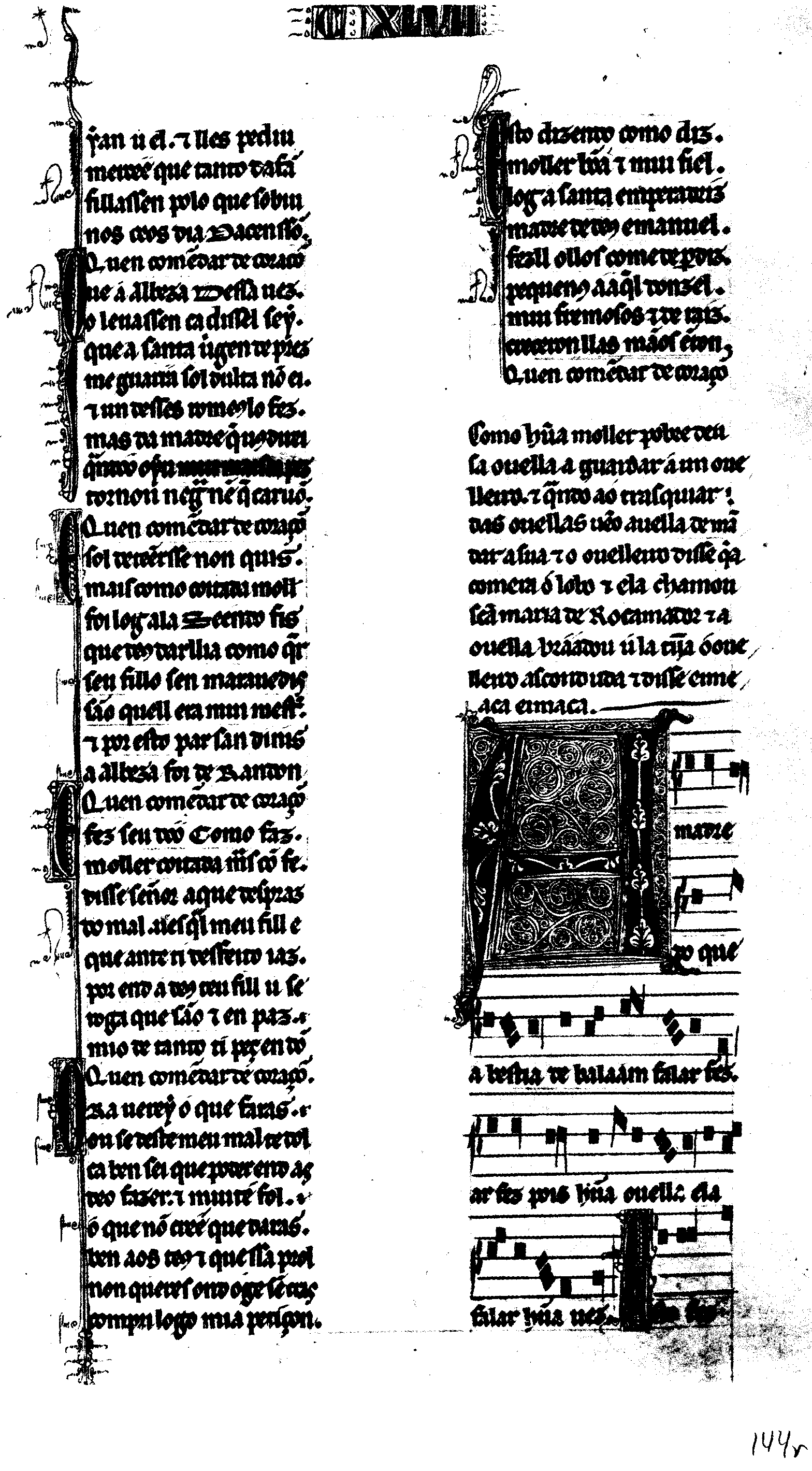
- 13th century CE, Alfonso X of Castile, Cantigas de Santa Maria, E codex, cantiga 147 (facsimile):
- eimeaca eimaca
- «ei-me aca; ei-m'aca!»
- "Here I am, here I am!"
Descendants[edit]
Old High German[edit]
Etymology[edit]
Inherited from Proto-West Germanic *aij, from Proto-Germanic *ajją, from Proto-Indo-European *h₂ōwyóm. Akin to Old English ǣġ, Old Norse egg.
Further Indo-European cognates include Latin ōvum and Ancient Greek ᾠόν (ōión)
Noun[edit]
ei n
Descendants[edit]
- Middle High German: ei
Old Saxon[edit]
Alternative forms[edit]
Etymology[edit]
From Proto-West Germanic *aij, from Proto-Germanic *ajją, from Proto-Indo-European *h₂ōwyóm.
Noun[edit]
ei n
Declension[edit]
| singular | plural | |
|---|---|---|
| nominative | ei | ei |
| accusative | ei | ei |
| genitive | eies | eiō |
| dative | eie | eium |
| instrumental | — | — |
Descendants[edit]
Papiamentu[edit]
Etymology[edit]
From Portuguese eis.
Pronoun[edit]
ei
Portuguese[edit]
Pronunciation[edit]
Etymology 1[edit]
Adverb[edit]
ei (not comparable)
Etymology 2[edit]
Interjection[edit]
ei
- hey (exclamation to get attention)
Romanian[edit]
Pronunciation[edit]
Etymology 1[edit]
Inherited from Latin illī, nominative masculine plural of ille.
Pronoun[edit]
ei m pl (third-person plural, feminine equivalent ele)
Declension[edit]
| Nominative | |||
|---|---|---|---|
| ei | |||
| Accusative | |||
| stressed | unstressed | ||
| ei | îi | ||
| Genitive | |||
| one form for all numbers and genders | |||
| lor | |||
| Dative | |||
| stressed | unstressed | ||
| lor | le | ||
| Reflexive | |||
| Accusative | Dative | ||
| stressed | unstressed | stressed | unstressed |
| sine | se | sieși | își |
Pronoun[edit]
ei m (stressed accusative form of ei)
- (direct object, preceded by preposition, such as "pe", "cu", "la", or "pentru") them (all-male or mixed-sex group)
Related terms[edit]
- el (third-person masculine singular)
- ea (third-person feminine singular)
- ele (third-person feminine plural)
See also[edit]
Etymology 2[edit]
Inherited from Vulgar Latin *illaei, from Latin illa, from ille.
Pronoun[edit]
ei f (genitive form of ea, masculine equivalent lui, plural lor)
Declension[edit]
| singular | plural | ||||||
|---|---|---|---|---|---|---|---|
| masculine | neuter | feminine | masculine | neuter | feminine | ||
| nominative/ accusative |
indefinite | ei | ei | ei | ei | ||
| definite | — | — | — | — | |||
| genitive/ dative |
indefinite | ei | ei | ei | ei | ||
| definite | — | — | — | — | |||
Pronoun[edit]
ei f (stressed dative form of ea, masculine equivalent lui, plural lor)
Sabu[edit]

Etymology[edit]
From Proto-Central-Eastern Malayo-Polynesian *waiʀ, from Proto-Malayo-Polynesian *wahiʀ.
Noun[edit]
ei
- water (clear liquid H₂O)
References[edit]
- ABVD
- Comparative Austronesian Dictionary
Sardinian[edit]
Pronunciation[edit]
Adverb[edit]
ei
References[edit]
- “ei” in Ditzionàriu in línia de sa limba e de sa cultura sarda (2016). Searchable in multiple languages at ditzionariu.sardegnacultura.it
Scots[edit]
Noun[edit]
ei (plural een)
- (South Scots) an eye.
Pronoun[edit]
ei
- (South Scots, personal) he (alternative form of hei)
Tedim Chin[edit]
Pronoun[edit]
ei
References[edit]
- Zomi Ordbog based on the work of D.L. Haokip
Veps[edit]
Etymology[edit]
From Proto-Finnic *e-. Cognates include Finnish ei.
Verb[edit]
ei
- not; expresses negation.
Inflection[edit]
| Inflection of ei | |||
|---|---|---|---|
| indicative | imperative | ||
| 1st singular | en | — | |
| 2nd singular | ed | ala | |
| 3rd singular | ei | algha | |
| 1st plural | em | algam | |
| 2nd plural | et | algat | |
| 3rd plural | ei | algha | |
References[edit]
- Zajceva, N. G., Mullonen, M. I. (2007) “не, ни”, in Uz’ venä-vepsläine vajehnik / Novyj russko-vepsskij slovarʹ [New Russian–Veps Dictionary][9], Petrozavodsk: Periodika
Votic[edit]
Etymology[edit]
Compare Russian эй (ej), Finnish hei, Ingrian hei.
Pronunciation[edit]
Interjection[edit]
ei
References[edit]
- Hallap, V., Adler, E., Grünberg, S., Leppik, M. (2012) “ei”, in Vadja keele sõnaraamat [A dictionary of the Votic language], 2nd edition, Tallinn
Welsh[edit]
Etymology 1[edit]
From Middle Welsh y, from Proto-Brythonic *eið, from Proto-Celtic *esyo m and *esyās f; compare Old Irish a (“his, her, its, their”) and Sanskrit अस्य (asyá, “his, its”) and अस्यास् (asyā́s, “her”).
Alternative forms[edit]
Pronunciation[edit]
Determiner[edit]
ei
- his, its (with reference to a masculine noun; triggers soft mutation of following consonant)
- Gwelir y thema dro ar ôl tro yn ei gerddi a’i emynau.
- The theme is seen repeatedly in his poems and his hymns.
- her, its (with reference to a feminine noun; triggers aspirate mutation of following consonant and h-prothesis of a following vowel)
- Gwelir y thema dro ar ôl tro yn ei cherddi a’i hemynau.
- The theme is seen repeatedly in her poems and her hymns.
Pronoun[edit]
ei
- him, it (with reference to masculine nouns; as object of a verbal noun; triggers soft mutation of following consonant)
- 18th century, Wil Hopcyn, “Bugeilio’r gwenith gwyn”:
- Myfi’n bugeilio’r gwenith gwyn,
Ac arall yn ei fedi.- Me watching the white wheat,
And another reaping it.
- Me watching the white wheat,
- 18th century, Wil Hopcyn, “Bugeilio’r gwenith gwyn”:
- her, it (with reference to masculine nouns; as object of a verbal noun; triggers aspirate mutation of following consonant and h-prothesis of a following vowel)
- Traditional, “Milgi, milgi”:
- Ar ben y bryn mae sgwarnog fach, ar hyd y nos mae'n pori
A’i chefen brith a’i bola bola gwyn yn hidio dim am filgi.- On top of the hill there's a little hare, all night long she grazes
With her speckled back and her white white belly without taking any heed of any greyhound.
- On top of the hill there's a little hare, all night long she grazes
- Traditional, “Milgi, milgi”:
Usage notes[edit]
- In formal Welsh, masculine ef or feminine hi is added after the noun or verbnoun which ei precedes to indicates emphasis on the determiner or pronoun. In colloquial Welsh, the masculine takes e or o (southern and northern forms respectively) after a consonant and fe or fo (southern and northern) after a vowel, whereas the feminine takes hi, but is not necessarily an indicator of emphasis. Here, it is often included with the determiner and always included with the pronoun. The exception to the latter case is in passive constructions employing cael, where no addition is found.
- In formal Welsh, the contraction 'i is a valid form of ei found after mostly functional vowel-final words. In colloquial Welsh, ei is often contracted to 'i after almost any vowel-final word. The exception is both forms of the language is after the preposition i (“to, for”), after which ei contracts to 'w. (Contraction to 'w after wedi is sometimes encountered but considered non-standard.)
- Pronomial ei and 'i can occur before any verbal noun. Before a verb, pronomial 'i is found only in formal language after certain vowel-final preverbal particles. See entry for 'i for more information.
- The colloquial pronunciation /iː/, /ɪ/ is the original pronunciation, as shown by the Middle Welsh form y. The more careful pronunciation /ei̯/ is a later spelling pronunciation.
Etymology 2[edit]
Pronunciation[edit]
Verb[edit]
ei
- second-person singular future of mynd (also present tense in the literary language)
Further reading[edit]
- R. J. Thomas, G. A. Bevan, P. J. Donovan, A. Hawke et al., editors (1950–present), “ei”, in Geiriadur Prifysgol Cymru Online (in Welsh), University of Wales Centre for Advanced Welsh & Celtic Studies
Ye'kwana[edit]
| Bolívar state | ei |
|---|---|
| Brazil | ei |
Pronunciation[edit]
Etymology 1[edit]
Verb[edit]
ei
- (intransitive, agentive) to be
Usage notes[edit]
Many forms of this verb are irregular. Some are based on a root ei ~ e', some on a ~ aa, some on a'ja, and some on ööne ~ wene:
- ei ~ e' is used with most tense/aspect/mood markers and all adverbial and nominal derivatives of the verb.
- a ~ aa is used for the nonpast form, question forms, and two third-person forms na'ñojo and naichü.
- a'ja is used for past imperfectives.
- ööne ~ wene is used for the permanent aspect; this is the only verb in the language that has such an aspect.
The verb also takes an irregular suffix -ya in place of the ordinary recent/distant past perfective suffix -i. Similarly, the plural form of the same suffix is -yato rather than -icho.
This verb can be used as an auxiliary to form various constructions, making it possible to express tense/aspect/mood for constructions made with non-finite verb forms by putting the relevant markers on the copula instead.
Etymology 2[edit]
Verb[edit]
ei
- (transitive) to seek, to look for
References[edit]
- Cáceres, Natalia (2011) “a'ja, ei, ka, ma, na, öönene, wa, weneene”, in Grammaire Fonctionnelle-Typologique du Ye’kwana[10], Lyon, pages 215–216, 238–239
- Hall, Katherine (2007) “wenēne”, in Mary Ritchie Key & Bernard Comrie, editors, The Intercontinental Dictionary Series[11], Leipzig: Max Planck Institute for Evolutionary Anthropology, published 2021
- Hall, Katherine (2007) “wenɲə”, in Mary Ritchie Key & Bernard Comrie, editors, The Intercontinental Dictionary Series[12], Leipzig: Max Planck Institute for Evolutionary Anthropology, published 2021
Zou[edit]
Pronunciation[edit]
Pronoun[edit]
ei
- we (exclusive)
Synonyms[edit]
References[edit]
- Lukram Himmat Singh (2013) A Descriptive Grammar of Zou, Canchipur: Manipur University, page 40
- Catalan terms with IPA pronunciation
- Catalan lemmas
- Catalan interjections
- Classical Nahuatl lemmas
- Classical Nahuatl numerals
- Classical Nahuatl obsolete forms
- Dutch terms inherited from Middle Dutch
- Dutch terms derived from Middle Dutch
- Dutch terms inherited from Old Dutch
- Dutch terms derived from Old Dutch
- Dutch terms inherited from Proto-West Germanic
- Dutch terms derived from Proto-West Germanic
- Dutch terms inherited from Proto-Germanic
- Dutch terms derived from Proto-Germanic
- Dutch terms derived from Proto-Indo-European
- Dutch terms with IPA pronunciation
- Dutch terms with audio links
- Rhymes:Dutch/ɛi̯
- Rhymes:Dutch/ɛi̯/1 syllable
- Dutch terms with homophones
- Dutch lemmas
- Dutch nouns
- Dutch nouns with plural in -eren
- Dutch neuter nouns
- Dutch terms with usage examples
- nl:Eggs
- nl:Food and drink
- Estonian terms inherited from Proto-Finno-Ugric
- Estonian terms derived from Proto-Finno-Ugric
- Estonian lemmas
- Estonian interjections
- Estonian verbs
- Fala terms inherited from Old Galician-Portuguese
- Fala terms derived from Old Galician-Portuguese
- Fala terms inherited from Late Latin
- Fala terms derived from Late Latin
- Fala terms inherited from Classical Latin
- Fala terms derived from Classical Latin
- Fala terms with IPA pronunciation
- Fala lemmas
- Fala pronouns
- Faroese terms inherited from Old Norse
- Faroese terms derived from Old Norse
- Faroese terms with IPA pronunciation
- Faroese lemmas
- Faroese adverbs
- Finnish terms inherited from Proto-Finnic
- Finnish terms derived from Proto-Finnic
- Finnish terms inherited from Proto-Uralic
- Finnish terms derived from Proto-Uralic
- Finnish terms inherited from Proto-Finno-Ugric
- Finnish terms derived from Proto-Finno-Ugric
- Finnish 1-syllable words
- Finnish terms with IPA pronunciation
- Finnish terms with audio links
- Rhymes:Finnish/ei
- Rhymes:Finnish/ei/1 syllable
- Finnish verbs
- Finnish lemmas
- Finnish auxiliary verbs
- Finnish terms with usage examples
- Finnish interjections
- Finnish two-letter words
- Galician terms with IPA pronunciation
- Galician lemmas
- Galician interjections
- German 1-syllable words
- German terms with IPA pronunciation
- German lemmas
- German interjections
- Gothic non-lemma forms
- Gothic romanizations
- Icelandic terms inherited from Old Norse
- Icelandic terms derived from Old Norse
- Icelandic terms inherited from Proto-Germanic
- Icelandic terms derived from Proto-Germanic
- Icelandic 1-syllable words
- Icelandic terms with IPA pronunciation
- Rhymes:Icelandic/eiː
- Rhymes:Icelandic/eiː/1 syllable
- Icelandic terms with homophones
- Icelandic lemmas
- Icelandic adverbs
- Icelandic terms with archaic senses
- Icelandic poetic terms
- Icelandic terms with usage examples
- Icelandic 2-syllable words
- Rhymes:Icelandic/ɛːɪ
- Rhymes:Icelandic/ɛːɪ/2 syllables
- Icelandic non-lemma forms
- Icelandic noun forms
- Ingrian terms inherited from Proto-Finnic
- Ingrian terms derived from Proto-Finnic
- Ingrian terms inherited from Proto-Uralic
- Ingrian terms derived from Proto-Uralic
- Ingrian terms with IPA pronunciation
- Rhymes:Ingrian/ei̯
- Rhymes:Ingrian/ei̯/1 syllable
- Ingrian lemmas
- Ingrian particles
- Ingrian verbs
- Ingrian terms with quotations
- Italian 1-syllable words
- Italian terms with IPA pronunciation
- Rhymes:Italian/ej
- Rhymes:Italian/ej/1 syllable
- Italian terms derived from Vulgar Latin
- Italian terms derived from Latin
- Italian lemmas
- Italian pronouns
- Italian poetic terms
- Italian terms with archaic senses
- Italian terms inherited from Latin
- Japanese non-lemma forms
- Japanese romanizations
- Karelian lemmas
- Karelian verbs
- Kott terms derived from Proto-Yeniseian
- Kott lemmas
- Kott nouns
- zko:Pines
- zko:Sound
- Latin 1-syllable words
- Latin terms with IPA pronunciation
- Latin lemmas
- Latin interjections
- Latin 2-syllable words
- Latin non-lemma forms
- Latin pronoun forms
- Latvian lemmas
- Latvian interjections
- Limburgish terms inherited from Middle Dutch
- Limburgish terms derived from Middle Dutch
- Limburgish terms inherited from Old Dutch
- Limburgish terms derived from Old Dutch
- Limburgish terms inherited from Proto-West Germanic
- Limburgish terms derived from Proto-West Germanic
- Limburgish terms inherited from Proto-Germanic
- Limburgish terms derived from Proto-Germanic
- Limburgish terms derived from Proto-Indo-European
- Limburgish terms with IPA pronunciation
- Rhymes:Limburgish/ɛi̯
- Rhymes:Limburgish/ɛi̯/1 syllable
- Limburgish lemmas
- Limburgish nouns
- Limburgish neuter nouns
- li:Eggs
- Livvi terms derived from Proto-Uralic
- Livvi terms inherited from Proto-Uralic
- Livvi terms inherited from Proto-Finnic
- Livvi terms derived from Proto-Finnic
- Livvi terms with IPA pronunciation
- Rhymes:Livvi/ei̯
- Rhymes:Livvi/ei̯/1 syllable
- Livvi lemmas
- Livvi verbs
- Malasanga lemmas
- Malasanga nouns
- Hanyu Pinyin
- Mandarin non-lemma forms
- Mandarin nonstandard forms
- Mbyá Guaraní lemmas
- Mbyá Guaraní nouns
- Middle Dutch terms inherited from Old Dutch
- Middle Dutch terms derived from Old Dutch
- Middle Dutch terms inherited from Proto-West Germanic
- Middle Dutch terms derived from Proto-West Germanic
- Middle Dutch terms inherited from Proto-Germanic
- Middle Dutch terms derived from Proto-Germanic
- Middle Dutch terms derived from Proto-Indo-European
- Middle Dutch lemmas
- Middle Dutch nouns
- Middle Dutch neuter nouns
- Middle English lemmas
- Middle English nouns
- Middle High German terms inherited from Old High German
- Middle High German terms derived from Old High German
- Middle High German terms inherited from Proto-West Germanic
- Middle High German terms derived from Proto-West Germanic
- Middle High German terms inherited from Proto-Germanic
- Middle High German terms derived from Proto-Germanic
- Middle High German terms inherited from Proto-Indo-European
- Middle High German terms derived from Proto-Indo-European
- Middle High German lemmas
- Middle High German nouns
- Middle High German neuter nouns
- Murui Huitoto terms with IPA pronunciation
- Murui Huitoto lemmas
- Murui Huitoto roots
- Murui Huitoto nouns
- Murui Huitoto non-lemma forms
- Murui Huitoto noun forms
- Murui Huitoto terms with quotations
- Norwegian Bokmål terms inherited from Old Norse
- Norwegian Bokmål terms derived from Old Norse
- Norwegian Bokmål terms with IPA pronunciation
- Norwegian Bokmål lemmas
- Norwegian Bokmål articles
- Norwegian Bokmål non-lemma forms
- Norwegian Bokmål pronoun forms
- Norwegian Bokmål adverbs
- Norwegian Bokmål terms with archaic senses
- Norwegian Bokmål verb forms
- Norwegian Bokmål article forms
- Norwegian Nynorsk terms with IPA pronunciation
- Norwegian Nynorsk terms inherited from Old Norse
- Norwegian Nynorsk terms derived from Old Norse
- Norwegian Nynorsk lemmas
- Norwegian Nynorsk articles
- Norwegian Nynorsk terms with usage examples
- Norwegian Nynorsk non-lemma forms
- Norwegian Nynorsk pronoun forms
- Norwegian Nynorsk terms inherited from Middle Norwegian
- Norwegian Nynorsk terms derived from Middle Norwegian
- Norwegian Nynorsk adverbs
- Old Galician-Portuguese terms with unknown etymologies
- Old Galician-Portuguese terms with IPA pronunciation
- Old Galician-Portuguese lemmas
- Old Galician-Portuguese adverbs
- Old High German terms inherited from Proto-West Germanic
- Old High German terms derived from Proto-West Germanic
- Old High German terms inherited from Proto-Germanic
- Old High German terms derived from Proto-Germanic
- Old High German terms inherited from Proto-Indo-European
- Old High German terms derived from Proto-Indo-European
- Old High German lemmas
- Old High German nouns
- Old High German neuter nouns
- goh:Zoology
- Old Saxon terms inherited from Proto-West Germanic
- Old Saxon terms derived from Proto-West Germanic
- Old Saxon terms inherited from Proto-Germanic
- Old Saxon terms derived from Proto-Germanic
- Old Saxon terms inherited from Proto-Indo-European
- Old Saxon terms derived from Proto-Indo-European
- Old Saxon lemmas
- Old Saxon nouns
- Old Saxon neuter nouns
- Old Saxon ja-stem nouns
- Papiamentu terms derived from Portuguese
- Papiamentu lemmas
- Papiamentu pronouns
- Portuguese 1-syllable words
- Portuguese terms with IPA pronunciation
- Portuguese lemmas
- Portuguese adverbs
- Portuguese uncomparable adverbs
- Portuguese apocopic forms
- Portuguese interjections
- Romanian terms with IPA pronunciation
- Rhymes:Romanian/ej
- Rhymes:Romanian/ej/1 syllable
- Romanian terms with audio links
- Romanian terms inherited from Latin
- Romanian terms derived from Latin
- Romanian lemmas
- Romanian pronouns
- Romanian personal pronouns
- Romanian terms inherited from Vulgar Latin
- Romanian terms derived from Vulgar Latin
- Romanian terms with usage examples
- Sabu terms inherited from Proto-Central-Eastern Malayo-Polynesian
- Sabu terms derived from Proto-Central-Eastern Malayo-Polynesian
- Sabu terms inherited from Proto-Malayo-Polynesian
- Sabu terms derived from Proto-Malayo-Polynesian
- Sabu lemmas
- Sabu nouns
- hvn:Water
- Sardinian terms with IPA pronunciation
- Sardinian lemmas
- Sardinian adverbs
- Scots lemmas
- Scots nouns
- South Scots
- Scots pronouns
- Tedim Chin lemmas
- Tedim Chin pronouns
- Veps terms inherited from Proto-Finnic
- Veps terms derived from Proto-Finnic
- Veps lemmas
- Veps verbs
- Votic terms with IPA pronunciation
- Rhymes:Votic/ei̯
- Rhymes:Votic/ei̯/1 syllable
- Votic interjections
- Votic lemmas
- Welsh terms inherited from Middle Welsh
- Welsh terms derived from Middle Welsh
- Welsh terms inherited from Proto-Brythonic
- Welsh terms derived from Proto-Brythonic
- Welsh terms inherited from Proto-Celtic
- Welsh terms derived from Proto-Celtic
- Welsh terms with IPA pronunciation
- Welsh terms with homophones
- Rhymes:Welsh/ei̯
- Rhymes:Welsh/ei̯/1 syllable
- Welsh lemmas
- Welsh determiners
- Welsh possessive determiners
- Welsh terms with usage examples
- Welsh pronouns
- Welsh personal pronouns
- Welsh terms with quotations
- Welsh non-lemma forms
- Welsh verb forms
- Ye'kwana terms with IPA pronunciation
- Ye'kwana lemmas
- Ye'kwana verbs
- Ye'kwana intransitive verbs
- Ye'kwana transitive verbs
- Zou terms with IPA pronunciation
- Zou lemmas
- Zou pronouns
- Zou personal pronouns