i
 | ||||||||
| ||||||||
| ||||||||
| ||||||||
Translingual[edit]

Etymology 1[edit]
Lower case variation of upper case I, from Ancient Greek letter Ι (I, “Iota”).
Letter[edit]
i (upper case I)
- The ninth letter of the basic modern Latin alphabet.
i (upper case İ)
- In the Turkish alphabet and its descendants, the lower-case form of dotted capital İ, which contrasts with ı as the lower-case form of dotless capital I.
See also[edit]
- (Latin script): Aa Bb Cc Dd Ee Ff Gg Hh Ii Jj Kk Ll Mm Nn Oo Pp Qq Rr Sſs Tt Uu Vv Ww Xx Yy Zz
- (Variations of letter I): Íí Ìì Ĭĭ Îî Ǐǐ Ïï Ḯḯ Ĩĩ Įį Īī Ỉỉ Ȉȉ Ȋȋ Ịị Ḭḭ Ɨɨɨ̆ ᵻ ᶖ İi Iı ɪ Ii fi ffi IJij IJij
- (Letters using dot sign): Ȧȧ Ạạ Ặặ Ậậ Ǡǡ Ḃḃ Ḅḅ Ċċ Ḋḋ Ḍḍ Ėė Ẹẹ Ḟḟ Ġġ Ḣḣ Ḥḥ Ii İi Iı Ịị Ḳḳ Ḷḷ Ṁṁ Ṃṃ Ṅṅ Ṇṇ Ȯȯ Ọọ Ợợ Ṗṗ Ṙṙ Ṛṛ Ṡṡ Ṣṣ ẛ Ṫṫ Ṭṭ Ụụ Ựự Ṿṿ Ẇẇ Ẉẉ Ẋẋ Ẏẏ Ỵỵ Żż Ẓẓ
Derived symbols
Similar and related symbols
- Ι and ι — Greek
- І and і — Cyrillic I, used in Belarusian and Ukrainian
- Ӏ and ӏ — Cyrillic palochka, used in the Caucasian languages
- ا — Arabic (alif)
- 1 — Arabic numeral
- Ꭵ — Cherokee (IPA: ə̃)
- ᛁ — Runic
- ɪ — IPA
Etymology 2[edit]
- (mathematics, imaginary number): abbreviation of imaginary
- (engineering, electric current): abbreviation of French intensité du courant first used by M. André-Marie Ampère
- (computer programming, generic index): abbreviation of index
Pronunciation[edit]
IPA (file)
Symbol[edit]
i
- (mathematics, often in italics or bold) The imaginary unit; a fixed square root of -1. Graphically, is shown on the vertical (y-axis) plane.
- Synonym: j
- a+bi with a is real part and b is imaginary part
- (engineering, often in bold) The current flow in an electric circuit, frequently measured in amperes.
- v=ir (Ohm's Law)
- (mathematics, programming) A common variable name representing a generic index, especially in loops.
- Synonym: j
- (IPA, romanization) a close front unrounded vowel.
- (superscript ⟨ⁱ⟩, IPA) [i]-coloring, an [i] on-glide or off-glide (a diphthong), or a weak, fleeting, epenthetic or echo [i].
- (international standards) transliterates Indic इ (or equivalent).
- (financial mathematics) annual effective interest rate

Etymology 3[edit]
Lower case form of upper case Roman numeral I, apparently derived from the shape of a notch scored across a tally stick.
Alternative forms[edit]
Numeral[edit]
i (lower case Roman numeral, upper case I)
See also[edit]
- Next: ii (2)
- Roman numerals
Gallery[edit]
- Letter styles
-
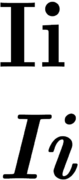 Uppercase and lowercase versions of I, in normal and italic type
 -
 Uppercase and lowercase I in Fraktur


See also[edit]
The template Template:Letter does not use the parameter(s):Character=I9Please see Module:checkparams for help with this warning.
Other representations of I:


English[edit]
Etymology 1[edit]
Pronunciation[edit]
- (phoneme): IPA(key): /aɪ/, /ɪ/, /i/
- (letter name): enPR: ī, IPA(key): /aɪ/
Audio (US) (file) - Rhymes: -aɪ
- Homophones: aye, eye
Letter[edit]
i (lower case, upper case I, plural is or i's)
- The ninth letter of the English alphabet, called i and written in the Latin script.
Usage notes[edit]
The English letter i represents many different sounds, often the diphthong /aɪ/ (from Middle English /iː/), as in the pronoun I, or /ɪ/ as in bit.
See also[edit]
- (Latin script letters) letter; Aa, Bb, Cc, Dd, Ee, Ff, Gg, Hh, Ii, Jj, Kk, Ll, Mm, Nn, Oo, Pp, Qq, Rr, Ss, Tt, Uu, Vv, Ww, Xx, Yy, Zz
Number[edit]
i (lower case, upper case I)
- The ordinal number ninth, derived from this letter of the English alphabet, called i and written in the Latin script.
Noun[edit]
i (plural ies)
- The name of the Latin-script letter I.
- the position of an i-dot (the dot of an i)
- i-mutation, i-umlaut
Alternative forms[edit]
Derived terms[edit]
Translations[edit]
See also[edit]
- (Latin-script letter names) letter; a, bee, cee, dee, e, ef, gee, aitch, i, jay, kay, el, em, en, o, pee, cue, ar, ess, tee, u, vee, double-u, ex, wye, zee/zed (Category: en:Latin letter names)
Etymology 2[edit]
From Old English iċ.
Pronunciation[edit]
Pronoun[edit]
i
- (nonstandard) Alternative letter-case form of I
- 1762, Benj[amin] Stillingfleet, Miscellaneous Tracts Relating to Natural History, Husbandry, and Physick. To Which Is Added the Calendar of Flora., 2nd edition, London: […] R. and J. Dodsley, […]; S. Baker, […]; and T. Payne, […], pages 30 and 32:
- Here follow ſome few lines in the original, which not underſtanding i have omitted. […] Laſtly that amidſt ſo many viciſſitudes of fortune, to which I have been expoſed, amongſt all the goods, i ſay, and evils, the joyfull and gloomy, the pleaſing, and diſagreeable circumſtances of life, thou endowedſt me with an equal, conſtant, manly, and ſuperior ſpirit on every occaſion.
Usage notes[edit]
- Also used in instant messaging due to limitations of entering capitals on a mobile phone's keypad.
- Sometimes to indicate informality, primarily in typed media
Etymology 3[edit]
Abbreviations.
- (stenoscript) a word-initial letter ⟨i⟩
- (stenoscript) the long vowel /aɪ/ at the end of a word, or before a final consonant that is not /dʒ, v, z/. (Note: the final consonant is not written.)
- (stenoscript) the words if, is, it, its
Acehnese[edit]
Pronunciation[edit]
Noun[edit]
i
References[edit]
- 2007. The UCLA Phonetics Lab Archive. Los Angeles, CA: UCLA Department of Linguistics.
Adangme[edit]
Pronoun[edit]
i
- I
- I suɔ mo. ― I love you.
Albanian[edit]
Pronunciation[edit]
Letter[edit]
i (lower case, upper case I)
- The thirteenth letter of the Albanian alphabet, written in the Latin script.
See also[edit]
- (Latin-script letters) shkronjë; A a, B b, C c, Ç ç, D d, Dh dh, E e, Ë ë, F f, G g, Gj gj, H h, I i, J j, K k, L l, Ll ll, M m, N n, Nj nj, O o, P p, Q q, R r, Rr rr, S s, Sh sh, T t, Th th, U u, V v, X x, Xh xh, Y y, Z z, Zh zh
Preposition[edit]
i m
- masculine singular preposition
- of (+ dative)
- Fisi i Malësorëve. ― The tribe of Highlanders.
- Fisi i Malësorëvet. ― The tribe of the Highlanders.
Article[edit]
i m
- masculine singular nominative adjectival article
- the
- Shkurt. I shkurt. I shkurti. ― Short. Short one. The short one. or Short. Shorty. The shorty.
- Madh. I madhi zot. / Zoti i madh. ― Great. The great god.
See also[edit]
See Appendix:Albanian adjectival articles for other forms.
Related terms[edit]
Alemannic German[edit]
Pronoun[edit]
i (unstressed)
Ama[edit]
Pronunciation[edit]
Noun[edit]
i
Anambé[edit]
Noun[edit]
i
Further reading[edit]
- Paul Ehrenreich, Materialien zur Sprachenkunde Brasiliens IV: Vocabulare der Guajajara und Anambē (Para) (1895) (i)
- Wolf Dietrich, Correspondências fonológicas e lexicais entre Karitiána (Arikém, Tupí) e Tupí-Guaraní (y)
Araweté[edit]
Noun[edit]
i
References[edit]
- Eliete de Jesus Bararuá Solano, Descrição gramatical da Língua Araweté, page 80, 2009
Aruá[edit]
Noun[edit]
i
References[edit]
- Čestmír Loukotka, Documents et vocabulaires inédits de langues et de dialectes Sud Américains, JSAP 52: 7-60 (1963), page 44
Azerbaijani[edit]
Pronunciation[edit]
Letter[edit]
i (lower case, upper case İ)
- The fourteenth letter of the Azerbaijani alphabet, written in the Latin script.
See also[edit]
- (Latin script letters) hərf; Aa, Bb, Cc, Çç, Dd, Ee, Əə, Ff, Gg, Ğğ, Hh, Xx, Iı, İi, Jj, Kk, Qq, Ll, Mm, Nn, Oo, Öö, Pp, Rr, Ss, Şş, Tt, Uu, Üü, Vv, Yy, Zz
Bambara[edit]
Pronoun[edit]
í
Basque[edit]
Pronunciation[edit]
Letter[edit]
i (lower case, upper case I)
- The ninth letter of the Basque alphabet, called i and written in the Latin script.
See also[edit]
- (Latin-script letters) A a, B b, C c, (Ç ç), D d, E e, F f, G g, H h, I i, J j, K k, L, l, M m, N n, Ñ ñ, O o, P p, Q q, R r, S s, T t, U u, (Ü ü), V v, W w, X x, Y y, Z z
Noun[edit]
i (indeclinable)
- The name of the Latin-script letter I.
See also[edit]
- (Latin-script letter names) a, be, ze, de, e, efe, ge, hatxe, i, jota, ka, ele, eme, ene, eñe, o, pe, ku, erre, ese, te, u, uve, uve bikoitz, ixa, i greko, zeta
Bavarian[edit]
Alternative forms[edit]
- y (Niederbayerisch)
Etymology[edit]
From Middle High German ich, from Old High German ih, from Proto-West Germanic *ik. Cognates include German ich and Yiddish איך (ikh).
Pronunciation[edit]
Pronoun[edit]
i
- I
- 2013, “I halts nit aus [I can't endure it]”, performed by Hannah:
- I halts nit aus, des Scheißgefühl, i kann di doch liaben wann und wo i will!
- I can't endure this shitty feeling, I can, after all, love you when and where I want!
See also[edit]
| nominative | accusative | dative | |||||
|---|---|---|---|---|---|---|---|
| stressed | unstressed | stressed | unstressed | stressed | unstressed | ||
| 1st person singular | i | — | mi | — | mia (mir) | ma | |
| 2nd person singular (informal) |
du | — | di | — | dia (dir) | da | |
| 2nd person singular (formal) |
Sie | — | Eahna | — | Eahna | — | |
| 3rd person singular | m | er | a | eahm | 'n | eahm | 'n |
| n | es, des | 's | des | 's | |||
| f | se, de | 's | se | 's | ihr | — | |
| 1st person plural | mia (mir) | ma | uns | — | uns | — | |
| 2nd person plural | eß, ihr | — | enk, eich | — | enk, eich | — | |
| 3rd person plural | se | 's | eahna | — | eahna | — | |
Bislama[edit]
Particle[edit]
i
- Separates the subject of a sentence from the predicate, used when the subject is a pronoun or a noun
Borôro[edit]
Pronunciation[edit]
Noun[edit]
i
Bourguignon[edit]
Alternative forms[edit]
Etymology[edit]
From Old French je, from Vulgar Latin eo, from Latin ego. Near cognates include Franc-Comtois i and standard French je.
Pronoun[edit]
i
Related terms[edit]
See Appendix:Bourguignon personal pronouns.
Cameroon Pidgin[edit]
Alternative forms[edit]
- he, she, it (in higher registers closer to English with corresponding gender distinction)
- il, ele (Camfranglais with Romance gender distinction)
Pronunciation[edit]
Pronoun[edit]
i
- 3rd person singular subject personal pronoun
See also[edit]
Catalan[edit]
Etymology 1[edit]
Pronunciation[edit]

|
This entry needs an audio pronunciation. If you are a native speaker with a microphone, please record this word. The recorded pronunciation will appear here when it's ready. |
Noun[edit]
i f (plural is)
Derived terms[edit]
Etymology 2[edit]
From Old Catalan e.
Pronunciation[edit]
Conjunction[edit]
i
- and; used to connect two similar words, phrases, sentences, etc.; as well as; together with; in addition to
- Hi ha moltes colomes i teuladins. ― There are many pigeons and sparrows.
- Ella escriu els articles i ell els il·lustra amb els seus dibuixos. ― She writes the articles and he illustrates them with his drawings.
Alternative forms[edit]
References[edit]
- “i” in Diccionari de la llengua catalana, segona edició, Institut d’Estudis Catalans.
- chapter I, in Gran Diccionari de la Llengua Catalana, Grup Enciclopèdia Catalana, 2024
- “i” in Diccionari normatiu valencià, Acadèmia Valenciana de la Llengua.
- “i” in Diccionari català-valencià-balear, Antoni Maria Alcover and Francesc de Borja Moll, 1962.
Cemuhî[edit]
Etymology[edit]
From Proto-Oceanic *kutu.
Noun[edit]
i
References[edit]
- Jim Hollyman,K. J. Hollyman, Études sur les langues du Nord de la Nouvelle-Calédonie, page 52, 1999
Chuukese[edit]
Pronoun[edit]
i
Related terms[edit]
Cimbrian[edit]
Alternative forms[edit]
Etymology[edit]
From Middle High German ich, from Old High German ih, from Proto-West Germanic *ik. Cognate with German ich, English I.
Pronoun[edit]
i
Inflection[edit]
| Personal pronouns | ||
|---|---|---|
| singular | plural | |
| 1st person | i | biar |
| 2nd person | du | iar |
| 3rd person | er, si, 'z | se |
References[edit]
- Patuzzi, Umberto, ed., (2013) Luserna / Lusérn: Le nostre parole / Ünsarne börtar / Unsere Wörter [Our Words], Luserna, Italy: Comitato unitario delle isole linguistiche storiche germaniche in Italia / Einheitskomitee der historischen deutschen Sprachinseln in Italien
Classical Nahuatl[edit]
Pronunciation[edit]
Verb[edit]
ī
- (transitive) to drink
Cornish[edit]
Pronoun[edit]
i
Corsican[edit]
Etymology[edit]
From the earlier li. Compare Italian i (“the”) and Romanian îi (“them”).
Article[edit]
i m pl (masculine singular u, feminine singular a, feminine plural e)
- the (masculine plural)
Usage notes[edit]
- Before a vowel, i turns into l'.
Pronoun[edit]
i m pl
- them (direct object)
Usage notes[edit]
- Before a vowel, i turns into l'.
See also[edit]
References[edit]
Czech[edit]
Etymology[edit]
From Proto-Slavic *i.
Pronunciation[edit]
Conjunction[edit]
i
Derived terms[edit]
Further reading[edit]
- i in Příruční slovník jazyka českého, 1935–1957
- i in Slovník spisovného jazyka českého, 1960–1971, 1989
Dalmatian[edit]
Etymology[edit]
From Latin illī, nominative masculine plural of ille. Compare Italian i, gli.
Article[edit]
i
- the; masculine plural definite article
Related terms[edit]
Dama (Sierra Leone)[edit]
Etymology[edit]
Likely cognate with Vai [script needed] (i, “you”).
Pronoun[edit]
i
- The meaning of this term is uncertain. Possibilities include:
Usage notes[edit]
The rememberer who glossed this word did so as "I", but Dalby proposes that this is an error, based on the Vai pronouns.
References[edit]
- Dalby, T. D. P. (1963) “The extinct language of Dama”, in Sierra Leone Language Review, volume 2, Freetown: Fourah Bay College, pages 50–54
Danish[edit]
Etymology[edit]
From Old Norse í, from Proto-Germanic *in, from Proto-Indo-European *en.
Pronunciation[edit]
Preposition[edit]
i
- in, inside
- Indicates exponentiation.
- Tre i femte. ― Three to the power of five. (short for tre i femte potens, three in fifth power). [note that the exponent is in the ordinal form]
- for (some duration)
- Jeg har boet her i tre år. ― I have lived here for three years.
- Used to indicate a past time or period when something took place.
- Han fyldte seks år i mandags. ― He turned six years old on Monday.
- Used to indicate regular presence in a location.
- Pigen går i gymnasiet og er 17 år ― The girl goes to high school and is 17 years old.
- Used in conjunction with time to indicate a number of minutes before a full hour.
- Fem minutter i tolv. ― Five minutes to twelve.
- Used when indicating that something is happening or repeated a number of times within each time period .
- Tre gange i timen. ― Three times a day
- Indicates affiliation with a profession.
- Professor i fysik ― Professor of physics
Drehu[edit]
Pronunciation[edit]
Noun[edit]
i
References[edit]
- Tyron, D.T., Hackman, B. (1983) Solomon Islands languages: An internal classification. Cited in: "Dehu" in Greenhill, S.J., Blust, R., & Gray, R.D. (2008). The Austronesian Basic Vocabulary Database: From Bioinformatics to Lexomics. Evolutionary Bioinformatics, 4:271–283.
- Leenhardt, M. (1946) Langues et dialectes de l'Austro-Mèlanèsie. Cited in: "ⁿDe’u" in Greenhill, S.J., Blust, R., & Gray, R.D. (2008). The Austronesian Basic Vocabulary Database: From Bioinformatics to Lexomics. Evolutionary Bioinformatics, 4:271–283.
Dutch[edit]
Pronunciation[edit]
Letter[edit]
i (lower case, upper case I)
- The ninth letter of the Dutch alphabet, written in the Latin script.
See also[edit]
- (Latin-script letters) letter; A a (Á á, Ä ä), B b, C c, D d, E e (É é, Ë ë), F f, G g, H h, I i (Í í, Ï ï, IJ ij), J j, K k, L l, M m, N n, O o (Ó ó, Ö ö), P p, Q q, R r, S s, T t, U u (Ú ú, Ü ü), V v, W w, X x, Y y (Ý ý), Z z
Elfdalian[edit]
Etymology[edit]
From Old Norse í, from Proto-Germanic *in. Cognate with Swedish i.
Preposition[edit]
i
Emilian[edit]
Alternative forms[edit]
Etymology[edit]
From Latin illī (“they”) (nominative plural of ille).
Pronunciation[edit]
Pronoun[edit]
i (personal)
Related terms[edit]
| Number | Person | Gender | Disjunctive (tonic) |
Nominative (subject) |
Accusative (direct complement) |
Dative (indirect complement) |
Reflexive (-self) |
Comitative (with) |
|---|---|---|---|---|---|---|---|---|
| Singular | First | — | mè | a | me | mêg | ||
| Second | — | tè | et | te | têg | |||
| Third | Masculine | ló | al | ge | se | sêg | ||
| Feminine | lê | la | ||||||
| Plural | First | Masculine | nuēter | a | se | nōsk | ||
| Feminine | nuētri | |||||||
| Second | Masculine | vuēter | a | ve | vōsk | |||
| Feminine | vuētri | |||||||
| Third | Masculine | lôr | i | ge | se | sêg | ||
| Feminine | el | li | ||||||
Esperanto[edit]
Pronunciation[edit]
Letter[edit]
i (lower case, upper case I)
- The twelfth letter of the Esperanto alphabet, called i and written in the Latin script.
See also[edit]
- (Latin script letters) litero; Aa, Bb, Cc, Ĉĉ, Dd, Ee, Ff, Gg, Ĝĝ, Hh, Ĥĥ, Ii, Jj, Ĵĵ, Kk, Ll, Mm, Nn, Oo, Pp, Rr, Ss, Ŝŝ, Tt, Uu, Ŭŭ, Vv, Zz
Noun[edit]
i (accusative singular i-on, plural i-oj, accusative plural i-ojn)
- The name of the Latin-script letter I.
See also[edit]
- (Latin-script letter names) litero; a, bo, co, ĉo, do, e, fo, go, ĝo, ho, ĥo, i, jo, ĵo, ko, lo, mo, no, o, po, ro, so, ŝo, to, u, ŭo, vo, zo
Estonian[edit]
Pronunciation[edit]
Letter[edit]
i (lower case, upper case I)
- The ninth letter of the Estonian alphabet, called ii and written in the Latin script.
See also[edit]
- (Latin-script letters) täht; A a, B b (C c), D d, E e, F f, G g, H h, I i, J j, K k, L l, M m, N n, O o, P p (Q q), R r, S s, Š š, Z z, Ž ž, T t, U u, V v (W w), Õ õ, Ä ä, Ö ö, Ü ü (X x, Y y)
Extremaduran[edit]
Conjunction[edit]
i
Fala[edit]
Alternative forms[edit]
Etymology[edit]
From Old Galician-Portuguese e.
Conjunction[edit]
i
- and (expressing two elements to be taken together)
Quotations[edit]
For more quotations using this term, see Citations:i.
Faroese[edit]
Pronunciation[edit]
Letter[edit]
i (upper case I)
- The tenth letter of the Faroese alphabet, called i and written in the Latin script.
See also[edit]
- (Latin script letters) bókstavur; Aa, Áá, Bb, Dd, Ðð, Ee, Ff, Gg, Hh, Ii, Íí, Jj, Kk, Ll, Mm, Nn, Oo, Óó, Pp, Rr, Ss, Tt, Uu, Úú, Vv, Yy, Ýý, Ææ, Øø
Noun[edit]
i n (genitive singular is, plural i)
- The name of the Latin-script letter I.
Declension[edit]
| Declension of i | ||||
|---|---|---|---|---|
| n4 | singular | plural | ||
| indefinite | definite | indefinite | definite | |
| nominative | i | iið | i | iini |
| accusative | i | iið | i | iini |
| dative | i, ii | inum | ium | iunum |
| genitive | is | isins | ia | ianna |
See also[edit]
- (Latin-script letter names) bókstavur; a / fyrra a, á, be, de, edd, e, eff, ge, há, i / fyrra i, í / fyrra í, jodd, ká, ell, emm, enn, o, ó, pe, err, ess, te, u, ú, ve, seinna i, seinna í, seinna a, ø
Finnish[edit]
Etymology[edit]
The Finnish orthography using the Latin script was based on those of Swedish, German and Latin, and was first used in the mid-16th century. No earlier script is known. See the Wikipedia article on Finnish for more information, and i for information on the development of the glyph itself.
Pronunciation[edit]
Letter[edit]
i (lower case, upper case I)
- The ninth letter of the Finnish alphabet, called ii and written in the Latin script.
See also[edit]
- (Latin-script letters) kirjain; A a, B b, C c, D d, E e, F f, G g, H h, I i, J j, K k, L l, M m, N n, O o, P p, Q q, R r, S s (Š š), T t, U u, V v (W w), X x, Y y, Z z (Ž ž), Å å, Ä ä, Ö ö
Foi[edit]
Noun[edit]
i
French[edit]
Pronunciation[edit]
Noun[edit]
i m (plural is)
- The name of the Latin-script letter I.
Derived terms[edit]
Friulian[edit]
| Friulian Definite Articles | ||
|---|---|---|
| singular | plural | |
| masculine | il l' |
i |
| feminine | la l' |
lis |
Etymology[edit]
Article[edit]
i m pl (singular il)
Pronoun[edit]
i (third person masculine/ feminine indirect object)
See also[edit]
Fula[edit]
Letter[edit]
i (lower case, upper case I)
- A letter of the Fula alphabet, written in the Latin script.
Usage notes[edit]
See also[edit]
- (Latin-script letters) karfeeje; ', A a, B b, Mb mb, Ɓ ɓ, C c, D d, Nd nd, Ɗ ɗ, E e, F f, G g, Ng ng, Ɠ ɠ, H h, I i, J j, Nj nj, K k, L l, M m, N n, Ŋ ŋ, Ñ ñ, Ɲ ɲ, O o, P p, R r, S s, T t, U u, W w, Y y, Ƴ ƴ
Galician[edit]
Etymology 1[edit]
Pronunciation[edit]
Letter[edit]
i (lower case, upper case I)
- The ninth letter of the Galician alphabet, written in the Latin script.
Noun[edit]
i m (plural is)
- The name of the Latin-script letter I.
Etymology 2[edit]
Alternative forms[edit]
Pronunciation[edit]
Particle[edit]
i
- an antihiatical particle that, due to sandhi, can precede a word which begins with a vowel sound after a word which ends with vowel sound; now rarely represented in written language
- 1594, anonymous author, Entremés dos pastores:
- Ay Jan cata non te enfermes, nen sentencies con malicia, cata que a yalma perdes.
- Oh, Xan, watch out, don't get sick, nor sentence with meanness, watch out that your soul you're loosing
Gothic[edit]
Romanization[edit]
i
- Romanization of 𐌹
Guinea-Bissau Creole[edit]
Etymology 1[edit]
From Portuguese ele.
Pronoun[edit]
i
Etymology 2[edit]
From Portuguese e. Cognate with Spanish y.
Conjunction[edit]
i
Haitian Creole[edit]
Pronunciation[edit]
Pronoun[edit]
i
- (Okap dialect) he, she, it
Hawaiian[edit]
Etymology[edit]
From Proto-Polynesian *i.
Pronunciation[edit]
Particle[edit]
i
- used to mark the following (noun or noun phrase) as a direct object
- Ua ʻai ka pōpoki i ka ʻiole. ― The cat ate the mouse.
- used to indicate past tense (precedes verb)
- I hana au. ― I worked.
- used to indicate perfect participle (precedes verb)
- i haʻalele ― having left, who had left
Preposition[edit]
i
See also[edit]
Hokkien[edit]
| For pronunciation and definitions of i – see 伊 (“he, him; she, her; it”). (This term is the pe̍h-ōe-jī form of 伊). |
Hungarian[edit]
Pronunciation[edit]
- (phoneme): IPA: [ˈi]
- (letter name): IPA: [ˈi]
Letter[edit]
i (lower case, upper case I)
- The fifteenth letter of the Hungarian alphabet, called i and written in the Latin script.
Declension[edit]
| Inflection (stem in long/high vowel, front unrounded harmony) | ||
|---|---|---|
| singular | plural | |
| nominative | i | i-k |
| accusative | i-t | i-ket |
| dative | i-nek | i-knek |
| instrumental | i-vel | i-kkel |
| causal-final | i-ért | i-kért |
| translative | i-vé | i-kké |
| terminative | i-ig | i-kig |
| essive-formal | i-ként | i-kként |
| essive-modal | — | — |
| inessive | i-ben | i-kben |
| superessive | i-n | i-ken |
| adessive | i-nél | i-knél |
| illative | i-be | i-kbe |
| sublative | i-re | i-kre |
| allative | i-hez | i-khez |
| elative | i-ből | i-kből |
| delative | i-ről | i-kről |
| ablative | i-től | i-ktől |
| non-attributive possessive - singular |
i-é | i-ké |
| non-attributive possessive - plural |
i-éi | i-kéi |
| Possessive forms of i | ||
|---|---|---|
| possessor | single possession | multiple possessions |
| 1st person sing. | i-m | i-im |
| 2nd person sing. | i-d | i-id |
| 3rd person sing. | i-je | i-i |
| 1st person plural | i-nk | i-ink |
| 2nd person plural | i-tek | i-itek |
| 3rd person plural | i-jük | i-ik |
See also[edit]
- (Latin-script letters) betű; A a, Á á, B b, C c, Cs cs, D d, Dz dz, Dzs dzs, E e, É é, F f, G g, Gy gy, H h, I i, Í í, J j, K k, L l, Ly ly, M m, N n, Ny ny, O o, Ó ó, Ö ö, Ő ő, P p, R r, S s, Sz sz, T t, Ty ty, U u, Ú ú, Ü ü, Ű ű, V v, Z z, Zs zs. Only in the extended alphabet: Q q W w X x Y y. Commonly used: ch. Also defined: à ë. In surnames (selection): ä aa cz ds eé eö ew oe oó th ts ÿ.
Further reading[edit]
- i in Bárczi, Géza and László Országh. A magyar nyelv értelmező szótára (’The Explanatory Dictionary of the Hungarian Language’). Budapest: Akadémiai Kiadó, 1959–1962. Fifth ed., 1992: →ISBN
Icelandic[edit]
Pronunciation[edit]
Letter[edit]
i (upper case I)
- The eleventh letter of the Icelandic alphabet, written in the Latin script.
See also[edit]
- (Latin-script letters) bókstafur; A a, Á á, B b, D d, Ð ð, E e, É é, F f, G g, H h, I i, Í í, J j, K k, L l, M m, N n, O o, Ó ó, P p, R r, S s, T t, U u, Ú ú, V v, X x, Y y, Ý ý, Þ þ, Æ æ, Ö ö
Ido[edit]
Pronunciation[edit]
Letter[edit]
i (upper case I)
- The ninth letter of the Ido alphabet, written in the Latin script.
See also[edit]
- (Latin-script letters) litero; A a, B b, C c, D d, E e, F f, G g, H h, I i, J j, K k, L, l, M m, N n, O o, P p, Q q, R r, S s, T t, U u, V v, W w, X x, Y y, Z z
Igbo[edit]
Etymology 1[edit]
Pronunciation[edit]
Letter[edit]
i (lower case, upper case I)
- The twelfth letter of the Igbo alphabet, written in the Latin script.
Etymology 2[edit]
Alternative forms[edit]
- ị (retracted tongue position)
Pronunciation[edit]
Pronoun[edit]
i (dependent form, independent form gị)
- (personal) you (singular)
- Kedụ ka i mere?
- How are you?
See also[edit]
Indonesian[edit]
Pronunciation[edit]
Letter[edit]
i (lower case, upper case I)
- The ninth letter of the Indonesian alphabet, written in the Latin script.
See also[edit]
- (Latin-script letters) huruf; A a, B b, C c, D d, E e, F f, G g, H h, I i, J j, K k, L l, M m, N n, O o, P p, Q q, R r, S s, T t, U u, V v, W w, X x, Y y, Z z
Ingrian[edit]
Etymology[edit]
Pronunciation[edit]
Conjunction[edit]
i
- and
- Miä läkkään ižoraks i soomeks. ― I speak Ingrian and Finnish.
- 1936, N. A. Iljin and V. I. Junus, Bukvari iƶoroin șkouluja vart, Leningrad: Riikin Ucebno-pedagogiceskoi Izdateljstva, page 19:
- Repo i kana.
- A fox and a hen.
Synonyms[edit]
Particle[edit]
i
- also, as well, too
- Mut, miä läkkään i viroks. ― But, I speak Estonian, too.
- 1885, “Sprachproben: Der goldene Vogel”, in Volmari Porkka, editor, Ueber den Ingrischen Dialekt mit Berücksichtigung der übrigen finnisch-ingermanländischen Dialekte:
- Mäni da i heittiis makkaamaa, ja makkais taas hoomuksee nasse.
- He went and threw himself to sleep, too, and he slept up till the morning again.
- 1936, V. I. Junus, Iƶoran Keelen Grammatikka[2], Leningrad: Riikin Ucebno-pedagogiceskoi Izdateljstva, page 3:
- Iƶorat laatiit kansan, kumpa keelen poolest kuuluu läns-fenniläisiin kansoin gruppaa ja sil viisii i iƶoroin keeli kuuluu läns-fenniläisee keelisisteemaa.
- The Ingrians make up a people, that based on their language belongs to the group of Finnic peoples and as such the language of Ingrians also belongs to the Finnic language family.
Synonyms[edit]
References[edit]
- Ruben E. Nirvi (1971) Inkeroismurteiden Sanakirja, Helsinki: Suomalais-Ugrilainen Seura, page 86
- Olga I. Konkova, Nikita A. Dyachkov (2014) Inkeroin Keel: Пособие по Ижорскому Языку[3], →ISBN, page 79
Irish[edit]
Alternative forms[edit]
- in (used before vowels in place of eclipsis; also used before bhur (“your”, pl), dhá (“two”), titles of books, films, and the like, and foreign words that resist mutation)
Etymology[edit]
From Old Irish i, from Proto-Celtic *eni (compare Welsh yn), from Proto-Indo-European *en (compare English in, Latin in, Ancient Greek ἐν (en)).
Pronunciation[edit]
Preposition[edit]
i (plus dative, triggers eclipsis, before the definite article s-, ins)
Inflection[edit]
Derived terms[edit]
| Basic form | Contracted with | Copular forms | ||||||||
|---|---|---|---|---|---|---|---|---|---|---|
| an (“the sg”) | na (“the pl”) | mo (“my”) | do (“your”) | a (“his, her, their; which (present)”) | ár (“our”) | ar (“which (past)”) | (before consonant) | (present/future before vowel) | (past/conditional before vowel) | |
| de (“from”) | den | de na desna* |
de mo dem* |
de do ded*, det* |
dá | dár | dar | darb | darbh | |
| do (“to, for”) | don | do na dosna* |
do mo dom* |
do do dod*, dot* |
dá | dár | dar | darb | darbh | |
| faoi (“under, about”) | faoin | faoi na | faoi mo | faoi do | faoina | faoinár | faoinar | faoinarb | faoinarbh | |
| i (“in”) | sa, san | sna | i mo im* |
i do id*, it* |
ina | inár | inar | inarb | inarbh | |
| le (“with”) | leis an | leis na | le mo lem* |
le do led*, let* |
lena | lenár | lenar | lenarb | lenarbh | |
| ó (“from, since”) | ón | ó na ósna* |
ó mo óm* |
ó do ód*, ót* |
óna | ónár | ónar | ónarb | ónarbh | |
| trí (“through”) | tríd an | trí na | trí mo | trí do | trína | trínár | trínar | trínarb | trínarbh | |
| *Dialectal. | ||||||||||
See also Category:Irish phrasal verbs with particle (i)
Mutation[edit]
| Irish mutation | |||
|---|---|---|---|
| Radical | Eclipsis | with h-prothesis | with t-prothesis |
| i | n-i | hi | not applicable |
| Note: Some of these forms may be hypothetical. Not every possible mutated form of every word actually occurs. | |||
References[edit]
- Ó Dónaill, Niall (1977) chapter I, in Foclóir Gaeilge–Béarla, Dublin: An Gúm, →ISBN
Italian[edit]
Etymology 1[edit]
Reduced form of gli, from earlier li, from Latin illī (nominative plural and dative singular of ille).[1]
Pronunciation[edit]
Article[edit]
| Italian Definite Articles | ||
|---|---|---|
| singular | plural | |
| masculine | il lo/l' |
i gli |
| feminine | la/l' | le |
i m pl (singular il)
Usage notes[edit]
- i is used before masculine plural words beginning with a single consonant other than x or z, or the plural noun dei; gli is used before masculine plural words beginning with a vowel, x, z, gn, or multiple consonants including pn, ps, and s+consonant, and before the plural noun dei.
Derived terms[edit]
Etymology 2[edit]
From Latin ī (the name of the letter I).
Pronunciation[edit]
Letter[edit]
i f or m (invariable, lower case, upper case I)
- The ninth letter of the Italian alphabet, called i and written in the Latin script.
Noun[edit]
i f (invariable)
- The name of the Latin-script letter I.; i
Derived terms[edit]
See also[edit]
- (Latin-script letter names) lettera; a, bi, ci, di, e, effe, gi, acca, i, i lunga, kappa, elle, emme, enne, o, pi, cu, erre, esse, ti, u, vu, doppia vu, ics, ipsilon, zeta
References[edit]
Further reading[edit]
- i in Luciano Canepari, Dizionario di Pronuncia Italiana (DiPI)
Italiot Greek[edit]
Etymology[edit]
From Ancient Greek ἡ (hē)
Article[edit]
i
Iu Mien[edit]
Etymology[edit]
From Proto-Hmong-Mien *ʔu̯i (“two”). Cognate with White Hmong ob and Western Xiangxi Miao [Fenghuang] oub.
Numeral[edit]
i
Japanese[edit]
Romanization[edit]
i
Kabuverdianu[edit]
Etymology[edit]
From Spanish y and Portuguese e.
Conjunction[edit]
i
Kabyle[edit]
Etymology[edit]
(This etymology is missing or incomplete. Please add to it, or discuss it at the Etymology scriptorium.)
Preposition[edit]
i
Kashubian[edit]
Pronunciation[edit]
Etymology 1[edit]
The Kashubian orthography is based on the Latin alphabet. No earlier script is known. See the Kashubian alphabet article on Wikipedia for more, and i for development of the glyph itself.
Letter[edit]
i (lower case, upper case I)
- The thirteenth letter of the Kashubian alphabet, written in the Latin script.
See also[edit]
- (Latin-script letters) A a, Ą ą, Ã ã, B b, C c, D d, E e, É é, Ë ë, F f, G g, H h, I i, J j, K k, L l, Ł ł, M m, N n, O o, Ò ò, Ó ó, Ô ô, P p, R r, S s, T t, U u, Ù ù, W w, Y y, Z z, Ż ż
Etymology 2[edit]
Inherited from Proto-Slavic *i.
Conjunction[edit]
i
- coordinating conjunction; and
Alternative forms[edit]
Further reading[edit]
- Eùgeniusz Gòłąbk (2011) chapter I, in Słownik Polsko-Kaszubski / Słowôrz Pòlskò-Kaszëbsczi[4], volume 1, page 515
- chapter I, in Internetowi Słowôrz Kaszëbsczégò Jãzëka [Internet Dictionary of the Kashubian Language], Fundacja Kaszuby, 2022
Ladin[edit]
Article[edit]
i m (plural)
See also[edit]
Ladino[edit]
Etymology[edit]
From Old Spanish é or e, from Latin et.
Conjunction[edit]
i (Latin spelling, Hebrew spelling אי)
Latgalian[edit]
Etymology[edit]
Shortened from Proto-Balto-Slavic *ir, from Proto-Indo-European *h₂r̥- (“thus”), preserved as such in Latvian ir and Lithuanian ir. Not related to Proto-Slavic *i and its descendants.
Pronunciation[edit]
Conjunction[edit]
i
Particle[edit]
i
References[edit]
- Nicole Nau (2011) A short grammar of Latgalian, München: LINCOM GmbH, →ISBN
Latin[edit]
Pronunciation[edit]
Etymology 1[edit]
(This etymology is missing or incomplete. Please add to it, or discuss it at the Etymology scriptorium.)
Noun[edit]
ī f (indeclinable)
- The name of the letter I.
Coordinate terms[edit]
- (Latin-script letter names) littera; ā, bē, cē, dē, ē, ef, gē, hā / *acca, ī, kā, el, em, en, ō, pē, kū, er, es, tē, ū, ix / īx / ex, ȳ / ī graeca / ȳpsīlon, zēta
References[edit]
- i in Charles du Fresne du Cange’s Glossarium Mediæ et Infimæ Latinitatis (augmented edition with additions by D. P. Carpenterius, Adelungius and others, edited by Léopold Favre, 1883–1887)
- i in Harry Thurston Peck, editor (1898), Harper's Dictionary of Classical Antiquities, New York: Harper & Brothers
- Arthur E. Gordon, The Letter Names of the Latin Alphabet (University of California Press, 1973; volume 9 of University of California Publications: Classical Studies), part III: “Summary of the Ancient Evidence”, page 32: "Clearly there is no question or doubt about the names of the vowels A, E, I, O, U. They are simply long A, long E, etc. (ā, ē, ī, ō, ū). Nor is there any uncertainty with respect to the six mutes B, C, D, G, P, T. Their names are bē, cē, dē, gē, pē, tē (each with a long E). Or about H, K, and Q: they are hā, kā, kū—each, again, with a long vowel sound."
Etymology 2[edit]
(This etymology is missing or incomplete. Please add to it, or discuss it at the Etymology scriptorium.)
Verb[edit]
ī
- go! walk!; second-person singular active imperative of eō
- I intro iam nunc. ― Now then, go in.
Latvian[edit]

Etymology[edit]
Proposed in 1908 as part of the new Latvian spelling by the scientific commission headed by K. Mīlenbahs, which was accepted and began to be taught in schools in 1909. Prior to that, Latvian had been written in German Fraktur, and sporadically in Cyrillic.
Pronunciation 1[edit]
- IPA: [i]
(file)
Letter[edit]
i (lower case, upper case I)
- The thirteenth letter of the Latvian alphabet, called i and written in the Latin script.
See also[edit]
- (Latvian letters) latviešu burti; Aa, Āā, Bb, Cc, Čč, Dd, Ee, Ēē, Ff, Gg, Ģģ, Hh, Ii, Īī, Jj, Kk, Ķķ, Ll, Ļļ, Mm, Nn, Ņņ, Oo, Pp, Rr, Ss, Šš, Tt, Uu, Ūū, Vv, Zz, Žž
Pronunciation 2[edit]
- IPA: [i]
Noun[edit]
i m (invariable)
- The name of the Latin-script letter I.
See also[edit]
- (Latvian letter names) latviešu burtu vārdi; a, garais ā, bē, cē, čē, dē, e, garais ē, ef, gā, ģē, hā, i, garais ī, jē, kā, ķē, el, eļ, em, en, eņ, o, pē, er, es, eš, tē, u, garais ū, vē, zē, žē
Liangmai Naga[edit]
Pronunciation[edit]
Pronoun[edit]
Ligurian[edit]
| Ligurian Definite Articles | ||
|---|---|---|
| singular | plural | |
| masculine | o | i |
| feminine | a | e |
Pronunciation[edit]
Article[edit]
i m pl (singular o)
Lithuanian[edit]
Pronunciation[edit]
Letter[edit]
i (upper case I)
- The thirteenth letter of the Lithuanian alphabet, called i trumpoji and written in the Latin script.
See also[edit]
- (Latin-script letters) A a, Ą ą, B b, C c, Č č, D d, E e, Ę ę, Ė ė, F f, G g, H h, I i, Į į, Y y, J j, K k, L l, M m, N n, O o, P p, R r, S s, Š š, T t, U u, Ų ų, Ū ū, V v, Y y, Z z, Ž ž
Livonian[edit]
Pronunciation[edit]
- (phoneme) IPA: /i/
Letter[edit]
i (upper case I)
- The thirteenth letter of the Livonian alphabet, written in the Latin script.
Lower Grand Valley Dani[edit]
Pronunciation[edit]
Noun[edit]
i
References[edit]
- H. Myron Bromley, A Grammar of Lower Grand Valley Dani (1981)
- H. Myron Bromley, The Phonology of Lower Grand Valley Dani (2013)
- The Papuan Languages of New Guinea (1986, →ISBN
Lower Sorbian[edit]
Pronunciation[edit]
Letter[edit]
i (upper case I)
- The thirteenth letter of the Lower Sorbian alphabet, called i and written in the Latin script.
- The name of the Latin-script letter i.
Conjunction[edit]
i
Interjection[edit]
i!
See also[edit]
Further reading[edit]
- Muka, Arnošt (1921, 1928) chapter I, in Słownik dolnoserbskeje rěcy a jeje narěcow (in German), St. Petersburg, Prague: ОРЯС РАН, ČAVU; Reprinted Bautzen: Domowina-Verlag, 2008
- Starosta, Manfred (1999) chapter I, in Dolnoserbsko-nimski słownik / Niedersorbisch-deutsches Wörterbuch (in German), Bautzen: Domowina-Verlag
Lule Sami[edit]
Verb[edit]
i
Lushootseed[edit]
Pronunciation[edit]
Letter[edit]
i
- The fifteenth letter of the Lushootseed alphabet, pronounced as a non-low front unrounded vowel.
Makasar[edit]
Article[edit]
i (Lontara spelling ᨕᨗ)
- article for personal names and pronouns
Malay[edit]
Letter[edit]
i
- The ninth letter of the Malay alphabet, written in the Latin script.
See also[edit]
- (Latin script letters) Aa, Bb, Cc, Dd, Ee, Ff, Gg, Hh, Ii, Jj, Kk, Ll, Mm, Nn, Oo, Pp, Qq, Rr, Ss, Tt, Uu, Vv, Ww, Xx, Yy, Zz
Maltese[edit]
Pronunciation[edit]
- IPA(key): /ɪ/ (short phoneme)
- IPA(key): /iː/ (long phoneme)
- IPA(key): /ɪː/ (long phoneme before the letters għ, ħ, h, q; merges with ie)
- IPA(key): /ɛj/, /aj/ (after għ; variation is regional and idiolectal)
Letter[edit]
i (upper case I)
- The twelfth letter of the Maltese alphabet, written in the Latin script.
See also[edit]
- (Latin-script letters) ittra; A a, B b, Ċ ċ, D d, E e, F f, Ġ ġ, G g, Għ għ, H h, Ħ ħ, I i, Ie ie, J j, K k, L l, M m, N n, O o, P p, Q q, R r, S s, T t, U u, V v, W w, X x, Ż ż, Z z
Mandinka[edit]
Pronoun[edit]
i
- you (personal pronoun)
- as i busa ― he/she struck you.
See also[edit]
Maori[edit]
Etymology[edit]
From Proto-Polynesian *i.
Particle[edit]
i
- from
- past-tense verbal particle
- particle indicating the direct object of a transitive sentence
- past-tense particle indicating location
Masurian[edit]
Etymology[edit]
Inherited from Old Polish i.
Pronunciation[edit]
Conjunction[edit]
i
Particle[edit]
i
- begins a statement
- even
Further reading[edit]
- Zofia Stamirowska (1987-2021) chapter I, in Anna Basara, editor, Słownik gwar Ostródzkiego, Warmii i Mazur[5], volume 3, Zakład Narodowy im. Ossolińskich Wydawnictwo Polskiej Akademii Nauk, →ISBN, page 30
Middle English[edit]
Etymology 1[edit]
Preposition[edit]
i
- Alternative form of in (“in”)
Etymology 2[edit]
Pronoun[edit]
i
- Alternative form of I (“I”)
Etymology 3[edit]
Pronoun[edit]
i
- Alternative form of he (“they”)
Middle Low German[edit]
Pronunciation[edit]
Pronoun[edit]
i m
- Alternative form of gî.
Mirandese[edit]
Etymology[edit]
Pronunciation[edit]
Conjunction[edit]
i
Mòcheno[edit]
Etymology[edit]
From Middle High German ich, from Old High German ih, from Proto-West Germanic *ik, from Proto-Germanic *ek. Cognate with German ich, English I.
Pronoun[edit]
i (dative mer)
Inflection[edit]
| Personal pronouns | ||
|---|---|---|
| singular | plural | |
| 1st person | i | biar |
| 2nd person | du | ir |
| 3rd person | er, si, s | sei |
References[edit]
- “i” in Cimbrian, Ladin, Mòcheno: Getting to know 3 peoples. 2015. Servizio minoranze linguistiche locali della Provincia autonoma di Trento, Trento, Italy.
Mondé[edit]
Noun[edit]
i
References[edit]
- Čestmír Loukotka, Documents et vocabulaires inédits de langues et de dialectes Sud Américains, JSAP 52: 7-60 (1963), page 44
Murui Huitoto[edit]
Pronunciation[edit]
Root[edit]
i
Derived terms[edit]
References[edit]
- Katarzyna Izabela Wojtylak (2017) A grammar of Murui (Bue): a Witotoan language of Northwest Amazonia.[6], Townsville: James Cook University press (PhD thesis), page 161
[edit]
Letter[edit]
i (upper case I)
- The thirteenth letter of the Navajo alphabet, written in the Latin script:
- i = /ɪ˨/
- į = /ɪ̃˨/
- í = /ɪ˥/
- į́ = /ɪ̃˥/
- ii = /iː˨˨/
- įį = /ĩː˨˨/
- íi = /iː˥˨/
- į́į = /ĩː˥˨/
- ií = /iː˨˥/
- įį́ = /ĩː˨˥/
- íí = /iː˥˥/
- į́į́ = /ĩː˥˥/
Neapolitan[edit]
Etymology 1[edit]
Verb[edit]
i
Etymology 2[edit]
Alternative forms[edit]
Pronunciation[edit]
Pronoun[edit]
i
- I: the first-person singular nominative personal pronoun.
Nheengatu[edit]
Etymology[edit]
Pronunciation[edit]
- Hyphenation: i
- Rhymes: -i
Pronoun[edit]
i
- (second-class) third-person singular personal pronoun (he, him, his, she, her, it, its)
- I akanhemu uikú nhaãsé i kirá uikú.
- He is scared because he is fat.
- Indé reputari repitá i irũmu.
- You want to stay with him.
- Indé remeẽ manungara i xupé.
- You give something to him.
- I manha uwiké uka pisasú upé.
- His mother enters the new house.
Usage notes[edit]
- As a second-class pronoun, i is used as the subject of a sentence when its verb is a second-class one (those verbs are sometimes referred to as adjectives). The personal pronoun i is also used when governed by any postposition with the exception of arama. Unlike other second-class pronouns, i is used when governed by the postposition supé. Finally, i is used as a possessive pronoun as well.
See also[edit]
| singular | first-class pronoun | second-class pronoun |
|---|---|---|
| first-person | ixé | se |
| second-person | indé | ne |
| third-person | aé | i |
| plural | first-class pronoun | second-class pronoun |
| first-person | yandé | yané |
| second-person | penhẽ | pe |
| third-person | aintá (or tá) | aintá (or tá) |
References[edit]
- ÁVILA, Marcel Twardowsky (2021) Proposta de dicionário nheengatu–português, page 311
- NAVARRO, Eduardo de Almeida (2016) Curso de língua geral (nheengatu ou tupi moderno): a língua das origens da civilização amazônica, 2nd edition, →ISBN, pages 11 and 104
North Frisian[edit]
Pronunciation[edit]
Pronoun[edit]
i
See also[edit]
- juu (object and possessive form)
Norwegian Bokmål[edit]
Etymology[edit]
From Old Norse í (“in”), from Proto-Germanic *in (“in, into”), from Proto-Indo-European *én (“in”).
Pronunciation[edit]
Letter[edit]
i
- The ninth letter of the Norwegian Bokmål alphabet, written in the Latin script.
Preposition[edit]
i
- (location) in, inside of
- Ligge i sengen ― Laying in bed
- Oppe i fjellene ― Up in the mountains
- (duration of time) for, in, during
- Møtet varte (i) to timer ― The meeting lasted two hours (literally, “The meeting went during two hours”)
- Han var utenlands i mange år ― He lived abroad for many years
- I høst, i vår, i dag, i går ― In autumn, in spring, today, yesterday
- (condition, state) in
- Være i fred ― To be in peace
- Være i god form ― To be in shape (physically fit)
- Leve i fattigdom ― To live in poverty
- (means, method) in
- Betale i gull ― To pay in gold.
- Gjøre noe i all hast ― To do something urgently (literally, “To do something in all haste”)
- i hemmelighet ― in secret
- pertaining to, in reference to
- I deg har jeg en sann venn. ― In you I have a true friend.
Norwegian Nynorsk[edit]
Etymology 1[edit]
From Old Norse í, from Proto-Germanic *in (“in, into”). Akin to English in.
Preposition[edit]
i
- (location) in, inside of
- No er me i Noreg. ― We are currently in Norway.
- (duration of time) for, in, during
- (condition, state) in
- (means, method) in
- pertaining to, in reference to
Derived terms[edit]
Adverb[edit]
i
- Used together with certain verbs.
Etymology 2[edit]
Pronunciation[edit]
Letter[edit]
i (upper case I, definite singular i-en, indefinite plural i-ar, definite plural i-ane)
- The ninth letter of the Norwegian alphabet, called i and written in the Latin script.
Derived terms[edit]
Etymology 3[edit]
Pronoun[edit]
i (objective me, possessive min)
- (dialectal) alternative letter-case form of I; alternative form of eg (“I”)
Etymology 4[edit]
From Old Norse ér, ír, from Proto-Germanic *jūz. Possibly via Danish I. Compare with de.
Pronunciation[edit]
Pronoun[edit]
i (objective jær or ær or ør, possessive jærs or ærs or ørs)
- (obsolete, dialectal, polite) you (second person singular)
- 1853, Ivar Aasen, Prøver af Landsmaalet i Norge (overall work in Danish), Christiania: Carl C. Werner & Co., page 2:
- men æg undras paa, at i sku kjenn' mæg; æg trur aller, at æg kjenne ør; æg tyks aller ha sett ør før.
- Though I wonder how you would know me. I don't think I know you. I don't think I've ever seen you before.
References[edit]
- “i” in The Nynorsk Dictionary.
- Torp, Alf (1919) chapter I, in Nynorsk etymologisk ordbok (in Norwegian Nynorsk), Kristiania: Aschehoug, page 240
- Ivar Aasen (1850) chapter I, in Ordbog over det norske Folkesprog[7] (in Danish), Oslo: Samlaget, published 2000
Anagrams[edit]
Nupe[edit]
Pronunciation[edit]
Letter[edit]
i (lower case, upper case I)
- The eleventh letter of the Nupe alphabet, written in the Latin script.
See also[edit]
- (Latin-script letters) banki; A a (Á á, À à), B b, C c, D d, Dz dz, E e (É é, È è), F f, G g, Gb gb, H h, I i (Í í, Ì ì), J j, K k, Kp kp, L l, M m (Ḿ ḿ, M̀ m̀, M̄ m̄), N n (Ń ń, Ǹ ǹ, N̄ n̄), O o (Ó ó, Ò ò), P p, R r, S s, Sh sh, T t, Ts ts, U u (Ú ú, Ù ù), V v, W w, Y y, Z z, Zh zh
Occitan[edit]
Pronunciation[edit]
Audio (file)
Noun[edit]
i f (plural is)
- i (the letter i, I)
Derived terms[edit]
Old French[edit]
Etymology[edit]
Adverb[edit]
i
- there
- c. 1155, Wace, Le Roman de Brut:
- Et grant compagnie i a d'omes
- And there is a large company of men
Descendants[edit]
- French: y
Old Irish[edit]
Alternative forms[edit]
Etymology[edit]
From Proto-Celtic *en (compare Welsh yn), from Proto-Indo-European *h₁én (compare English in, Latin in, Ancient Greek ἐν (en)).
The third-person singular masculine and neuter inflected dative form and is not derived from a contraction with a pronoun. Instead, it was originally an adverb with an independent etymology. See its page for its etymology.
Preposition[edit]
i (triggers eclipsis)
- in [+dative]
- into [+accusative]
- in regard to, as to [+dative]
- as [+accusative]
For quotations using this term, see Citations:i.
Inflection[edit]
| Person | Normal | Emphatic |
|---|---|---|
| 1st person sing. | indium(m) | indiumsa |
| 2d person sing. | indiut | indiuts(i)u |
| 3d sing. masc./neut., dative | and | andsom |
| 3d sing. masc./neut., accusative | ind | indsom |
| 3d sing. fem., dative | indi | |
| 3d sing. fem., accusative | inte | intesi |
| 1st person pl. | indiunn | indiunni |
| 2d person pl. | indib | indibsi |
| 3d person pl., dative | indib | indibsom, indibsem |
| 3d person pl., accusative | intiu |
Combinations with the definite article:
- isin (accusative masculine/feminine singular)
- issa (accusative neuter singular)
- isin(d) (dative singular)
- isna (accusative plural)
- isnaib (dative plural)
Combinations with possessive determiners:
The form i is unchanged in combination with a relative pronoun.
Descendants[edit]
Further reading[edit]
- Thurneysen, Rudolf (1940, reprinted 2003) D. A. Binchy and Osborn Bergin, transl., A Grammar of Old Irish, Dublin Institute for Advanced Studies, →ISBN, § 842, pages 518–22
Old Occitan[edit]
Etymology[edit]
Adverb[edit]
i
- there
- 12th century, Bernard de Ventadour — Anc no gardei sazo ni mes
- E las melhors domnas i son !
- And the best women are there!
- 12th century, Bernard de Ventadour — Anc no gardei sazo ni mes
Descendants[edit]
- Occitan: i
Old Polish[edit]
Alternative forms[edit]
Etymology[edit]
Inherited from Proto-Slavic *i. First attested in the 14th century.
Pronunciation[edit]
Conjunction[edit]
i
- and (cumulative coordinating conjunction)
Descendants[edit]
References[edit]
- B. Sieradzka-Baziur, editor (2011–2015), “i, hi”, in Słownik pojęciowy języka staropolskiego [Conceptual Dictionary of Old Polish] (in Polish), Kraków: IJP PAN, →ISBN
Old Tupi[edit]
Alternative forms[edit]
- î (after vowels)
Pronunciation[edit]
Pronoun[edit]
i (2nd class, 3rd person singular and plural, dative i xupé)
- (before adjectives) he, she, they, it
- him, her, them
- his, her, their, its
- I roka
- Her house
- (dummy pronoun) it
- Gûyrá i porang
- The bird is beautiful
- (literally, “bird it beautiful”)
- Aîkutuk
- I poked it
Descendants[edit]
- Nheengatu: i
See also[edit]
| Person | Number | Nominative Accusative |
Possessive | Dative | Objective | ||||
|---|---|---|---|---|---|---|---|---|---|
| Subject | 1st class | 2nd class | Nonreflexive | Reflexive | 1st class | 2nd class | |||
| Singular | 1st | ixé | xe | ixébe | xebe | ||||
| 2nd | îepé | endé | nde | endébe | ndebe | oro- | |||
| Singular and Plural | 3rd | a'e | i | o | i xupé | ||||
| Plural | 1st exc | oré | orébe | ||||||
| 1st inc | îandé | îandébe | |||||||
| 2nd | peîepé | peẽ | pe | peẽme | peme | opo- | |||
| Indefinite | asé | asébe | |||||||
References[edit]
- Eduardo de Almeida Navarro (2005) Método Moderno de Tupi Antigo: a língua do Brasil dos primeiros séculos[8] (in Portuguese), 3 edition, São Paulo: Global Editora, →ISBN
- Eduardo de Almeida Navarro (2013) chapter I, in Dicionário de tupi antigo: a língua indígena clássica do Brasil (in Portuguese), 1 edition, São Paulo: Global, →ISBN, page 149, column 1
Paicî[edit]
Etymology[edit]
From Proto-Oceanic *kutu, from Proto-Malayo-Polynesian *kutu, from Proto-Austronesian *kuCu.
Noun[edit]
i
References[edit]
- Jim Hollyman, K. J. Hollyman, Études sur les langues du Nord de la Nouvelle-Calédonie, page 52, 1999
Papiamentu[edit]
Alternative forms[edit]
- y (alternative spelling)
Etymology[edit]
From Spanish y and Portuguese e and Kabuverdianu i.
Conjunction[edit]
i
Pijin[edit]
Particle[edit]
i
- Separates the subject of a sentence from the predicate, used when the subject is a pronoun or a noun
Polish[edit]
Pronunciation[edit]
- IPA(key): /i/
- (Middle Polish) IPA(key): /ˈi/
Audio 1 (file) Audio 2 (file) Audio 3 (file) - Rhymes: -i
- Syllabification: i
- Homophone: -i
Etymology 1[edit]
The Polish orthography is based on the Latin alphabet. No earlier script is known. See the history of Polish orthography article on Wikipedia for more, and i for development of the glyph itself.
Letter[edit]
i (lower case, upper case I)
- The twelfth letter of the Polish alphabet, called i and written in the Latin script.
See also[edit]
- (Latin-script letters) A a, Ą ą, B b, C c, Ć ć, D d, E e, Ę ę, F f, G g, H h, I i, J j, K k, L l, Ł ł, M m, N n, Ń ń, O o, Ó ó, P p, R r, S s, Ś ś, T t, U u, W w, Y y, Z z, Ź ź, Ż ż
Etymology 2[edit]
Inherited from Old Polish i.
Conjunction[edit]
i
- and
- Adam i Ewa tylko zjedli jabłko. ― Adam and Eve only ate an apple.
- Patrzę na nią i oczom nie wierzę. ― I look at her and can't believe my eyes.
- even
- Wychodząc i kaloryfer nam naprawił. ― Leaving he even repaired our radiator.
- I ślepa wiewiórka czasem znajdzie orzech. ― Even a blind squirrel finds an acorn sometimes.
- Ja krowy to i w telewizji nigdy nie widziałem. ― I never saw a cow, even on TV.
- also, too
- I mnie się podoba wasz wybór. ― I like your choice too.
- Czy i my? ― We too?
- so, so that
- Zmęczyłem się i nie byłem już w stanie grać w koszykówkę. ― I grew tired, so I couldn't play basketball anymore.
- Byłeś głupi, i cierp teraz. ― You were a fool, so now suffer.
- (i...i) as well as
- Polsce potrzebne są i armia, i flota. ― Poland needs an army as well as a navy.
- emphasizing particle
- I dobrze. ― Fine.
Derived terms[edit]
- (possibly) bajbardzo
Trivia[edit]
According to Słownik frekwencyjny polszczyzny współczesnej (1990), i is one of the most used words in Polish, appearing 2473 times in scientific texts, 2409 times in news, 3061 times in essays, 2636 times in fiction, and 1806 times in plays, each out of a corpus of 100,000 words, totaling 12385 times, making it the 2nd most common word in a corpus of 500,000 words.[1]
References[edit]
Further reading[edit]
- i in Wielki słownik języka polskiego, Instytut Języka Polskiego PAN
- i in Polish dictionaries at PWN
- Maria Renata Mayenowa, Stanisław Rospond, Witold Taszycki, Stefan Hrabec, Władysław Kuraszkiewicz (2010-2023) chapter I, in Słownik Polszczyzny XVI Wieku [A Dictionary of 16th Century Polish]
- Maria Renata Mayenowa, Stanisław Rospond, Witold Taszycki, Stefan Hrabec, Władysław Kuraszkiewicz (2010-2023) chapter I, in Słownik Polszczyzny XVI Wieku [A Dictionary of 16th Century Polish]
- chapter I, in Elektroniczny Słownik Języka Polskiego XVII i XVIII Wieku [Electronic Dictionary of the Polish Language of the XVII and XVIII Century], 16.09.2009
- Samuel Bogumił Linde (1807–1814) chapter I, in Słownik języka polskiego[9]
- Aleksander Zdanowicz (1861) chapter I, in Słownik języka polskiego, Wilno 1861[10]
- J. Karłowicz, A. Kryński, W. Niedźwiedzki, editors (1900), chapter I, in Słownik języka polskiego[11] (in Polish), volume 1, Warsaw, page 71
Portuguese[edit]
Pronunciation[edit]
- Hyphenation: i
Audio (BR) (file)
Letter[edit]
i (lower case, upper case I)
- The ninth letter of the Portuguese alphabet, written in the Latin script.
See also[edit]
- (Latin-script letters) letra; A a (Á á, À à, Â â, Ã ã), B b, C c (Ç ç), D d, E e (É é, Ê ê), F f, G g, H h, I i (Í í), J j, K k, L l, M m, N n, O o (Ó ó, Ô ô, Õ õ), P p, Q q, R r, S s, T t, U u (Ú ú), V v, W w, X x, Y y, Z z
Noun[edit]
i m (plural is)
- The name of the Latin-script letter I.
Rapa Nui[edit]
Etymology[edit]
From Proto-Polynesian *i.
Particle[edit]
i
- relational particle that marks the object of a verb
Usage notes[edit]
Used in all cases except with verbs of sensing; in which case, use e.
Preposition[edit]
i
Romani[edit]
Pronunciation[edit]
Etymology 1[edit]
Letter[edit]
i (lower case, upper case I)
- (International Standard) The twelfth letter of the Romani alphabet, written in the Latin script.
- (Pan-Vlax) The thirteenth letter of the Romani alphabet, written in the Latin script.
See also[edit]
- (Latin-script letters) A a, B b, C c, D d, E e, F f, G g, H h, X x, I i, J j, K k, Kh kh, L l, M m, N n, O o, P p, Ph ph, R r, S s, T t, Th th, U u, V v, Z z International Standard: (À à, Ä ä, Ǎ ǎ), Ć ć, Ćh ćh, (È è, Ë ë, Ě ě), (Ì ì, Ï ï, Ǐ ǐ), (Ò ò, Ö ö, Ǒ ǒ), Rr rr, Ś ś, (Ù ù, Ü ü, Ǔ ǔ), Ź ź, Ʒ ʒ, Q q, Ç ç, ϴ θ. Pan-Vlax: Č č, Čh čh, Dž dž, (Dź dź), Ř ř, Š š, (Ś ś), Ž ž, (Ź ź).
Etymology 2[edit]
Article[edit]
i f sg (masculine singular o, plural e)
- the; feminine singular definite article
- i Sperànca ― Speranza
- i Rumùnia ― Romania
Usage notes[edit]
- The definite article is used with proper nouns (given names and place names) as well.
Declension[edit]
Romanian[edit]
Etymology 1[edit]
See Translingual section.
Pronunciation[edit]
Letter[edit]
i (lower case, upper case I)
- The eleventh letter of the Romanian alphabet, called i and written in the Latin script.
Usage notes[edit]
See I for notes on pronunciation.
See also[edit]
- (Latin script letters) Aa, Ăă, Ââ, Bb, Cc, Dd, Ee, Ff, Gg, Hh, Ii, Îî, Jj, Kk, Ll, Mm, Nn, Oo, Pp, Qq, Rr, Ss, Șș, Tt, Țț, Uu, Vv, Ww, Xx, Yy, Zz
Etymology 2[edit]
From Old Church Slavonic и (i).
Pronunciation[edit]
Conjunction[edit]
i
Usage notes[edit]
Mostly used in the context of iproci (and so on...)
Samoan[edit]
Etymology[edit]
From Proto-Polynesian *i.
Particle[edit]
i
- used to mark the following (noun or noun phrase) as a direct object
Preposition[edit]
i
- (indicating destination) to
Sardinian[edit]
Etymology[edit]
Pronoun[edit]
i (adverbial)
Sassarese[edit]
Etymology 1[edit]
From Latin ī (the name of the letter I).
Noun[edit]
i f (invariable)
- The name of the Latin-script letter I.; i
Etymology 2[edit]
Apocopic form of in.
Preposition[edit]
i
- Alternative form of i'
- 1989, Giovanni Maria Cherchi, “Un cuntaddu [A tale]”, in La poesia di l'althri [The poetry of others], Sassari: Arnoldo Mondadori Editore, page 47:
- Di la ziddài natiba i lu so’ cori
diricaddu una mamma s’ammintaba
ch’era verdhi e fiuridda che giardhinu.- About the native town, in her delicate heart, a mother remembered it was as green and full of flowers as a garden.
Sathmar Swabian[edit]
Pronoun[edit]
i
References[edit]
- Claus Stephani, Volksgut der Sathmarschwaben (1985)
Savi[edit]
Noun[edit]
i
References[edit]
- Kendall D. Decker Languages of Chitral )1992), Sociolinguistic Survey of Northern Pakistan, 5. Islamabad: National Institute of Pakistan Studies, Quaid-i-Azam University and Summer Institute of Linguistics xxii, page 185
Scots[edit]
Etymology[edit]
From Middle English i, variant of in (“in”).
Pronunciation[edit]
Preposition[edit]
i
Scottish Gaelic[edit]
Pronunciation[edit]
Etymology 1[edit]
Letter[edit]
i (lower case, upper case I)
- The ninth letter of the Scottish Gaelic alphabet, written in the Latin script. It is preceded by h and followed by l. Its traditional name is iodh (“yew”).
See also[edit]
- (Latin-script letters) litir; A a (À à), B b (Bh bh), C c (Ch ch), D d (Dh dh), E e (È è), F f (Fh fh), G g (Gh gh), H h, I i (Ì ì), L l, M m (Mh mh), N n, O o (Ò ò), P p (Ph ph), R r, S s (Sh sh), T t (Th th), U u (Ù ù)
- (diacritics) ◌̀
- (obsolete vowels) Á á É é Ó ó
Etymology 2[edit]
From Old Irish sí. Cognates include Irish sí and Manx ee.
Pronoun[edit]
i (emphatic ise)
See also[edit]
| simple | emphatic | |||
|---|---|---|---|---|
| singular | plural | singular | plural | |
| First person | mi | sinn | mise | sinne |
| Second person | thu, tu1) | sibh | thusa, tusa1) | sibhse |
| Third person m | e | iad | esan | iadsan |
| Third person f | i | ise | ||
| *) sibh and sibhse also act as the polite singular pronouns. **) To mark a direct object of a verbal noun, the derivatives of gam are used. 1) used when following a verb ending in -n, -s or -dh. | ||||
Serbo-Croatian[edit]
Etymology 1[edit]
See Translingual section.
Pronunciation[edit]
Letter[edit]
i (Cyrillic spelling и)
- The thirteenth letter of the Serbo-Croatian alphabet, written in the Latin script.
Etymology 2[edit]
From Proto-Slavic *i.
Pronunciation[edit]
Conjunction[edit]
i (Cyrillic spelling и)
- and
- Ivica i Marica se vole ― Ivica and Marica love each other.
- i tako dalje ― and so on
- (i… i…) both… and…
- ne možeš istovremeno i tužiti i suditi. ― you can't simultaneously both sue and judge
- also, too, as well
- i meni se sviđa vaš odabir ― I like your choice too
- even (usually preceded by čȁk)
- (čak) i ja sam pozvan na zabavu! ― even I have been invited to the party
- (ne sȁmo… nȅgo/vȅć i…) also, too
- on je ne samo darovit, nego i jako marljiv ― he is not only talented, but also very industrious
- so, so that (= te, pa)
- umorio sam se i nisam mogao više igrati košarku ― I grew tired, so I couldn't play basketball anymore
Sicilian[edit]
Etymology 1[edit]
From Latin ī (the name of the letter I).
Pronunciation[edit]
Noun[edit]
i f
- The name of the Latin-script letter I.; i
Derived terms[edit]
Etymology 2[edit]
From the lenition of li, from the conflation of the apheresis of Latin illī and illae, both nominative plurals of ille.
Pronunciation[edit]
Article[edit]
i m pl or f pl
Usage notes[edit]
- As for other Romance languages, such as Neapolitan or Portuguese, Sicilian definite articles have undergone a consonant lenition that has led to the phonetic fall of the initial l. The use of this illiquid variant has not yet made the use of liquid variants disappear, but today it is still the prevalent use in speech and writing.
- In the case of the production of literary texts, such as singing or poetry, or of formal and institutional texts, resorting to "liquid articles" and "liquid articulated prepositions" confers greater euphony to the text, although it may sound a form of courtly recovery.
- Illiquid definite articles can be phonetically absorbed by the following noun. I.e: l'arancini (liquid) and ârancini (illiquid).
Inflection[edit]
| Sicilian articles | ||||
|---|---|---|---|---|
| Masculine singular definite article | Feminine singular definite article | Masculine and feminine plural definite article | ||
| Definite articles (liquid) | lu | la | li | |
| Definite articles (illiquid) | u | a | i | |
| Definite articles | nu (also: un, 'n) |
na | ||
Etymology 3[edit]
From the lenition of li, from the conflation of the apheresis of Latin illī and illae, both nominative plurals of ille.
Alternative forms[edit]
- li (liquid form)
Pronunciation[edit]
Pronoun[edit]
i m pl or f pl
- (accusative) them
- Synonym: li
- I canusci? ― Do you know them?
- (accusative) it, this or that thing
- Synonym: li
- Quannu tî desi. ― When I gave them to you.
Usage notes[edit]
- This pronoun can blend in contracted forms with other particles, especially other personal pronominal particles.
Inflection[edit]
| Sicilian pronominal particles | ||||
|---|---|---|---|---|
| Masculine singular pronominal particles | Feminine singular pronominal particles | Masculine and feminine plural pronominal particles | ||
| mi | mû | mâ | mî | |
| ti | tû | tâ | tî | |
| ci | ci u | ci a | cî | |
| ni | nû | nâ | nî | |
| vi | vû | vâ | vî | |
| ci | ci u | ci a | cî | |
Silesian[edit]
Pronunciation[edit]
Etymology 1[edit]
The Silesian orthography is based on the Latin alphabet. No earlier script is known. See the Silesian language article on Wikipedia for more, and i for development of the glyph itself.
Letter[edit]
i (lower case, upper case i)
- The eleventh letter of the Silesian alphabet, written in the Latin script.
See also[edit]
- (Latin-script letters) A a, Ã ã, B b, C c, Ć ć, D d, E e, F f, G g, H h, I i, J j, K k, L l, Ł ł, M m, N n, Ń ń, O o, Ǒ ǒ, Ō ō, Ô ô, Õ õ, P p, R r, S s, Ś ś, T t, U u, W w, Y y, Z z, Ź ź, Ż ż
Etymology 2[edit]
Inherited from Old Polish i.
Conjunction[edit]
i
Further reading[edit]
- i in silling.org
Silimo[edit]
Noun[edit]
i
References[edit]
- Cornelis L. Voorhoeve, Languages of Irian Jaya Checklist (1975, Canberra: Pacific Linguistics), page 105
Sirionó[edit]
Noun[edit]
i
References[edit]
Skolt Sami[edit]
Pronunciation[edit]
Letter[edit]
i (upper case I)
- The sixteenth letter of the Skolt Sami alphabet, written in the Latin script.
See also[edit]
- (Latin-script letters) bukva; A a, Â â, B b, C c, Č č, Ʒ ʒ, Ǯ ǯ, D d, Đ đ, E e, F f, G g, Ǧ ǧ, Ǥ ǥ, H h, I i, J j, K k, Ǩ ǩ, L l, M m, N n, Ŋ ŋ, O o, Õ õ, P p, R r, S s, Š š, T t, U u, V v, Z z, Ž ž, Å å, Ä ä, ʹ
Slovak[edit]
Etymology[edit]
From Proto-Slavic *i.
Pronunciation[edit]
Conjunction[edit]
i
Derived terms[edit]
Further reading[edit]
- chapter I, in Slovníkový portál Jazykovedného ústavu Ľ. Štúra SAV [Dictionary portal of the Ľ. Štúr Institute of Linguistics, Slovak Academy of Science] (in Slovak), https://slovnik.juls.savba.sk, 2024
Slovene[edit]
Etymology 1[edit]
From Gaj's Latin alphabet i, from Czech alphabet i, from Latin i, lower case variation of I from the Etruscan letter 𐌉 (i, “i”), from the Ancient Greek letter Ι (I, “iota”), derived from the Phoenician letter 𐤉 (y, “yod”), from the Egyptian hieroglyph 𓂝.
Pronunciation[edit]
|
• (Standard Slovene, tonal) IPA(key): /ˈíː/, /ˈìː/, /ˈî/, /i/, [ˈɪ́ː], [ˈɪ̀ː], [ˈɪ̂], [ˈîː], [ˈǐː], [ˈɪ̂ː], [ˈɪ̌ː], SNPT: /ī/, /ȉ/, /i/ |
Note:different distinctions and accent shifts do not necessarily exclude other and most of them exist in both tonal and non-tonal Slovene.
|
• (Standard Slovene, tonal) IPA(key): [ˈîː], [ˈǐː], SNPT: [ī] • (Standard Slovene, non-tonal) IPA(key): [ˈiː], SNPT: [í],
|
Note:different distinctions and accent shifts do not necessarily exclude other and most of them exist in both tonal and non-tonal Slovene.
|
• Rhymes: -iː ([-í]) (non-tonal)
|
|
|
Letter[edit]
i (lower case, upper case I)
- The tenth letter of the Slovene alphabet, written in the Latin script.
- The fifteenth letter of the Resian alphabet, written in the Latin script.
- The eleventh letter of the Natisone Valley dialect alphabet, written in the Latin script.
Symbol[edit]
i
- (SNPT) Phonetic transcription of sound [i].
Noun[edit]
ī m inan
- The name of the Latin script letter I / i.
- (linguistics) The name of the phoneme /i/.
Inflection[edit]
- Overall more common
| First masculine declension (soft o-stem, inanimate) , fixed accent, -j- infix | |||
|---|---|---|---|
| nom. sing. | i | ||
| gen. sing. | i-ja | ||
| singular | dual | plural | |
| nominative imenovȃlnik |
i | i-ja | i-ji |
| genitive rodȋlnik |
i-ja | i-jev | i-jev |
| dative dajȃlnik |
i-ju, i-ji | i-jema | i-jem |
| accusative tožȋlnik |
i | i-ja | i-je |
| locative mẹ̑stnik |
i-ju, i-ji | i-jih | i-jih |
| instrumental orọ̑dnik |
i-jem | i-jema | i-ji |
| (vocative) (ogȏvorni imenovȃlnik) |
i | i-ja | i-ji |
- More common when with a definite adjective
| Third masculine declension (no endings) , fixed accent | |||
|---|---|---|---|
| nom. sing. | i | ||
| gen. sing. | i | ||
| singular | dual | plural | |
| nominative imenovȃlnik |
i | i | i |
| genitive rodȋlnik |
i | i | i |
| dative dajȃlnik |
i | i | i |
| accusative tožȋlnik |
i | i | i |
| locative mẹ̑stnik |
i | i | i |
| instrumental orọ̑dnik |
i | i | i |
| (vocative) (ogȏvorni imenovȃlnik) |
i | i | i |
- Dialectal, in common written language used till 19th century
| First masculine declension (hard o-stem, inanimate) , -j- infix | |||
|---|---|---|---|
| nom. sing. | i | ||
| gen. sing. | i-ja | ||
| singular | dual | plural | |
| nominative imenovȃlnik |
i | i-ja | i-ji |
| genitive rodȋlnik |
i-ja | i-jov | i-jov |
| dative dajȃlnik |
i-ju, i-ji | i-joma | i-jom |
| accusative tožȋlnik |
i | i-ja | i-je |
| locative mẹ̑stnik |
i-ju, i-ji | i-jih | i-jih |
| instrumental orọ̑dnik |
i-jom | i-joma | i-ji |
| (vocative) (ogȏvorni imenovȃlnik) |
i | i-ja | i-ji |
Derived terms[edit]
Etymology 2[edit]
(This etymology is missing or incomplete. Please add to it, or discuss it at the Etymology scriptorium.)
Pronunciation[edit]
|
• (Standard Slovene, tonal) IPA(key): [ˈîː], SNPT: [ȋ] • (Standard Slovene, non-tonal) IPA(key): [ˈiː], SNPT: [í],
|
Note:different distinctions and accent shifts do not necessarily exclude other and most of them exist in both tonal and non-tonal Slovene.
|
• Rhymes: -iː ([-í]) (non-tonal)
|
|
|
Interjection[edit]
i
- used to denote happiness after correct assumption
Etymology 3[edit]
(This etymology is missing or incomplete. Please add to it, or discuss it at the Etymology scriptorium.)
Pronunciation[edit]
|
• (Standard Slovene, tonal) IPA(key): [ˈî], SNPT: [ȉ] |
Note:different distinctions and accent shifts do not necessarily exclude other and most of them exist in both tonal and non-tonal Slovene.
|
• Rhymes: -i ([-ì]) (non-tonal)
|
|
|
Interjection[edit]
i
- (archaic) used to denote unhappiness or unpleasant surprise
- (archaic) used to denote that speaker is indifferent to the topic
Etymology 4[edit]
Derived from Proto-Slavic *i (“and”), itself from Proto-Indo-European *éy, an early locative singular determiner, formed from the root *h₁e-, *h₁o-. Cognates with Serbo-Croatian i, Macedonian и (i), Bulgarian и (i), Old Church Slavonic и (i), Czech i, Polish i, Kashubian ë, Slovak i, Belarusian і (i), Belarusian й (j), Carpathian Rusyn й (j), Ukrainian і (i), Ukrainian й (j), and Russian и (i).
Pronunciation[edit]
|
• (Standard Slovene, tonal) IPA(key): [i], [ˈî], SNPT: [i], [ȉ] |
Note:different distinctions and accent shifts do not necessarily exclude other and most of them exist in both tonal and non-tonal Slovene.
|
• Rhymes: -i ([-ì]) (non-tonal)
|
|
|
Conjunction[edit]
i
Usage notes[edit]
Use of i as a conjunction in Slovene is obsolete and not well-known, so most nowadays speakers usually relate it with other Slavic languages rather than with old Slovene. Nowadays, its derivative, in is used, which is etymologically speaking a stressed variant, but has since lost the initial difference.
As opposed to in, i can be pronounced as stressed or unstressed form in all contexts (but if taken out of context, only the stressed version is allowed) whereas in is stressed only if taken out of context.
Derived terms[edit]
Etymology 5[edit]
(This etymology is missing or incomplete. Please add to it, or discuss it at the Etymology scriptorium.)
Pronunciation[edit]
|
• (Standard Slovene, tonal) IPA(key): [i], SNPT: [i] |
Note:different distinctions and accent shifts do not necessarily exclude other and most of them exist in both tonal and non-tonal Slovene.
|
• (Standard Slovene, tonal) IPA(key): [ˈîː], SNPT: [ȋ] • (Standard Slovene, non-tonal) IPA(key): [ˈiː], SNPT: [í],
|
Note:different distinctions and accent shifts do not necessarily exclude other and most of them exist in both tonal and non-tonal Slovene.
|
• Rhymes: -iː ([-í]) (non-tonal)
|
|
|
Particle[edit]
i
Further reading[edit]
“i”, in Slovarji Inštituta za slovenski jezik Frana Ramovša ZRC SAZU, portal Fran
Spanish[edit]
Pronunciation[edit]
Etymology 1[edit]
Directly from Latin.
Letter[edit]
i (lower case, upper case I)
- The ninth letter of the Spanish alphabet, written in the Latin script.
- Synonym: i latina
Noun[edit]
i f (plural íes)
- name of the letter I
Derived terms[edit]
Etymology 2[edit]
See y.
Conjunction[edit]
i
Sranan Tongo[edit]
Pronoun[edit]
i
Sumerian[edit]
Romanization[edit]
i
Swabian[edit]
Etymology[edit]
(This etymology is missing or incomplete. Please add to it, or discuss it at the Etymology scriptorium.)
Pronunciation[edit]
Pronoun[edit]
i
Coordinate terms[edit]
Swedish[edit]
Etymology 1[edit]
From Old Swedish ī, from Old Norse í, from Proto-Germanic *in.
Pronunciation[edit]
Adverb[edit]
i (verb particle)
- used to signify that an action is done with intensity
Derived terms[edit]
Preposition[edit]
i
- in; located inside
- in; specifies a place, a region or a country
- Kim bor i Stockholm, som ligger i Sverige.
- Kim lives in Stockholm which lies in Sweden.
- (about time) to; before a full hour or, if used in the phrase "fem i halv", a half-hour
- Antonym: (past) över
- Middag serveras mellan sex och kvart i åtta varje kväll.
- Dinner is served between six and quarter to eight every evening.
- (about time) for; duration
- Jag sover i flera timmar.
- I sleep for several hours.
- (in various constructions) last, previous
- i måndags
- last Monday
- i julas
- last Christmas
Usage notes[edit]
In definition 5, (last, previous) the following noun gets a suffix -s (weekdays: i måndags) or -as (seasons: i höstas, certain holidays, e.g. jul, midsommar, påsk, pingst). Other holidays instead use förra, senaste, sista, e.g. förra nyåret.
Derived terms[edit]
- I
- i akt
- i dag
- i det (att)
- i ett
- i fatt
- i fjol
- i fjor
- i fred
- i fråga
- i gång
- i höstas
- i julas
- i jåns
- i kapp
- i kraft
- i kväll
- i land
- i midsomras
- i morgon
- i morron
- i morse
- i måndags
- i natt
- i pingstas
- i påskas
- i somras
- i stånd
- i stället
- i synnerhet
- i sänder
- i vintras
- i våras
- i väg
- i-balk
- i-järn
- i-land
- i-ljud
- i-omljud
- i-stål
- iaktta
- ibland
- iblanda
- idag
- idriftsättning
- idrifttagande
- idrifttagning
- ifall
- ifatt
- ifjol
- ifjor
- ifred
- ifråga
- ifrågakomma
- ifrågasätta
- ifrågasättande
- ifrågavarande
- ifrån
- ifylla
- ifyllnad
- ifyllning
- iföra
- igen
- igång
- igångkörning
- igångsätta
- ihakning
- ihjäl
- ihop
- ihåg
- ihålig
- ihållande
- ihälld
- ihällning
- ihängande
- ihängsen
- ihärdig
- ijåns
- ikapp
- iklä
- ikläda
- ikraft
- ikring
- ikull
- ikväll
- iland
- ilasta
- ilastning
- iläggning
- iläggsskiva
- imatning
- imorgon
- imorron
- inatt
- ini
- inuti
- iordninggjord
- iordninglagd
- iordningställa
- iplockad
- iplockning
- iråkad
- iröra
- iscensätta
- iscensättare
- iscensättning
- isittande
- iskarvning
- iskruvning
- iskuren
- islag
- islagen
- islagning
- istadarätt
- istadig
- istickning
- istoppad
- istoppning
- istoppstäcke
- istånd
- istället
- iständsätta
- isydd
- isyning
- isynnerhet
- isåning
- isänder
- isär
- isättning
- itu
- ituta
- ity
- itänd
- iväg
- iögonenfallande
- iögonfallande
See also[edit]
Etymology 2[edit]
from Proto-Germanic *ek.
Pronunciation[edit]
Pronoun[edit]
i
- (pitemål) I
References[edit]
- i in Svensk ordbok (SO)
- i in Svenska Akademiens ordlista (SAOL)
- i in Svenska Akademiens ordbok (SAOB)
- i in Elof Hellquist, Svensk etymologisk ordbok (1st ed., 1922)
Tagalog[edit]
Etymology 1[edit]
From Spanish i. Each pronunciation has a different source:
- Filipino alphabet pronunciation is influenced by English i.
- Abakada alphabet pronunciation is influenced by Baybayin character ᜁ (i).
- Abecedario pronunciation is from Spanish i.
Pronunciation[edit]
- (letter name, Filipino alphabet): IPA(key): /ˈʔaj/, [ˈʔaɪ̯]
- (letter name, Abakada alphabet, Abecedario): IPA(key): /ʔi/, [ʔɪ]
- (phoneme): IPA(key): /i/, [ɪ]
- Rhymes: -aj, -i
- Hyphenation: i
Letter[edit]
i (lower case, upper case I, Baybayin spelling ᜀᜌ᜔)
- The ninth letter of the Tagalog alphabet (Filipino alphabet), called ay and written in the Latin script.
Letter[edit]
i (lower case, upper case I, Baybayin spelling ᜁ)
- The eighth letter of the Tagalog alphabet (Abakada alphabet), called i and written in the Latin script.
- (historical) The tenth letter of the Tagalog alphabet (Abecedario), called i and written in the Latin script.
See also[edit]
- (Latin-script letters) titik; A a, B b, C c, D d, E e, F f, G g, H h, I i, J j, K k, L l, M m, N n, Ñ ñ, Ng ng, O o, P p, Q q, R r, S s, T t, U u, V v, W w, X x, Y y, Z z
Noun[edit]
i (Baybayin spelling ᜁ)
- the name of the Latin-script letter I, in the Abakada alphabet.
- Synonym: (in the Filipino alphabet) ay
- (historical) the name of the Latin-script letter I, in the Abecedario.
- Synonym: (in the Filipino alphabet) ay
See also[edit]
Etymology 2[edit]
Borrowed from English ee, the English name of the letter E/e.
Pronunciation[edit]
Noun[edit]
i (Baybayin spelling ᜁ)
- the name of the Latin-script letter E, in the Filipino alphabet.
- Synonym: (in the Abakada alphabet and Abecedario) e
See also[edit]
- (Latin-script letter names) titik; ey, bi, si, di, i, ef, dyi, eyts, ay, dyey, key, el, em, en, enye, en dyi, o, pi, kyu, ar, es, ti, yu, vi, dobolyu, eks, way, zi
Further reading[edit]
- chapter I, in Pambansang Diksiyonaryo | Diksiyonaryo.ph, Manila, 2018
Tahitian[edit]
Etymology[edit]
From Proto-Polynesian *i.
Preposition[edit]
i
Talysh[edit]
Etymology[edit]
Cognate with Persian یک (yek).
Numeral[edit]
i
Tarifit[edit]
Preposition[edit]
i (Tifinagh spelling ⵉ)
Tlingit[edit]
Pronunciation[edit]
Pronoun[edit]
i
- your (second-person singular possessive pronoun)
Tok Pisin[edit]
Etymology[edit]
Particle[edit]
i
- Separates the subject of a sentence from the predicate, used when the subject is a pronoun, or a noun
Tokelauan[edit]
Etymology[edit]
From Proto-Polynesian *i. Cognates include Hawaiian i and Samoan i.
Pronunciation[edit]
Preposition[edit]
i
- in, on, at
- 1948, Tūlāfono fakavae a Tokelau [Constitution of Tokelau][12], page 1:
- Ko te fakavae tenei e matea i nā nuku ma kafai ona tagata e faifaimea fakatahi, ma nonofo fakatahi i te filemu ma te fiafia.
- This foundation is recognised in the villages and if their people repetedly do things together, and they live together in peace and happiness.
- on, during
- with, by, using
- because of
References[edit]
- R. Simona, editor (1986), Tokelau Dictionary[13], Auckland: Office of Tokelau Affairs, page 26
Tongan[edit]
Etymology[edit]
From Proto-Polynesian *i.
Pronunciation[edit]
Preposition[edit]
i
Tupinambá[edit]
Pronoun[edit]
i
- He, she, it, they (with descriptive verbs)
- i porang ― he/she/it is / they are beautiful
- Him, her, it, them (with transitive verbs)
- a-i-kuab ― i know him/her/it/them
- His, her, its, their (with nouns)
- i py ― his/her/its/their foot/feet
- Him, her, it, them (before postpositions)
- i xupé ― to him/her/it/them
Turkish[edit]
Pronunciation[edit]
Letter[edit]
The template Template:tr-letter does not use the parameter(s):sort=iPlease see Module:checkparams for help with this warning.
i (lower case, upper case İ)
- The twelfth letter of the Turkish alphabet, called i and written in the Latin script.
See also[edit]
- (Latin script letters) harf; Aa, Bb, Cc, Çç, Dd, Ee, Ff, Gg, Ğğ, Hh, Iı, İi, Jj, Kk, Ll, Mm, Nn, Oo, Öö, Pp, Rr, Ss, Şş, Tt, Uu, Üü, Vv, Yy, Zz
Noun[edit]
i
- The name of the Latin-script letter İ.
See also[edit]
- (Latin script letter names) harf; a, be, ce, çe, de, e, fe, ge, yumuşak ge, he, ı, i, je, ke, le, me, ne, o, ö, pe, re, se, şe, te, u, ü, ve, ye, ze (Category: tr:Latin letter names)
Turkmen[edit]
Pronunciation[edit]
Letter[edit]
i (upper case I)
- The tenth letter of the Turkmen alphabet, called i and written in the Latin script.
See also[edit]
- (Latin-script letters) harp; A a, B b, Ç ç, D d, E e, Ä ä, F f, G g, H h, I i, J j, Ž ž, K k, L l, M m, N n, Ň ň, O o, Ö ö, P p, R r, S s, Ş ş, T t, U u, Ü ü, W w, Y y, Ý ý, Z z
Vietnamese[edit]
Etymology[edit]
Borrowed from French i or Portuguese i.
Pronunciation[edit]
Noun[edit]
i
- The name of the Latin-script letter I.
Synonyms[edit]
Volapük[edit]
Adverb[edit]
i
Votic[edit]
Etymology[edit]
Pronunciation[edit]
Conjunction[edit]
i
Particle[edit]
i
See also[edit]
- i ... i (“as ... so”)
References[edit]
- Hallap, V., Adler, E., Grünberg, S., Leppik, M. (2012) Vadja keele sõnaraamat [A dictionary of the Votic language], 2nd edition, Tallinn
Walloon[edit]
Pronunciation[edit]
Etymology 1[edit]
From Vulgar Latin *illī, from Classical Latin ille.
Pronoun[edit]
i
Related terms[edit]
Etymology 2[edit]
From Vulgar Latin illos, used in place of the missing third-person pronoun, from Latin illos, accusative plural of ille.
Pronoun[edit]
i
Related terms[edit]
Wano[edit]
Noun[edit]
i
References[edit]
- Willem Brurung, The Phonology of Wano, SIL Electronic Working Papers 2007-003 (2007), page 30
Welsh[edit]
Pronunciation[edit]
Etymology 1[edit]
Alternative forms[edit]
- (with grave accent to indicate otherwise unpredictable short vowel): ì
- (with acute accent to indicate unusually stressed short vowel): í
- (with circumflex to indicate otherwise unpredictable or unusually stressed long vowel): î
- (with diaeresis to indicate disyllabicity): ï
Letter[edit]
i (lower case, upper case I)
- The thirteenth letter of the Welsh alphabet, called i and written in the Latin script. It is preceded by h and followed by l.
Mutation[edit]
- i cannot mutate but, being a vowel, does take h-prothesis, for example with the word iwrch (“roe deer”):
| Welsh mutation | |||
|---|---|---|---|
| radical | soft | nasal | h-prothesis |
| iwrch | unchanged | unchanged | hiwrch |
| Note: Some of these forms may be hypothetical. Not every possible mutated form of every word actually occurs. | |||
Derived terms[edit]
- Digraph sequences: iw
See also[edit]
- (Latin-script letters) llythyren; A a (Á á, À à, Â â, Ä ä), B b, C c, Ch ch, D d, Dd dd, E e (É é, È è, Ê ê, Ë ë), F f, Ff ff, G g, Ng ng, H h, I i (Í í, Ì ì, Î î, Ï ï), J j, L l, Ll ll, M m, N n, O o (Ó ó, Ò ò, Ô ô, Ö ö), P p, Ph ph, R r, Rh rh, S s, T t, Th th, U u (Ú ú, Ù ù, Û û, Ü ü), W w (Ẃ ẃ, Ẁ ẁ, Ŵ ŵ, Ẅ ẅ), Y y (Ý ý, Ỳ ỳ, Ŷ ŷ, Ÿ ÿ)
- (Latin-script letter names) llythyren; a, bi, ec, èch, di, èdd, e, èf, èff, èg, eng, aetsh, i / i dot, je, ce, el, èll, em, en, o, pi, ffi, ciw, er, rhi, ès, ti, èth, u / u bedol / u gwpan, fi, w, ecs, y, sèd
Noun[edit]
i f (plural ïau)
- The name of the Latin-script letter I.
Mutation[edit]
| Welsh mutation | |||
|---|---|---|---|
| radical | soft | nasal | h-prothesis |
| i | unchanged | unchanged | hi |
| Note: Some of these forms may be hypothetical. Not every possible mutated form of every word actually occurs. | |||
Etymology 2[edit]
From Proto-Brythonic *mi, from Proto-Celtic *mī.
Pronoun[edit]
i
See also[edit]
Etymology 3[edit]
From Middle Welsh y, from Old Welsh di (pronounced /ði/), from Proto-Celtic *dū, related to Breton da (“to, for”), Cornish dhe (“to, for”), Irish do (“to, for”).
Preposition[edit]
i (triggers soft mutation)
- to, into (a place)
- Aethon nhw iʼr ysbyty.
- They went to the hospital.
- for (a recipient)
- Mae’r jem i Siân.
- The jewel is for Siân.
- Dw i’n prynu teiar newydd i’n car.
- I'm buying a new tyre for our car.
- that
- Maen nhw’n dweud iddi hi yfed gormod o gwrw.
- They say that she drank too much beer.
Usage notes[edit]
- I is often used to indicate direction "to" a place or "(in order) to" do an action in contrast to at, which indicates direction "to" a person.
- Rwy'n mynd i'r feddygfa. ― I'm going to the surgery.
- Rwy'n mynd i weld y meddyg. ― I'm going to see the surgery.
- Rwy'n mynd at y meddyg. ― I'm going to the doctor.
- See o for a similar distinction for "from".
- The literary language distinguishes between unemphatic personal forms and personal forms with emphasis on the pronoun.
- Rhaid inni fynd. ― We must go. (no particular emphasis)
- Rhaid i ni fynd. ― We must go. (emphasis on we)
- In less formal language, this distinction is not made in writing.
- Rhaid i ni fynd. ― We must go. (no particular emphasis)
- Used as a preterite tense form of ‘that’. The subject moves to the front of the subordinate clause, directly following i, and the verb changes back to its verbal noun form.
Inflection[edit]
Derived terms[edit]
See also[edit]
West Makian[edit]
Etymology 1[edit]
Pronunciation[edit]
Verb[edit]
i
- (intransitive) to go
- nii i nopoli ― please go and buy
- (intransitive) to leave
Conjugation[edit]
| Conjugation of i (action verb) | ||||
|---|---|---|---|---|
| singular | plural | |||
| inclusive | exclusive | |||
| 1st person | tii | mii | ai | |
| 2nd person | nii | fii | ||
| 3rd person | inanimate | ii | dii | |
| animate | ||||
| imperative | nii, i | fii, i | ||
Etymology 2[edit]
Pronunciation[edit]
Adverb[edit]
i
- still
- te ne isasafo i ― this tea is still hot
Etymology 3[edit]
Pronunciation[edit]
Adverb[edit]
i
- makes a request or command more polite, please
- nii i nopoli ― please go and buy
- nifi sesine i ― please come up here
References[edit]
- Clemens Voorhoeve (1982) The Makian languages and their neighbours[14], Pacific linguistics
White Lachi[edit]
Pronunciation[edit]
Noun[edit]
i
References[edit]
- Weera Ostapirat, Proto-Kra, Linguistics of the Tibeto-Burman Area 23(1) (2000) (as ʔi) (see ASJP)
- ^ Tai-Kadai 100-wordlists, compiled by Ilya Peiros
- ^ Jerold A. Edmondson, kenneth J. Gregerson, Outlying Kam-Tai, in Mon-Khmer Studies 27
- ^ ABVD, citing Li Yunbing [李云兵], A Study of Lachi [拉基语硏究 / Laji yu yan jiu] (Beijing: 中央民族大学出版社 / Zhong yang min zu da xue chu ban she, 2000)
- ^ ABVD, citing Ryuichi Kosaka [小坂, 隆一], A descriptive study of the Lachi language: syntactic description, historical reconstruction and genetic relation (2000, PhD dissertation, Tokyo: Tokyo University of Foreign Studies)
Yola[edit]
Preposition[edit]
i [1]
- Alternative form of ing (“in”)
- 1927, “ZONG OF TWI MAARKEET MOANS”, in THE ANCIENT DIALECT OF THE BARONIES OF FORTH AND BARGY, COUNTY WEXFORD, page 129, lines 15[2]:
- Maa bee haghed i more caar an angish than Ich."
- May be upset in more care and hardship than I."
- 1927, “ZONG O DHREE YOLA MYTHENS”, in THE ANCIENT DIALECT OF THE BARONIES OF FORTH AND BARGY, COUNTY WEXFORD, page 131, lines 11[2]:
- Or i a vaarin gees a shaar,
- Or of the fairing give us a share,
References[edit]
- ^ Jacob Poole (d. 1827) (before 1828) William Barnes, editor, A Glossary, With some Pieces of Verse, of the old Dialect of the English Colony in the Baronies of Forth and Bargy, County of Wexford, Ireland, London: J. Russell Smith, published 1867, page 47
- ↑ 2.0 2.1 Kathleen A. Browne (1927) The Journal of the Royal Society of Antiquaries of Ireland Sixth Series, Vol.17 No.2, Royal Society of Antiquaries of Ireland
Yoruba[edit]
Etymology 1[edit]
Pronunciation[edit]
Letter[edit]
i (lower case, upper case I)
- The tenth letter of the Yoruba alphabet, called í and written in the Latin script.
Noun[edit]
í
- The name of the Latin-script letter I.
See also[edit]
- (Latin-script letters) lẹ́tà; A a (Á á, À à, Ā ā), B b, D d, E e (É é, È è, Ē ē), Ẹ ẹ (Ẹ́ ẹ́, Ẹ̀ ẹ̀, Ẹ̄ ẹ̄), F f, G g, Gb gb, H h, I i (Í í, Ì ì, Ī ī), J j, K k, L l, M m (Ḿ ḿ, M̀ m̀, M̄ m̄), N n (Ń ń, Ǹ ǹ, N̄ n̄), O o (Ó ó, Ò ò, Ō ō), Ọ ọ (Ọ́ ọ́, Ọ̀ ọ̀, Ọ̄ ọ̄), P p, R r, S s, Ṣ ṣ, T t, U u (Ú ú, Ù ù, Ū ū), W w, Y y
- (Benin) (Latin-script letters) lɛ́tà; A a, B b, D d, E e, Ɛ ɛ, F f, G g, Gb gb, H h, I i, J j, K k, Kp kp, L l, M m, N n, O o, Ɔ ɔ, P p, R r, S s, Sh sh, T t, U u, W w, Y y
- (Latin-script letter names) lẹ́tà; á, bí, dí, é, ẹ́, fí, gí, gbì, hí, í, jí, kí, lí, mí, ní, ó, ọ́, pí, rí, sí, ṣí, tí, ú, wí, yí
Etymology 2[edit]
Pronunciation[edit]
Particle[edit]
í
- Used to express the progressive tense in negative constructions.
Etymology 3[edit]
Pronunciation[edit]
Pronoun[edit]
i
- him, her, it (third-person singular non-honorific object pronoun following a monosyllabic verb with a high-tone /i/)
Pronoun[edit]
í
- him, her, it (third-person singular non-honorific object pronoun following a monosyllabic verb with a low- or mid-tone /i/)
See also[edit]
| singular | plural or honorific | |
|---|---|---|
| 1st person | mi | wa |
| 2nd person | ọ / ẹ | yín |
| 3rd person | [preceding vowel repeated for monosyllabic verbs] / ẹ̀ | wọn |
Yuqui[edit]
Noun[edit]
i
References[edit]
- Perry N. Priest, A contribution to comparative studies in the Guaraní linguistic family, Language Sciences 9(1): 17-20, page 18 (1987)
- L. Villafañe, Gramática Yuki. Lengua Tupí-Guaraní de Bolivia (Universidad Nacional de Tucumán, Ediciones del Rectorado, 2004), page 302
Zia[edit]
Etymology[edit]
From Proto-Trans-New Guinea *inda.
Noun[edit]
i
Zou[edit]
Etymology 1[edit]
Pronunciation[edit]
Particle[edit]
i
Etymology 2[edit]
Pronunciation[edit]
Particle[edit]
ì
References[edit]
- Lukram Himmat Singh (2013) A Descriptive Grammar of Zou, Canchipur: Manipur University, page 62
Zulu[edit]
Letter[edit]
i (lower case, upper case I)
- The ninth letter of the Zulu alphabet, written in the Latin script.
See also[edit]
- Character boxes with images
- Basic Latin block
- Latin script characters
- Superscripts and Subscripts block
- Number Forms block
- Halfwidth and Fullwidth Forms block
- Translingual terms derived from Ancient Greek
- Translingual lemmas
- Translingual letters
- Translingual terms with audio links
- Translingual symbols
- mul:Mathematics
- English terms with usage examples
- mul:Engineering
- mul:Programming
- IPA symbols
- Translingual numerals
- mul:Music
- mul:One
- English terms derived from Latin
- English 1-syllable words
- English terms with IPA pronunciation
- English terms with audio links
- Rhymes:English/aɪ
- Rhymes:English/aɪ/1 syllable
- English terms with homophones
- English lemmas
- English letters
- English numeral symbols
- English ordinal numbers
- English nouns
- English countable nouns
- en:Latin letter names
- English terms inherited from Old English
- English terms derived from Old English
- English pronouns
- English nonstandard terms
- English terms with quotations
- English stenoscript abbreviations
- English nouns with irregular plurals
- Acehnese terms with IPA pronunciation
- Acehnese lemmas
- Acehnese nouns
- ace:Water
- Adangme lemmas
- Adangme pronouns
- Adangme terms with usage examples
- Albanian terms with IPA pronunciation
- Albanian lemmas
- Albanian letters
- Albanian prepositions
- Albanian terms with usage examples
- Albanian articles
- Alemannic German lemmas
- Alemannic German pronouns
- Ama terms with IPA pronunciation
- Ama lemmas
- Ama nouns
- Anambé lemmas
- Anambé nouns
- Araweté lemmas
- Araweté nouns
- Aruá lemmas
- Aruá nouns
- Azerbaijani terms with IPA pronunciation
- Azerbaijani lemmas
- Azerbaijani letters
- Bambara lemmas
- Bambara pronouns
- Basque terms with IPA pronunciation
- Basque lemmas
- Basque letters
- Basque nouns
- eu:Latin letter names
- Bavarian terms inherited from Middle High German
- Bavarian terms derived from Middle High German
- Bavarian terms inherited from Old High German
- Bavarian terms derived from Old High German
- Bavarian terms inherited from Proto-West Germanic
- Bavarian terms derived from Proto-West Germanic
- Bavarian terms with IPA pronunciation
- Bavarian lemmas
- Bavarian pronouns
- Bavarian personal pronouns
- Bavarian terms with quotations
- Bislama lemmas
- Bislama particles
- Borôro terms with IPA pronunciation
- Borôro lemmas
- Borôro nouns
- Bourguignon terms derived from Old French
- Bourguignon terms derived from Vulgar Latin
- Bourguignon terms derived from Latin
- Bourguignon lemmas
- Bourguignon pronouns
- Bourguignon terms with usage examples
- Cameroon Pidgin terms with IPA pronunciation
- Cameroon Pidgin lemmas
- Cameroon Pidgin pronouns
- Cameroon Pidgin personal pronouns
- Catalan terms with IPA pronunciation
- Catalan terms with homophones
- Rhymes:Catalan/i
- Rhymes:Catalan/i/1 syllable
- Catalan lemmas
- Catalan nouns
- Catalan feminine nouns with no feminine ending
- Catalan feminine nouns
- Catalan terms inherited from Old Catalan
- Catalan terms derived from Old Catalan
- Catalan conjunctions
- Catalan terms with usage examples
- ca:Latin letter names
- Cemuhî terms inherited from Proto-Oceanic
- Cemuhî terms derived from Proto-Oceanic
- Cemuhî lemmas
- Cemuhî nouns
- Chuukese lemmas
- Chuukese pronouns
- Cimbrian terms inherited from Middle High German
- Cimbrian terms derived from Middle High German
- Cimbrian terms inherited from Old High German
- Cimbrian terms derived from Old High German
- Cimbrian terms inherited from Proto-West Germanic
- Cimbrian terms derived from Proto-West Germanic
- Cimbrian lemmas
- Cimbrian pronouns
- Cimbrian personal pronouns
- Luserna Cimbrian
- Cimbrian terms with usage examples
- Classical Nahuatl terms with IPA pronunciation
- Classical Nahuatl lemmas
- Classical Nahuatl verbs
- Classical Nahuatl transitive verbs
- Cornish lemmas
- Cornish pronouns
- Corsican lemmas
- Corsican articles
- Corsican pronouns
- Corsican personal pronouns
- Czech terms inherited from Proto-Slavic
- Czech terms derived from Proto-Slavic
- Czech 1-syllable words
- Czech terms with IPA pronunciation
- Czech terms with audio links
- Czech lemmas
- Czech conjunctions
- Czech terms with usage examples
- Dalmatian terms inherited from Latin
- Dalmatian terms derived from Latin
- Dalmatian lemmas
- Dalmatian articles
- Dama (Sierra Leone) lemmas
- Dama (Sierra Leone) pronouns
- Dama (Sierra Leone) terms with uncertain meaning
- Danish terms inherited from Old Norse
- Danish terms derived from Old Norse
- Danish terms inherited from Proto-Germanic
- Danish terms derived from Proto-Germanic
- Danish terms inherited from Proto-Indo-European
- Danish terms derived from Proto-Indo-European
- Rhymes:Danish/i
- Rhymes:Danish/i/1 syllable
- Danish terms with homophones
- Rhymes:Danish/iː
- Danish lemmas
- Danish prepositions
- Danish terms with usage examples
- Drehu terms with IPA pronunciation
- Drehu lemmas
- Drehu nouns
- dhv:Fish
- Dutch terms with audio links
- Rhymes:Dutch/i
- Rhymes:Dutch/i/1 syllable
- Dutch terms with IPA pronunciation
- Dutch lemmas
- Dutch letters
- Elfdalian terms derived from Old Norse
- Elfdalian terms derived from Proto-Germanic
- Elfdalian lemmas
- Elfdalian prepositions
- Emilian terms inherited from Latin
- Emilian terms derived from Latin
- Emilian terms with IPA pronunciation
- Emilian lemmas
- Emilian pronouns
- Esperanto terms with IPA pronunciation
- Esperanto terms with audio links
- Esperanto lemmas
- Esperanto letters
- Esperanto nouns
- eo:Latin letter names
- Estonian terms with IPA pronunciation
- Estonian lemmas
- Estonian letters
- Extremaduran lemmas
- Extremaduran conjunctions
- Fala terms derived from Old Galician-Portuguese
- Fala lemmas
- Fala conjunctions
- Faroese terms with IPA pronunciation
- Faroese terms with homophones
- Faroese lemmas
- Faroese letters
- Faroese nouns
- Faroese neuter nouns
- fo:Latin letter names
- Finnish terms with audio links
- Finnish lemmas
- Finnish letters
- Foi lemmas
- Foi nouns
- French 1-syllable words
- French terms with IPA pronunciation
- French terms with audio links
- French lemmas
- French nouns
- French countable nouns
- French masculine nouns
- fr:Latin letter names
- Friulian terms inherited from Latin
- Friulian terms derived from Latin
- Friulian lemmas
- Friulian articles
- Friulian pronouns
- Fula lemmas
- Fula letters
- Galician terms with IPA pronunciation
- Galician lemmas
- Galician letters
- Galician nouns
- Galician countable nouns
- Galician masculine nouns
- gl:Latin letter names
- Galician particles
- Galician terms with quotations
- Gothic non-lemma forms
- Gothic romanizations
- Guinea-Bissau Creole terms derived from Portuguese
- Guinea-Bissau Creole lemmas
- Guinea-Bissau Creole pronouns
- Guinea-Bissau Creole conjunctions
- Haitian Creole terms with IPA pronunciation
- Haitian Creole lemmas
- Haitian Creole pronouns
- Hawaiian terms derived from Proto-Polynesian
- Hawaiian terms with IPA pronunciation
- Hawaiian lemmas
- Hawaiian particles
- Hawaiian terms with usage examples
- Hawaiian prepositions
- Chinese lemmas
- Hokkien lemmas
- Chinese pronouns
- Hokkien pronouns
- Chinese proper nouns
- Hokkien proper nouns
- Chinese terms with IPA pronunciation
- Hokkien pe̍h-ōe-jī forms
- Hungarian lemmas
- Hungarian letters
- Icelandic 1-syllable words
- Icelandic terms with IPA pronunciation
- Icelandic lemmas
- Icelandic letters
- Ido terms with IPA pronunciation
- Ido lemmas
- Ido letters
- Igbo terms with IPA pronunciation
- Igbo lemmas
- Igbo letters
- Igbo pronouns
- Igbo terms with usage examples
- Indonesian 1-syllable words
- Indonesian terms with IPA pronunciation
- Indonesian lemmas
- Indonesian letters
- Ingrian terms borrowed from Russian
- Ingrian terms derived from Russian
- Ingrian terms with IPA pronunciation
- Rhymes:Ingrian/i
- Rhymes:Ingrian/i/1 syllable
- Ingrian lemmas
- Ingrian conjunctions
- Ingrian terms with usage examples
- Ingrian terms with quotations
- Ingrian particles
- Irish terms inherited from Old Irish
- Irish terms derived from Old Irish
- Irish terms inherited from Proto-Celtic
- Irish terms derived from Proto-Celtic
- Irish terms inherited from Proto-Indo-European
- Irish terms derived from Proto-Indo-European
- Irish terms with IPA pronunciation
- Irish lemmas
- Irish prepositions
- Irish prepositions governing the dative
- Italian terms inherited from Latin
- Italian terms derived from Latin
- Italian 1-syllable words
- Italian terms with IPA pronunciation
- Rhymes:Italian/i
- Rhymes:Italian/i/1 syllable
- Italian lemmas
- Italian articles
- Italian letters
- Italian nouns
- Italian indeclinable nouns
- Italian countable nouns
- Italian feminine nouns
- it:Latin letter names
- Italiot Greek terms inherited from Ancient Greek
- Italiot Greek terms derived from Ancient Greek
- Italiot Greek non-lemma forms
- Italiot Greek article forms
- Iu Mien terms inherited from Proto-Hmong-Mien
- Iu Mien terms derived from Proto-Hmong-Mien
- Iu Mien lemmas
- Iu Mien numerals
- Japanese non-lemma forms
- Japanese romanizations
- Kabuverdianu terms derived from Spanish
- Kabuverdianu terms derived from Portuguese
- Kabuverdianu lemmas
- Kabuverdianu conjunctions
- Kabyle lemmas
- Kabyle prepositions
- Kashubian terms with IPA pronunciation
- Kashubian lemmas
- Kashubian letters
- Kashubian terms derived from Proto-Indo-European
- Kashubian terms inherited from Proto-Slavic
- Kashubian terms derived from Proto-Slavic
- Kashubian conjunctions
- Ladin lemmas
- Ladin articles
- Ladino terms inherited from Old Spanish
- Ladino terms derived from Old Spanish
- Ladino terms inherited from Latin
- Ladino terms derived from Latin
- Ladino lemmas
- Ladino conjunctions
- Ladino conjunctions in Latin script
- Latgalian terms inherited from Proto-Balto-Slavic
- Latgalian terms derived from Proto-Balto-Slavic
- Latgalian terms inherited from Proto-Indo-European
- Latgalian terms derived from Proto-Indo-European
- Latgalian terms with IPA pronunciation
- Latgalian lemmas
- Latgalian conjunctions
- Latgalian particles
- Latin 1-syllable words
- Latin terms with IPA pronunciation
- Latin lemmas
- Latin nouns
- Latin indeclinable nouns
- Latin feminine indeclinable nouns
- Latin feminine nouns
- Latin non-lemma forms
- Latin verb forms
- Latin terms with usage examples
- Latin letters
- la:Latin letter names
- Latvian terms with audio links
- Latvian lemmas
- Latvian letters
- Latvian nouns
- Latvian masculine nouns
- Latvian indeclinable nouns
- lv:Latin letter names
- Liangmai Naga terms with IPA pronunciation
- Liangmai Naga lemmas
- Liangmai Naga pronouns
- Ligurian terms with IPA pronunciation
- Ligurian lemmas
- Ligurian articles
- Lithuanian terms with IPA pronunciation
- Lithuanian lemmas
- Lithuanian letters
- Livonian lemmas
- Livonian letters
- Lower Grand Valley Dani terms with IPA pronunciation
- Lower Grand Valley Dani lemmas
- Lower Grand Valley Dani nouns
- Lower Sorbian terms with IPA pronunciation
- Lower Sorbian lemmas
- Lower Sorbian letters
- dsb:Latin letter names
- Lower Sorbian conjunctions
- Lower Sorbian archaic terms
- Lower Sorbian interjections
- Lule Sami non-lemma forms
- Lule Sami verb forms
- Lushootseed terms with IPA pronunciation
- Lushootseed lemmas
- Lushootseed letters
- Makasar lemmas
- Makasar articles
- Malay lemmas
- Malay letters
- Maltese 1-syllable words
- Maltese terms with IPA pronunciation
- Maltese lemmas
- Maltese letters
- Mandinka lemmas
- Mandinka pronouns
- Mandinka terms with usage examples
- Maori terms inherited from Proto-Polynesian
- Maori terms derived from Proto-Polynesian
- Maori lemmas
- Maori particles
- Masurian terms derived from Proto-Slavic
- Masurian terms inherited from Proto-Slavic
- Masurian terms derived from Proto-Balto-Slavic
- Masurian terms inherited from Proto-Balto-Slavic
- Masurian terms derived from Proto-Indo-European
- Masurian terms inherited from Proto-Indo-European
- Masurian terms inherited from Old Polish
- Masurian terms derived from Old Polish
- Masurian terms with IPA pronunciation
- Masurian lemmas
- Masurian conjunctions
- Masurian particles
- Middle English lemmas
- Middle English prepositions
- Middle English pronouns
- Middle Low German terms with IPA pronunciation
- Middle Low German lemmas
- Middle Low German pronouns
- Mirandese terms derived from Latin
- Mirandese terms with IPA pronunciation
- Mirandese lemmas
- Mirandese conjunctions
- Mòcheno terms inherited from Middle High German
- Mòcheno terms derived from Middle High German
- Mòcheno terms inherited from Old High German
- Mòcheno terms derived from Old High German
- Mòcheno terms inherited from Proto-West Germanic
- Mòcheno terms derived from Proto-West Germanic
- Mòcheno terms inherited from Proto-Germanic
- Mòcheno terms derived from Proto-Germanic
- Mòcheno lemmas
- Mòcheno pronouns
- Mòcheno personal pronouns
- Mondé lemmas
- Mondé nouns
- Murui Huitoto terms with IPA pronunciation
- Murui Huitoto lemmas
- Murui Huitoto roots
- Navajo lemmas
- Navajo letters
- Neapolitan lemmas
- Neapolitan verbs
- Neapolitan terms inherited from Latin
- Neapolitan terms derived from Latin
- Neapolitan terms with IPA pronunciation
- Neapolitan pronouns
- Nheengatu terms derived from Old Tupi
- Nheengatu terms with IPA pronunciation
- Rhymes:Nheengatu/i
- Nheengatu lemmas
- Nheengatu pronouns
- Nheengatu terms with usage examples
- North Frisian terms with IPA pronunciation
- North Frisian lemmas
- North Frisian pronouns
- Sylt North Frisian
- Norwegian Bokmål terms inherited from Old Norse
- Norwegian Bokmål terms derived from Old Norse
- Norwegian Bokmål terms inherited from Proto-Germanic
- Norwegian Bokmål terms derived from Proto-Germanic
- Norwegian Bokmål terms inherited from Proto-Indo-European
- Norwegian Bokmål terms derived from Proto-Indo-European
- Norwegian Bokmål terms with IPA pronunciation
- Norwegian Bokmål lemmas
- Norwegian Bokmål letters
- Norwegian Bokmål prepositions
- Norwegian Bokmål terms with usage examples
- Norwegian Nynorsk terms inherited from Old Norse
- Norwegian Nynorsk terms derived from Old Norse
- Norwegian Nynorsk terms inherited from Proto-Germanic
- Norwegian Nynorsk terms derived from Proto-Germanic
- Norwegian Nynorsk lemmas
- Norwegian Nynorsk prepositions
- Norwegian Nynorsk terms with usage examples
- Norwegian Nynorsk adverbs
- Norwegian Nynorsk terms derived from Latin
- Norwegian Nynorsk terms with IPA pronunciation
- Norwegian Nynorsk nouns
- Norwegian Nynorsk letters
- Norwegian Nynorsk pronouns
- Norwegian Nynorsk personal pronouns
- Norwegian Nynorsk dialectal terms
- Norwegian Nynorsk terms borrowed from Danish
- Norwegian Nynorsk terms derived from Danish
- Norwegian Nynorsk terms with obsolete senses
- Norwegian Nynorsk polite terms
- Norwegian Nynorsk terms with quotations
- Nupe terms with IPA pronunciation
- Nupe lemmas
- Nupe letters
- Occitan terms with audio links
- Occitan lemmas
- Occitan nouns
- Occitan feminine nouns
- Occitan countable nouns
- oc:Latin letter names
- Old French terms inherited from Latin
- Old French terms derived from Latin
- Old French lemmas
- Old French adverbs
- Old French terms with quotations
- Old Irish terms inherited from Proto-Celtic
- Old Irish terms derived from Proto-Celtic
- Old Irish terms inherited from Proto-Indo-European
- Old Irish terms derived from Proto-Indo-European
- Old Irish lemmas
- Old Irish prepositions
- Old Occitan terms inherited from Latin
- Old Occitan terms derived from Latin
- Old Occitan lemmas
- Old Occitan adverbs
- Old Occitan terms with quotations
- Old Polish terms derived from Proto-Indo-European
- Old Polish terms inherited from Proto-Slavic
- Old Polish terms derived from Proto-Slavic
- Old Polish terms with IPA pronunciation
- Old Polish lemmas
- Old Polish conjunctions
- Old Tupi terms with IPA pronunciation
- Rhymes:Old Tupi/i
- Rhymes:Old Tupi/i/1 syllable
- Old Tupi lemmas
- Old Tupi pronouns
- Old Tupi personal pronouns
- Old Tupi terms with usage examples
- Paicî terms inherited from Proto-Oceanic
- Paicî terms derived from Proto-Oceanic
- Paicî terms inherited from Proto-Malayo-Polynesian
- Paicî terms derived from Proto-Malayo-Polynesian
- Paicî terms inherited from Proto-Austronesian
- Paicî terms derived from Proto-Austronesian
- Paicî lemmas
- Paicî nouns
- pri:Lice
- pri:Parasites
- Papiamentu terms derived from Spanish
- Papiamentu terms derived from Portuguese
- Papiamentu terms derived from Kabuverdianu
- Papiamentu lemmas
- Papiamentu conjunctions
- Pijin lemmas
- Pijin particles
- Polish 1-syllable words
- Polish terms with IPA pronunciation
- Polish terms with audio links
- Rhymes:Polish/i
- Rhymes:Polish/i/1 syllable
- Polish terms with homophones
- Polish lemmas
- Polish letters
- Polish terms derived from Proto-Slavic
- Polish terms inherited from Proto-Slavic
- Polish terms derived from Proto-Balto-Slavic
- Polish terms inherited from Proto-Balto-Slavic
- Polish terms derived from Proto-Indo-European
- Polish terms inherited from Proto-Indo-European
- Polish terms inherited from Old Polish
- Polish terms derived from Old Polish
- Polish conjunctions
- Polish terms with usage examples
- Portuguese 1-syllable words
- Portuguese terms with IPA pronunciation
- Portuguese terms with audio links
- Portuguese lemmas
- Portuguese letters
- Portuguese nouns
- Portuguese countable nouns
- Portuguese masculine nouns
- pt:Latin letter names
- Rapa Nui terms inherited from Proto-Polynesian
- Rapa Nui terms derived from Proto-Polynesian
- Rapa Nui lemmas
- Rapa Nui particles
- Rapa Nui prepositions
- Romani terms with IPA pronunciation
- Romani lemmas
- Romani letters
- Romani International Standard spellings
- Romani Pan-Vlax spellings
- Romani articles
- Romani terms with usage examples
- Romanian terms with IPA pronunciation
- Romanian lemmas
- Romanian letters
- Romanian terms derived from Old Church Slavonic
- Romanian conjunctions
- Romanian terms with obsolete senses
- Samoan terms inherited from Proto-Polynesian
- Samoan terms derived from Proto-Polynesian
- Samoan lemmas
- Samoan particles
- Samoan prepositions
- Sardinian terms inherited from Latin
- Sardinian terms derived from Latin
- Sardinian lemmas
- Sardinian pronouns
- Sassarese terms inherited from Latin
- Sassarese terms derived from Latin
- Sassarese lemmas
- Sassarese nouns
- Sassarese feminine nouns
- sdc:Latin letter names
- Sassarese prepositions
- Sassarese terms with quotations
- Sathmar Swabian lemmas
- Sathmar Swabian pronouns
- Savi lemmas
- Savi nouns
- Scots terms inherited from Middle English
- Scots terms derived from Middle English
- Scots terms with IPA pronunciation
- Scots lemmas
- Scots prepositions
- Scottish Gaelic terms with IPA pronunciation
- Scottish Gaelic lemmas
- Scottish Gaelic letters
- Scottish Gaelic terms inherited from Old Irish
- Scottish Gaelic terms derived from Old Irish
- Scottish Gaelic pronouns
- Scottish Gaelic personal pronouns
- Serbo-Croatian terms with IPA pronunciation
- Serbo-Croatian lemmas
- Serbo-Croatian letters
- Serbo-Croatian terms inherited from Proto-Slavic
- Serbo-Croatian terms derived from Proto-Slavic
- Serbo-Croatian terms with audio links
- Serbo-Croatian conjunctions
- Serbo-Croatian terms with usage examples
- Sicilian terms derived from Latin
- Sicilian terms with IPA pronunciation
- Sicilian lemmas
- Sicilian nouns
- Sicilian feminine nouns
- scn:Latin letter names
- Sicilian articles
- Sicilian pronouns
- Sicilian terms with usage examples
- Silesian terms with IPA pronunciation
- Rhymes:Silesian/i
- Rhymes:Silesian/i/1 syllable
- Silesian lemmas
- Silesian letters
- Silesian terms derived from Proto-Slavic
- Silesian terms inherited from Proto-Slavic
- Silesian terms derived from Proto-Indo-European
- Silesian terms inherited from Old Polish
- Silesian terms derived from Old Polish
- Silesian conjunctions
- Silimo lemmas
- Silimo nouns
- Sirionó lemmas
- Sirionó nouns
- Skolt Sami terms with IPA pronunciation
- Skolt Sami lemmas
- Skolt Sami letters
- Slovak terms inherited from Proto-Slavic
- Slovak terms derived from Proto-Slavic
- Slovak 1-syllable words
- Slovak terms with IPA pronunciation
- Slovak lemmas
- Slovak conjunctions
- Translingual terms derived from Czech
- Translingual terms derived from Etruscan
- Translingual terms derived from Phoenician
- Translingual terms derived from Egyptian
- Slovene 1-syllable words
- Slovene terms with IPA pronunciation
- Slovene terms with SNPT pronunciation
- Slovene terms with audio links
- Rhymes:Slovene/iː
- Slovene terms with homophones
- Slovene lemmas
- Slovene letters
- Slovene symbols
- Slovene nouns
- Slovene masculine inanimate nouns
- Slovene masculine nouns
- Slovene inanimate nouns
- sl:Linguistics
- Slovene masculine soft o-stem nouns
- Slovene masculine nouns with j-infix
- Slovene masculine nouns with no endings
- Slovene masculine nouns with no infix
- Slovene masculine hard o-stem nouns
- Requests for accentual type in Slovene noun entries
- Slovene interjections
- Slovene terms with usage examples
- Rhymes:Slovene/i
- Slovene terms derived from Proto-Slavic
- Slovene terms inherited from Proto-Indo-European
- Slovene terms derived from Proto-Indo-European
- Slovene conjunctions
- Slovene terms with obsolete senses
- Slovene particles
- Spanish terms with IPA pronunciation
- Spanish terms with audio links
- Spanish terms derived from Latin
- Spanish lemmas
- Spanish letters
- Spanish nouns
- Spanish countable nouns
- Spanish feminine nouns
- Spanish conjunctions
- Spanish obsolete forms
- Spanish 1-syllable words
- es:Latin letter names
- Sranan Tongo lemmas
- Sranan Tongo pronouns
- Sranan Tongo pronunciation spellings
- Sumerian non-lemma forms
- Sumerian romanizations
- Swabian terms with IPA pronunciation
- Swabian lemmas
- Swabian pronouns
- Swedish terms inherited from Old Swedish
- Swedish terms derived from Old Swedish
- Swedish terms inherited from Old Norse
- Swedish terms derived from Old Norse
- Swedish terms inherited from Proto-Germanic
- Swedish terms derived from Proto-Germanic
- Swedish terms with IPA pronunciation
- Swedish terms with audio links
- Swedish lemmas
- Swedish adverbs
- Swedish prepositions
- Swedish terms with usage examples
- Swedish pronouns
- Swedish one-letter words
- Tagalog terms borrowed from Spanish
- Tagalog terms derived from Spanish
- Tagalog terms derived from English
- Tagalog 1-syllable words
- Tagalog terms with IPA pronunciation
- Rhymes:Tagalog/aj
- Rhymes:Tagalog/aj/1 syllable
- Rhymes:Tagalog/i
- Rhymes:Tagalog/i/1 syllable
- Tagalog lemmas
- Tagalog letters
- Tagalog terms with Baybayin script
- Tagalog terms with historical senses
- Tagalog nouns
- tl:Latin letter names
- Tagalog terms borrowed from English
- Tahitian terms inherited from Proto-Polynesian
- Tahitian terms derived from Proto-Polynesian
- Tahitian lemmas
- Tahitian prepositions
- Talysh lemmas
- Talysh numerals
- Tarifit lemmas
- Tarifit prepositions
- Tarifit terms with usage examples
- Tlingit terms with IPA pronunciation
- Tlingit lemmas
- Tlingit pronouns
- Tok Pisin terms inherited from English
- Tok Pisin terms derived from English
- Tok Pisin lemmas
- Tok Pisin particles
- Tok Pisin terms with quotations
- Tokelauan terms inherited from Proto-Polynesian
- Tokelauan terms derived from Proto-Polynesian
- Tokelauan terms with IPA pronunciation
- Tokelauan lemmas
- Tokelauan prepositions
- Tokelauan terms with quotations
- Tongan terms inherited from Proto-Polynesian
- Tongan terms derived from Proto-Polynesian
- Tongan terms with IPA pronunciation
- Tongan lemmas
- Tongan prepositions
- Tupinambá lemmas
- Tupinambá pronouns
- Tupinambá terms with usage examples
- Turkish terms with IPA pronunciation
- Turkish terms with audio links
- Turkish lemmas
- Turkish letters
- Turkish nouns
- tr:Latin letter names
- Turkmen terms with IPA pronunciation
- Turkmen lemmas
- Turkmen letters
- Vietnamese terms borrowed from French
- Vietnamese terms derived from French
- Vietnamese terms derived from Portuguese
- Vietnamese terms with IPA pronunciation
- Vietnamese lemmas
- Vietnamese nouns
- vi:Latin letter names
- Vietnamese letters
- Volapük lemmas
- Volapük adverbs
- Votic terms borrowed from Russian
- Votic terms derived from Russian
- Votic terms with IPA pronunciation
- Rhymes:Votic/i
- Rhymes:Votic/i/1 syllable
- Votic lemmas
- Votic conjunctions
- Votic particles
- Walloon terms with IPA pronunciation
- Walloon terms inherited from Vulgar Latin
- Walloon terms derived from Vulgar Latin
- Walloon terms inherited from Latin
- Walloon terms derived from Latin
- Walloon lemmas
- Walloon pronouns
- Wano lemmas
- Wano nouns
- Welsh terms with IPA pronunciation
- Rhymes:Welsh/iː
- Welsh lemmas
- Welsh letters
- Welsh nouns
- Welsh countable nouns
- Welsh feminine nouns
- cy:Latin letter names
- Welsh terms inherited from Proto-Brythonic
- Welsh terms derived from Proto-Brythonic
- Welsh terms inherited from Proto-Celtic
- Welsh terms derived from Proto-Celtic
- Welsh pronouns
- Welsh personal pronouns
- Welsh terms inherited from Middle Welsh
- Welsh terms derived from Middle Welsh
- Welsh terms inherited from Old Welsh
- Welsh terms derived from Old Welsh
- Welsh prepositions
- Welsh terms with usage examples
- West Makian terms with IPA pronunciation
- West Makian lemmas
- West Makian verbs
- West Makian intransitive verbs
- West Makian terms with usage examples
- West Makian adverbs
- White Lachi terms with IPA pronunciation
- White Lachi lemmas
- White Lachi nouns
- Yola lemmas
- Yola prepositions
- Yola terms with quotations
- Yoruba terms with IPA pronunciation
- Yoruba lemmas
- Yoruba letters
- Yoruba nouns
- yo:Latin letter names
- Yoruba particles
- Yoruba pronouns
- Yuqui lemmas
- Yuqui nouns
- Zia terms inherited from Proto-Trans-New Guinea
- Zia terms derived from Proto-Trans-New Guinea
- Zia lemmas
- Zia nouns
- Zou terms with IPA pronunciation
- Zou lemmas
- Zou particles
- Zulu lemmas
- Zulu letters