ye
English[edit]

Etymology 1[edit]
From Middle English ye, ȝe, from Old English ġē (“ye”), the nominative case of the second-person plural personal pronoun, from Proto-West Germanic *jiʀ, from Proto-Germanic *jīz, a North-West variant of Proto-Germanic *jūz (“ye”), from Proto-Indo-European *yūs, *yū́ (“ye”), plural of *túh₂. Cognate with Scots ye (“ye”), Saterland Frisian jie, Dutch gij, ge, jij, je (“ye”), Low German ji, jie (“ye”), German ihr (“ye”), Danish and Swedish I (“ye”), Icelandic ér (“ye”). See also you.
Pronunciation[edit]
Pronoun[edit]
ye (personal pronoun)
- (archaic outside Northern England, Cornwall, Ireland, Newfoundland) You (the people being addressed).
- 1596, Edmund Spenser, “Book VI, Canto XII”, in The Faerie Queene. […], part II (books IV–VI), London: […] [Richard Field] for William Ponsonby, →OCLC, stanza 17, page 512:
- My liefe (ſayd ſhe) ye know, that long ygo, / Whileſt ye in durance dwelt, ye to me gaue / A little mayde, the which ye chylded tho ; / The ſame againe if now ye liſt to haue, / The ſame is yonder Lady, whom high God did ſaue.
- 1671, Elisha Coles, chapter 6, in ΧΡΙΣΤΟΛΟΓΙΑ: Or, a Metrical Paraphraſe on the Hiſtory of Our Lord and Saviour Jeſus Chriſt : Dedicated to His Univerſal Church[1]:
- Queſtion me then no more; whate'er ye want, / Ask in my Name, and God ſhall ſurely grant. / You've asked nothing yet for Jesus sake : / Ask and receive, and of my joyes partake.
- 1995, Elizabeth II, “Legal Notice 247 of 1996”, in Hong Kong Government Gazette[2], page B1096:
- Know Ye that We have declared and by these Presents do declare our Will and Pleasure as follows— […]
- (archaic) You (the singular person being addressed).
- 1851, Herman Melville, Moby Dick[3], chapter 23:
- Know ye now, Bulkington? Glimpses do ye seem to see of that mortally intolerable truth; that all deep, earnest thinking is but the intrepid effort of the soul to keep the open independence of her sea; [...]
Usage notes[edit]
Ye was originally used only for the nominative case (as the subject), and only for the second-person plural. Later, ye was used as a subject or an object, either singular or plural, which is the way that you is used today. In modern Hiberno-English usage, ye is used as a subject or an object in the plural, to contrast with you (singular).
Synonyms[edit]
- (second-person plural): See Thesaurus:y'all
Derived terms[edit]
References[edit]
- Newcastle 1970s, Scott Dobson and Dick Irwin, [4]
Etymology 2[edit]
From Middle English þe. Early press typographies lacked the letter þ (“thorn”), for which the letter y was substituted due to their resemblance in blackletter hand (etymological y was for a while distinguished by a dot, ẏ). Short form yͤ continued long after the digraph th had replaced þ elsewhere.
Alternative forms[edit]
- ye, yͤ
Pronunciation[edit]
- Traditionally pronounced the same as the, but now often pronounced with the ordinary sound of ⟨y⟩: IPA(key): /jiː/
Article[edit]
ye
- (archaic, definite) The.
- 1611, The Holy Bible, […] (King James Version), London: […] Robert Barker, […], →OCLC, 1 Timothy 1:17, column 2:
- Now vnto yͤ king eternal, immortall, inuiſible, the onely wiſe God, be honour and glory for euer ⁊ euer. Amen.
- 1647, The old deluder, Satan, Act. (cited in American Public School Law, K. Alexander, M. Alexander, 1995)
- It being one cheife proiect of ye ould deluder, Satan, to keepe men from the knowledge of Scriptures, as in formr times by keeping ym in an unknowne tongue, so in these lattr times by perswading from ye use of tongues, yt so at least ye true sence & meaning of ye originall might be clouded by false glosses of saint seeming deceivers, yt learning may not be buried in ye church and commonwealth, the Lord assisting or endeavors,—
- Ye Olde Medicine Shoppe (pseudoarchaic)
Derived terms[edit]
Etymology 3[edit]
Interjection[edit]
ye
Etymology 4[edit]
Noun[edit]
ye (plural yes)
Translations[edit]
Anagrams[edit]
Asturian[edit]
Alternative forms[edit]
Pronunciation[edit]
Verb[edit]
ye
Azerbaijani[edit]
Verb[edit]
ye
Bambara[edit]
Etymology 1[edit]
Postposition[edit]
ye
- at, towards
- for
- N ye nin kɛ Madu ye
- I did this for Madou
- with
- N bɛ n ko ni safunɛ ye
- I wash myself with soap
Etymology 2[edit]
Verb[edit]
ye (auxiliary)
- (verbal auxiliary for transitive verbs) marks an action which is accomplished
- Ne ye moto san
- I bought a motorbike
Etymology 3[edit]
Verb[edit]
ye
- (transitive) to see
- Ne m'a ye fɔlɔ
- I haven't seen him yet
Derived terms[edit]
Catawba[edit]
Noun[edit]
ye
Usage notes[edit]
- Catawba nouns do not inflect for number.
- Many of Catawba's names for tribes incorporate this word, e.g. yę iswa (“the Catawba”, literally “people of the river”), yę manterą (“the Cherokee”, literally “people born in/on the land”).
- The vowel of this word is generally nasalized; this is reflected in different ways or not at all in different transcriptions: ye, yę, yen. Sometimes, an initial i, also nasalized, is found: inyen / įyę.
References[edit]
- 1858, Oscar M. Lieber, Vocabulary of the Catawba Language
- 1900, Albert S. Gatschet, Grammatic Sketch of the Catawba Language (published in the American Anthropologist)
- 1942, Frank G. Speck and C. E. Shaeffer, Catawba Kinship and Social Organization
- 1945, Frank T. Siebert, Jr., Linguistic Classification of Catawba (published in the International Journal of American Linguistics)
Fula[edit]
Etymology[edit]
(This etymology is missing or incomplete. Please add to it, or discuss it at the Etymology scriptorium.).
Particle[edit]
ye
References[edit]
- Oumar Bah, Dictionnaire Pular-Français, Avec un index français-pular, Webonary.org, SIL International, 2014.
Haitian Creole[edit]
Etymology[edit]
From French est (“is”), third person singular of the indicative present of être (“to be”).
Pronunciation[edit]
Verb[edit]
ye
- Form of se used at the end of a phrase, after the predicate and the subject, in that order; to be.
- Kimoun ou ye? (“Who are you?”, literally “Who you are?”)
Ido[edit]
Pronunciation[edit]
Etymology 1[edit]
Preposition[edit]
ye
- to, at, by (preposition used when no other fits the meaning)
- Lu kaptis la kavalo per lazo ye la kolo.
- He/she captured the horse by a lasso to the neck.
- Ye la angulo di la strado.
- At the corner of the street.
- Ilu prenis elu ye la tayo.
- He took her by the waist.
Etymology 2[edit]
Noun[edit]
ye (plural ye-i)
- The name of the Latin script letter Y/y.
See also[edit]
- (Latin script letter names) litero; a, be, ce, che, de, e, fe, ge, he, i, je, ke, le, me, ne, o, pe, que, re, se, she, te, u, ve, we, xe, ye, ze (Category: io:Latin letter names)
Indonesian[edit]
Alternative forms[edit]
Etymology[edit]
From Dutch jee. Doublet of je.
Pronunciation[edit]
Noun[edit]
yè
- The name of the Latin-script letter Y/y.
Synonyms[edit]
- way (Standard Malay)
See also[edit]
- (Latin-script letter names) huruf; a, be, ce, de, e, ef, ge, ha, i, je, ka, el, em, en, o, pe, ki, er, es, te, u, ve, we, eks, ye, zet
Further reading[edit]
- “ye” in Kamus Besar Bahasa Indonesia, Jakarta: Agency for Language Development and Cultivation — Ministry of Education, Culture, Research, and Technology of the Republic Indonesia, 2016.
Japanese[edit]
Romanization[edit]
ye
- Rōmaji transcription of いぇ
- Rōmaji transcription of イェ
- (obsolete) Rōmaji transcription of 𛀁
- (obsolete) Rōmaji transcription of エ
- (obsolete) Rōmaji transcription of 𛄡 (𛄡)
Mandarin[edit]
Romanization[edit]
ye
- Nonstandard spelling of yē.
- Nonstandard spelling of yé.
- Nonstandard spelling of yě.
- Nonstandard spelling of yè.
Usage notes[edit]
- Transcriptions of Mandarin into the Latin script often do not distinguish between the critical tonal differences employed in the Mandarin language, using words such as this one without indication of tone.
Middle English[edit]
Etymology 1[edit]
From Old English ġē, from Proto-West Germanic *jiʀ, from Proto-Germanic *jūz, from Proto-Indo-European *yū́ (with the nominative ending added). Compare the second-person dual pronoun ȝit.
Alternative forms[edit]
Pronunciation[edit]
Pronoun[edit]
ye (accusative yow, genitive youres, youren, possessive determiner your)
- Second-person plural pronoun: ye, you (plural).
- c. 1225, “Introduction”, in Ancrene Ƿiſſe (MS. Corpus Christi 402)[5], Herefordshire, published c. 1235, folio 1, verso; republished at Cambridge: Parker Library on the Web, 2018 January:
- Ant ȝe mine leoue ſuſtren habbeð moni dei icrauet on me efter riƿle
- And you, my beloved sisters, have asked me for a rule many times.
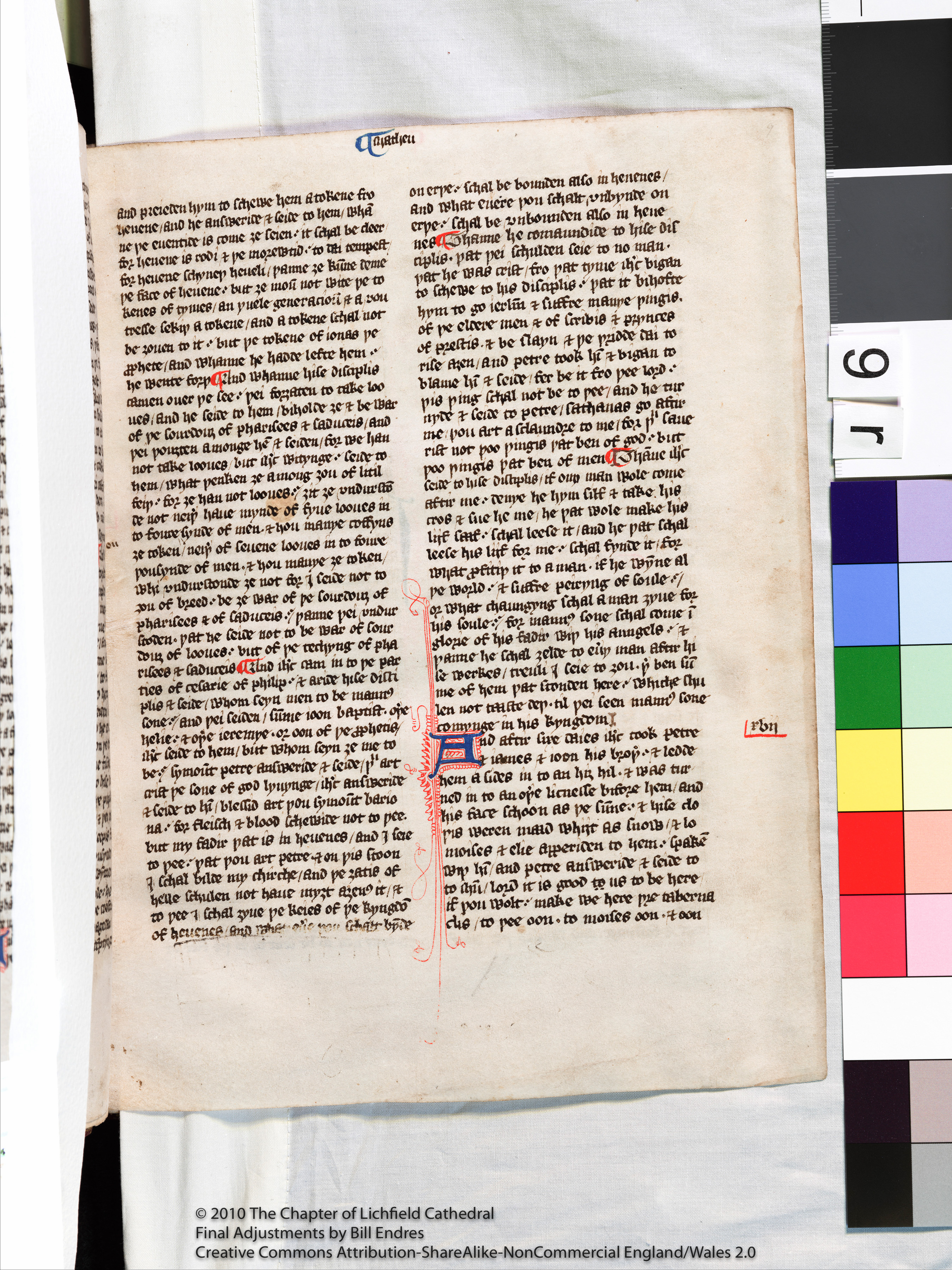
- c. 1395, John Wycliffe, John Purvey [et al.], transl., Bible (Wycliffite Bible (later version), MS Lich 10.)[6], published c. 1410, Matheu 16:15, page 9r, column 1; republished as Wycliffe's translation of the New Testament, Lichfield: Bill Endres, 2010:
- iheſus ſeide to hem / but whom ſeyn ȝe me to be .·?
- Jesus said to them, "But who do you say I am?"
- (formal) second-person singular pronoun: you (singular).
- a. 1400, Geoffrey Chaucer, “Book II”, in Troilus and Criseyde, lines 22–28:
- Ȝe knowe ek that in fourme of ſpeche is chaunge / With-inne a thousand ȝeer, and wordes tho /That hadden pris now wonder nyce and ſtraunge /Us thenketh hem, and ȝet thei ſpake hem so / And ſpedde as wel in loue as men now do / Ek forto wynnen loue in ſondry ages / In ſondry londes, ſondry ben vſages […]
- You also know that the form of language is in flux; / within a thousand years, words / that had currency; really weird and bizarre / they seem to us now, but they still spoke them / and accomplished as much in love as men do now. / As for winning love across ages and / across nations, there are lots of usages […]
Usage notes[edit]
The formal singular usage, following the T-V distinction, was used to address one's superiors, elders or others to whom one might wish to show politeness or respect.
Descendants[edit]
Verb[edit]
ye (present participle yeyn)
- Address a single person by the use of the pronoun ye instead of thou.
- 1511, Promptorium Parvulorum (de Worde), sig. M.iiiᵛ/2
- Yeyn or sey ye with worshyp, viso.
- (please add an English translation of this quotation)
- 1511, Promptorium Parvulorum (de Worde), sig. M.iiiᵛ/2
See also[edit]
| nominative | accusative | dative | genitive | possessive | |||
|---|---|---|---|---|---|---|---|
| singular | 1st-person | I, ich, ik | me | min mi1 |
min | ||
| 2nd-person | þou | þe | þin þi1 |
þin | |||
| 3rd-person | m | he | him hine2 |
him | his | his hisen | |
| f | sche, heo | hire heo |
hire | hire hires, hiren | |||
| n | hit | hit him2 |
his, hit | — | |||
| dual3 | 1st-person | wit | unk | unker | |||
| 2nd-person | ȝit | inc | inker | ||||
| plural | 1st-person | we | us, ous | oure | oure oures, ouren | ||
| 2nd-person4 | ye | yow | your | your youres, youren | |||
| 3rd-person | inh. | he | hem he2 |
hem | here | here heres, heren | |
| bor. | þei | þem, þeim | þeir | þeir þeires, þeiren | |||
1Used preconsonantally or before h.
2Early or dialectal.
3Dual pronouns are only sporadically found in Early Middle English; after that, they are replaced by plural forms. There are no third-person dual forms in Middle English.
4Sometimes used as a formal 2nd-person singular.
References[edit]
- “yẹ̄, pron.”, in MED Online, Ann Arbor, Mich.: University of Michigan, 2007, retrieved 16 May 2018.
Etymology 2[edit]
From Old English gēa, from Proto-West Germanic *jā, from Proto-Germanic *ja.
Alternative forms[edit]
Pronunciation[edit]
Adverb[edit]
ye
Descendants[edit]
References[edit]
- “yē, adv.”, in MED Online, Ann Arbor, Mich.: University of Michigan, 2007.
Etymology 3[edit]
Noun[edit]
yë (plural yën)
- Alternative form of eie
- 1387–1400, Geoffrey Chaucer, “The Prologues”, in The Canterbury Tales, [Westminster: William Caxton, published 1478], →OCLC; republished in [William Thynne], editor, The Workes of Geffray Chaucer Newlye Printed, […], [London]: […] [Richard Grafton for] Iohn Reynes […], 1542, →OCLC, lines 9–10:
- And smale foweles maken melodye, / That slepen al the nyght with open yë.
- (please add an English translation of this quotation)
Etymology 4[edit]
Article[edit]
ye
- (chiefly Northern) Alternative form of þe (“the”)
Etymology 5[edit]
Pronoun[edit]
ye
- (chiefly Northern) Alternative form of þe (“thee”)
Norn[edit]
Etymology[edit]
Adverb[edit]
ye
- (Orkney) not
Pali[edit]
Alternative forms[edit]
Pronoun[edit]
ye
- masculine nominative/accusative plural of ya (“who (relative)”)
Scots[edit]
Alternative forms[edit]
Pronunciation[edit]
Pronoun[edit]
ye (second person, singular or plural; possessive determiner yer, possessive pronoun yers, singular reflexive yersel, plural reflexive yersel)
See also[edit]
| personal pronoun | possessive pronoun |
possessive determiner | |||||
|---|---|---|---|---|---|---|---|
| subjective | objective | reflexive | |||||
| first person | singular | A I, ik |
me mei |
masel mysel |
mines | ma my | |
| plural | we | us, we's hus |
oorsels, oorsel wirsels, wirsel |
oors wirs |
oor wir | ||
| second person | singular | standard (formal) | ye you, yow |
ye you, yow |
yersel yoursel |
yers yours |
yer your |
| Insular (informal) | thoo | thee | thysel, theesel | thines | thy, thee, thees | ||
| plural | ye, yese you, youse |
ye, yese you, youse theer |
yesels yoursels |
yers yours |
yer your | ||
| third person | singular | masculine | he, e | him, im | himsel, hissel | his, is | his, is |
| feminine | she | her, er | hersel | hers | her, er | ||
| neuter | it hit |
it hit |
itsel hitsel |
its hits |
its hits | ||
| genderless, nonspecific (formal) |
ane | ane | – | – | ane's | ||
| plural | thay | thaim | thaimsel, thaimsels | thairs | thair | ||
Spanish[edit]
Pronunciation[edit]
- Rhymes: -e
- Syllabification: ye
Noun[edit]
ye f (plural yes)
- The name of the Latin-script letter Y.
- Synonym: i griega
Usage notes[edit]
- "Ye" was recommended by the Real Academia Española as a simpler name for the more common i griega (literally “Greek i”). Adoption of it has been slow.
Further reading[edit]
- “ye”, in Diccionario de la lengua española, Vigésima tercera edición, Real Academia Española, 2014
Tagalog[edit]
Etymology[edit]
From Spanish ye, the Spanish name of the letter Y/y.
Pronunciation[edit]
- (Standard Tagalog) IPA(key): /ˈje/, [ˈjɛ]
- Rhymes: -e
Noun[edit]
ye (Baybayin spelling ᜌᜒ) (historical)
- The name of the Latin-script letter Y/y, in the Abecedario.
Turkish[edit]
Pronunciation[edit]
Etymology 1[edit]
Noun[edit]
ye
- The name of the Latin-script letter Y.
See also[edit]
- (Latin-script letter names) harf; a, be, ce, çe, de, e, fe, ge, yumuşak ge, he, ı, i, je, ke, le, me, ne, o, ö, pe, re, se, şe, te, u, ü, ve, ye, ze
Etymology 2[edit]
Borrowed from Persian یه (ye).
Noun[edit]
ye
- Last letter of the Arabic alphabet: ي
- Previous: و
Etymology 3[edit]
Verb[edit]
ye
Uzbek[edit]
Verb[edit]
ye
- imperative of yemoq
Volapük[edit]
Conjunction[edit]
ye
Ye'kwana[edit]
Pronunciation[edit]
Noun[edit]
ye
- (Caura River dialect) Alternative form of iye (“wood, tree”)
Yola[edit]
Pronunciation[edit]
- IPA(key): /jiː/
- Homophones: yee, yie
Etymology 1[edit]
From Middle English ye, from Old English ġē, from Proto-West Germanic *jiʀ.
Pronoun[edit]
ye
- you[1]
- 1867, “THE WEDDEEN O BALLYMORE”, in SONGS, ETC. IN THE DIALECT OF FORTH AND BARGY, number 1, page 94:
- Ye be welcome, hearthilee welcome, mee joees,
- You are welcome, heartily welcome, my joys,
- 1867, “THE WEDDEEN O BALLYMORE”, in SONGS, ETC. IN THE DIALECT OF FORTH AND BARGY, number 1, page 94:
- Ye be welcome, hearthillee, ivery oan.
- You are heartily welcome, every one.
- 1867, “THE WEDDEEN O BALLYMORE”, in SONGS, ETC. IN THE DIALECT OF FORTH AND BARGY, number 3, page 94:
- Maade a nicest coolecannan that e'er ye did zee.
- Made the nicest coolecannan that ever you did see.
- 1867, “VERSES IN ANSWER TO THE WEDDEEN O BALLYMORE”, in SONGS, ETC. IN THE DIALECT OF FORTH AND BARGY, number 3, page 100:
- At ye mye ne'er be wooveless ta vill a lear jock an cooan.
- That you may never be unprovided to fill an empty jack and can.
Derived terms[edit]
Etymology 2[edit]
Contraction[edit]
ye
Etymology 3[edit]
Article[edit]
ye
- Alternative form of a (“the”)[1]
- 1867, “CASTEALE CUDDE'S LAMENTATION”, in SONGS, ETC. IN THE DIALECT OF FORTH AND BARGY, number 1, page 102:
- Ye nyporès aul, come hark to mee,
- Ye neighbours all, come hark to me,
- 1867, “Prologue”, in CONGRATULATORY ADDRESS IN THE DIALECT OF FORTH AND BARGY, page 114:
- Ye soumissive Spakeen o'ouz Dwelleres o' Baronie Forthe, Weisforthe.
- The humble Address of the Inhabitants of the Barony of Forth, Wexford.
- 1867, CONGRATULATORY ADDRESS IN THE DIALECT OF FORTH AND BARGY, page 114, lines 6-7:
- wi vengem o' core t'gie oure zense o' ye gradès whilke be ee-dighte wi yer name;
- to pour forth from the strength of our hearts, our sense of the qualities which characterise your name,
- 1927, “THE FORTH MAN'S GRACE AFTER A SCANTY DINNER”, in THE ANCIENT DIALECT OF THE BARONIES OF FORTH AND BARGY, COUNTY WEXFORD, page 137, line 2:
- When ye Lord plaase, He ma mend this,
- [When the Lord please, He may mend this,]
- 1927, “THE FORTH MAN'S GRACE AFTER A SCANTY DINNER”, in THE ANCIENT DIALECT OF THE BARONIES OF FORTH AND BARGY, COUNTY WEXFORD, page 137, line 4:
- God save ye Kinge, hev awaa ye platter."
- [God save the King, heave away the platter.]
Etymology 4[edit]
Determiner[edit]
ye
- Pronunciation spelling of yer (“your”).[2]
- 1927, “ZONG OF TWI MAARKEET MOANS”, in THE ANCIENT DIALECT OF THE BARONIES OF FORTH AND BARGY, COUNTY WEXFORD, page 129, line 14:
- Thou liest valse co secun that thou an ye thick,
- You lie false, said the second, that you and your kid,
References[edit]
- ↑ 1.0 1.1 1.2 Jacob Poole (d. 1827) (before 1828) William Barnes, editor, A Glossary, With some Pieces of Verse, of the old Dialect of the English Colony in the Baronies of Forth and Bargy, County of Wexford, Ireland, London: J. Russell Smith, published 1867, pages 80, 94 & 114
- ^ Kathleen A. Browne (1927) The Journal of the Royal Society of Antiquaries of Ireland Sixth Series, Vol.17 No.2, Royal Society of Antiquaries of Ireland, page 129
Yoruba[edit]
Etymology 1[edit]
Pronunciation[edit]
Noun[edit]
yè
- (Idanre, Ondo) mother
- (Idanre, Ondo) a term of endearment or respect for an older woman or female relative
Usage notes[edit]
- (term of endearment): usually used with mi (“third-person singular possessive pronoun”).
- (both senses): follow greetings and pleasantries.
Etymology 2[edit]
Pronunciation[edit]
Verb[edit]
yé
- (transitive) to understand
- Ṣó yé yín? ― Do you understand?
- Kò yé mi ― I don't understand
Etymology 3[edit]
Pronunciation[edit]
Verb[edit]
yé
Etymology 4[edit]
Pronunciation[edit]
Verb[edit]
yè
- (intransitive) to survive
- Ògún yè, mo yè ― Ogun survives, I survive
Etymology 5[edit]
Pronunciation[edit]
Verb[edit]
yé
- (transitive) to lay (eggs)
- Adìẹ mi ti yé ẹyin ― My hen's laid eggs
Zulu[edit]
Pronoun[edit]
-ye
- Combining stem of yena.
- English terms inherited from Middle English
- English terms derived from Middle English
- English terms inherited from Old English
- English terms derived from Old English
- English terms inherited from Proto-West Germanic
- English terms derived from Proto-West Germanic
- English terms derived from Proto-Germanic
- English terms inherited from Proto-Germanic
- English terms inherited from Proto-Indo-European
- English terms derived from Proto-Indo-European
- English 1-syllable words
- English terms with IPA pronunciation
- English terms with audio links
- Rhymes:English/iː
- Rhymes:English/iː/1 syllable
- English lemmas
- English pronouns
- English terms with archaic senses
- Northern England English
- Cornish English
- Irish English
- Newfoundland English
- English terms with quotations
- Geordie English
- English articles
- English interjections
- English slang
- English terms borrowed from Russian
- English terms derived from Russian
- English nouns
- English countable nouns
- English personal pronouns
- English second person pronouns
- English two-letter words
- en:Cyrillic letter names
- Asturian terms with IPA pronunciation
- Asturian non-lemma forms
- Asturian verb forms
- Azerbaijani non-lemma forms
- Azerbaijani verb forms
- Bambara lemmas
- Bambara postpositions
- Bambara terms with usage examples
- Bambara verbs
- Bambara auxiliary verbs
- Bambara transitive verbs
- Catawba lemmas
- Catawba nouns
- Fula lemmas
- Fula particles
- Haitian Creole terms inherited from French
- Haitian Creole terms derived from French
- Haitian Creole terms with IPA pronunciation
- Haitian Creole lemmas
- Haitian Creole verbs
- Ido terms with IPA pronunciation
- Ido terms derived from Esperanto
- Ido lemmas
- Ido prepositions
- Ido terms with usage examples
- Ido nouns
- io:Latin letter names
- Indonesian terms borrowed from Dutch
- Indonesian terms derived from Dutch
- Indonesian doublets
- Indonesian 1-syllable words
- Indonesian terms with IPA pronunciation
- Indonesian lemmas
- Indonesian nouns
- Requests for plural forms in Indonesian entries
- id:Latin letter names
- Japanese non-lemma forms
- Japanese romanizations
- Japanese terms with obsolete senses
- Hanyu Pinyin
- Mandarin non-lemma forms
- Mandarin nonstandard forms
- Middle English terms inherited from Old English
- Middle English terms derived from Old English
- Middle English terms inherited from Proto-West Germanic
- Middle English terms derived from Proto-West Germanic
- Middle English terms inherited from Proto-Germanic
- Middle English terms derived from Proto-Germanic
- Middle English terms inherited from Proto-Indo-European
- Middle English terms derived from Proto-Indo-European
- Middle English terms with IPA pronunciation
- Rhymes:Middle English/eː
- Rhymes:Middle English/eː/1 syllable
- Middle English lemmas
- Middle English pronouns
- Middle English terms with quotations
- Middle English formal terms
- Middle English verbs
- Middle English personal pronouns
- Middle English adverbs
- Middle English nouns
- Middle English articles
- Northern Middle English
- Norn terms derived from Old Norse
- Norn lemmas
- Norn adverbs
- Orkney Norn
- Pali non-lemma forms
- Pali pronoun forms
- Scots terms with IPA pronunciation
- Scots lemmas
- Scots pronouns
- Spanish 1-syllable words
- Spanish terms with IPA pronunciation
- Rhymes:Spanish/e
- Rhymes:Spanish/e/1 syllable
- Spanish lemmas
- Spanish nouns
- Spanish countable nouns
- Spanish feminine nouns
- es:Latin letter names
- Tagalog terms borrowed from Spanish
- Tagalog terms derived from Spanish
- Tagalog 1-syllable words
- Tagalog terms with IPA pronunciation
- Rhymes:Tagalog/e
- Rhymes:Tagalog/e/1 syllable
- Tagalog terms with mabilis pronunciation
- Tagalog lemmas
- Tagalog nouns
- Tagalog terms with Baybayin script
- Tagalog historical terms
- tl:Latin letter names
- Turkish terms with IPA pronunciation
- Turkish lemmas
- Turkish nouns
- tr:Latin letter names
- Turkish terms borrowed from Persian
- Turkish terms derived from Persian
- Turkish non-lemma forms
- Turkish noun forms
- Turkish verb forms
- tr:Arabic letter names
- Uzbek non-lemma forms
- Uzbek verb forms
- Volapük lemmas
- Volapük conjunctions
- Ye'kwana terms with IPA pronunciation
- Ye'kwana lemmas
- Ye'kwana nouns
- Caura River Ye'kwana
- Yola terms with IPA pronunciation
- Yola terms with homophones
- Yola terms inherited from Middle English
- Yola terms derived from Middle English
- Yola terms inherited from Old English
- Yola terms derived from Old English
- Yola terms inherited from Proto-West Germanic
- Yola terms derived from Proto-West Germanic
- Yola lemmas
- Yola pronouns
- Yola terms with quotations
- Yola non-lemma forms
- Yola contractions
- Yola articles
- Yola determiners
- Yola pronunciation spellings
- Yoruba terms with IPA pronunciation
- Yoruba lemmas
- Yoruba nouns
- Idanre Yoruba
- Ondo Yoruba
- Yoruba terms with usage examples
- Yoruba verbs
- Yoruba transitive verbs
- Yoruba intransitive verbs
- yo:People
- yo:Family
- Zulu non-lemma forms
- Zulu pronoun forms