u
 | ||||||||
| ||||||||
| ||||||||
Translingual[edit]
Etymology 1[edit]

Minuscule variation of U, a modern variation of classical Latin V, from seventh century Old Latin adoption of Old Italic letter 𐌖 (V).
Letter[edit]
u (upper case U)
- The twenty-first letter of the basic modern Latin alphabet.
See also[edit]
- (Latin script): Aa Bb Cc Dd Ee Ff Gg Hh Ii Jj Kk Ll Mm Nn Oo Pp Qq Rr Sſs Tt Uu Vv Ww Xx Yy Zz
- (Variations of letter U): Úú Ùù Ŭŭ Ûû Ǔǔ Ůů Üü Ǘǘ Ǜǜ Ǚǚ Ǖǖ Űű Ũũ Ṹṹ Ųų Ūū Ṻṻ Ủủ Ȕȕ Ȗȗ Ưư Ứứ Ừừ Ữữ Ửử Ựự Ụụ Ṳṳ Ṷṷ Ṵṵ Ʉʉ ᵾ ᶙ ᴜ Uu Ꜷꜷ Ȣȣ ᵫ
- (other scripts) Cyrillic у, Greek υ (upsilon), Hebrew ו (vav)
 u on Wikipedia.Wikipedia

Etymology 2[edit]
Pronunciation[edit]
IPA (file)
Symbol[edit]
u
- (metrology) Symbol for atomic mass unit
- (IPA, phonetics) a close back rounded vowel.
- (IPA, superscript ⟨ᵘ⟩) [u]-coloring, a [u] on-glide or off-glide (a diphthong), or a weak, fleeting, epenthetic or echo [u].
- (international standards) transliterates Indic उ (or equivalent).
- (physics) up quark
Gallery[edit]
- Letter styles
-
 Uppercase and lowercase versions of U, in normal and italic type
 -
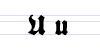 Uppercase and lowercase U in Fraktur


See also[edit]
The template Template:Letter does not use the parameter(s):Character=UPlease see Module:checkparams for help with this warning.
Other representations of U:


English[edit]
Etymology 1[edit]

From Middle English lower case letter v (also written u), from Old English lower case u, from 7th century replacement by lower case u of the Anglo-Saxon Futhorc letter ᚢ (u, ur), derived from Raetic letter u.
Before the 1700s, the pointed form v was written at the beginning of a word, while a rounded form u was used elsewhere, regardless of sound. So whereas valor and excuse appeared as in modern printing, have and upon were printed haue and vpon. Eventually, in the 1700s, to differentiate between the consonant and vowel sounds, the v form was used to represent the consonant, and u the vowel sound. v then preceded u in the alphabet, but the order has since reversed.
Pronunciation[edit]
- Letter name
- IPA(key): /ˈjuː/
- Rhymes: -uː
- Homophones: ewe, yew, you, hew (in h-dropping dialects), hue (in h-dropping dialects)
- Phoneme
- (General Australian) IPA(key): /a/, /ʉː/, /ʊ/
Audio (CAN) (file) - (Received Pronunciation) IPA(key): /ʌ/, /uː/, /ʊ/
- (US, Canada) IPA(key): /ʌ/, /u/, /ʊ/
Audio (GA) (file) - (South US) IPA(key): /ʌ/, /ɜ/, /uː/, /ʊ/
Letter[edit]
u (lower case, upper case U, plural us or u's)
- The twenty-first letter of the English alphabet, called u and written in the Latin script.
- I prefer the u in Arial to the one in Times New Roman.
See also[edit]
- (Latin script letters) letter; Aa, Bb, Cc, Dd, Ee, Ff, Gg, Hh, Ii, Jj, Kk, Ll, Mm, Nn, Oo, Pp, Qq, Rr, Ss, Tt, Uu, Vv, Ww, Xx, Yy, Zz
Noun[edit]
u (plural ues)
- The name of the Latin-script letter U.
- A thing in the shape of the letter U
Alternative forms[edit]
Translations[edit]
|
Derived terms[edit]
See also[edit]
- (Latin-script letter names) letter; a, bee, cee, dee, e, ef, gee, aitch, i, jay, kay, el, em, en, o, pee, cue, ar, ess, tee, u, vee, double-u, ex, wye, zee/zed (Category: en:Latin letter names)
Etymology 2[edit]
Pronoun[edit]
u (second person, singular or plural, nominative or objective, possessive determiner ur, possessive pronoun urs, singular reflexive urself, plural reflexive urselves)
- (Internet slang, text messaging, colloquial) Abbreviation of you.
- t8k me w u
Derived terms[edit]
Adjective[edit]
u
Derived terms[edit]
- u-boat (1)
Etymology 3[edit]
Abbreviations.
- (stenoscript) a word-initial letter ⟨u⟩
- (stenoscript) the long vowel /uː/ or /juː/ at the end of a word, or before a final consonant that is not /dʒ, v, z/. (Note: the final consonant is not written; [ʊə˞] (-ure, -oor etc.) counts as /uːr/.)
- (stenoscript) the prefix un-
Derived terms[edit]
Acehnese[edit]
Pronunciation[edit]
Noun[edit]
u
- coconut (fruit of the coco palm)
References[edit]
- 2007. The UCLA Phonetics Lab Archive. Los Angeles, CA: UCLA Department of Linguistics.
Afrikaans[edit]
Pronunciation[edit]
Etymology 1[edit]
Pronoun[edit]
u
See also[edit]
| subjective | objective | possessive determiner | possessive pronoun | |||
|---|---|---|---|---|---|---|
| singular | 1st | ek | my | myne | ||
| 2nd | jy | jou | joune | |||
| 2nd, formal | u | u s’n | ||||
| 3rd, masc | hy | hom | sy | syne | ||
| 3rd, fem | sy | haar | hare | |||
| 3rd, neut | dit | sy | syne | |||
| plural | 1st | ons | ons s’n | |||
| 2nd | julle / jul1 | julle s’n | ||||
| 3rd | hulle / hul1 | hulle s’n | ||||
| 1. The forms jul and hul are unstressed variants. They are used mostly in possessive function, but also otherwise, chiefly when the pronoun is repeated within the same sentence. | ||||||
Etymology 2[edit]
Determiner[edit]
u
See also[edit]
| subjective | objective | possessive determiner | possessive pronoun | |||
|---|---|---|---|---|---|---|
| singular | 1st | ek | my | myne | ||
| 2nd | jy | jou | joune | |||
| 2nd, formal | u | u s’n | ||||
| 3rd, masc | hy | hom | sy | syne | ||
| 3rd, fem | sy | haar | hare | |||
| 3rd, neut | dit | sy | syne | |||
| plural | 1st | ons | ons s’n | |||
| 2nd | julle / jul1 | julle s’n | ||||
| 3rd | hulle / hul1 | hulle s’n | ||||
| 1. The forms jul and hul are unstressed variants. They are used mostly in possessive function, but also otherwise, chiefly when the pronoun is repeated within the same sentence. | ||||||
Ajië[edit]
Pronunciation[edit]
Verb[edit]
u
- to swim
References[edit]
- Leenhardt, M. (1935) Vocabulaire et grammaire de la langue Houaïlou, Paris: Institut d'ethnologie. Cited in: "Houaïlou" in Greenhill, S.J., Blust, R., & Gray, R.D. (2008). The Austronesian Basic Vocabulary Database: From Bioinformatics to Lexomics. Evolutionary Bioinformatics, 4:271–283.
- Leenhardt, M. (1946) Langues et dialectes de l'Austro-Mèlanèsie. Cited in: "Ajiø" in Greenhill, S.J., Blust, R., & Gray, R.D. (2008). The Austronesian Basic Vocabulary Database: From Bioinformatics to Lexomics. Evolutionary Bioinformatics, 4:271–283.
Akkadian[edit]
Etymology[edit]
From Proto-Semitic *wa (“and”). Cognate with Arabic وَ (wa) and Biblical Hebrew וְ־ (wə̆-).
Pronunciation[edit]
- (Old Babylonian) IPA(key): /u/
Conjunction[edit]
u
- and
- 1755–1750 BCE, King Hammurabi of Babylon, translated by CDLI, Hammurabi Code[2], The Louvre, Prologue, lines 3-5:
- 𒀭𒂗𒆤 𒁁𒂖 𒊭𒈨𒂊 𒅇 𒅕𒍢𒁴
- [Enlil bēl šamê u erṣetim]
- den-lil₂ be-el ša-me-e u₃ er-ṣe-tim
- Enlil, lord of heaven and earth
- moreover, likewise, also, too
- 𒅇 𒅆𒅅𒁕𒄠 𒋗𒁉𒇴 [u šiqdam šūbilam] ― u₃ ši-iq-da-am šu-bi-lam ― also, send me almonds
- 1755–1750 BCE, King Hammurabi of Babylon, translated by OMNIKA Foundation, Hammurabi Code[3], The Louvre, Law 129:
- 𒋳𒈠𒀸𒊭𒀜 𒀀𒉿𒅆 𒀉𒋾𒍣𒅗𒊑𒅎 𒊭𒉌𒅎 𒄿𒈾𒄿𒌅𒅆 𒀉𒋫𒊍𒁁 𒄿𒅗𒍪𒋗𒉡𒋾𒈠 𒀀𒈾 𒈨𒂊 𒄿𒈾𒀜𒁺𒌑 𒋗𒉡𒋾 𒋳𒈠𒁁𒂖 𒀸𒊭𒁴 𒀸𒊭𒍪𒌑𒁀𒆷𒀜 𒅇 𒊬𒊒𒌝 𒀵𒍪𒌑𒁀𒆷𒀜
- [šumma aššat awīlim itti zikarim šanîm ina itūlim ittaṣbat, ikassûšunūtī-ma ana mê inaddûšunūti; šumma bēl aššatim aššassu uballaṭ, u šarrum warassu uballaṭ.]
- šum-ma aš-ša-at a-wi-lim it-ti zi-ka-ri-im ša-ni-im i-na i-tu-lim it-ta-aṣ-bat i-ka-su₂-šu-nu-ti-ma a-na me-e i-na-ad-du-u₂-šu-nu-ti šum-ma be-el aš-ša-tim aš-ša-su₂ u₂-ba-la-aṭ u₃ šar-ru-um IR₃-su₂ u₂-ba-la-aṭ
- If an awīlum's wife has been caught lying with another man, they will be bound and thrown into the water; if the wife's lord wishes to spare his wife, also the king may spare his servant.
| Phonetic |
|---|
|
References[edit]
- Huehnergard, John (2011) A Grammar of Akkadian (Harvard Semitic Studies; 45), 3rd edition, Winona Lake, IN: Eisenbrauns
- “šiqdu”, in The Assyrian Dictionary of the Oriental Institute of the University of Chicago (CAD)[4], Chicago: University of Chicago Oriental Institute, 1956–2011
Albanian[edit]
Etymology[edit]
From Proto-Albanian *wa, from Proto-Indo-European *swom, from Proto-Indo-European *swé. Compare Latin sē.
Pronunciation[edit]
Pronoun[edit]
u
- the reflexive pronoun
- u mblodhën ― they gathered (literally, “they gathered themselves”)
Alemannic German[edit]
Etymology 1[edit]
Alternative forms[edit]
Pronunciation[edit]
Conjunction[edit]
u
- (Bern) and
- 2008, Ulrich Stuber, Der Bettleschloss-Tüfel:
- Si hei glachet u der Grossätti het gfunge: „So, jetz wärs Zyt für no chlei öppis z Znacht - u nächär göh mir de ungere.
- She laughed and the grandpa opined: „So, now is the time for a little bit of dinner - and afterwards we'll go downstairs.
Etymology 2[edit]
Adverb[edit]
u
- Alternative spelling of uu
Further reading[edit]
- “u”, in Wörterbuch Berndeutsch-Deutsch (in German), berndeutsch.ch, 1999–2024
Aragonese[edit]
Etymology[edit]
Conjunction[edit]
u
Aromanian[edit]
Etymology[edit]
Probably from an early (proto-Romanian) root *eaua, from Latin illam, accusative feminine singular of ille. Compare Romanian o.
Pronoun[edit]
u f (short/unstressed accusative form of ea)
- (direct object) her
Related terms[edit]
Asturian[edit]
Etymology 1[edit]
Conjunction[edit]
u
Etymology 2[edit]
Pronoun[edit]
u
- where (relative pronoun)
- Equí ye u alcontré la fueya.
- Here is where I found the leaf.
Adverb[edit]
u
- where
- ¿Du yes? ¿Au vas? ¿Nu tas?
- Where are you from? Where are you going? Where are you in?
Related terms[edit]
Azerbaijani[edit]
Pronunciation[edit]
Letter[edit]
u lower case (upper case U)
- The twenty-eighth letter of the Azerbaijani alphabet, written in the Latin script.
See also[edit]
- (Latin script letters) hərf; Aa, Bb, Cc, Çç, Dd, Ee, Əə, Ff, Gg, Ğğ, Hh, Xx, Iı, İi, Jj, Kk, Qq, Ll, Mm, Nn, Oo, Öö, Pp, Rr, Ss, Şş, Tt, Uu, Üü, Vv, Yy, Zz
Bambara[edit]
Pronoun[edit]
u (tone ù)
See also[edit]
Basque[edit]
Pronunciation[edit]
Letter[edit]
u (lower case, upper case U)
- The twenty-second letter of the Basque alphabet, called u and written in the Latin script.
See also[edit]
- (Latin-script letters) A a, B b, C c, (Ç ç), D d, E e, F f, G g, H h, I i, J j, K k, L, l, M m, N n, Ñ ñ, O o, P p, Q q, R r, S s, T t, U u, (Ü ü), V v, W w, X x, Y y, Z z
Noun[edit]
u (indeclinable)
- The name of the Latin-script letter U.
See also[edit]
- (Latin-script letter names) a, be, ze, de, e, efe, ge, hatxe, i, jota, ka, ele, eme, ene, eñe, o, pe, ku, erre, ese, te, u, uve, uve bikoitz, ixa, i greko, zeta
Catalan[edit]
Pronunciation[edit]
Etymology 1[edit]
Noun[edit]
u f (plural us)
Etymology 2[edit]
| 10 | ||||
| ← 0 | 1 | 2 → | 10 → | |
|---|---|---|---|---|
| Cardinal: u, un Ordinal: primer Ordinal abbreviation: 1r | ||||
| Catalan Wikipedia article on 1 | ||||
Noun[edit]
u m (plural uns)
Derived terms[edit]
Cora[edit]
Particle[edit]
u
- inside
- within view (of the speaker)
- entering a deep domain; entering a domain in an extensive manner
- utyásuuna ša'ari cahta'a
- The water is pouring into the (deep) pot.
Antonyms[edit]
- a (“outside; out of view”)
References[edit]
- Eugene Casad, Ronald Langacker (1985) “'Inside' and 'outside' in Cora grammar”, in International Journal of American Linguistics
Corsican[edit]
Etymology[edit]
From the earlier lu. Compare Portuguese o and Aragonese o.
Article[edit]
u m (feminine a, masculine plural i, feminine plural e)
Usage notes[edit]
- Before a vowel, u turns into l'.
Pronoun[edit]
u m
Usage notes[edit]
- Before a vowel, u turns into l'.
See also[edit]
References[edit]
- “u, lu” in INFCOR: Banca di dati di a lingua corsa
Czech[edit]
Etymology[edit]
Inherited from Old Czech u, from Proto-Slavic *u.
Pronunciation[edit]
Preposition[edit]
u + genitive
Further reading[edit]
- u in Příruční slovník jazyka českého, 1935–1957
- u in Slovník spisovného jazyka českého, 1960–1971, 1989
Drung[edit]
Etymology[edit]
From Proto-Sino-Tibetan *d-bu-s.
Noun[edit]
u
References[edit]
- Ross Perlin (2019) A Grammar of Trung[5], Santa Barbara: University of California
Dutch[edit]
Etymology[edit]
Originally the dative and accusative form of jij/gij, from Middle Dutch u, from Old Dutch iu, from Proto-West Germanic *iwwiz, from Proto-Germanic *iwwiz, West Germanic variant of *izwiz, dative/accusative of *jūz, from Proto-Indo-European *yū́. Doublet of jou.
The use as a nominative form is linked to the polite address uwe edelheid (“your nobility, your gentility”), which was shortened to U E. in writing and at times accordingly pronounced /yˈ(w)eː/. It is debated, however, whether this was the actual cause of the development or whether it merely reinforced it. Compare English you, which was originally an object form, as well as Afrikaans ons and nonstandard Dutch hun.
Cognate with West Frisian jo, Low German jo, ju, English you, German euch.
Pronunciation[edit]
Pronoun[edit]
u
- (personal, second-person singular, subjective) you (polite).
- Bent u klaar? ― Are you ready?
- Bent u er nog? ― Are you still there?
- (personal, second-person singular, objective) you (polite).
- Ik zal het aan u geven. ― I will give it to you.
- Dit zal niet werken voor u. ― This won’t work for you.
- (personal, second-person singular, objective) thee (dialectal).
- Ik doe dat wel voor u. ― I’ll do it for thee.
- (personal, second-person plural, subjective) you (polite).
- Hebt u die oefening gemaakt? ― Have you prepared that exercise?
- (personal, second-person plural, objective) you (polite).
- Ze zullen dat wel voor u doen. ― They’ll do it for you.
- (reflexive, second-person singular) thyself (dialectal)
- Gij hebt u niet gewassen. ― Thou hast not washed thyself.
- (reflexive, second-person plural) yourselves (dialectal)
- Wast u eens. ― Wash yourselves.
Usage notes[edit]
- The capitalization of u (as in U or Uw) is now considered old-fashioned and no longer compulsory. In religious contexts, it is still often capitalized when addressing God.
- In verbs whose second and third persons singular are distinct, u may be construed with either of them. In formal context, the second person form is generally preferred except for the verb hebben (“to have”). Thus predominantly u bent, kunt, wilt, zult, whereas u heeft is more common than (or at least equally common as) u hebt.
- See also the usage notes at gij.
Inflection[edit]
| subject | object | possessive | reflexive | genitive5 | |||||
|---|---|---|---|---|---|---|---|---|---|
| singular | full | unstr. | full | unstr. | full | unstr. | pred. | ||
| 1st person | ik | 'k1 | mij | me | mijn | m'n1 | mijne | me | mijner, mijns |
| 2nd person | jij | je | jou | je | jouw | je | jouwe | je | jouwer, jouws |
| 2nd person archaic or regiolectal | gij | ge | u | – | uw | – | uwe | u | uwer, uws |
| 2nd person formal | u | – | u | – | uw | – | uwe | zich | uwer, uws |
| 3rd person masculine | hij | ie1 | hem | 'm1 | zijn | z'n1 | zijne | zich | zijner, zijns |
| 3rd person feminine | zij | ze | haar | h'r1, 'r1, d'r1 | haar | h'r1, 'r1, d'r1 | hare | zich | harer, haars |
| 3rd person neuter | het | 't1 | het | 't1 | zijn | z'n1 | zijne | zich | zijner, zijns |
| plural | |||||||||
| 1st person | wij | we | ons | – | ons, onze2 | – | onze | ons | onzer, onzes |
| 2nd person | jullie | je | jullie | je | jullie | je | – | je | – |
| 2nd person archaic or regiolectal6 | gij | ge | u | – | uw | – | uwe | u | uwer, uws |
| 2nd person formal | u | – | u | – | uw | – | uwe | zich | uwer, uws |
| 3rd person | zij | ze | hen3, hun4 | ze | hun | – | hunne | zich | hunner, huns |
| 1) Not as common in written language. 2) Inflected as an adjective. 3) In prescriptivist use, used only as direct object (accusative). 4) In prescriptivist use, used only as indirect object (dative). |
5) Archaic. Nowadays used for formal, literary or poetic purposes, and in fixed expressions. 6) To differentiate from the singular gij, and in a similar vein to "you lot" or "you guys" in English, it is common to use gijlui ("you people") or gijlieden ("you people") or one of their contracted variants, and their corresponding objects, possessives and reflexives, in the plural. | ||||||||
Alternative forms[edit]
- (Brabantian) a
Synonyms[edit]
Letter[edit]
u (lower case, upper case U)
- The twenty-first letter of the Dutch alphabet, written in the Latin script.
See also[edit]
Esperanto[edit]
Pronunciation[edit]
Letter[edit]
u (lower case, upper case U)
- The twenty-fifth letter of the Esperanto alphabet, called u and written in the Latin script.
See also[edit]
- (Latin script letters) litero; Aa, Bb, Cc, Ĉĉ, Dd, Ee, Ff, Gg, Ĝĝ, Hh, Ĥĥ, Ii, Jj, Ĵĵ, Kk, Ll, Mm, Nn, Oo, Pp, Rr, Ss, Ŝŝ, Tt, Uu, Ŭŭ, Vv, Zz
Noun[edit]
u (accusative singular u-on, plural u-oj, accusative plural u-ojn)
- The name of the Latin-script letter U.
See also[edit]
- (Latin script letter names) litero; a, bo, co, ĉo, do, e, fo, go, ĝo, ho, ĥo, i, jo, ĵo, ko, lo, mo, no, o, po, ro, so, ŝo, to, u, ŭo, vo, zo (Category: eo:Latin letter names)
Fala[edit]
Etymology[edit]
From Old Galician-Portuguese o, from Latin illo (“he”).
Article[edit]
u m sg (plural us, feminine a, feminine plural as)
- (Lagarteiru, Valverdeñu) Masculine singular definite article; the
Pronoun[edit]
u
- (Lagarteiru, Valverdeñu) Third person singular masculine accusative pronoun; him
See also[edit]
| nominative | dative | accusative | disjunctive | |||
|---|---|---|---|---|---|---|
| first person | singular | ei | me, -mi | mi | ||
| plural | common | nos | musL nusLV nos, -nusM |
nos | ||
| masculine | noshotrusM | noshotrusM | ||||
| feminine | noshotrasM | noshotrasM | ||||
| second person | singular | tú | te, -ti | ti | ||
| plural | common | vos | vusLV vos, -vusM |
vos | ||
| masculine | voshotrusM | voshotrusM | ||||
| feminine | voshotrasM | voshotrasM | ||||
| third person | singular | masculine | el | le, -li | uLV, oM | el |
| feminine | ela | a | ela | |||
| plural | masculine | elis | usLV, osM | elis | ||
| feminine | elas | as | elas | |||
| reflexive | — | se, -si | sí | |||
References[edit]
- Valeš, Miroslav (2021) Diccionariu de A Fala: lagarteiru, mañegu, valverdeñu (web)[6], 2nd edition, Minde, Portugal: CIDLeS, published 2022, →ISBN
Faroese[edit]
Pronunciation[edit]
Letter[edit]
u (upper case U)
- The twenty-third letter of the Faroese alphabet, written in the Latin script.
See also[edit]
- (Latin script letters) bókstavur; Aa, Áá, Bb, Dd, Ðð, Ee, Ff, Gg, Hh, Ii, Íí, Jj, Kk, Ll, Mm, Nn, Oo, Óó, Pp, Rr, Ss, Tt, Uu, Úú, Vv, Yy, Ýý, Ææ, Øø
Finnish[edit]
Etymology[edit]
The Finnish orthography using the Latin script was based on those of Swedish, German and Latin, and was first used in the mid-16th century. No earlier script is known. See the Wikipedia article on Finnish for more information, and u for information on the development of the glyph itself.
Pronunciation[edit]
Letter[edit]
u (lower case, upper case U)
- The twenty-first letter of the Finnish alphabet, called uu and written in the Latin script.
See also[edit]
- (Latin-script letters) kirjain; A a, B b, C c, D d, E e, F f, G g, H h, I i, J j, K k, L l, M m, N n, O o, P p, Q q, R r, S s (Š š), T t, U u, V v (W w), X x, Y y, Z z (Ž ž), Å å, Ä ä, Ö ö
French[edit]
Pronunciation[edit]
Noun[edit]
u m (plural u)
- The name of the Latin-script letter U.
Fula[edit]
Letter[edit]
u (lower case, upper case U)
- A letter of the Fula alphabet, written in the Latin script.
Usage notes[edit]
See also[edit]
- (Latin-script letters) karfeeje; ', A a, B b, Mb mb, Ɓ ɓ, C c, D d, Nd nd, Ɗ ɗ, E e, F f, G g, Ng ng, Ɠ ɠ, H h, I i, J j, Nj nj, K k, L l, M m, N n, Ŋ ŋ, Ñ ñ, Ɲ ɲ, O o, P p, R r, S s, T t, U u, W w, Y y, Ƴ ƴ
Galician[edit]
Etymology 1[edit]
Pronunciation[edit]
Noun[edit]
u m (plural us)
- the name of the letter U.
Etymology 2[edit]
Inherited from Old Galician-Portuguese u, from ubi.
Pronunciation[edit]
Adverb[edit]
u
- (archaic) where, whereby(Can we verify(+) this sense?)
- Synonym: onde
- where (interrogative adverb)
- Synonym: onde
- U-los libros? Ulos? ― Where are the books? Where are they?
References[edit]
- “u” in Dicionario da Real Academia Galega, Royal Galician Academy.
- “u” in Dicionário Estraviz de galego (2014).
- “u” in Dicionario de Dicionarios da lingua galega, SLI - ILGA 2006–2013.
- “u” in Álvarez, Rosario (coord.): Tesouro do léxico patrimonial galego e portugués, Santiago de Compostela: Instituto da Lingua Galega.
Gothic[edit]
Romanization[edit]
u
- Romanization of 𐌿
Guinea-Bissau Creole[edit]
Etymology[edit]
From Portuguese tu.
Pronoun[edit]
u
- you (second person singular).
Hungarian[edit]
Pronunciation[edit]
Letter[edit]
u (lower case, upper case U)
- The thirty-fourth letter of the Hungarian alphabet, called u and written in the Latin script.
Declension[edit]
| Inflection (stem in long/high vowel, back harmony) | ||
|---|---|---|
| singular | plural | |
| nominative | u | u-k |
| accusative | u-t | u-kat |
| dative | u-nak | u-knak |
| instrumental | u-val | u-kkal |
| causal-final | u-ért | u-kért |
| translative | u-vá | u-kká |
| terminative | u-ig | u-kig |
| essive-formal | u-ként | u-kként |
| essive-modal | — | — |
| inessive | u-ban | u-kban |
| superessive | u-n | u-kon |
| adessive | u-nál | u-knál |
| illative | u-ba | u-kba |
| sublative | u-ra | u-kra |
| allative | u-hoz | u-khoz |
| elative | u-ból | u-kból |
| delative | u-ról | u-król |
| ablative | u-tól | u-któl |
| non-attributive possessive - singular |
u-é | u-ké |
| non-attributive possessive - plural |
u-éi | u-kéi |
| Possessive forms of u | ||
|---|---|---|
| possessor | single possession | multiple possessions |
| 1st person sing. | u-m | u-im |
| 2nd person sing. | u-d | u-id |
| 3rd person sing. | u-ja | u-i |
| 1st person plural | u-nk | u-ink |
| 2nd person plural | u-tok | u-itok |
| 3rd person plural | u-juk | u-ik |
See also[edit]
- (Latin-script letters) betű; A a, Á á, B b, C c, Cs cs, D d, Dz dz, Dzs dzs, E e, É é, F f, G g, Gy gy, H h, I i, Í í, J j, K k, L l, Ly ly, M m, N n, Ny ny, O o, Ó ó, Ö ö, Ő ő, P p, Q q, R r, S s, Sz sz, T t, Ty ty, U u, Ú ú, Ü ü, Ű ű, V v, W w, X x, Y y, Z z, Zs zs
Further reading[edit]
- (sound and letter): u in Bárczi, Géza and László Országh. A magyar nyelv értelmező szótára (‘The Explanatory Dictionary of the Hungarian Language’, abbr.: ÉrtSz.). Budapest: Akadémiai Kiadó, 1959–1962. Fifth ed., 1992: →ISBN
- ([onomatopoeia] imitation of barking): u in Bárczi, Géza and László Országh. A magyar nyelv értelmező szótára (‘The Explanatory Dictionary of the Hungarian Language’, abbr.: ÉrtSz.). Budapest: Akadémiai Kiadó, 1959–1962. Fifth ed., 1992: →ISBN
Ido[edit]
Pronunciation[edit]
Letter[edit]
u (upper case U)
- The twenty-first letter of the Ido alphabet, written in the Latin script.
See also[edit]
- (Latin-script letters) litero; A a, B b, C c, D d, E e, F f, G g, H h, I i, J j, K k, L, l, M m, N n, O o, P p, Q q, R r, S s, T t, U u, V v, W w, X x, Y y, Z z
Italian[edit]
Etymology[edit]
From Latin ū (the name of the letter V).
Pronunciation[edit]
Letter[edit]
u f or m (invariable, lower case, upper case U)
- The nineteenth letter of the Italian alphabet, called u and written in the Latin script.
Noun[edit]
u f (invariable)
- The name of the Latin-script letter U.
See also[edit]
- (Latin-script letter names) lettera; a, bi, ci, di, e, effe, gi, acca, i, gei / i lunga, cappa, elle, emme, enne, o, pi, cu, erre, esse, ti, u, vu / vi, doppia vu, ics, ipsilon / i greca, zeta
Further reading[edit]
- u in Luciano Canepari, Dizionario di Pronuncia Italiana (DiPI)
Japanese[edit]
Romanization[edit]
u
K'iche'[edit]
Pronoun[edit]
u
- his, her, its
References[edit]
- Allen J. Christenson, Kʼiche-English dictionary
Kashubian[edit]
Etymology[edit]
The Kashubian orthography is based on the Latin alphabet. No earlier script is known. See the Kashubian alphabet article on Wikipedia for more, and u for development of the glyph itself.
Letter[edit]
u (lower case, upper case U)
- The twenty-eighth letter of the Kashubian alphabet, written in the Latin script.
See also[edit]
- (Latin-script letters) A a, Ą ą, Ã ã, B b, C c, D d, E e, É é, Ë ë, F f, G g, H h, I i, J j, K k, L l, Ł ł, M m, N n, O o, Ò ò, Ó ó, Ô ô, P p, R r, S s, T t, U u, Ù ù, W w, Y y, Z z, Ż ż
Khasi[edit]
Pronunciation[edit]
Article[edit]
u m (feminine ka, masculine and feminine plural ki)
- the (masculine singular definite article)
Pronoun[edit]
u m (feminine ka, masculine and feminine plural ki)
References[edit]
- Singh, U Nissor (1906) Khasi-English dictionary[7], Shillong: Eastern Bengal and Assam Secretariat Press, page 242. Searchable online at SEAlang.net.
Lashi[edit]
Etymology[edit]
From Proto-Sino-Tibetan *ʔu (“egg, bird”). Cognates include Burmese ဥ (u., “egg”) and Chinese 嫗/妪 (yǔ, “to incubate”).
Pronunciation[edit]
Noun[edit]
u
Verb[edit]
u
References[edit]
- Hkaw Luk (2017) A grammatical sketch of Lacid[8], Chiang Mai: Payap University (master thesis)
Latin[edit]
Pronunciation[edit]
Noun[edit]
ū f (indeclinable)
- The name of the letter V.
Coordinate terms[edit]
- (Latin-script letter names) littera; ā, bē, cē, dē, ē, ef, gē, hā / *acca, ī, kā, el, em, en, ō, pē, kū, er, es, tē, ū, ix / īx / ex, ȳ / ī graeca / ȳpsīlon, zēta
References[edit]
- u in Gaffiot, Félix (1934) Dictionnaire illustré latin-français, Hachette.
- Carl Meißner, Henry William Auden (1894) Latin Phrase-Book[9], London: Macmillan and Co.
- anger is defined as a passionate desire for revenge: iracundiam sic (ita) definiunt, ut ulciscendi libidinem esse dicant or ut u. libido sit or iracundiam sic definiunt, ulc. libidinem
- anger is defined as a passionate desire for revenge: iracundiam sic (ita) definiunt, ut ulciscendi libidinem esse dicant or ut u. libido sit or iracundiam sic definiunt, ulc. libidinem
- u in Harry Thurston Peck, editor (1898), Harper's Dictionary of Classical Antiquities, New York: Harper & Brothers
- Arthur E. Gordon, The Letter Names of the Latin Alphabet (University of California Press, 1973; volume 9 of University of California Publications: Classical Studies), part III: “Summary of the Ancient Evidence”, page 32: "Clearly there is no question or doubt about the names of the vowels A, E, I, O, U. They are simply long A, long E, etc. (ā, ē, ī, ō, ū). Nor is there any uncertainty with respect to the six mutes B, C, D, G, P, T. Their names are bē, cē, dē, gē, pē, tē (each with a long E). Or about H, K, and Q: they are hā, kā, kū—each, again, with a long vowel sound."
Latvian[edit]

Etymology[edit]
Proposed in 1908 as part of the new Latvian spelling by the scientific commission headed by K. Mīlenbahs, which was accepted and began to be taught in schools in 1909. Prior to that, Latvian had been written in German Fraktur, and sporadically in Cyrillic.
Pronunciation 1[edit]

Letter[edit]

u (lower case, upper case U)
- The twenty-ninth letter of the Latvian alphabet, called u and written in the Latin script.
See also[edit]
- Letters of the Latvian alphabet:
Pronunciation 2[edit]
Noun[edit]
u m (invariable)
- The name of the Latin script letter U/u.
See also[edit]
- Latvian letter names:
Lithuanian[edit]
Pronunciation[edit]
Letter[edit]
u (upper case U)
- The twenty-seventh letter of the Lithuanian alphabet, called u trumpoji and written in the Latin script.
See also[edit]
- (Latin-script letters) A a, Ą ą, B b, C c, Č č, D d, E e, Ę ę, Ė ė, F f, G g, H h, I i, Į į, Y y, J j, K k, L l, M m, N n, O o, P p, R r, S s, Š š, T t, U u, Ų ų, Ū ū, V v, Y y, Z z, Ž ž
Livonian[edit]
Pronunciation[edit]
Letter[edit]
u (upper case U)
- The thirty-fifth letter of the Livonian alphabet, written in the Latin script.
See also[edit]
- (Latin-script letters) kēratēd̦; A a, Ā ā, Ä ä, Ǟ ǟ, B b, D d, D̦ d̦, E e, Ē ē, F f, G g, H h, I i, Ī ī, J j, K k, L l, Ļ ļ, M m, N n, Ņ ņ, O o, Ō ō, Ȯ ȯ, Ȱ ȱ, Õ õ, Ȭ ȭ, P p, R r, Ŗ ŗ, S s, Š š, T t, Ț ț, U u, Ū ū, V v, Z z, Ž ž
Lower Sorbian[edit]
Pronunciation[edit]
Letter[edit]
u (upper case U)
- The twenty-ninth letter of the Lower Sorbian alphabet, called u and written in the Latin script.
- The name of the Latin-script letter u.
See also[edit]
Malay[edit]
Letter[edit]
u (lower case, upper case U)
- The twenty-first letter of the Malay alphabet, written in the Latin script.
See also[edit]
- (Latin script letters) Aa, Bb, Cc, Dd, Ee, Ff, Gg, Hh, Ii, Jj, Kk, Ll, Mm, Nn, Oo, Pp, Qq, Rr, Ss, Tt, Uu, Vv, Ww, Xx, Yy, Zz
Maltese[edit]
Etymology 1[edit]
Pronunciation[edit]
- IPA(key): /u/ (short phoneme)
- IPA(key): /uː/ (long phoneme)
- IPA(key): /ɔw/, /aw/ (after għ; variation is regional and idiolectal)
- In inherited words, short u occurs almost exclusively in unstressed syllables. In borrowings, it is a full phoneme and commonly stressed.
Letter[edit]
u (lower case, upper case U)
- The twenty-fifth letter of the Maltese alphabet, written in the Latin script.
See also[edit]
- (Latin-script letters) ittra; A a, B b, Ċ ċ, D d, E e, F f, Ġ ġ, G g, Għ għ, H h, Ħ ħ, I i, Ie ie, J j, K k, L l, M m, N n, O o, P p, Q q, R r, S s, T t, U u, V v, W w, X x, Ż ż, Z z
Etymology 2[edit]
From Arabic وَ (wa), from Proto-Semitic *wa. Cognate with Hebrew וְ־ (wə-).
Pronunciation[edit]
Conjunction[edit]
u
- and; used to connect words, phrases, etc.
- il-kelb u l-qattus ― the dog and the cat
- tpejjep u tixrob ― she smokes and drinks
- when, as; used after a personal pronoun and followed by an active participle or imperfect verb
- huma u reqdin
- when they were sleeping
- (literally, “they and sleeping”)
- aħna u nitkellmu
- when we were talking
- (literally, “we and we talk”)
Alternative forms[edit]
- w (superseded representation of the consonantal pronunciation)
Marshallese[edit]
Pronunciation[edit]
Noun[edit]
u (construct form uin)
- (alienable) a fish trap
References[edit]
Mauritian Creole[edit]
Pronoun[edit]
u (informal to)
- Alternative spelling of ou
See also[edit]
Mezquital Otomi[edit]
Alternative forms[edit]
Etymology[edit]
(This etymology is missing or incomplete. Please add to it, or discuss it at the Etymology scriptorium.)
Noun[edit]
ú
Adjective[edit]
ú
Derived terms[edit]
References[edit]
- Andrews, Enriqueta (1950) Vocabulario otomí de Tasquillo, Hidalgo[10] (in Spanish), México, D.F.: Instituto Lingüístico de Verano, pages 36, 76
- Hernández Cruz, Luis, Victoria Torquemada, Moisés (2010) Diccionario del hñähñu (otomí) del Valle del Mezquital, estado de Hidalgo (Serie de vocabularios y diccionarios indígenas “Mariano Silva y Aceves”; 45)[11] (in Spanish), second edition, Instituto Lingüístico de Verano, A.C., page 360
Middle Dutch[edit]
Etymology 1[edit]
From Old Dutch iuwa, from Proto-Germanic *izweraz.
Determiner[edit]
u
- your (plural)
- your (singular, informal)
Usage notes[edit]
See the usage notes for gi.
Descendants[edit]
Etymology 2[edit]
See the etymology of the corresponding lemma form.
Pronoun[edit]
u
- accusative/dative of gi
Descendants[edit]
- Dutch: u
Further reading[edit]
- “uwe”, in Vroegmiddelnederlands Woordenboek, 2000
- Verwijs, E., Verdam, J. (1885–1929) “u (II)”, in Middelnederlandsch Woordenboek, The Hague: Martinus Nijhoff, →ISBN, page II
Middle English[edit]
Noun[edit]
u
- Alternative form of ew
Middle French[edit]
Etymology[edit]
Letter[edit]
u
Usage notes[edit]
- u and v were represented by a single character in Middle French, although scholars consider them to be separate letters both in terms of usage and in terms of pronunciation.
Middle High German[edit]
Pronoun[edit]
ū
- (personal pronoun, dative, Middle German) Alternative form of iu.
Middle Low German[edit]
Pronunciation[edit]
Pronoun[edit]
û
Declension[edit]
Possessive pronoun:
| nominative | accusative | dative | genitive | |
|---|---|---|---|---|
| Strong declension | ||||
| Masculine | û | ûwen | ûwem(e) (ûwennote) | ûwes |
| Neuter | û | |||
| Feminine | ûwe | ûwer(e) | ||
| Plural | ûwe | ûwen | ûwer(e) | |
| Weak declension | ||||
| Masculine | ûwe | ûwen | ûwen | |
| Neuter | ûwe | |||
| Feminine | ûwen | |||
| Plural | ûwen | |||
| The longer forms become rarer in the course of the period. | ||||
Norman[edit]
Alternative forms[edit]
Etymology[edit]
From Old French ueil, from Vulgar Latin oclus, from Latin oculus, from Proto-Indo-European *h₃ekʷ- (“eye; to see”).
Noun[edit]
Norwegian[edit]
Pronunciation[edit]
Letter[edit]
u
- The twenty-first letter of the Norwegian alphabet, written in the Latin script.
Nupe[edit]
Pronunciation[edit]
Letter[edit]
u (lower case, upper case U)
- The twenty-fifth letter of the Nupe alphabet, written in the Latin script.
See also[edit]
- (Latin-script letters) banki; A a (Á á, À à), B b, C c, D d, Dz dz, E e (É é, È è), F f, G g, Gb gb, H h, I i (Í í, Ì ì), J j, K k, Kp kp, L l, M m (Ḿ ḿ, M̀ m̀, M̄ m̄), N n (Ń ń, Ǹ ǹ, N̄ n̄), O o (Ó ó, Ò ò), P p, R r, S s, Sh sh, T t, Ts ts, U u (Ú ú, Ù ù), V v, W w, Y y, Z z, Zh zh
Occitan[edit]
Noun[edit]
u f (plural us)
- u (the letter u, U)
Old Czech[edit]
Pronunciation[edit]
Etymology 1[edit]
Inherited from Proto-Slavic *u.
Preposition[edit]
u
Descendants[edit]
- Czech: u
Etymology 2[edit]
Preposition[edit]
u
- Alternative form of v (often before labial consonants)
References[edit]
- Jan Gebauer (1903–1916) “u”, in Slovník staročeský (in Czech), Prague: Česká grafická společnost "unie", Česká akademie císaře Františka Josefa pro vědy, slovesnost a umění
Old French[edit]
Etymology 1[edit]
Adverb[edit]
u
- Alternative form of ou (“where”)
Descendants[edit]
Etymology 2[edit]
Letter[edit]
u
Usage notes[edit]
- u and v were represented by a single character in Old French, although scholars consider them to be separate letters both in terms of usage and in terms of pronunciation.
Old Galician-Portuguese[edit]
Etymology[edit]
Pronunciation[edit]
Adverb[edit]
u
- where
- 13th century, Vindel manuscript, Martín Codax, Mia irmana fremosa, treides comigo (facsimile)
- Mia irmana fremoſa treides de grado / ala ygreia de uigo u e o mar leuado / E miraremos las ondas.
- Lovely sister, come willingly / To the church in Vigo, where the sea is up, / And we will gaze at the waves.
- 1264, E. Portela Silva, editor, La región del obispado de Tuy en los siglos XII a XV, Santiago: Tip. El Eco Franciscano, page 364:
- pelo camino que vay peraa devesa de valadares asy como vay o porto do rrio u pasan os carros
- by the road that goes to the wood of Valadares as it goes by the ford of the river where the carts cross
- 13th century, Vindel manuscript, Martín Codax, Mia irmana fremosa, treides comigo (facsimile)

Descendants[edit]
References[edit]
- “u” in Dicionario de Dicionarios do galego medieval, SLI - ILGA 2006–2022.
Old Polish[edit]
Etymology[edit]
Inherited from Proto-Slavic *u. First attested in the 14th century.
Pronunciation[edit]
Preposition[edit]
u [+genitive]
- denotes approximate location; by, at
- denotes subject of action; at
- denotes movement away; away, out of
- denotes topographic region; in; at, on
- denotes property; in the homestead of
- denotes position in a group; among, between
- denotes possession; in the possession of
- with być; creates a possessive phrase meaning "to have"
- denotes witness or subject of some action; in front of, on behalf of
- denotes opinion; in one's eyes, in one's opinion, according to
- denotes person from whom someone receives; from
- denotes person being asked or requested; from, of
- denotes object to which something belongs; 's
- denotes perpetrator or performer of an action to create a passive voice; by
- denotes time; during, at the time of
Related terms[edit]
Descendants[edit]
References[edit]
- Boryś, Wiesław (2005) “u”, in Słownik etymologiczny języka polskiego (in Polish), Kraków: Wydawnictwo Literackie, →ISBN
- B. Sieradzka-Baziur, editor (2011–2015), “u”, in Słownik pojęciowy języka staropolskiego [Conceptual Dictionary of Old Polish] (in Polish), Kraków: IJP PAN, →ISBN
Polish[edit]
Pronunciation[edit]
Etymology 1[edit]
The Polish orthography is based on the Latin alphabet. No earlier script is known. See the history of Polish orthography article on Wikipedia for more, and u for development of the glyph itself.
Letter[edit]
u (upper case U, lower case)
- The twenty-seventh letter of the Polish alphabet, called u and written in the Latin script.
See also[edit]
- (Latin-script letters) A a, Ą ą, B b, C c, Ć ć, D d, E e, Ę ę, F f, G g, H h, I i, J j, K k, L l, Ł ł, M m, N n, Ń ń, O o, Ó ó, P p, R r, S s, Ś ś, T t, U u, W w, Y y, Z z, Ź ź, Ż ż
Noun[edit]
u n (indeclinable)
Etymology 2[edit]
Inherited from Old Polish u.
Preposition[edit]
u [+genitive]
- denotes a part belonging to a larger whole; of
- palce u nogi ― toes (literally, “fingers of the foot”)
- denotes near position; by, at
- denotes position with something else; at, by; with; chez
- u Kasi ― at Kasia's
- u rodziców ― at one's parents
- u lekarza ― at the doctor's
- u dentysty ― at the dentist's
- denotes tutor or doer of an action; at, with; from
- denotes someone or something for which something else is named
- denotes someone or something about which something may apply; among; in
- u mężczyzn ― in men
- u dzikich zwierząt ― in wild animals
- denotes subject of an action; at
Trivia[edit]
According to Słownik frekwencyjny polszczyzny współczesnej (1990), u is one of the most used words in Polish, appearing 103 times in scientific texts, 27 times in news, 53 times in essays, 75 times in fiction, and 141 times in plays, each out of a corpus of 100,000 words, totaling 399 times, making it the 122nd most common word in a corpus of 500,000 words.[1]
References[edit]
Further reading[edit]
- u in Wielki słownik języka polskiego, Instytut Języka Polskiego PAN
- u in Polish dictionaries at PWN
- Maria Renata Mayenowa, Stanisław Rospond, Witold Taszycki, Stefan Hrabec, Władysław Kuraszkiewicz (2010-2023) “1. u”, in Słownik Polszczyzny XVI Wieku [A Dictionary of 16th Century Polish]
- Maria Renata Mayenowa, Stanisław Rospond, Witold Taszycki, Stefan Hrabec, Władysław Kuraszkiewicz (2010-2023) “2. u”, in Słownik Polszczyzny XVI Wieku [A Dictionary of 16th Century Polish]
- “U”, in Elektroniczny Słownik Języka Polskiego XVII i XVIII Wieku [Electronic Dictionary of the Polish Language of the XVII and XVIII Century], 07.03.2022
- Samuel Bogumił Linde (1807–1814) “u”, in Słownik języka polskiego[13]
- Aleksander Zdanowicz (1861) “u”, in Słownik języka polskiego, Wilno 1861[14]
- J. Karłowicz, A. Kryński, W. Niedźwiedzki, editors (1919), “u”, in Słownik języka polskiego[15] (in Polish), volume 7, Warsaw, page 195
- u in Narodowy Fotokorpus Języka Polskiego
Portuguese[edit]
Pronunciation[edit]
- Rhymes: -u
Etymology 1[edit]
Letter[edit]
u (lower case, upper case U)
- The twenty-first letter of the Portuguese alphabet, written in the Latin script.
Noun[edit]
u m (plural us)
- u (name of the letter U, u)
See also[edit]
- (Latin-script letters) letra; A a (Á á, À à, Â â, Ã ã), B b, C c (Ç ç), D d, E e (É é, Ê ê), F f, G g, H h, I i (Í í), J j, K k, L l, M m, N n, O o (Ó ó, Ô ô, Õ õ), P p, Q q, R r, S s, T t, U u (Ú ú), V v, W w, X x, Y y, Z z
Etymology 2[edit]
From Old Galician-Portuguese u, from Latin ubi. Cognate with Galician u, French où, Italian ove and Romanian iuo.
Adverb[edit]
u
- (obsolete) where
- Synonym: onde
- 1534, Gil Vicente, Auto de Mofina Mendes:
- […] nam ſey per u
- […] (I) don't know where
Etymology 3[edit]
Article[edit]
u m
- Eye dialect spelling of o.
Pumpokol[edit]
Etymology[edit]
From Proto-Yeniseian *aw (/ *ʔu) ("thou").
Pronoun[edit]
u
- you (second-person plural subjective)
Synonyms[edit]
Romani[edit]
Pronunciation[edit]
Letter[edit]
u (lower case, upper case U)
- (International Standard) The twenty-eighth letter of the Romani alphabet, written in the Latin script.
- (Pan-Vlax) The twenty-ninth letter of the Romani alphabet, written in the Latin script.
See also[edit]
- (Latin-script letters) A a, B b, C c, D d, E e, F f, G g, H h, X x, I i, J j, K k, Kh kh, L l, M m, N n, O o, P p, Ph ph, R r, S s, T t, Th th, U u, V v, Z z International Standard: (À à, Ä ä, Ǎ ǎ), Ć ć, Ćh ćh, (È è, Ë ë, Ě ě), (Ì ì, Ï ï, Ǐ ǐ), (Ò ò, Ö ö, Ǒ ǒ), Rr rr, Ś ś, (Ù ù, Ü ü, Ǔ ǔ), Ź ź, Ʒ ʒ, Q q, Ç ç, ϴ θ. Pan-Vlax: Č č, Čh čh, Dž dž, (Dź dź), Ř ř, Š š, (Ś ś), Ž ž, (Ź ź).
Romanian[edit]
Pronunciation[edit]
Letter[edit]
u (lower case, upper case U)
- The twenty-sixth letter of the Romanian alphabet, called u and written in the Latin script.
See also[edit]
- (Latin script letters) Aa, Ăă, Ââ, Bb, Cc, Dd, Ee, Ff, Gg, Hh, Ii, Îî, Jj, Kk, Ll, Mm, Nn, Oo, Pp, Qq, Rr, Ss, Șș, Tt, Țț, Uu, Vv, Ww, Xx, Yy, Zz
Romansch[edit]
Etymology[edit]
Conjunction[edit]
u
Rumu[edit]
Noun[edit]
u
References[edit]
- Rumu-English-Motu dictionary; Rumu (misc)
- Transnewguinea.org, citing G. E. MacDonald, The Teberan Language Family, pages 111-121, in The Linguistic Situation in the Gulf District and Adjacent Area, Papua New Guinea (editor K. J. Franklin) (1973)
- Karl J. Franklin, Comparative Wordlist 1 of the Gulf District and adjacent areas (1975), page 67
Salar[edit]
Etymology[edit]
From Proto-Turkic *ol.
Pronoun[edit]
u
Declension[edit]
See also[edit]
References[edit]
- Tenishev, Edhem (1976) “vu”, in Stroj salárskovo jazyká [Grammar of Salar], Moscow
- 林 (Lin), 莲云 (Lianyun) (1985) “u”, in 撒拉语简志 [A Brief History of Salar][16], Beijing: 民族出版社: 琴書店, →OCLC, page 53
- Ma, Chengjun, Han, Lianye, Ma, Weisheng (December 2010) “u”, in 米娜瓦尔 艾比布拉 (Minavar Abibra), editor, 撒维汉词典 (Sāwéihàncídiǎn) [Salar-Uyghur-Chinese dictionary], 1st edition, Beijing, →ISBN, page 362
- Yakup, Abdurishid (2002) “u”, in An Ili Salar Vocabulary: Introduction and a Provisional Salar-English Lexicon[17], Tokyo: University of Tokyo, →ISBN, page 41
Scottish Gaelic[edit]
Letter[edit]
u (lower case, upper case U)
- The eighteenth letter of the Scottish Gaelic alphabet, written in the Latin script. It is preceded by t. Its traditional name is ur (“heather”).
See also[edit]
- (Latin-script letters) litir; A a (À à), B b (Bh bh), C c (Ch ch), D d (Dh dh), E e (È è), F f (Fh fh), G g (Gh gh), H h, I i (Ì ì), L l, M m (Mh mh), N n, O o (Ò ò), P p (Ph ph), R r, S s (Sh sh), T t (Th th), U u (Ù ù)
- (diacritics) ◌̀
- (obsolete vowels) Á á É é Ó ó
Serbo-Croatian[edit]
Pronunciation[edit]
Etymology 1[edit]
See Translingual section.
Alternative forms[edit]
- (uppercase) U
Letter[edit]
u (Cyrillic spelling у)
Etymology 2[edit]
From Proto-Slavic *vъ(n).
Preposition[edit]
u (Cyrillic spelling у)
- (+ locative case) in, at (without change of position, answering the question gdjȅ/gdȅ)
- biti u školi ― to be in school
- u c(ij)elom društvu ― in the whole society
- (+ accusative case) to, into (with change of position, answering the question kùda)
- ići u školu ― to go to school
- putovati u Ameriku ― to travel to America
- (+ accusative case) on, in, at, during (in expressions concerning time)
- u podne ― at noon
- u sr(ij)edu ― on Wednesday
- u zoru ― at dawn
- U koliko sati? ― At what time?
- (+ locative case) in, during (in expressions concerning time)
- u jednom danu ― in one day
- u mladosti ― during one's youth
Etymology 3[edit]
From Proto-Slavic *u.
Preposition[edit]
u (Cyrillic spelling у)
- (+ genitive case) chez
Sicilian[edit]
Etymology 1[edit]
From the lenition of lu, from the apheresis of Vulgar Latin *illu, from Latin illum, from ille.
Pronunciation[edit]
Article[edit]
Usage notes[edit]
- As for other Romance languages, such as Neapolitan or Portuguese, Sicilian definite articles have undergone a consonant lenition that has led to the phonetic fall of the initial l. The use of this illiquid variant has not yet made the use of liquid variants disappear, but today it is still the prevalent use in speech and writing.
- In the case of the production of literary texts, such as singing or poetry, or of formal and institutional texts, resorting to "liquid articles" and "liquid articulated prepositions" confers greater euphony to the text, although it may sound a form of courtly recovery.
- Illiquid definite articles can be phonetically absorbed by the following noun. I.e: l'arancinu (liquid) and ârancinu (illiquid).
Inflection[edit]
| Sicilian articles | ||||
|---|---|---|---|---|
| Masculine singular definite article | Feminine singular definite article | Masculine and feminine plural definite article | ||
| Definite articles (liquid) | lu | la | li | |
| Definite articles (illiquid) | u | a | i | |
| Definite articles | nu (also: un,'n) |
na | ||
Etymology 2[edit]
From the lenition of lu, from the apheresis of Vulgar Latin *illu, from Latin illum, from ille.
Alternative forms[edit]
- lu (liquid form)
Pronunciation[edit]
Pronoun[edit]
- (accusative) him
- Synonym: lu
- U canusci? ― Do you know him?
- (accusative) it, this or that thing
- Synonym: lu
- Quannu tû desi. ― When I gave it to you.
Usage notes[edit]
- This pronoun can blend in contracted forms with other particles, especially other personal pronominal particles.
Inflection[edit]
| Sicilian pronominal particles | ||||
|---|---|---|---|---|
| Masculine singular pronominal particles | Feminine singular pronominal particles | Masculine and feminine plural pronominal particles | ||
| mi | mû | mâ | mî | |
| ti | tû | tâ | tî | |
| ci | ci u | ci a | cî | |
| ni | nû | nâ | nî | |
| vi | vû | vâ | vî | |
| ci | ci u | ci a | cî | |
Silesian[edit]
Pronunciation[edit]
Etymology 1[edit]
The Silesian orthography is based on the Latin alphabet. No earlier script is known. See the Silesian language article on Wikipedia for more, and u for development of the glyph itself.
Letter[edit]
u (lower case, upper case U)
- The twenty-ninth letter of the Silesian alphabet, written in the Latin script.
See also[edit]
- (Latin-script letters) A a, Ã ã, B b, C c, Ć ć, D d, E e, F f, G g, H h, I i, J j, K k, L l, Ł ł, M m, N n, Ń ń, O o, Ŏ ŏ, Ō ō, Ô ô, Õ õ, P p, R r, S s, Ś ś, T t, U u, W w, Y y, Z z, Ź ź, Ż ż
Etymology 2[edit]
Inherited from Old Polish u.
Preposition[edit]
u [+genitive]
- denotes approximate location; by, at; with
- denotes a part belonging to a larger whole; of
- Synonym: przi
Further reading[edit]
- u in silling.org
Skolt Sami[edit]
Pronunciation[edit]
Letter[edit]
u (upper case U)
- The thirty-first letter of the Skolt Sami alphabet, written in the Latin script.
See also[edit]
- (Latin-script letters) bukva; A a, Â â, B b, C c, Č č, Ʒ ʒ, Ǯ ǯ, D d, Đ đ, E e, F f, G g, Ǧ ǧ, Ǥ ǥ, H h, I i, J j, K k, Ǩ ǩ, L l, M m, N n, Ŋ ŋ, O o, Õ õ, P p, R r, S s, Š š, T t, U u, V v, Z z, Ž ž, Å å, Ä ä, ʹ
Somali[edit]
Preposition[edit]
u
Usage notes[edit]
- In Somali, prepositions fall before the verb and not before the noun they modify:
Spanish[edit]
Etymology 1[edit]
Pronunciation[edit]
Letter[edit]
u (lower case, upper case U)
- The twenty-second letter of the Spanish alphabet, written in the Latin script.
Noun[edit]
u f (plural úes)
- Name of the letter U
Etymology 2[edit]
Pronunciation[edit]
Conjunction[edit]
u
- or
- diez u once
- ten or eleven
Usage notes[edit]
- Used instead of o when the following word starts with a vowel sound which is pronounced /o/.
Alternative forms[edit]
Further reading[edit]
- “u”, in Diccionario de la lengua española, Vigésima tercera edición, Real Academia Española, 2014
Sumerian[edit]
Romanization[edit]
u
- Romanization of 𒌋
Swahili[edit]
Verb[edit]
u
- (uncommon, archaic) you are; thou art
- u hali gani? ― how are you doing?
- Pepo waliwatoka watu wengi, wakapiga kelele wakisema: "Wewe u Mwana wa Mungu!" ― Demons came out of many people, shouting, "You are the Son of God!"
Usage notes[edit]
This term is archaic except in the common greeting u hali gani. Along with m and ni it is not conjugated.
See also[edit]
Swedish[edit]
Pronunciation[edit]
- Letter name
- Phoneme
Letter[edit]
u (lower case, upper case U)
- The twenty-first letter of the Swedish alphabet, called u and written in the Latin script.
Tagalog[edit]
Etymology[edit]
From Spanish u. Each pronunciation has a different source:
- Filipino alphabet pronunciation is influenced by English u.
- Abakada alphabet pronunciation is influenced by the Baybayin character ᜂ (u).
- Abecedario pronunciation is from Spanish u.
Pronunciation[edit]
- (letter name, Filipino alphabet): IPA(key): /ju/, [jʊ]
- (letter name, Abakada alphabet, Abecedario): IPA(key): /ʔu/, [ʔʊ]
- (phoneme): IPA(key): /ʔu/, [ʔʊ]
- (phoneme, Spanish-based spellings, before vowels): IPA(key): /w/, [w]
- Rhymes: -u
- Hyphenation: u
Letter[edit]
u (lower case, upper case U, Baybayin spelling ᜌᜓ)
- The twenty-third letter of the Tagalog alphabet (Filipino alphabet), called yu and written in the Latin script.
See also[edit]
- (Latin-script letters) titik; A a, B b, C c, D d, E e, F f, G g, H h, I i, J j, K k, L l, M m, N n, Ñ ñ, Ng ng, O o, P p, Q q, R r, S s, T t, U u, V v, W w, X x, Y y, Z z
Letter[edit]
u (lower case, upper case U, Baybayin spelling ᜂ)
- The eighteenth letter of the Tagalog alphabet (Abakada alphabet), called u and written in the Latin script.
- (historical) The twenty-fourth letter of the Tagalog alphabet (Abecedario), called u and written in the Latin script.
Noun[edit]
u (Baybayin spelling ᜂ)
- the name of the Latin-script letter U, in the Abakada alphabet.
- (historical) the name of the Latin-script letter U, in the Abecedario.
See also[edit]
- (Latin-script letter names) titik; ey, bi, si, di, i, ef, dyi, eyts, ay, dyey, key, el, em, en, enye, en dyi, o, pi, kyu, ar, es, ti, yu, vi, dobolyu, eks, way, zi
- uo
Further reading[edit]
- “u”, in Pambansang Diksiyonaryo | Diksiyonaryo.ph, Manila, 2018
Tausug[edit]
Etymology[edit]
From Proto-Malayo-Polynesian *qulu, compare Tagalog ulo.
Noun[edit]
ū
Derived terms[edit]
Tolai[edit]
Pronoun[edit]
u
- Second-person singular pronoun: you (singular)
Declension[edit]
Torres Strait Creole[edit]
Noun[edit]
u
Usage notes[edit]
U is the sixth stage of coconut growth. It is preceded by pes and followed by drai koknat.
Turkish[edit]
Letter[edit]
u (lower case, upper case U)
- The twenty-fifth letter of the Turkish alphabet, called u and written in the Latin script.
See also[edit]
- (Latin script letters) harf; Aa, Bb, Cc, Çç, Dd, Ee, Ff, Gg, Ğğ, Hh, Iı, İi, Jj, Kk, Ll, Mm, Nn, Oo, Öö, Pp, Rr, Ss, Şş, Tt, Uu, Üü, Vv, Yy, Zz
Noun[edit]
u
- The name of the Latin-script letter U.
See also[edit]
- (Latin-script letter names) harf; a, be, ce, çe, de, e, fe, ge, yumuşak ge, he, ı, i, je, ke, le, me, ne, o, ö, pe, re, se, şe, te, u, ü, ve, ye, ze
Turkmen[edit]
Pronunciation[edit]
Letter[edit]
u (upper case U)
- The twenty-fifth letter of the Turkmen alphabet, called u and written in the Latin script.
See also[edit]
- (Latin-script letters) harp; A a, B b, Ç ç, D d, E e, Ä ä, F f, G g, H h, I i, J j, Ž ž, K k, L l, M m, N n, Ň ň, O o, Ö ö, P p, R r, S s, Ş ş, T t, U u, Ü ü, W w, Y y, Ý ý, Z z
Tzotzil[edit]
Pronunciation[edit]
Noun[edit]
u
Synonyms[edit]
- (moon): jch'ul me'tik
References[edit]
- “ˀu(1)” in Laughlin, Robert M. (1975) The Great Tzotzil Dictionary of San Lorenzo Zinacantán. Washington: Smithsonian Institution Press.
Uyghur[edit]
Letter[edit]
u
- Latin (ULY) transcription of ئۇ (u)
Pronoun[edit]
u
- Latin (ULY) transcription of ئۇ (u)
Uzbek[edit]
| Other scripts | |
|---|---|
| Cyrillic | у (u) |
| Latin | |
| Perso-Arabic | |
Etymology[edit]
From Proto-Turkic *ol.
Pronoun[edit]
u
Declension[edit]
| Nominative | Accusative | Genitive | Dative | Locative | Ablative | ||
|---|---|---|---|---|---|---|---|
| singular | 1st person | men | meni | mening | menga | menda | mendan |
| 2nd person | sen | seni | sening | senga | senda | sendan | |
| 3rd person | u | uni | uning | unga | unda | undan | |
| plural | 1st person | biz | bizni | bizning | bizga | bizda | bizdan |
| 2nd person | siz | sizni | sizning | sizga | sizda | sizdan | |
| 3rd person | ular | ularni | ularning | ularga | ularda | ulardan | |
Pronoun[edit]
u (plural ular)
Determiner[edit]
u
Vietnamese[edit]
Pronunciation[edit]
- (Hà Nội) IPA(key): [ʔu˧˧]
- (Huế) IPA(key): [ʔʊw˧˧]
- (Hồ Chí Minh City) IPA(key): [ʔʊw˧˧]
Audio (Hồ Chí Minh City) (file)
Etymology 1[edit]
(This etymology is missing or incomplete. Please add to it, or discuss it at the Etymology scriptorium.)
Noun[edit]
Synonyms[edit]
Etymology 2[edit]
From Proto-Vietic *ʔuː (“hump (of a zebu)”).
Noun[edit]
(classifier khối, cục) u • (幽, 𢉾)
Derived terms[edit]
See also[edit]
Verb[edit]
u
Etymology 3[edit]
Noun[edit]
u
- (children's games) a game consists of two teams, where the offensive player has to chant ⟨u⟩ during offense
Etymology 4[edit]
From Portuguese u.
Noun[edit]
u
- The name of the Latin-script letter U.
Volapük[edit]
Conjunction[edit]
u
Alternative forms[edit]
- (in front of vowels) ud
Welsh[edit]
Alternative forms[edit]
- (with grave accent to indicate otherwise unpredictable short vowel): ù
- (with acute accent to indicate unusually stressed short vowel): ú
- (with circumflex to indicate otherwise unpredictable or unusually stressed long vowel or disyllabicity): û
- (with diaeresis to indicate disyllabicity): ü
Pronunciation[edit]
- (North Wales) IPA(key): /ɨː/
- (South Wales) IPA(key): /ˌiː ˈbeːdɔl/, /ˌiː ˈbɛdɔl/, /ˌiː ˈɡʊpan/
Letter[edit]
u (lower case, upper case U)
- The twenty-eighth letter of the Welsh alphabet, called u and written in the Latin script. It is preceded by th and followed by w.
Mutation[edit]
- u cannot mutate but, being a vowel, does take h-prothesis, for example with the word uchelwydd (“mistletoe”):
| Welsh mutation | |||
|---|---|---|---|
| radical | soft | nasal | h-prothesis |
| uchelwydd | unchanged | unchanged | huchelwydd |
| Note: Some of these forms may be hypothetical. Not every possible mutated form of every word actually occurs. | |||
See also[edit]
- (Latin-script letters) llythyren; A a (Á á, À à, Â â, Ä ä), B b, C c, Ch ch, D d, Dd dd, E e (É é, È è, Ê ê, Ë ë), F f, Ff ff, G g, Ng ng, H h, I i (Í í, Ì ì, Î î, Ï ï), J j, L l, Ll ll, M m, N n, O o (Ó ó, Ò ò, Ô ô, Ö ö), P p, Ph ph, R r, Rh rh, S s, T t, Th th, U u (Ú ú, Ù ù, Û û, Ü ü), W w (Ẃ ẃ, Ẁ ẁ, Ŵ ŵ, Ẅ ẅ), Y y (Ý ý, Ỳ ỳ, Ŷ ŷ, Ÿ ÿ)
- (Latin-script letter names) llythyren; a, bi, ec, èch, di, èdd, e, èf, èff, èg, eng, aetsh, i / i dot, je, ce, el, èll, em, en, o, pi, ffi, ciw, er, rhi, ès, ti, èth, u / u bedol / u gwpan, fi, w, ecs, y, sèd
Derived terms[edit]
- Digraph sequences: uw
Noun[edit]
u f (plural uau)
- The name of the Latin-script letter U.
Mutation[edit]
| Welsh mutation | |||
|---|---|---|---|
| radical | soft | nasal | h-prothesis |
| u | unchanged | unchanged | hu |
| Note: Some of these forms may be hypothetical. Not every possible mutated form of every word actually occurs. | |||
Yoruba[edit]
Etymology 1[edit]
Pronunciation[edit]
Letter[edit]
u (lower case, upper case U)
- The twenty-third letter of the Yoruba alphabet, called ú and written in the Latin script.
Noun[edit]
ú
- The name of the Latin-script letter U.
See also[edit]
- (Latin-script letters) lẹ́tà; A a (Á á, À à, Ā ā), B b, D d, E e (É é, È è, Ē ē), Ẹ ẹ (Ẹ́ ẹ́, Ẹ̀ ẹ̀, Ẹ̄ ẹ̄), F f, G g, Gb gb, H h, I i (Í í, Ì ì, Ī ī), J j, K k, L l, M m (Ḿ ḿ, M̀ m̀, M̄ m̄), N n (Ń ń, Ǹ ǹ, N̄ n̄), O o (Ó ó, Ò ò, Ō ō), Ọ ọ (Ọ́ ọ́, Ọ̀ ọ̀, Ọ̄ ọ̄), P p, R r, S s, Ṣ ṣ, T t, U u (Ú ú, Ù ù, Ū ū), W w, Y y
- (Benin) (Latin-script letters) lɛ́tà; A a, B b, D d, E e, Ɛ ɛ, F f, G g, Gb gb, H h, I i, J j, K k, Kp kp, L l, M m, N n, O o, Ɔ ɔ, P p, R r, S s, Sh sh, T t, U u, W w, Y y
- (Latin-script letter names) lẹ́tà; á, bí, dí, é, ẹ́, fí, gí, gbì, hí, í, jí, kí, lí, mí, ní, ó, ọ́, pí, rí, sí, ṣí, tí, ú, wí, yí
Etymology 2[edit]
Pronunciation[edit]
Pronoun[edit]
u
- him, her, it (third-person singular object pronoun following a monosyllabic verb with a high-tone /u/)
Pronoun[edit]
ú
- him, her, it (third-person singular object pronoun following a monosyllabic verb with a low- or mid-tone /u/)
See also[edit]
| singular | plural or honorific | |
|---|---|---|
| 1st person | mi | wa |
| 2nd person | ọ / ẹ | yín |
| 3rd person | [preceding vowel repeated for monosyllabic verbs] / ẹ̀ | wọn |
Zou[edit]
Pronunciation[edit]
Noun[edit]
u
References[edit]
- Lukram Himmat Singh (2013) A Descriptive Grammar of Zou, Canchipur: Manipur University, pages 41, 60
Zulu[edit]
Letter[edit]
u (lower case, upper case U)
- The twenty-first letter of the Zulu alphabet, written in the Latin script.
See also[edit]
- Character boxes with images
- Basic Latin block
- Latin script characters
- Halfwidth and Fullwidth Forms block
- Phonetic Extensions block
- Translingual lemmas
- Translingual letters
- Translingual terms with audio links
- Translingual symbols
- mul:Metrology
- IPA symbols
- mul:Phonetics
- mul:Subatomic particles
- English terms derived from Middle English
- English terms derived from Old English
- English 1-syllable words
- English terms with IPA pronunciation
- Rhymes:English/uː
- Rhymes:English/uː/1 syllable
- English terms with homophones
- English terms with audio links
- English lemmas
- English letters
- English nouns
- English countable nouns
- en:Latin letter names
- English pronouns
- English internet slang
- English text messaging slang
- English colloquialisms
- English abbreviations
- English terms with usage examples
- English adjectives
- English stenoscript abbreviations
- English nouns with irregular plurals
- English second person pronouns
- Acehnese terms with IPA pronunciation
- Acehnese lemmas
- Acehnese nouns
- ace:Fruits
- Afrikaans terms with IPA pronunciation
- Afrikaans terms inherited from Dutch
- Afrikaans terms derived from Dutch
- Afrikaans lemmas
- Afrikaans pronouns
- Afrikaans formal terms
- Afrikaans determiners
- Ajië terms with IPA pronunciation
- Ajië lemmas
- Ajië verbs
- Akkadian terms inherited from Proto-Semitic
- Akkadian terms derived from Proto-Semitic
- Akkadian terms with IPA pronunciation
- Akkadian lemmas
- Akkadian conjunctions
- Akkadian terms with quotations
- Akkadian terms with usage examples
- Albanian terms inherited from Proto-Albanian
- Albanian terms derived from Proto-Albanian
- Albanian terms derived from Proto-Indo-European
- Albanian 1-syllable words
- Albanian terms with IPA pronunciation
- Albanian lemmas
- Albanian pronouns
- Albanian terms with usage examples
- Alemannic German terms with IPA pronunciation
- Alemannic German lemmas
- Alemannic German conjunctions
- Bernese Alemannic German
- Alemannic German terms with quotations
- Alemannic German adverbs
- Aragonese terms inherited from Latin
- Aragonese terms derived from Latin
- Aragonese lemmas
- Aragonese conjunctions
- Aromanian terms inherited from Latin
- Aromanian terms derived from Latin
- Aromanian lemmas
- Aromanian pronouns
- Aromanian personal pronouns
- Asturian terms inherited from Latin
- Asturian terms derived from Latin
- Asturian lemmas
- Asturian conjunctions
- Asturian pronouns
- Asturian terms with usage examples
- Asturian adverbs
- Azerbaijani terms with IPA pronunciation
- Azerbaijani lemmas
- Azerbaijani letters
- Bambara lemmas
- Bambara pronouns
- Basque terms with IPA pronunciation
- Basque lemmas
- Basque letters
- Basque nouns
- eu:Latin letter names
- Catalan terms with IPA pronunciation
- Rhymes:Catalan/u
- Rhymes:Catalan/u/1 syllable
- Catalan lemmas
- Catalan nouns
- Catalan countable nouns
- Catalan feminine nouns with no feminine ending
- Catalan feminine nouns
- Catalan masculine nouns
- Catalan cardinal numbers
- ca:Latin letter names
- Cora lemmas
- Cora particles
- Cora terms with usage examples
- Corsican lemmas
- Corsican articles
- Corsican pronouns
- Corsican personal pronouns
- Czech terms inherited from Old Czech
- Czech terms derived from Old Czech
- Czech terms inherited from Proto-Slavic
- Czech terms derived from Proto-Slavic
- Czech 1-syllable words
- Czech terms with IPA pronunciation
- Czech terms with audio links
- Czech lemmas
- Czech prepositions
- Drung terms inherited from Proto-Sino-Tibetan
- Drung terms derived from Proto-Sino-Tibetan
- Drung lemmas
- Drung nouns
- Dutch terms inherited from Middle Dutch
- Dutch terms derived from Middle Dutch
- Dutch terms inherited from Old Dutch
- Dutch terms derived from Old Dutch
- Dutch terms inherited from Proto-West Germanic
- Dutch terms derived from Proto-West Germanic
- Dutch terms inherited from Proto-Germanic
- Dutch terms derived from Proto-Germanic
- Dutch terms derived from West Germanic languages
- Dutch terms derived from Proto-Indo-European
- Dutch doublets
- Dutch terms with audio links
- Dutch terms with IPA pronunciation
- Dutch lemmas
- Dutch pronouns
- Dutch personal pronouns
- Dutch terms with usage examples
- Dutch reflexive pronouns
- Dutch letters
- Esperanto terms with IPA pronunciation
- Esperanto terms with audio links
- Esperanto lemmas
- Esperanto letters
- Esperanto nouns
- eo:Latin letter names
- Fala terms inherited from Old Galician-Portuguese
- Fala terms derived from Old Galician-Portuguese
- Fala terms inherited from Latin
- Fala terms derived from Latin
- Fala lemmas
- Fala articles
- Lagarteiru Fala
- Valverdeñu Fala
- Fala pronouns
- Faroese terms with IPA pronunciation
- Faroese lemmas
- Faroese letters
- Finnish terms with audio links
- Finnish lemmas
- Finnish letters
- French 1-syllable words
- French terms with IPA pronunciation
- French terms with audio links
- Rhymes:French/y
- French lemmas
- French nouns
- French countable nouns
- French masculine nouns
- fr:Latin letter names
- Fula lemmas
- Fula letters
- Galician terms inherited from Latin
- Galician terms derived from Latin
- Galician terms with IPA pronunciation
- Galician lemmas
- Galician nouns
- Galician countable nouns
- Galician masculine nouns
- Galician terms inherited from Old Galician-Portuguese
- Galician terms derived from Old Galician-Portuguese
- Galician adverbs
- Galician terms with archaic senses
- Galician terms with usage examples
- Gothic non-lemma forms
- Gothic romanizations
- Guinea-Bissau Creole terms derived from Portuguese
- Guinea-Bissau Creole lemmas
- Guinea-Bissau Creole pronouns
- Hungarian terms with IPA pronunciation
- Hungarian terms with manual IPA pronunciation
- Hungarian lemmas
- Hungarian letters
- Ido terms with IPA pronunciation
- Ido lemmas
- Ido letters
- Italian terms derived from Latin
- Italian 1-syllable words
- Italian terms with IPA pronunciation
- Rhymes:Italian/u
- Rhymes:Italian/u/1 syllable
- Italian lemmas
- Italian letters
- Italian nouns
- Italian indeclinable nouns
- Italian countable nouns
- Italian feminine nouns
- it:Latin letter names
- Japanese non-lemma forms
- Japanese romanizations
- K'iche' lemmas
- K'iche' pronouns
- Kashubian lemmas
- Kashubian letters
- Khasi terms with IPA pronunciation
- Khasi lemmas
- Khasi articles
- Khasi pronouns
- Lashi terms inherited from Proto-Sino-Tibetan
- Lashi terms derived from Proto-Sino-Tibetan
- Lashi terms with IPA pronunciation
- Lashi lemmas
- Lashi nouns
- Lashi verbs
- Latin 1-syllable words
- Latin terms with IPA pronunciation
- Latin lemmas
- Latin nouns
- Latin indeclinable nouns
- Latin feminine indeclinable nouns
- Latin feminine nouns
- Latin words in Meissner and Auden's phrasebook
- la:Latin letter names
- Latvian terms with IPA pronunciation
- Latvian lemmas
- Latvian letters
- Latvian nouns
- Latvian masculine nouns
- Latvian indeclinable nouns
- Lithuanian terms with IPA pronunciation
- Lithuanian lemmas
- Lithuanian letters
- Livonian terms with IPA pronunciation
- Livonian lemmas
- Livonian letters
- Lower Sorbian terms with IPA pronunciation
- Lower Sorbian lemmas
- Lower Sorbian letters
- dsb:Latin letter names
- Malay lemmas
- Malay letters
- Maltese 1-syllable words
- Maltese terms with IPA pronunciation
- Maltese lemmas
- Maltese letters
- Maltese terms inherited from Arabic
- Maltese terms derived from Arabic
- Maltese terms inherited from Proto-Semitic
- Maltese terms derived from Proto-Semitic
- Maltese terms with homophones
- Maltese conjunctions
- Maltese terms with usage examples
- Marshallese terms with IPA pronunciation
- Marshallese lemmas
- Marshallese nouns
- mh:Fishing
- Mauritian Creole lemmas
- Mauritian Creole pronouns
- Mezquital Otomi lemmas
- Mezquital Otomi nouns
- Mezquital Otomi adjectives
- Middle Dutch terms inherited from Old Dutch
- Middle Dutch terms derived from Old Dutch
- Middle Dutch terms inherited from Proto-Germanic
- Middle Dutch terms derived from Proto-Germanic
- Middle Dutch lemmas
- Middle Dutch determiners
- Middle Dutch non-lemma forms
- Middle Dutch pronoun forms
- Middle English lemmas
- Middle English nouns
- Middle French terms inherited from Latin
- Middle French terms derived from Latin
- Middle French lemmas
- Middle French letters
- Middle High German non-lemma forms
- Middle High German pronoun forms
- Middle Low German terms with IPA pronunciation
- Middle Low German lemmas
- Middle Low German pronouns
- Middle Low German possessive pronouns
- Norman terms inherited from Old French
- Norman terms derived from Old French
- Norman terms inherited from Vulgar Latin
- Norman terms derived from Vulgar Latin
- Norman terms inherited from Latin
- Norman terms derived from Latin
- Norman terms derived from Proto-Indo-European
- Norman lemmas
- Norman nouns
- Norman masculine nouns
- French Norman
- nrf:Anatomy
- Norwegian terms with IPA pronunciation
- Norwegian Bokmål terms with audio links
- Norwegian lemmas
- Norwegian letters
- Nupe terms with IPA pronunciation
- Nupe lemmas
- Nupe letters
- Occitan lemmas
- Occitan nouns
- Occitan feminine nouns
- Occitan countable nouns
- oc:Latin letter names
- Old Czech terms with IPA pronunciation
- Old Czech terms inherited from Proto-Slavic
- Old Czech terms derived from Proto-Slavic
- Old Czech lemmas
- Old Czech prepositions
- Old French terms inherited from Latin
- Old French terms derived from Latin
- Old French lemmas
- Old French adverbs
- Old French terms with quotations
- Old French letters
- Old Galician-Portuguese terms inherited from Latin
- Old Galician-Portuguese terms derived from Latin
- Old Galician-Portuguese terms with IPA pronunciation
- Old Galician-Portuguese lemmas
- Old Galician-Portuguese adverbs
- Old Galician-Portuguese terms with quotations
- Old Polish terms derived from Proto-Balto-Slavic
- Old Polish terms inherited from Proto-Balto-Slavic
- Old Polish terms derived from Proto-Indo-European
- Old Polish terms inherited from Proto-Indo-European
- Old Polish terms inherited from Proto-Slavic
- Old Polish terms derived from Proto-Slavic
- Old Polish terms with IPA pronunciation
- Old Polish lemmas
- Old Polish prepositions
- Polish 1-syllable words
- Polish terms with IPA pronunciation
- Polish terms with audio links
- Rhymes:Polish/u
- Rhymes:Polish/u/1 syllable
- Polish lemmas
- Polish letters
- Polish nouns
- Polish indeclinable nouns
- Polish neuter nouns
- Polish terms derived from Proto-Slavic
- Polish terms inherited from Proto-Slavic
- Polish terms derived from Proto-Balto-Slavic
- Polish terms inherited from Proto-Balto-Slavic
- Polish terms derived from Proto-Indo-European
- Polish terms inherited from Proto-Indo-European
- Polish terms inherited from Old Polish
- Polish terms derived from Old Polish
- Polish prepositions
- Polish terms with collocations
- Portuguese 1-syllable words
- Portuguese terms with IPA pronunciation
- Rhymes:Portuguese/u
- Rhymes:Portuguese/u/1 syllable
- Portuguese lemmas
- Portuguese letters
- Portuguese nouns
- Portuguese countable nouns
- Portuguese masculine nouns
- Portuguese terms inherited from Old Galician-Portuguese
- Portuguese terms derived from Old Galician-Portuguese
- Portuguese terms inherited from Latin
- Portuguese terms derived from Latin
- Portuguese adverbs
- Portuguese terms with obsolete senses
- Portuguese terms with quotations
- Portuguese articles
- Portuguese eye dialect
- pt:Latin letter names
- Pumpokol terms derived from Proto-Yeniseian
- Pumpokol lemmas
- Pumpokol pronouns
- Romani terms with IPA pronunciation
- Romani lemmas
- Romani letters
- Romani International Standard spellings
- Romani Pan-Vlax spellings
- Romanian terms with IPA pronunciation
- Romanian lemmas
- Romanian letters
- Romansch terms inherited from Latin
- Romansch terms derived from Latin
- Romansch lemmas
- Romansch conjunctions
- Rumu lemmas
- Rumu nouns
- Salar terms inherited from Proto-Turkic
- Salar terms derived from Proto-Turkic
- Salar lemmas
- Salar pronouns
- Scottish Gaelic lemmas
- Scottish Gaelic letters
- Serbo-Croatian terms with IPA pronunciation
- Serbo-Croatian terms with audio links
- Serbo-Croatian lemmas
- Serbo-Croatian letters
- Serbo-Croatian terms inherited from Proto-Slavic
- Serbo-Croatian terms derived from Proto-Slavic
- Serbo-Croatian prepositions
- Serbo-Croatian terms with usage examples
- Sicilian terms inherited from Vulgar Latin
- Sicilian terms derived from Vulgar Latin
- Sicilian terms inherited from Latin
- Sicilian terms derived from Latin
- Sicilian terms with IPA pronunciation
- Sicilian lemmas
- Sicilian articles
- Sicilian pronouns
- Sicilian terms with usage examples
- Silesian terms with IPA pronunciation
- Rhymes:Silesian/u
- Rhymes:Silesian/u/1 syllable
- Silesian lemmas
- Silesian letters
- Silesian terms derived from Proto-Slavic
- Silesian terms inherited from Proto-Slavic
- Silesian terms inherited from Old Polish
- Silesian terms derived from Old Polish
- Silesian prepositions
- Skolt Sami terms with IPA pronunciation
- Skolt Sami lemmas
- Skolt Sami letters
- Somali lemmas
- Somali prepositions
- Spanish 1-syllable words
- Spanish terms with IPA pronunciation
- Spanish terms with audio links
- Rhymes:Spanish/u
- Rhymes:Spanish/u/1 syllable
- Spanish lemmas
- Spanish letters
- Spanish nouns
- Spanish countable nouns
- Spanish feminine nouns
- Spanish conjunctions
- Spanish terms with usage examples
- es:Latin letter names
- Sumerian non-lemma forms
- Sumerian romanizations
- Swahili lemmas
- Swahili verbs
- Swahili terms with uncommon senses
- Swahili terms with archaic senses
- Swahili terms with usage examples
- Swedish terms with IPA pronunciation
- Swedish lemmas
- Swedish letters
- Tagalog terms borrowed from Spanish
- Tagalog terms derived from Spanish
- Tagalog terms derived from English
- Tagalog 1-syllable words
- Tagalog terms with IPA pronunciation
- Rhymes:Tagalog/u
- Rhymes:Tagalog/u/1 syllable
- Tagalog lemmas
- Tagalog letters
- Tagalog terms with Baybayin script
- Tagalog terms with historical senses
- Tagalog nouns
- tl:Latin letter names
- Tausug terms inherited from Proto-Malayo-Polynesian
- Tausug terms derived from Proto-Malayo-Polynesian
- Tausug lemmas
- Tausug nouns
- Tolai lemmas
- Tolai pronouns
- Torres Strait Creole lemmas
- Torres Strait Creole nouns
- Turkish lemmas
- Turkish letters
- Turkish nouns
- tr:Latin letter names
- Turkmen terms with IPA pronunciation
- Turkmen lemmas
- Turkmen letters
- Tzotzil terms with IPA pronunciation
- Tzotzil lemmas
- Tzotzil nouns
- tzo:Celestial bodies
- Uyghur lemmas
- Uyghur letters
- Uyghur pronouns
- Uyghur terms in Latin script
- Uzbek terms inherited from Proto-Turkic
- Uzbek terms derived from Proto-Turkic
- Uzbek lemmas
- Uzbek pronouns
- Uzbek terms with usage examples
- Uzbek determiners
- Vietnamese terms with IPA pronunciation
- Vietnamese terms with audio links
- Vietnamese lemmas
- Vietnamese nouns
- Northern Vietnamese
- Vietnamese terms inherited from Proto-Vietic
- Vietnamese terms derived from Proto-Vietic
- Vietnamese nouns classified by khối
- Vietnamese nouns classified by cục
- vi:Oncology
- vi:Pathology
- Vietnamese verbs
- vi:Games
- Vietnamese terms derived from Portuguese
- vi:Latin letter names
- Vietnamese letters
- vi:Female
- vi:Parents
- Volapük lemmas
- Volapük conjunctions
- Welsh terms with IPA pronunciation
- Welsh lemmas
- Welsh letters
- Welsh nouns
- Welsh countable nouns
- Welsh feminine nouns
- cy:Latin letter names
- Yoruba terms with IPA pronunciation
- Yoruba lemmas
- Yoruba letters
- Yoruba nouns
- yo:Latin letter names
- Yoruba pronouns
- Zou terms with IPA pronunciation
- Zou lemmas
- Zou nouns
- zom:Family members
- Zulu lemmas
- Zulu letters