é
| ||||||||||
Blin • Bourguignon • Czech • Fala • Galician • Hokkien • Hungarian • Icelandic • Irish • Italian • Kashubian • Ligurian • Lote • Mandarin • Muong • Narua • Noon • Old Galician-Portuguese • Old Irish • Old Spanish • Old Tupi • Picard • Portuguese • Rawang • Slovene • Spanish • Swedish • Tlingit • Vietnamese • Welsh • Yele
Page categories
English
[edit]Letter
[edit]é
- Found chiefly in words borrowed from other languages. When it occurs as the last letter of the word, it indicates that the e is not silent.
Blin
[edit]Pronunciation
[edit]Letter
[edit]é (uppercase É)
Bourguignon
[edit]Etymology
[edit]From Old French el, contraction of en + lou. This form is now archaic and replaced by au from ài + lou, but may still be encountered in fixed sentences and proverbs.
Preposition
[edit]é
Usage notes
[edit]Now used mainly in fixed sentences and proverbs like laissai ailai le chait é formaige.
Related terms
[edit]References
[edit]- Vocabulaire raisonné et comparé du dialecte et du patois de la province de Bourgogne, by Thomas Mignard, 1870.
Czech
[edit]Pronunciation
[edit]Letter
[edit]é (lower case, upper case É)
Fala
[edit]Verb
[edit]é
Galician
[edit]Etymology 1
[edit]From Latin est, inflected form of sum.
Pronunciation
[edit]Verb
[edit]é
- is; third-person singular present indicative of ser
- Esta árbore é dereita coma un fuso.
- This tree is straight as a spindle.
Etymology 2
[edit]Verb
[edit]é
Hokkien
[edit]| For pronunciation and definitions of é – see 矮 (“short; low; etc.”). (This term is the pe̍h-ōe-jī form of 矮). |
Hungarian
[edit]Pronunciation
[edit]Letter
[edit]é (lower case, upper case É)
- The tenth letter of the Hungarian alphabet, called é and written in the Latin script.
Declension
[edit]| Inflection (stem in long/high vowel, front unrounded harmony) | ||
|---|---|---|
| singular | plural | |
| nominative | é | é-k |
| accusative | é-t | é-ket |
| dative | é-nek | é-knek |
| instrumental | é-vel | é-kkel |
| causal-final | é-ért | é-kért |
| translative | é-vé | é-kké |
| terminative | é-ig | é-kig |
| essive-formal | é-ként | é-kként |
| essive-modal | — | — |
| inessive | é-ben | é-kben |
| superessive | é-n | é-ken |
| adessive | é-nél | é-knél |
| illative | é-be | é-kbe |
| sublative | é-re | é-kre |
| allative | é-hez | é-khez |
| elative | é-ből | é-kből |
| delative | é-ről | é-kről |
| ablative | é-től | é-ktől |
| non-attributive possessive - singular |
é-é | é-ké |
| non-attributive possessive - plural |
é-éi | é-kéi |
| Possessive forms of é | ||
|---|---|---|
| possessor | single possession | multiple possessions |
| 1st person sing. | é-m | é-im |
| 2nd person sing. | é-d | é-id |
| 3rd person sing. | é-je | é-i |
| 1st person plural | é-nk | é-ink |
| 2nd person plural | é-tek | é-itek |
| 3rd person plural | é-jük | é-ik |
See also
[edit]- (Latin-script letters) betű; A a, Á á, B b, C c, Cs cs, D d, Dz dz, Dzs dzs, E e, É é, F f, G g, Gy gy, H h, I i, Í í, J j, K k, L l, Ly ly, M m, N n, Ny ny, O o, Ó ó, Ö ö, Ő ő, P p, R r, S s, Sz sz, T t, Ty ty, U u, Ú ú, Ü ü, Ű ű, V v, Z z, Zs zs. Only in the extended alphabet: Q q W w X x Y y. Commonly used: ch. Also defined: à ë. In surnames (selection): ä aa cz ds eé eö ew oe oó th ts ÿ.
Further reading
[edit]- é in Bárczi, Géza and László Országh. A magyar nyelv értelmező szótára (“The Explanatory Dictionary of the Hungarian Language”, abbr.: ÉrtSz.). Budapest: Akadémiai Kiadó, 1959–1962. Fifth ed., 1992: →ISBN
- é in Nóra Ittzés, editor, A magyar nyelv nagyszótára [A Comprehensive Dictionary of the Hungarian Language] (Nszt.), Budapest: Akadémiai Kiadó, 2006–2031 (work in progress; published a–ez as of 2024).
Icelandic
[edit]Pronunciation
[edit]Letter
[edit]é (upper case É)
- The seventh letter of the Icelandic alphabet, written in the Latin script.
See also
[edit]- (Latin-script letters) bókstafur; A a, Á á, B b, D d, Ð ð, E e, É é, F f, G g, H h, I i, Í í, J j, K k, L l, M m, N n, O o, Ó ó, P p, R r, S s, T t, U u, Ú ú, V v, X x, Y y, Ý ý, Þ þ, Æ æ, Ö ö
Irish
[edit]Etymology 1
[edit]From Old Irish é, from Proto-Indo-European *éy.
Pronunciation
[edit]Pronoun
[edit]é (emphatic form eisean, disjunctive)
See also
[edit]| Number | Person (and gender) | Conjunctive (emphatic) |
Disjunctive (emphatic) |
Possessive determiner |
|---|---|---|---|---|
| Singular | First | mé (mise) |
mo L m' before vowel sounds | |
| Second | tú (tusa)1 |
thú (thusa) |
do L d' before vowel sounds | |
| Third masculine | sé (seisean) |
é (eisean) |
a L | |
| Third feminine | sí (sise) |
í (ise) |
a H | |
| Third neuter | — | ea | — | |
| Plural | First | muid, sinn (muidne, muide), (sinne) |
ár E | |
| Second | sibh (sibhse)1 |
bhur E | ||
| Third | siad (siadsan) |
iad (iadsan) |
a E | |
Etymology 2
[edit]Pronunciation
[edit]Letter
[edit]é (upper case É)
- The letter e with an acute accent, called é fada (literally “long e”)
Noun
[edit]é
- The name of the Latin-script letter e/E.
See also
[edit]- (Latin-script letters) litir; A a (Á á), B b (Bh bh, bhF bhf, bP bp), C c (Ch ch), D d (Dh dh, dT dt), E e (É é), F f (Fh fh), G g (gC gc, Gh gh), H h, I i (Í í), L l, M m (mB mb, Mh mh), N n (nD nd, nG ng), O o (Ó ó), P p (Ph ph), R r, S s (Sh sh), T t (Th th, tS ts), U u (Ú ú), V v
- (diacritics) ◌́ ◌̇
- (dotted letters used chiefly in Gaelic type) Ḃ ḃ, Ċ ċ, Ḋ ḋ, Ḟ ḟ, Ġ ġ, Ṁ ṁ, Ṗ ṗ, Ṡ ẛ ṡ, Ṫ ṫ
- (Latin-script letter names) litir; á, bé, cé, dé, é, eif, gé, héis, í, jé, cá, eil, eim, ein, ó, pé, cú, ear, eas, té, ú, vé, wae, ex, yé, zae
- Note: The English names are also widely used by Irish speakers.
Mutation
[edit]| Irish mutation | |||
|---|---|---|---|
| Radical | Eclipsis | with h-prothesis | with t-prothesis |
| é | n-é | hé | not applicable |
| Note: Some of these forms may be hypothetical. Not every possible mutated form of every word actually occurs. | |||
Italian
[edit]Pronunciation
[edit]Letter
[edit]é (upper case É)
- The letter ⟨e⟩ in a stressed final syllable when pronounced /e/.
Kashubian
[edit]Etymology
[edit]The Kashubian orthography is based on the Latin alphabet. No earlier script is known. See the Kashubian alphabet article on Wikipedia for more, and é for development of the glyph itself.
Letter
[edit]é (lower case, upper case É)
- The eighth letter of the Kashubian alphabet, written in the Latin script.
See also
[edit]- (Latin-script letters) A a, Ą ą, Ã ã, B b, C c, D d, E e, É é, Ë ë, F f, G g, H h, I i, J j, K k, L l, Ł ł, M m, N n, O o, Ò ò, Ó ó, Ô ô, P p, R r, S s, T t, U u, Ù ù, W w, Y y, Z z, Ż ż
Ligurian
[edit]Verb
[edit]é
- third-person singular present indicative of êse; “[he/she/it] is”
Lote
[edit]Numeral
[edit]é
Synonyms
[edit]References
[edit]- Greg Pearson, René van den Berg, Lote Grammar Sketch (2008)
Mandarin
[edit]Alternative forms
[edit]- e — nonstandard
Pronunciation
[edit]Audio: (file)
Romanization
[edit]- Hanyu Pinyin reading of 俄
- Hanyu Pinyin reading of 吪
- Hanyu Pinyin reading of 哦
- Hanyu Pinyin reading of 囫
- Hanyu Pinyin reading of 娥
- Hanyu Pinyin reading of 峨
- Hanyu Pinyin reading of 峩
- Hanyu Pinyin reading of 枙
- Hanyu Pinyin reading of 涐
- Hanyu Pinyin reading of 珴
- Hanyu Pinyin reading of 皒
- Hanyu Pinyin reading of 睋
- Hanyu Pinyin reading of 硪
- Hanyu Pinyin reading of 磀
- Hanyu Pinyin reading of 莪
- Hanyu Pinyin reading of 蛾
- Hanyu Pinyin reading of 訛/讹
- Hanyu Pinyin reading of 誐/𰵮
- Hanyu Pinyin reading of 譌/𰵑
- Hanyu Pinyin reading of 讹
- Hanyu Pinyin reading of 迗
- Hanyu Pinyin reading of 鈋/𨱂
- Hanyu Pinyin reading of 鋧/𰽢
- Hanyu Pinyin reading of 锄
- Hanyu Pinyin reading of 隲
- Hanyu Pinyin reading of 頟/额
- Hanyu Pinyin reading of 額/额
- Hanyu Pinyin reading of 额
- Hanyu Pinyin reading of 騀/𱅗
- Hanyu Pinyin reading of 魤
- Hanyu Pinyin reading of 鵝/鹅
- Hanyu Pinyin reading of 鵞/鹅
- Hanyu Pinyin reading of 鹅
Muong
[edit]Etymology
[edit]From Proto-Vietic *ʔɛh. Cognate with Vietnamese ỉa (“to shit”).
In Mường Bi (and pretty much all Muong lects, per Ngữ âm tiếng Mường qua các phương ngôn), this word is both a verb and a noun, unlike the Vietnamese word, which is strictly verbal. The cognate of Vietnamese cứt in Mường Bi is kếch, whose meaning shifted to "rusted, rusty".
Pronunciation
[edit]Verb
[edit]é
- (Mường Bi) to take a shit
Noun
[edit]é
- (Mường Bi) shit
References
[edit]- Nguyễn Văn Khang, Bùi Chỉ, Hoàng Văn Hành (2002) Từ điển Mường - Việt (Muong - Vietnamese dictionary)[1], Nhà xuất bản Văn hoá Dân tộc Hà Nội
Narua
[edit]Pronoun
[edit]é
Declension
[edit]| NOM | é |
|---|---|
| ACC | alum |
| DAT | ékégébé |
| ABL | ékégélo |
| GEN | ékégé |
| COM | ékégélékobé |
Noon
[edit]Pronunciation
[edit]Letter
[edit]é (upper case É)
- A letter of the Noon alphabet, written in the Latin script.
Old Galician-Portuguese
[edit]Pronunciation
[edit]Verb
[edit]é
- third-person singular present indicative of seer
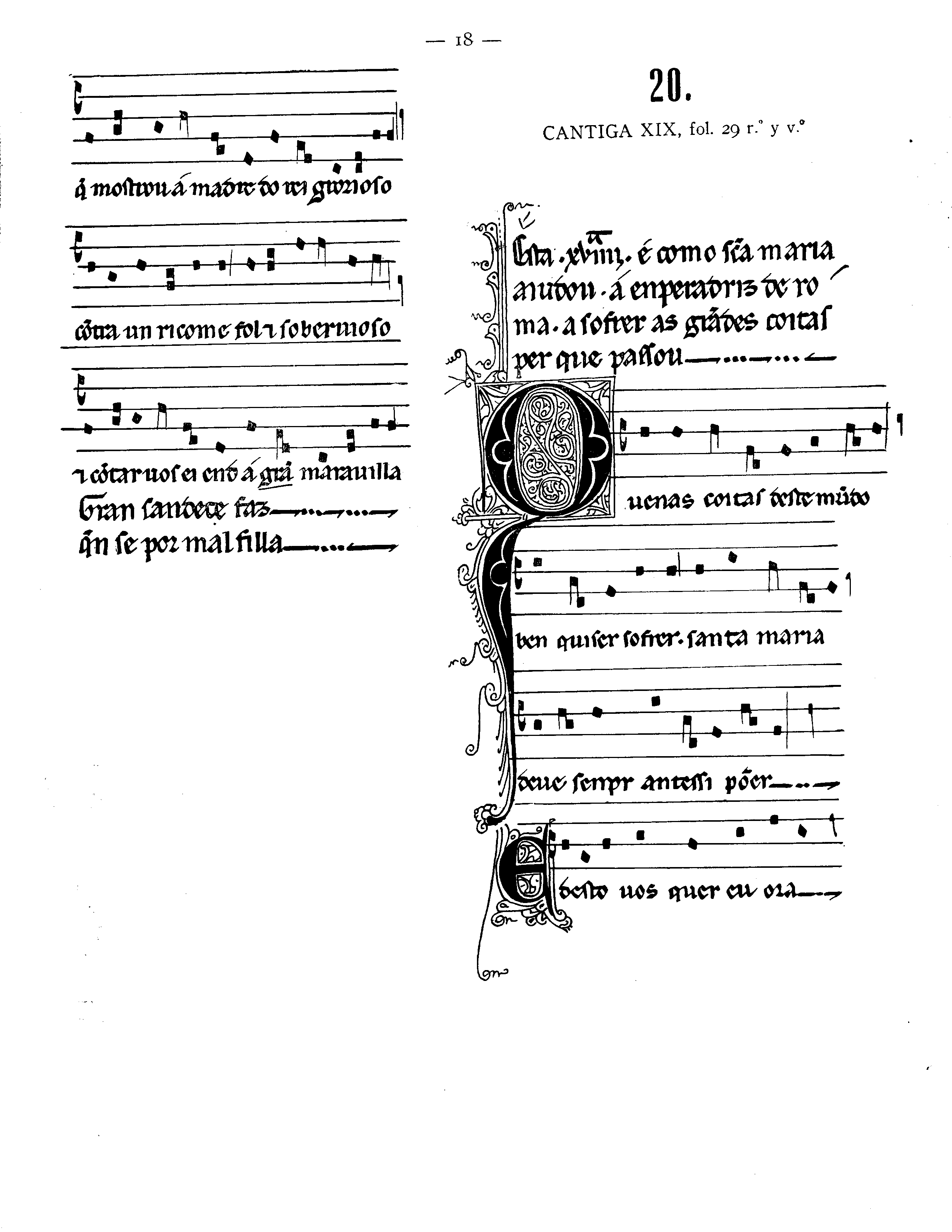
- 13th century CE, Alfonso X of Castile, Cantigas de Santa Maria, Códice de Toledo, cantiga 5 (facsimile):
- Eſta ·xviiii· é como ſṫa maria aiudou · á emperadriz de roma · a ſofrer as grãdes coitaſ per que paſſou.
- This 19th is about how Holy Mary helped the empress of Rome suffer through the great pains she underwent.
- Eſta ·xviiii· é como ſṫa maria aiudou · á emperadriz de roma · a ſofrer as grãdes coitaſ per que paſſou.
Old Irish
[edit]Alternative forms
[edit]Pronunciation
[edit]Etymology 1
[edit]From Proto-Celtic *es or *ēs, from Proto-Indo-European *éy.
Pronoun
[edit]é (feminine sí, neuter ed, emphatic ésom)
- he
- c. 800, Würzburg Glosses on the Pauline Epistles, published in Thesaurus Palaeohibernicus (reprinted 1987, Dublin Institute for Advanced Studies), edited and with translations by Whitley Stokes and John Strachan, vol. I, pp. 499–712, Wb. 4c3
- Is hé as airchinnech inna n-uile.
- It is he who is the chief of all.
- c. 800, Würzburg Glosses on the Pauline Epistles, published in Thesaurus Palaeohibernicus (reprinted 1987, Dublin Institute for Advanced Studies), edited and with translations by Whitley Stokes and John Strachan, vol. I, pp. 499–712, Wb. 4c3
- it (referring to a masculine noun)
- c. 800, Würzburg Glosses on the Pauline Epistles, published in Thesaurus Palaeohibernicus (reprinted 1987, Dublin Institute for Advanced Studies), edited and with translations by Whitley Stokes and John Strachan, vol. I, pp. 499–712, Wb. 5b28
- Ní tú nod·n-ail, acht is hé not·ail.
- It is not you that nourishes it, but it that nourishes you.
- c. 800, Würzburg Glosses on the Pauline Epistles, published in Thesaurus Palaeohibernicus (reprinted 1987, Dublin Institute for Advanced Studies), edited and with translations by Whitley Stokes and John Strachan, vol. I, pp. 499–712, Wb. 5b28
Descendants
[edit]Etymology 2
[edit]From Proto-Celtic *eyes (nom. pl.) or *ens (acc. pl.) (compare Middle Welsh wy), from Proto-Indo-European *éy.
Pronoun
[edit]é (emphatic ésom)
- they
- c. 800, Würzburg Glosses on the Pauline Epistles, published in Thesaurus Palaeohibernicus (reprinted 1987, Dublin Institute for Advanced Studies), edited and with translations by Whitley Stokes and John Strachan, vol. I, pp. 499–712, Wb. 4a8
- Nitat pecthi collnidi híccatar and ind echt so cebtar hé riam.
- It is not fleshly sins that are paid for there now, though it was they before.
- Nitat pecthi collnidi híccatar and ind echt so cebtar hé riam.
- c. 800, Würzburg Glosses on the Pauline Epistles, published in Thesaurus Palaeohibernicus (reprinted 1987, Dublin Institute for Advanced Studies), edited and with translations by Whitley Stokes and John Strachan, vol. I, pp. 499–712, Wb. 4a8
Old Spanish
[edit]Alternative forms
[edit]Etymology
[edit]Pronunciation
[edit]Conjunction
[edit]é
Descendants
[edit]Old Tupi
[edit]Pronunciation
[edit]Etymology 1
[edit]Particle
[edit]é
- own; oneself
- by motu proprio; own will
- in fact; actually
- even
- really
- only
- but
- because
- again
- for the first time
- another time; another day
- time will come [with 'e (+ gerund)]
- (men's speech) expresses doubt
- Coordinate term: (woman's speech) ri
Etymology 2
[edit]Adjective
[edit]é (noun form é)
Declension
[edit]| Causative | moé | |||||
| Deadjectivals | ||||||
|---|---|---|---|---|---|---|
| -ba'e | i eba'e | |||||
| -sab(a) | eaba/esaba | |||||
| Singular | Singular & Plural | Plural | ||||
| 1st person | 2nd person | 3rd person | 1st person exclusive | 1st person inclusive | 2nd person | |
| Adjectival forms | ||||||
| Active | ||||||
| Indicative | xe é | nde é | i é | oré é | îandé é | pe é |
| Imperative | ||||||
| Permissive | ta xe é | ta nde é | t'i é | t'oré é | t'îandé é | ta pe é |
| Negative indicative | na xe éî | na nde éî | n'i éî | n'oré éî | n'îandé éî | na pe éî |
| Negative imperative | nde é umẽ | pe é umẽ | ||||
| Negative permissive | ta xe é umẽ | ta nde é umẽ | t'i é umẽ | t'oré é umẽ | t'îandé é umẽ | ta pe é umẽ |
| Gerund | ||||||
| Affirmative | xe éramo | nde éramo | o éramo | oré éramo | îandé éramo | pe éramo |
| Negative | xe ee'ymamo | nde ee'ymamo | o ee'ymamo | oré ee'ymamo | îandé ee'ymamo | pe ee'ymamo |
| Nominal forms | ||||||
| Infinitive | ||||||
| Affirmative | é | |||||
| Negative | ee'yma | |||||
| Circumstantial | ||||||
| Affirmative | same as gerund1 | |||||
| xe éû2 | i éû2 | oré éû2 | îandé éû2 | |||
| Negative | same as gerund1 | |||||
| xe ee'ymi2 | i ee'ymi2 | oré ee'ymi2 | îandé ee'ymi2 | |||
| 1South Tupi 2North Tupi | ||||||
Adverb
[edit]é
Etymology 3
[edit]Adjective
[edit]é (IIa class pluriform, R1 ré, R2 sé, noun form é)
Declension
[edit]| Causative | moé | |||||
| Deadjectivals | ||||||
|---|---|---|---|---|---|---|
| -ba'e | seba'e | |||||
| -sab(a) | eaba/esaba | |||||
| Singular | Singular & Plural | Plural | ||||
| 1st person | 2nd person | 3rd person | 1st person exclusive | 1st person inclusive | 2nd person | |
| Adjectival forms | ||||||
| Active | ||||||
| Indicative | xe ré | nde ré | sé | oré ré | îandé ré | pe ré |
| Imperative | ||||||
| Permissive | ta xe ré | ta nde ré | ta sé | t'oré ré | t'îandé ré | ta pe ré |
| Negative indicative | na xe réî | na nde réî | na séî | n'oré réî | n'îandé réî | na pe réî |
| Negative imperative | nde ré umẽ | pe ré umẽ | ||||
| Negative permissive | ta xe ré umẽ | ta nde ré umẽ | ta sé umẽ | t'oré ré umẽ | t'îandé ré umẽ | ta pe ré umẽ |
| Gerund | ||||||
| Affirmative | xe réramo | nde réramo | o éramo | oré réramo | îandé réramo | pe réramo |
| Negative | xe ree'ymamo | nde ree'ymamo | o ee'ymamo | oré ree'ymamo | îandé ree'ymamo | pe ree'ymamo |
| Nominal forms | ||||||
| Infinitive | ||||||
| Affirmative | é | |||||
| Negative | ee'yma | |||||
| Circumstantial | ||||||
| Affirmative | same as gerund1 | |||||
| xe réû2 | séû2 | oré réû2 | îandé réû2 | |||
| Negative | same as gerund1 | |||||
| xe ree'ymi2 | see'ymi2 | oré ree'ymi2 | îandé ree'ymi2 | |||
| 1South Tupi 2North Tupi | ||||||
Noun
[edit]é (possessable, IIa class pluriform, absolute té, R1 ré, R2 sé)
References
[edit]- Eduardo de Almeida Navarro (2013) “é”, in Dicionário de tupi antigo: a língua indígena clássica do Brasil [Dictionary of Old Tupi: The Classical Indigenous Language of Brazil] (overall work in Portuguese), São Paulo: Global, →ISBN, pages 87–88
Picard
[edit]Etymology
[edit]From Old French ef, from Latin apem.
Noun
[edit]é f (plural és)
- bee
- Ch’est unne é
- It’s a bee
Portuguese
[edit]Pronunciation
[edit]
Etymology 1
[edit]Inherited from Old Galician-Portuguese é, from Latin est.
Alternative forms
[edit]- eh (text messaging)
- he (obsolete)
Verb
[edit]é
Etymology 2
[edit]Alternative forms
[edit]Noun
[edit]é m (plural és)
- e (name of the letter E, e)
Etymology 3
[edit]Alternative forms
[edit]- eh (text messaging)
- éé, ééé, éééé
Interjection
[edit]é
- that's right; yes; yeah; indicates agreement
- É, eu fiz isso.
- Yeah, I did that.
- erm; um; used in hesitant speech
Rawang
[edit]Verb
[edit]é
- hey, hi, you knowǃ.
- Bøø̀ go mvshìé.
- The snake is still alive.
Prefix
[edit]é
- marker of speech act participant involvement, but speaker is not actor.
Slovene
[edit]
Etymology 1
[edit]Letter e with acute (◌́) to signify long close-mid stressed vowel.
Pronunciation
[edit]Letter
[edit]é (upper case, lower case é)
- Additional letter, used to denote the long stress on close-mid e.
Symbol
[edit]é
- (non-tonal SNPT) Phonetic transcription of sound [eː].
Etymology 2
[edit]Letter e with acute (◌́) to signify long low-pitched vowel.
Pronunciation
[edit]- (sound): IPA(key): /ɛ́ː/, /ɛ̀ː/
- (letter name): IPA(key): /akutìːrani ʃirɔ̀ːki èː/, /akutìːrani ʃirɔ̀ːki éː/ (akutirani široki e)
- Rhymes: -eː
Symbol
[edit]é
- (tonal SNPT) Phonetic transcription of sound [ɛ̀ː].
Etymology 3
[edit]Letter e with acute (◌́) to signify short vowel.
Pronunciation
[edit]Letter
[edit]é (lower case, usually not in upper case)
- (Natisone Valley dialect) Additional letter, used in some words to denote the short stress on e.
Etymology 4
[edit]Letter e with acute (◌́) to signify stressed vowel.
Pronunciation
[edit]Letter
[edit]é (upper case, lower case é)
- (Resian) Additional letter, used to denote stress on e.
See also
[edit]References
[edit]- Toporišič, Jože (2000) Slovenska slovnica / Jože Toporišič. - 4. prenovljena in razširjena izd. (in Slovene), Maribor: Obzorja, →ISBN
- Steenwijk, Han (1994) Ortografia resiana = Tö jošt rozajanskë pïsanjë (overall work in Italian and Slovene), Padua: CLEUP
- Špehonja, Nino (2012) Nediška gramatika[2] (in Italian), Poligrafice San Marco
Spanish
[edit]Conjunction
[edit]é
Swedish
[edit]Pronunciation
[edit]Letter
[edit]é
- Form of e, used to mark that the letter is long and fully stressed.
Usage notes
[edit]- Although this is considered a variant of e and is not an independent letter in the Swedish alphabet, it distinguishes a few words such as idé (“idea”) and ide (“place of hibernation”).
Further reading
[edit] é on the Swedish Wikipedia.Wikipedia sv

Tlingit
[edit]Pronunciation
[edit]Letter
[edit]é (upper case É)
- A letter of the Tlingit alphabet, written in the Latin script.
See also
[edit]- Canada: (Latin-script letters) A a, Á á, À à, Â â, Ch ch, Chʼ chʼ, D d, Dł dł, Dz dz, E e, É é, È è, Ê ê, G g, Gw gw, Gh gh, Ghw ghw, H h, I i, Í í, Ì ì, Î î, J j, K k, Kw kw, Kʼ kʼ, Kʼw kʼw, Kh kh, Khw khw, Khʼ khʼ, Khʼw khʼw (L l), Ł ł, Łʼ łʼ (M m), N n (O o), S s, Sʼ sʼ, Sh sh, T t, Tʼ tʼ, Tl tl, Tlʼ tlʼ, Ts ts, Tsʼ tsʼ, U u, Ú ú, Ù ù, Û û, W w, X x, Xw xw, Xʼ xʼ, Xʼw xʼw, Xh xh, Xhw xhw, Xhʼ xhʼ, Xhʼw xhʼw, Y y (Ÿ ÿ), ․
- US: (Latin-script letters) A a, Á á, Aa aa, Áa áa, Ch ch, Chʼ chʼ, D d, Dl dl, Dz dz, E e, É é, Ee ee, Ée ée, Ei ei, Éi éi, G g, Gw gw, G̱ g̱, G̱w g̱w, H h, I i, Í í, J j, K k, Kw kw, Kʼ kʼ, Kʼw kʼw, Ḵ ḵ, Ḵw ḵw, Ḵʼ ḵʼ, Ḵʼw ḵʼw, L l, Lʼ lʼ (Ḻ ḻ, M m), N n (O o), Oo oo, Óo óo, S s, Sʼ sʼ, Sh sh, T t, Tʼ tʼ, Tl tl, Tlʼ tlʼ, Ts ts, Tsʼ tsʼ, U u, Ú ú, W w, X x, Xw xw, Xʼ xʼ, Xʼw xʼw, X̱ x̱, X̱w x̱w, X̱ʼ x̱ʼ, X̱ʼw x̱ʼw, Y y (Ÿ ÿ, Y̱ y̱), ․
Vietnamese
[edit]Pronunciation
[edit]Etymology 1
[edit]Noun
[edit](classifier cây, hạt, hột) é • (薏)
- (botany) lemon basil
- bé như hột é ― very small (literally, “as small as a lemon basil seed”)
Etymology 2
[edit]Letter
[edit]é (lower case, upper case É)
- The letter e with the acute accent.
See also
[edit]- (Quốc ngữ letters) chữ cái; A a (À à, Ả ả, Ã ã, Á á, Ạ ạ), Ă ă (Ằ ằ, Ẳ ẳ, Ẵ ẵ, Ắ ắ, Ặ ặ), Â â (Ầ ầ, Ẩ ẩ, Ẫ ẫ, Ấ ấ, Ậ ậ), B b, C c (Ch ch), D d, Đ đ, E e (È è, Ẻ ẻ, Ẽ ẽ, É é, Ẹ ẹ), Ê ê (Ề ề, Ể ể, Ễ ễ, Ế ế, Ệ ệ), G g (Gh gh, Gi gi), H h, I i (Ì ì, Ỉ ỉ, Ĩ ĩ, Í í, Ị ị), K k (Kh kh), L l, M m, N n (Ng ng, Ngh ngh, Nh nh), O o (Ò ò, Ỏ ỏ, Õ õ, Ó ó, Ọ ọ), Ô ô (Ồ ồ, Ổ ổ, Ỗ ỗ, Ố ố, Ộ ộ), Ơ ơ (Ờ ờ, Ở ở, Ỡ ỡ, Ớ ớ, Ợ ợ), P p (Ph ph), Q q (Qu qu), R r, S s, T t (Th th, Tr tr), U u (Ù ù, Ủ ủ, Ũ ũ, Ú ú, Ụ ụ), Ư ư (Ừ ừ, Ử ử, Ữ ữ, Ứ ứ, Ự ự), V v, X x, Y y (Ỳ ỳ, Ỷ ỷ, Ỹ ỹ, Ý ý, Ỵ ỵ)
Welsh
[edit]Pronunciation
[edit]Letter
[edit]é (upper case É)
- The letter E, marked for its short pronunciation when in a stressed final syllable of a polysyllabic word.
Yele
[edit]Pronunciation
[edit]Letter
[edit]é
- A letter of the Yele alphabet.
Derived terms
[edit]- The digraph ⟨éé⟩ transcribes the long vowel /eː/
See also
[edit]- Character boxes with compositions
- Latin-1 Supplement block
- Latin script characters
- English lemmas
- English symbols
- English terms spelled with ◌́
- Blin terms with IPA pronunciation
- Blin lemmas
- Blin letters
- Bourguignon terms inherited from Old French
- Bourguignon terms derived from Old French
- Bourguignon lemmas
- Bourguignon prepositions
- Bourguignon terms with archaic senses
- Czech terms with IPA pronunciation
- Czech lemmas
- Czech letters
- Fala non-lemma forms
- Fala verb forms
- Galician terms inherited from Latin
- Galician terms derived from Latin
- Galician terms with IPA pronunciation
- Galician terms with audio links
- Galician non-lemma forms
- Galician verb forms
- Galician terms with usage examples
- Chinese lemmas
- Hokkien lemmas
- Chinese adjectives
- Hokkien adjectives
- Hokkien pe̍h-ōe-jī forms
- Hungarian terms with IPA pronunciation
- Hungarian lemmas
- Hungarian letters
- Icelandic 1-syllable words
- Icelandic terms with IPA pronunciation
- Rhymes:Icelandic/jɛː
- Icelandic lemmas
- Icelandic letters
- Irish terms inherited from Old Irish
- Irish terms derived from Old Irish
- Irish terms inherited from Proto-Indo-European
- Irish terms derived from Proto-Indo-European
- Irish terms with IPA pronunciation
- Irish lemmas
- Irish pronouns
- Irish personal pronouns
- Irish terms derived from Latin
- Irish letters
- Irish nouns
- ga:Latin letter names
- Italian 1-syllable words
- Italian terms with IPA pronunciation
- Italian lemmas
- Italian letters
- Kashubian lemmas
- Kashubian letters
- Ligurian non-lemma forms
- Ligurian verb forms
- Lote lemmas
- Lote numerals
- Mandarin terms with audio links
- Hanyu Pinyin
- Mandarin non-lemma forms
- Muong terms inherited from Proto-Vietic
- Muong terms derived from Proto-Vietic
- Muong terms with IPA pronunciation
- Muong lemmas
- Muong verbs
- Muong nouns
- Narua lemmas
- Narua pronouns
- Narua personal pronouns
- Noon terms with IPA pronunciation
- Noon lemmas
- Noon letters
- Old Galician-Portuguese terms with IPA pronunciation
- Old Galician-Portuguese non-lemma forms
- Old Galician-Portuguese verb forms
- Old Irish terms with IPA pronunciation
- Old Irish terms inherited from Proto-Celtic
- Old Irish terms derived from Proto-Celtic
- Old Irish terms inherited from Proto-Indo-European
- Old Irish terms derived from Proto-Indo-European
- Old Irish lemmas
- Old Irish pronouns
- Old Irish personal pronouns
- Old Irish terms with quotations
- Old Spanish terms inherited from Latin
- Old Spanish terms derived from Latin
- Old Spanish terms with IPA pronunciation
- Old Spanish lemmas
- Old Spanish conjunctions
- Old Tupi terms with IPA pronunciation
- Rhymes:Old Tupi/ɛ
- Rhymes:Old Tupi/ɛ/1 syllable
- Old Tupi lemmas
- Old Tupi particles
- Old Tupi men's speech terms
- Old Tupi adjectives
- Old Tupi adverbs
- Old Tupi IIa class adjectives
- Old Tupi pluriform adjectives
- Old Tupi nouns
- Old Tupi IIa class nouns
- Old Tupi possessable nouns
- Old Tupi pluriform nouns
- Picard terms inherited from Old French
- Picard terms derived from Old French
- Picard terms inherited from Latin
- Picard terms derived from Latin
- Picard lemmas
- Picard nouns
- Picard feminine nouns
- Picard terms with usage examples
- Portuguese 1-syllable words
- Portuguese terms with IPA pronunciation
- Rhymes:Portuguese/ɛ
- Rhymes:Portuguese/ɛ/1 syllable
- Portuguese terms with audio links
- Portuguese terms inherited from Old Galician-Portuguese
- Portuguese terms derived from Old Galician-Portuguese
- Portuguese terms inherited from Latin
- Portuguese terms derived from Latin
- Portuguese non-lemma forms
- Portuguese verb forms
- Portuguese lemmas
- Portuguese nouns
- Portuguese countable nouns
- Portuguese masculine nouns
- Portuguese interjections
- Portuguese terms with usage examples
- pt:Latin letter names
- Rawang lemmas
- Rawang verbs
- Rawang terms with usage examples
- Rawang prefixes
- Slovene 1-syllable words
- Slovene terms with IPA pronunciation
- Rhymes:Slovene/eː
- Slovene lemmas
- Slovene letters
- Slovene terms spelled with ◌́
- Slovene symbols
- Spanish lemmas
- Spanish conjunctions
- Spanish obsolete forms
- Swedish terms with IPA pronunciation
- Swedish lemmas
- Swedish letters
- Swedish terms spelled with ◌́
- Tlingit terms with IPA pronunciation
- Tlingit lemmas
- Tlingit letters
- Vietnamese terms with IPA pronunciation
- Vietnamese nouns classified by cây
- Vietnamese nouns classified by hạt
- Vietnamese nouns classified by hột
- Vietnamese lemmas
- Vietnamese nouns
- vi:Botany
- Vietnamese terms with usage examples
- Vietnamese letters
- Welsh terms with IPA pronunciation
- Welsh lemmas
- Welsh letters
- Welsh terms spelled with ◌́
- Yele terms with IPA pronunciation
- Yele lemmas
- Yele letters