á
| ||||||||||
Czech[edit]
Letter[edit]
á (lower case, upper case Á)
Faroese[edit]

Pronunciation[edit]
Etymology 1[edit]
Long Old Norse /a/. Often written as ā or normalized á or even aa, compare Swedish, Danish, Norwegian å.[2]
Noun[edit]
á (upper case Á)
- The second letter of the Faroese alphabet, written in the Latin script.
See also[edit]
- (Latin-script letters) bókstavur; A a, Á á, B b, D d, Ð ð, E e, F f, G g, H h, I i, Í í, J j, K k, L l, M m, N n, O o, Ó ó, P p, R r, S s, T t, U u, Ú ú, V v, Y y, Ý ý, Æ æ, Ø ø
Etymology 2[edit]
From Old Norse á (“river”), Svabo: Aa,[3] from Proto-Germanic *ahwō, from Proto-Indo-European *h₂ekʷeh₂ (“water”).
Noun[edit]
á f (genitive singular áar, plural áir)
Usage notes[edit]
- (poetry): áir renna vakrar har ― the rivers flow beautiful there
- áirnar standa á svølgi ― the rivers stand on deep water (= it's raining a lot) (compare áarføri)
- um áir og gjáir ― over rivers and gorges (= to travel a long way)
- fara yvir um á(nna) eftir vatni ― go over the river in order to get water (= to look for unnecessary struggle)
- tað gekk sum eftir ánni ― it went like after the river (= it was very easy)
- ganga / fara í áir ― go to the river in order to fish trouts[3] (described in Føroysk orðabók 1998 as local usage in the island of Vágar about fishing trouts in a lake[4])
Declension[edit]
| Declension of á | ||||
|---|---|---|---|---|
| f2 (á) | singular | plural | ||
| indefinite | definite | indefinite | definite | |
| nominative | á | áin | áir | áirnar |
| accusative | á | ánna | áir | áirnar |
| dative | á | ánni | áum | áunum |
| genitive | áar | áarinnar | áa | áanna |
Synonyms[edit]
- (brook): løkur
Etymology 3[edit]
From Old Norse á (“on, onto, in, at”). [5]
Preposition[edit]
á
- on, onto, to, near, beside [+accusative]
- (with accusative, fjords, bays, harbours) to
- on, in, at [+dative]
- (with dative, place names) in
- (with dative, fjords, bays, harbours) at, in
- (with dative, seafaring and fishery) at
Usage notes[edit]
The preposition 'á' is used with accusative case if the verb shows movement from one place to another, whereas it is used with dative case if the verb shows location. This is the same usage as with German auf:
- Governing accusative
- legg bókina á borðið ― place the book on the table
- hann fer umborð á skipið ― he goes aboard the ship
- skriva á talvuna ― to write on the blackboard
- fara á fjall ― to go into the mountains
- with fjords, bays, harbours
- skipið kom á Vestmanna ― the ship came to Vestmanna
- skipið kom á Havnina ― the ship came to Tórshavn
- Governing dative
- bókin liggur á borðinum ― the book is on the table
- hann er umborð á skipinum ― he is aboard the ship
- tað stendur á talvuni ― this stands on the blackboard
- vera á fjalli ― to be in the mountains (in order to roundup the sheep[5])
- Place names (antonym: av)
- á Eiði ― in Eiði
- á Glyvrum ― in Glyvrar
- á Húsum ― in Húsar
- á Kirkju ― in Kirkja
- á Skála ― in Skáli
- á Velbastað ― in Velbastaður
- á bygd ― in the village (countryside)
- with fjords, bays, harbours
- skipið lá á Havnini ― the ship lays in Tórshavn
- with seafaring and fishery
Etymology 4[edit]
Interjection[edit]
á!
Etymology 5[edit]
From Old Norse [Term?].
Verb[edit]
á
References[edit]
- ^ V. U. Hammershaimb: Færøsk Anthologi. Copenhagen 1891, 3rd edition Tórshavn 1991 (volume 2, page 2, entry á1, 2)
- ^ Vibeke Sandersen: „Om bogstavet å“ in Nyt fra Sprognævnet 2002/3 September.
- ↑ 3.0 3.1 Aa1 in: Jens Christian Svabo: Dictionarium Færoense : Færøsk-dansk-latinsk ordbog. (ed. Christian Matras after manuscripts from late 18th century). Copenhagen: Munksgaard, 1966. (p. 1)
- ^ Jóhan Hendrik W. Poulsen, et al.: Føroysk orðabók. Tórshavn: Føroya Fróðskaparfelag 1998. (Entry á2)
- ↑ 5.0 5.1 5.2 aa2 in: Jens Christian Svabo: Dictionarium Færoense : Færøsk-dansk-latinsk ordbog. (ed. Christian Matras after manuscripts from late 18th century). Copenhagen: Munksgaard, 1966. (p. 1f.)
Galician[edit]
Alternative forms[edit]
Etymology 1[edit]
From contraction of preposition a (“to, towards”) + feminine definite article a (“the”).
Pronunciation[edit]
Contraction[edit]
á f (masculine ao, masculine plural aos, feminine plural ás)
Etymology 2[edit]
From Old Galician-Portuguese aa (13th century, Cantigas de Santa Maria), from Latin ala. Compare Portuguese á. Doublet of ala.
Pronunciation[edit]
Noun[edit]
á f (plural ás)
- wing
- c1350, K. M. Parker (ed.), Historia Troyana. Santiago: Instituto "Padre Sarmiento", page 30:
- et as de leychuza
- and wings of an owl
- 1697, Juan Antonio Torrado, Fala o corvo:
- Fala o corbo, escoyten todos:
Eu veño con asas negras
Cortando os ventos de longe
Para chegar à estas festas.- The raven speaks, listen everyone:
"I come with black wings
Cutting the winds from afar
To arrive to these feasts"
- The raven speaks, listen everyone:
- Synonym: ala
- c1350, K. M. Parker (ed.), Historia Troyana. Santiago: Instituto "Padre Sarmiento", page 30:
Related terms[edit]
References[edit]
- “aa” in Dicionario de Dicionarios do galego medieval, SLI - ILGA 2006–2022.
- “á” in Dicionario de Dicionarios da lingua galega, SLI - ILGA 2006–2013.
- “á” in Tesouro informatizado da lingua galega. Santiago: ILG.
- “á” in Álvarez, Rosario (coord.): Tesouro do léxico patrimonial galego e portugués, Santiago de Compostela: Instituto da Lingua Galega.
Hokkien[edit]
Etymology 1[edit]
| For pronunciation and definitions of á – see 仔 (“suffix or interfix”). (This term is the pe̍h-ōe-jī form of 仔). |
Etymology 2[edit]
| For pronunciation and definitions of á – see 猶 (“still; yet”). (This term is the pe̍h-ōe-jī form of 猶). |
Hungarian[edit]
Pronunciation[edit]
Etymology 1[edit]
Interjection[edit]
á
- oh, ah (expression of surprise)
- Á, már itt is vagy? ― Oh, are you here already?
- oh (expression of dismissiveness, disagreement, or disbelief)
- Á, nem hiszem. Ő sose mond ilyet. ― Oh, I don't believe it. He/She'll never say such a thing.
Etymology 2[edit]
Letter[edit]
á (lower case, upper case Á)
- The second letter of the Hungarian alphabet, called á and written in the Latin script.
Declension[edit]
| Inflection (stem in long/high vowel, back harmony) | ||
|---|---|---|
| singular | plural | |
| nominative | á | á-k |
| accusative | á-t | á-kat |
| dative | á-nak | á-knak |
| instrumental | á-val | á-kkal |
| causal-final | á-ért | á-kért |
| translative | á-vá | á-kká |
| terminative | á-ig | á-kig |
| essive-formal | á-ként | á-kként |
| essive-modal | — | — |
| inessive | á-ban | á-kban |
| superessive | á-n | á-kon |
| adessive | á-nál | á-knál |
| illative | á-ba | á-kba |
| sublative | á-ra | á-kra |
| allative | á-hoz | á-khoz |
| elative | á-ból | á-kból |
| delative | á-ról | á-król |
| ablative | á-tól | á-któl |
| non-attributive possessive - singular |
á-é | á-ké |
| non-attributive possessive - plural |
á-éi | á-kéi |
| Possessive forms of á | ||
|---|---|---|
| possessor | single possession | multiple possessions |
| 1st person sing. | á-m | á-im |
| 2nd person sing. | á-d | á-id |
| 3rd person sing. | á-ja | á-i |
| 1st person plural | á-nk | á-ink |
| 2nd person plural | á-tok | á-itok |
| 3rd person plural | á-juk | á-ik |
Derived terms[edit]
See also[edit]
- (Latin-script letters) betű; A a, Á á, B b, C c, Cs cs, D d, Dz dz, Dzs dzs, E e, É é, F f, G g, Gy gy, H h, I i, Í í, J j, K k, L l, Ly ly, M m, N n, Ny ny, O o, Ó ó, Ö ö, Ő ő, P p, R r, S s, Sz sz, T t, Ty ty, U u, Ú ú, Ü ü, Ű ű, V v, Z z, Zs zs. Only in the extended alphabet: Q q W w X x Y y. Commonly used: ch. Also defined: à ë. In surnames (selection): ä aa cz ds eé eö ew oe oó th ts ÿ.
Further reading[edit]
- (interjection): á in Bárczi, Géza and László Országh. A magyar nyelv értelmező szótára (‘The Explanatory Dictionary of the Hungarian Language’, abbr.: ÉrtSz.). Budapest: Akadémiai Kiadó, 1959–1962. Fifth ed., 1992: →ISBN
- (sound and letter): á in Bárczi, Géza and László Országh. A magyar nyelv értelmező szótára (‘The Explanatory Dictionary of the Hungarian Language’, abbr.: ÉrtSz.). Budapest: Akadémiai Kiadó, 1959–1962. Fifth ed., 1992: →ISBN
- á in Ittzés, Nóra (ed.). A magyar nyelv nagyszótára (‘A Comprehensive Dictionary of the Hungarian Language’). Budapest: Akadémiai Kiadó, 2006–2031 (work in progress; published A–ez as of 2024)
Icelandic[edit]
Pronunciation[edit]
Etymology 1[edit]
Letter[edit]
á (upper case Á)
- The second letter of the Icelandic alphabet, written in the Latin script.
Noun[edit]
á ?
- The name of the Latin-script letter Á.
See also[edit]
- (Latin-script letters) bókstafur; A a, Á á, B b, D d, Ð ð, E e, É é, F f, G g, H h, I i, Í í, J j, K k, L l, M m, N n, O o, Ó ó, P p, R r, S s, T t, U u, Ú ú, V v, X x, Y y, Ý ý, Þ þ, Æ æ, Ö ö
Etymology 2[edit]
From Old Norse á (“river”), from Proto-Germanic *ahwō, from Proto-Indo-European *h₂ekʷeh₂ (“water”). Compare Danish å, Norwegian å, Swedish å.
Noun[edit]
á f (genitive singular ár, nominative plural ár)
Declension[edit]
Etymology 3[edit]
Inflection of á.
Noun[edit]
á f
- indefinite accusative singular of á
- indefinite dative singular of á
Etymology 4[edit]
Inflection of ær.
Noun[edit]
á f
Etymology 5[edit]
Conjugation of eiga.
Verb[edit]
á
- first-person singular present indicative of eiga I own.
- third-person singular present indicative of eiga He owns.
Etymology 6[edit]
(This etymology is missing or incomplete. Please add to it, or discuss it at the Etymology scriptorium. Particularly: “perhaps onomatopoeic?”)
Interjection[edit]
á!
Etymology 7[edit]
From Old Norse á, from Proto-Norse ᚨᚾ (an), from Proto-Germanic *ana.
Preposition[edit]
á
Derived terms[edit]
- á eftir
- á fjórum fótum
- á næstu grösum
- bera kápuna á báðum öxlum
- bíta á jaxlinn
- draga á tálar
- færa sönnur á
- hafa nóg á sinni könnu
- heill á húfi
- hlaupa á glæ
- hæla á hvert reipi
- kasta á glæ
- káfa á
- kyssa á hönd
- kýla á
- leggja á
- leggja á minnið
- leita á
- líta á
- líta á með vanþóknun
- líta niður á
- líta snöggvast á
- lítast á
- minnast á
- peningar vaxa ekki á trjám
- skella á
- spila á
- standa eins og stafur á bók
- stara eins og naut á nývirki
- súpa á
- togast á um
- vel á minnst
- vera á bandi
Irish[edit]
Pronunciation[edit]
Etymology 1[edit]
From dhá, lenited variant of dá.
Pronoun[edit]
á (triggers lenition in the masculine singular, h-prothesis in the feminine singular, and eclipsis in the plural)
- him, her, it, them (used before the verbal noun in the progressive to indicate a third person direct object)
- Táim á bhualadh. ― I am hitting him.
- Táim á ól.
- I am drinking it (referring to a masculine noun, e.g. bainne (“milk”)).
- Táim á bualadh. ― I am hitting her.
- Táim á hól.
- I am drinking it (referring to a feminine noun, e.g. bláthach (“buttermilk”)).
- Táim á mbualadh. ― I am hitting them.
- Táim á n-ól. ― I am drinking them.
- used as a quasi-reflexive pronoun in a sentence with passive semantics
- Tá an buachaill á bhualadh.
- The boy is being hit (literally ‘The boy is at his hitting’).
- Tá an chloch á tógáil ag Séamas.
- The stone is being lifted by Séamas (literally ‘The stone is at its lifting by Séamas’).
Alternative forms[edit]
Related terms[edit]
Etymology 2[edit]
Interjection[edit]
á!
- ah!
Etymology 3[edit]
Letter[edit]
á (upper case Á)
- The letter a with an acute accent, called á fada (literally “long a”).
Noun[edit]
á
- The name of the Latin-script letter a.
See also[edit]
- (Latin-script letters) litir; A a (Á á), B b (Bh bh, bhF bhf, bP bp), C c (Ch ch), D d (Dh dh, dT dt), E e (É é), F f (Fh fh), G g (gC gc, Gh gh), H h, I i (Í í), L l, M m (mB mb, Mh mh), N n (nD nd, nG ng), O o (Ó ó), P p (Ph ph), R r, S s (Sh sh), T t (Th th, tS ts), U u (Ú ú), V v
- (diacritics) ◌́ ◌̇
- (dotted letters used chiefly in Gaelic type) Ḃ ḃ, Ċ ċ, Ḋ ḋ, Ḟ ḟ, Ġ ġ, Ṁ ṁ, Ṗ ṗ, Ṡ ẛ ṡ, Ṫ ṫ
- (Latin-script letter names) litir; á, bé, cé, dé, é, eif, gé, héis, í, jé, cá, eil, eim, ein, ó, pé, cú, ear, eas, té, ú, vé, wae, ex, yé, zae
- Note: The English names are also widely used by Irish speakers.
Further reading[edit]
- Ó Dónaill, Niall (1977) “á”, in Foclóir Gaeilge–Béarla, Dublin: An Gúm, →ISBN
- Entries containing “á” in English-Irish Dictionary, An Gúm, 1959, by Tomás de Bhaldraithe.
- Entries containing “á” in New English-Irish Dictionary by Foras na Gaeilge.
Mandarin[edit]
Alternative forms[edit]
- a — nonstandard
Romanization[edit]
- Hanyu Pinyin reading of 啊
- Hanyu Pinyin reading of 嗄
- Hanyu Pinyin reading of 𭉿
Old Galician-Portuguese[edit]
Alternative forms[edit]
Etymology[edit]
Inherited from Latin illa f (“that”).
Pronunciation[edit]
Article[edit]
á f
- feminine singular of o
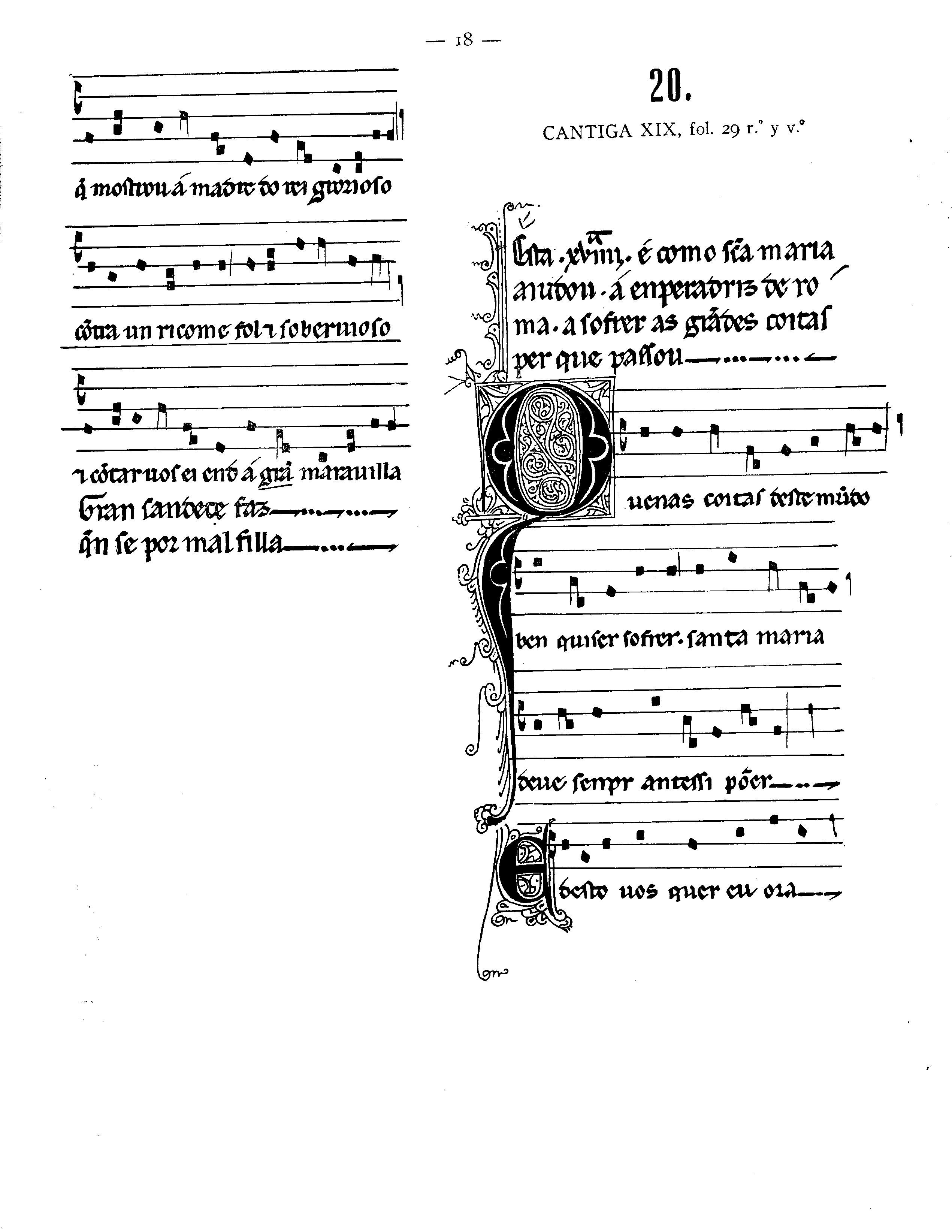
- 13th century CE, Alfonso X of Castile, Cantigas de Santa Maria, To codex, cantiga 5 (facsimile):
- Eſta ·xviiii· é como ſṫa maria aiudou · á emperadriꝣ de roma · a ſofrer as grãdes coitaſ per que paſſou.
- This 19th is (about) how Holy Mary helped · the empress of Rome · suffer through the great pains she underwent.
- Eſta ·xviiii· é como ſṫa maria aiudou · á emperadriꝣ de roma · a ſofrer as grãdes coitaſ per que paſſou.
Descendants[edit]
Old Irish[edit]
Etymology 1[edit]
Determiner[edit]
á (3rd person possessive) (triggers lenition in the masculine and neuter singular, an unwritten prothetic /h/ in the feminine singular, and eclipsis in the plural)
- Alternative form of a
- c. 800–825, Diarmait, Milan Glosses on the Psalms, published in Thesaurus Palaeohibernicus (reprinted 1987, Dublin Institute for Advanced Studies), edited and with translations by Whitley Stokes and John Strachan, vol. I, pp. 7–483, Ml. 90b12
- Mad·genatar á thimthirthidi.
- Blessed are his servants.
- c. 800–825, Diarmait, Milan Glosses on the Psalms, published in Thesaurus Palaeohibernicus (reprinted 1987, Dublin Institute for Advanced Studies), edited and with translations by Whitley Stokes and John Strachan, vol. I, pp. 7–483, Ml. 144d3
- Nach torbatu coitchenn ro·boí indib fri denum n-uilc at·rubalt tar hesi á pectha.
- Every common advantage that had been in them for doing evil has perished for their sin.
- c. 800–825, Diarmait, Milan Glosses on the Psalms, published in Thesaurus Palaeohibernicus (reprinted 1987, Dublin Institute for Advanced Studies), edited and with translations by Whitley Stokes and John Strachan, vol. I, pp. 7–483, Ml. 90b12
Etymology 2[edit]
Particle[edit]
á (triggers lenition)
- Alternative form of a
- c. 800–825, Diarmait, Milan Glosses on the Psalms, published in Thesaurus Palaeohibernicus (reprinted 1987, Dublin Institute for Advanced Studies), edited and with translations by Whitley Stokes and John Strachan, vol. I, pp. 7–483, Ml. 53c11
- in tan as·mbeir, Tait, á maccu
- when he says, "Come, O sons"
- c. 800–825, Diarmait, Milan Glosses on the Psalms, published in Thesaurus Palaeohibernicus (reprinted 1987, Dublin Institute for Advanced Studies), edited and with translations by Whitley Stokes and John Strachan, vol. I, pp. 7–483, Ml. 53c11
Etymology 3[edit]
From Proto-Indo-European *h₁óh₃s.
Noun[edit]
á (gender unknown)
Etymology 4[edit]
From Proto-Celtic *yās, from Proto-Indo-European *yeh₂- (“to go”).[1][2]
Noun[edit]
á n (genitive unattested)
- cart, chariot
- c. 800–825, Diarmait, Milan Glosses on the Psalms, published in Thesaurus Palaeohibernicus (reprinted 1987, Dublin Institute for Advanced Studies), edited and with translations by Whitley Stokes and John Strachan, vol. I, pp. 7–483, Ml. 96c12
- dunaib aaib
- to the chariots
- c. 800–825, Diarmait, Milan Glosses on the Psalms, published in Thesaurus Palaeohibernicus (reprinted 1987, Dublin Institute for Advanced Studies), edited and with translations by Whitley Stokes and John Strachan, vol. I, pp. 7–483, Ml. 96c12
Inflection[edit]
| Neuter s-stem | |||
|---|---|---|---|
| Singular | Dual | Plural | |
| Nominative | áN | áN | áL |
| Vocative | áN | áN | áL |
| Accusative | áN | áN | áL |
| Genitive | áL | á | áN |
| Dative | áL | áib, aaib | áib, aaib |
Initial mutations of a following adjective:
| |||
Mutation[edit]
| Old Irish mutation | ||
|---|---|---|
| Radical | Lenition | Nasalization |
| á | unchanged | n-á |
| Note: Some of these forms may be hypothetical. Not every possible mutated form of every word actually occurs. | ||
References[edit]
- ^ Watkins, Calvert (1978) “Varia III”, in Ériu[1], volume 29, Royal Irish Academy, →ISSN, →JSTOR, retrieved July 20, 2022, pages 155–165
- ^ Matasović, Ranko (2009) “*yās”, in Etymological Dictionary of Proto-Celtic (Leiden Indo-European Etymological Dictionary Series; 9), Leiden: Brill, →ISBN, page 434
Further reading[edit]
- G. Toner, M. Ní Mhaonaigh, S. Arbuthnot, D. Wodtko, M.-L. Theuerkauf, editors (2019), “á”, in eDIL: Electronic Dictionary of the Irish Language
Old Norse[edit]
Etymology 1[edit]
From Proto-Germanic *ahwō (“water, stream”), from Proto-Indo-European *h₂ekʷeh₂ (“water”). Cognate with Old English ēa, Old Frisian ā, ē, Old Saxon aha, Old High German aha, Gothic 𐌰𐍈𐌰 (aƕa).
Alternative forms[edit]
Noun[edit]
- river, creek
- Ásmundar saga kappabana, chapter 9:
- Síðan óc hann upp með ánni Rín til móz við Ásmund.
- Then [Hildibrandr] went up along the river Rhine to meet Ásmundr.
- Ásmundar saga kappabana, chapter 9:
Declension[edit]
Derived terms[edit]
Descendants[edit]
Etymology 2[edit]
From Proto-Germanic *awiz, from Proto-Indo-European *h₂ówis.
Noun[edit]
- Alternative form of ær
Declension[edit]
Etymology 3[edit]
From Proto-Norse ᚨᚾ (an), from Proto-Germanic *ana (“on, onto”). Cognate with Old English on, Old Frisian on, Old Saxon ana, an, Old Dutch ana, an, in, Old High German ana, an, Gothic 𐌰𐌽𐌰 (ana).
Alternative forms[edit]
Preposition[edit]
á
- (with dative) on
- Þeir eru á hólmi.
- They are on an island.
- in [+dative]
- Ek bý á Islandi.
- I live in Iceland.
Descendants[edit]
In most descendant languages, this preposition was replaced by reflexes of upp á.
- Icelandic: á
- Faroese: á
- Norwegian Nynorsk: å (dialectal)
- Elfdalian: ą̊
- Old Swedish: ā
- Old Danish: ā
- Danish: å (dialectal)
Etymology 4[edit]
Probably related to Old Norse æ (“always”)
Adverb[edit]
á (not comparable)
Etymology 5[edit]
An imitation of a cry of pain.
Interjection[edit]
á
Descendants[edit]
- Icelandic: á
Etymology 6[edit]
See the etymology of the corresponding lemma form.
Noun[edit]
á
Verb[edit]
á
- inflection of eiga:
References[edit]
- á in A Concise Dictionary of Old Icelandic, G. T. Zoëga, Clarendon Press, 1910, at Internet Archive.
- á in A Concise Dictionary of Old Icelandic, G. T. Zoëga, Clarendon Press, 1910, at Internet Archive.
Parauk[edit]
Pronunciation[edit]
Verb[edit]
á
- to numb.
Portuguese[edit]
Pronunciation[edit]
Etymology 1[edit]
Alternative forms[edit]
Noun[edit]
á m (plural ás)
- The name of the Latin-script letter A.
Derived terms[edit]
Etymology 2[edit]
From Old Galician-Portuguese aa (“wing”), from Latin āla (“wing”). Cognate with Galician á, Spanish, Catalan, Italian, and Occitan ala, French aile and Ligurian âa. Doublet of ala, which was a borrowing.
Noun[edit]
á f (plural ás)
References[edit]
- “aa” in Dicionario de dicionarios do galego medieval.
Rawang[edit]
Interjection[edit]
á
- well, Oh!, my God!
- Àngkøø̀ maq rvmá chuaòe.
- He is ploughing his father-in-law's field.
- Àng dvpvt vv́mpà køtnaòe.
- They are cooking rice for him.
Verb[edit]
á
- open mouth.
- Ló nònggøp èáshì.
- Well, open up your mouth..
Particle[edit]
á
- vocative particle suffixed to the name of the person hailed.
Slovene[edit]
Etymology 1[edit]
Letter a with acute (◌́) to signify long vowel.
Pronunciation[edit]
- (phoneme): IPA(key): /áː/, /àː/
- (letter name): IPA(key): /dɔ́ːʋɡi àː/, /dɔ́ːʋɡi áː/, dolgi a
- Rhymes: -aː
Letter[edit]
á (lower case, upper case Á)
- Additional letter, used in some words to denote the long stress on a.
Symbol[edit]
á
- (non-tonal SNPT) Phonetic transcription of sound [aː].
Etymology 2[edit]
Letter a with acute (◌́) to signify long low-pitched vowel.
Pronunciation[edit]
- (phoneme): IPA(key): /àː/, [ǎː]
- (letter name, tonal transcription): IPA(key): /akutíːrani àː/, /akutíːrani áː/, akutirani a
- Rhymes: -aː
Symbol[edit]
á
- (tonal SNPT) Phonetic transcription of sound [àː].
Usage notes[edit]
Symbol is sometimes used as a letter to denote pitch in a word, but that is mostly limited to foreign or specialized dictionaries.
Etymology 3[edit]
Letter a with acute (◌́) to signify short vowel.
Pronunciation[edit]
Letter[edit]
á (lower case, usually not in upper case)
- (Natisone Valley dialect) Additional letter, used in some words to denote the short stress on a.
Etymology 4[edit]
Letter a with acute ´ to signify stress.
Pronunciation[edit]
Letter[edit]
á (lower case, upper case Á)
- (Resian) Additional letter, used in some words to denote the stress on a.
See also[edit]
Spanish[edit]
Preposition[edit]
á
Tày[edit]
Pronunciation[edit]
- (Thạch An – Tràng Định) IPA(key): [ʔaː˧˥]
- (Trùng Khánh) IPA(key): [ʔaː˦]
Etymology 1[edit]
Noun[edit]
á
- older sister
- pi̱ á ― (polite) elder sister
Etymology 2[edit]
Particle[edit]
á
- Question particle.
- Nắm pây nau á? ― You're not coming?
- Hết đảy mí á? ― Can you do it?
Etymology 3[edit]
Particle[edit]
á
- already
- đảy á ― alright
References[edit]
- Hoàng Văn Ma, Lục Văn Pảo, Hoàng Chí (2006) Từ điển Tày-Nùng-Việt [Tay-Nung-Vietnamese dictionary] (in Vietnamese), Hanoi: Nhà xuất bản Từ điển Bách khoa Hà Nội
- Lương Bèn (2011) Từ điển Tày-Việt [Tay-Vietnamese dictionary][2][3] (in Vietnamese), Thái Nguyên: Nhà Xuất bản Đại học Thái Nguyên
- Lục Văn Pảo, Hoàng Tuấn Nam (2003) Hoàng Triều Ân, editor, Từ điển chữ Nôm Tày [A Dictionary of (chữ) Nôm Tày][4] (in Vietnamese), Hanoi: Nhà xuất bản Khoa học Xã hội
Vietnamese[edit]
Pronunciation[edit]
- (Hà Nội) IPA(key): [ʔaː˧˦]
- (Huế) IPA(key): [ʔaː˨˩˦]
- (Hồ Chí Minh City) IPA(key): [ʔaː˦˥]
- Homophone: Á
Etymology 1[edit]
(This etymology is missing or incomplete. Please add to it, or discuss it at the Etymology scriptorium.)
Noun[edit]
á
- The name of the Latin-script letter Ă.
Etymology 2[edit]
Sino-Vietnamese word from 亞 (“sub-”)
Prefix[edit]
á
- secondary
- á hậu ― a beauty pageant runner-up
- Mạnh Tử được mệnh danh là á thánh, sau Khổng Tử.
- Mencius is known as the secondary sage, second only to Confucius.
- semi-; demi-
- á kim ― a metalloid
- á thần ― a demigod
Etymology 3[edit]
(This etymology is missing or incomplete. Please add to it, or discuss it at the Etymology scriptorium.)
Interjection[edit]
á
Welsh[edit]
Pronunciation[edit]
Letter[edit]
á (upper case Á)
- The letter A, marked for its short pronunciation when in a stressed final syllable of a polysyllabic word.
- Character boxes with compositions
- Latin-1 Supplement block
- Latin script characters
- Czech lemmas
- Czech letters
- Faroese terms with IPA pronunciation
- Rhymes:Faroese/ɔaː
- Rhymes:Faroese/ɔaː/1 syllable
- Faroese lemmas
- Faroese letters
- Faroese terms inherited from Old Norse
- Faroese terms derived from Old Norse
- Faroese terms derived from Proto-Germanic
- Faroese terms derived from Proto-Indo-European
- Faroese nouns
- Faroese feminine nouns
- Faroese terms with usage examples
- Faroese prepositions
- Faroese onomatopoeias
- Faroese interjections
- Faroese verbs
- fo:Animal sounds
- fo:Geography
- Galician terms with IPA pronunciation
- Galician non-lemma forms
- Galician contractions
- Galician terms inherited from Old Galician-Portuguese
- Galician terms derived from Old Galician-Portuguese
- Galician terms inherited from Latin
- Galician terms derived from Latin
- Galician doublets
- Galician lemmas
- Galician nouns
- Galician countable nouns
- Galician feminine nouns
- Galician terms with quotations
- Chinese lemmas
- Hokkien lemmas
- Chinese adjectives
- Hokkien adjectives
- Chinese nouns
- Hokkien nouns
- Chinese terms with IPA pronunciation
- Hokkien pe̍h-ōe-jī forms
- Chinese verbs
- Hokkien verbs
- Chinese adverbs
- Hokkien adverbs
- Chinese proper nouns
- Hokkien proper nouns
- Hungarian terms with IPA pronunciation
- Rhymes:Hungarian/aː
- Rhymes:Hungarian/aː/1 syllable
- Hungarian lemmas
- Hungarian interjections
- Hungarian terms with usage examples
- Hungarian letters
- Hungarian one-letter words
- Hungarian terms with multiple lemma etymologies
- Hungarian terms with interjection and letter etymologies
- Icelandic 1-syllable words
- Icelandic terms with IPA pronunciation
- Rhymes:Icelandic/auː
- Rhymes:Icelandic/auː/1 syllable
- Icelandic lemmas
- Icelandic letters
- Icelandic nouns
- is:Latin letter names
- Icelandic terms inherited from Old Norse
- Icelandic terms derived from Old Norse
- Icelandic terms inherited from Proto-Germanic
- Icelandic terms derived from Proto-Germanic
- Icelandic terms inherited from Proto-Indo-European
- Icelandic terms derived from Proto-Indo-European
- Icelandic feminine nouns
- Icelandic countable nouns
- Icelandic non-lemma forms
- Icelandic noun forms
- Icelandic verb forms
- Icelandic interjections
- Icelandic terms with usage examples
- Icelandic terms inherited from Proto-Norse
- Icelandic terms derived from Proto-Norse
- Icelandic prepositions
- is:Bodies of water
- is:Landforms
- Irish terms with IPA pronunciation
- Irish lemmas
- Irish pronouns
- Irish personal pronouns
- Irish terms with usage examples
- Irish onomatopoeias
- Irish interjections
- Irish letters
- Irish nouns
- ga:Latin letter names
- Hanyu Pinyin
- Mandarin non-lemma forms
- Old Galician-Portuguese terms inherited from Latin
- Old Galician-Portuguese terms derived from Latin
- Old Galician-Portuguese terms with IPA pronunciation
- Old Galician-Portuguese non-lemma forms
- Old Galician-Portuguese article forms
- Old Irish lemmas
- Old Irish determiners
- Old Irish terms with usage examples
- Old Irish particles
- Old Irish terms with quotations
- Old Irish terms inherited from Proto-Indo-European
- Old Irish terms derived from Proto-Indo-European
- Old Irish nouns
- Old Irish terms inherited from Proto-Celtic
- Old Irish terms derived from Proto-Celtic
- Old Irish neuter nouns
- Old Irish s-stem nouns
- Old Norse terms inherited from Proto-Germanic
- Old Norse terms derived from Proto-Germanic
- Old Norse terms inherited from Proto-Indo-European
- Old Norse terms derived from Proto-Indo-European
- Old Norse lemmas
- Old Norse nouns
- Old Norse feminine nouns
- Old Norse terms with quotations
- Old Norse ō-stem nouns
- Old Norse terms inherited from Proto-Norse
- Old Norse terms derived from Proto-Norse
- Old Norse prepositions
- Old Norse terms with usage examples
- Old Norse adverbs
- Old Norse interjections
- Old Norse non-lemma forms
- Old Norse noun forms
- Old Norse verb forms
- Parauk terms with IPA pronunciation
- Parauk lemmas
- Parauk verbs
- Parauk one-letter words
- Portuguese 1-syllable words
- Portuguese terms with IPA pronunciation
- Portuguese terms with homophones
- Portuguese terms with audio links
- Rhymes:Portuguese/a
- Rhymes:Portuguese/a/1 syllable
- Portuguese terms inherited from Latin
- Portuguese terms derived from Latin
- Portuguese lemmas
- Portuguese nouns
- Portuguese countable nouns
- Portuguese masculine nouns
- pt:Latin letter names
- Portuguese terms inherited from Old Galician-Portuguese
- Portuguese terms derived from Old Galician-Portuguese
- Portuguese doublets
- Portuguese feminine nouns
- Portuguese terms with archaic senses
- Rawang lemmas
- Rawang interjections
- Rawang terms with usage examples
- Rawang verbs
- Rawang particles
- Slovene 1-syllable words
- Slovene terms with IPA pronunciation
- Rhymes:Slovene/aː
- Slovene lemmas
- Slovene letters
- Slovene terms spelled with ◌́
- Slovene symbols
- Spanish lemmas
- Spanish prepositions
- Spanish obsolete forms
- Tày terms with IPA pronunciation
- Tày lemmas
- Tày nouns
- Tày polite terms
- Tày terms with usage examples
- Tày particles
- Vietnamese terms with IPA pronunciation
- Vietnamese terms with homophones
- Vietnamese lemmas
- Vietnamese nouns
- vi:Latin letter names
- Sino-Vietnamese words
- Vietnamese prefixes
- Vietnamese terms with usage examples
- Vietnamese interjections
- Vietnamese letters
- Welsh terms with IPA pronunciation
- Welsh lemmas
- Welsh letters
- Welsh terms spelled with ◌́