pan
Afrikaans • Aragonese • Asturian • Atong (India) • Bambara • Bikol Central • Cebuano • Chavacano • Chuukese • Cypriot Arabic • Czech • Dutch • Franco-Provençal • French • Friulian • Galician • Istriot • Japanese • Leonese • Ligurian • Lombard • Maguindanao • Malay • Mandarin • Middle English • Occitan • Old French • Old Galician-Portuguese • Old Polish • Old Spanish • Papiamentu • Piedmontese • Pochutec • Polish • Romansch • Scots • Southwestern Dinka • Spanish • Venetian • Walloon • Welsh • Ye'kwana • Yogad • Zou
Page categories
Translingual
[edit]Symbol
[edit]pan
English
[edit]
Pronunciation
[edit]Etymology 1
[edit]From Middle English panne, from Old English panne, from Proto-West Germanic *pannā, from Proto-Germanic *pannǭ, from Late Latin panna, from Latin patina (“broad, shallow dish, pan, stewpan”), from Ancient Greek πατάνη (patánē, “kind of flat dish”), which is probably from Pre-Greek.
Cognate with West Frisian panne, Saterland Frisian Ponne, Dutch pan, German Low German Panne, Pann, German Pfanne, Danish pande, Swedish panna, Icelandic panna.
Noun
[edit]pan (plural pans or (humorous) pen)
.jpg)
- A wide, flat receptacle used around the house, especially for cooking.
- The contents of such a receptacle.
- A cylindrical receptacle about as tall as it is wide, with one long handle, usually made of metal, used for cooking in the home.
- (Ireland) A deep plastic receptacle, used for washing or food preparation; a basin.
- A wide receptacle in which gold grains are separated from gravel by washing the contents with water.
- (geography, geology) An expanse of level land located in a depression, especially
- A pond or lake, considered as the expanse of land upon which the water sits.
- (especially South Africa) A dry lake or playa, especially a salt flat.
- (South Africa) Synonym of playa lake: a temporary pond or lake in a playa.
- Short for salt pan: a flat artificial pond used for collecting minerals from evaporated water.
- (geology) Short for hardpan: a hard substrate such as is formed in pans.
- (geology, obsolete South Africa) Synonym of pipe: a channel for lava within a volcano; the cylindrical remains of such channels.
- Strong adverse criticism.
- 1977 August 20, Robert Etherington, “John Horne Burns and His Enemies”, in Gay Community News, volume 5, number 7, page 10:
- The notices The Gallery received, while hardly pans, were only mixed.
- (chiefly Ireland)[1] A loaf of bread; a pan-loaf. [from 1970s][1]
- (obsolete) The chamber pot in a close stool; (now) the base of a toilet, consisting of the bowl and its support.
- A bedpan.
- 1977-1980, Lou Sullivan, personal diary, quoted in 2019, Ellis Martin, Zach Ozma (editors), We Both Laughed In Pleasure
- She yanks the pan out from under me & it spills all over the bed. Then she's got to change the sheets! Unreal.
- 1977-1980, Lou Sullivan, personal diary, quoted in 2019, Ellis Martin, Zach Ozma (editors), We Both Laughed In Pleasure
- (slang) A human face, a mug.
- 1946, George Johnston, Skyscrapers in the Mist, page 121:
- "He's a foreign-looking guy with thinnish black hair and a meaty sort of pan."
- 1993, William S. Burroughs, edited by Oliver Harris, The Letters of William S. Burroughs, 1945–1959, New York: Penguin, →ISBN, page 92:
- Dave and I have parted company, and I hope I never see his junky pan again.
- 1953, Raymond Chandler, The Long Goodbye, Penguin, published 2010, page 103:
- This was the kind of operator who would tell you to be there at nine sharp and if you weren't sitting quietly with a pleased smile on your pan when he floated in two hours later on a double Gibson, he would have a paroxysm of outraged executive ability […].
- (roofing) The bottom flat part of a roofing panel that is between the ribs of the panel.
- A closed vessel for boiling or evaporating as part of manufacture; a vacuum pan.
- (firearms) The part of a flintlock that holds the priming.
- 1743, Robert Drury, The Pleasant, and Surprizing Adventures of Mr. Robert Drury, during his Fifteen Years Captivity on the Island of Madagascar[1], London, pages 95–96:
- […] he pull’d the Trigger, but Providence being pleas’d to preserve me for some other Purpose, the Cock snapp’d, and miss’d Fire. Whether the Prime was wet in the Pan, or by what other Miracle it was I escap’d his Fury, I cannot say […]
- 1863, Sheridan Le Fanu, The House by the Churchyard:
- And he […] glared on the cold pistols that hung before him—ready for anything. And he took down one with a snatch and weighed it in his hand, and fell to thinking again; and, as he did, kept opening and shutting the pan with a snap, […]
- The skull, considered as a vessel containing the brain; the brainpan.
- (figurative) The brain, seen as one's intellect.
- 14th century, Geoffrey Chaucer, The Canterbury Tales: The Friar's Tale,
- Unto the devil rough and black of hue
- Give I thy body and my pan also."
- 14th century, Geoffrey Chaucer, The Canterbury Tales: The Friar's Tale,
- (carpentry) A recess, or bed, for the leaf of a hinge.
- (music) Short for steelpan.
- 2009, Pnina Werbner, Black and Ethnic Leaderships, page 122:
- The steel band transforms the people who play in it and dance to it, and fosters links between them. […] He learned to play the pan and filled in for absent members.
Synonyms
[edit]- (flat receptacle): frying pan, skillet, cookie sheet, tin
- (tall receptacle): saucepan
- (chamber pot): See Thesaurus:chamber pot
- (toilet): See Thesaurus:toilet
Hypernyms
[edit]- (expanse of flat land in a depression): salt pan, salt flat, alkali pan
Hyponyms
[edit]- (expanse of flat land in a depression): flat
Derived terms
[edit]- ash pan
- baking pan
- bedpan
- best thing since sliced pan
- brainpan
- bratt pan
- bread pan
- calandria pan
- cat in the pan
- chef's pan
- chip pan
- deadpan
- down the pan
- drain pan
- dripping pan
- firepan
- flash in the pan
- flash pan
- frying pan
- frypan
- go down the pan
- hardpan
- harnpan
- hotel pan
- jelly roll pan
- loaf pan
- maslin pan
- milk pan
- moo goo gai pan
- muffin pan
- oil pan
- paella pan
- pan bread
- pancake
- pan drop
- pan flute
- pan former
- pan-fry
- panful
- pan haggerty
- pan-loaf
- pan-loaf
- pan man
- pan-nationalism
- pan pipe
- pan pipes
- pan pizza
- pan pot
- panyard
- panyard
- pie pan
- pizza pan
- preserving pan
- priming pan
- Pullman pan
- roasting pan
- salt pan
- saucepan
- saute pan
- sheet pan
- skull-pan
- soap pan
- solution pan
- steelpan
- swing pan
- track pan
- warming pan
- weathering pan
Descendants
[edit]Translations
[edit]
|
|
|
|
- The translations below need to be checked and inserted above into the appropriate translation tables. See instructions at Wiktionary:Entry layout § Translations.
Verb
[edit]
pan (third-person singular simple present pans, present participle panning, simple past and past participle panned)
- (transitive) To wash in a pan (of earth, sand etc. when searching for gold).
- Coordinate term: sluice
- 1875, William Tecumseh Sherman, Memoirs:
- We […] witnessed the process of cleaning up and panning out, which is the last process of separating the pure gold from the fine dirt and black sand.
- (transitive) To disparage; to belittle; to put down; to harshly criticize, especially a work (book, movie, etc.)
- Synonyms: see Thesaurus:criticize
- 2022 May 17, Tiffany Hsu, “All Those Celebrities Pushing Crypto Are Not So Vocal Now”, in The New York Times[2], →ISSN:
- Matt Damon, who compared the advent of virtual money to the development of aviation and spaceflight in a critically panned but widely seen Crypto.com ad last year, did not respond to requests to weigh in.
- (intransitive, with out, to pan out) To turn out well; to be successful.
- (transitive, informal, of a contest) To beat one's opposition convincingly.
Translations
[edit]
|
See also
[edit]- lavatory (“place where gold is panned”) (obsolete)
Etymology 2
[edit]From a clipped form of panorama.
Verb
[edit]pan (third-person singular simple present pans, present participle panning, simple past and past participle panned)
- (intransitive, of a camera, etc.) To turn horizontally.
- 2018 February, Robert Draper, “They are Watching You—and Everything Else on the Planet: Technology and Our Increasing Demand for Security have Put Us All under Surveillance. Is Privacy Becoming just a Memory?”, in National Geographic[3], Washington, D.C.: National Geographic Society, →ISSN, →OCLC, archived from the original on 14 June 2018:
- Later today in Finsbury Park, the cameras would spend hours panning across 35,000 festivalgoers in search of pickpockets, drunken brawlers, and other assorted agents of petty mischief.
- (intransitive, photography) To move the camera lens angle while continuing to expose the film, enabling a contiguous view and enrichment of context. In still-photography large-group portraits the film usually remains on a horizontal fixed plane as the lens and/or the film holder moves to expose the film laterally. The resulting image may extend a short distance laterally or as great as 360 degrees from the point where the film first began to be exposed.
- (intransitive, imaging) To shift an image relative to the display window without changing the viewing scale.
- (audio) To spread a sound signal into a new stereo or multichannel sound field, typically giving the impression that it is moving across the sound stage.
Coordinate terms
[edit]Derived terms
[edit]Translations
[edit]See also
[edit]Noun
[edit]pan (plural pans)
- A sequence in a film in which the camera pans over an area.
- 2013, Monle Lee, Carla Johnson, Principles of Advertising: A Global Perspective, page 197:
- For instance, in the film Dances with Wolves, a pan of an uninhabited landscape contrasts the gruesome beginning footage that depicts the carnage of war.
Derived terms
[edit]Etymology 3
[edit]Noun
[edit]pan (uncountable)
- Alternative form of paan
Etymology 4
[edit]Compare French pan (“skirt, lappet”), Latin pannus (“a cloth, rag”). Doublet of pagne, pane, and pannus.
Verb
[edit]pan (third-person singular simple present pans, present participle panning, simple past and past participle panned)
- To join or fit together; to unite.
- 31 May 1884, Leeds Mercury
- Pan it down—press an article into its proper place
- 1963, Grower Talks:
- The plants can either be sold individually in the 3 inch pots as Valentine favors , or several may be panned together in larger pots
- 31 May 1884, Leeds Mercury
Etymology 5
[edit]From Old English. See pane.
Noun
[edit]pan (plural pans)
- A part; a portion.
- (fortifications) The distance comprised between the angle of the epaule and the flanked angle.
- A leaf of gold or silver.
Etymology 6
[edit]Clipping of pansexual or panromantic.
Adjective
[edit]pan (not comparable)
- (informal) Pansexual or panromantic.
- 2012 December 28, Anna Waugh, “Texas got a pansexual legislator”, in Dallas Voice, volume 29, number 33, page 9:
- When she publicly acknowledged that she is pan, it educated citizens near and far on what that sexuality meant and the importance of being proud of who you are.
- 2013, Alejandra Rodriguez, "Isn't That Bisexual?", Outwrite, Fall 2013, page 7:
- Another anonymous pansexual disclosed, "Sometimes I feel really left out because I'm pan. […] "
- 2013, Megan Hertner, "Understanding Gender and Sexuality", Grapevine (Huron University College), December 2013, page 19:
- A similar experience is shared by individuals who identify their sexuality as pan, bi or queer.
- For more quotations using this term, see Citations:pan.
Coordinate terms
[edit]Etymology 7
[edit]Noun
[edit]pan (plural pans)
- (rail transport, informal) Short for pantograph.
Synonyms
[edit]- (pantograph): panto
See also
[edit]References
[edit]- ↑ 1.0 1.1 “pan, n.1”, in OED Online
 , Oxford, Oxfordshire: Oxford University Press, launched 2000.

Anagrams
[edit]Afrikaans
[edit]Etymology
[edit]From Dutch pan, from Middle Dutch panne, from Old Dutch *panna, from Latin panna, contraction of patina. The sense “lake, pond” is likely borrowed from or influenced by English pan.
Pronunciation
[edit]Noun
[edit]pan (plural panne)
Synonyms
[edit]- (lake): meer
Aragonese
[edit]Etymology
[edit]From Latin pānis, pānem.
Noun
[edit]pan m
References
[edit]- Bal Palazios, Santiago (2002) “pan”, in Dizionario breu de a luenga aragonesa, Zaragoza, →ISBN
Asturian
[edit]Etymology
[edit]From Latin pānis, pānem.
Noun
[edit]pan m (plural panes)
Atong (India)
[edit]Pronunciation
[edit]Etymology 1
[edit]Noun
[edit]pan (Bengali script পান)
Etymology 2
[edit]Classifier
[edit]pan- (Bengali script পান)
- used with apparatus, appliances, mechanical and electrical things, cars, bikes, bicycles, mortars and umbrellas
References
[edit]- van Breugel, Seino. 2015. Atong-English dictionary, second edition. Available online: https://www.academia.edu/487044/Atong_English_Dictionary.
Bambara
[edit]Pronunciation
[edit]Verb
[edit]pan
References
[edit]- 2007. The UCLA Phonetics Lab Archive. Los Angeles, CA: UCLA Department of Linguistics.
Bikol Central
[edit]Etymology
[edit]Pronunciation
[edit]Noun
[edit]pan (Basahan spelling ᜉᜈ᜔)
Related terms
[edit]Cebuano
[edit]Etymology
[edit]Pronunciation
[edit]Noun
[edit]pan (Badlit spelling ᜉᜈ᜔)
Related terms
[edit]Chavacano
[edit]Etymology
[edit]Inherited from Spanish pan (“bread”).
Pronunciation
[edit]Noun
[edit]pan
Chuukese
[edit]Noun
[edit]pan
- branch (with its leaves)
Cypriot Arabic
[edit]| Root |
|---|
| p-y-n |
| 2 terms |
Etymology
[edit]Verb
[edit]pan I (present pipán) (intransitive)
References
[edit]- Borg, Alexander (2004) A Comparative Glossary of Cypriot Maronite Arabic (Arabic–English) (Handbook of Oriental Studies; I.70), Leiden and Boston: Brill, page 171
Czech
[edit]Pronunciation
[edit]Noun
[edit]pan m anim
- Alternative form of pán
Usage notes
[edit]- This is the form used when followed by a name, title, occupation etc.
- pan Novák ― Mr Novák
- Pane předsedo, dámy a pánové... ― Mr Chairman, ladies and gentlemen...
- Vítejte, pane rytíři. ― Welcome, Sir Knight.
- Kdy přijde pan doktor, sestřičko? ― When will the doctor come, nurse?
Declension
[edit]Further reading
[edit]- “pan”, in Kartotéka Novočeského lexikálního archivu (in Czech)
- “pan”, in Slovník spisovného jazyka českého (in Czech), 1960–1971, 1989
Dutch
[edit]Etymology
[edit]From Middle Dutch panne, from Old Dutch *panna, from Latin panna, contraction of patina.
Pronunciation
[edit]Noun
[edit]pan f (plural pannen, diminutive pannetje n)
- pan, especially for cooking
- (Netherlands) cooking pot
- Synonym: pot
Derived terms
[edit]Descendants
[edit]- Afrikaans: pan
- Jersey Dutch: pān
- Negerhollands: pan
- → Caribbean Javanese: pan
- → Indonesian: panci (from the diminutive)
- → Javanese: ꦥꦚ꧀ꦕꦶ (panci), ꦮꦚ꧀ꦕꦶ (wanci) (from the diminutive)
- → Munsee: pán
- → Papiamentu: panchi, pannetsji, pannetsje (from the diminutive)
- → Sranan Tongo: pan
- → Saramaccan: pánu
Anagrams
[edit]Franco-Provençal
[edit]Etymology
[edit]Noun
[edit]pan m (plural pans) (ORB, broad)
References
[edit]- pain in DicoFranPro: Dictionnaire Français/Francoprovençal – on dicofranpro.llm.umontreal.ca
- pan in Lo trèsor Arpitan – on arpitan.eu
French
[edit]Pronunciation
[edit]Etymology 1
[edit]Inherited from Old French pan, from Latin pannus. Doublet of pagne.
Noun
[edit]pan m (plural pans)
Etymology 2
[edit]Onomatopoeic.
Interjection
[edit]pan
Further reading
[edit]- “pan”, in Trésor de la langue française informatisé [Digitized Treasury of the French Language], 2012.
Anagrams
[edit]Friulian
[edit]Etymology
[edit]From Latin pānis, pānem.
Noun
[edit]pan m (plural pans)
Galician
[edit].jpg)
Alternative forms
[edit]Etymology
[edit]From Old Galician-Portuguese pan, from Latin pānis, pānem. Cognate with Portuguese pão.
Pronunciation
[edit]Noun
[edit]pan m (plural pans)
- (uncountable) bread
- 1418, Á. Rodríguez González (ed.), Libro do Concello de Santiago (1416-1422). Santiago de Compostela: Consello da Cultura Galega, page 95:
- que façan as paadeiras pan de dineiro que pese seis onças desque for cosido et que seja o dito pan bõo et ben cosido
- the bakers must make bread for a denarius that must weight six ounces once baked and said bread must be good and well baked
- 1418, Á. Rodríguez González (ed.), Libro do Concello de Santiago (1416-1422). Santiago de Compostela: Consello da Cultura Galega, page 95:
- a piece of bread
- Synonym: peza
- grain, corn, cereal
- 1276, M. Lucas Álvarez, P. Lucas Dominguez, editors, El monasterio de San Clodio do Ribeiro en la Edad Media: estudio y documentos, Sada / A Coruña: Edicións do Castro, page 375:
- et este pan deue a seer qual o Deus der no logar et seer linpo de palla et de poo, d'eruellada et de mosceyra, et deue a seer ben seco et ben linpo et bõõ pan
- and this grain must be that that God gives at that place, and it must be clean of chaff and dust, of vetch and fodder, and it must be well dry and well clean and good grain
- 1301, X. Ferro Couselo, editor, A vida e a fala dos devanceiros. Escolma de documentos en galego dos séculos XIII ao XVI, Vigo: Galaxia, page 52:
- A Eluira, I moyo de pan do nouo, de qual ouueren, e I bacoro
- To Elvira, one modius of grain of the new harvest, whichever they happen to have there, and one piglet
- (by extension) food
Related terms
[edit]References
[edit]- Ernesto Xosé González Seoane, María Álvarez de la Granja, Ana Isabel Boullón Agrelo (2006–2022) “pan”, in Dicionario de Dicionarios do galego medieval (in Galician), Santiago de Compostela: Instituto da Lingua Galega
- “pan” in Xavier Varela Barreiro & Xavier Gómez Guinovart: Corpus Xelmírez - Corpus lingüístico da Galicia medieval. SLI / Grupo TALG / ILG, 2006-2016.
- Antón Luís Santamarina Fernández, editor (2006–2013), “pan”, in Dicionario de Dicionarios da lingua galega [Dictionary of Dictionaries of the Galician language] (in Galician), Santiago de Compostela: Instituto da Lingua Galega
- Antón Luís Santamarina Fernández, Ernesto Xosé González Seoane, María Álvarez de la Granja, editors (2003–2018), “pan”, in Tesouro informatizado da lingua galega (in Galician), Santiago de Compostela: Instituto da Lingua Galega
- Rosario Álvarez Blanco, editor (2014–2024), “pan”, in Tesouro do léxico patrimonial galego e portugués (in Galician), Santiago de Compostela: Instituto da Lingua Galega, →ISSN
Istriot
[edit]Etymology
[edit]From Latin pānis, pānem.
Noun
[edit]pan m
Japanese
[edit]Romanization
[edit]pan
Leonese
[edit]Etymology
[edit]From Latin pānis, pānem.
Noun
[edit]pan m
References
[edit]Ligurian
[edit]Etymology
[edit]From Latin pānis, pānem.
Pronunciation
[edit]Noun
[edit]pan m (invariable)
Lombard
[edit]Etymology
[edit]From Latin pānis, pānem.
Pronunciation
[edit]Noun
[edit]pan m (invariable)
Maguindanao
[edit]Etymology
[edit]Pronunciation
[edit]Noun
[edit]pan
Malay
[edit]Noun
[edit]pan
Mandarin
[edit]Romanization
[edit]pan
- Nonstandard spelling of pān.
- Nonstandard spelling of pán.
- Nonstandard spelling of pǎn.
- Nonstandard spelling of pàn.
Usage notes
[edit]- Transcriptions of Mandarin into the Latin script often do not distinguish between the critical tonal differences employed in the Mandarin language, using words such as this one without indication of tone.
Middle English
[edit]Etymology 1
[edit]From Old English panne.
Noun
[edit]pan
- Alternative form of pane (“pan”)
Etymology 2
[edit]From Old French pan, from Latin pannus.
Noun
[edit]pan
- Alternative form of pane (“fabric, fur; a portion”)
Occitan
[edit]Etymology
[edit]From Old Occitan pan, from Latin pānis, pānem.
Pronunciation
[edit]Audio: (file)
Noun
[edit]pan m (plural pans)
Derived terms
[edit]Related terms
[edit]Old French
[edit]Etymology
[edit]Noun
[edit]pan oblique singular, m (oblique plural pans, nominative singular pans, nominative plural pan)
- bit; piece; part
- (specifically) a piece of armor
- Et de l'hauberc li runpirent les pans
- They broke apart parts of his armor
- Et de l'hauberc li runpirent les pans
Derived terms
[edit]Descendants
[edit]References
[edit]- Godefroy, Frédéric, Dictionnaire de l’ancienne langue française et de tous ses dialectes du IXe au XVe siècle (1881) (pan)
Old Galician-Portuguese
[edit]Alternative forms
[edit]Etymology
[edit]Inherited from Latin pānem. Cognate with Old Spanish pan.
Noun
[edit]pan m (plural pães)
- bread
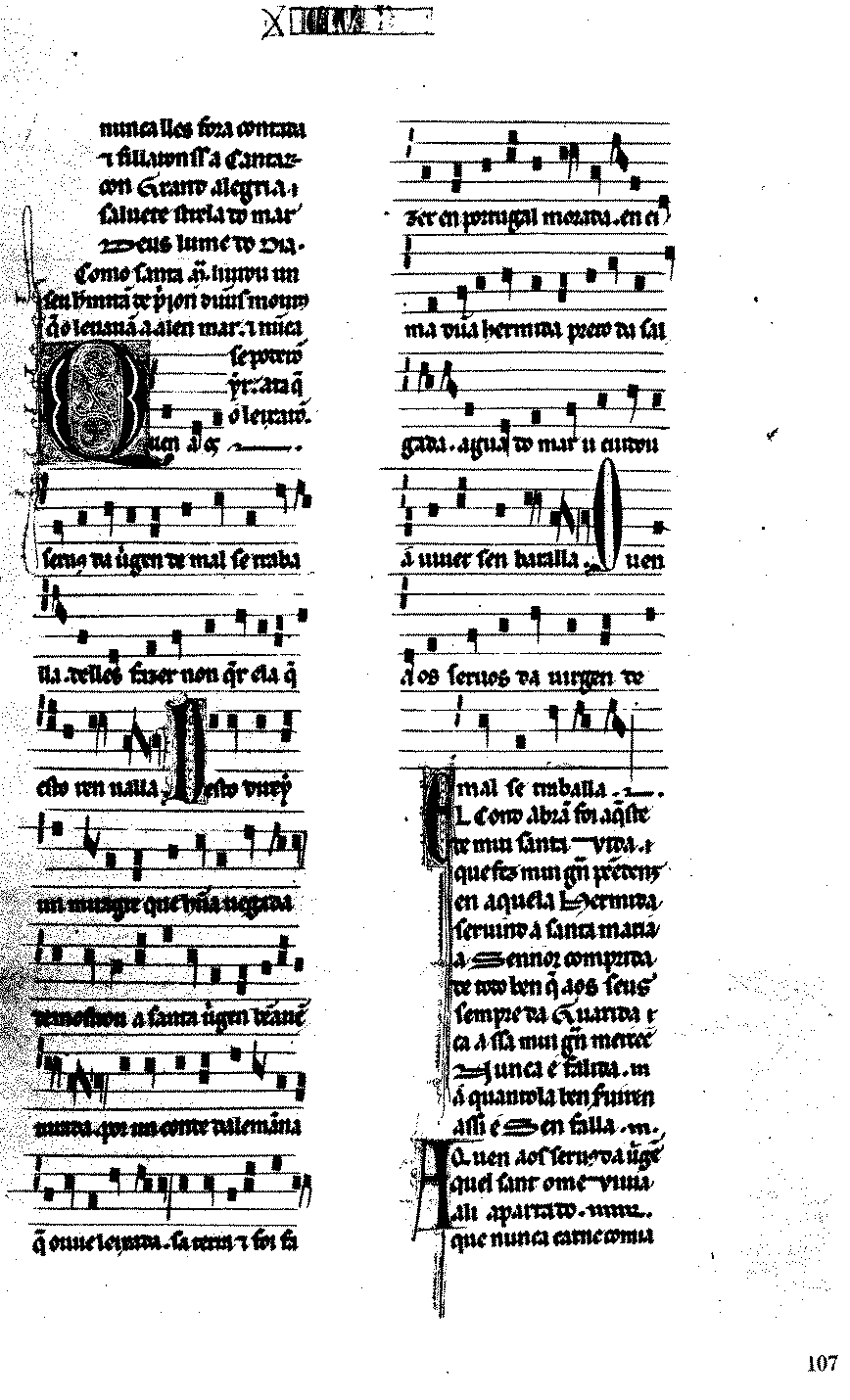
- 13th century CE, Alfonso X of Castile, Cantigas de Santa Maria, Códice de los músicos, cantiga 95 (facsimile):
- Aquel ſantome […] nunca carne comia nen pan nen bocado / ſe non q[ua]ndo con cĩjſa Era Meſturado
- That holy man […] never ate a mouthful of meat nor bread / except when it was mixed with ashes.
- (metonymically) wheat; cereals
- Synonym: triigo
Descendants
[edit]References
[edit]- Manuel Ferreiro (2014–2024) “pan”, in Universo Cantigas. Edición crítica da poesía medieval galego-portuguesa (in Galician), A Coruña: UDC, →ISSN
- Ernesto Xosé González Seoane, María Álvarez de la Granja, Ana Isabel Boullón Agrelo (2006–2022) “pan”, in Dicionario de Dicionarios do galego medieval (in Galician), Santiago de Compostela: Instituto da Lingua Galega
- Xavier Varela Barreiro, Xavier Gómez Guinovart (2006–2018) “pan”, in Corpus Xelmírez - Corpus lingüístico da Galicia medieval (in Galician), Santiago de Compostela: ILG
Old Polish
[edit]Etymology
[edit]Inherited from Proto-Slavic *gъpanъ. First attested in the 13th century. Displaced gospodzin.
Pronunciation
[edit]Noun
[edit]pan m pers (female equivalent pani or panna)
- (attested in Greater Poland) lord (master of a feudal manor)
- 1881-1882 [1293], Max Perlbach, editor, Pommerellisches Urkundenbuch[4], page 451:
- Pan Andreas castellanus Danensis
- [Pan Andreas castellanus Danensis]
- 1959 [1399], Henryk Kowalewicz, Władysław Kuraszkiewicz, editors, Wielkopolskie roty sądowe XIV-XV wieku, Roty poznańskie, volume I, number 368, Poznań:
- Esze Boguchna otkaszala Potrkovi dacz swego posagu panu posnanskemu trzinaczcze grziwni
- [Eże Boguchna otkazała Piotrkowi dać swego posagu panu poznańskiemu trzynaćcie grzywny]
- ducal or princely official
- 1874 [1275], Monumenta Medii Aevi Historica res gestas Poloniae illustrantia. Pomniki Dziejowe Wieków Średnich do objaśnienia rzeczy polskich służące[5], volume IX, page 136:
- Omnesque eius (sc. monasterii) villas... cum... incolis... a domino custodie, qui dicitur vlg. pan stroze vel stroznj, semper facimus liberos
- [Omnesque eius (sc. monasterii) villas... cum... incolis... a domino custodie, qui dicitur vlg. pan stroże vel strożny, semper facimus liberos]
- (more specifically) beaver official (ducal lord or acting official in charge of beavers, the mammal)
- Synonym: bobrownik
- 1874 [1275], Monumenta Medii Aevi Historica res gestas Poloniae illustrantia. Pomniki Dziejowe Wieków Średnich do objaśnienia rzeczy polskich służące[6], volume IX, page 136:
- Dominus castorum dictus wlgo pan bobrowi
- [Dominus castorum dictus wlgo pan bobrowi]
- (attested in Lesser Poland, Silesia) dignitary
- 1864 [14th/15th century], August Bielowski, editor, Monumenta Poloniae Historica. Pomniki Dziejowe Polski[7], volume II, page 468:
- Dicitur pan in Slavonico maior dominus... Xandz autem maior est quam pan, veluti princeps et superior rex
- [Dicitur pan in Slavonico maior dominus... Ksiądz autem maior est quam pan, veluti princeps et superior rex]
- Beginning of the 15th century, Łukasz z Wielkiego Koźmina, Kazania gnieźnieńskie[8], Krakow, page 11b:
- A *szaprafdocz na tem tho svecze malo takich kaplanof nadze ('najdzie')..., chos bycz ony krole, xøszøtha y tesze pany bogathe o gich sloscz karaly ge
- [A zaprawdęć na tem to świecie mało takich kapłanow nadzie ('najdzie')..., coż być oni krole, książęta y teże pany bogate o jich złość karali je]
- 1885-2024 [c. 15th century], Jan Baudouina de Courtenay, Jan Karłowicz, Antoni Adam Kryńskiego, Malinowski Lucjan, editors, Prace Filologiczne[9], volume III, Wrocław, page 289:
- Czelny panowye barones
- [Czelni panowie barones]
- dignitary of property
- 1462-1463, Wiersz o zabiciu Andrzeja Tęczyńskiego[10], line 2:
- Pana swego wyelkyego, choragyewnego, zabylyszcze, chlopy!
- [Pana swego wielkiego, chorągiewnego, zabiliście, chłopy!]
- (military) cavalry officer
- (attested in Greater Poland) nobleman
- 1930 [c. 1455], “Judith”, in Ludwik Bernacki, editor, Biblia królowej Zofii (Biblia szaroszpatacka)[14], section 5,26:
- Y stalo syø gdisz Achior przestal mowyenya slow swich, roznyewaly syø wszitcy wyelyci panowye (omnes magnates) Olofernovy
- [I stało się gdyż Achior przestał mowienia słow swych, rozniewali się wszytcy wielicy panowie (omnes magnates) Olofernowi]
- (in the plural, law, attested in Greater Poland) court officials
- 1959 [1398], Henryk Kowalewicz, Władysław Kuraszkiewicz, editors, Wielkopolskie roty sądowe XIV-XV wieku, Roty poznańskie, volume I, number 362, Poznań:
- Iako Sandziuoy starosta wmovil medzi mnø a medzi Sczepanem, esz ne mal na mø niyednego roku stacz nisz przet timi pani, czso sø nameneni
- [Jako Sędziwoj starosta umowił miedzy mną a miedzy Szczepanem, eż nie miał na mię nijednego roku stać niż przed tymi pany, czso są namienieni]
- (attested in Greater Poland, Masovia) lord (one possessing similar mastery over others; any feudal superior generally; any nobleman or aristocrat; any chief, prince, or sovereign ruler)
- 1959 [1398], Henryk Kowalewicz, Władysław Kuraszkiewicz, editors, Wielkopolskie roty sądowe XIV-XV wieku, Roty poznańskie, volume I, number 381, Poznań:
- Yssze Marczin ne odmouil Yana szoltisa od rok za swego pana, za Wolwrama
- [Iże Marcin nie odmowił Jana sołtysa od rok za swego pana, za Wolwrama]
- 1967 [1424], Henryk Kowalewicz, Władysław Kuraszkiewicz, editors, Wielkopolskie roty sądowe XIV-XV wieku, Roty kościańskie, volume III, number 1048, Kościan:
- Jaco pan dzedziczny Dzbansky dal Janowy mlin czynicz w dzedzyczstwo
- [Jako pan dziedziczny Dzbąski dał Janowi młyn czynić w dziedzicstwo]
- 1885-2024 [c. 1428], Jan Baudouina de Courtenay, Jan Karłowicz, Antoni Adam Kryńskiego, Malinowski Lucjan, editors, Prace Filologiczne[16], volume I, Międzyrzecz, Warsaw, page 487:
- Dobrowolne panowe ffeodales
- [Dobrowolne panowie ffeodales]
- (attested in Greater Poland, Masovia) title of respect or formality often used with nobility or officials
- 1959 [1395], Henryk Kowalewicz, Władysław Kuraszkiewicz, editors, Wielkopolskie roty sądowe XIV-XV wieku, Roty poznańskie, volume I, number 187, Poznań:
- Tedi *rzegk pan Hinczka
- [Tedy rzek[ł] pan Hynczka]
- 1959 [1395], Henryk Kowalewicz, Władysław Kuraszkiewicz, editors, Wielkopolskie roty sądowe XIV-XV wieku, Roty poznańskie, volume I, number 187, Poznań:
- Jako do Vtroszina... przigeli, taco rzecli gednacze pana Hinczkoui
- [Jako do [J]utroszyna... przyjeli, tako rzekli jednacze pana Hynczkowi]
- 1959 [1399], Henryk Kowalewicz, Władysław Kuraszkiewicz, editors, Wielkopolskie roty sądowe XIV-XV wieku, Roty poznańskie, volume I, number 378, Poznań:
- Pani Poluiczska Hanka ma postauicz zachoczczø przecziw Potraszoui Czepurskemu pana choranszego Paska
- [Pani Polwicska Hanka ma postawić zachodźcę przeciw Piotraszowi Czepurskiemu pana chorążego Paszka]
- 1959 [1400], Henryk Kowalewicz, Władysław Kuraszkiewicz, editors, Wielkopolskie roty sądowe XIV-XV wieku, Roty poznańskie, volume I, number 433, Poznań:
- Iaco to swatczø, iz pan sandza o tø rzecz alisz po trzech *ledzech zalowal na Troyana
- [Jako to świadczę, iż pan sędzia o tę rzecz aliż po trzech leciech żałował na Trojana]
- 1959 [1401], Henryk Kowalewicz, Władysław Kuraszkiewicz, editors, Wielkopolskie roty sądowe XIV-XV wieku, Roty poznańskie, volume I, number 522, Poznań:
- Iacom sø ne zamowil prze[d] pani Czarnkowskimi Janoui praw bich (leg. być) *vsm krziwen
- [Jakom się nie zamowił prze[d] pany Czarnkowskimi Janowi praw być ośm krzywien]
- 1959 [1411], Henryk Kowalewicz, Władysław Kuraszkiewicz, editors, Wielkopolskie roty sądowe XIV-XV wieku, Roty poznańskie, volume I, number 835, Poznań:
- Yaco gdy pan Jan Czepurski wyprawil Splawskego s gysczyny, tedi go ne gabal prawem, asz trsy latha mynøly
- [Jaco gdy pan Jan Czepurski wyprawił Spławskiego z jiściny, tedy go nie gabał prawem, aż trzy lata minęły]
- 1959 [1419], Henryk Kowalewicz, Władysław Kuraszkiewicz, editors, Wielkopolskie roty sądowe XIV-XV wieku, Roty poznańskie, volume I, number 979, Poznań:
- Yaco Newstąmp Swekoczsky szedl na pana Janową lanka Potrowskego gwaltem
- [Jako Nieustęp Świekocski szedł na pana Janowę łąkę Piotrowskiego gwałtem]
- 1959 [1422], Henryk Kowalewicz, Władysław Kuraszkiewicz, editors, Wielkopolskie roty sądowe XIV-XV wieku, Roty poznańskie, volume I, number 1117, Poznań:
- Ysze pąn Jaroslaw sz Lubacowa, podkomorze, ne yest vinouat... czterdczesczy grzyven... sza woly
- [Iże pan Jarosław z Lubiatowa, podkomorze, nie jest winowat... czterdzieści grzywien... za woły]
- 1895 [1448–1450], Mikołaj Suled, edited by Franciszek Piekosiński, Tłumaczenia polskie statutów ziemskich, Kodeks Świętosławów, Warka, page 72:
- Vstawyenye przes oswyeczonego ksządza pana Wlodzyslawa (per serenissimum regem Vladislaum), krola polskego, ... w Krakowye... wywolane
- [Ustawienie przez oświeconego księdza pana Włodzisława (per serenissimum regem Vladislaum), krola polskiego, ... w Krakowie... wywołane]
- (attested in Greater Poland) lord, master (male head of a household, a father or husband)
- 1939 [end of the 14th century], Ryszard Ganszyniec, Witold Taszycki, Stefan Kubica, Ludwik Bernacki, editors, Psałterz florjański łacińsko-polsko-niemiecki [Sankt Florian Psalter][18], Krakow: Zakład Narodowy imienia Ossolińskich, z zasiłkiem Sejmu Śląskiego [The Ossoliński National Institute: with the benefit of the Silesian Parliament], page 104:
- Postawil gyey panem (constituit eum dominum) domu swego y ksødzem wszego bydla swego
- [Postawił jej panem (constituit eum dominum) domu swego i księdzem wszego bydła swego]
- 1853 [Fifteenth century], Wacław Aleksander Maciejowski, editor, Piśmiennictwo polskie od czasów najdawniejszych aż do roku 1830, volume 4, Rogoźno, page 44:
- Ktho tho wsdruschy, dyabel bandzye pan gego duschi
- [Kto to wzdruszy, diabeł będzie pan jego duszy]
- husband (male member of a marriage)
- Synonym: mąż
- 1959 [1386], Henryk Kowalewicz, Władysław Kuraszkiewicz, editors, Wielkopolskie roty sądowe XIV-XV wieku, Roty poznańskie, volume I, number 4, Poznań:
- Item domina de Czepury prestabit iuramentum...: Jaco yest moy pan ne uinouat Sulcoui trzinaczcze grziwen za Czepuri
- [Item domina de Czepury prestabit iuramentum...: Jako jest moj pan nie winowat Sułkowi trzynaćcie grzywien za Czepury]
- (attested in Lesser Poland) Lord (title of God)
- 1939 [end of the 14th century], Ryszard Ganszyniec, Witold Taszycki, Stefan Kubica, Ludwik Bernacki, editors, Psałterz florjański łacińsko-polsko-niemiecki [Sankt Florian Psalter][19], Krakow: Zakład Narodowy imienia Ossolińskich, z zasiłkiem Sejmu Śląskiego [The Ossoliński National Institute: with the benefit of the Silesian Parliament], page 102:
- Blogoslawcze panv (domino) wszyczki syly yego
- [Błogosławcie Panu (domino) wszyćki siły jego]
Derived terms
[edit]Descendants
[edit]References
[edit]- B. Sieradzka-Baziur, Ewa Deptuchowa, Joanna Duska, Mariusz Frodyma, Beata Hejmo, Dorota Janeczko, Katarzyna Jasińska, Krystyna Kajtoch, Joanna Kozioł, Marian Kucała, Dorota Mika, Gabriela Niemiec, Urszula Poprawska, Elżbieta Supranowicz, Ludwika Szelachowska-Winiarzowa, Zofia Wanicowa, Piotr Szpor, Bartłomiej Borek, editors (2011–2015), “pan”, in Słownik pojęciowy języka staropolskiego [Conceptual Dictionary of Old Polish] (in Polish), Kraków: IJP PAN, →ISBN
Old Spanish
[edit]Etymology
[edit]Noun
[edit]pan m (plural panes)
- bread
- c. 1200, Cantar de mio Cid:
- Del agua fezist vino e dela piedra pan,
- Of the water Thou madest wine and of the stone bread,
Descendants
[edit]Papiamentu
[edit]
Etymology
[edit]Noun
[edit]pan
Piedmontese
[edit]Etymology
[edit]From Latin pānis, pānem.
Pronunciation
[edit]Noun
[edit]pan m
Pochutec
[edit]Etymology
[edit]Noun
[edit]pan
References
[edit]- Boas, Franz (1917 July) “El Dialecto mexicano de Pochutla, Oaxaca”, in International Journal of American Linguistics (in Spanish), volume 1, number 1, , →JSTOR, pages 9–44
Polish
[edit]Etymology
[edit]Inherited from Old Polish pan.
Pronunciation
[edit]- IPA(key): /pan/
- (Middle Polish) IPA(key): /ˈpɒn/
Audio 1: (file) Audio 2: (file) Audio 3: (file) - Rhymes: -an
- Syllabification: pan
- Homophones: Pan, PAN, pan-
Noun
[edit]pan m pers (female equivalent pani, abbreviation p. or pp.)
- gentleman, man (specific male person, especially one unknown to the speaker)
- Jakiś pan mi pomógł. ― A certain gentleman helped me.
- master, lord (person with power over something)
- sir (rich, well-presenting person)
- Synonym: panisko
- lord (master of a house)
- teacher
- Synonym: nauczyciel
- master (owner of a household pet)
- Mr, mister (title before a last name)
- (Middle Polish) husband (male member of a marriage)
- Synonym: mąż
- (Middle Polish) protector
- Synonym: protektor
- (Middle Polish) owner
- Synonym: właściciel
Declension
[edit]Derived terms
[edit]- być za pan brat
- panoszyć impf
- panować impf
Descendants
[edit]Pronoun
[edit]pan m (feminine pani)
- you polite second person m-personal nominative, it takes verbs as third-person sg form
Declension
[edit]See also
[edit]Trivia
[edit]According to Słownik frekwencyjny polszczyzny współczesnej (1990), pan is one of the most used words in Polish, appearing 7 times in scientific texts, 10 times in news, 12 times in essays, 373 times in fiction, and 1417 times in plays, each out of a corpus of 100,000 words, totaling 1819 times, making it the 22nd most common word in a corpus of 500,000 words.[1]
References
[edit]Further reading
[edit]- pan in Wielki słownik języka polskiego, Instytut Języka Polskiego PAN
- pan in Polish dictionaries at PWN
- Maria Renata Mayenowa, Stanisław Rospond, Witold Taszycki, Stefan Hrabec, Władysław Kuraszkiewicz (2010-2023) “pan”, in Słownik Polszczyzny XVI Wieku [A Dictionary of 16th Century Polish]
- “PAN”, in Elektroniczny Słownik Języka Polskiego XVII i XVIII Wieku [Electronic Dictionary of the Polish Language of the XVII and XVIII Century], 19.11.2009
- Samuel Bogumił Linde (1807–1814) “pan”, in Słownik języka polskiego
- Aleksander Zdanowicz (1861) “pan”, in Słownik języka polskiego, Wilno 1861
- A. Kryński, W. Niedźwiedzki, editors (1908), “pan”, in Słownik języka polskiego (in Polish), volume 4, Warsaw, page 30
- pan in Narodowy Fotokorpus Języka Polskiego
Romansch
[edit]Alternative forms
[edit]Etymology
[edit]From Latin pānis, pānem.
Noun
[edit]pan m (plural pans)
Scots
[edit]Verb
[edit]pan (third-person singular simple present pans, present participle pannin, simple past panned, past participle panned)
- (slang) break, smash (particularly of windows)
- Eh'm gonnae pan yer windaes in! ― I'm going to smash your windows!
Southwestern Dinka
[edit]Noun
[edit]pan
References
[edit]- Dinka-English Dictionary[20], 2005
Spanish
[edit]
Etymology
[edit]Inherited from Latin pānem whence English pantry and company. Compare Catalan pa, French pain, Galician pan, Italian pane, Occitan pan, Portuguese pão, Romanian pâine, possibly from Proto-Indo-European *peh₂- (“to feed, to graze”).
Pronunciation
[edit]Noun
[edit]pan m (plural panes)
- bread
- Para mi desayuno, tomo pan y leche.
- For my breakfast, I have bread and milk.
- bun (e.g. the kinds used for a hamburger or hot dog)
- (figurative) money, dough
- (figurative) work, job
Hyponyms
[edit]- pan ácimo
- pan bimbo
- pan blanco (“white bread”)
- pan de especias
- pan de jengibre
- pan de molde
- pan de pita
- pan de sal
- pan dulce
- pan francés (“French toast”) (Mexico, Spain); ("French bread") (everywhere else)
- pan integral (“whole wheat bread, wholemeal bread”)
- pan rebanado
- pan tostado
- pan tumaca
Derived terms
[edit]- a buen hambre no hay pan duro
- a falta de pan, buenas son tortas
- a mucha hambre, no hay pan duro
- a pan y agua
- apanar
- árbol de pan (“breadfruit tree”)
- árbol del pan
- barra de pan
- buen pan
- contigo, pan y cebolla
- dame pan y llámame tonto
- Dios da pan a quien no tiene dientes
- el pan nuestro de cada día
- empanar
- empanizar
- flauta de pan
- fruta de pan
- fruto del árbol del pan
- ganarse el pan (“to make or earn a living, to bring home the bacon”)
- hacerse el de los panes
- llamar al pan, pan, y al vino, vino
- pan comido
- pan con pan, comida de tontos
- pan de azúcar
- pan de cada día
- pan de caja (“sliced bread”)
- pan de carne (“meatloaf”) (River Plate)
- pan de Dios
- pan de molde
- pan de oro
- pan de puerco
- pan de ranas
- pan duro (“stale bread”)
- pan integral
- pan molido (“breadcrumbs”) (Mexico, Peru)
- pan para hoy, hambre para mañana
- pan rallado (“breadcrumbs”)
- panadería
- pancito
- panecillo
- panecito
- panificador
- panificadora
- pedazo de pan
Related terms
[edit]Descendants
[edit]Further reading
[edit]- “pan”, in Diccionario de la lengua española, Vigésima tercera edición, Real Academia Española, 2014
Venetian
[edit]Etymology
[edit]From Latin pānis, pānem. Compare Italian pane and Neapolitan pane.
Pronunciation
[edit]Noun
[edit]pan m (plural pani)
Walloon
[edit]Etymology
[edit]Pronunciation
[edit]Noun
[edit]pan m (plural pans)
Welsh
[edit]Etymology
[edit]Ultimately from Proto-Indo-European *kʷos, *kʷis. See also Scottish Gaelic cuin, Latin quando, Proto-Germanic *hwan (“when”).[1]
Pronunciation
[edit]Conjunction
[edit]pan
Mutation
[edit]| Welsh mutation | |||
|---|---|---|---|
| radical | soft | nasal | aspirate |
| pan | ban | mhan | phan |
| Note: Some of these forms may be hypothetical. Not every possible mutated form of every word actually occurs. | |||
References
[edit]- ^ Matasović, Ranko (2009) Etymological Dictionary of Proto-Celtic (Leiden Indo-European Etymological Dictionary Series; 9), Leiden: Brill, →ISBN
Ye'kwana
[edit]| ALIV | pan |
|---|---|
| Brazilian standard | pan |
| New Tribes | pan |
Etymology
[edit]Unadapted borrowing from Spanish pan.
Pronunciation
[edit]Noun
[edit]pan
References
[edit]- Hall, Katherine Lee (1988) The morphosyntax of discourse in De'kwana Carib, volumes I and II, Saint Louis, Missouri: PhD Thesis, Washington University, page 216: “All nasal phonemes occur syllable finally but not in word-final position, except for the nasal velar allophone [ŋ] of the phoneme /n/ which appears word-finally in lexical items borrowed from Spanish (paŋ 'bread', […] ).”
Yogad
[edit]Etymology
[edit]Borrowed from Spanish pan (“bread”).
Noun
[edit]pan
Zou
[edit]Adjective
[edit]pan
References
[edit]- Lukram Himmat Singh (2013) A Descriptive Grammar of Zou, Canchipur: Manipur University, page 45
- Translingual lemmas
- Translingual symbols
- ISO 639-2
- ISO 639-3
- English 1-syllable words
- English terms with IPA pronunciation
- English terms with audio links
- English terms with homophones
- Rhymes:English/æn
- Rhymes:English/æn/1 syllable
- English terms inherited from Middle English
- English terms derived from Middle English
- English terms inherited from Old English
- English terms derived from Old English
- English terms inherited from Proto-West Germanic
- English terms derived from Proto-West Germanic
- English terms inherited from Proto-Germanic
- English terms derived from Proto-Germanic
- English terms derived from Late Latin
- English terms derived from Latin
- English terms derived from Ancient Greek
- English terms derived from a Pre-Greek substrate
- English lemmas
- English nouns
- English countable nouns
- English nouns with irregular plurals
- Irish English
- en:Geography
- en:Geology
- South African English
- English short forms
- English terms with obsolete senses
- English terms with quotations
- English slang
- en:Roofing
- en:Firearms
- English terms with collocations
- en:Carpentry
- en:Musical instruments
- English verbs
- English transitive verbs
- English intransitive verbs
- English informal terms
- en:Photography
- English uncountable nouns
- English doublets
- English clippings
- English adjectives
- English uncomparable adjectives
- en:Rail transportation
- English three-letter words
- en:Breads
- en:Cookware and bakeware
- en:Landforms
- en:Sexual orientations
- Afrikaans terms inherited from Dutch
- Afrikaans terms derived from Dutch
- Afrikaans terms inherited from Middle Dutch
- Afrikaans terms derived from Middle Dutch
- Afrikaans terms inherited from Old Dutch
- Afrikaans terms derived from Old Dutch
- Afrikaans terms derived from Latin
- Afrikaans terms derived from English
- Afrikaans terms with IPA pronunciation
- Afrikaans terms with audio links
- Afrikaans lemmas
- Afrikaans nouns
- Aragonese terms inherited from Latin
- Aragonese terms derived from Latin
- Aragonese lemmas
- Aragonese nouns
- Aragonese masculine nouns
- Asturian terms inherited from Latin
- Asturian terms derived from Latin
- Asturian lemmas
- Asturian nouns
- Asturian masculine nouns
- Atong (India) terms with IPA pronunciation
- Atong (India) lemmas
- Atong (India) nouns
- Atong (India) nouns in Latin script
- Atong (India) classifiers
- Atong (India) classifiers in Latin script
- Bambara terms with IPA pronunciation
- Bambara lemmas
- Bambara verbs
- bm:Gaits
- Bikol Central terms borrowed from Spanish
- Bikol Central terms derived from Spanish
- Bikol Central terms with IPA pronunciation
- Bikol Central lemmas
- Bikol Central nouns
- Bikol Central terms with Basahan script
- Cebuano terms borrowed from Spanish
- Cebuano terms derived from Spanish
- Cebuano terms with IPA pronunciation
- Cebuano lemmas
- Cebuano nouns
- Cebuano terms with Badlit script
- ceb:Breads
- Chavacano terms inherited from Spanish
- Chavacano terms derived from Spanish
- Chavacano terms with IPA pronunciation
- Chavacano lemmas
- Chavacano nouns
- Chuukese lemmas
- Chuukese nouns
- Cypriot Arabic terms belonging to the root p-y-n
- Cypriot Arabic terms inherited from Arabic
- Cypriot Arabic terms derived from Arabic
- Cypriot Arabic lemmas
- Cypriot Arabic verbs
- Cypriot Arabic form-I verbs
- Cypriot Arabic intransitive verbs
- Czech terms with IPA pronunciation
- Czech terms with homophones
- Rhymes:Czech/an
- Rhymes:Czech/an/1 syllable
- Czech non-lemma forms
- Czech noun forms
- Czech terms with collocations
- Czech terms with usage examples
- Czech masculine animate nouns
- Czech hard masculine animate nouns
- Czech nouns with multiple stems
- Dutch terms inherited from Middle Dutch
- Dutch terms derived from Middle Dutch
- Dutch terms inherited from Old Dutch
- Dutch terms derived from Old Dutch
- Dutch terms derived from Latin
- Dutch terms with IPA pronunciation
- Dutch terms with audio links
- Rhymes:Dutch/ɑn
- Rhymes:Dutch/ɑn/1 syllable
- Dutch lemmas
- Dutch nouns
- Dutch nouns with plural in -en
- Dutch feminine nouns
- Netherlands Dutch
- nl:Cookware and bakeware
- Franco-Provençal terms inherited from Latin
- Franco-Provençal terms derived from Latin
- Franco-Provençal lemmas
- Franco-Provençal nouns
- Franco-Provençal countable nouns
- Franco-Provençal masculine nouns
- ORB, broad
- French 1-syllable words
- French terms with IPA pronunciation
- French terms with audio links
- French terms with homophones
- French terms inherited from Old French
- French terms derived from Old French
- French terms inherited from Latin
- French terms derived from Latin
- French doublets
- French lemmas
- French nouns
- French countable nouns
- French masculine nouns
- French terms with usage examples
- French interjections
- Friulian terms inherited from Latin
- Friulian terms derived from Latin
- Friulian lemmas
- Friulian nouns
- Friulian masculine nouns
- Galician terms inherited from Old Galician-Portuguese
- Galician terms derived from Old Galician-Portuguese
- Galician terms inherited from Latin
- Galician terms derived from Latin
- Galician terms with IPA pronunciation
- Galician lemmas
- Galician nouns
- Galician countable nouns
- Galician masculine nouns
- Galician uncountable nouns
- Galician terms with quotations
- gl:Breads
- gl:Foods
- Istriot terms inherited from Latin
- Istriot terms derived from Latin
- Istriot lemmas
- Istriot nouns
- Istriot masculine nouns
- Japanese non-lemma forms
- Japanese romanizations
- Leonese terms inherited from Latin
- Leonese terms derived from Latin
- Leonese lemmas
- Leonese nouns
- Leonese masculine nouns
- Ligurian terms inherited from Latin
- Ligurian terms derived from Latin
- Ligurian terms with IPA pronunciation
- Ligurian lemmas
- Ligurian nouns
- Ligurian masculine nouns
- Lombard terms inherited from Latin
- Lombard terms derived from Latin
- Lombard terms with IPA pronunciation
- Lombard lemmas
- Lombard nouns
- Lombard masculine nouns
- lmo:Breads
- Maguindanao terms borrowed from Spanish
- Maguindanao terms derived from Spanish
- Maguindanao terms with IPA pronunciation
- Rhymes:Maguindanao/an
- Rhymes:Maguindanao/an/1 syllable
- Maguindanao lemmas
- Maguindanao nouns
- Malay lemmas
- Malay nouns
- Hanyu Pinyin
- Mandarin non-lemma forms
- Mandarin nonstandard forms
- Middle English terms inherited from Old English
- Middle English terms derived from Old English
- Middle English lemmas
- Middle English nouns
- Middle English terms borrowed from Old French
- Middle English terms derived from Old French
- Middle English terms derived from Latin
- Occitan terms inherited from Old Occitan
- Occitan terms derived from Old Occitan
- Occitan terms inherited from Latin
- Occitan terms derived from Latin
- Occitan terms with audio links
- Occitan lemmas
- Occitan nouns
- Occitan masculine nouns
- Occitan countable nouns
- oc:Breads
- Old French terms inherited from Latin
- Old French terms derived from Latin
- Old French lemmas
- Old French nouns
- Old French masculine nouns
- Old Galician-Portuguese terms derived from Latin
- Old Galician-Portuguese terms derived from the Proto-Indo-European root *peh₂-
- Old Galician-Portuguese terms inherited from Latin
- Old Galician-Portuguese terms derived from Proto-Indo-European
- Old Galician-Portuguese lemmas
- Old Galician-Portuguese nouns
- Old Galician-Portuguese masculine nouns
- Old Galician-Portuguese terms with quotations
- Old Galician-Portuguese metonyms
- roa-opt:Breads
- roa-opt:Grains
- Old Polish terms inherited from Proto-Slavic
- Old Polish terms derived from Proto-Slavic
- Old Polish terms with IPA pronunciation
- Old Polish lemmas
- Old Polish nouns
- Old Polish masculine nouns
- Old Polish personal nouns
- Greater Poland Old Polish
- Old Polish terms with quotations
- Lesser Poland Old Polish
- Silesia Old Polish
- zlw-opl:Military ranks
- zlw-opl:Law
- Masovia Old Polish
- zlw-opl:Male people
- zlw-opl:Titles
- Old Spanish terms inherited from Latin
- Old Spanish terms derived from Latin
- Old Spanish lemmas
- Old Spanish nouns
- Old Spanish masculine nouns
- Spanish terms with quotations
- Papiamentu terms derived from Spanish
- Papiamentu lemmas
- Papiamentu nouns
- Piedmontese terms inherited from Latin
- Piedmontese terms derived from Latin
- Piedmontese terms with IPA pronunciation
- Piedmontese lemmas
- Piedmontese nouns
- Piedmontese masculine nouns
- Pochutec terms borrowed from Spanish
- Pochutec terms derived from Spanish
- Pochutec lemmas
- Pochutec nouns
- Polish terms derived from Proto-Slavic
- Polish terms inherited from Proto-Slavic
- Polish terms inherited from Old Polish
- Polish terms derived from Old Polish
- Polish 1-syllable words
- Polish terms with IPA pronunciation
- Polish terms with audio links
- Rhymes:Polish/an
- Rhymes:Polish/an/1 syllable
- Polish terms with homophones
- Polish lemmas
- Polish nouns
- Polish masculine nouns
- Polish personal nouns
- Polish terms with usage examples
- Middle Polish
- Polish pronouns
- Polish polite terms
- Polish terms of address
- pl:Male people
- pl:Titles
- Romansch terms inherited from Latin
- Romansch terms derived from Latin
- Romansch lemmas
- Romansch nouns
- Romansch masculine nouns
- Vallader Romansch
- Romansch uncountable nouns
- Romansch countable nouns
- rm:Breads
- rm:Foods
- Scots lemmas
- Scots verbs
- Scots slang
- Scots terms with usage examples
- Southwestern Dinka lemmas
- Southwestern Dinka nouns
- Spanish terms inherited from Latin
- Spanish terms derived from Latin
- Spanish terms derived from Proto-Indo-European
- Spanish 1-syllable words
- Spanish terms with IPA pronunciation
- Rhymes:Spanish/an
- Rhymes:Spanish/an/1 syllable
- Spanish lemmas
- Spanish nouns
- Spanish countable nouns
- Spanish masculine nouns
- Spanish terms with usage examples
- es:Breads
- Spanish three-letter words
- Venetian terms inherited from Latin
- Venetian terms derived from Latin
- Venetian terms with IPA pronunciation
- Venetian lemmas
- Venetian nouns
- Venetian masculine nouns
- Walloon terms inherited from Latin
- Walloon terms derived from Latin
- Walloon terms with IPA pronunciation
- Walloon lemmas
- Walloon nouns
- Walloon masculine nouns
- Welsh terms derived from Proto-Indo-European
- Welsh terms derived from the Proto-Indo-European root *kʷ-
- Welsh terms inherited from Proto-Indo-European
- Welsh terms with IPA pronunciation
- Rhymes:Welsh/an
- Rhymes:Welsh/an/1 syllable
- Welsh lemmas
- Welsh conjunctions
- Ye'kwana terms borrowed from Spanish
- Ye'kwana terms derived from Spanish
- Ye'kwana terms with IPA pronunciation
- Ye'kwana lemmas
- Ye'kwana nouns
- Yogad terms borrowed from Spanish
- Yogad terms derived from Spanish
- Yogad lemmas
- Yogad nouns
- Zou lemmas
- Zou adjectives