Two parallel horizontal lines .
In the modern sense as the equal sign, first attested in The Whetstone of Witte Robert Recorde , in which the two parallel lines expressed equality, because, as Recorde wrote, "bicauſe noe .2. thynges, can be moare equalle " ("because no two things can be more equal").
=
( mathematics ) equal sign. It asserts that two quantities or expressions have the same value .
2+2= 4 ( mathematics , computing theory , abuse of notation , with big O notation ) Is . Used to state the relation that the growth rate of the expression on the left side of the sign is bounded or limited by that of the expression on the right.
Synonyms: ∈ ⊂ ⊆ (depending on context) The statement
f
(
x
)
=
O
(
l
o
g
2
x
)
{\displaystyle f(x)=O(log^{2}x)}
x
{\displaystyle x}
f
(
x
)
{\displaystyle f(x)}
l
o
g
2
x
{\displaystyle log^{2}x}
( chemistry ) bond ; a chemical bond between two chemical elements involving four bonding electrons instead of the usual two .( programming ) assignment operator. It assigns a value to a variable .
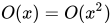
$price= 18.95 (this causes $price to be 18.95 from now on)( programming ) compares if two values are equal . In some languages, == is used instead.( lexicography ) sheep pl. = ( lexicography ) Indicates synonyms of a word. ( linguistics ) Indicates a clitic boundary. (Chinese bronze script ) A ditto mark . When used in big O notation, the = relation is asymmetric i.e.
O
(
x
)
=
O
(
x
2
)
{\displaystyle O(x)=O(x^{2})}
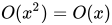
not equivalent to
O
(
x
2
)
=
O
(
x
)
{\displaystyle O(x^{2})=O(x)}
this English Wikipedia article .
For quotations using this term, see Citations:= .
( assignment ) : := ≔ ← ( compares if equal ) : == ⩵ ( antonym(s) of “ equals ” ) : ≠ =
( informal ) same as; equal to.
A wireless keyboard = a keyboard without a wire.
Vulpes vulpes = red fox.
For quotations using this term, see Citations:= .
( antonym(s) of “ equals ” ) : ≠
Related symbols from U+2242–U+2269
=( イコール ) • (ikōru
( informal ) Alternative form of イコール ( ikōru , “ equals, is equal to ” ) =
Alternative form of ゠ =
Symbol for sextans