来
Jump to navigation
Jump to search
| ||||||||
Translingual[edit]
| Traditional | 來 |
|---|---|
| Simplified | 来 |
| Japanese | 来 |
| Korean | 來 |
| Stroke order | |||
|---|---|---|---|

| |||
| Stroke order | |||
|---|---|---|---|

| |||
Glyph origin[edit]
Variant of 來.
Han character[edit]
来 (Kangxi radical 75, 木+3, 7 strokes, cangjie input 木廿 (DT), composition ⿻未丷 or ⿻木䒑 or ⿻一米)
Derived characters[edit]
References[edit]
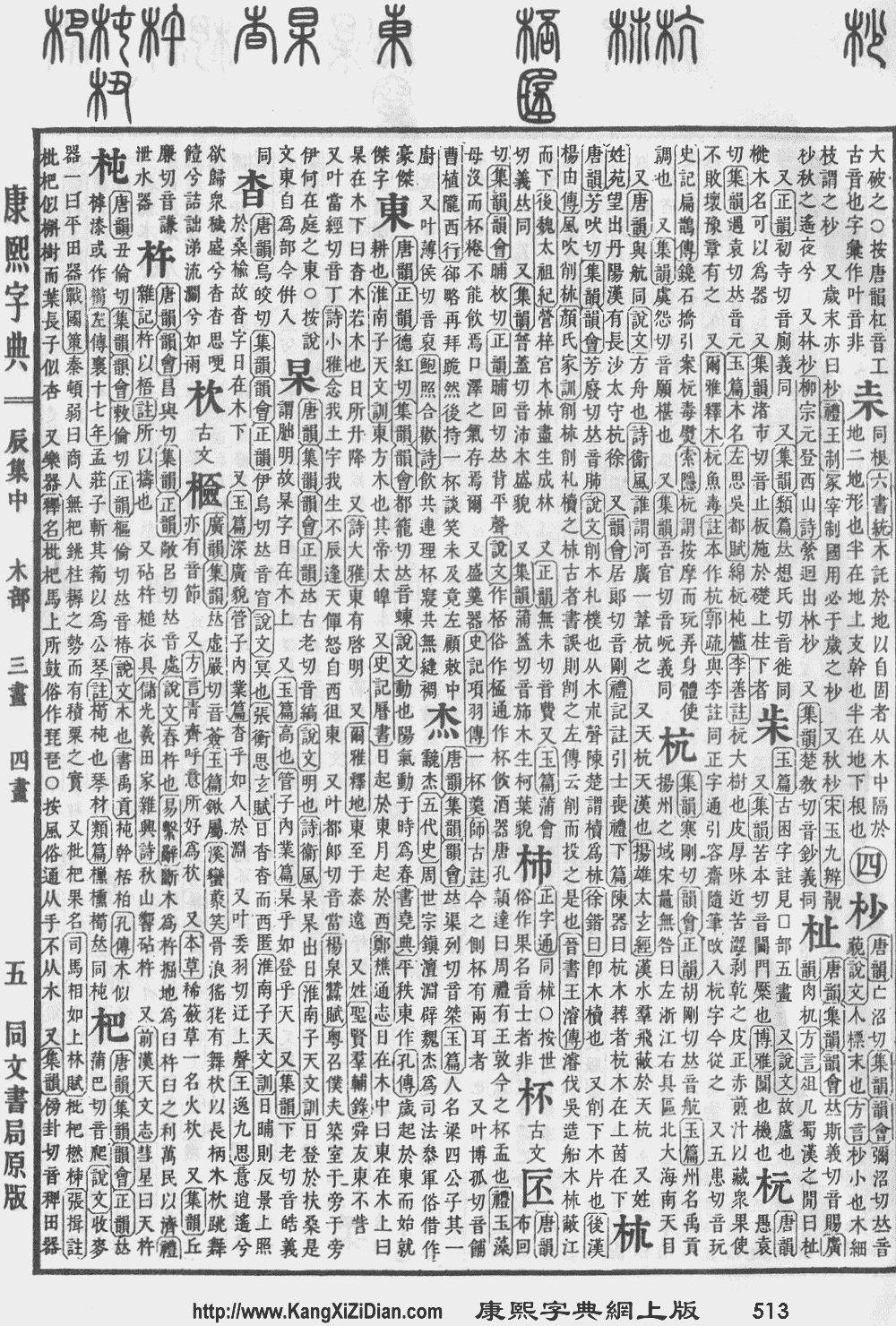
- Kangxi Dictionary: not present, would follow page 513, character 1
- Dai Kanwa Jiten: character 14489
- Hanyu Da Zidian (first edition): volume 1, page 21, character 9
- Unihan data for U+6765
Chinese[edit]
| For pronunciation and definitions of 来 – see 來 (“to come; to arrive; to happen; to occur; etc.”). (This character is the simplified and variant form of 來). |
Notes:
|
Japanese[edit]
| 来 | |
| 來 |
Kanji[edit]
来
(grade 2 “Kyōiku” kanji, shinjitai kanji, kyūjitai form 來)
Readings[edit]
- Go-on: らい (rai, Jōyō)
- Kan-on: らい (rai, Jōyō)
- Kun: くる (kuru, 来る, Jōyō); きたる (kitaru, 来る, Jōyō); きたす (kitasu, 来す, Jōyō); きし (kishi, 来し); こし (koshi, 来し)
- Nanori: き (ki); こ (ko); な (na); ゆき (yuki)
Compounds[edit]
Etymology 1[edit]
| Kanji in this term |
|---|
| 来 |
| らい Grade: 2 |
| on’yomi |
| Alternative spelling |
|---|
| 來 (kyūjitai) |
From Middle Chinese 來 (MC loj).
Compare modern Mandarin 來/来 (lái).
Pronunciation[edit]
(Can we verify(+) this pronunciation?)
Prefix[edit]
Derived terms[edit]
Derived terms
Suffix[edit]
- since..., in...
- 1944, Osamu Dazai, Tsugaru:
- この二、三年来、私は青森市へ二、三度行ったが...
- Kono ni, sannen-rai, watashi wa Aomori-shi e ni, sando itta ga
- I went to Aomori two or three times in the past two or three years...
- この二、三年来、私は青森市へ二、三度行ったが...
- Kono ni, sannen-rai, watashi wa Aomori-shi e ni, sando itta ga
- I went to Aomori two or three times in the past two or three years...
- (please add an English translation of this quotation)
Affix[edit]
- coming, arriving
- coming, approaching, passing
- from (some point in the) past to present
- coming in time
Derived terms[edit]
Derived terms
- 来意 (raī)
- 来客 (raikyaku)
- 来迎 (raigō)
- 来書 (raisho)
- 来状 (raijō)
- 来信 (raishin)
- 来世 (raise)
- 来日 (rainichi)
- 来賓 (raihin)
- 来訪 (raihō)
- 来由 (raiyu)
- 来歴 (raireki)
- 以来 (irai)
- 遠来 (enrai)
- 往来 (ōrai)
- 外来 (gairai)
- 元来 (ganrai)
- 近来 (kinrai)
- 古来 (korai)
- 再来 (sairai)
- 在来 (zairai)
- 爾来 (jirai)
- 襲来 (shūrai)
- 従来 (jūrai)
- 招来 (shōrai)
- 将来 (shōrai)
- 新来 (shinrai)
- 生来 (seirai)
- 帰来 (kirai)
- 去来 (kyorai)
- 光来, 高来 (kōrai)
- 伝来 (denrai)
- 渡来 (torai)
- 当来 (tōrai)
- 到来 (tōrai)
- 淘来 (tōrai)
- 年来 (nenrai)
- 舶来 (hakurai)
- 飛来 (hirai)
- 本来 (honrai)
- 未来 (mirai)
- 夜来 (yarai)
- 由来 (yurai)
- 帰去来 (kikyorai)
Proper noun[edit]
- a surname, especially of those descended from swordsmiths arriving from Goryeo around the mid-Kamakura period
Etymology 2[edit]
| Kanji in this term |
|---|
| 来 |
| く Grade: 2 |
| kun’yomi |
| Alternative spelling |
|---|
| 來 (kyūjitai) |
From Old Japanese 來 (ku).
Verb[edit]
- (archaic, obsolete) to come (approach one’s position from a remote location, specifically towards the speaker)
- (archaic, obsolete) to go (to a direction or place far from the speaker but near the listener)
- (archaic, suffixed to the 連用形 (ren'yōkei, “stem form”) of a verb) to gradually begin to [verb]
Conjugation[edit]
| Stem forms | ||||
|---|---|---|---|---|
| Irrealis (未然形) | 来 | こ | ko | |
| Continuative (連用形) | 来 | き | ki | |
| Terminal (終止形) | 来 | く | ku | |
| Attributive (連体形) | 来る | くる | kuru | |
| Realis (已然形) | 来れ | くれ | kure | |
| Imperative (命令形) | 来 来よ |
こ こよ |
ko koyo | |
| Key constructions | ||||
| Negative | 来ず | こず | kozu | |
| Contrasting conjunction | 来れど | くれど | kuredo | |
| Causal conjunction | 来れば | くれば | kureba | |
| Conditional conjunction | 来ば | こば | koba | |
| Past tense (firsthand knowledge) | 来し[1] 来し[1] |
こし きし |
kosi kisi | |
| Past tense (secondhand knowledge) | 来けり | きけり | kikeri | |
| Perfect tense (conscious action) | 来つ | きつ | kitu | |
| Perfect tense (natural event) | 来ぬ | きぬ | kinu | |
| Perfect-continuative tense | 来たり | きたり | kitari | |
| Volitional | 来む | こむ | komu | |
| [1]Attributive form, as the terminal form (lemma) does not exist for this construction in this conjugation. | ||||
Derived terms[edit]
Categories:
- CJK Unified Ideographs block
- Han script characters
- Translingual lemmas
- Translingual symbols
- Beginning Mandarin
- Elementary Mandarin
- Chinese lemmas
- Mandarin lemmas
- Sichuanese lemmas
- Dungan lemmas
- Cantonese lemmas
- Taishanese lemmas
- Gan lemmas
- Hakka lemmas
- Jin lemmas
- Northern Min lemmas
- Eastern Min lemmas
- Hokkien lemmas
- Teochew lemmas
- Wu lemmas
- Xiang lemmas
- Chinese verbs
- Mandarin verbs
- Sichuanese verbs
- Dungan verbs
- Cantonese verbs
- Taishanese verbs
- Gan verbs
- Hakka verbs
- Jin verbs
- Northern Min verbs
- Eastern Min verbs
- Hokkien verbs
- Teochew verbs
- Wu verbs
- Xiang verbs
- Chinese adjectives
- Mandarin adjectives
- Sichuanese adjectives
- Dungan adjectives
- Cantonese adjectives
- Taishanese adjectives
- Gan adjectives
- Hakka adjectives
- Jin adjectives
- Northern Min adjectives
- Eastern Min adjectives
- Hokkien adjectives
- Teochew adjectives
- Wu adjectives
- Xiang adjectives
- Chinese particles
- Mandarin particles
- Sichuanese particles
- Dungan particles
- Cantonese particles
- Taishanese particles
- Gan particles
- Hakka particles
- Jin particles
- Northern Min particles
- Eastern Min particles
- Hokkien particles
- Teochew particles
- Wu particles
- Xiang particles
- Chinese proper nouns
- Mandarin proper nouns
- Sichuanese proper nouns
- Dungan proper nouns
- Cantonese proper nouns
- Taishanese proper nouns
- Gan proper nouns
- Hakka proper nouns
- Jin proper nouns
- Northern Min proper nouns
- Eastern Min proper nouns
- Hokkien proper nouns
- Teochew proper nouns
- Wu proper nouns
- Xiang proper nouns
- Chinese terms with IPA pronunciation
- Chinese Han characters
- Chinese simplified forms
- Chinese variant forms
- Japanese Han characters
- Grade 2 kanji
- Japanese kanji with goon reading らい
- Japanese kanji with kan'on reading らい
- Japanese kanji with kun reading く-る
- Japanese kanji with kun reading きた-る
- Japanese kanji with kun reading きた-す
- Japanese kanji with kun reading き-し
- Japanese kanji with kun reading こ-し
- Japanese kanji with nanori reading き
- Japanese kanji with nanori reading こ
- Japanese kanji with nanori reading な
- Japanese kanji with nanori reading ゆき
- Japanese terms spelled with 来 read as らい
- Japanese terms read with on'yomi
- Japanese terms derived from Middle Chinese
- Japanese terms with IPA pronunciation
- Japanese lemmas
- Japanese prefixes
- Japanese terms with multiple readings
- Japanese terms spelled with second grade kanji
- Japanese terms written with one Han script character
- Japanese terms spelled with 来
- Japanese single-kanji terms
- Japanese suffixes
- Japanese terms with usage examples
- Japanese terms with quotations
- Japanese affixes
- Japanese proper nouns
- Japanese surnames
- Japanese terms spelled with 来 read as く
- Japanese terms read with kun'yomi
- Japanese terms inherited from Old Japanese
- Japanese terms derived from Old Japanese
- Japanese verbs
- Japanese intransitive verbs
- Japanese terms with archaic senses
- Japanese terms with obsolete senses