畏
Jump to navigation
Jump to search
| ||||||||
Translingual[edit]
Han character[edit]
畏 (Kangxi radical 102, 田+4, 9 strokes, cangjie input 田一女 (WMV), four-corner 60732, composition ⿳田一⿰𠄌⿺乀丿(GJKV) or ⿱田⿸⿱一𠄌⿺乀丿(HT))
Derived characters[edit]
References[edit]
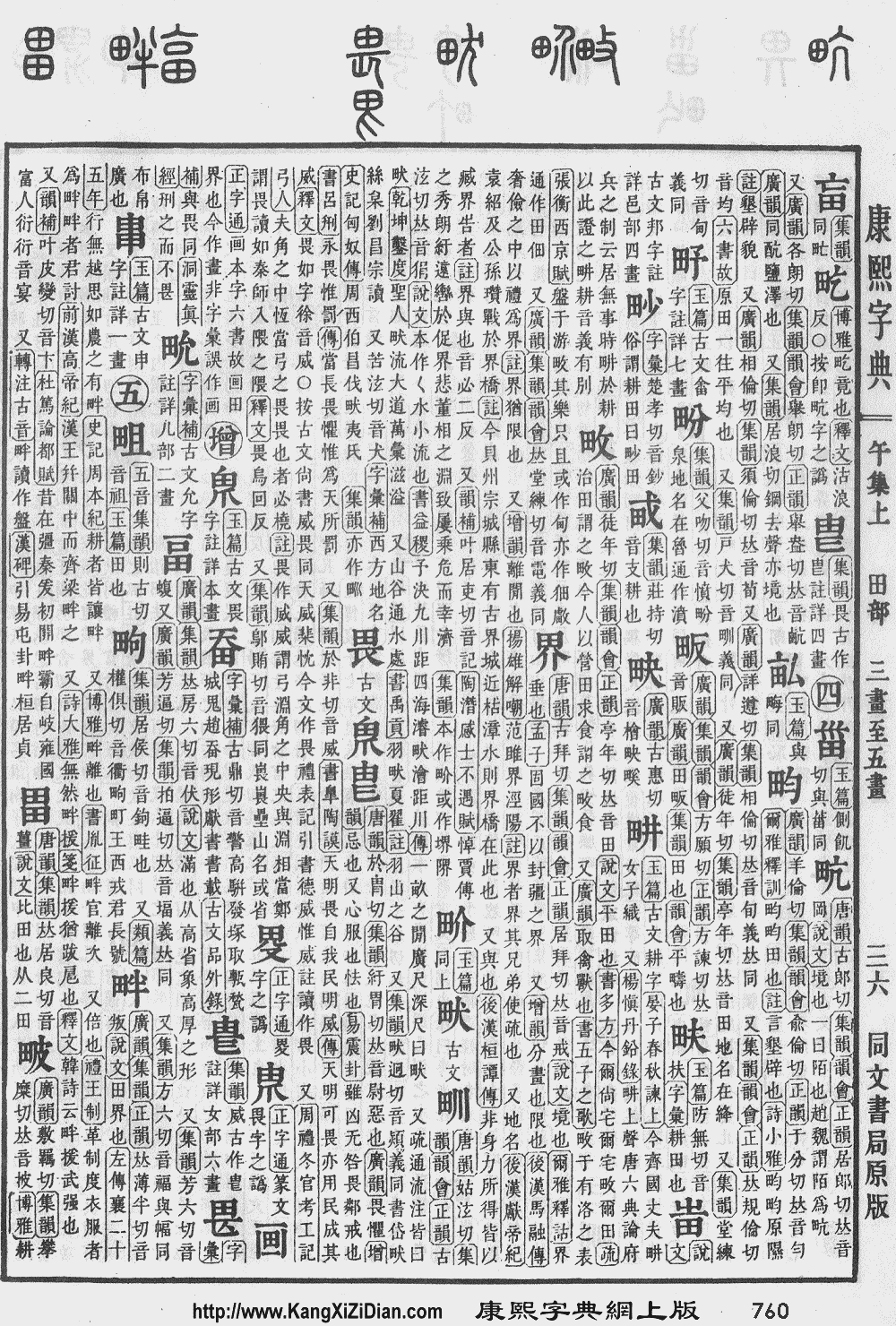
- Kangxi Dictionary: page 760, character 22
- Dai Kanwa Jiten: character 21778
- Dae Jaweon: page 1170, character 14
- Hanyu Da Zidian (first edition): volume 4, page 2532, character 3
- Unihan data for U+754F
Chinese[edit]
| simp. and trad. |
畏 | |
|---|---|---|
| alternative forms | ||
Glyph origin[edit]
| Historical forms of the character 畏 | |||
|---|---|---|---|
| Shang | Western Zhou | Shuowen Jiezi (compiled in Han) | Liushutong (compiled in Ming) |
| Oracle bone script | Bronze inscriptions | Small seal script | Transcribed ancient scripts |

|

|

|

|
Ideogrammic compound (會意/会意) .
In oracle bone script form, this character depicts a ghost (鬼 (guǐ)) holding a stick. (Hsiao-ting Li)
The small seal glyph was analysed by Shuo Wen as a ghost head (甶 (fú)) with part of a tiger, including its claw.
Pronunciation[edit]
Definitions[edit]
畏
- to fear
- 畏難/畏难 ― wèinán ― to be afraid of difficulty
- 佢好畏行夜路。 [Meixian Hakka, trad. and simp.]
- From: 梅县客家方言标准音词典 p. 279
- gi2 hau3 vi4 hang2 ya4 lu4. [Hakka Transliteration Scheme]
- They are so afraid of walking in the night.
- to respect; to admire
- 後生可畏,焉知來者之不如今也? [Classical Chinese, trad.]
- From: The Analects of Confucius, c. 475 – 221 BCE, translated based on James Legge's version
- Hòushēng kě wèi, yān zhī láizhě zhī bùrú jīn yě? [Pinyin]
- A youth is to be regarded with respect. How do we know that his future will not be equal to our present?
后生可畏,焉知来者之不如今也? [Classical Chinese, simp.]
- a surname: Wei
Synonyms[edit]
- (to fear):
Compounds[edit]
- 不畏 (bùwèi)
- 不畏強禦/不畏强御
- 不畏彊禦/不畏强御
- 人言可畏 (rényánkěwèi)
- 可畏 (kěwèi)
- 君子三畏
- 善無畏/善无畏
- 困畏
- 夏日可畏
- 大無畏/大无畏 (dàwúwèi)
- 寅畏 (yínwèi)
- 後生可畏/后生可畏 (hòushēngkěwèi)
- 憺畏
- 懷德畏威/怀德畏威
- 敬畏 (jìngwèi)
- 望而生畏 (wàng'érshēngwèi)
- 無所畏忌/无所畏忌
- 無所畏懼/无所畏惧 (wúsuǒwèijù)
- 無畏/无畏 (wúwèi)
- 畏兀字
- 畏光 (wèiguāng)
- 畏友 (wèiyǒu)
- 畏天恤民
- 畏天愛民/畏天爱民
- 畏天知命
- 畏威懷德/畏威怀德
- 畏強凌弱
- 畏影惡跡/畏影恶迹
- 畏影而走
- 畏忌
- 畏怯 (wèiqiè)
- 畏懼/畏惧 (wèijù)
- 畏服 (wèifú)
- 畏死貪生/畏死贪生
- 畏畏縮縮/畏畏缩缩 (wèiwèisuōsuō)
- 畏縮/畏缩 (wèisuō)
- 畏縮不前/畏缩不前 (wèisuōbùqián)
- 畏罪 (wèizuì)
- 畏罪潛逃/畏罪潜逃
- 畏罪自殺/畏罪自杀
- 畏葸 (wèixǐ)
- 畏葸不前 (wèixǐbùqián)
- 畏途 (wèitú)
- 畏避 (wèibì)
- 畏難/畏难 (wèinán)
- 畏難苟安/畏难苟安 (wèinángǒu'ān)
- 畏頭畏尾/畏头畏尾
- 畏首畏尾 (wèishǒuwèiwěi)
- 視人畏傷/视人畏伤
- 視為畏途/视为畏途 (shìwéiwèitú)
- 貪生畏死/贪生畏死
References[edit]
- “畏”, in 漢語多功能字庫 (Multi-function Chinese Character Database)[1], 香港中文大學 (the Chinese University of Hong Kong), 2014–
- Dictionary of Chinese Character Variants (教育部異體字字典), A02639
Japanese[edit]
Kanji[edit]
畏
Readings[edit]
- Go-on: え (e)←ゑ (we, historical)
- Kan-on: い (i, Jōyō)←ゐ (wi, historical)
- Kun: おそれる (osoreru, 畏れる, Jōyō); かしこし (kashikoshi, 畏し); かしこまる (kashikomaru, 畏まる)
Etymology 1[edit]
| Kanji in this term |
|---|
| 畏 |
| い Grade: S |
| kan’on |
From Middle Chinese 畏 (MC 'jw+jH).
The kan'on, so likely a later borrowing.
Affix[edit]
Derived terms[edit]
Etymology 2[edit]
| Kanji in this term |
|---|
| 畏 |
| かしこ Grade: S |
| kun’yomi |
| For pronunciation and definitions of 畏 – see the following entry. | ||
| ||
| (This term, 畏, is an alternative spelling of the above term.) |
Korean[edit]
Hanja[edit]
畏 (eum 외 (oe))
- This term needs a translation to English. Please help out and add a translation, then remove the text
{{rfdef}}.
Vietnamese[edit]
Han character[edit]
畏: Hán Nôm readings: úy/uý, hoáy, hoay
- This term needs a translation to English. Please help out and add a translation, then remove the text
{{rfdef}}.
Categories:
- CJK Unified Ideographs block
- Han script characters
- Translingual lemmas
- Translingual symbols
- Han ideogrammic compounds
- Middle Chinese lemmas
- Old Chinese lemmas
- Chinese lemmas
- Mandarin lemmas
- Cantonese lemmas
- Taishanese lemmas
- Hakka lemmas
- Northern Min lemmas
- Eastern Min lemmas
- Hokkien lemmas
- Teochew lemmas
- Wu lemmas
- Chinese verbs
- Mandarin verbs
- Cantonese verbs
- Taishanese verbs
- Hakka verbs
- Northern Min verbs
- Eastern Min verbs
- Hokkien verbs
- Teochew verbs
- Wu verbs
- Chinese proper nouns
- Mandarin proper nouns
- Cantonese proper nouns
- Taishanese proper nouns
- Hakka proper nouns
- Northern Min proper nouns
- Eastern Min proper nouns
- Hokkien proper nouns
- Teochew proper nouns
- Wu proper nouns
- Chinese terms with IPA pronunciation
- Chinese Han characters
- Mandarin terms with usage examples
- Hakka terms with quotations
- Literary Chinese terms with quotations
- Chinese surnames
- Advanced Mandarin
- Japanese Han characters
- Common kanji
- Japanese kanji with goon reading え
- Japanese kanji with historical goon reading ゑ
- Japanese kanji with kan'on reading い
- Japanese kanji with historical kan'on reading ゐ
- Japanese kanji with kun reading おそ-れる
- Japanese kanji with kun reading かしこ-し
- Japanese kanji with kun reading かしこ-まる
- Japanese terms spelled with 畏 read as い
- Japanese terms read with on'yomi
- Japanese terms derived from Middle Chinese
- Japanese lemmas
- Japanese affixes
- Japanese terms historically spelled with ゐ
- Japanese terms with multiple readings
- Japanese terms spelled with secondary school kanji
- Japanese terms written with one Han script character
- Japanese terms spelled with 畏
- Japanese single-kanji terms
- Japanese terms spelled with 畏 read as かしこ
- Japanese terms read with kun'yomi
- Japanese interjections
- Korean lemmas
- Korean Han characters
- Vietnamese lemmas
- Vietnamese Han characters