涙
| ||||||||
Translingual[edit]
| Traditional | 淚 |
|---|---|
| Shinjitai | 涙 |
| Simplified | 泪 |
Han character[edit]
涙 (Kangxi radical 85, 水+7, 10 strokes, cangjie input 水戈尸大 (EISK) or 水一尸大 (EMSK), four-corner 33184, composition ⿰氵戻)
Related characters[edit]
- 淚 (Traditional Chinese and kyūjitai form)
References[edit]
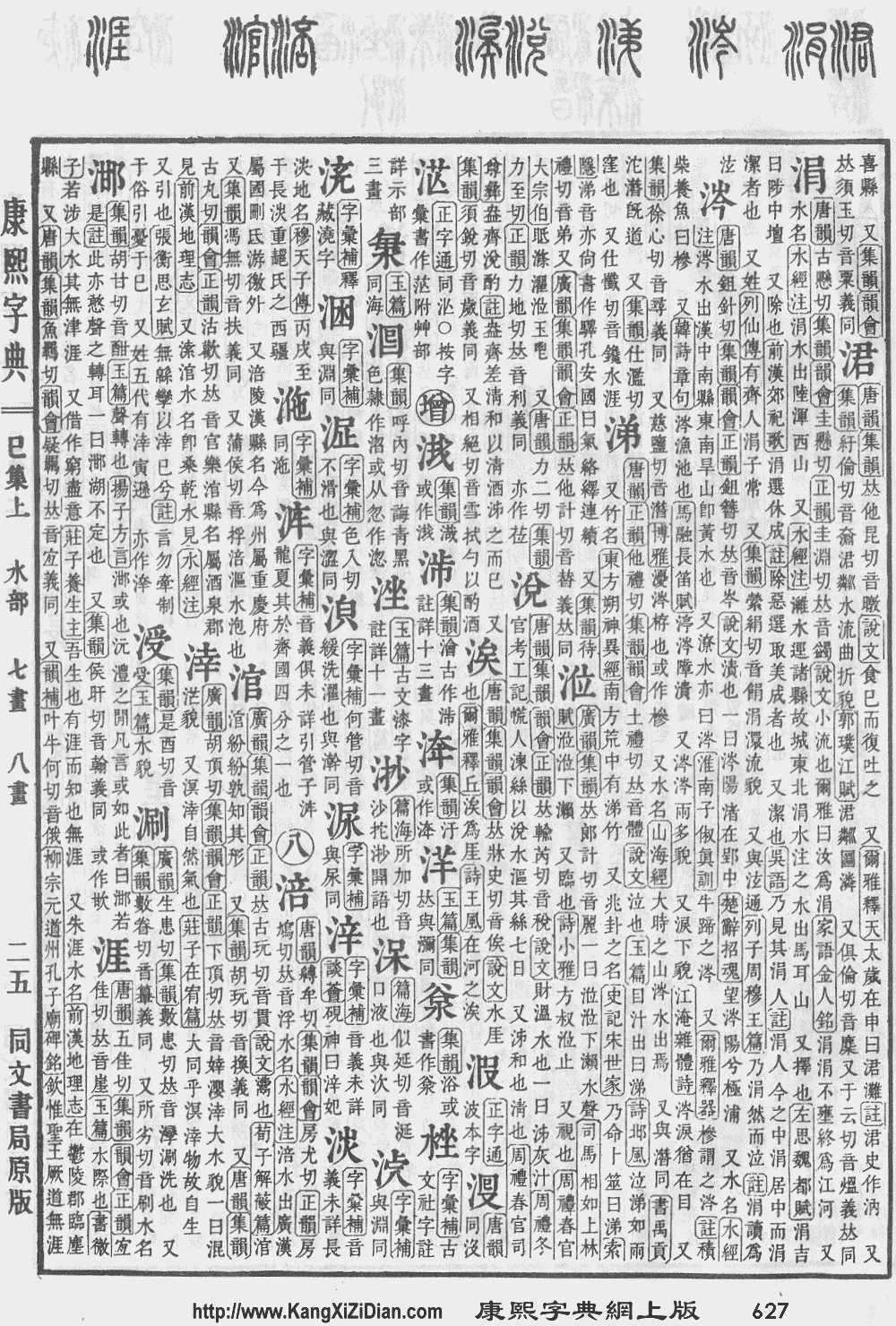
- Kangxi Dictionary: not present, would follow page 627, character 31
- Dai Kanwa Jiten: character 17573
- Hanyu Da Zidian (first edition): not present, would follow volume 3, page 1634, character 6
- Unihan data for U+6D99
Chinese[edit]
| For pronunciation and definitions of 涙 – see 淚 (“tear; teardrop; to weep; to cry”). (This character is a variant form of 淚). |
Japanese[edit]
| 涙 | |
| 淚 |
Kanji[edit]
(common “Jōyō” kanji, shinjitai kanji, kyūjitai form 淚)
Readings[edit]
- Go-on: るい (rui, Jōyō)←るい (rui, historical)←るゐ (rwi, ancient)
- Kan-on: るい (rui, Jōyō)←るい (rui, historical)←るゐ (rwi, ancient)
- Tō-on: れい (rei)
- On: らい (rai)
- Kun: なみだ (namida, 涙, Jōyō)
Etymology 1[edit]
| Kanji in this term |
|---|
| 涙 |
| なみだ Grade: S |
| kun’yomi |
| Alternative spellings |
|---|
| 淚 (kyūjitai) 泪 涕 |
From Old Japanese. Ultimately from Proto-Japonic *namita.
Attested in the Nihon Shoki with the man'yōgana spelling 那瀰多 (namita). The Kojiki and Man'yōshū have 那美多 (namita),[1] and the Man'yōshū also has later instances where the 多 (ta) was replaced with 太 (da), forming 奈美太 (namida),[2] indicating a phonetic change over time from namita to namida.
Ultimate derivation unknown. There are interesting phonetic and semantic similarities with Thai น้ำตา (nám-dtaa, “tear”, literally “water + eye”), overlapping semantically with Korean 눈물 (nunmul, “tear”, literally “eye + water”), perhaps pointing to an ancient prehistoric borrowing. However, such similarities may also be purely accidental.
Pronunciation[edit]
Noun[edit]
Verb[edit]
涙する • (namida suru) suru (stem 涙し (namida shi), past 涙した (namida shita))
Conjugation[edit]
| Katsuyōkei ("stem forms") | ||||
|---|---|---|---|---|
| Mizenkei ("imperfective") | 涙し | なみだし | namida shi | |
| Ren’yōkei ("continuative") | 涙し | なみだし | namida shi | |
| Shūshikei ("terminal") | 涙する | なみだする | namida suru | |
| Rentaikei ("attributive") | 涙する | なみだする | namida suru | |
| Kateikei ("hypothetical") | 涙すれ | なみだすれ | namida sure | |
| Meireikei ("imperative") | 涙せよ¹ 涙しろ² |
なみだせよ¹ なみだしろ² |
namida seyo¹ namida shiro² | |
| Key constructions | ||||
| Passive | 涙される | なみだされる | namida sareru | |
| Causative | 涙させる 涙さす |
なみださせる なみださす |
namida saseru namida sasu | |
| Potential | 涙できる | なみだできる | namida dekiru | |
| Volitional | 涙しよう | なみだしよう | namida shiyō | |
| Negative | 涙しない | なみだしない | namida shinai | |
| Negative continuative | 涙せず | なみだせず | namida sezu | |
| Formal | 涙します | なみだします | namida shimasu | |
| Perfective | 涙した | なみだした | namida shita | |
| Conjunctive | 涙して | なみだして | namida shite | |
| Hypothetical conditional | 涙すれば | なみだすれば | namida sureba | |
| ¹ Written imperative ² Spoken imperative | ||||
Etymology 2[edit]
| Kanji in this term |
|---|
| 涙 |
| なんだ Grade: S |
| kun’yomi |
| Alternative spelling |
|---|
| 淚 (kyūjitai) |
/namida/ → /nanda/
Alteration of namida above.[4][3][5]
Pronunciation[edit]
Noun[edit]
Etymology 3[edit]
| Kanji in this term |
|---|
| 涙 |
| なだ Grade: S |
| kun’yomi |
| Alternative spelling |
|---|
| 淚 (kyūjitai) |
Alteration of namida or nanda above. Used during the Edo period in the rough informal speech used by the staff and servants of samurai households, and others of lower social rank.[4][3][5]
Pronunciation[edit]
Noun[edit]
See also[edit]
References[edit]
- ^ , text here
- ^ , text here
- ↑ 3.0 3.1 3.2 3.3 Matsumura, Akira, editor (2006), 大辞林 (in Japanese), Third edition, Tōkyō: Sanseidō, →ISBN
- ↑ 4.0 4.1 Shōgaku Tosho (1988) 国語大辞典(新装版) [Unabridged Dictionary of Japanese (Revised Edition)] (in Japanese), Tōkyō: Shogakukan, →ISBN
- ↑ 5.0 5.1 Matsumura, Akira (1995) 大辞泉 (in Japanese), First edition, Tōkyō: Shogakukan, →ISBN
- CJK Unified Ideographs block
- Han script characters
- CJKV characters simplified differently in Japan and China
- Translingual lemmas
- Translingual symbols
- Chinese lemmas
- Mandarin lemmas
- Sichuanese lemmas
- Cantonese lemmas
- Taishanese lemmas
- Gan lemmas
- Hakka lemmas
- Jin lemmas
- Northern Min lemmas
- Eastern Min lemmas
- Hokkien lemmas
- Teochew lemmas
- Wu lemmas
- Xiang lemmas
- Chinese nouns
- Mandarin nouns
- Sichuanese nouns
- Cantonese nouns
- Taishanese nouns
- Gan nouns
- Hakka nouns
- Jin nouns
- Northern Min nouns
- Eastern Min nouns
- Hokkien nouns
- Teochew nouns
- Wu nouns
- Xiang nouns
- Chinese verbs
- Mandarin verbs
- Sichuanese verbs
- Cantonese verbs
- Taishanese verbs
- Gan verbs
- Hakka verbs
- Jin verbs
- Northern Min verbs
- Eastern Min verbs
- Hokkien verbs
- Teochew verbs
- Wu verbs
- Xiang verbs
- Chinese terms with IPA pronunciation
- Chinese Han characters
- Chinese variant forms
- Japanese Han characters
- Common kanji
- Japanese kanji with goon reading るい
- Japanese kanji with historical goon reading るい
- Japanese kanji with ancient goon reading るゐ
- Japanese kanji with kan'on reading るい
- Japanese kanji with historical kan'on reading るい
- Japanese kanji with ancient kan'on reading るゐ
- Japanese kanji with tōon reading れい
- Japanese kanji with on reading らい
- Japanese kanji with kun reading なみだ
- Japanese terms spelled with 涙 read as なみだ
- Japanese terms read with kun'yomi
- Japanese terms inherited from Old Japanese
- Japanese terms derived from Old Japanese
- Japanese terms inherited from Proto-Japonic
- Japanese terms derived from Proto-Japonic
- Japanese terms with unknown etymologies
- Japanese terms with IPA pronunciation
- Japanese lemmas
- Japanese nouns
- Japanese terms with multiple readings
- Japanese terms spelled with secondary school kanji
- Japanese terms written with one Han script character
- Japanese terms spelled with 涙
- Japanese single-kanji terms
- Japanese verbs
- Japanese suru verbs
- Japanese terms spelled with 涙 read as なんだ
- Japanese terms spelled with 涙 read as なだ
- Japanese terms with archaic senses
- Japanese terms with obsolete senses
- ja:Bodily fluids