肅
Appearance
| ||||||||
Translingual
[edit]| Traditional | 肅 |
|---|---|
| Shinjitai | 粛 |
| Simplified | 肃 |
Han character
[edit]肅 (Kangxi radical 129, 聿+7, 13 strokes, cangjie input 中難 (LX), four-corner 50227, composition ⿻肀𣶒(GJKT) or ⿻𦘒𣶒(H))
Derived characters
[edit]References
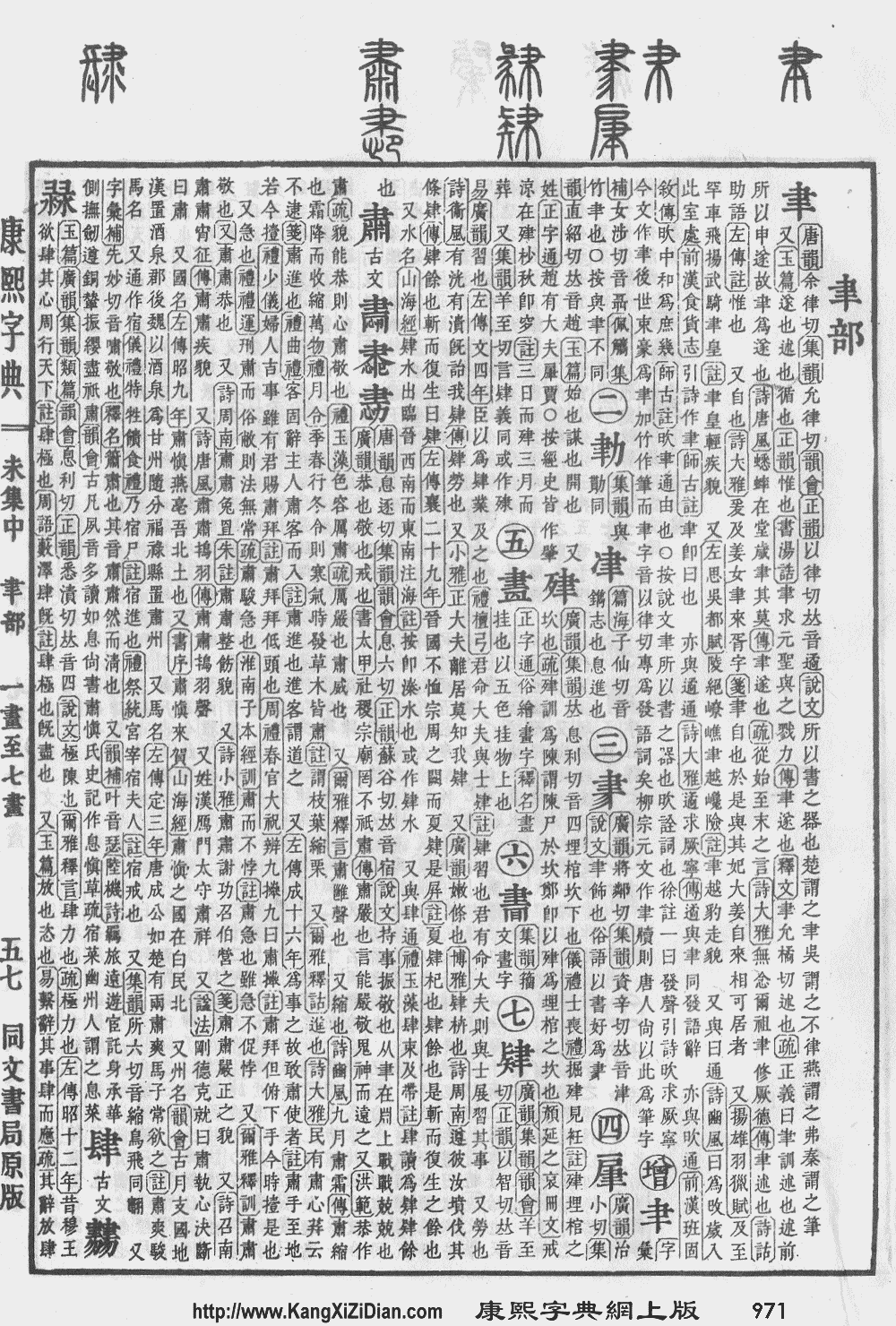
[edit]- Kangxi Dictionary: page 971, character 11
- Dai Kanwa Jiten: character 29225
- Dae Jaweon: page 1423, character 12
- Hanyu Da Zidian (first edition): volume 5, page 3169, character 4
- Unihan data for U+8085
Chinese
[edit]| trad. | 肅 | |
|---|---|---|
| simp. | 肃 | |
| alternative forms | ||
Glyph origin
[edit]| Historical forms of the character 肅 |
|---|
| Shuowen Jiezi (compiled in Han) |
| Small seal script |
Ideogrammic compound (會意 / 会意): 𦘒 (“hand holding brush”) + 𣶒 (“abyss”). Uncertain. One interpretation says it depicts a person sweeping or walking with a staff near an abyss, conveying solemnity or respectful handling of affairs.
Pronunciation
[edit]- Mandarin
- Cantonese (Jyutping): suk1
- Hakka
- Northern Min (KCR): sṳ̆
- Eastern Min (BUC): sé̤ṳk
- Puxian Min (Pouseng Ping'ing): soeh6 / syoeh6 / sieh6
- Southern Min
- Mandarin
- (Standard Chinese)+
- Hanyu Pinyin: sù
- Zhuyin: ㄙㄨˋ
- Tongyong Pinyin: sù
- Wade–Giles: su4
- Yale: sù
- Gwoyeu Romatzyh: suh
- Palladius: су (su)
- Sinological IPA (key): /su⁵¹/
- (Standard Chinese)+
- Cantonese
- (Standard Cantonese, Guangzhou–Hong Kong)
- Jyutping: suk1
- Yale: sūk
- Cantonese Pinyin: suk7
- Guangdong Romanization: sug1
- Sinological IPA (key): /sʊk̚⁵/
- (Standard Cantonese, Guangzhou–Hong Kong)
- Hakka
- (Sixian, incl. Miaoli and Neipu)
- Pha̍k-fa-sṳ: sok / suk / siuk
- Hakka Romanization System: sogˋ / sugˋ / xiugˋ
- Hagfa Pinyim: sog5 / sug5 / xiug5
- Sinological IPA: /sok̚²/, /suk̚²/, /si̯uk̚²/
- (Hailu, incl. Zhudong)
- Hakka Romanization System: sog / sug / siug
- Sinological IPA: /sok⁵/, /suk⁵/, /siuk⁵/
- (Sixian, incl. Miaoli and Neipu)
- Northern Min
- (Jian'ou)
- Kienning Colloquial Romanized: sṳ̆
- Sinological IPA (key): /sy²⁴/
- (Jian'ou)
- Eastern Min
- (Fuzhou)
- Bàng-uâ-cê: sé̤ṳk
- Sinological IPA (key): /søyʔ²⁴/
- (Fuzhou)
- Puxian Min
- (Putian, Jiangkou, Nanri)
- Pouseng Ping'ing: soeh6
- Báⁿ-uā-ci̍: se̤h
- Sinological IPA (key): /ɬœʔ²¹/
- (Youyang)
- Pouseng Ping'ing: soeh6
- Sinological IPA (key): /θœʔ²/
- (Xianyou)
- Pouseng Ping'ing: syoeh6
- Sinological IPA (key): /ɬyøʔ²/
- (Fengting)
- Pouseng Ping'ing: sieh6
- Sinological IPA (key): /ɬieʔ²/
- (Putian, Jiangkou, Nanri)
- Southern Min
- (Hokkien: General Taiwanese, Xiamen, Zhangzhou)
- Pe̍h-ōe-jī: siok
- Tâi-lô: siok
- Phofsit Daibuun: siog
- Sinological IPA (Taipei, Kaohsiung, Xiamen, Zhangzhou): /siɔk̚³²/
- (Hokkien: Quanzhou, General Taiwanese)
- Pe̍h-ōe-jī: sok
- Tâi-lô: sok
- Phofsit Daibuun: sog
- Sinological IPA (Taipei, Kaohsiung): /sɔk̚³²/
- Sinological IPA (Quanzhou): /sɔk̚⁵/
- (Teochew)
- Peng'im: sog4
- Pe̍h-ōe-jī-like: sok
- Sinological IPA (key): /sok̚²/
- (Hokkien: General Taiwanese, Xiamen, Zhangzhou)
- Dialectal data
- Middle Chinese: sjuwk
- Old Chinese
- (Baxter–Sagart): /*siwk/
- (Zhengzhang): /*sɯwɢ/
Definitions
[edit]肅
- respectful
- solemn
- to rectify; to tighten; to strengthen
- to eliminate
- a surname
Compounds
[edit]- 名正肅 / 名正肃
- 嚴肅 / 严肃 (yánsù)
- 寒肅 / 寒肃
- 恭肅嚴整 / 恭肃严整
- 態度嚴肅 / 态度严肃
- 敬肅者 / 敬肃者
- 整肅 / 整肃 (zhěngsù)
- 檢肅 / 检肃
- 甘肅 / 甘肃 (Gānsù)
- 祗肅 / 祗肃
- 秋高氣肅 / 秋高气肃
- 端肅 / 端肃
- 肅函 / 肃函
- 肅北 / 肃北 (Sùběi)
- 肅北蒙古族自治縣 / 肃北蒙古族自治县
- 肅反 / 肃反 (sùfǎn)
- 肅呈 / 肃呈
- 肅坐 / 肃坐
- 肅客 / 肃客
- 肅州 / 肃州 (Sùzhōu)
- 肅恭 / 肃恭
- 肅慎 / 肃慎 (Sùshèn)
- 肅拜 / 肃拜
- 肅殺 / 肃杀 (sùshā)
- 肅清 / 肃清 (sùqīng)
- 肅然 / 肃然 (sùrán)
- 肅然起敬 / 肃然起敬 (sùránqǐjìng)
- 肅爽 / 肃爽 (sùshuāng)
- 肅穆 / 肃穆 (sùmù)
- 肅立 / 肃立 (sùlì)
- 肅肅 / 肃肃
- 肅貪 / 肃贪
- 肅雝 / 肃雍
- 肅靜 / 肃静 (sùjìng)
- 茲肅者 / 兹肃者
- 謹肅 / 谨肃
- 魯肅指囷 / 鲁肃指囷
- 齊肅 / 齐肃
Further reading
[edit]- Dictionary of Chinese Character Variants (教育部異體字字典), A03286
- “肅”, in 重編國語辭典修訂本 [Revised Mandarin Chinese Dictionary] (in Chinese), National Academy for Educational Research (Taiwan), 2021.
- “肅”, in 漢語多功能字庫 (Multi-function Chinese Character Database)[1], 香港中文大學 (the Chinese University of Hong Kong), 2014–
- “肅”, in 教育部臺灣台語常用詞辭典 [Dictionary of Frequently-Used Taiwanese Taigi] (overall work in Mandarin and Hokkien), Ministry of Education, R.O.C., 2025.
- “Entry #14813”, in 臺灣客語辭典 [Dictionary of Taiwan Hakka] (overall work in Chinese and Hakka), Ministry of Education, R.O.C., 2022.
- “Entry #15069”, in 臺灣客語辭典 [Dictionary of Taiwan Hakka] (overall work in Chinese and Hakka), Ministry of Education, R.O.C., 2022.
- “Entry #16492”, in 臺灣客語辭典 [Dictionary of Taiwan Hakka] (overall work in Chinese and Hakka), Ministry of Education, R.O.C., 2022.
- 李如龙 [Li, Ru-long]; 刘福铸 [Liu, Fu-zhu]; 吴华英 [Wu, Hua-ying]; 黄国城 [Huang, Guo-cheng] (2019), “肃”, in 莆仙方言调查报告 [Investigation Report on Puxian Dialect] (overall work in Mandarin and Puxian Min), Xiamen University Press, →ISBN, page 283.
Japanese
[edit]| 粛 | |
| 肅 |
Kanji
[edit]肅
(Hyōgai kanji, kyūjitai kanji, shinjitai form 粛)
- This term needs a translation to English. Please help out and add a translation, then remove the text
{{rfdef}}.
Readings
[edit]Korean
[edit]Hanja
[edit]肅 • (suk) (hangeul 숙, revised suk, McCune–Reischauer suk, Yale swuk)
- This term needs a translation to English. Please help out and add a translation, then remove the text
{{rfdef}}.
Vietnamese
[edit]Han character
[edit]- This term needs a translation to English. Please help out and add a translation, then remove the text
{{rfdef}}.
Categories:
- CJK Unified Ideographs block
- Han script characters
- CJKV characters simplified differently in Japan and China
- Translingual lemmas
- Translingual symbols
- Han ideogrammic compounds
- Chinese lemmas
- Mandarin lemmas
- Cantonese lemmas
- Hakka lemmas
- Northern Min lemmas
- Eastern Min lemmas
- Hokkien lemmas
- Teochew lemmas
- Puxian Min lemmas
- Middle Chinese lemmas
- Old Chinese lemmas
- Chinese hanzi
- Mandarin hanzi
- Cantonese hanzi
- Hakka hanzi
- Northern Min hanzi
- Eastern Min hanzi
- Hokkien hanzi
- Teochew hanzi
- Puxian Min hanzi
- Middle Chinese hanzi
- Old Chinese hanzi
- Chinese verbs
- Mandarin verbs
- Cantonese verbs
- Hakka verbs
- Northern Min verbs
- Eastern Min verbs
- Hokkien verbs
- Teochew verbs
- Puxian Min verbs
- Middle Chinese verbs
- Old Chinese verbs
- Chinese adverbs
- Mandarin adverbs
- Cantonese adverbs
- Hakka adverbs
- Northern Min adverbs
- Eastern Min adverbs
- Hokkien adverbs
- Teochew adverbs
- Puxian Min adverbs
- Middle Chinese adverbs
- Old Chinese adverbs
- Chinese proper nouns
- Mandarin proper nouns
- Cantonese proper nouns
- Hakka proper nouns
- Northern Min proper nouns
- Eastern Min proper nouns
- Hokkien proper nouns
- Teochew proper nouns
- Puxian Min proper nouns
- Middle Chinese proper nouns
- Old Chinese proper nouns
- Chinese terms with IPA pronunciation
- Chinese terms spelled with 肅
- Mandarin terms with usage examples
- Chinese surnames
- Japanese kanji
- Japanese hyōgai kanji
- Japanese kanji with goon reading すく
- Japanese kanji with kan'on reading しゅく
- Japanese kanji with kun reading つつし・む
- Korean lemmas
- Korean hanja
- Vietnamese lemmas
- Vietnamese Han characters