mel
English
[edit]Pronunciation
[edit]Etymology 1
[edit]Shortening of melody.
Noun
[edit]mel (plural mels)
- (psychoacoustics) A unit of pitch on a scale of pitches perceived by listeners to be equally spaced from one another.
Further reading
[edit]
Etymology 2
[edit]From Latin mel (“honey”). Doublet of mell.
Noun
[edit]mel (uncountable)
Anagrams
[edit]Albanian
[edit]Etymology
[edit]Borrowed through Vulgar Latin from Latin milium.
Noun
[edit]mel m (definite meli)
Breton
[edit]Etymology
[edit]From Proto-Celtic *meli (“honey”) (compare Welsh mêl, Old Irish mil), from Proto-Indo-European *mélid, whence also Latin mel (“honey”).
Pronunciation
[edit]Noun
[edit]mel m
Catalan
[edit]Pronunciation
[edit]Etymology 1
[edit]Inherited from Vulgar Latin *melem m or f, from Latin mel n.
Noun
[edit]mel f (plural mels)
Derived terms
[edit]Related terms
[edit]Etymology 2
[edit]Inherited from Late Latin mēlum, variant of mālum (“apple”).
Noun
[edit]mel m (plural mels)
Etymology 3
[edit]Pronoun
[edit]mel
Further reading
[edit]- “mel” in Diccionari de la llengua catalana, segona edició, Institut d’Estudis Catalans.
- “mel”, in Gran Diccionari de la Llengua Catalana, Grup Enciclopèdia Catalana, 2024
- “mel” in Diccionari normatiu valencià, Acadèmia Valenciana de la Llengua.
- “mel” in Diccionari català-valencià-balear, Antoni Maria Alcover and Francesc de Borja Moll, 1962.
Classical Nahuatl
[edit]Pronunciation
[edit]Noun
[edit]mēl inan
- second-person singular possessive singular of ēlli; (it is) your liver.
Cornish
[edit]Etymology
[edit]From Proto-Brythonic *mel, from Proto-Celtic *meli (“honey”) (compare Welsh mêl, Old Irish mil), from Proto-Indo-European *mélid, whence also Latin mel (“honey”).
Noun
[edit]mel m
Mutation
[edit]| Cornish consonant mutation | |||||
|---|---|---|---|---|---|
| unmutated | soft | aspirate | hard | mixed | mixed after 'th |
| mel | vel | unchanged | unchanged | fel | vel |
Czech
[edit]Pronunciation
[edit]Verb
[edit]mel
Dalmatian
[edit]Etymology
[edit]Numeral
[edit]mel
Danish
[edit]Etymology
[edit]From Old Norse mjǫl, from Proto-Germanic *melwą, from Proto-Indo-European *melh₂- (“to grind, rub, break up”).
Pronunciation
[edit]
Noun
[edit]mel n (singular definite melet, not used in plural form)
Declension
[edit]| neuter gender |
Singular | |
|---|---|---|
| indefinite | definite | |
| nominative | mel | melet |
| genitive | mels | melets |
Further reading
[edit]- “mel” in Den Danske Ordbog
- “mel” in Ordbog over det danske Sprog
Dhuwal
[edit]Noun
[edit]mel
Galician
[edit]Etymology
[edit]From Old Galician-Portuguese mel, from Vulgar Latin *melem m or f, from Latin mel n.
Pronunciation
[edit]Noun
[edit]mel m (plural meles)
Derived terms
[edit]References
[edit]- Ernesto Xosé González Seoane, María Álvarez de la Granja, Ana Isabel Boullón Agrelo (2006–2022) “mel”, in Dicionario de Dicionarios do galego medieval (in Galician), Santiago de Compostela: Instituto da Lingua Galega
- Xavier Varela Barreiro, Xavier Gómez Guinovart (2006–2018) “mel”, in Corpus Xelmírez - Corpus lingüístico da Galicia medieval (in Galician), Santiago de Compostela: ILG
- Antón Luís Santamarina Fernández, editor (2006–2013), “mel”, in Dicionario de Dicionarios da lingua galega [Dictionary of Dictionaries of the Galician language] (in Galician), Santiago de Compostela: Instituto da Lingua Galega
- Antón Luís Santamarina Fernández, Ernesto Xosé González Seoane, María Álvarez de la Granja, editors (2003–2018), “mel”, in Tesouro informatizado da lingua galega (in Galician), Santiago de Compostela: Instituto da Lingua Galega
- Rosario Álvarez Blanco, editor (2014–2024), “mel”, in Tesouro do léxico patrimonial galego e portugués (in Galician), Santiago de Compostela: Instituto da Lingua Galega, →ISSN
Gothic
[edit]Romanization
[edit]mēl
- Romanization of 𐌼𐌴𐌻
Istriot
[edit]Etymology
[edit]From Vulgar Latin *melem m or f, from Latin mel n.
Noun
[edit]mel
References
[edit]- AIS: Sprach- und Sachatlas Italiens und der Südschweiz [Linguistic and Ethnographic Atlas of Italy and Southern Switzerland] – map 1159: “il miele” – on navigais-web.pd.istc.cnr.it
Latin
[edit]Etymology
[edit]From Proto-Italic *meli, from Proto-Indo-European *mel-it (“honey”), with the athematic suffix *-it that indicates comestible substances (compare Proto-Indo-European *h₂élbʰ-it (“barley”) or Proto-Indo-European *sép-it (“wheat”))) Cognate with Ancient Greek μέλι (méli), Gothic 𐌼𐌹𐌻𐌹𐌸 (miliþ), Old Armenian մեղր (mełr), Hittite [script needed] (milit), Luwian [script needed] (mallit-).[1]
Pronunciation
[edit]- (Classical Latin) IPA(key): /mel/, [mɛɫ̪]
- (modern Italianate Ecclesiastical) IPA(key): /mel/, [mɛl]
Noun
[edit]mel n (genitive mellis); third declension
- honey
- 8 CE, Ovid, Fasti 3.743–744:
- colligit errantēs et in arbore claudit inānī
Liber et inventī praemia mellis habet.- Liber gathers the wandering [bees] and confines them in a hollow tree,
and he has the rewards of discovering honey.
(See Liber – the Greek Dionysus or Roman Bacchus – and The Discovery of Honey by Bacchus.)
- Liber gathers the wandering [bees] and confines them in a hollow tree,
- colligit errantēs et in arbore claudit inānī
- c. 189 BCE, Plautus, Truculentus 371, (ed. by Friedric Leo, Plauti Comoediae vol. 2, 1896, Berlin: Weidmann):
- Heia, hoc est melle dulci dulcius.
- Ah! This is sweeter than sweet honey.
- Heia, hoc est melle dulci dulcius.
- (figuratively) sweetness, pleasantness
- c. 35 CE – 100 CE, Quintilian, Institutio Oratoria 3.1.5:
- Sed nos veremur ne parum hic liber mellis et absinthii multum habere videatur
- But I fear that this book will have too little sweetness and too much wormwood.
- Sed nos veremur ne parum hic liber mellis et absinthii multum habere videatur
- (figuratively, term of endearment) darling, sweet, honey
Declension
[edit]Third-declension noun (neuter, i-stem).
| Case | Singular | Plural |
|---|---|---|
| Nominative | mel | mella |
| Genitive | mellis | mellium mellum |
| Dative | mellī | mellibus |
| Accusative | mel | mella |
| Ablative | melle mellī |
mellibus |
| Vocative | mel | mella |
Synonyms
[edit]Derived terms
[edit]Related terms
[edit]Descendants
[edit]- Vulgar Latin: *melem m or f (see there for further descendants)
References
[edit]- “mel”, in Charlton T. Lewis and Charles Short (1879) A Latin Dictionary, Oxford: Clarendon Press
- “mel”, in Charlton T. Lewis (1891) An Elementary Latin Dictionary, New York: Harper & Brothers
- mel in Gaffiot, Félix (1934) Dictionnaire illustré latin-français, Hachette.
- Carl Meißner, Henry William Auden (1894) Latin Phrase-Book[1], London: Macmillan and Co.
- somebody's darling: mel ac deliciae alicuius (Fam. 8. 8. 1)
- somebody's darling: mel ac deliciae alicuius (Fam. 8. 8. 1)
- ^ De Vaan, Michiel (2008) “mel”, in Etymological Dictionary of Latin and the other Italic Languages (Leiden Indo-European Etymological Dictionary Series; 7), Leiden, Boston: Brill, →ISBN, page 370
Malay
[edit]Etymology
[edit]Pronunciation
[edit]Noun
[edit]mél (Jawi spelling ميل, plural mel-mel, informal 1st possessive melku, 2nd possessive melmu, 3rd possessive melnya)
Derived terms
[edit]Further reading
[edit]- “mel” in Pusat Rujukan Persuratan Melayu | Malay Literary Reference Centre, Kuala Lumpur: Dewan Bahasa dan Pustaka, 2017.
Middle English
[edit]Alternative forms
[edit]Etymology
[edit]From Old English mǣl, from Proto-West Germanic *māl, from Proto-Germanic *mēlą.
Pronunciation
[edit]Noun
[edit]mel (plural meles)
Descendants
[edit]References
[edit]- “mēl, n.(2).”, in MED Online, Ann Arbor, Mich.: University of Michigan, 2007.
Norwegian Bokmål
[edit]
Alternative forms
[edit]- mjøl (also Nynorsk)
Etymology
[edit]From Danish mel, from Old Norse mjǫl.
Noun
[edit]mel n (definite singular melet)
Derived terms
[edit]References
[edit]- “mel” in The Bokmål Dictionary.
Norwegian Nynorsk
[edit]Verb
[edit]mel
Old Galician-Portuguese
[edit]Etymology
[edit]From Latin mel, from Vulgar Latin *melem m or f, from Latin mel n.
Pronunciation
[edit]Noun
[edit]mel m
- honey
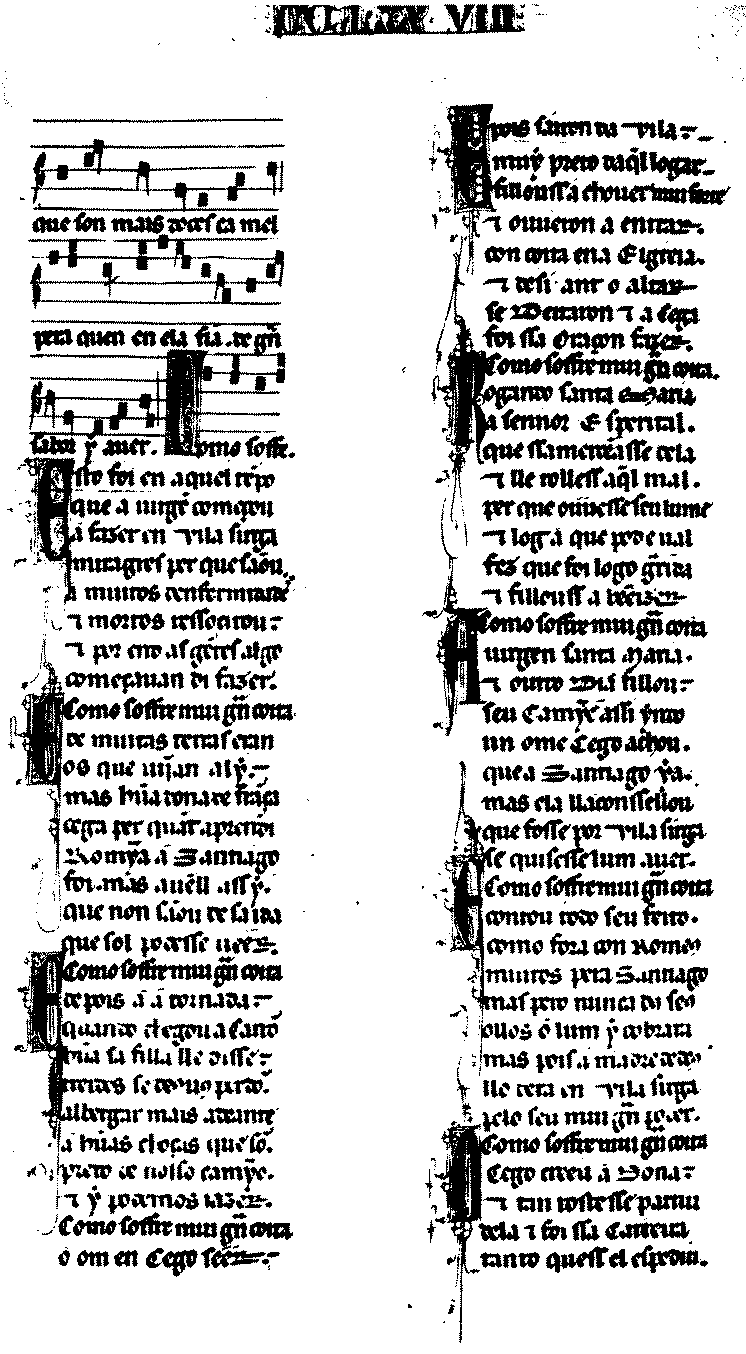
- 13th century CE, Alfonso X of Castile, Cantigas de Santa Maria, Códice de los músicos, cantiga 278 (facsimile):
- […] que ſon mais doceſ ca mel […]
- […] which are sweeter than honey […]
- […] que ſon mais doceſ ca mel […]
Descendants
[edit]Old Welsh
[edit]Etymology
[edit]From Proto-Brythonic *mel, from Proto-Celtic *meli, from Proto-Indo-European *mélit.
Noun
[edit]mel m
Descendants
[edit]Portuguese
[edit]

Etymology
[edit]Inherited from Old Galician-Portuguese mel, from Vulgar Latin *melem m or f, from Latin mel n.
Compare Galician mel m, Spanish miel f.
Pronunciation
[edit]
- Rhymes: (Portugal) -ɛl, (Brazil) -ɛw
- Homophone: mele (Portugal)
- Hyphenation: mel
Audio (Portugal): (file)
Noun
[edit]Quotations
[edit]For quotations using this term, see Citations:mel.
Derived terms
[edit]Romanian
[edit]Etymology
[edit]Noun
[edit]mel m (plural meli)
Declension
[edit]Romansch
[edit]Alternative forms
[edit]Etymology
[edit]From Vulgar Latin *melem m, from Latin mel n.
Noun
[edit]mel m (plural mels)
Synonyms
[edit]- (honey): mel d'avieuls
References
[edit]- AIS: Sprach- und Sachatlas Italiens und der Südschweiz [Linguistic and Ethnographic Atlas of Italy and Southern Switzerland] – map 1159: “il miele” – on navigais-web.pd.istc.cnr.it
Volapük
[edit]Etymology
[edit]Borrowed from French mer (“sea”), with the 'r' turned into 'l'.
Noun
[edit]mel (nominative plural mels)
Declension
[edit]- English 1-syllable words
- English terms with IPA pronunciation
- Rhymes:English/ɛl
- Rhymes:English/ɛl/1 syllable
- English terms with homophones
- English lemmas
- English nouns
- English countable nouns
- English terms borrowed from Latin
- English terms derived from Latin
- English doublets
- English uncountable nouns
- Albanian terms borrowed from Vulgar Latin
- Albanian terms derived from Vulgar Latin
- Albanian terms borrowed from Latin
- Albanian terms derived from Latin
- Albanian lemmas
- Albanian nouns
- Albanian masculine nouns
- sq:Plants
- Breton terms inherited from Proto-Celtic
- Breton terms derived from Proto-Celtic
- Breton terms inherited from Proto-Indo-European
- Breton terms derived from Proto-Indo-European
- Breton terms with IPA pronunciation
- Breton lemmas
- Breton nouns
- Breton masculine nouns
- br:Condiments
- Catalan terms with IPA pronunciation
- Catalan terms with audio links
- Catalan terms inherited from Vulgar Latin
- Catalan terms derived from Vulgar Latin
- Catalan terms inherited from Latin
- Catalan terms derived from Latin
- Catalan lemmas
- Catalan nouns
- Catalan countable nouns
- Catalan feminine nouns with no feminine ending
- Catalan feminine nouns
- Catalan terms inherited from Late Latin
- Catalan terms derived from Late Latin
- Catalan masculine nouns
- Balearic Catalan
- ca:Anatomy
- Catalan pronouns
- Catalan terms with archaic senses
- Catalan contractions
- ca:Beekeeping
- ca:Condiments
- Classical Nahuatl terms with IPA pronunciation
- Classical Nahuatl non-lemma forms
- Classical Nahuatl noun forms
- Cornish terms inherited from Proto-Brythonic
- Cornish terms derived from Proto-Brythonic
- Cornish terms inherited from Proto-Celtic
- Cornish terms derived from Proto-Celtic
- Cornish terms derived from Proto-Indo-European
- Cornish lemmas
- Cornish nouns
- Cornish masculine nouns
- kw:Condiments
- Czech terms with IPA pronunciation
- Czech non-lemma forms
- Czech verb forms
- Dalmatian terms inherited from Latin
- Dalmatian terms derived from Latin
- Dalmatian lemmas
- Dalmatian numerals
- Dalmatian cardinal numbers
- Danish terms inherited from Old Norse
- Danish terms derived from Old Norse
- Danish terms inherited from Proto-Germanic
- Danish terms derived from Proto-Germanic
- Danish terms inherited from Proto-Indo-European
- Danish terms derived from Proto-Indo-European
- Danish lemmas
- Danish nouns
- Danish neuter nouns
- Dhuwal lemmas
- Dhuwal nouns
- dwu:Anatomy
- Galician terms inherited from Old Galician-Portuguese
- Galician terms derived from Old Galician-Portuguese
- Galician terms inherited from Vulgar Latin
- Galician terms derived from Vulgar Latin
- Galician terms inherited from Latin
- Galician terms derived from Latin
- Galician terms with IPA pronunciation
- Galician lemmas
- Galician nouns
- Galician countable nouns
- Galician masculine nouns
- gl:Condiments
- Gothic non-lemma forms
- Gothic romanizations
- Istriot terms inherited from Vulgar Latin
- Istriot terms derived from Vulgar Latin
- Istriot terms inherited from Latin
- Istriot terms derived from Latin
- Istriot lemmas
- Istriot nouns
- Latin terms inherited from Proto-Italic
- Latin terms derived from Proto-Italic
- Latin terms inherited from Proto-Indo-European
- Latin terms derived from Proto-Indo-European
- Latin 1-syllable words
- Latin terms with IPA pronunciation
- Latin lemmas
- Latin nouns
- Latin third declension nouns
- Latin neuter nouns in the third declension
- Latin neuter nouns
- Latin terms with quotations
- Latin words in Meissner and Auden's phrasebook
- Latin endearing terms
- la:Condiments
- Malay terms borrowed from English
- Malay terms derived from English
- Malay 1-syllable words
- Malay terms with IPA pronunciation
- Malay lemmas
- Malay nouns
- Malay terms with uncommon senses
- Middle English terms inherited from Old English
- Middle English terms derived from Old English
- Middle English terms inherited from Proto-West Germanic
- Middle English terms derived from Proto-West Germanic
- Middle English terms inherited from Proto-Germanic
- Middle English terms derived from Proto-Germanic
- Middle English terms with IPA pronunciation
- Middle English lemmas
- Middle English nouns
- enm:Foods
- enm:Times of day
- Norwegian Bokmål terms inherited from Danish
- Norwegian Bokmål terms derived from Danish
- Norwegian Bokmål terms inherited from Old Norse
- Norwegian Bokmål terms derived from Old Norse
- Norwegian Bokmål lemmas
- Norwegian Bokmål nouns
- Norwegian Bokmål neuter nouns
- Norwegian Nynorsk non-lemma forms
- Norwegian Nynorsk verb forms
- Old Galician-Portuguese terms inherited from Latin
- Old Galician-Portuguese terms derived from Latin
- Old Galician-Portuguese terms inherited from Vulgar Latin
- Old Galician-Portuguese terms derived from Vulgar Latin
- Old Galician-Portuguese terms with IPA pronunciation
- Old Galician-Portuguese lemmas
- Old Galician-Portuguese nouns
- Old Galician-Portuguese masculine nouns
- Old Welsh terms inherited from Proto-Brythonic
- Old Welsh terms derived from Proto-Brythonic
- Old Welsh terms inherited from Proto-Celtic
- Old Welsh terms derived from Proto-Celtic
- Old Welsh terms inherited from Proto-Indo-European
- Old Welsh terms derived from Proto-Indo-European
- Old Welsh lemmas
- Old Welsh nouns
- Old Welsh masculine nouns
- Portuguese terms derived from Proto-Italic
- Portuguese terms inherited from Proto-Italic
- Portuguese terms derived from Proto-Indo-European
- Portuguese terms inherited from Old Galician-Portuguese
- Portuguese terms derived from Old Galician-Portuguese
- Portuguese terms inherited from Vulgar Latin
- Portuguese terms derived from Vulgar Latin
- Portuguese terms inherited from Latin
- Portuguese terms derived from Latin
- Portuguese 1-syllable words
- Portuguese terms with IPA pronunciation
- Portuguese 2-syllable words
- Rhymes:Portuguese/ɛl
- Rhymes:Portuguese/ɛl/1 syllable
- Rhymes:Portuguese/ɛw
- Rhymes:Portuguese/ɛw/1 syllable
- Portuguese terms with homophones
- Portuguese terms with audio links
- Portuguese lemmas
- Portuguese nouns
- Portuguese countable nouns
- Portuguese nouns with multiple plurals
- Portuguese masculine nouns
- pt:Condiments
- Romanian terms borrowed from English
- Romanian terms derived from English
- Romanian lemmas
- Romanian nouns
- Romanian countable nouns
- Romanian masculine nouns
- Romansch terms inherited from Vulgar Latin
- Romansch terms derived from Vulgar Latin
- Romansch terms inherited from Latin
- Romansch terms derived from Latin
- Romansch lemmas
- Romansch nouns
- Romansch masculine nouns
- Rumantsch Grischun
- rm:Condiments
- Volapük terms borrowed from French
- Volapük terms derived from French
- Volapük lemmas
- Volapük nouns
- vo:Geography