沛
Appearance
| ||||||||
Translingual
[edit]Han character
[edit]沛 (Kangxi radical 85, 水+4, 7 strokes, Cangjie input 水十月 (EJB) or 水卜中月 (EYLB), four-corner 35127, composition ⿰氵巿(GHTJV) or ⿰氵市(K))
Derived characters
[edit]References
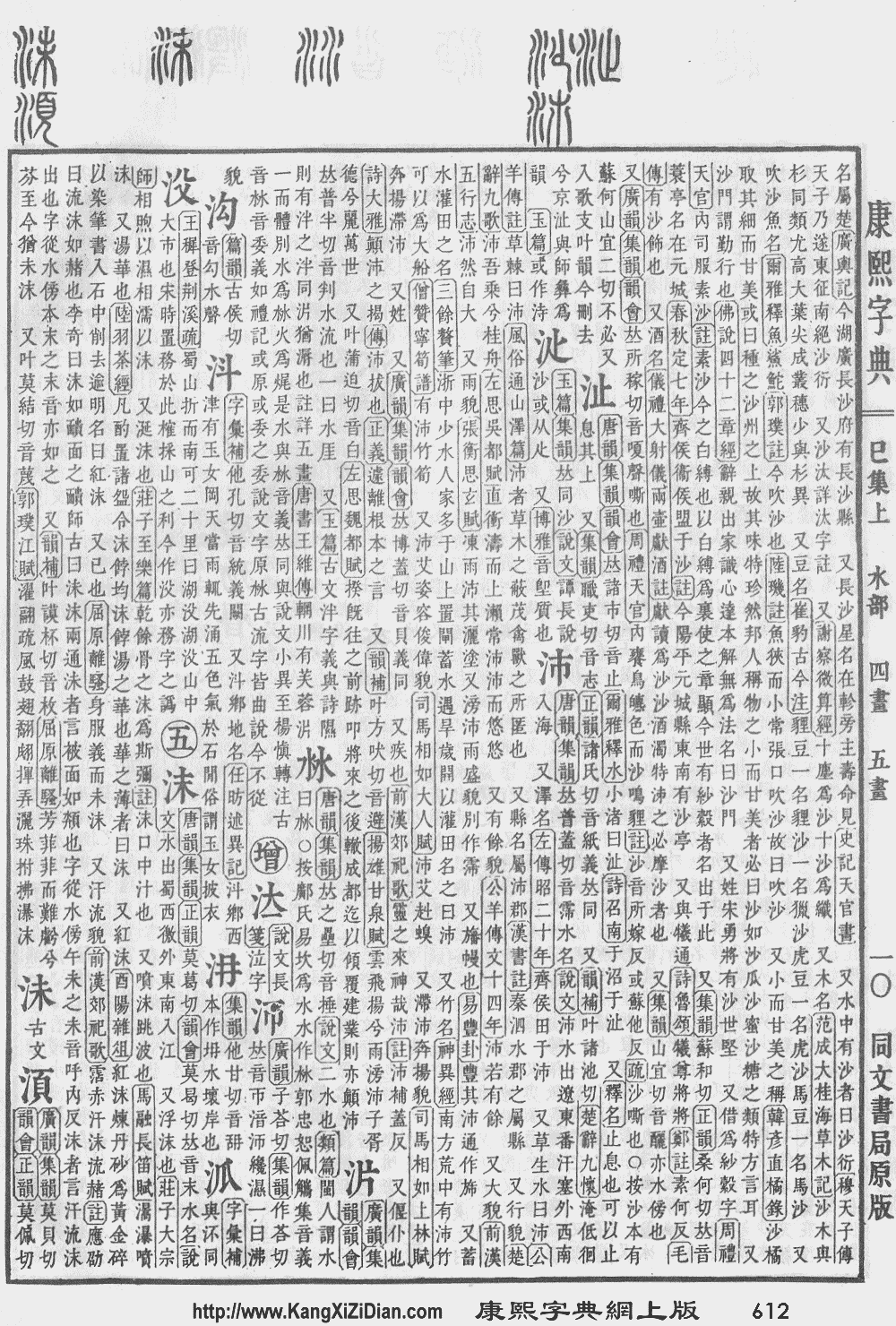
[edit]- Kangxi Dictionary: page 612, character 3
- Dai Kanwa Jiten: character 17216
- Dae Jaweon: page 1005, character 6
- Hanyu Da Zidian (first edition): volume 3, page 1559, character 3
- Unihan data for U+6C9B
Chinese
[edit]| simp. and trad. |
沛 | |
|---|---|---|
| alternative forms | 𥫴 㳈 伂 | |
Glyph origin
[edit]| Historical forms of the character 沛 | |
|---|---|
| Shuowen Jiezi (compiled in Han) | Liushutong (compiled in Ming) |
| Small seal script | Transcribed ancient scripts |
Phono-semantic compound (形聲 / 形声, OC *poːbs, *pʰoːbs): semantic 氵 (“water”) + phonetic 巿 (OC *pub).
Pronunciation
[edit]- Mandarin
- Cantonese (Jyutping): pui3
- Hakka
- Puxian Min (Pouseng Ping'ing): puei4
- Southern Min
- Mandarin
- (Standard Chinese)+
- Hanyu Pinyin: pèi
- Zhuyin: ㄆㄟˋ
- Tongyong Pinyin: pèi
- Wade–Giles: pʻei4
- Yale: pèi
- Gwoyeu Romatzyh: pey
- Palladius: пэй (pɛj)
- Sinological IPA (key): /pʰeɪ̯⁵¹/
- (Standard Chinese)+
- Cantonese
- (Standard Cantonese, Guangzhou–Hong Kong)
- Jyutping: pui3
- Yale: pui
- Cantonese Pinyin: pui3
- Guangdong Romanization: pui3
- Sinological IPA (key): /pʰuːi̯³³/
- (Standard Cantonese, Guangzhou–Hong Kong)
- Hakka
- (Sixian, incl. Miaoli and Neipu)
- Pha̍k-fa-sṳ: phi / phai
- Hakka Romanization System: pi / pai
- Hagfa Pinyim: pi4 / pai4
- Sinological IPA: /pʰi⁵⁵/, /pʰai̯⁵⁵/
- (Hailu, incl. Zhudong)
- Hakka Romanization System: poiˇ / paiˇ
- Sinological IPA: /pʰoi¹¹/, /pʰai¹¹/
- (Meixian)
- (Sixian, incl. Miaoli and Neipu)
- Puxian Min
- (Putian, Xianyou)
- Pouseng Ping'ing: puei4
- Báⁿ-uā-ci̍: po̍i
- Sinological IPA (key): /pʰuei⁴²/
- (Putian, Xianyou)
- Southern Min
- Middle Chinese: pajH, phajH
- Old Chinese
- (Zhengzhang): /*poːbs/, /*pʰoːbs/
Definitions
[edit]沛
Compounds
[edit]Japanese
[edit]Kanji
[edit]沛
- This term needs a translation to English. Please help out and add a translation, then remove the text
{{rfdef}}.
Readings
[edit]Korean
[edit]Hanja
[edit]- This term needs a translation to English. Please help out and add a translation, then remove the text
{{rfdef}}.
Vietnamese
[edit]Han character
[edit]沛: Hán Việt readings: phái[1][2][3][4][5][6], bái[2][3][4][5][7]
沛: Nôm readings: phải[1][2][3][5][6][7][8], phới[1][2][3][5][6][7][8], phai[1][2][3][5][6][8], phảy[3][5], phởi[5][6], pháy[5][7], phơi[2], phay[3], phây[3], phẩy[3]
References
[edit]- ↑ 1.0 1.1 1.2 1.3 Nguyễn (2014).
- ↑ 2.0 2.1 2.2 2.3 2.4 2.5 Nguyễn et al. (2009).
- ↑ 3.0 3.1 3.2 3.3 3.4 3.5 3.6 3.7 3.8 Trần (2004).
- ↑ 4.0 4.1 Thiều Chửu (1942).
- ↑ 5.0 5.1 5.2 5.3 5.4 5.5 5.6 5.7 Bonet (1899).
- ↑ 6.0 6.1 6.2 6.3 6.4 Génibrel (1898).
- ↑ 7.0 7.1 7.2 7.3 Hồ (1976).
- ↑ 8.0 8.1 8.2 Taberd & Pigneau de Béhaine (1838).
Categories:
- CJK Unified Ideographs block
- Han script characters
- Translingual lemmas
- Translingual symbols
- Han phono-semantic compounds
- Chinese lemmas
- Mandarin lemmas
- Cantonese lemmas
- Hakka lemmas
- Hokkien lemmas
- Teochew lemmas
- Puxian Min lemmas
- Middle Chinese lemmas
- Old Chinese lemmas
- Chinese hanzi
- Mandarin hanzi
- Cantonese hanzi
- Hakka hanzi
- Hokkien hanzi
- Teochew hanzi
- Puxian Min hanzi
- Middle Chinese hanzi
- Old Chinese hanzi
- Chinese adjectives
- Mandarin adjectives
- Cantonese adjectives
- Hakka adjectives
- Hokkien adjectives
- Teochew adjectives
- Puxian Min adjectives
- Middle Chinese adjectives
- Old Chinese adjectives
- Chinese nouns
- Mandarin nouns
- Cantonese nouns
- Hakka nouns
- Hokkien nouns
- Teochew nouns
- Puxian Min nouns
- Middle Chinese nouns
- Old Chinese nouns
- Chinese proper nouns
- Mandarin proper nouns
- Cantonese proper nouns
- Hakka proper nouns
- Hokkien proper nouns
- Teochew proper nouns
- Puxian Min proper nouns
- Middle Chinese proper nouns
- Old Chinese proper nouns
- Chinese terms with IPA pronunciation
- Chinese terms spelled with 沛
- Chinese literary terms
- Chinese surnames
- Japanese kanji
- Japanese hyōgai kanji
- Japanese kanji with goon reading はい
- Japanese kanji with kan'on reading はい
- Japanese kanji with kun reading さわ
- Japanese kanji with kun reading さかん
- Korean lemmas
- Korean hanja
- Vietnamese Chữ Hán
- Vietnamese lemmas
- Vietnamese Han characters
- Vietnamese Nom
- Vietnamese auxiliary verbs