肫
Jump to navigation
Jump to search
| ||||||||
Translingual[edit]
Han character[edit]
肫 (Kangxi radical 130, 肉+4, 8 strokes, cangjie input 月心山 (BPU), four-corner 75217, composition ⿰月屯)
Derived characters[edit]
References[edit]
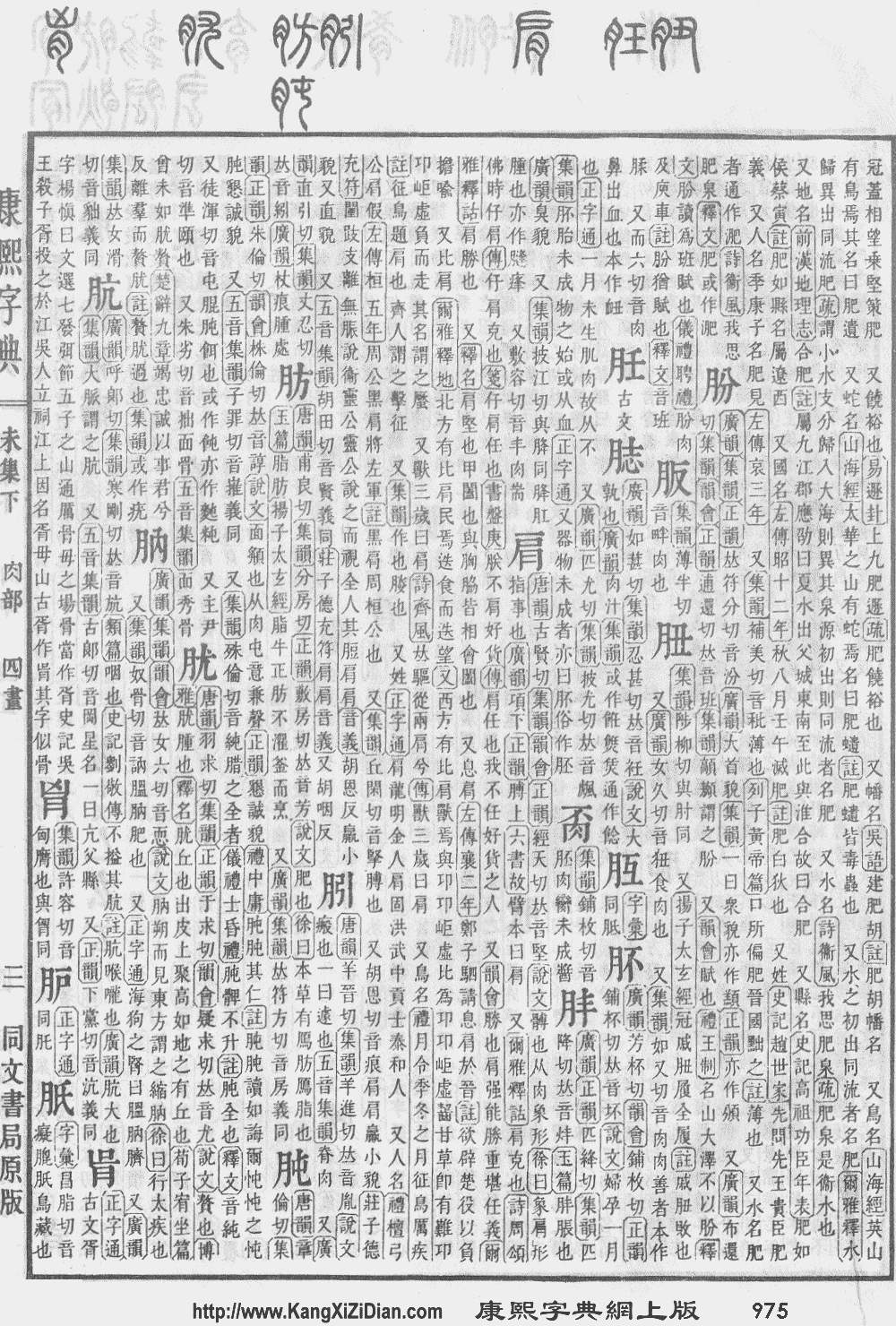
- Kangxi Dictionary: page 975, character 13
- Dai Kanwa Jiten: character 29303
- Dae Jaweon: page 1427, character 4
- Hanyu Da Zidian (first edition): volume 3, page 2047, character 10
- Unihan data for U+80AB
Chinese[edit]
| trad. | 肫 | |
|---|---|---|
| simp. # | 肫 | |
Glyph origin[edit]
| Historical forms of the character 肫 |
|---|
| Shuowen Jiezi (compiled in Han) |
| Small seal script |

|
| Old Chinese | |
|---|---|
| 躉 | *tuːnʔ |
| 窀 | *rduːn, *duːn, *tun |
| 沌 | *donʔ, *duːn, *duːnʔ |
| 盹 | *tuːnʔ, *tjuns |
| 頓 | *tuːns |
| 扽 | *tuːns |
| 黗 | *tʰuːn, *tʰuːnʔ |
| 吨 | *tʰuːnʔ |
| 屯 | *duːn, *tun |
| 飩 | *duːn |
| 豘 | *duːn |
| 軘 | *duːn |
| 坉 | *duːn |
| 邨 | *duːn, *stʰuːn |
| 忳 | *duːn |
| 芚 | *duːn |
| 庉 | *duːn, *duːnʔ |
| 囤 | *duːnʔ |
| 迍 | *tun |
| 杶 | *tʰun |
| 瑃 | *tʰun |
| 椿 | *tʰun |
| 偆 | *tʰunʔ, *tʰjunʔ |
| 肫 | *tjun |
| 訰 | *tjun, *tjuns |
| 純 | *tjunʔ, *djun |
| 春 | *tʰjun |
| 蠢 | *tʰjunʔ |
| 踳 | *tʰjunʔ |
| 惷 | *tʰjunʔ |
| 蒓 | *djun |
| 賰 | *hljunʔ |
| 鬊 | *hljuns |
Pronunciation 1[edit]
Definitions[edit]
肫
Compounds[edit]
Pronunciation 2[edit]
Definitions[edit]
肫
Compounds[edit]
Pronunciation 3[edit]
Definitions[edit]
肫
- Alternative form of 豚
Pronunciation 4[edit]
| For pronunciation and definitions of 肫 – see 䪼. (This character is a variant form of 䪼). |
References[edit]
- “肫”, in 漢語多功能字庫 (Multi-function Chinese Character Database)[1], 香港中文大學 (the Chinese University of Hong Kong), 2014–
Japanese[edit]
Kanji[edit]
肫
Readings[edit]
Korean[edit]
Hanja[edit]
肫 • (sun) (hangeul 순, revised sun, McCune–Reischauer sun, Yale swun)
Vietnamese[edit]
Han character[edit]
- This term needs a translation to English. Please help out and add a translation, then remove the text
{{rfdef}}.
Categories:
- CJK Unified Ideographs block
- Han script characters
- Translingual lemmas
- Translingual symbols
- Middle Chinese lemmas
- Old Chinese lemmas
- Chinese lemmas
- Mandarin lemmas
- Cantonese lemmas
- Teochew lemmas
- Chinese terms with IPA pronunciation
- Chinese Han characters
- Chinese terms with obsolete senses
- Chinese literary terms
- Chinese nouns
- Mandarin nouns
- Cantonese nouns
- Chinese variant forms
- Japanese Han characters
- Uncommon kanji
- Japanese kanji with on reading しゅん
- Japanese kanji with on reading さい
- Japanese kanji with on reading すい
- Japanese kanji with kun reading ほおぼね
- Korean lemmas
- Korean Han characters
- Vietnamese lemmas
- Vietnamese Han characters