蓑
Appearance
See also: 簑
| ||||||||
Translingual
[edit]Han character
[edit]蓑 (Kangxi radical 140, 艸+10, 16 strokes, Cangjie input 廿卜田女 (TYWV), four-corner 44732, composition ⿱艹衰)
References
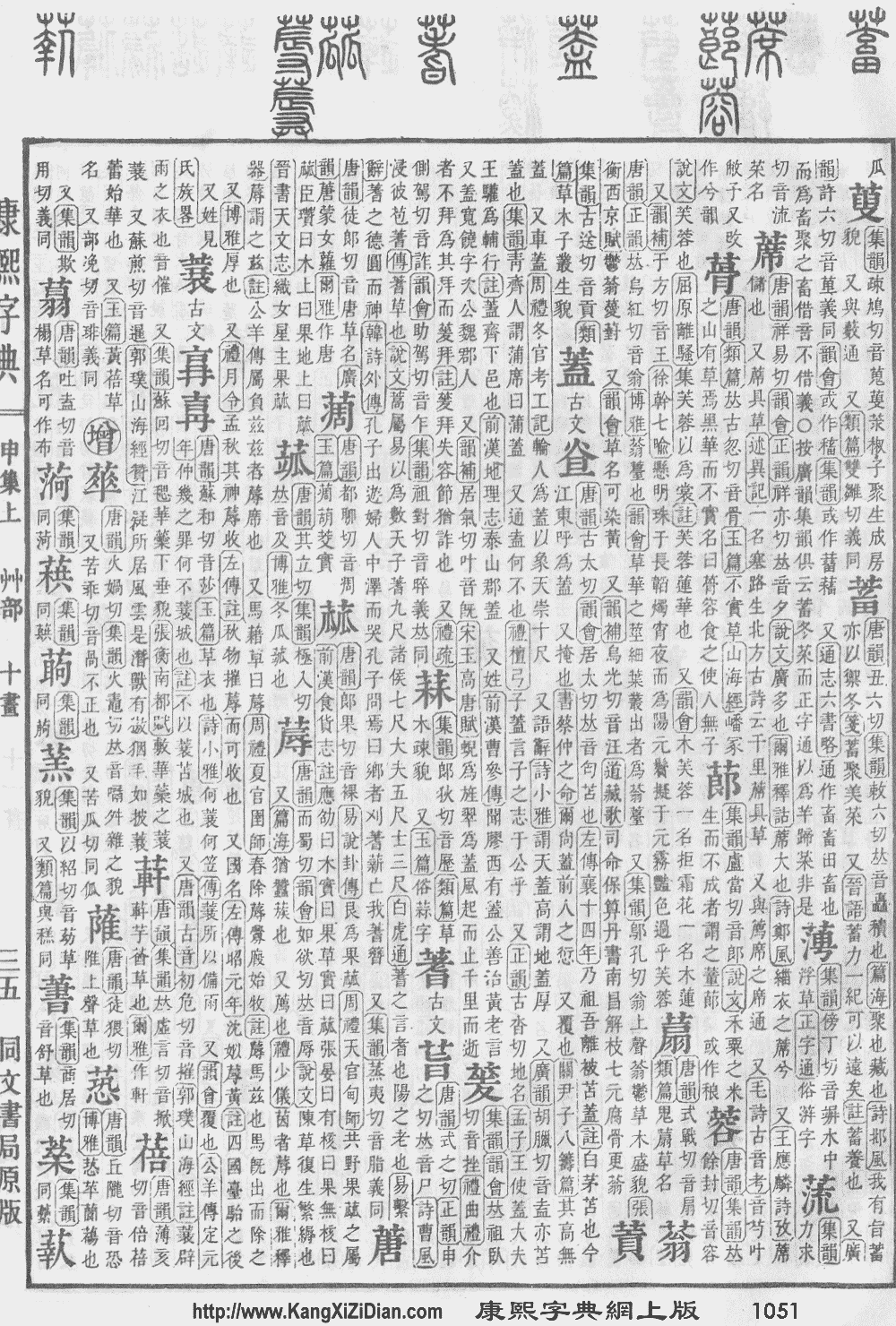
[edit]- Kangxi Dictionary: page 1051, character 23
- Dai Kanwa Jiten: character 31661
- Dae Jaweon: page 1513, character 15
- Hanyu Da Zidian (first edition): volume 5, page 3267, character 14
- Unihan data for U+84D1
Chinese
[edit]| trad. | 蓑 | |
|---|---|---|
| simp. # | 蓑 | |
| alternative forms | 𠱗 𡔤 衰 | |
Glyph origin
[edit]Etymology 1
[edit]Pronunciation
[edit]- Mandarin
- Cantonese (Jyutping): so1
- Puxian Min (Pouseng Ping'ing): sui1 / suei1
- Southern Min (Hokkien, POJ): sui
- Wu (Shanghai, Wugniu): 1su
- Mandarin
- (Standard Chinese)+
- Hanyu Pinyin: suō
- Zhuyin: ㄙㄨㄛ
- Tongyong Pinyin: suo
- Wade–Giles: so1
- Yale: swō
- Gwoyeu Romatzyh: suo
- Palladius: со (so)
- Sinological IPA (key): /su̯ɔ⁵⁵/
- (Standard Chinese)+
- Cantonese
- (Standard Cantonese, Guangzhou–Hong Kong)
- Jyutping: so1
- Yale: sō
- Cantonese Pinyin: so1
- Guangdong Romanization: so1
- Sinological IPA (key): /sɔː⁵⁵/
- (Standard Cantonese, Guangzhou–Hong Kong)
- Puxian Min
- (Putian)
- Pouseng Ping'ing: sui1
- Báⁿ-uā-ci̍: sui
- Sinological IPA (key): /ɬui⁵³³/
- (Xianyou)
- Pouseng Ping'ing: sui1
- Sinological IPA (key): /ɬui⁵⁴⁴/
- (Putian)
- Pouseng Ping'ing: suei1
- Báⁿ-uā-ci̍: soi
- Sinological IPA (key): /ɬuei⁵³³/
- (Xianyou)
- Pouseng Ping'ing: suei1
- Sinological IPA (key): /ɬuei⁵⁴⁴/
- (Putian)
Note:
- sueii1 - vernacular;
- suei1 - literary.
- Middle Chinese: swa
- Old Chinese
- (Baxter–Sagart): /*[s]ˤoj/
- (Zhengzhang): /*sloːl/
Definitions
[edit]蓑
Synonyms
[edit]Compounds
[edit]Descendants
[edit]- → Vietnamese: tơi
Etymology 2
[edit]Pronunciation
[edit]- Mandarin
- (Standard Chinese)+
- Hanyu Pinyin: suī
- Zhuyin: ㄙㄨㄟ
- Tongyong Pinyin: suei
- Wade–Giles: sui1
- Yale: swēi
- Gwoyeu Romatzyh: suei
- Palladius: суй (suj)
- Sinological IPA (key): /su̯eɪ̯⁵⁵/
- (Standard Chinese)+
- Cantonese
- (Standard Cantonese, Guangzhou–Hong Kong)
- Jyutping: seoi1
- Yale: sēui
- Cantonese Pinyin: soey1
- Guangdong Romanization: sêu1
- Sinological IPA (key): /sɵy̯⁵⁵/
- (Standard Cantonese, Guangzhou–Hong Kong)
- Southern Min
- Middle Chinese: swoj
- Old Chinese
- (Zhengzhang): /*sluːl/
Definitions
[edit]蓑
- used in 蓑蓑 (“sag; droop”)
References
[edit]- “蓑”, in 漢語多功能字庫 (Multi-function Chinese Character Database)[1], 香港中文大學 (the Chinese University of Hong Kong), 2014–
- 李如龙 [Li, Ru-long]; 刘福铸 [Liu, Fu-zhu]; 吴华英 [Wu, Hua-ying]; 黄国城 [Huang, Guo-cheng] (2019), “蓑”, in 莆仙方言调查报告 [Investigation Report on Puxian Dialect] (overall work in Mandarin and Puxian Min), Xiamen University Press, →ISBN, page 128.
Japanese
[edit]| Shinjitai | 蓑 | |
| Kyūjitai [1] |
蓑󠄂 蓑+ 󠄂?(Hanyo-Denshi) (Moji_Joho) |
|
| The displayed kanji may be different from the image due to your environment. See here for details. | ||
Kanji
[edit]蓑
Readings
[edit]From Middle Chinese 蓑 (MC swa):
From Middle Chinese 蓑 (MC swoj):
From native Japanese roots:
Etymology 1
[edit]| Kanji in this term |
|---|
| 蓑 |
| みの Jinmeiyō |
| kun'yomi |
| Alternative spelling |
|---|
| 簑 |
From Old Japanese 蓑 (mi₁no₂), ultimately from Proto-Japonic *minə. The word is presumably attested in Old Japanese phonetically in Shōsōin documents, where "母宇治部弥乃売" is lined up with "妻物部小蓑売".[2]
Alternative forms
[edit]- にの (nino, Akita, Awaji, Tottori, Shimane, Okayama, Suō Ōshima, Ehime Shūsō, Iyo Ōmishima, Setouchi)[3]
- ねの (neno, Shimane)[3]
- みぬ (minu, Iwate, Yamagata, Fukushima, Ibaraki)[3]
- みぬ (minu, Iwate, Akita, Yamagata)[3]
- みんこ (minko, Tsugaru (1963))[3]
Pronunciation
[edit]- Historical evolution of the Kyoto pitch accent
- (the Heian period) LH
- (the Kamakura period) LH
- ※ H for high and flat syllables (◌́), L for low and flat syllables (◌̀), F for high-to-low syllables (◌̂), R for low-to-high syllables (◌̌).
※ References: [3]
Noun
[edit]- [from 702] a raincoat made from thatches, sedges, or straw, and wrapped around the shoulder
- [from 1797] a hairpiece
Derived terms
[edit]Etymology 2
[edit]| Kanji in this term |
|---|
| 蓑 |
| Jinmeiyō |
From 蓑 (mino). Attested in the Shinsen Jikyō (898-901).
Noun
[edit]- [from early 900s] (hapax legomenon, obsolete or dialect) synonym of 蓑 (mino)
References
[edit]- ^ Haga, Gōtarō (1914), 漢和大辞書 [The Great Kanji-Japanese Dictionary] (in Japanese), Fourth edition, Tōkyō: Kōbunsha, , page 1847 (paper), page 975 (digital)
- ^ Omodaka, Hisataka (1967), 時代別国語大辞典 上代編 [The dictionary of historical Japanese: Old Japanese] (in Japanese), Tōkyō: Sanseidō, →ISBN, page 714
- ↑ 3.0 3.1 3.2 3.3 3.4 3.5 3.6 3.7 Nihon Kokugo Daijiten Dai-ni-han Henshū I'inkai (日本国語大辞典第二版編集委員会) (2001-2002), 日本国語大辞典 第二版 [Unabridged Japanese Dictionary: Second Edition], Tokyo (東京都): Shōgakukan (小学館), →ISBN
- ^ Matsumura, Akira, editor (2019), 大辞林 [Daijirin] (in Japanese), Fourth edition, Tokyo: Sanseidō, →ISBN
- ^ Yamada, Tadao et al., editors (2020), 新明解国語辞典 [Shin Meikai Kokugo Jiten] (in Japanese), Eighth edition, Tokyo: Sanseidō, →ISBN
- ^ NHK Broadcasting Culture Research Institute, editor (1998), NHK日本語発音アクセント辞典 [NHK Japanese Pronunciation Accent Dictionary] (in Japanese), Tokyo: NHK Publishing, Inc., →ISBN
- “▲蓑”, in 漢字ぺディア [Kanjipedia][2] (in Japanese), The Japan Kanji Aptitude Testing Foundation, 2015–2026
Korean
[edit]Hanja
[edit]蓑 • (sa) (hangeul 사, revised sa, McCune–Reischauer sa, Yale sa)
- This term needs a translation to English. Please help out and add a translation, then remove the text
{{rfdef}}.
Vietnamese
[edit]Han character
[edit]蓑: Hán Nôm readings: thoa, soa
- This term needs a translation to English. Please help out and add a translation, then remove the text
{{rfdef}}.
Categories:
- CJK Unified Ideographs block
- Han script characters
- Translingual lemmas
- Translingual symbols
- Chinese lemmas
- Mandarin lemmas
- Cantonese lemmas
- Hokkien lemmas
- Puxian Min lemmas
- Wu lemmas
- Middle Chinese lemmas
- Old Chinese lemmas
- Chinese hanzi
- Mandarin hanzi
- Cantonese hanzi
- Hokkien hanzi
- Puxian Min hanzi
- Wu hanzi
- Middle Chinese hanzi
- Old Chinese hanzi
- Chinese nouns
- Mandarin nouns
- Cantonese nouns
- Hokkien nouns
- Puxian Min nouns
- Wu nouns
- Middle Chinese nouns
- Old Chinese nouns
- Chinese terms with IPA pronunciation
- Chinese terms spelled with 蓑
- Chinese verbs
- Mandarin verbs
- Cantonese verbs
- Hokkien verbs
- Middle Chinese verbs
- Old Chinese verbs
- Japanese kanji
- Japanese jinmeiyō kanji
- Japanese terms derived from Middle Chinese
- Japanese kanji with goon reading さ
- Japanese kanji with kan'on reading さ
- Japanese kanji with goon reading せ
- Japanese kanji with kan'on reading さい
- Japanese kanji with kun reading みの
- Japanese kanji with nanori reading みの
- Japanese terms spelled with 蓑 read as みの
- Japanese terms read with kun'yomi
- Japanese terms inherited from Old Japanese
- Japanese terms derived from Old Japanese
- Japanese terms inherited from Proto-Japonic
- Japanese terms derived from Proto-Japonic
- Japanese terms with IPA pronunciation
- Japanese terms with Atamadaka pitch accent (Tōkyō)
- Japanese terms with IPA pronunciation with pitch accent
- Japanese lemmas
- Japanese nouns
- Japanese terms with multiple readings
- Japanese terms spelled with jinmeiyō kanji
- Japanese terms with 1 kanji
- Japanese terms spelled with 蓑
- Japanese single-kanji terms
- Japanese hapax legomena
- Japanese terms with obsolete senses
- Japanese dialectal terms
- ja:Coats
- Korean lemmas
- Korean hanja
- Vietnamese lemmas
- Vietnamese Han characters
