negro
English
[edit]
Etymology
[edit]Borrowed from Spanish and Portuguese negro (“black”), from Latin nigrum (“shiny black”), of uncertain origin,[1] but possibly from Proto-Indo-European *negʷ- (“bare; night”).[2] Doublet of noir.
Pronunciation
[edit]- (General American) IPA(key): /ˈniɡɹoʊ/
- (Southern US, dated) IPA(key): /ˈnɪɡɹə/
- (Received Pronunciation) IPA(key): /ˈniːɡɹəʊ/
Audio (Southern England): (file)
Adjective
[edit]negro (not comparable)
- (dated, offensive) Relating to a black ethnicity.
- 1963 April, “Anti-bias Coffee Klatsch: Windy City Interfaith Project Fights Bigotry with Coffee, Cookies and Conversation”, in Ebony, volume XVIII, number 6, Chicago, Ill.: Johnson Publishing Company, →ISSN, page 67:
- Recently, on a wintry Sunday, some 2,500 white Chicago area residents embarked on a strange safari across the city, determined to do what most of them had never done before—visit a Negro home. Eager to purge themselves of ignorance about the city's "other half," they were participants in Interracial Home Visit Day, a "Coffee Klatsch" co-sponsored by local Catholic, Jewish and Protestant groups in an effort to eliminate racial bigotry and hate.
- (dated, now offensive) Black or dark brown in color.
Usage notes
[edit]As the primary term for persons of Black African ancestry during the 18th, 19th, and early 20th century, negro is both less immediately offensive than various other slurs and more connected with racist pseudoscientific work, which may be perceived as more racist and offensive than the slur itself. W. E. B. Du Bois in particular advocated strenuously for the use of capitalized Negro in preference to colored/coloured, which became less common by the 1920s, but in the United States the word negro now is considered acceptable only in polite historical contexts or in specific proper names such as the United Negro College Fund. Black and black (which replaced negro as part of the Black Power and black pride movements from 1966 onward) or the more recent African-American (from the 1980s) are the preferred alternatives, with neither being categorically preferred in all contexts. As a self-designation, negro was still preferred on average as late as 1968, while black became clearly more common by 1974. Usage in publications followed.[3] See also discussion on this topic at Wikipedia.
Related terms
[edit]Translations
[edit]- The translations below need to be checked and inserted above into the appropriate translation tables. See instructions at Wiktionary:Entry layout § Translations.
Noun
[edit]negro (plural negroes or negros)
- (dated, now offensive) A person of Black African ancestry.
- 1867, Mayne Reid, Quadrupeds: what they are and where found, page 141:
- The negroes believe that its presence has a sanitary effect upon their cattle […]
- 1936 June 30, Margaret Mitchell, Gone with the Wind, New York, N.Y.: The Macmillan Company, →OCLC; republished New York, N.Y.: The Macmillan Company, 1944, →OCLC, part IV, page 675:
- What Peter said was true but she hated to hear it from a negro and a family negro, too. Not to stand high in the opinion of one's servants was a humiliating a thing as could happen to a Southerner.
- 2003, Benjamin Hawkins, Howard Thomas Foster, The Collected Works of Benjamin Hawkins, 1796–1810, page 259:
- There were two negros who were guilty of thieving; he went and had them both shot, and gave notice that he would put all to death who kept disturbing the property of the white people, and kept confusion in their land.
- 2010, Ryan Acheson, Chalk, page 68:
- His parents had always said that the area he grew up in had been a nice place to live before 'those Negros invaded'.
Usage notes
[edit]Synonyms
[edit](noun):
(adjective and noun):
- black, Black
- African-American (nonstandard, US)
Hypernyms
[edit](noun):
Hyponyms
[edit](adjective and noun):
- Afro-American
- African-American (in the proper sense)
- negress
Derived terms
[edit]Translations
[edit]
|
See also
[edit]References
[edit]- ^ De Vaan, Michiel (2008) Etymological Dictionary of Latin and the other Italic Languages (Leiden Indo-European Etymological Dictionary Series; 7)[1], Leiden, Boston: Brill, →ISBN
- ^ Watkins, Calvert, editor (2000), The American Heritage Dictionary of Indo-European Roots, 2nd edition, Boston (Mass.): Houghton Mifflin, →ISBN
- ^ Palmer, Brian (2010 January 11) “When Did the Word Negro Become Taboo?”, in Slate[2], Washington, DC: The Slate Group: “The turning point came when Stokely Carmichael coined the phrase black power at a 1966 rally in Mississippi.”
Anagrams
[edit]Aragonese
[edit]Alternative forms
[edit]Etymology
[edit]Akin to Spanish negro, from Latin nigrum.
Pronunciation
[edit]Adjective
[edit]negro (feminine negra, masculine plural negros, feminine plural negras)
- black (color)
References
[edit]- “negro”, in Aragonario, diccionario castellano–aragonés (in Spanish)
- Bal Palazios, Santiago (2002) “negro”, in Dizionario breu de a luenga aragonesa, Zaragoza, →ISBN
Asturian
[edit]Pronunciation
[edit]Adjective
[edit]negro
Cebuano
[edit]Etymology
[edit]Pronunciation
[edit]Noun
[edit]negro (feminine negra)
- (offensive, vulgar) a dark-skinned person
- (offensive, ethnic slur, vulgar) a person of African descent; a black person
Esperanto
[edit]Pronunciation
[edit]Audio: (file)
Noun
[edit]negro (accusative singular negron, plural negroj, accusative plural negrojn)
- (offensive, ethnic slur) a Negro
- Hyponym: negrino
- 1897 June, A. Kofman, “El Heine: La sklavoŝipo”, in Lingvo Internacia, volume 2, numbers 6-7, page 89:
- “Ses centojn da negroj mi ĉe Senegal
Akiris je prezo profita,
Malmola viando, simila al ŝton’,
La membroj — el ŝtalo forĝita.”- “600 negros at Senegal I acquired at a profitable price, hard meat, like stone, the members—from steel forged.”
Derived terms
[edit]Galician
[edit]Etymology
[edit]From Old Galician-Portuguese negro, from Latin nigrum.
Pronunciation
[edit]
Adjective
[edit]negro (feminine negra, masculine plural negros, feminine plural negras)
- black, dark colored
- Synonym: preto
- 1995, Xesús Manuel Valcárcel, O capitán lobo negro:
- O vello leñador, sabio e taimado, observaba a acción distante, [...], atento unicamente a rafar o pan negro na cunca de caldo morno.
- The old lumberjack, wise and crafty, watched the distant commotion, ..., focused only on crumbling the black bread in the bowl with warm broth.
- 1973, X. Gayoso Verga, Coa nosa xente:
- Matías e mais eu estabamos sentados acarón da lareira, eu cáseque detrás do caldeiro onde se coce a pitanza dos cochos; o cadeiro é grande e negro [...]
- Matias and I were seated in front of the fireplace, with me almost behind the cauldron where we prepare the feed for the pigs; the cauldron is big and black ...
- (figurative) sad, unfortunate, ill-fated
- 1995, Xesús Manuel Valcárcel, O capitán lobo negro:
- Unha princesa enfeitizada que os malos designios e o negro destino converteron en mestra de escola [...]
- A cursed princess that was turned into a [mere] school teacher by vile plans and the unfortunate destiny ...
Derived terms
[edit]Noun
[edit]negro m (plural negros, feminine negra, feminine plural negras)
Usage notes
[edit]This last usage is, a priori, not pejorative; still, periphrases as persoa de cor are usually preferred in formal context, if needed at all.
See also
[edit]| branco | gris | negro, preto |
| vermello; carmín | laranxa; castaño, marrón | amarelo; crema |
| verde lima | verde | menta; verde escuro |
| ciano; azul verdoso | cerúleo | azul |
| violeta; anil | maxenta; púrpura | rosa |
References
[edit]- “negro”, in Dicionario da Real Academia Galega (in Galician), A Coruña: Royal Galician Academy, 2012–2024
- Antón Luís Santamarina Fernández, editor (2006–2013), “negro”, in Dicionario de Dicionarios da lingua galega [Dictionary of Dictionaries of the Galician language] (in Galician), Santiago de Compostela: Instituto da Lingua Galega
- Antón Luís Santamarina Fernández, Ernesto Xosé González Seoane, María Álvarez de la Granja, editors (2003–2018), “negro”, in Tesouro informatizado da lingua galega (in Galician), Santiago de Compostela: Instituto da Lingua Galega
- Rosario Álvarez Blanco, editor (2014–2024), “negro”, in Tesouro do léxico patrimonial galego e portugués (in Galician), Santiago de Compostela: Instituto da Lingua Galega, →ISSN
Interlingua
[edit]Noun
[edit]negro (plural negros)
Related terms
[edit]Italian
[edit]Alternative forms
[edit]Etymology
[edit]From Latin nigrum. The offensive senses derive from the anglophone usage of Spanish negro.
Pronunciation
[edit]Adjective
[edit]negro (feminine negra, masculine plural negri, feminine plural negre)
Noun
[edit]negro m (plural negri)
Related terms
[edit]Anagrams
[edit]Ladino
[edit]Etymology
[edit]From Old Spanish negro (“black”). Cognate with Spanish negro.
Adjective
[edit]negro (Latin spelling)
- bad
- Synonym: malo
- 1979, Kamelia Shahar, “La verdadera felisidad”, in Aki Yerushalayim, number 1, page 5:
- Eliau Anavi ke lo estava mirando d'enfrente se aserko de el i le disho: Dime ombre, deke estas de negra umor ?
- The prophet Elijah, who was watching him from across, approached him and said: Tell me, man, why are you in a bad mood?
- 2018 November 21, Silvyo OVADYA, “Un fotografo modesto ma korajoso”, in Şalom[3]:
- Ma estos diyas, la mas grande partida de los filmos negativos estan en una negra situasyon en la umidita de un vyejo apartamento.
- But these days, the majority of the film negatives are in a bad situation in the dampness of an old apartment.
See also
[edit]- preto (“black”)
Lombard
[edit]Etymology
[edit]Adjective
[edit]negro m (plural negri)
Old Galician-Portuguese
[edit]Etymology
[edit]Pronunciation
[edit]Adjective
[edit]negro m (plural negros, feminine negra, feminine plural negras)
- black
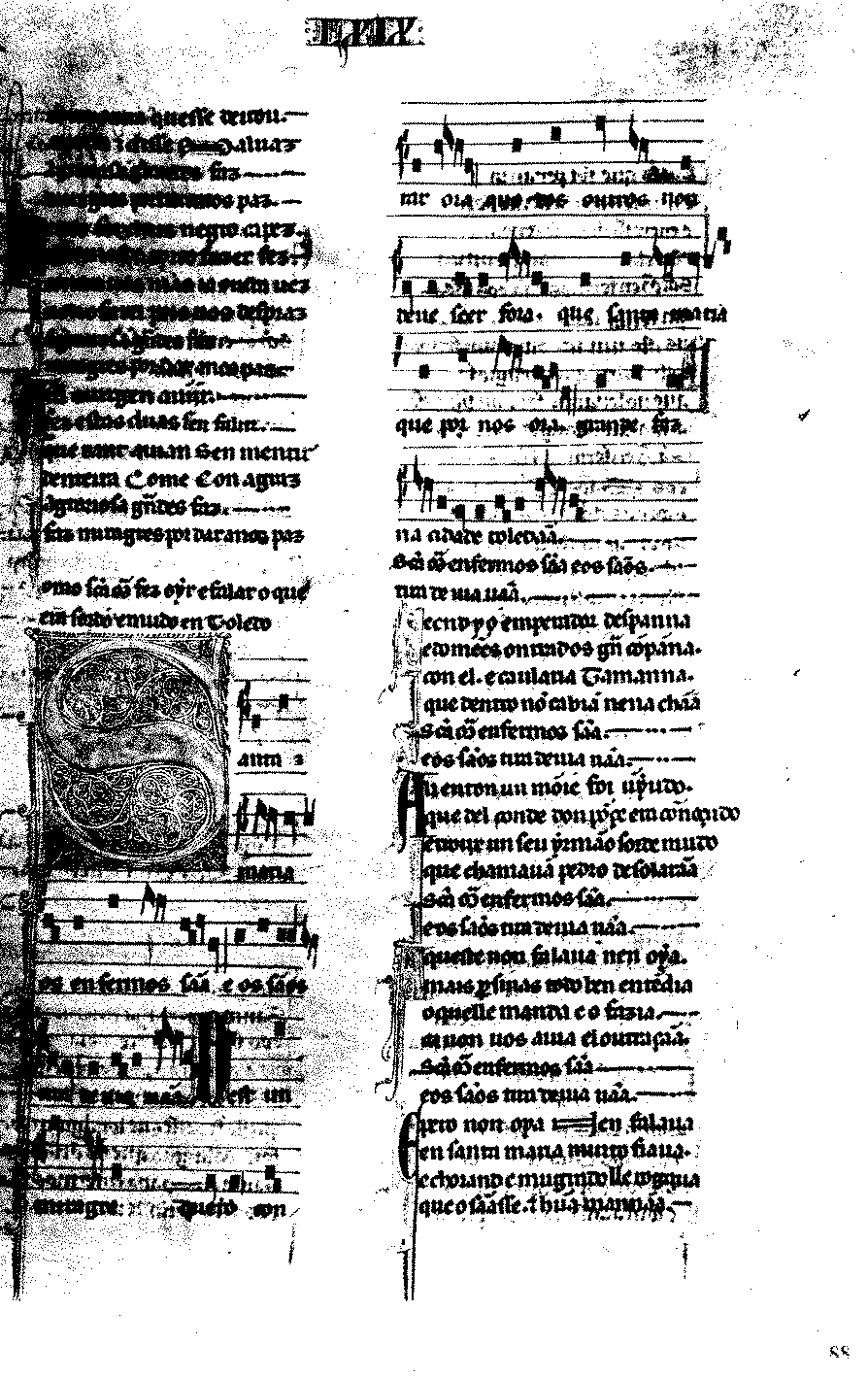
- 13th century CE, Alfonso X of Castile, Cantigas de Santa Maria, Códice de los músicos, cantiga 68 (facsimile):
- […] chus negro ca pez.
- […] blacker than pitch.
- […] chus negro ca pez.
- 1281, Clarinda de Azevedo Maia (ed.), História do galego-português. Estado linguístico da Galiza e do Noroeste de Portugal do século XII ao século XVI (com referência á situação do galego moderno). Coimbra: I.N.I.C., page 133:
- Mando o meu manto de broneta negra a Eluira Ffernandez de Uilar
- I bequeath my robe of black brunet cloth to Elvira Fernandez de Vilar
- Mando o meu manto de broneta negra a Eluira Ffernandez de Uilar
- Synonym: preto
- (figurative) sad, unfortunate, ill-fated
- 1370, R. Lorenzo, editor, Crónica troiana, A Coruña: Fundación Barrié, page 467:
- seméllame, fillo, que ora son cõpridos de tj os soños que eu sonaua et as uisiões que uij́a et as coytas grãdes que sofría ẽno coraçõ, que cada día se me fazía negro et triste.
- it seems to me, my son, that now you have accomplished the dreams I dreamed and the visions I envisioned and the big sorrows I suffered in my heart, that each day was black and sad to me
- 1370, R. Lorenzo, editor, Crónica troiana, A Coruña: Fundación Barrié, page 742:
- en negra ora naçí
- At an unfortunate hour I was born
Descendants
[edit]See also
[edit]| branco, blanco, alvo | gris | negro, preto |
| vermelho | castanho | amarelo |
| verde | ||
| azur | ||
| cardẽo | rosa |
References
[edit]- Ernesto Xosé González Seoane, María Álvarez de la Granja, Ana Isabel Boullón Agrelo (2006–2022) “negro”, in Dicionario de Dicionarios do galego medieval (in Galician), Santiago de Compostela: Instituto da Lingua Galega
- Xavier Varela Barreiro, Xavier Gómez Guinovart (2006–2018) “negr”, in Corpus Xelmírez - Corpus lingüístico da Galicia medieval (in Galician), Santiago de Compostela: ILG
Portuguese
[edit]

Etymology
[edit]From Old Galician-Portuguese negro, from Latin nigrum.
Pronunciation
[edit]
- Hyphenation: ne‧gro
Noun
[edit]negro m (plural negros, feminine negra, feminine plural negras)
- black (the darkest colour)
- (possibly offensive) black; negro (dark-skinned person)
- Synonyms: (formal) afrodescendente, preto, (Brazil, colloquial) nego
- 2018, “Minotauro de Borges”, performed by Baco Exu do Blues:
- Pisando no céu enquanto eles se perguntam
Como esse negro não cai
Dizem que o céu é o limite
Eles se perguntam
Porque esse negro não cai- Stepping on the sky while they ask
How this nigga don't fall
They say the sky is the limit
They ask themselves
Why this nigga don't fall
- Stepping on the sky while they ask
Adjective
[edit]negro (feminine negra, masculine plural negros, feminine plural negras, comparable, comparative mais negro, superlative o mais negro or negríssimo, diminutive negrinho, augmentative negrão)
- (somewhat formal) black in colour
- Synonym: preto (colloquial)
- black; dark-skinned
- Synonym: preto
- (literary) dark (associated with evil)
- Cavaleiro negro. ― Dark knight.
Derived terms
[edit]Related terms
[edit]Descendants
[edit]- Papiamentu: negru
Spanish
[edit]Etymology
[edit]Pronunciation
[edit]Noun
[edit]negro m (plural negros)
Noun
[edit]negro m (plural negros, feminine negra, feminine plural negras)
- a black person; a person of black African descent
- a member of any typically dark-skinned people
- ghost writer
- 2016 April 18, “Mario Vaquerizo, fan del 15M y de Federico Jiménez Losantos”, in El Confidencial[4]:
- Es improbable, casi imposible, que haya sido escrito por un negro, al estilo de Belén Esteban, David Beckham y Ana Rosa Quintana.
- It's unlikely, almost impossible, that it was written by a ghost writer, in the style of Belén Esteban, David Beckham and Ana Rosa Quintana.
Adjective
[edit]negro (feminine negra, masculine plural negros, feminine plural negras)
- black (absorbing all light and reflecting none; dark and hueless)
- Antonym: blanco
- black (of or relating to any of various ethnic groups having dark pigmentation of the skin)
- Synonym: prieto (Louisiana)
- dirty
- sad
- clandestine
- Synonym: clandestino
- (Spain) angry
- Synonym: rabioso
- está negro ― he's in a rage
- (Latin America) ( mi ~) my darling, my honey
Derived terms
[edit]- aceituna negra
- agua negra
- aguilucho negro
- agujero negro
- albinegro
- algarrobo negro
- aliso negro
- arroz negro
- beleño negro
- beso negro
- bestia negra
- bilis negra
- boda de negros
- bolsa negra
- buitre negro
- caimán negro
- caja negra
- camarina negra
- carbonero cresta negra
- carinegro
- carpintero negro
- chacal de lomo negro
- cigüeña negra
- cine negro
- cisne negro
- colinegro
- como un negro
- cuerpo negro
- dejar negro
- dinero negro
- duraznillo negro
- eléboro negro
- en blanco y negro
- en negro
- enana negra
- gaviotín negro
- gordolobo negro
- grabado en negro
- grosella negra
- hoyo negro
- humor negro
- lechuza negra
- Leyenda Negra
- lista negra
- luz negra
- magia negra
- maíz negro
- mano negra
- mar Negro
- marea negra
- mercado negro
- merienda de negros
- Montenegro
- negro como un zapato
- negro de humo
- negro de la uña
- negro sobre blanco
- novela negra
- nueza negra
- oreja de negro
- oro negro
- oso negro
- oveja negra
- pantera negra
- perdiz negra
- peste negra
- pimienta negra
- pino negro
- pito negro
- poner negro
- pozo negro
- punto negro
- rama negra
- relleno negro
- renegrido
- rinoceronte negro
- sacar lo que el negro del sermón
- sangre negra
- sopa negra
- té negro
- tierra negra
- trabajar como un negro
- trabajo en negro
- trompeta negra
- trompetilla negra
- verdinegro
- verlo todo negro
- viuda negra
- zapote negro
Descendants
[edit]- → English: negro (or via Portuguese), nigro (cross-loan with Latin niger, obsolete), nigra [1900s]
- → French: nègre
- → French: négro
See also
[edit]| blanco | gris | negro |
| rojo; carmín, carmesí | naranja, anaranjado; marrón | amarillo; crema |
| lima | verde | menta |
| cian, turquesa; azul-petróleo | celeste, cerúleo | azul |
| violeta; añil, índigo | magenta; morado, púrpura | rosa, rosado |
Further reading
[edit]- “negro”, in Diccionario de la lengua española, Vigésima tercera edición, Real Academia Española, 2014
Tagalog
[edit]Etymology
[edit]Borrowed from Spanish negro, from Latin nigrum.
Pronunciation
[edit]- (Standard Tagalog) IPA(key): /ˈneɡɾo/ [ˈn̪ɛː.ɡɾo]
- Rhymes: -eɡɾo
- Syllabification: ne‧gro
Adjective
[edit]negro (Baybayin spelling ᜈᜒᜄ᜔ᜇᜓ)
- (colloquial, usually derogatory, potentially offensive) having dark pigmentation of the skin
Noun
[edit]negro (feminine negra, Baybayin spelling ᜈᜒᜄ᜔ᜇᜓ)
- (colloquial, usually derogatory, offensive, ethnic slur) one with dark pigmentation of the skin, such as those of African descent with sub-Saharan origin
- (archaic, rare) black (the color perceived in the absence of light)
Usage notes
[edit]- When heard by African Americans visiting or living in the Philippines, the term is often considered offensive due to its derogatory sense in English and associations with the term, nigger, in English, although the term is not used very often due to the meager and sparse population of those of sub-Saharan origin in the Philippines.
Derived terms
[edit]Related terms
[edit]Further reading
[edit]- “negro”, in Pambansang Diksiyonaryo | Diksiyonaryo.ph, Manila, 2018
Anagrams
[edit]Venetian
[edit]Etymology
[edit]Adjective
[edit]negro
- English terms borrowed from Spanish
- English terms borrowed from Portuguese
- English terms derived from Spanish
- English terms derived from Portuguese
- English terms derived from Latin
- English terms derived from Proto-Indo-European
- English doublets
- English 2-syllable words
- English terms with IPA pronunciation
- English terms with audio links
- English lemmas
- English adjectives
- English uncomparable adjectives
- English dated terms
- English offensive terms
- English terms with quotations
- English nouns
- English countable nouns
- en:Colors
- Aragonese terms inherited from Latin
- Aragonese terms derived from Latin
- Aragonese terms with IPA pronunciation
- Rhymes:Aragonese/eɡɾo
- Rhymes:Aragonese/eɡɾo/2 syllables
- Aragonese lemmas
- Aragonese adjectives
- an:Colors
- Asturian terms with IPA pronunciation
- Asturian non-lemma forms
- Asturian adjective forms
- Cebuano terms borrowed from Spanish
- Cebuano terms derived from Spanish
- Cebuano terms with IPA pronunciation
- Cebuano lemmas
- Cebuano nouns
- Cebuano offensive terms
- Cebuano vulgarities
- Cebuano ethnic slurs
- Esperanto terms with IPA pronunciation
- Rhymes:Esperanto/eɡro
- Esperanto terms with audio links
- Esperanto lemmas
- Esperanto nouns
- Esperanto offensive terms
- Esperanto ethnic slurs
- Esperanto terms with quotations
- eo:Ethnicity
- Galician terms inherited from Old Galician-Portuguese
- Galician terms derived from Old Galician-Portuguese
- Galician terms inherited from Latin
- Galician terms derived from Latin
- Galician terms with IPA pronunciation
- Rhymes:Galician/eɡɾo
- Rhymes:Galician/eɡɾo/2 syllables
- Rhymes:Galician/eħɾo
- Rhymes:Galician/eħɾo/2 syllables
- Galician lemmas
- Galician adjectives
- Galician terms with quotations
- Galician nouns
- Galician countable nouns
- Galician masculine nouns
- Interlingua lemmas
- Interlingua nouns
- Italian terms inherited from Latin
- Italian terms derived from Latin
- Italian terms borrowed from Spanish
- Italian terms derived from Spanish
- Italian 2-syllable words
- Italian terms with IPA pronunciation
- Rhymes:Italian/eɡro
- Rhymes:Italian/eɡro/2 syllables
- Italian lemmas
- Italian adjectives
- Italian terms with archaic senses
- Italian offensive terms
- Italian nouns
- Italian countable nouns
- Italian masculine nouns
- Italian ethnic slurs
- Italian vulgarities
- it:Colors
- Ladino terms inherited from Old Spanish
- Ladino terms derived from Old Spanish
- Ladino lemmas
- Ladino adjectives
- Ladino adjectives in Latin script
- Ladino terms with quotations
- Lombard terms derived from Latin
- Lombard lemmas
- Lombard adjectives
- Old Galician-Portuguese terms inherited from Latin
- Old Galician-Portuguese terms derived from Latin
- Old Galician-Portuguese terms with IPA pronunciation
- Old Galician-Portuguese lemmas
- Old Galician-Portuguese adjectives
- Old Galician-Portuguese terms with quotations
- Portuguese terms inherited from Old Galician-Portuguese
- Portuguese terms derived from Old Galician-Portuguese
- Portuguese terms inherited from Latin
- Portuguese terms derived from Latin
- Portuguese 2-syllable words
- Portuguese terms with IPA pronunciation
- Portuguese lemmas
- Portuguese nouns
- Portuguese countable nouns
- Portuguese masculine nouns
- Portuguese offensive terms
- Portuguese terms with quotations
- Portuguese adjectives
- Portuguese comparable adjectives
- Portuguese formal terms
- Portuguese literary terms
- Portuguese terms with usage examples
- pt:Blacks
- pt:Ethnicity
- pt:Colors
- Spanish terms inherited from Latin
- Spanish terms derived from Latin
- Spanish 2-syllable words
- Spanish terms with IPA pronunciation
- Spanish terms with audio links
- Rhymes:Spanish/eɡɾo
- Rhymes:Spanish/eɡɾo/2 syllables
- Spanish lemmas
- Spanish nouns
- Spanish countable nouns
- Spanish masculine nouns
- Spanish terms with quotations
- Spanish adjectives
- Peninsular Spanish
- Spanish terms with usage examples
- Latin American Spanish
- Spanish terms borrowed from Latin
- es:Authors
- es:Anger
- es:Emotions
- es:Blacks
- Tagalog terms borrowed from Spanish
- Tagalog terms derived from Spanish
- Tagalog terms derived from Latin
- Tagalog 2-syllable words
- Tagalog terms with IPA pronunciation
- Rhymes:Tagalog/eɡɾo
- Rhymes:Tagalog/eɡɾo/2 syllables
- Tagalog terms with malumay pronunciation
- Tagalog lemmas
- Tagalog adjectives
- Tagalog terms with Baybayin script
- Tagalog colloquialisms
- Tagalog derogatory terms
- Tagalog offensive terms
- Tagalog nouns
- Tagalog ethnic slurs
- Tagalog terms with archaic senses
- Tagalog terms with rare senses
- tl:Colors
- Venetian terms inherited from Latin
- Venetian terms derived from Latin
- Venetian lemmas
- Venetian adjectives