rosa
Aragonese[edit]
Etymology[edit]
Noun[edit]
rosa f (plural rosas)
- rose (flower)
References[edit]
- Bal Palazios, Santiago (2002) “rosa”, in Dizionario breu de a luenga aragonesa, Zaragoza, →ISBN
Asturian[edit]
Etymology[edit]
Pronunciation[edit]
Noun[edit]
rosa f (plural roses)
- rose (flower)
Noun[edit]
rosa m (plural roses)
- rose (colour)
Bavarian[edit]
Etymology[edit]
Pronunciation[edit]
Adjective[edit]
rosa
- pink (color/colour)
See also[edit]
| weiß | grau | schwoarz |
| roud/rood | oransch/orange; braun | gejb/gölb/gööb |
| grea/grean | ||
| blau | blau | |
| lila, violett | lila | rosa |
Catalan[edit]
Etymology[edit]
Pronunciation[edit]
- IPA(key): (Central, Balearic) [ˈrɔ.zə]
- IPA(key): (Valencian) [ˈrɔ.za]
Audio (Valencian) (file) Audio (Catalonia) (file)
Noun[edit]
rosa f (plural roses)
- rose (a flower of the rose plant)
Derived terms[edit]
Related terms[edit]
Noun[edit]
rosa m (plural roses)
- rose (a purplish-red or pink colour)
Adjective[edit]
rosa (invariable)
- pink (color/colour)
See also[edit]
| blanc | gris | negre |
| roig, vermell; carmesí | taronja; marró | groc; crema |
| verd llima | verd | |
| cian; xarxet | atzur | blau |
| violat; indi | magenta; lila, porpra | rosa |
Further reading[edit]
- “rosa” in Diccionari de la llengua catalana, segona edició, Institut d’Estudis Catalans.
- “rosa”, in Gran Diccionari de la Llengua Catalana, Grup Enciclopèdia Catalana, 2024
- “rosa” in Diccionari normatiu valencià, Acadèmia Valenciana de la Llengua.
- “rosa” in Diccionari català-valencià-balear, Antoni Maria Alcover and Francesc de Borja Moll, 1962.
Cebuano[edit]
Etymology[edit]
From Spanish rosa, from Latin rosa, probably from Ancient Greek ῥόδον (rhódon).
Pronunciation[edit]
- Hyphenation: ro‧sa
Noun[edit]
rosa
Adjective[edit]
rosa
- pink (color/colour)
Classical Nahuatl[edit]
Etymology[edit]
From Spanish rosa, from Latin rosa.
Noun[edit]
rosa
- rose
- Synonym: Caxtillan xochitl
- 1555, Alonso de Molina, Aqui comienca vn vocabulario en la lengua Castellana y Mexicana:
- Flor o roſa de caſtilla. caſtillan xuchitl. Roſa.
- (please add an English translation of this quotation)
Czech[edit]

Etymology[edit]
From Old Czech rosa, from Proto-Slavic *rosà, from Proto-Indo-European *h₁róseh₂.
Pronunciation[edit]
Noun[edit]
rosa f
Declension[edit]
Derived terms[edit]
Further reading[edit]
- rosa in Příruční slovník jazyka českého, 1935–1957
- rosa in Slovník spisovného jazyka českého, 1960–1971, 1989
- rosa in Internetová jazyková příručka
Galician[edit]
Etymology[edit]
Noun[edit]
rosa f (plural rosas)
Derived terms[edit]
See also[edit]
| branco | gris | negro, preto |
| vermello; carmín | laranxa; castaño, marrón | amarelo; crema |
| verde lima | verde | menta; verde escuro |
| ciano; azul verdoso | cerúleo | azul |
| violeta; anil | maxenta; púrpura | rosa |
Gallurese[edit]
Alternative forms[edit]
Etymology[edit]
From Latin rosa, of disputed origin.
Pronunciation[edit]
Noun[edit]
rosa f (plural rosi)
- rose (flower)
Derived terms[edit]
Related terms[edit]
Noun[edit]
rosa m (uncountable)
- pink (color/colour)
Related terms[edit]
Adjective[edit]
rosa (invariable)
- pink (color/colour)
References[edit]
- Rubattu, Antoninu (2006) Dizionario universale della lingua di Sardegna, 2nd edition, Sassari: Edes
German[edit]
Etymology[edit]
Pronunciation[edit]
Adjective[edit]
rosa (indeclinable) or (informal)
rosa (strong nominative masculine singular rosaner or (now rare) rosaer, comparative rosaner, superlative am rosansten or (now rare) am rosasten)
Usage notes[edit]
- The adjective is usually treated as invariable in the formal standard language, thus neither declined forms nor comparative forms are used.
- rosa also has normal inflected forms. An -n- is then infixed before (vocalic) endings. Additionally, it has also inflected forms without an infix. Compare the same in lila.
Declension[edit]
1Now rare.
| number & gender | singular | plural | |||
|---|---|---|---|---|---|
| masculine | feminine | neuter | |||
| predicative | er ist rosaner | sie ist rosaner | es ist rosaner | sie sind rosaner | |
| strong declension (without article) |
nominative | rosanerer | rosanere | rosaneres | rosanere |
| genitive | rosaneren | rosanerer | rosaneren | rosanerer | |
| dative | rosanerem | rosanerer | rosanerem | rosaneren | |
| accusative | rosaneren | rosanere | rosaneres | rosanere | |
| weak declension (with definite article) |
nominative | der rosanere | die rosanere | das rosanere | die rosaneren |
| genitive | des rosaneren | der rosaneren | des rosaneren | der rosaneren | |
| dative | dem rosaneren | der rosaneren | dem rosaneren | den rosaneren | |
| accusative | den rosaneren | die rosanere | das rosanere | die rosaneren | |
| mixed declension (with indefinite article) |
nominative | ein rosanerer | eine rosanere | ein rosaneres | (keine) rosaneren |
| genitive | eines rosaneren | einer rosaneren | eines rosaneren | (keiner) rosaneren | |
| dative | einem rosaneren | einer rosaneren | einem rosaneren | (keinen) rosaneren | |
| accusative | einen rosaneren | eine rosanere | ein rosaneres | (keine) rosaneren | |
1Now rare.
Descendants[edit]
See also[edit]
- pink (used in German for stronger shades only)
Further reading[edit]
Irish[edit]
Noun[edit]
rosa m sg or m pl
Noun[edit]
a rosa m pl
Mutation[edit]
| Irish mutation | ||
|---|---|---|
| Radical | Lenition | Eclipsis |
| rosa | not applicable | not applicable |
| Note: Some of these forms may be hypothetical. Not every possible mutated form of every word actually occurs. | ||
Further reading[edit]
- Ó Dónaill, Niall (1977) “rosa”, in Foclóir Gaeilge–Béarla, Dublin: An Gúm, →ISBN
- Entries containing “rosa” in English-Irish Dictionary, An Gúm, 1959, by Tomás de Bhaldraithe.
- Entries containing “rosa” in New English-Irish Dictionary by Foras na Gaeilge.
Italian[edit]


Etymology 1[edit]
Pronunciation[edit]
Noun[edit]
rosa f (plural rose, diminutive (uncommon) rosèlla or rosellìna or rosétta or rosettìna)
Noun[edit]
rosa m (invariable)
Adjective[edit]
rosa (invariable)
- pink (color/colour)
- romantic (of movies, books, etc.)
- (relational) gossip (of news, magazines, etc.)
Related terms[edit]
See also[edit]
| bianco | argento; grigio | nero |
| rosso; cremisi | arancione; marrone; bronzo | giallo; oro; crema |
| verde chiaro; limetta | verde | verde acqua; acquamarina; verde menta; verde menta scuro |
| ciano; azzurro; celeste; blu petrolio; foglia di tè | azzurro; celeste; celeste scuro | blu; blu scuro |
| violetto; indaco | magenta; viola | rosa; fucsia; porpora |
Etymology 2[edit]
Past participle of rodere.
Pronunciation[edit]
Participle[edit]
rosa f sg
Etymology 3[edit]
Pronunciation[edit]
Noun[edit]
rosa f (plural rose)
Anagrams[edit]
Latin[edit]

Etymology 1[edit]
Probably derived from a variant of Ancient Greek ῥόδον (rhódon), but some of the details remain mysterious. Possibly via another Italic language like Oscan, or alternatively via the Aeolic version of ρόδεα (ródea, “rose-bush”) which would have been *ρόζα (*róza).[1]
Pronunciation[edit]
- rosa: (Classical) IPA(key): /ˈro.sa/, [ˈrɔs̠ä]
- rosa: (modern Italianate Ecclesiastical) IPA(key): /ˈro.sa/, [ˈrɔːs̬ä]
- rosā: (Classical) IPA(key): /ˈro.saː/, [ˈrɔs̠äː]
- rosā: (modern Italianate Ecclesiastical) IPA(key): /ˈro.sa/, [ˈrɔːs̬ä]
Noun[edit]
rosa f (genitive rosae); first declension
- rose (flower)
- 61 CE – c. 112 CE, Pliny the Younger, Epistulae 5:
- Inde etiam rosas effert, umbrarumque frigus non ingrato sole distinguit. Finito vario illo multiplicique curvamine recto limiti redditur nec huic uni, nam viae plures intercedentibus buxis dividuntur.[2][3]
- Farther on, there are roses too along the path, and the cool shade is pleasantly alternated with sunshine. Having passed through these manifold winding alleys, the path resumes a straight course, and at the same time divides into several tracks, separated by box hedges.[4][5]
Even roses grow there, and the warmth of the sun is delightful as a change from the cool of the shade. When you come to the end of these various winding alleys, the boundary again runs straight, or should I say boundaries, for there are a number of paths with box shrubs between them.[6]
- Farther on, there are roses too along the path, and the cool shade is pleasantly alternated with sunshine. Having passed through these manifold winding alleys, the path resumes a straight course, and at the same time divides into several tracks, separated by box hedges.[4][5]
- Inde etiam rosas effert, umbrarumque frigus non ingrato sole distinguit. Finito vario illo multiplicique curvamine recto limiti redditur nec huic uni, nam viae plures intercedentibus buxis dividuntur.[2][3]
- (transferred sense, endearment) dear, rose, sweetheart, love; a word of endearment
- Mea rosa. ― My love.
- Rosa! ― Honey!
- Tu mihi rosa es. ― You are my sweetheart.
Declension[edit]
First-declension noun.
| Case | Singular | Plural |
|---|---|---|
| Nominative | rosa | rosae |
| Genitive | rosae | rosārum |
| Dative | rosae | rosīs |
| Accusative | rosam | rosās |
| Ablative | rosā | rosīs |
| Vocative | rosa | rosae |
Related terms[edit]
Descendants[edit]
- Borrowings
- → Basque: arrosa
- → Old French: rose
- → German: rosa (“pink”) (see there for further descendants)
- → Proto-West Germanic: *rōsā (see there for further descendants)
- → Hungarian: rózsa
- → Middle Irish: rós (see there for further descendants)
- → Luxembourgish: rosa
- → Romanian: roză
- → Old Church Slavonic: рожа (roža)
Unsorted borrowings
- → Breton: roz
- → Cornish: ros
- → Dutch: roze
- → North Frisian: ruus
- → West Frisian: rôze
- → Ladino: roz
- → Lingala: roze
- → Lithuanian: rožė
- → Malay: ros
- → Northern Sami: ruvsu
- → Polish: róż
- → Rwanda-Rundi: iroza
- → Samogitian: ruožė
- → Silesian: rołza
- → Tongan: lose
- → Veps: ruza
- → Voro: roosa
- → Welsh: rhos
Noun[edit]
rosā
Etymology 2[edit]
See the etymology of the corresponding lemma form.
Pronunciation[edit]
- rōsa: (Classical) IPA(key): /ˈroː.sa/, [ˈroːs̠ä]
- rōsa: (modern Italianate Ecclesiastical) IPA(key): /ˈro.sa/, [ˈrɔːs̬ä]
- rōsā: (Classical) IPA(key): /ˈroː.saː/, [ˈroːs̠äː]
- rōsā: (modern Italianate Ecclesiastical) IPA(key): /ˈro.sa/, [ˈrɔːs̬ä]
Participle[edit]
rōsa
- inflection of rōsus:
Participle[edit]
rōsā
References[edit]
- ^ Walde, Alois, Hofmann, Johann Baptist (1954) “rosa”, in Lateinisches etymologisches Wörterbuch (in German), 3rd edition, volume 2, Heidelberg: Carl Winter, page 443
- ^ Pliny text, Latin version
- ^ Pliny text, Latin version 2
- ^ Pliny text, English translation 1
- ^ Pliny text, English translation 2
- ^ Pliny text, alternative English translation
Further reading[edit]
- "rosa", in Charlton T. Lewis and Charles Short (1879) A Latin Dictionary, Oxford: Clarendon Press
- "rosa", in Charlton T. Lewis (1891) An Elementary Latin Dictionary, New York: Harper & Brothers
- rosa in Charles du Fresne du Cange’s Glossarium Mediæ et Infimæ Latinitatis (augmented edition with additions by D. P. Carpenterius, Adelungius and others, edited by Léopold Favre, 1883–1887)
- rosa in Gaffiot, Félix (1934) Dictionnaire illustré latin-français, Hachette.
Latvian[edit]
Noun[edit]
rosa f (4 declension)
Lower Sorbian[edit]

Etymology[edit]
From Proto-Slavic *rosà, from Proto-Indo-European *h₁róseh₂.
Pronunciation[edit]
Noun[edit]
rosa f inan (diminutive roska)
Declension[edit]
Further reading[edit]
- Muka, Arnošt (1921, 1928) “rosa”, in Słownik dolnoserbskeje rěcy a jeje narěcow (in German), St. Petersburg, Prague: ОРЯС РАН, ČAVU; Reprinted Bautzen: Domowina-Verlag, 2008
- Starosta, Manfred (1999) “rosa”, in Dolnoserbsko-nimski słownik / Niedersorbisch-deutsches Wörterbuch (in German), Bautzen: Domowina-Verlag
Luxembourgish[edit]
Etymology[edit]
Pronunciation[edit]
Adjective[edit]
rosa (masculine rosaen, neuter rosat, comparative méi rosa, superlative am rosasten)
- pink (color/colour)
Declension[edit]
| number and gender | singular | plural | |||
|---|---|---|---|---|---|
| masculine | feminine | neuter | all genders | ||
| predicative | hien ass rosa | si ass rosa | et ass rosa | si si(nn) rosa | |
| nominative / accusative |
attributive and/or after determiner | rosaen | rosa | rosat | rosa |
| independent without determiner | rosaes | rosaer | |||
| dative | after any declined word | rosaen | rosaer | rosaen | rosaen |
| as first declined word | rosaem | rosaem | |||
See also[edit]
| wäiss | gro | schwaarz |
| rout | orange; brong | giel |
| gréng | ||
| turquoise | blo (hellblo, himmelblo) | blo (donkelblo) |
| violett; indigo | magenta; mof | rosa; pink |
Norwegian Bokmål[edit]
Etymology 1[edit]
Adjective[edit]
rosa (indeclinable)
Etymology 2[edit]
Noun[edit]
rosa (indeclinable)
- (uncountable) pink, rose (colour)
Etymology 3[edit]
Alternative forms[edit]
Noun[edit]
rosa m or f
Norwegian Nynorsk[edit]
Etymology 1[edit]
From Latin rosa. Doublet of rose and ros.
Pronunciation[edit]
Adjective[edit]
rosa (singular and plural rosa)
- pink (color/colour)
Noun[edit]
rosa ?
See also[edit]
| kvit | grå | svart |
| raud | oransje; brun | gul |
| grøn | ||
| (turkis) | blå | |
| rosa; lilla | rosa |
Etymology 2[edit]
Pronunciation[edit]
Verb[edit]
rosa (present tense rosar/roser, past tense rosa/roste, past participle rosa/rost, passive infinitive rosast, present participle rosande, imperative rosa/ros)
- to praise
Alternative forms[edit]
- rose (e- and split infinitives)
Derived terms[edit]
- ros m
Etymology 3[edit]

A first part likely rose (“rose”) + -a.
Pronunciation[edit]
Adjective[edit]
rosa (singular and plural rosa)
- decorated, especially with rosemaling
Etymology 4[edit]

From Old Norse rós, rósa, from Latin rosa.
Pronunciation[edit]
Noun[edit]
rosa f (definite singular rosa, indefinite plural roser or rosor, definite plural rosene or rosone)
Etymology 5[edit]
Pronunciation[edit]
Noun[edit]
rosa f
- (non-standard since 1959) definite singular of ros (“praise”)
- definite singular of ros (“erysipelas”)
Etymology 6[edit]
Pronunciation[edit]
Noun[edit]
rosa f
Etymology 7[edit]
Alternative forms[edit]
- ròsa
Pronunciation[edit]
Noun[edit]
rosa f (definite singular rosa, indefinite plural roser or rosor, definite plural rosene or rosone)
References[edit]
- “rosa” in The Nynorsk Dictionary.
Anagrams[edit]
Old Czech[edit]
Etymology[edit]
Inherited from Proto-Slavic *rosà, from Proto-Indo-European *h₁róseh₂.
Pronunciation[edit]
Noun[edit]
rosa f
Declension[edit]
| singular | dual | plural | |
|---|---|---|---|
| nominative | rosa | rosě | rosy |
| genitive | rosy | rosú | ros |
| dative | rosě | rosama | rosám |
| accusative | rosu | rosě | rosy |
| vocative | roso | rosě | rosy |
| locative | rosě | rosú | rosách |
| instrumental | rosú | rosama | rosami |
See also Appendix:Old Czech nouns and Appendix:Old Czech pronunciation.
Descendants[edit]
- Czech: rosa
Further reading[edit]
- Jan Gebauer (1903–1916) “rosa”, in Slovník staročeský (in Czech), Prague: Česká grafická společnost "unie", Česká akademie císaře Františka Josefa pro vědy, slovesnost a umění
Old Galician-Portuguese[edit]
Etymology[edit]
Pronunciation[edit]
Noun[edit]
rosa f
- rose (flower)
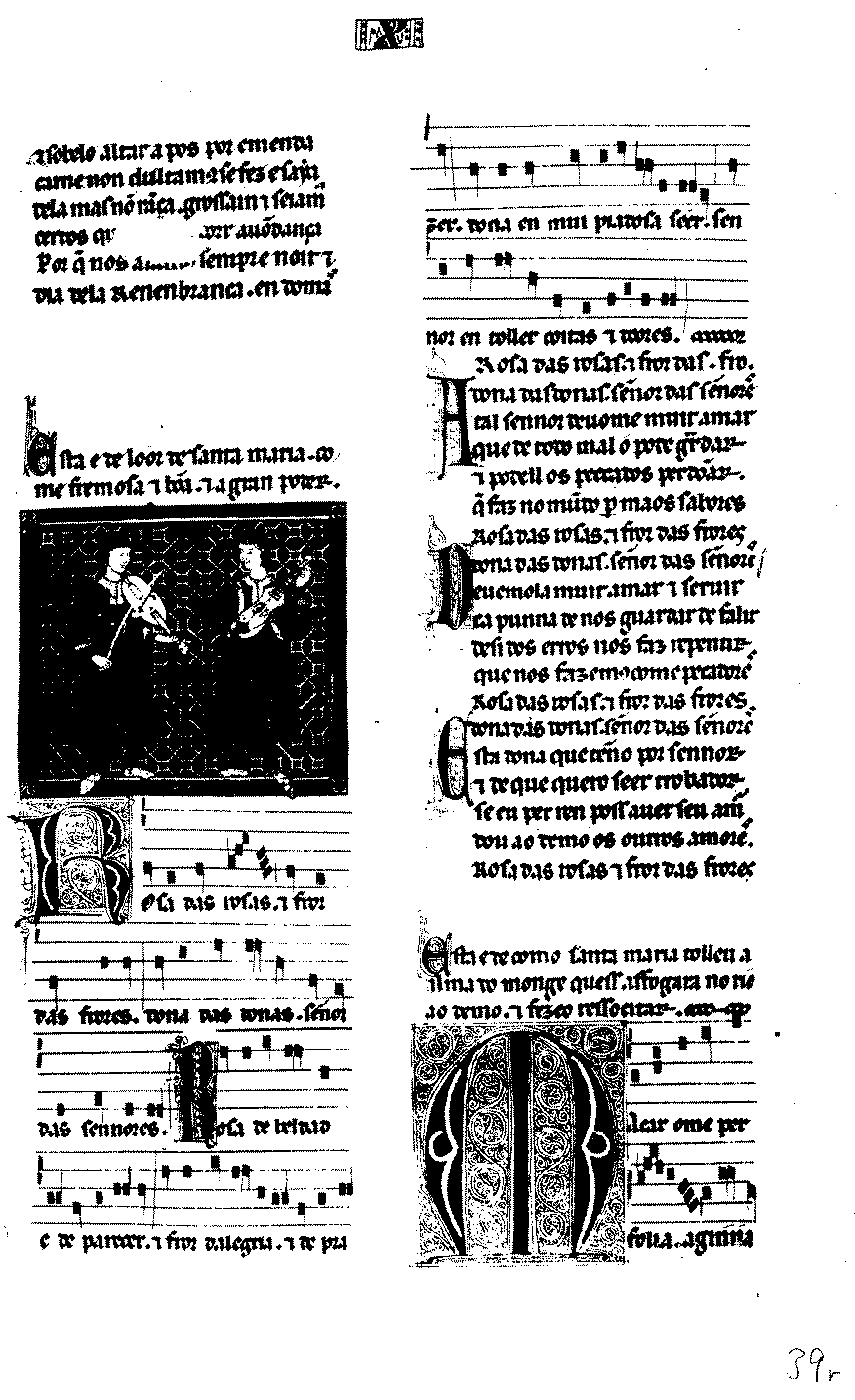
- 13th century CE, Alfonso X of Castile, Cantigas de Santa Maria, E codex, cantiga 10 (facsimile):
- Roſa das roſas. ⁊ fror / das frores. dona das donas. / ſeñor das ſennores.
- Rose of roses; And flower / of flowers. Woman of women; / Lady of ladies.
- Roſa das roſas. ⁊ fror / das frores. dona das donas. / ſeñor das ſennores.
- pink, rose (color/colour)
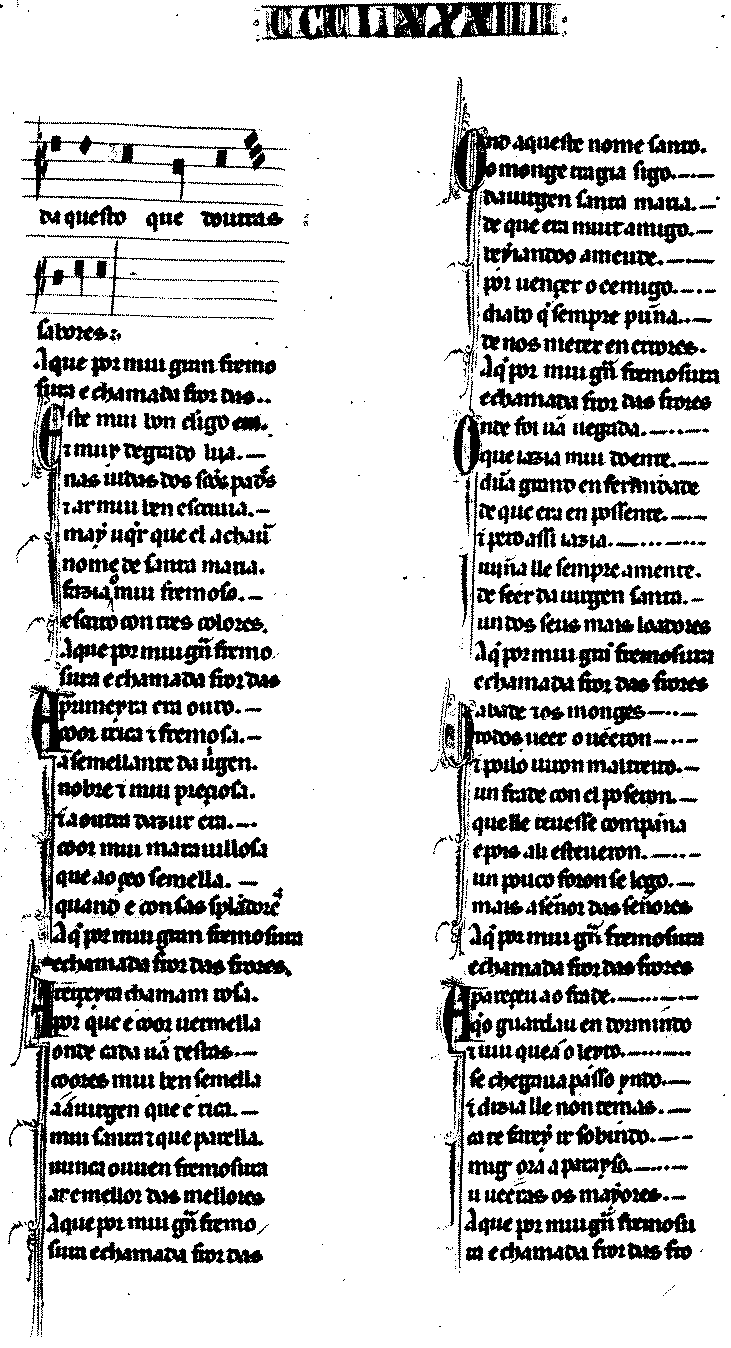
- 13th century CE, Alfonso X of Castile, Cantigas de Santa Maria, E codex, cantiga 384 (facsimile):
- A terçeyra chamam roſa / por que e coor uermella.
- The third (colour) is called rose, / because it is a reddish colour.
- A terçeyra chamam roſa / por que e coor uermella.
Descendants[edit]
See also[edit]
| branco, blanco, alvo | gris | negro, preto |
| vermelho | castanho | amarelo |
| verde | ||
| azur | ||
| cardẽo | rosa |
Pali[edit]
Alternative forms[edit]
Etymology[edit]
From the root rus. For the noun, inherited from Sanskrit रोष (roṣa, “anger”). For the verb, see rosati.
Noun[edit]
rosa m[1]
Declension[edit]
| Case \ Number | Singular | Plural |
|---|---|---|
| Nominative (first) | roso | rosā |
| Accusative (second) | rosaṃ | rose |
| Instrumental (third) | rosena | rosehi or rosebhi |
| Dative (fourth) | rosassa or rosāya or rosatthaṃ | rosānaṃ |
| Ablative (fifth) | rosasmā or rosamhā or rosā | rosehi or rosebhi |
| Genitive (sixth) | rosassa | rosānaṃ |
| Locative (seventh) | rosasmiṃ or rosamhi or rose | rosesu |
| Vocative (calling) | rosa | rosā |
Verb[edit]
rosa
- imperative active second-person singular of rosati (“to annoy”)
References[edit]
Polish[edit]

Etymology[edit]
Inherited from Proto-Slavic *rosà.
Pronunciation[edit]
Noun[edit]
rosa f
- dew (any moisture from the atmosphere condensed by cool bodies upon their surfaces)
Declension[edit]
Further reading[edit]
- rosa in Wielki słownik języka polskiego, Instytut Języka Polskiego PAN
- rosa in Polish dictionaries at PWN
- rosa in PWN's encyclopedia
Portuguese[edit]
Etymology[edit]
From Old Galician-Portuguese rosa, from Latin rosa (“rose”).
Pronunciation[edit]
Noun[edit]
rosa f (plural rosas)
- rose (flower)
Derived terms[edit]
Related terms[edit]
Descendants[edit]
- → Tamil: ரோஜா (rōjā)
Adjective[edit]
rosa (invariable)
- pink (color/colour)
- Synonym: cor-de-rosa
Noun[edit]
rosa m (plural rosas)
- pink (color/colour)
- Synonym: cor-de-rosa
See also[edit]
| branco, alvo, cândido | cinza, gris, cinzento |
preto, negro, atro |
| vermelho, encarnado, rubro, salmão; carmim |
laranja, cor de laranja; castanho, marrom |
amarelo, lúteo; creme, ocre |
| verde-limão | verde | verde-água; verde-menta |
| ciano, turquesa; azul-petróleo |
azul-celeste | azul, índigo, anil |
| violeta, lilás |
magenta; roxo, púrpura | rosa, cor-de-rosa, rosa-choque |
Romansch[edit]
Alternative forms[edit]
Etymology[edit]
Noun[edit]
rosa f (plural rosas)
Sardinian[edit]
Alternative forms[edit]
Etymology[edit]
From Latin rosa, of disputed origin.
Pronunciation[edit]
Noun[edit]
rosa f (plural rosas)
- rose (flower)
Derived terms[edit]
Noun[edit]
rosa f (uncountable)
- pink (color/colour)
Adjective[edit]
rosa (plural rosas)
- pink (color/colour)
Derived terms[edit]
References[edit]
- Rubattu, Antoninu (2006) Dizionario universale della lingua di Sardegna, 2nd edition, Sassari: Edes
Sassarese[edit]

Etymology[edit]
Pronunciation[edit]
Noun[edit]
rosa m (plural rosi)
- rose (flower)
Derived terms[edit]
Noun[edit]
rosa m (uncountable)
- pink (color/colour)
- chicken pox (childhood disease)
- Synonym: baglioru basthardhu
Adjective[edit]
rosa (invariable)
- pink (color/colour)
Related terms[edit]
References[edit]
- Rubattu, Antoninu (2006) Dizionario universale della lingua di Sardegna, 2nd edition, Sassari: Edes
Serbo-Croatian[edit]
Etymology[edit]
From Proto-Slavic *rosà, from Proto-Balto-Slavic *rasā́ˀ, from Proto-Indo-European *h₁róseh₂.
Pronunciation[edit]
Noun[edit]
ròsa f (Cyrillic spelling ро̀са)
Declension[edit]
Further reading[edit]
- “rosa” in Hrvatski jezični portal
Slovak[edit]
Etymology[edit]
From Proto-Slavic *rosà, from Proto-Balto-Slavic *rasā́ˀ, from Proto-Indo-European *h₁róseh₂.
Pronunciation[edit]
Noun[edit]
rosa f (genitive singular rosy, nominative plural rosy, genitive plural rôs, declension pattern of žena)
Declension[edit]
References[edit]
- “rosa”, in Slovníkový portál Jazykovedného ústavu Ľ. Štúra SAV [Dictionary portal of the Ľ. Štúr Institute of Linguistics, Slovak Academy of Science] (in Slovak), https://slovnik.juls.savba.sk, 2024
Slovene[edit]
Etymology[edit]
From Proto-Slavic *rosà, from Proto-Indo-European *h₁róseh₂.
Pronunciation[edit]
Noun[edit]
rósa f
- dew (moisture in the air that settles on plants, etc.)
Inflection[edit]

| Feminine, a-stem | ||
|---|---|---|
| nominative | rôsa | |
| genitive | rôse | |
| singular | ||
| nominative (imenovȃlnik) |
rôsa | |
| genitive (rodȋlnik) |
— | |
| dative (dajȃlnik) |
— | |
| accusative (tožȋlnik) |
— | |
| locative (mẹ̑stnik) |
rôsi | |
| instrumental (orọ̑dnik) |
rôso | |
| Feminine, a-stem, long mixed accent | ||
|---|---|---|
| nominative | rôsa | |
| genitive | rosé | |
| singular | ||
| nominative (imenovȃlnik) |
rôsa | |
| genitive (rodȋlnik) |
— | |
| dative (dajȃlnik) |
— | |
| accusative (tožȋlnik) |
— | |
| locative (mẹ̑stnik) |
rôsi | |
| instrumental (orọ̑dnik) |
rosó | |
Further reading[edit]
- “rosa”, in Slovarji Inštituta za slovenski jezik Frana Ramovša ZRC SAZU, portal Fran
- “rosa”, in Termania, Amebis
- See also the general references
Spanish[edit]
Etymology[edit]
From Old Spanish rosa, a semi-learned borrowing from Latin rosa.[1]
Pronunciation[edit]
Noun[edit]
rosa f (plural rosas)
Derived terms[edit]
- camino de rosas
- cara de rosa
- como las propias rosas
- como una rosa
- de rositas
- estar más fresco que una rosa
- geranio de rosa
- hecho una rosa
- lecho de rosas
- Leyenda Rosa
- mal de la rosa
- no hay rosa sin espina
- palo de rosa
- prensa rosa
- revista rosa
- rosa amarilla
- rosa china
- rosa de alabastro
- rosa de Jericó
- rosa de los vientos
- rosa de Navidad
- rosa de rejalgar
- rosa de té
- rosa del azafrán
- rosa japonesa
- rosa palo
- salsa rosa
Related terms[edit]
Descendants[edit]
- → Cebuano: rosa
- → Classical Nahuatl: rosa
- → Zoogocho Zapotec: ros
- →⇒ Cebuano: rosas (via rosas (pl.))
- →⇒ Tagalog: rosas (via rosas (pl.))
Adjective[edit]
rosa m or f (masculine and feminine plural rosa or rosas)
Usage notes[edit]
- The adjective rosa does not undergo inflection in gender. Thus, whether modifying a masculine or feminine noun, one should use rosa and never "roso".
See also[edit]
| blanco | gris | negro |
| rojo; carmín, carmesí | naranja, anaranjado; marrón | amarillo; crema |
| lima | verde | menta |
| cian, turquesa; azul-petróleo | celeste, cerúleo | azul |
| violeta; añil, índigo | magenta; morado, púrpura | rosa, rosado |
References[edit]
- ^ Joan Coromines, José A. Pascual (1983–1991) Diccionario crítico etimológico castellano e hispánico (in Spanish), Madrid: Gredos
Further reading[edit]
- “rosa”, in Diccionario de la lengua española, Vigésima tercera edición, Real Academia Española, 2014
Anagrams[edit]
Swedish[edit]
Pronunciation[edit]
Etymology 1[edit]
From a Romance language, likely via German, from French rose.
Noun[edit]
rosa n
Adjective[edit]
rosa (not comparable)
- pink (color/colour)
- en rosa kanin
- a pink rabbit
- ett rosa hus
- a pink house
Usage notes[edit]
Uninflected – see the examples.
Etymology 2[edit]
From Old Norse hrósa, from Proto-Germanic *hrōþrą. Compare origin of Gothic *𐌷𐍂𐍉𐌸𐍃 (*hrōþs), German Ruhm. Doublet of berömma.
Verb[edit]
rosa (present rosar, preterite rosade, supine rosat, imperative rosa)
Conjugation[edit]
| Active | Passive | |||
|---|---|---|---|---|
| Infinitive | rosa | rosas | ||
| Supine | rosat | rosats | ||
| Imperative | rosa | — | ||
| Imper. plural1 | rosen | — | ||
| Present | Past | Present | Past | |
| Indicative | rosar | rosade | rosas | rosades |
| Ind. plural1 | rosa | rosade | rosas | rosades |
| Subjunctive2 | rose | rosade | roses | rosades |
| Participles | ||||
| Present participle | rosande | |||
| Past participle | rosad | |||
| 1 Archaic. 2 Dated. See the appendix on Swedish verbs. | ||||
Derived terms[edit]
References[edit]
- rosa in Svensk ordbok (SO)
- rosa in Svenska Akademiens ordlista (SAOL)
- rosa in Svenska Akademiens ordbok (SAOB)
- rosa in Elof Hellquist, Svensk etymologisk ordbok (1st ed., 1922)
Anagrams[edit]
Upper Sorbian[edit]
Etymology[edit]
From Proto-Slavic *rosà, from Proto-Indo-European *h₁róseh₂.
Pronunciation[edit]
Noun[edit]
rosa f
Further reading[edit]
- “rosa” in Soblex
- Aragonese terms derived from Latin
- Aragonese lemmas
- Aragonese nouns
- Aragonese feminine nouns
- Asturian terms derived from Latin
- Asturian terms with IPA pronunciation
- Asturian lemmas
- Asturian nouns
- Asturian feminine nouns
- Asturian masculine nouns
- ast:Pinks
- Bavarian terms with IPA pronunciation
- Bavarian terms with audio links
- Bavarian lemmas
- Bavarian adjectives
- bar:Pinks
- Catalan terms derived from Latin
- Catalan terms with IPA pronunciation
- Catalan terms with audio links
- Catalan lemmas
- Catalan nouns
- Catalan countable nouns
- Catalan feminine nouns
- Catalan masculine nouns ending in -a
- Catalan masculine nouns
- Catalan adjectives
- Catalan indeclinable adjectives
- ca:Pinks
- ca:Flowers
- Cebuano terms derived from Spanish
- Cebuano terms derived from Latin
- Cebuano terms derived from Ancient Greek
- Cebuano lemmas
- Cebuano nouns
- Cebuano adjectives
- ceb:Pinks
- ceb:Flowers
- ceb:Roses
- Classical Nahuatl terms derived from Spanish
- Classical Nahuatl terms derived from Latin
- Classical Nahuatl lemmas
- Classical Nahuatl nouns
- Classical Nahuatl terms with quotations
- nci:Flowers
- Czech terms inherited from Old Czech
- Czech terms derived from Old Czech
- Czech terms inherited from Proto-Slavic
- Czech terms derived from Proto-Slavic
- Czech terms inherited from Proto-Indo-European
- Czech terms derived from Proto-Indo-European
- Czech terms with IPA pronunciation
- Rhymes:Czech/osa
- Rhymes:Czech/osa/2 syllables
- Czech lemmas
- Czech nouns
- Czech feminine nouns
- Czech hard feminine nouns
- cs:Liquids
- Galician terms derived from Latin
- Galician lemmas
- Galician nouns
- Galician countable nouns
- Galician feminine nouns
- gl:Flowers
- gl:Pinks
- Gallurese terms inherited from Latin
- Gallurese terms derived from Latin
- Gallurese terms with IPA pronunciation
- Gallurese lemmas
- Gallurese nouns
- Gallurese feminine nouns
- Gallurese uncountable nouns
- Gallurese masculine nouns
- Gallurese adjectives
- sdn:Pinks
- sdn:Flowers
- sdn:Rose family plants
- German terms derived from Latin
- German 2-syllable words
- German terms with IPA pronunciation
- German terms with audio links
- Rhymes:German/oːza
- Rhymes:German/oːza/2 syllables
- German lemmas
- German adjectives
- German uncomparable adjectives
- de:Pinks
- Irish non-lemma forms
- Irish noun forms
- Italian terms derived from Latin
- Italian 2-syllable words
- Italian terms with IPA pronunciation
- Rhymes:Italian/ɔza
- Rhymes:Italian/ɔza/2 syllables
- Italian lemmas
- Italian nouns
- Italian countable nouns
- Italian feminine nouns
- it:Heraldic charges
- it:Sports
- Italian collective nouns
- Italian indeclinable nouns
- Italian nouns with irregular gender
- Italian masculine nouns
- Italian adjectives
- Italian indeclinable adjectives
- Italian relational adjectives
- Rhymes:Italian/oza
- Rhymes:Italian/oza/2 syllables
- Rhymes:Italian/osa
- Rhymes:Italian/osa/2 syllables
- Italian non-lemma forms
- Italian past participle forms
- Italian terms with obsolete senses
- Tuscan Italian
- it:Flowers
- it:Pinks
- it:Rose family plants
- Latin terms derived from Proto-Indo-European
- Latin terms derived from the Proto-Indo-European root *Hwerdʰ-
- Latin terms derived from Ancient Greek
- Latin terms with unknown etymologies
- Latin terms derived from Oscan
- Latin terms derived from Proto-Iranian
- Latin 2-syllable words
- Latin terms with IPA pronunciation
- Latin lemmas
- Latin nouns
- Latin first declension nouns
- Latin feminine nouns in the first declension
- Latin feminine nouns
- Latin terms with quotations
- Latin terms with transferred senses
- Latin terms with usage examples
- Latin non-lemma forms
- Latin noun forms
- Latin participle forms
- la:Flowers
- Latvian lemmas
- Latvian nouns
- Latvian feminine nouns
- Lower Sorbian terms inherited from Proto-Slavic
- Lower Sorbian terms derived from Proto-Slavic
- Lower Sorbian terms inherited from Proto-Indo-European
- Lower Sorbian terms derived from Proto-Indo-European
- Lower Sorbian terms with IPA pronunciation
- Lower Sorbian lemmas
- Lower Sorbian nouns
- Lower Sorbian feminine nouns
- Lower Sorbian inanimate nouns
- dsb:Water
- dsb:Weather
- Luxembourgish terms derived from Latin
- Luxembourgish 2-syllable words
- Luxembourgish terms with IPA pronunciation
- Luxembourgish terms with audio links
- Luxembourgish lemmas
- Luxembourgish adjectives
- lb:Pinks
- Norwegian Bokmål terms derived from Latin
- Norwegian Bokmål lemmas
- Norwegian Bokmål adjectives
- Norwegian Bokmål nouns
- Norwegian Bokmål uncountable nouns
- Norwegian Bokmål non-lemma forms
- Norwegian Bokmål noun forms
- nb:Pinks
- Norwegian Nynorsk terms derived from Latin
- Norwegian Nynorsk doublets
- Norwegian Nynorsk terms with IPA pronunciation
- Norwegian Nynorsk lemmas
- Norwegian Nynorsk adjectives
- Norwegian Nynorsk nouns
- Norwegian Nynorsk terms inherited from Old Norse
- Norwegian Nynorsk terms derived from Old Norse
- Norwegian Nynorsk verbs
- Norwegian Nynorsk weak verbs
- Norwegian Nynorsk terms suffixed with -a (-ed)
- Norwegian Nynorsk feminine nouns
- Norwegian Nynorsk weak feminine nouns ending in -a
- Norwegian Nynorsk non-lemma forms
- Norwegian Nynorsk noun forms
- nn:Pinks
- Old Czech terms inherited from Proto-Slavic
- Old Czech terms derived from Proto-Slavic
- Old Czech terms inherited from Proto-Indo-European
- Old Czech terms derived from Proto-Indo-European
- Old Czech terms with IPA pronunciation
- Old Czech lemmas
- Old Czech nouns
- Old Czech feminine nouns
- Old Czech nouns with actual gender different from declined gender
- Old Czech hard feminine a-stem nouns
- zlw-ocs:Liquids
- Old Galician-Portuguese terms derived from Latin
- Old Galician-Portuguese terms derived from Ancient Greek
- Old Galician-Portuguese terms derived from Proto-Iranian
- Old Galician-Portuguese terms with IPA pronunciation
- Old Galician-Portuguese lemmas
- Old Galician-Portuguese nouns
- Old Galician-Portuguese feminine nouns
- roa-opt:Pinks
- Pali terms belonging to the root rus
- Pali terms inherited from Sanskrit
- Pali terms derived from Sanskrit
- Pali lemmas
- Pali nouns
- Pali nouns in Latin script
- Pali masculine nouns
- Pali non-lemma forms
- Pali verb forms
- Pali verb forms in Latin script
- Polish terms derived from Proto-Balto-Slavic
- Polish terms inherited from Proto-Balto-Slavic
- Polish terms derived from Proto-Indo-European
- Polish terms inherited from Proto-Indo-European
- Polish terms inherited from Proto-Slavic
- Polish terms derived from Proto-Slavic
- Polish 2-syllable words
- Polish terms with IPA pronunciation
- Polish terms with audio links
- Rhymes:Polish/ɔsa
- Rhymes:Polish/ɔsa/2 syllables
- Polish terms with homophones
- Polish lemmas
- Polish nouns
- Polish feminine nouns
- pl:Liquids
- Portuguese terms inherited from Old Galician-Portuguese
- Portuguese terms derived from Old Galician-Portuguese
- Portuguese terms derived from Latin
- Portuguese terms derived from Ancient Greek
- Portuguese terms derived from Proto-Iranian
- Portuguese 2-syllable words
- Portuguese terms with IPA pronunciation
- Portuguese terms with homophones
- Portuguese lemmas
- Portuguese nouns
- Portuguese countable nouns
- Portuguese feminine nouns
- Portuguese adjectives
- Portuguese indeclinable adjectives
- Portuguese nouns with irregular gender
- Portuguese masculine nouns
- pt:Pinks
- pt:Flowers
- Romansch terms derived from Latin
- Romansch lemmas
- Romansch nouns
- Romansch feminine nouns
- Rumantsch Grischun
- Sursilvan Romansch
- Sutsilvan Romansch
- Surmiran Romansch
- rm:Flowers
- Sardinian terms inherited from Latin
- Sardinian terms derived from Latin
- Sardinian terms with IPA pronunciation
- Sardinian lemmas
- Sardinian nouns
- Sardinian feminine nouns
- Sardinian uncountable nouns
- Sardinian adjectives
- sc:Pinks
- sc:Flowers
- sc:Rose family plants
- Sassarese terms inherited from Latin
- Sassarese terms derived from Latin
- Sassarese terms with IPA pronunciation
- Sassarese lemmas
- Sassarese nouns
- Sassarese masculine nouns
- Sassarese uncountable nouns
- Sassarese adjectives
- sdc:Pinks
- sdc:Flowers
- sdc:Rose family plants
- sdc:Viral diseases
- Serbo-Croatian terms inherited from Proto-Slavic
- Serbo-Croatian terms derived from Proto-Slavic
- Serbo-Croatian terms inherited from Proto-Balto-Slavic
- Serbo-Croatian terms derived from Proto-Balto-Slavic
- Serbo-Croatian terms inherited from Proto-Indo-European
- Serbo-Croatian terms derived from Proto-Indo-European
- Serbo-Croatian terms with IPA pronunciation
- Serbo-Croatian lemmas
- Serbo-Croatian nouns
- Serbo-Croatian feminine nouns
- sh:Liquids
- Slovak terms inherited from Proto-Slavic
- Slovak terms derived from Proto-Slavic
- Slovak terms inherited from Proto-Balto-Slavic
- Slovak terms derived from Proto-Balto-Slavic
- Slovak terms inherited from Proto-Indo-European
- Slovak terms derived from Proto-Indo-European
- Slovak terms with IPA pronunciation
- Slovak lemmas
- Slovak nouns
- Slovak feminine nouns
- sk:Liquids
- Slovene terms inherited from Proto-Slavic
- Slovene terms derived from Proto-Slavic
- Slovene terms inherited from Proto-Indo-European
- Slovene terms derived from Proto-Indo-European
- Slovene 2-syllable words
- Slovene terms with IPA pronunciation
- Slovene lemmas
- Slovene nouns
- Slovene feminine nouns
- Slovene feminine a-stem nouns
- Slovene feminine a-stem nouns with long mixed accent
- sl:Liquids
- Spanish terms inherited from Old Spanish
- Spanish terms derived from Old Spanish
- Spanish terms derived from Latin
- Spanish 2-syllable words
- Spanish terms with IPA pronunciation
- Spanish terms with audio links
- Rhymes:Spanish/osa
- Rhymes:Spanish/osa/2 syllables
- Spanish lemmas
- Spanish nouns
- Spanish countable nouns
- Spanish feminine nouns
- es:Heraldic charges
- Spanish adjectives
- Spanish epicene adjectives
- es:Flowers
- es:Pinks
- Swedish terms with IPA pronunciation
- Swedish terms with audio links
- Swedish terms derived from Romance languages
- Swedish terms derived from German
- Swedish terms derived from French
- Swedish lemmas
- Swedish nouns
- Swedish neuter nouns
- Swedish adjectives
- Swedish terms with usage examples
- Swedish terms inherited from Old Norse
- Swedish terms derived from Old Norse
- Swedish terms derived from Proto-Germanic
- Swedish doublets
- Swedish verbs
- Swedish weak verbs
- sv:Pinks
- Upper Sorbian terms inherited from Proto-Slavic
- Upper Sorbian terms derived from Proto-Slavic
- Upper Sorbian terms inherited from Proto-Indo-European
- Upper Sorbian terms derived from Proto-Indo-European
- Upper Sorbian terms with IPA pronunciation
- Upper Sorbian lemmas
- Upper Sorbian nouns
- Upper Sorbian feminine nouns
- hsb:Liquids