縦
Jump to navigation
Jump to search
See also: 縱
| ||||||||
Translingual[edit]
| Traditional | 縱 |
|---|---|
| Shinjitai | 縦 |
| Simplified | 纵 |
Han character[edit]
縦 (Kangxi radical 120, 糸+10, 16 strokes, cangjie input 女火竹人人 (VFHOO) or 難難女火竹 (XXVFH), composition ⿰糹従)
References[edit]
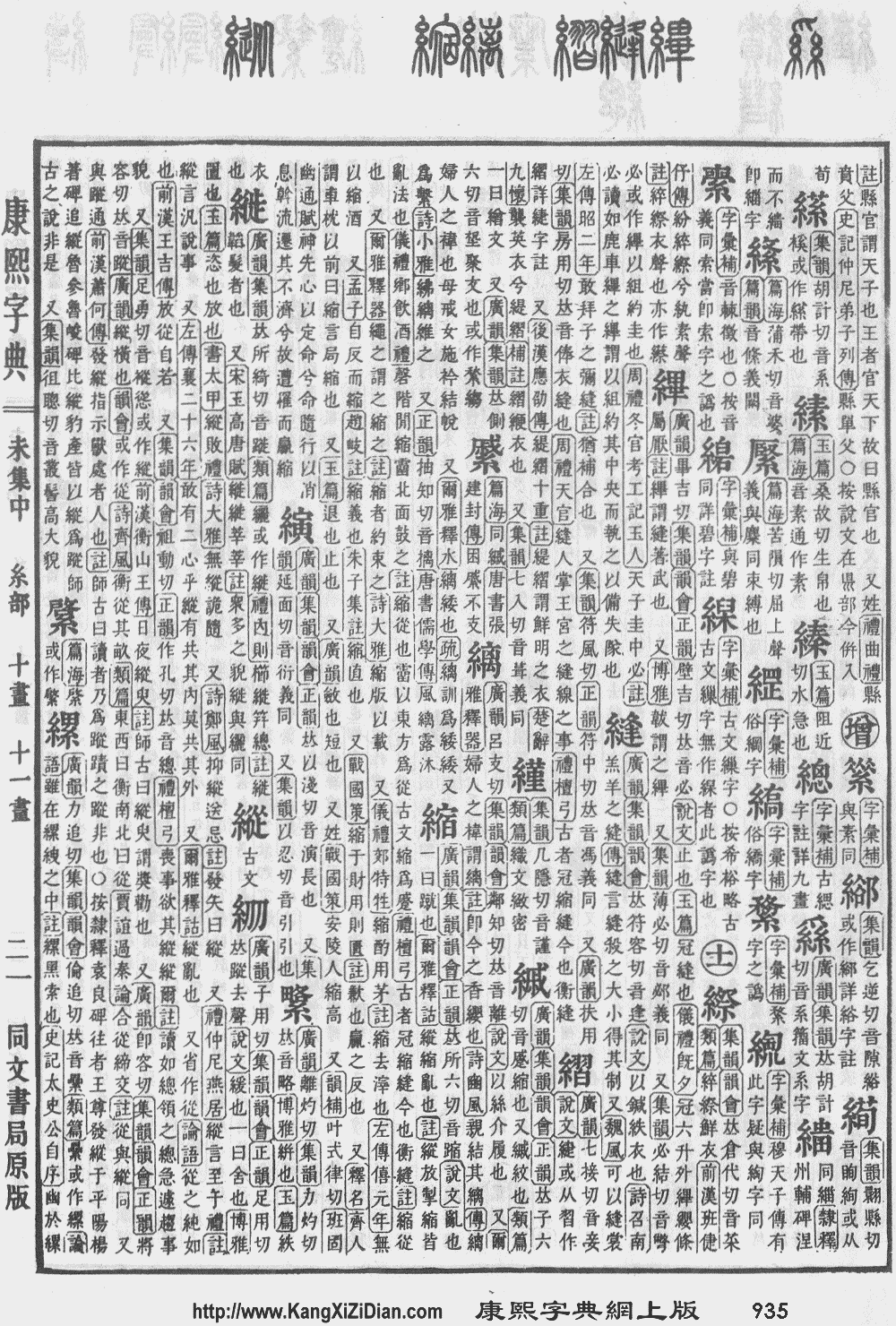
- Kangxi Dictionary: not present, would follow page 935, character 18
- Dai Kanwa Jiten: character 27804
- Hanyu Da Zidian (first edition): volume 5, page 3437, character 14
- Unihan data for U+7E26
Chinese[edit]
| For pronunciation and definitions of 縦 – see 縱 (“loose; relaxed; to shoot an arrow; etc.”). (This character is a variant form of 縱). |
Japanese[edit]
| 縦 | |
| 縱 |
Kanji[edit]
縦
(grade 6 “Kyōiku” kanji, shinjitai kanji, kyūjitai form 縱)
Readings[edit]
- Go-on: しゅ (shu)←しゆ (syu, historical)
- Kan-on: しょう (shō)←しよう (syou, historical)
- Kan’yō-on: じゅう (jū, Jōyō)←じゆう (zyuu, historical)
- Kun: たて (tate); たとえ (tatoe, 縦え); はなつ (hanatsu, 縦つ); ほしいまま (hoshiimama, 縦); ゆるす (yurusu, 縦す); よし (yoshi, 縦); よしんば (yoshinba, 縦しんば)
Compounds[edit]
Etymology 1[edit]
| For pronunciation and definitions of 縦 – see the following entry: 従 |
(The following entry is uncreated: 従.)
Etymology 2[edit]
| Kanji in this term |
|---|
| 縦 |
| じゅう Grade: 6 |
| kan’yōon |
| Alternative spelling |
|---|
| 縱 (kyūjitai) |
(This etymology is missing or incomplete. Please add to it, or discuss it at the Etymology scriptorium.)
Pronunciation[edit]
This term needs a translation to English. Please help out and add a translation, then remove the text {{rfdef}}.
Etymology 3[edit]
| Kanji in this term |
|---|
| 縦 |
| たて Grade: 6 |
| kun’yomi |
| Alternative spellings |
|---|
| 縱 (kyūjitai) 経 竪 |
(This etymology is missing or incomplete. Please add to it, or discuss it at the Etymology scriptorium.)
Pronunciation[edit]
Noun[edit]
Etymology 4[edit]
| Kanji in this term |
|---|
| 縦 |
| ほしいまま Grade: 6 |
| kun’yomi |
| Alternative spellings |
|---|
| 縱 (kyūjitai) 恣 擅 欲しい儘 欲しい侭 肆 |
(This etymology is missing or incomplete. Please add to it, or discuss it at the Etymology scriptorium.)
Pronunciation[edit]
Adjective[edit]
縦 • (hoshiimama) -na (adnominal 縦な (hoshiimama na), adverbial 縦に (hoshiimama ni))
Inflection[edit]
Inflection of 縦
| Stem forms | |||
|---|---|---|---|
| Imperfective (未然形) | 縦だろ | ほしいままだろ | hoshiimama daro |
| Continuative (連用形) | 縦で | ほしいままで | hoshiimama de |
| Terminal (終止形) | 縦だ | ほしいままだ | hoshiimama da |
| Attributive (連体形) | 縦な | ほしいままな | hoshiimama na |
| Hypothetical (仮定形) | 縦なら | ほしいままなら | hoshiimama nara |
| Imperative (命令形) | 縦であれ | ほしいままであれ | hoshiimama de are |
| Key constructions | |||
| Informal negative | 縦ではない 縦じゃない |
ほしいままではない ほしいままじゃない |
hoshiimama de wa nai hoshiimama ja nai |
| Informal past | 縦だった | ほしいままだった | hoshiimama datta |
| Informal negative past | 縦ではなかった 縦じゃなかった |
ほしいままではなかった ほしいままじゃなかった |
hoshiimama de wa nakatta hoshiimama ja nakatta |
| Formal | 縦です | ほしいままです | hoshiimama desu |
| Formal negative | 縦ではありません 縦じゃありません |
ほしいままではありません ほしいままじゃありません |
hoshiimama de wa arimasen hoshiimama ja arimasen |
| Formal past | 縦でした | ほしいままでした | hoshiimama deshita |
| Formal negative past | 縦ではありませんでした 縦じゃありませんでした |
ほしいままではありませんでした ほしいままじゃありませんでした |
hoshiimama de wa arimasen deshita hoshiimama ja arimasen deshita |
| Conjunctive | 縦で | ほしいままで | hoshiimama de |
| Conditional | 縦なら(ば) | ほしいままなら(ば) | hoshiimama nara (ba) |
| Provisional | 縦だったら | ほしいままだったら | hoshiimama dattara |
| Volitional | 縦だろう | ほしいままだろう | hoshiimama darō |
| Adverbial | 縦に | ほしいままに | hoshiimama ni |
| Degree | 縦さ | ほしいままさ | hoshiimamasa |
Synonyms[edit]
References[edit]
- ↑ 1.0 1.1 Matsumura, Akira, editor (2006), 大辞林 [Daijirin] (in Japanese), Third edition, Tōkyō: Sanseidō, →ISBN
- ^ NHK Broadcasting Culture Research Institute, editor (1998), NHK日本語発音アクセント辞典 [NHK Japanese Pronunciation Accent Dictionary] (in Japanese), Tōkyō: NHK Publishing, →ISBN
- ↑ 3.0 3.1 Kindaichi, Kyōsuke et al., editors (1997), 新明解国語辞典 [Shin Meikai Kokugo Jiten] (in Japanese), Fifth edition, Tōkyō: Sanseidō, →ISBN
Categories:
- CJK Unified Ideographs block
- Han script characters
- CJKV characters simplified differently in Japan and China
- Translingual lemmas
- Translingual symbols
- Chinese lemmas
- Mandarin lemmas
- Cantonese lemmas
- Hakka lemmas
- Eastern Min lemmas
- Hokkien lemmas
- Wu lemmas
- Chinese adjectives
- Mandarin adjectives
- Cantonese adjectives
- Hakka adjectives
- Eastern Min adjectives
- Hokkien adjectives
- Wu adjectives
- Chinese verbs
- Mandarin verbs
- Cantonese verbs
- Hakka verbs
- Eastern Min verbs
- Hokkien verbs
- Wu verbs
- Chinese conjunctions
- Mandarin conjunctions
- Cantonese conjunctions
- Hakka conjunctions
- Eastern Min conjunctions
- Hokkien conjunctions
- Wu conjunctions
- Chinese proper nouns
- Mandarin proper nouns
- Cantonese proper nouns
- Hakka proper nouns
- Eastern Min proper nouns
- Hokkien proper nouns
- Wu proper nouns
- Chinese terms with IPA pronunciation
- Chinese Han characters
- Chinese variant forms
- Japanese Han characters
- Grade 6 kanji
- Japanese kanji with goon reading しゅ
- Japanese kanji with historical goon reading しゆ
- Japanese kanji with kan'on reading しょう
- Japanese kanji with historical kan'on reading しよう
- Japanese kanji with kan'yōon reading じゅう
- Japanese kanji with historical kan'yōon reading じゆう
- Japanese kanji with kun reading たて
- Japanese kanji with kun reading たと-え
- Japanese kanji with kun reading はな-つ
- Japanese kanji with kun reading ほしいまま
- Japanese kanji with kun reading ゆる-す
- Japanese kanji with kun reading よし
- Japanese kanji with kun reading よ-しんば
- Japanese terms spelled with 縦 read as じゅう
- Japanese terms read with on'yomi
- Japanese terms with IPA pronunciation
- Japanese terms spelled with 縦 read as たて
- Japanese terms read with kun'yomi
- Japanese lemmas
- Japanese nouns
- Japanese terms with multiple readings
- Japanese terms spelled with sixth grade kanji
- Japanese terms written with one Han script character
- Japanese terms spelled with 縦
- Japanese single-kanji terms
- Japanese terms spelled with 縦 read as ほしいまま
- Japanese adjectives
- Japanese な-na adjectives