pole
English[edit]
Pronunciation[edit]
- (UK) IPA(key): /pəʊl/, [pʰɒʊɫ]
- (New Zealand, General Australian) IPA(key): /pɐʉl/, [pʰɒʊɫ]
- (US, Canada) IPA(key): /poʊl/, [pʰoʊɫ], [pʰoəɫ]
- Rhymes: -əʊl
- Homophones: Pole, poll
Etymology 1[edit]
From Middle English pole, pal, from Old English pāl (“a pole, stake, post; a kind of hoe or spade”), from Proto-West Germanic *pāl (“pole”), from Latin pālus (“stake, pale, prop, stay”), perhaps from Old Latin *paxlos, from Proto-Italic *pākslos, ultimately from Proto-Indo-European *peh₂ǵ- (“to nail, fasten”). Doublet of peel, pale, and palus.
Noun[edit]
pole (plural poles)
- Originally, a stick; now specifically, a long and slender piece of metal or (especially) wood, used for various construction or support purposes.
- 1913, Joseph C[rosby] Lincoln, chapter I, in Mr. Pratt’s Patients, New York, N.Y., London: D[aniel] Appleton and Company, →OCLC:
- For a spell we done pretty well. Then there came a reg'lar terror of a sou'wester same as you don't get one summer in a thousand, and blowed the shanty flat and ripped about half of the weir poles out of the sand.
- A construction by which an animal is harnessed to a carriage.
- Synonyms: carriage pole, beam, shaft, drawbar
- Meronyms: pole-guard, pole-hook, pole-hound, pole-pad, pole-pin, pole-pin-strap, pole-plate, pole-ring, pole-screen, pole-socket, pole-stop, pole-strap
- (fishing) A type of basic fishing rod.
- A long sports implement used for pole-vaulting; now made of glassfiber or carbon fiber, formerly also metal, bamboo and wood have been used.
- (slang, spotting) A telescope used to identify birds, aeroplanes or wildlife.
- (historical) A unit of length, equal to a rod (1⁄4 chain or 51⁄2 yards).
- (motor racing) Pole position.
- (US, African-American Vernacular, slang) A rifle.
- (vulgar, slang) A penis.
Synonyms[edit]
- See also Thesaurus:stick
- (unit of length): rod
Derived terms[edit]
- barber pole
- barge pole, bargepole
- beanpole
- boom pole
- bush pole
- carrying pole
- clothespole
- coupling pole
- cross-pole
- dance pole
- depress the pole
- double pole
- double-pole technique
- family pole
- Festivus pole
- firepole
- fishing pole
- flagpole
- foul pole
- gee pole
- gin pole
- greasy pole
- habitat pole
- hiking pole
- hop pole
- hydro pole
- ice pole
- icy pole
- J-pole antenna
- lightpole
- lodge pole
- maypole
- memorial pole
- monkey pole
- mortuary pole
- nerd pole
- not touch something with a ten-foot pole
- over-the-pole
- perch pole
- pike pole
- polearm
- poleaxe
- pole building
- pole charge
- pole cleaver
- pole dance
- pole dancer
- pole dancing
- pole fitness
- polehead
- pole jam
- pole-jocking
- pole lathe
- pole plate
- pole position
- polescreen
- polesitter
- pole-sitter
- pole-smoker
- polespear
- polestar
- pole up one's ass
- pole vault
- pole vaulter
- power pole
- punting pole
- quant pole
- range pole
- ranging pole
- rhythm pole
- ridgepole
- ridicule pole
- setting pole
- shame pole
- shoulder pole
- ski pole
- smoke pole
- smoke someone's pole
- snow pole
- socket pole
- spinnaker pole
- springpole
- Stobie pole
- tail-pole
- taxi pole
- telegraph pole
- telephone pole
- tentpole
- the longest pole knocks the persimmon
- totem pole
- trekking pole
- trolley pole
- up the pole
- utility pole
- walking pole
- welcome pole
- whisker pole
Translations[edit]
|
|
Verb[edit]
pole (third-person singular simple present poles, present participle poling, simple past and past participle poled)
- To propel by pushing with poles, to push with a pole.
- Huck Finn poled that raft southward down the Mississippi because going northward against the current was too much work.
- To identify something quite precisely using a telescope.
- He poled off the serial of the Gulfstream to confirm its identity.
- (transitive) To furnish with poles for support.
- to pole beans or hops
- (transitive) To convey on poles.
- to pole hay into a barn
- (transitive) To stir, as molten glass, with a pole.
- (transitive, baseball) To strike (the ball) very hard.
- 2007, Tony Silvia, Baseball Over the Air:
- Long had poled the ball into the lower deck in right center.
- (transitive, metallurgy) To treat (copper) by blowing natural gas or other reducing agent through the molten oxide, burning off the oxygen.
- to pole copper
Translations[edit]
Etymology 2[edit]
From Middle French pole, pôle, from Latin polus, from Ancient Greek πόλος (pólos, “axis of rotation”).
Noun[edit]
pole (plural poles)
- Either of the two points on the earth's surface around which it rotates; also, similar points on any other rotating object.
- A point of magnetic focus, especially each of the two opposing such points of a magnet (designated north and south).
- (geometry) A fixed point relative to other points or lines.
- (electricity) A contact on an electrical device (such as a battery) at which electric current enters or leaves.
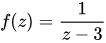
- (complex analysis) For a meromorphic function , any point for which as .
- The function has a single pole at .
- (obsolete) The firmament; the sky.
- 1634 October 9 (first performance), [John Milton], edited by H[enry] Lawes, A Maske Presented at Ludlow Castle, 1634: […], London: […] [Augustine Matthews] for Hvmphrey Robinson, […], published 1637, →OCLC; reprinted as Comus: […] (Dodd, Mead & Company’s Facsimile Reprints of Rare Books; Literature Series; no. I), New York, N.Y.: Dodd, Mead & Company, 1903, →OCLC:
- And the slope sun his upward beam / Shoots against the dusky pole,
- Either of the states that characterize a bipolar disorder.



Antonyms[edit]
- (antonym(s) of "complex analysis"): zero
Derived terms[edit]
- analogous pole
- animal pole
- celestial pole
- cross-pole
- dipole
- Earth's third pole
- hexadecapole
- hexapole
- interpole
- magnetic pole
- monopole
- multipole
- north pole
- north-seeking pole
- N-pole
- octupole
- polar
- polarity
- pole arctic
- pole face
- pole of cold
- poles apart
- polestar, pole star
- quadrupole
- shaded pole
- south pole
- south-seeking pole
- S-pole
- tripole
- vegetal pole
- Voronoi pole
Translations[edit]
|
|
|
- The translations below need to be checked and inserted above into the appropriate translation tables. See instructions at Wiktionary:Entry layout § Translations.
Verb[edit]
pole (third-person singular simple present poles, present participle poling, simple past and past participle poled)
- (transitive) To induce piezoelectricity in (a substance) by aligning the dipoles.
Anagrams[edit]
Aiwoo[edit]
Verb[edit]
pole
- to work (in a garden or field)
References[edit]
- Ross, M. & Næss, Å. (2007) “An Oceanic origin for Äiwoo, the language of the Reef Islands?”, in Oceanic Linguistics, volume 46, number 2. Cited in: "Äiwoo" in Greenhill, S.J., Blust, R., & Gray, R.D. (2008). The Austronesian Basic Vocabulary Database: From Bioinformatics to Lexomics. Evolutionary Bioinformatics, 4:271–283.
Alemannic German[edit]
Etymology[edit]
From Middle High German boln.
Verb[edit]
pole
References[edit]
- Abegg, Emil, (1911) Die Mundart von Urseren (Beiträge zur Schweizerdeutschen Grammatik. IV.) [The Dialect of Urseren], Frauenfeld, Switzerland: Huber & Co., page 35.
Czech[edit]

Etymology[edit]
Inherited from Old Czech pole, from Proto-Slavic *poľe.
Pronunciation[edit]
Noun[edit]
pole n
- (agriculture) field
- (physics) field
- (algebra) field
- Synonym: komutativní těleso
- (computing) field
- (programming) array
Declension[edit]
Derived terms[edit]
Further reading[edit]
- pole in Příruční slovník jazyka českého, 1935–1957
- pole in Slovník spisovného jazyka českého, 1960–1971, 1989
- pole in Internetová jazyková příručka
Esperanto[edit]
Pronunciation[edit]
Audio (file)
Adverb[edit]
pole
Estonian[edit]
Etymology[edit]
Contraction of ep ole (Modern: ei ole). ep is the old 3rd person singular form of the negative verb.
Verb[edit]
pole
Galician[edit]
Etymology 1[edit]
Noun[edit]
pole m (plural poles)
Synonyms[edit]
Etymology 2[edit]
See the etymology of the corresponding lemma form.
Verb[edit]
pole
Latin[edit]
Noun[edit]
pole
References[edit]
- pole in Charles du Fresne du Cange’s Glossarium Mediæ et Infimæ Latinitatis (augmented edition with additions by D. P. Carpenterius, Adelungius and others, edited by Léopold Favre, 1883–1887)
- “pole”, in Harry Thurston Peck, editor (1898), Harper's Dictionary of Classical Antiquities, New York: Harper & Brothers
Masurian[edit]
Etymology[edit]
Inherited from Old Polish pole.
Pronunciation[edit]
Noun[edit]
pole n
- field (land for cultivation)
- field (plot of separated land)
- field (area outside a village)
- battlefield
Further reading[edit]
- Zofia Stamirowska (1987-2021) “pole”, in Anna Basara, editor, Słownik gwar Ostródzkiego, Warmii i Mazur[2], volume 6, Zakład Narodowy im. Ossolińskich Wydawnictwo Polskiej Akademii Nauk, →ISBN, page 204
Middle English[edit]
Alternative forms[edit]
Etymology[edit]
From Old English pāl, from Latin pālus.
Pronunciation[edit]
Noun[edit]
pole (plural poles)
Descendants[edit]
References[edit]
- “pōl(e, n.2”, in MED Online, Ann Arbor, Mich.: University of Michigan, 2007.
Nubi[edit]
Etymology[edit]
Interjection[edit]
póle
- sorry
- pole ma kasul!
- sorry for washing (the clothes)!
References[edit]
- Ineke Wellens (2005) The Nubi Language of Uganda: an Arabic Creole in Africa, Leiden, The Netherlands: Brill, →ISBN, page 193
Old Czech[edit]
Alternative forms[edit]
- poľe (alternative writing)
Etymology[edit]
Inherited from Proto-Slavic *pȍľe.
Pronunciation[edit]
Noun[edit]
pole n
- field (land area; wide open space)
- polem / na poli ― outside
- přěs pole přějěti/jězditi ― to have sex
- plain
- battlefield, battleground
- polem / v poli ležěti ― (please add an English translation of this usage example)
Declension[edit]
| singular | dual | plural | |
|---|---|---|---|
| nominative | pole | poli | pole |
| genitive | pole | poľú | polí |
| dative | poľu | poľoma | poľóm |
| accusative | pole | poli | pole |
| vocative | pole | poli | pole |
| locative | poli, poľu | poľú | polích |
| instrumental | polem | poľoma | poli |
See also Appendix:Old Czech nouns and Appendix:Old Czech pronunciation.
Derived terms[edit]
Descendants[edit]
- Czech: pole
Further reading[edit]
- Jan Gebauer (1903–1916) “pole”, in Slovník staročeský (in Czech), Prague: Česká grafická společnost "unie", Česká akademie císaře Františka Josefa pro vědy, slovesnost a umění
Old Polish[edit]
Etymology[edit]
Inherited from Proto-Slavic *pȍľe. First attested in 1250.
Pronunciation[edit]
Noun[edit]
pole n (related adjective polny)
- field (arable land)
- 1930 [Fifteenth century], “Ex”, in Ludwik Bernacki, editor, Biblia królowej Zofii (Biblia szaroszpatacka)[3], 9, 25:
- Zbyl gest grad we wszey szemy egipskyey wszitko, czsosz bilo na polyech (in agris)
- [Zbił jest grad we wszej ziemi ejipskiej wszytko, csoż było na polech (in agris)]
- (figuratively) crops from a field
- 1415, O zachowaniu się przy stole[5], line 4:
- Sgarne na szø wszytko pole, ... czszole szø na niwe swøze, tho wszytko na stole løsze
- [Zgarnie na się wszytko pole, ... csole się na niwie swięże, to wszytko na stole lęże]
- field (open land)
- 1930 [Fifteenth century], “Gen”, in Ludwik Bernacki, editor, Biblia królowej Zofii (Biblia szaroszpatacka)[6], 4, 8:
- A gdisz na polu (in agro) bilasta, podnosl szø Kayn ku Ablowy
- [A gdyż na polu (in agro) byłasta, podniosł się Kain ku Ablowi]
- 1962-1975 [1439], Stanisław Kuraś, Irena Sułkowska-Kuraś, editors, Zbiór dokumentów małopolskich [A collection of documents from Lesser Poland][7], volume II, page 311:
- Quia ex recognicione fratrum predictorum... cessit castrum Bankowecz cum villis..., item in campo al. w polyu ville Gebolthow, et utraque Cowalicow, Maloschow... de his fratri predicto iuniori cesserunt
- [Quia ex recognicione fratrum predictorum... cessit castrum Bąkowiec cum villis..., item in campo al. w polu ville Giebołtow, et utraque Kowalikow, Małoszow... de his fratri predicto iuniori cesserunt]
- 1939 [end of the 14th century], Ryszard Ganszyniec, Witold Taszycki, Stefan Kubica, Ludwik Bernacki, editors, Psałterz florjański łacińsko-polsko-niemiecki [Latin-Polish-German Florian Psalter][8], Zakład Narodowy imienia Ossolińskich, z zasiłkiem Sejmu Śląskiego [The Ossoliński National Institute: with the benefit of the Silesian Parliament], pages 131, 6:
- Naleszly gesmy gy w polech (in campis) lassa
- [Naleźli jeśmy ji w polech (in campis) lasa]
- 1939 [end of the 14th century], Ryszard Ganszyniec, Witold Taszycki, Stefan Kubica, Ludwik Bernacki, editors, Psałterz florjański łacińsko-polsko-niemiecki [Latin-Polish-German Florian Psalter][9], Zakład Narodowy imienia Ossolińskich, z zasiłkiem Sejmu Śląskiego [The Ossoliński National Institute: with the benefit of the Silesian Parliament], pages 103, 12:
- Pycz bødzye wszytek zwyerz pola (agri)
- [Pić będzie wszytek źwierz pola (agri)]
- campsite; battlefield
- 1895 [1448–1450], Franciszek Piekosiński, editor, Tłumaczenia polskie statutów ziemskich, Kodeks Świętosławów, page 15:
- Gydączy na woyną na ląnkach any we wszi staacz mayą, yano na polyv (nisi in campo)
- [Jidący na wojnę na łąkach ani we wsi stać mają, jano na polu (nisi in campo)]
- outside (area not in a building)
- Middle of the 15th century, Rozmyślanie o żywocie Pana Jezusa[10], page 132:
- Vyschly na polye (ad campum), nalyezly Yesvsa chodzącz y tam, y szam
- [Wyszli na pole i naleźli Jesusa chodząc i tam i sam]
- (heraldry) background
- 1856-1870 [1455], Antoni Zygmunt Helcel, editor, Starodawne Prawa Polskiego Pomniki, volume VII, number 610:
- Niccolaus post awam suam est de sangwine et armis ipsorum dictis Stanczowye, proclamacio autem ipsorum Nabra, deferentes in clipeo tres lineas vlg. trzy *polye in longitudine clipei
- [Niccolaus post awam suam est de sangwine et armis ipsorum dictis Stańcowie, proclamacio autem ipsorum Nabra, deferentes in clipeo tres lineas vlg. trzy pola in longitudine clipei5]
- corruption of opole
- 1840 [1252], Edward Raczyński, editor, Kodex dyplomatyczny Wielkiej Polski zawierający bulle papieżów, nadania książąt, przywileje miast, klasztorów i wsi, wraz z innemi podobnej treści dyplomatami tyczącemi się historyi tej prowincyi od roku 1136 do roku 1597[11], page 257:
- Dedimus omnimodam libertatem... a podworowe, ab pole, a bove et vacca annuali
- [Dedimus omnimodam libertatem... a podworowe, ab pole, a bove et vacca annuali]
Derived terms[edit]
- pole gonić impf
Descendants[edit]
References[edit]
- Boryś, Wiesław (2005) “pole”, in Słownik etymologiczny języka polskiego (in Polish), Kraków: Wydawnictwo Literackie, →ISBN
- Mańczak, Witold (2017) “pole”, in Polski słownik etymologiczny (in Polish), Kraków: Polska Akademia Umiejętności, →ISBN
- Bańkowski, Andrzej (2000) “pole”, in Etymologiczny słownik języka polskiego [Etymological Dictionary of the Polish Language] (in Polish)
- B. Sieradzka-Baziur, editor (2011–2015), “pole”, in Słownik pojęciowy języka staropolskiego [Conceptual Dictionary of Old Polish] (in Polish), Kraków: IJP PAN, →ISBN
Polish[edit]

Pronunciation[edit]
- IPA(key): /ˈpɔ.lɛ/
- (Middle Polish) IPA(key): /ˈpɔ.lɛ/
Audio 1 (file) Audio 2 (file) - Rhymes: -ɔlɛ
- Syllabification: po‧le
- Homophones: Pole, Polę
Etymology 1[edit]
Inherited from Old Polish pole. Doublet of polje.
Noun[edit]
pole n (diminutive pólko or poletko, related adjective polny)
- (countable, agriculture) field (land for cultivation)
- (countable) field (land designated for some activity)
- field (area characterized by some activity, i.e. battle)
- Synonym: teren
- (uncountable, Kraków) outside (area not inside a building)
- Synonym: (Warsaw) dwór
- (countable, sports) field. ground, pitch
- (countable) field (part of some surface)
- (countable) field (extent of someone's interest or activities)
- Synonym: dziedzina
- (uncountable) field (freedom of action or choice) [+ do (genitive) = for what]
- Synonym: możliwość
- (countable, physics) field (physical phenomenon (such as force, potential or fluid velocity) that pervades a region)
- (uncountable, mathematics) field (number that expresses the area of a given geometric figure in square units)
- Synonym: powierzchnia
- (computing) field (area of memory or storage reserved for a particular value, subject to virtual access controls)
- (obsolete) background (part of an image that is not the main part)
- (obsolete, anatomy) group of nerve cells located close to each other in the central nervous system and performing the same function
- (obsolete, hunting) hunting ground
- Synonym: łowisko
- (obsolete) measure of land
- (Middle Polish, chess) field (area on a chessboard)
- (Middle Polish) The meaning of this term is uncertain.
- 1564, J. Mączyński, Lexicon[12], page 9a:
- Fortuna anatina et anataria, Szcżeśćie ná kácze pole.
Declension[edit]
Derived terms[edit]
- dotrzymać pola pf, dotrzymywać pola impf
- szukać wiatru w polu impf
- ustąpić pola pf, ustępować pola impf
- wyprowadzić w pole kogoś pf, wyprowadzać w pole impf
- polować impf
Trivia[edit]
According to Słownik frekwencyjny polszczyzny współczesnej (1990), pole is one of the most used words in Polish, appearing 40 times in scientific texts, 6 times in news, 17 times in essays, 28 times in fiction, and 17 times in plays, each out of a corpus of 100,000 words, totaling 108 times, making it the 581st most common word in a corpus of 500,000 words.[1]
Etymology 2[edit]
See the etymology of the corresponding lemma form.
Noun[edit]
pole f
References[edit]
Further reading[edit]
- pole in Wielki słownik języka polskiego, Instytut Języka Polskiego PAN
- pole in Polish dictionaries at PWN
- Maria Renata Mayenowa, Stanisław Rospond, Witold Taszycki, Stefan Hrabec, Władysław Kuraszkiewicz (2010-2023) “pole”, in Słownik Polszczyzny XVI Wieku [A Dictionary of 16th Century Polish]
- Dorota Adamiec (25.03.2019) “POLE”, in Elektroniczny Słownik Języka Polskiego XVII i XVIII Wieku [Electronic Dictionary of the Polish Language of the XVII and XVIII Century]
- Samuel Bogumił Linde (1807–1814) “pole”, in Słownik języka polskiego[13]
- Aleksander Zdanowicz (1861) “pole”, in Słownik języka polskiego, Wilno 1861[14]
- J. Karłowicz, A. Kryński, W. Niedźwiedzki, editors (1900–1927), chapter 525, in Słownik języka polskiego (in Polish), Warsaw, page 4
Serbo-Croatian[edit]
Noun[edit]
pole (Cyrillic spelling поле)
Silesian[edit]
Etymology[edit]
Inherited from Old Polish pole.
Pronunciation[edit]
Noun[edit]
pole n (related adjective polny)
- field (open earth, especially for cultivation)
- (computing) field (area of memory or storage reserved for a particular value, subject to virtual access controls)
Declension[edit]
Further reading[edit]
Slovak[edit]
Etymology[edit]
Inherited from Proto-Slavic *poľe.
Pronunciation[edit]
Noun[edit]
pole n
Declension[edit]
Derived terms[edit]
Further reading[edit]
- Peciar, Štefan, editor (1959–1968), “pole”, in Slovník slovenského jazyka [Dictionary of the Slovak Language] (in Slovak), volumes 1–6 (A – Ž; Doplnky, Dodatky), Bratislava: Vydavateľstvo SAV, →OCLC
- “pole”, in Slovníkový portál Jazykovedného ústavu Ľ. Štúra SAV [Dictionary portal of the Ľ. Štúr Institute of Linguistics, Slovak Academy of Science] (in Slovak), https://slovnik.juls.savba.sk, 2024
Spanish[edit]
Etymology 1[edit]
Borrowed from English pole position.
Noun[edit]
pole m (plural poles)
- (motor racing) pole position
- Synonym: primera posición
Etymology 2[edit]
Verb[edit]
pole
- inflection of polir:
Swahili[edit]
Pronunciation[edit]
Audio (Kenya) (file)
Interjection[edit]
pole (plural poleni)
See also[edit]
Adjective[edit]
-pole (declinable)
Declension[edit]
| Noun class | singular | plural |
|---|---|---|
| m-wa class(I/II) | mpole | wapole |
| m-mi class(III/IV) | mpole | mipole |
| ji-ma class(V/VI) | pole | mapole |
| ki-vi class(VII/VIII) | kipole | vipole |
| n class(IX/X) | pole | pole |
| u class(XI) | mpole | see n(X) or ma(VI) class |
| pa class(XVI) | papole | |
| ku class(XVII) | kupole | |
| mu class(XVIII) | mupole |
Derived terms[edit]
- Nominal derivations:
- upole (“gentleness”)
Descendants[edit]
- → Nubi: pole
- English 1-syllable words
- English terms with IPA pronunciation
- English terms with audio links
- Rhymes:English/əʊl
- Rhymes:English/əʊl/1 syllable
- English terms with homophones
- English terms derived from Proto-Indo-European
- English terms derived from the Proto-Indo-European root *peh₂ǵ-
- English terms inherited from Middle English
- English terms derived from Middle English
- English terms inherited from Old English
- English terms derived from Old English
- English terms inherited from Proto-West Germanic
- English terms derived from Proto-West Germanic
- English terms derived from Latin
- English terms derived from Old Latin
- English terms derived from Proto-Italic
- English doublets
- English lemmas
- English nouns
- English countable nouns
- English terms with quotations
- en:Fishing
- English slang
- English terms with historical senses
- en:Motor racing
- American English
- African-American Vernacular English
- English vulgarities
- English verbs
- English terms with usage examples
- English transitive verbs
- en:Baseball
- en:Metallurgy
- English terms derived from the Proto-Indo-European root *kʷel-
- English terms derived from Middle French
- English terms derived from Ancient Greek
- en:Geometry
- en:Electricity
- en:Complex analysis
- English terms with obsolete senses
- Aiwoo lemmas
- Aiwoo verbs
- Alemannic German terms inherited from Middle High German
- Alemannic German terms derived from Middle High German
- Alemannic German lemmas
- Alemannic German verbs
- Urner Alemannic German
- gsw:Sound
- Czech terms inherited from Old Czech
- Czech terms derived from Old Czech
- Czech terms inherited from Proto-Slavic
- Czech terms derived from Proto-Slavic
- Czech terms with IPA pronunciation
- Czech terms with audio links
- Czech lemmas
- Czech nouns
- Czech neuter nouns
- cs:Agriculture
- cs:Physics
- cs:Algebra
- cs:Computing
- cs:Programming
- Czech soft neuter nouns
- Esperanto terms with audio links
- Esperanto lemmas
- Esperanto adverbs
- Estonian non-lemma forms
- Estonian verb forms
- Galician terms inherited from Latin
- Galician terms derived from Latin
- Galician lemmas
- Galician nouns
- Galician countable nouns
- Galician masculine nouns
- gl:Motor racing
- Galician non-lemma forms
- Galician verb forms
- Latin non-lemma forms
- Latin noun forms
- Masurian terms derived from Proto-Slavic
- Masurian terms inherited from Proto-Slavic
- Masurian terms inherited from Old Polish
- Masurian terms derived from Old Polish
- Masurian terms with IPA pronunciation
- Masurian lemmas
- Masurian nouns
- Masurian neuter nouns
- zlw-mas:Places
- Middle English terms inherited from Old English
- Middle English terms derived from Old English
- Middle English terms derived from Latin
- Middle English terms with IPA pronunciation
- Middle English lemmas
- Middle English nouns
- Nubi terms borrowed from Swahili
- Nubi terms derived from Swahili
- Nubi lemmas
- Nubi interjections
- Nubi terms with usage examples
- Old Czech terms inherited from Proto-Slavic
- Old Czech terms derived from Proto-Slavic
- Old Czech terms with IPA pronunciation
- Old Czech lemmas
- Old Czech nouns
- Old Czech neuter nouns
- Old Czech terms with collocations
- Old Czech nouns with actual gender different from declined gender
- Old Czech soft neuter o-stem nouns
- Old Polish terms derived from Proto-Indo-European
- Old Polish terms inherited from Proto-Slavic
- Old Polish terms derived from Proto-Slavic
- Old Polish terms with IPA pronunciation
- Old Polish lemmas
- Old Polish nouns
- Old Polish neuter nouns
- Old Polish terms with quotations
- zlw-opl:Heraldry
- Polish 2-syllable words
- Polish terms with IPA pronunciation
- Polish terms with audio links
- Rhymes:Polish/ɔlɛ
- Rhymes:Polish/ɔlɛ/2 syllables
- Polish terms with homophones
- Polish terms derived from Proto-Slavic
- Polish terms inherited from Proto-Slavic
- Polish terms derived from Proto-Indo-European
- Polish terms inherited from Old Polish
- Polish terms derived from Old Polish
- Polish doublets
- Polish lemmas
- Polish nouns
- Polish neuter nouns
- Polish countable nouns
- pl:Agriculture
- Polish uncountable nouns
- Kraków Polish
- pl:Sports
- pl:Physics
- pl:Mathematics
- pl:Computing
- Polish terms with obsolete senses
- pl:Anatomy
- pl:Hunting
- Middle Polish
- pl:Chess
- Polish terms with uncertain meaning
- Polish terms with quotations
- Polish non-lemma forms
- Polish noun forms
- pl:Places
- pl:Units of measure
- Serbo-Croatian non-lemma forms
- Serbo-Croatian noun forms
- Silesian terms derived from Proto-Slavic
- Silesian terms inherited from Proto-Slavic
- Silesian terms derived from Proto-Indo-European
- Silesian terms inherited from Old Polish
- Silesian terms derived from Old Polish
- Silesian terms with IPA pronunciation
- Rhymes:Silesian/ɔlɛ
- Rhymes:Silesian/ɔlɛ/2 syllables
- Silesian lemmas
- Silesian nouns
- Silesian neuter nouns
- szl:Computing
- Slovak terms inherited from Proto-Slavic
- Slovak terms derived from Proto-Slavic
- Slovak terms with IPA pronunciation
- Slovak lemmas
- Slovak nouns
- Slovak neuter nouns
- Spanish terms borrowed from English
- Spanish terms derived from English
- Spanish lemmas
- Spanish nouns
- Spanish countable nouns
- Spanish masculine nouns
- es:Motor racing
- Spanish non-lemma forms
- Spanish verb forms
- Swahili terms with audio links
- Swahili lemmas
- Swahili interjections
- Swahili adjectives