奄
Appearance
| ||||||||
| ||||||||
Translingual
[edit]Han character
[edit]奄 (Kangxi radical 37, 大+5, 8 strokes, Cangjie input 大中田山 (KLWU), four-corner 40716, composition ⿱大电(GTJKV) or ⿱大⿻日㇄(T))
Derived characters
[edit]- 俺, 唵, 埯, 㛪, 崦, 㡋, 𢔂, 㤿, 掩, 淹, 晻, 㭺, 殗, 㷈, 䄋, 腌, 㽢, 䁆, 硽, 䅖, 裺, 䎨, 䛳, 醃, 䤶, 餣, 馣, 黤, 㞄, 剦, 䣍, 㪑, 鵪 (鹌), 奙, 菴, 罨, 閹 (阉), 庵, 痷, 匎
References
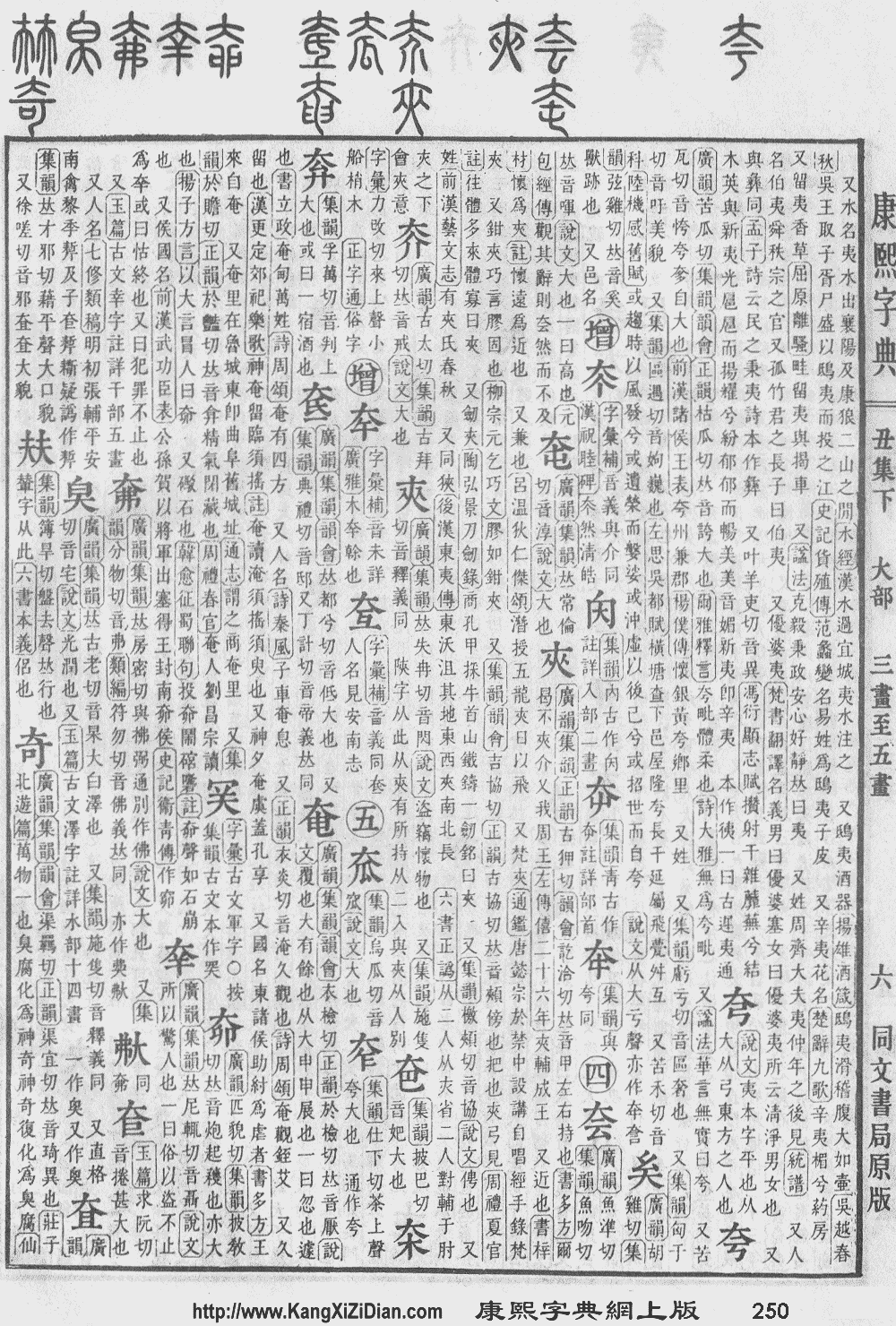
[edit]- Kangxi Dictionary: page 250, character 21
- Dai Kanwa Jiten: character 5881
- Dae Jaweon: page 510, character 8
- Hanyu Da Zidian (first edition): volume 1, page 534, character 3
- Unihan data for U+5944
Chinese
[edit]| trad. | 奄 | |
|---|---|---|
| simp. # | 奄 | |
| alternative forms | 闇/暗 suddenly | |
Glyph origin
[edit]| Historical forms of the character 奄 | ||
|---|---|---|
| Western Zhou | Shuowen Jiezi (compiled in Han) | Liushutong (compiled in Ming) |
| Bronze inscriptions | Small seal script | Transcribed ancient scripts |
Chen (2021): Phono-semantic compound (形聲 / 形声, OC *qromʔ): abbreviated semantic 盍 + phonetic 甲 (OC *kraːb)[1] — original form of 掩 (OC *qromʔ, “to cover”).
Shuowen: ideogrammic compound (會意 / 会意): 大 (“big”) + 申 (“extend”) – to cover.
Pronunciation 1
[edit]- Mandarin
- (Standard Chinese)+
- Hanyu Pinyin: yǎn
- Zhuyin: ㄧㄢˇ
- Tongyong Pinyin: yǎn
- Wade–Giles: yen3
- Yale: yǎn
- Gwoyeu Romatzyh: yean
- Palladius: янь (janʹ)
- Sinological IPA (key): /jɛn²¹⁴/
- (Standard Chinese)+
- Cantonese
- (Standard Cantonese, Guangzhou–Hong Kong)
- Jyutping: jim2
- Yale: yím
- Cantonese Pinyin: jim2
- Guangdong Romanization: yim2
- Sinological IPA (key): /jiːm³⁵/
- (Standard Cantonese, Guangzhou–Hong Kong)
- Southern Min
- Middle Chinese: 'jemX
- Old Chinese
- (Baxter–Sagart): /*ʔ(r)omʔ/
- (Zhengzhang): /*qromʔ/
Definitions
[edit]奄
- (obsolete on its own in Standard Chinese) to cover; to surround; to include
- (obsolete on its own in Standard Chinese) suddenly; abruptly; quickly; hastily
Compounds
[edit]Pronunciation 2
[edit]- Mandarin
- (Standard Chinese, standard in Mainland)+
- Hanyu Pinyin: yǎn
- Zhuyin: ㄧㄢˇ
- Tongyong Pinyin: yǎn
- Wade–Giles: yen3
- Yale: yǎn
- Gwoyeu Romatzyh: yean
- Palladius: янь (janʹ)
- Sinological IPA (key): /jɛn²¹⁴/
- (Standard Chinese, standard in Taiwan; variant in Mainland)+
- Hanyu Pinyin: yān
- Zhuyin: ㄧㄢ
- Tongyong Pinyin: yan
- Wade–Giles: yen1
- Yale: yān
- Gwoyeu Romatzyh: ian
- Palladius: янь (janʹ)
- Sinological IPA (key): /jɛn⁵⁵/
- (Standard Chinese, standard in Mainland)+
- Cantonese
- (Standard Cantonese, Guangzhou–Hong Kong)
- Jyutping: jim1
- Yale: yīm
- Cantonese Pinyin: jim1
- Guangdong Romanization: yim1
- Sinological IPA (key): /jiːm⁵⁵/
- (Standard Cantonese, Guangzhou–Hong Kong)
- Southern Min
- (Hokkien: Xiamen, Quanzhou, Zhangzhou)
- Pe̍h-ōe-jī: iám
- Tâi-lô: iám
- Phofsit Daibuun: iarm
- Sinological IPA (Xiamen, Zhangzhou): /iam⁵³/
- Sinological IPA (Quanzhou): /iam⁵⁵⁴/
- (Hokkien: Quanzhou)
- Pe̍h-ōe-jī: iam
- Tâi-lô: iam
- Phofsit Daibuun: iafm
- Sinological IPA (Quanzhou): /iam³³/
- (Hokkien: General Taiwanese)
- Pe̍h-ōe-jī: am
- Tâi-lô: am
- Phofsit Daibuun: afm
- Sinological IPA (Taipei, Kaohsiung): /am⁴⁴/
- (Hokkien: Xiamen, Quanzhou, Zhangzhou)
Definitions
[edit]奄
Compounds
[edit]
Pronunciation 3
[edit]- Mandarin
- (Standard Chinese)+
- Hanyu Pinyin: yān
- Zhuyin: ㄧㄢ
- Tongyong Pinyin: yan
- Wade–Giles: yen1
- Yale: yān
- Gwoyeu Romatzyh: ian
- Palladius: янь (janʹ)
- Sinological IPA (key): /jɛn⁵⁵/
- (Standard Chinese)+
- Cantonese
- (Standard Cantonese, Guangzhou–Hong Kong)
- Jyutping: jim1
- Yale: yīm
- Cantonese Pinyin: jim1
- Guangdong Romanization: yim1
- Sinological IPA (key): /jiːm⁵⁵/
- (Standard Cantonese, Guangzhou–Hong Kong)
Definitions
[edit]奄
- (obsolete on its own in Standard Chinese) alternative form of 閹 / 阉 (yān, “to castrate; eunuch”)
- (obsolete on its own in Standard Chinese) alternative form of 淹 (yān, “to remain; to tarry”)
Compounds
[edit]Pronunciation 4
[edit]- Cantonese
- (Standard Cantonese, Guangzhou–Hong Kong)
- Jyutping: am1
- Yale: ām
- Cantonese Pinyin: am1
- Guangdong Romanization: em1
- Sinological IPA (key): /ɐm⁵⁵/
- (Standard Cantonese, Guangzhou–Hong Kong)
Note: The zero initial /∅-/ is commonly pronounced with a ng-initial /ŋ-/ in some varieties of Cantonese, including Hong Kong Cantonese.
Compounds
[edit]References
[edit]- ^ 陳剣 「説“規”等字並論一些特別的形声字意符」 『源遠流長――漢字国際学術検討会暨AEARU第三届漢字文化検討会論文集』 楊栄祥、胡勅瑞主編、北京大学出版社、2017年、10-12頁。
Japanese
[edit]Kanji
[edit]奄
Readings
[edit]- Go-on: えん (en)←えん (en, historical)←えむ (emu, ancient)
- Kan-on: えん (en)←えん (en, historical)←えむ (emu, ancient)
- Kun: おおう (ōu, 奄う)←おほふ (ofofu, 奄ふ, historical)、たちまち (tachimachi, 奄ち)、ふさがる (fusagaru, 奄がる)
- Nanori: あま (ama)
Korean
[edit]Hanja
[edit]奄 • (eom) (hangeul 엄, revised eom, McCune–Reischauer ŏm)
- This term needs a translation to English. Please help out and add a translation, then remove the text
{{rfdef}}.
Vietnamese
[edit]Han character
[edit]奄: Hán Nôm readings: yêm, yểm, ăm, im, em
- This term needs a translation to English. Please help out and add a translation, then remove the text
{{rfdef}}.
References
[edit]Categories:
- Character boxes with images
- CJK Unified Ideographs block
- Han script characters
- CJK Compatibility Ideographs block
- Unspecified script characters
- Translingual lemmas
- Translingual symbols
- Han phono-semantic compounds
- Han ideogrammic compounds
- Chinese lemmas
- Mandarin lemmas
- Cantonese lemmas
- Hokkien lemmas
- Middle Chinese lemmas
- Old Chinese lemmas
- Chinese hanzi
- Mandarin hanzi
- Cantonese hanzi
- Hokkien hanzi
- Middle Chinese hanzi
- Old Chinese hanzi
- Chinese verbs
- Mandarin verbs
- Cantonese verbs
- Hokkien verbs
- Middle Chinese verbs
- Old Chinese verbs
- Chinese adverbs
- Mandarin adverbs
- Cantonese adverbs
- Hokkien adverbs
- Middle Chinese adverbs
- Old Chinese adverbs
- Chinese terms with IPA pronunciation
- Chinese terms spelled with 奄
- Chinese terms with obsolete senses
- Mandarin terms with multiple pronunciations
- Chinese adjectives
- Mandarin adjectives
- Cantonese adjectives
- Hokkien adjectives
- Chinese proper nouns
- Mandarin proper nouns
- Cantonese proper nouns
- Hokkien proper nouns
- Chinese surnames
- Chinese nouns
- Mandarin nouns
- Cantonese nouns
- Japanese kanji
- Japanese jinmeiyō kanji
- Japanese kanji with goon reading えん
- Japanese kanji with historical goon reading えん
- Japanese kanji with ancient goon reading えむ
- Japanese kanji with kan'on reading えん
- Japanese kanji with historical kan'on reading えん
- Japanese kanji with ancient kan'on reading えむ
- Japanese kanji with kun reading おお・う
- Japanese kanji with historical kun reading おほ・ふ
- Japanese kanji with kun reading たちま・ち
- Japanese kanji with kun reading ふさ・がる
- Japanese kanji with nanori reading あま
- Korean lemmas
- Korean hanja
- Vietnamese lemmas
- Vietnamese Han characters