chai
English
[edit]Etymology 1
[edit]Borrowed from Romani ćhaj (“Romani girl, daughter”).
Noun
[edit]chai (plural chais)
Alternative forms
[edit]Etymology 2
[edit]From Hindustani चाय / چائے (cāy, “tea”), from Classical Persian چَای (čāy) (and Turkish çay, and cognates)[1] from Sinitic 茶 (chá).[2] Doublet of tea; see that page for extended history.
Pronunciation
[edit]Noun
[edit]chai (usually uncountable, plural chais)
- Ellipsis of masala chai, a beverage made with black teas, steamed milk and sweet spices, based loosely on Indian recipes.
- 2023, Santanu Bhattacharya, One Small Voice, Fig Tree, page 350:
- ‘So much for making chai,ʼ she teases, but lets him do the rest of the work. He adds the tea leaves to the boiling milk, then strains the liquid into cups.
Synonyms
[edit]Derived terms
[edit]Related terms
[edit]Translations
[edit]Etymology 3
[edit]
Borrowed from Hebrew חַי (kháy, “alive”).
Pronunciation
[edit]Noun
[edit]chai
- (Judaism) A Jewish symbol representing life, traditionally worn as an amulet.
- 2011 February 18, Mark Marino, “Kosher beef between two rappers”, in CNN[2], archived from the original on 1 February 2023:
- Today, he [Drake] wears a diamond-studded Chai, a symbol of the Jewish word for life, and has his mother pressuring him to marry "a nice Jewish girl," according to Heeb magazine.
Alternative forms
[edit]Etymology 4
[edit]Borrowed from French chai, from Occitan.
Pronunciation
[edit]Noun
[edit]chai (plural chais)
- (winemaking) A place above ground for storing wine casks.
References
[edit]- ^ “chai”, in Merriam-Webster Online Dictionary, Springfield, Mass.: Merriam-Webster, 1996–present.
- ^ “chai”, in Dictionary.com Unabridged, Dictionary.com, LLC, 1995–present.
Further reading
[edit] chai on Wikipedia.Wikipedia
 - chai (symbol) on Wikipedia.Wikipedia

Anagrams
[edit]Caló
[edit]Etymology
[edit]Noun
[edit]chai f (plural chais)
- girl
- (antiphrastic) harlot, prostitute
References
[edit]- “chai” in J. Tineo Rebolledo, A Chipicalli (La Llengua Gitana), Granada: Gómez de la Cruz, 1900, →OCLC, page 32.
- “chai” in Francisco Quindalé, Diccionario gitano, Madrid: Oficina Tipográfica del Hospicio.
- “chai” in Vocabulario : Caló - Español, Portal del Flamenco y Universidad.
Finnish
[edit]Pronunciation
[edit]Noun
[edit]chai (colloquial)
- (jargon) Clipping of chai latte (“chai latte”).
Declension
[edit]| Inflection of chai (Kotus type 18/maa, no gradation) | |||
|---|---|---|---|
| nominative | chai | chait | |
| genitive | chain | chaiden chaitten | |
| partitive | chaita | chaita | |
| illative | chaihin | chaihin | |
| singular | plural | ||
| nominative | chai | chait | |
| accusative | nom. | chai | chait |
| gen. | chain | ||
| genitive | chain | chaiden chaitten | |
| partitive | chaita | chaita | |
| inessive | chaissa | chaissa | |
| elative | chaista | chaista | |
| illative | chaihin | chaihin | |
| adessive | chailla | chailla | |
| ablative | chailta | chailta | |
| allative | chaille | chaille | |
| essive | chaina | chaina | |
| translative | chaiksi | chaiksi | |
| abessive | chaitta | chaitta | |
| instructive | — | chain | |
| comitative | See the possessive forms below. | ||
French
[edit]Etymology 1
[edit]Via English chai from Urdu چائے (cāe), Hindi चाय (cāy, “tea”). Doublet of thé.
Alternative forms
[edit]Pronunciation
[edit]Noun
[edit]chai m (plural chais)
- masala chai (a tea drink)
Etymology 2
[edit]Borrowed from Occitan [Term?].
Pronunciation
[edit]Noun
[edit]chai m (plural chais)
- wine cellar
- Synonym: cave à vin
- Mis en bouteille dans nos chais. ― Bottled in our wine cellars.
Further reading
[edit]- “chai”, in Trésor de la langue française informatisé [Digitized Treasury of the French Language], 2012.
Hokkien
[edit]| For pronunciation and definitions of chai – see 知 (“to know; to understand; to comprehend; to cause to know; to tell; to inform; etc.”). (This term is the pe̍h-ōe-jī form of 知). |
Jamaican Creole
[edit]Verb
[edit]chai
- (Maroon Spirit Language) Carry.
Mandarin
[edit]Romanization
[edit]chai
- Nonstandard spelling of chāi.
- Nonstandard spelling of chái.
- Nonstandard spelling of chǎi.
- Nonstandard spelling of chài.
Usage notes
[edit]- Transcriptions of Mandarin into the Latin script often do not distinguish between the critical tonal differences employed in the Mandarin language, using words such as this one without indication of tone.
Navajo
[edit]Pronunciation
[edit]Noun
[edit]-chai (inalienable, e.g., shichai "my grandfather/grandson", bichai "her/his/their grandfather/grandson")
- maternal grandfather, mother's father, grandson (from daughter), daughter's son
Norman
[edit]Alternative forms
[edit]Etymology
[edit](This etymology is missing or incomplete. Please add to it, or discuss it at the Etymology scriptorium.)
Noun
[edit]chai f (uncountable)
Palauan
[edit]Etymology 1
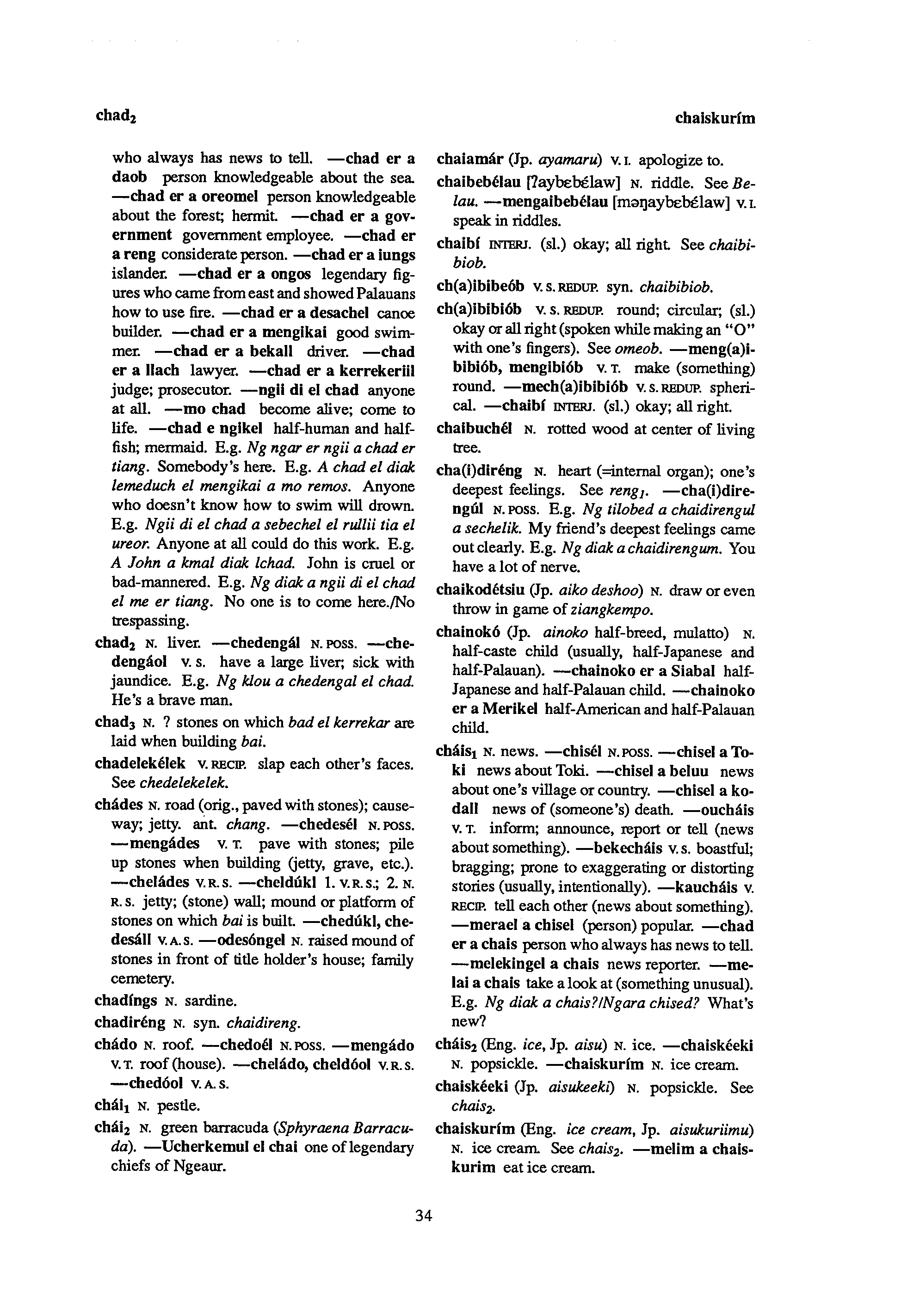
[edit]Inherited from Proto-Malayo-Polynesian *qahəlu (“pestle”). Compare Malay alu (“pestle”).
Noun
[edit]chai
Etymology 2
[edit]Inherited from Proto-Malayo-Polynesian *qalu (“barracuda”). Compare Malay alu-alu (“barracuda”).
Noun
[edit]chai
References
[edit]- chai in Palauan Language Online: Palauan-English Dictionary, at tekinged.com.
- chai in Palauan-English Dictionary, at trussel2.com.
- chai in Lewis S. Josephs, Edwin G. McManus, Masa-aki Emesiochel (1977) Palauan-English Dictionary, University Press of Hawaii, →ISBN, page 34.
Swahili
[edit]

Etymology
[edit]Borrowed from Classical Persian چای (čāy)
Pronunciation
[edit]Noun
[edit]chai (n class, plural chai)
- tea
- (Tanzania) breakfast
- Synonyms: chakula cha asubuhi, staftahi, (Kenya) kiamsha kinywa, (Tanzania) kifungua kinywa
- (slang, Kenya) tea money, small bribe, petty bribe (likened to the cost, and function, of a cup of tea)
- Synonyms: rushwa, hongo, (Kenya) kitu kidogo
Derived terms
[edit]Tày
[edit]Pronunciation
[edit]- (Thạch An – Tràng Định) IPA(key): [caːj˧˧]
- (Trùng Khánh) IPA(key): [caːj˦˥]
Etymology 1
[edit]Noun
[edit]chai
- bottle
- chai lẩu ― bottle of wine
Etymology 2
[edit]Verb
[edit]chai
- to fast
- chai tón nâng ― to fast for one meal
Adjective
[edit]chai (⿻斋丷)
- vegan, especially in the Buddhist style
- kin chai ― to go vegan
- 否容易𫩒{⿻斋丷}地下
- Bấu doòng dỉ kin chai tỉ giả
- It's not easy to be a vegan on Earth.
- in an ordinary, even lackluster, way
- kin khẩu chai ― to eat plain rice
- old, specifically past something's developmental phase
- mảy khửn chai
- bamboo shoots that grow even when it's too old to grow
References
[edit]- Hoàng Văn Ma, Lục Văn Pảo, Hoàng Chí (2006) Từ điển Tày-Nùng-Việt [Tay-Nung-Vietnamese dictionary] (in Vietnamese), Hanoi: Nhà xuất bản Từ điển Bách khoa Hà Nội
- Lương Bèn (2011) Từ điển Tày-Việt [Tay-Vietnamese dictionary][3][4] (in Vietnamese), Thái Nguyên: Nhà Xuất bản Đại học Thái Nguyên
- Lục Văn Pảo, Hoàng Tuấn Nam (2003) Hoàng Triều Ân, editor, Từ điển chữ Nôm Tày [A Dictionary of (chữ) Nôm Tày][5] (in Vietnamese), Hanoi: Nhà xuất bản Khoa học Xã hội
Vietnamese
[edit]Pronunciation
[edit]- (Hà Nội) IPA(key): [t͡ɕaːj˧˧]
- (Huế) IPA(key): [t͡ɕaːj˧˧]
- (Saigon) IPA(key): [caːj˧˧]
- Homophone: trai
Noun
[edit]Descendants
[edit]Adjective
[edit]chai
- (of skin) callous
- vết chai ― a callus
- bị chai tay ― to have calluses on one's hand
- chai sạn ― callous; apathetic
- (of a battery) spent
- pin bị chai rồi ― the battery's no good anymore (won't hold a charge)
Anagrams
[edit]Ye'kwana
[edit]| ALIV | chai |
|---|---|
| Brazilian standard | chai |
| New Tribes | chai |
Pronunciation
[edit]Suffix
[edit]chai
- English terms borrowed from Romani
- English terms derived from Romani
- English lemmas
- English nouns
- English countable nouns
- English terms borrowed from Hindustani languages
- English terms derived from Hindustani languages
- English terms derived from Classical Persian
- English terms derived from Turkish
- English terms derived from Sinitic languages
- English doublets
- English 1-syllable words
- English terms with IPA pronunciation
- English terms with audio pronunciation
- English terms with homophones
- Rhymes:English/aɪ
- Rhymes:English/aɪ/1 syllable
- English uncountable nouns
- English ellipses
- English terms with quotations
- English terms borrowed from Hebrew
- English terms derived from Hebrew
- English nouns with unknown or uncertain plurals
- en:Judaism
- English terms borrowed from French
- English terms derived from French
- English terms derived from Occitan
- en:Wine
- en:Tea
- Caló terms inherited from Romani
- Caló terms derived from Romani
- Caló lemmas
- Caló nouns
- Caló feminine nouns
- rmq:Female people
- Finnish 1-syllable words
- Finnish terms with IPA pronunciation
- Rhymes:Finnish/ɑi
- Rhymes:Finnish/ɑi/1 syllable
- Finnish lemmas
- Finnish nouns
- Finnish terms spelled with C
- Finnish colloquialisms
- Finnish clippings
- Finnish maa-type nominals
- French terms borrowed from English
- French terms derived from English
- French terms derived from Urdu
- French terms derived from Hindi
- French doublets
- French 1-syllable words
- French terms with IPA pronunciation
- French lemmas
- French nouns
- French countable nouns
- French masculine nouns
- French terms borrowed from Occitan
- French terms derived from Occitan
- French terms with homophones
- French terms with usage examples
- fr:Tea
- fr:Wine
- Chinese lemmas
- Hokkien lemmas
- Chinese verbs
- Hokkien verbs
- Chinese nouns
- Hokkien nouns
- Hokkien pe̍h-ōe-jī forms
- Jamaican Creole lemmas
- Jamaican Creole verbs
- Hanyu Pinyin
- Mandarin non-lemma forms
- Mandarin nonstandard forms
- Navajo terms with IPA pronunciation
- Navajo lemmas
- Navajo nouns
- nv:Family
- Norman lemmas
- Norman nouns
- Norman feminine nouns
- French Norman
- Jersey Norman
- Palauan terms inherited from Proto-Malayo-Polynesian
- Palauan terms derived from Proto-Malayo-Polynesian
- Palauan lemmas
- Palauan nouns
- pau:Fish
- pau:Tools
- Swahili terms borrowed from Classical Persian
- Swahili terms derived from Classical Persian
- Swahili terms with audio pronunciation
- Swahili lemmas
- Swahili nouns
- Swahili n class nouns
- Tanzanian Swahili
- Swahili slang
- Kenyan Swahili
- sw:Beverages
- sw:Meals
- sw:Corruption
- Tày terms with IPA pronunciation
- Tày lemmas
- Tày nouns
- Tày terms with usage examples
- Tày verbs
- Tày adjectives
- Vietnamese terms with IPA pronunciation
- Vietnamese terms with homophones
- Vietnamese nouns classified by cái
- Vietnamese lemmas
- Vietnamese nouns
- Vietnamese slang
- Vietnamese adjectives
- Vietnamese terms with usage examples
- vi:Containers
- vi:Skin
- Ye'kwana terms with IPA pronunciation
- Ye'kwana lemmas
- Ye'kwana suffixes