幺
Jump to navigation
Jump to search
| ||||||||
| ||||||||
| ||||||||
Translingual[edit]
| Stroke order | |||
|---|---|---|---|

| |||
Han character[edit]

幺 (Kangxi radical 52, 幺+0, 3 strokes, cangjie input 女戈 (VI), composition ⿽𠃋厶(GHT) or ⿽𡿨厶(JK))
- Kangxi radical #52, ⼳.
Derived characters[edit]
Descendants[edit]
- ㄠ (Zhuyin alphabet)
References[edit]
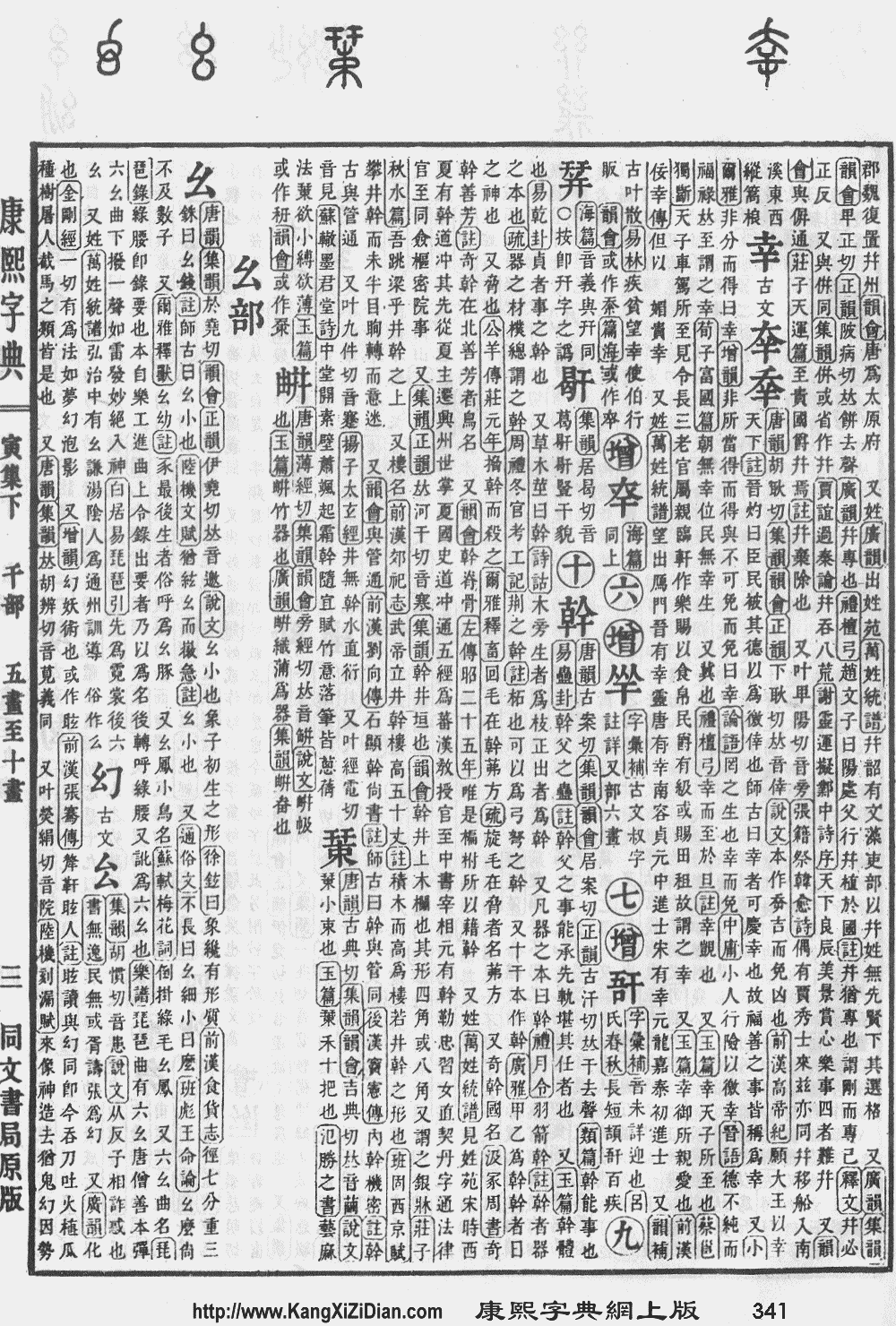
- Kangxi Dictionary: page 341, character 12
- Dai Kanwa Jiten: character 9189
- Dae Jaweon: page 650, character 6
- Hanyu Da Zidian (first edition): volume 2, page 1092, character 14
- Unihan data for U+5E7A
Chinese[edit]
| simp. and trad. |
幺 | |
|---|---|---|
| alternative forms | 么 𡆩 | |
Glyph origin[edit]
| Historical forms of the character 幺 | |
|---|---|
| Western Zhou | Shuowen Jiezi (compiled in Han) |
| Bronze inscriptions | Small seal script |

|

|
Pictogram (象形) . Depiction of a silk thread. Compare 糸.
Etymology 1[edit]
Pronunciation[edit]
Definitions[edit]
幺
- tiny; minute
- youngest
- 老幺 ― lǎoyāo ― informal manner of referring to the last (youngest) child in a family
- (dialectal) one
- one (used to reduce ambiguity when saying the numeral 1, especially on the phone, when reading an ID card, in aviation, or in the military)
- ace; one on dice or dominoes
- (mathematics) related to number 1
- a surname
- (Mainland China) yocto- (SI unit prefix)
- Synonym: 攸 (yōu) (Taiwan)
Synonyms[edit]
- (one):
Compounds[edit]
Usage notes[edit]
- 么 is used instead of 幺 in mahjong and as a surname. Xiandai Hanyu Guifan Cidian (《现代汉语规范词典》) says '幺' and '么' are different characters.
See also[edit]
| SI prefix | ||
|---|---|---|
| Last | Next | |
| 介/仄 | 攸/幺 | 絨/柔/绒/柔 |
Etymology 2[edit]
| For pronunciation and definitions of 幺 – see 糸 (“thin silk”). (This character is a variant form of 糸). |
Japanese[edit]
Kanji[edit]
幺
Readings[edit]
Usage notes[edit]
- As a radical it is generally referred to as いとがしら (itogashira).
- The variant form 么 is often used in mahjong terms.
Korean[edit]
Hanja[edit]
幺 • (yo) (hangeul 요, revised yo, McCune–Reischauer yo)
- This term needs a translation to English. Please help out and add a translation, then remove the text
{{rfdef}}.
Vietnamese[edit]
Han character[edit]
- This term needs a translation to English. Please help out and add a translation, then remove the text
{{rfdef}}.
Categories:
- CJK Unified Ideographs block
- Han script characters
- Kangxi Radicals block
- CJK Radicals Supplement block
- Han character radicals
- Translingual lemmas
- Translingual symbols
- Han pictograms
- Mandarin terms with audio links
- Mandarin terms with multiple pronunciations
- Middle Chinese lemmas
- Old Chinese lemmas
- Chinese lemmas
- Mandarin lemmas
- Sichuanese lemmas
- Cantonese lemmas
- Hakka lemmas
- Hokkien lemmas
- Teochew lemmas
- Wu lemmas
- Chinese adjectives
- Mandarin adjectives
- Sichuanese adjectives
- Cantonese adjectives
- Hakka adjectives
- Hokkien adjectives
- Teochew adjectives
- Wu adjectives
- Chinese nouns
- Mandarin nouns
- Sichuanese nouns
- Cantonese nouns
- Hakka nouns
- Hokkien nouns
- Teochew nouns
- Wu nouns
- Chinese proper nouns
- Mandarin proper nouns
- Sichuanese proper nouns
- Cantonese proper nouns
- Hakka proper nouns
- Hokkien proper nouns
- Teochew proper nouns
- Wu proper nouns
- Chinese terms with IPA pronunciation
- Chinese Han characters
- Mandarin terms with usage examples
- Chinese dialectal terms
- zh:Mathematics
- Chinese surnames
- Mainland China Chinese
- Chinese variant forms
- Chinese numeral symbols
- Chinese numerals
- Japanese Han characters
- Uncommon kanji
- Japanese kanji with on reading よう
- Japanese kanji with kun reading ちいさい
- Korean lemmas
- Korean Han characters
- Vietnamese lemmas
- Vietnamese Han characters
- CJKV radicals