mad
Translingual[edit]
Symbol[edit]
mad
English[edit]
Etymology[edit]
From Middle English mad, madde, madd, medd, from Old English ġemǣdd, ġemǣded (“enraged”), past participle of ġemǣdan, *mǣdan (“to make insane or foolish”), from Proto-Germanic *maidijaną (“to change; damage; cripple; injure; make mad”), from Proto-Germanic *maidaz ("weak; crippled"; compare Old English gemād (“silly, mad”), Old High German gimeit (“foolish, crazy”), literary German gemeit (“mad, insane”), Gothic 𐌲𐌰𐌼𐌰𐌹𐌸𐍃 (gamaiþs, “crippled”)), from Proto-Indo-European *mey- ("to change"; compare Old Irish máel (“bald, dull”), Old Lithuanian ap-maitinti (“to wound”), Sanskrit मेथति (méthati, “he hurts, comes to blows”)).
Pronunciation[edit]
Adjective[edit]
mad (comparative madder, superlative maddest)
- (chiefly British Isles) Insane; crazy, mentally deranged.
- You want to spend $1000 on a pair of shoes? Are you mad?
- He's got this mad idea that he's irresistible to women.
- c. 1588–1593 (date written), William Shakespeare, “The Lamentable Tragedy of Titus Andronicus”, in Mr. William Shakespeares Comedies, Histories, & Tragedies […] (First Folio), London: […] Isaac Iaggard, and Ed[ward] Blount, published 1623, →OCLC, [Act IV, scene i]:
- I have heard my grandsire say full oft, / Extremity of griefs would make men mad.
- 2008, BioWare, Mass Effect (Science Fiction), Redwood City: Electronic Arts, →ISBN, →OCLC, PC, scene: Eden Prime:
- Dr. Manuel: Is it madness to see the future? To see the destruction rushing towards us? To understand there is no escape? No hope? No, I am not mad. I'm the only sane one left!
- (chiefly US; informal in UK) Angry, annoyed.
- Are you mad at me?
- 1611, The Holy Bible, […] (King James Version), London: […] Robert Barker, […], →OCLC, Acts 26:11:
- And I punished them oft in euery Synagogue, and compelled them to blaspheme, and being exceedingly mad against them, I persecuted them euen vnto strange cities.
- 1913, Joseph C[rosby] Lincoln, chapter VI, in Mr. Pratt’s Patients, New York, N.Y., London: D[aniel] Appleton and Company, →OCLC:
- She was so mad she wouldn't speak to me for quite a spell, but at last I coaxed her into going up to Miss Emmeline's room and fetching down a tintype of the missing Deacon man.
- (chiefly in the negative, informal) Used litotically to indicate satisfaction or approval.
- Wow, you really made this pie from scratch? I'm not mad at it.
- (UK, informal) Bizarre; incredible.
- It's mad that I got that job back a day after being fired.
- Wildly confused or excited.
- to be mad with terror, lust, or hatred
- 1611, The Holy Bible, […] (King James Version), London: […] Robert Barker, […], →OCLC, Jeremiah 1:88:
- It is the land of graven images, and they are mad upon their idols.
- 1787, R. Bage, The Fair Syrian, page 314:
- My brother, quiet as a cat, seems perfectly contented with the internal feelings of his felicity. The Marquis, mad as a kitten, is all in motion to express it, from tongue to heel.
- Extremely foolish or unwise; irrational; imprudent.
- (colloquial, usually with for or about) Extremely enthusiastic about; crazy about; infatuated with; overcome with desire for.
- Aren't you just mad for that red dress?
- (of animals) Abnormally ferocious or furious; or, rabid, affected with rabies.
- a mad dog
- (slang, chiefly New York, African-American Vernacular) Intensifier, signifying abundance or high quality of a thing; very, much or many.
- I gotta give you mad props for scoring us those tickets.
Their lead guitarist has mad skills.
There are always mad girls at those parties.
- (of a compass needle) Having impaired polarity.
Usage notes[edit]
- In Commonwealth countries other than Canada, mad typically implies the insane or crazy sense more so than the angry sense.
- In the United States and Canada, the word mad refers to anger much more often than madness, but such usage is still considered informal by some speakers and labeled as such even in North American English by most UK dictionaries. This is due to an old campaign (since 1781 by amateur language pundits) to discredit the angry sense of the word that was more effective in the UK than in North America. Though not as old as the sense denoting insanity, the sense relating to anger is certainly very old (going back at least to the fourteenth century).[1]
- On the other hand, if one is described as having "went mad" or "gone mad" in North America, this denotes insanity, and not anger. Meanwhile, if one "is mad at" something or has "been mad about" something, it is understood that they are angered rather than insane. In addition, such derivatives as "madness", "madman", "madhouse" and "madly" always denote insanity, irrespective of whether one is in the Commonwealth or in North America.
Synonyms[edit]
- (insane): See also Thesaurus:insane
- (angry): See also Thesaurus:angry
- (slang: Intensifier, much): wicked, mighty, kinda, helluv, hella.
Translations[edit]
|
|
Adverb[edit]
mad (not comparable)
- (slang, chiefly New York, African-American Vernacular and UK, dialectal) Intensifier; to a large degree; extremely; exceedingly; very; unbelievably.
- He was driving mad slow.
- It's mad hot today.
- He seems mad keen on her.
Synonyms[edit]
Verb[edit]
mad (third-person singular simple present mads, present participle madding, simple past and past participle madded)
- (obsolete, intransitive) To be or become mad. [14th–19th c.]
- 1832, Tales of the Alhambra, Washington Irving:
- The imperial Elizabetta gazed with surprise at the youthful and unpretending appearance of the little being that had set the world madding.
- (now colloquial US, Jamaica) To madden, to anger, to frustrate. [from 15th c.]
- 1595 December 9 (first known performance), William Shakespeare, “The life and death of King Richard the Second”, in Mr. William Shakespeares Comedies, Histories, & Tragedies: Published According to the True Originall Copies (First Folio), London: […] Isaac Iaggard, and Ed[ward] Blount, published 1623, →OCLC, [Act V, scene 5]:
- This musick mads me, let it sound no more.
- 1624, Democritus Junior [pseudonym; Robert Burton], The Anatomy of Melancholy: […], 2nd edition, Oxford, Oxfordshire: Printed by John Lichfield and James Short, for Henry Cripps, →OCLC, partition I, section 2, member 4, subsection iv:
- He that mads others, if he were so humoured, would be as mad himself, as much grieved and tormented […] .
- 1993 March 22, “Oh Carolina”, in Pure Pleasure[3], performed by Shaggy (musician):
- Carolina! Whine your body gyal! Make Dem know say you have it fi mad dem
Derived terms[edit]
- all over the place like a mad woman's custard
- as mad as a cut snake
- barking mad
- bemad
- big mad
- big mad
- boiling mad
- drive someone mad
- flaming mad
- hopping mad
- horn-mad
- like hey-go-mad
- like mad
- little mad
- little mad
- mad-apple
- mad as a bear with a sore head
- mad as a box of frogs
- mad as a brush
- mad as a cut snake
- mad as a fish
- mad as a hatter / mad hatter
- mad as a hornet
- mad as a March hare
- mad as a meat axe
- mad as a mongoose
- mad as a wet hen
- mad as hops
- madbrain
- madbrained
- mad-cap
- madcap
- Madchester
- mad cow
- mad cow disease
- madden
- madding
- maddish
- maddle
- mad-doctor
- mad dog
- mad-dog
- mad dogs and Englishmen
- mad enough to chew nails
- mad for it
- mad hatter disease
- mad hatter syndrome
- madhead
- mad honey
- madhouse
- mad itch
- Mad King George
- mad lad
- Mad Lib
- madling
- madly
- mad man
- madman
- mad minute
- mad money
- madness
- mad on
- mad-on
- madperson
- mad professor
- mad props
- mad queen chess
- Mad River
- mad science
- mad scientist
- madsome
- madstone
- mad with it
- madwoman
- madwort
- mald
- malding
- raging mad
- rip-snorting mad
- run mad
- semimad
- spitting mad
- stark raving mad
- stark staring mad
- unmad
References[edit]
Anagrams[edit]
Breton[edit]
Etymology[edit]
From Proto-Brythonic *mad, from Proto-Celtic *matis.
Adjective[edit]
mad
Noun[edit]
mad
Danish[edit]

Etymology 1[edit]
From Old Norse matr, from Proto-Germanic *matiz, cognate with Norwegian, Swedish mat (“food”), English meat, German Mett (from Low German).
Pronunciation[edit]
Noun[edit]
mad c (singular definite maden, not used in plural form)
Declension[edit]
| common gender |
Singular | |
|---|---|---|
| indefinite | definite | |
| nominative | mad | maden |
| genitive | mads | madens |
Derived terms[edit]
- babymad
- aftensmad
- morgenmad
- natmad
- madglad
Noun[edit]
mad c (singular definite madden, plural indefinite madder)
- a slice of bread with something on top.
Usage notes[edit]
Very compound-prone; see for example ostemad or pølsemad.
Declension[edit]
Derived terms[edit]
Etymology 2[edit]
See the etymology of the corresponding lemma form.
Pronunciation[edit]
Verb[edit]
mad
- imperative of made
Middle English[edit]
Etymology 1[edit]
From Old English ġemǣdd, ġemǣded, the past participle of ġemǣdan.
Alternative forms[edit]
Pronunciation[edit]
Adjective[edit]
mad (plural and weak singular madde, comparative madder, superlative maddyst)
- Mad, insane, deranged; not of sound mind.
- Emotionally overwhelmed; consumed by mood or feelings.
- Perplexed, bewildered; surprised emotionally.
- Irate, rageful; having much anger or fury.
- Idiotic or dumb; badly thought out or conceived
- (rare) Obstinate, incautious, overenthusiastic.
- (rare) Distraught, sad, unhappy.
- (rare) Scatterbrained or absent-minded.
Derived terms[edit]
Descendants[edit]
References[edit]
- “mā̆d, adj.”, in MED Online, Ann Arbor, Mich.: University of Michigan, 2007, retrieved 2019-03-09.
Etymology 2[edit]
Derived from the adjective.
Verb[edit]
mad
- Alternative form of madden
Etymology 3[edit]
Pronunciation[edit]
Verb[edit]
mad
- past participle of make
Old Irish[edit]
Pronunciation[edit]
Etymology 1[edit]
Univerbation of má (“if”) + ba/bid
Verb[edit]
mad
For quotations using this term, see Citations:mad.
Etymology 2[edit]
A reduced form of maith (“good”).
Adverb[edit]
mad
Descendants[edit]
Further reading[edit]
- G. Toner, M. Ní Mhaonaigh, S. Arbuthnot, D. Wodtko, M.-L. Theuerkauf, editors (2019), “mad”, in eDIL: Electronic Dictionary of the Irish Language
Mutation[edit]
| Old Irish mutation | ||
|---|---|---|
| Radical | Lenition | Nasalization |
| mad also mmad after a proclitic |
mad pronounced with /ṽ(ʲ)-/ |
unchanged |
| Note: Some of these forms may be hypothetical. Not every possible mutated form of every word actually occurs. | ||
Palauan[edit]
Etymology 1[edit]
From Pre-Palauan *maða, from Proto-Malayo-Polynesian *mata, from Proto-Austronesian *maCa.
Noun[edit]
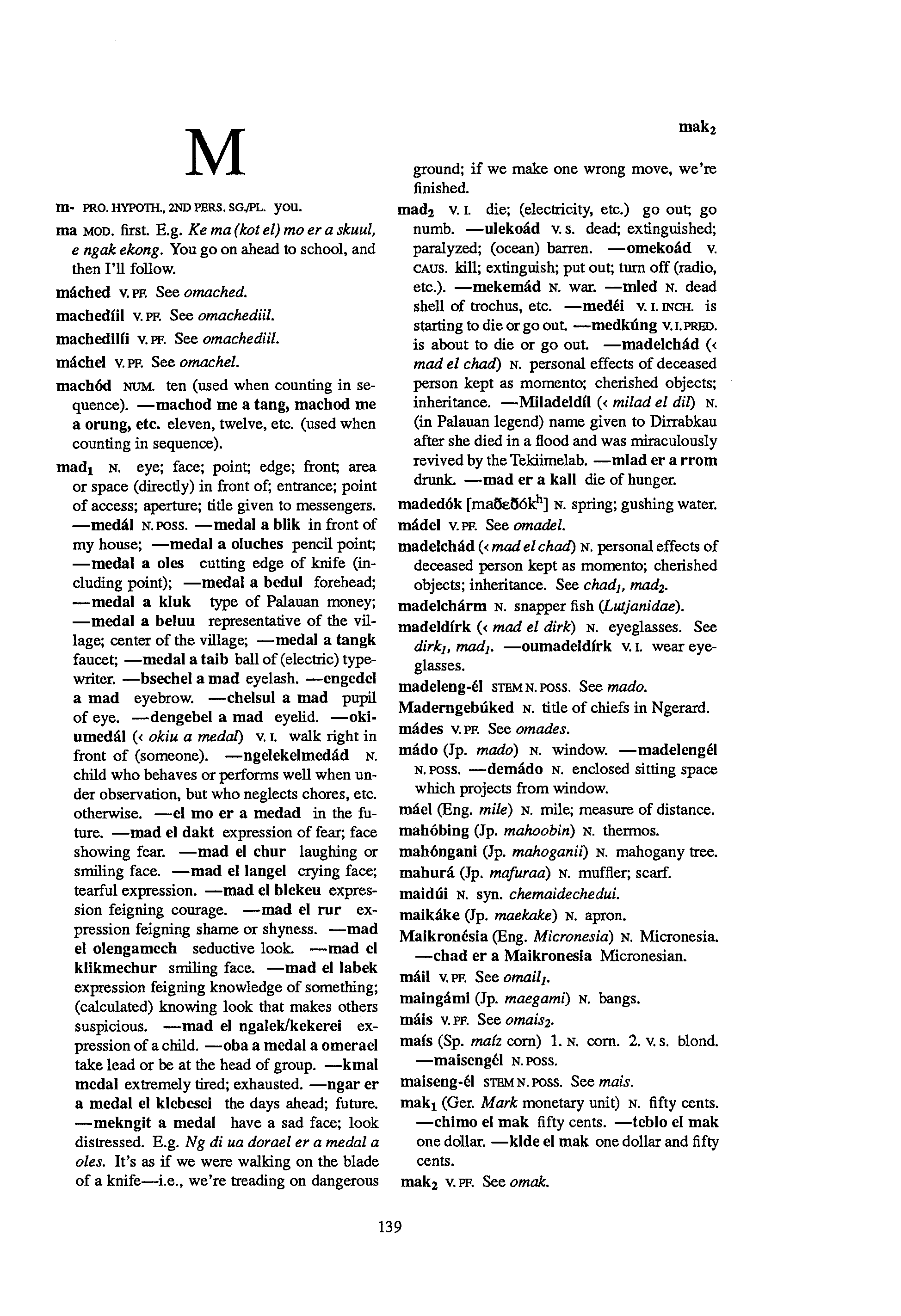
mad
- (anatomy) eye (organ), face, facial expression
- front; area, space or time in front of
- Medal a blik. ― In front of my house.
- El mo er a medad. ― In the future (literally, “what extends beyond (in the direction of) our face”)
- aperture, access, entrance
Inflection[edit]
| Singular | Plural | ||
|---|---|---|---|
| First | inclusive | medad | |
| exclusive | medak | medemam | |
| Second | medam | medemiu | |
| Third | medal | mederir | |
Etymology 2[edit]
From Pre-Palauan *maðe, from Proto-Malayo-Polynesian *(m-)atay, from Proto-Austronesian *(m-)aCay.
Verb[edit]
mad
- to die
References[edit]
- mad in Palauan Language Online: Palauan-English Dictionary, at tekinged.com.
- mad in Palauan-English Dictionary, at trussel2.com.
- mad in Lewis S. Josephs, Edwin G. McManus, Masa-aki Emesiochel (1977) Palauan-English Dictionary, University Press of Hawaii, →ISBN, page 139.
Welsh[edit]
Etymology[edit]
From Proto-Brythonic *mad, from Proto-Celtic *matis.
Pronunciation[edit]
Adjective[edit]
mad (feminine singular mad, plural mad, equative mated, comparative matach, superlative mataf)
Noun[edit]
mad m (plural madioedd)
Mutation[edit]
| Welsh mutation | |||
|---|---|---|---|
| radical | soft | nasal | aspirate |
| mad | fad | unchanged | unchanged |
| Note: Some of these forms may be hypothetical. Not every possible mutated form of every word actually occurs. | |||
Yola[edit]
Etymology[edit]
From Middle English mad, from Old English ġemǣdd, ġemǣded (“enraged”).
Pronunciation[edit]
Adjective[edit]
mad
- mad
- 1927, “YOLA ZONG O BARONY VORTH”, in THE ANCIENT DIALECT OF THE BARONIES OF FORTH AND BARGY, COUNTY WEXFORD, page 132, line 4:
- Fan Buckeen hay pooked lik own thing mad.
- When Buckeen he jumped like a thing mad.
References[edit]
- Kathleen A. Browne (1927) The Journal of the Royal Society of Antiquaries of Ireland Sixth Series, Vol.17 No.2, Royal Society of Antiquaries of Ireland, page 132
- Translingual lemmas
- Translingual symbols
- ISO 639-2
- ISO 639-3
- English terms derived from Proto-Indo-European
- English terms derived from the Proto-Indo-European root *mey- (change)
- English terms inherited from Middle English
- English terms derived from Middle English
- English terms inherited from Old English
- English terms derived from Old English
- English terms derived from Proto-Germanic
- English 1-syllable words
- English terms with IPA pronunciation
- English terms with audio links
- Rhymes:English/æd
- Rhymes:English/æd/1 syllable
- English lemmas
- English adjectives
- English terms with usage examples
- English terms with quotations
- English negative polarity items
- English informal terms
- British English
- English colloquialisms
- English slang
- New York English
- African-American Vernacular English
- English adverbs
- English uncomparable adverbs
- English dialectal terms
- English verbs
- English terms with obsolete senses
- English intransitive verbs
- American English
- Jamaican English
- English degree adverbs
- English intensifiers
- English three-letter words
- en:Anger
- en:Emotions
- Breton terms inherited from Proto-Brythonic
- Breton terms derived from Proto-Brythonic
- Breton terms inherited from Proto-Celtic
- Breton terms derived from Proto-Celtic
- Breton lemmas
- Breton adjectives
- Breton nouns
- Danish terms derived from Old Norse
- Danish terms inherited from Proto-Germanic
- Danish terms derived from Proto-Germanic
- Danish terms with IPA pronunciation
- Danish terms with audio links
- Rhymes:Danish/ad
- Rhymes:Danish/ad/1 syllable
- Danish lemmas
- Danish nouns
- Danish common-gender nouns
- Danish non-lemma forms
- Danish verb forms
- Middle English terms inherited from Old English
- Middle English terms derived from Old English
- Middle English terms with IPA pronunciation
- Middle English lemmas
- Middle English adjectives
- Middle English terms with rare senses
- Middle English verbs
- Middle English non-lemma forms
- Middle English verb forms
- Middle English past participles
- enm:Emotions
- enm:Health
- enm:Mind
- Old Irish terms with IPA pronunciation
- Old Irish univerbations
- Old Irish non-lemma forms
- Old Irish verb forms
- Old Irish lemmas
- Old Irish adverbs
- Palauan terms inherited from Proto-Malayo-Polynesian
- Palauan terms derived from Proto-Malayo-Polynesian
- Palauan terms inherited from Proto-Austronesian
- Palauan terms derived from Proto-Austronesian
- Palauan lemmas
- Palauan nouns
- pau:Anatomy
- Palauan terms with usage examples
- Palauan verbs
- Welsh terms inherited from Proto-Brythonic
- Welsh terms derived from Proto-Brythonic
- Welsh terms inherited from Proto-Celtic
- Welsh terms derived from Proto-Celtic
- Welsh terms with IPA pronunciation
- Rhymes:Welsh/aːd
- Rhymes:Welsh/aːd/1 syllable
- Welsh lemmas
- Welsh adjectives
- Welsh nouns
- Welsh countable nouns
- Welsh masculine nouns
- Yola terms inherited from Middle English
- Yola terms derived from Middle English
- Yola terms inherited from Old English
- Yola terms derived from Old English
- Yola terms with IPA pronunciation
- Yola lemmas
- Yola adjectives
- Yola terms with quotations