甬
Jump to navigation
Jump to search
See also: 角
| ||||||||
Translingual[edit]
Han character[edit]
甬 (Kangxi radical 101, 用+2, 7 strokes, cangjie input 弓戈月手 (NIBQ), four-corner 17227, composition ⿱龴用)
Derived characters[edit]
- 俑, 𠳀, 埇, 㛚, 𢓶, 悀, 捅, 涌, 通, 𦛸, 桶, 㷁, 𭺢, 𭾸, 硧, 𮁾, 𮄯, 𧚔, 蛹, 誦(诵), 𧻹, 踊, 銿, 𩊾, 𩛤, 鯒(鲬), 𪌻, 勈, 㦷, 㪌, 㼧, 𩒼(𬱥), 𫈏, 痛, 𥦁, 筩, 𧆿, 𨴭, 勇, 𭺹, 恿, 𣵳, 𡇮
References[edit]
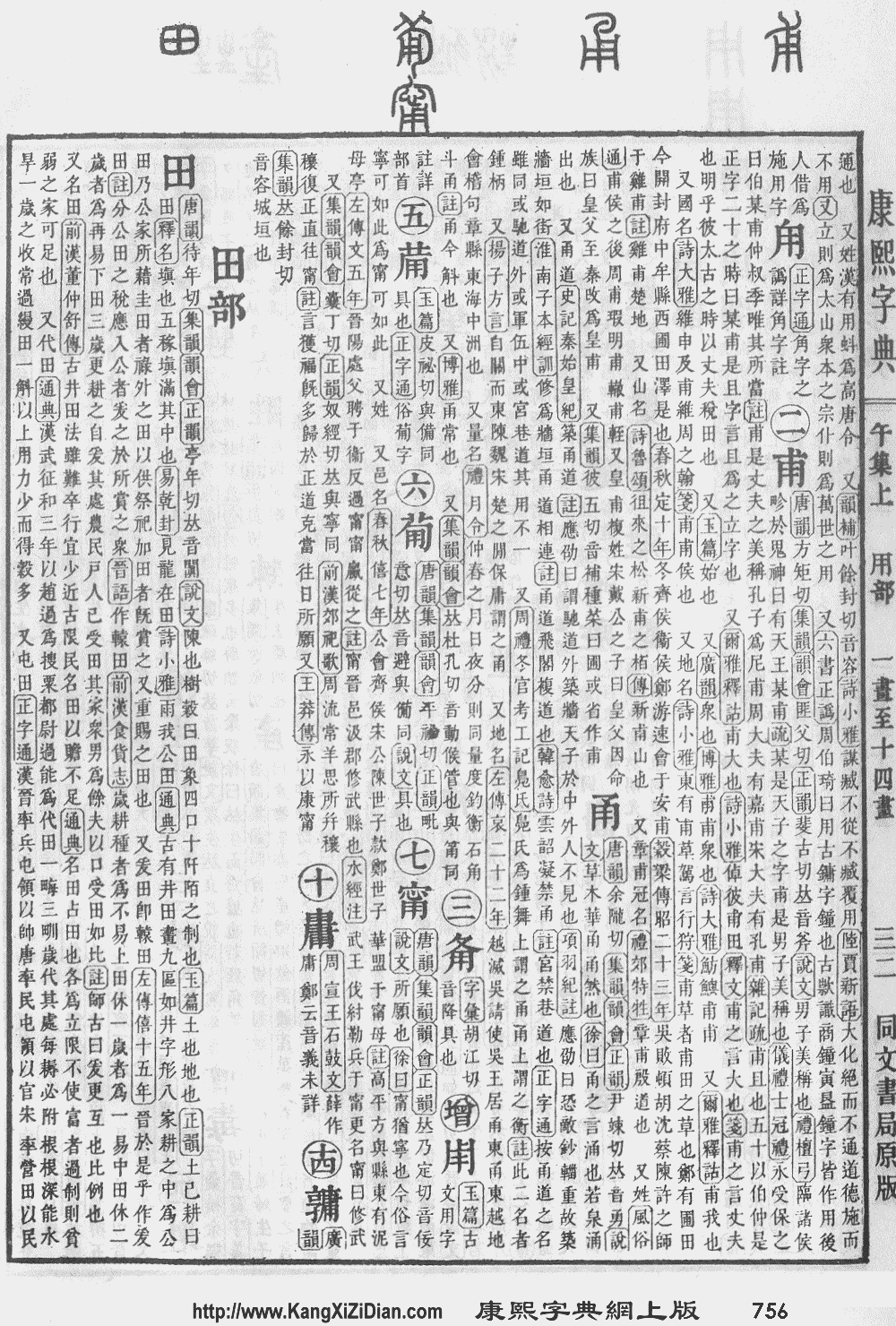
- Kangxi Dictionary: page 756, character 3
- Dai Kanwa Jiten: character 21707
- Dae Jaweon: page 1166, character 5
- Hanyu Da Zidian (first edition): volume 1, page 53, character 18
- Unihan data for U+752C
Chinese[edit]
| simp. and trad. |
甬 | |
|---|---|---|
Glyph origin[edit]
| Historical forms of the character 甬 | |||
|---|---|---|---|
| Shang | Western Zhou | Shuowen Jiezi (compiled in Han) | Liushutong (compiled in Ming) |
| Oracle bone script | Bronze inscriptions | Small seal script | Transcribed ancient scripts |

|

|

|

|
Pictogram (象形) – a bell. In the bronze inscription, the lower part evolved into 用 (OC *loŋs), which serves as a phonetic component.
Pronunciation[edit]
Definitions[edit]
甬
- † handle of a bell
- path screened by walls on both sides
- An ancient name for Ningbo, a city in Zhejiang province
- The Yong River in Ningbo
Compounds[edit]
Japanese[edit]
Kanji[edit]
甬
- road with walls on both sides
Readings[edit]
Korean[edit]
Hanja[edit]
甬 (eumhun 양쪽에 담을 쌓은 길 용 (yangjjoge dameul ssa'eun gil yong))
- This term needs a translation to English. Please help out and add a translation, then remove the text
{{rfdef}}.
Vietnamese[edit]
Han character[edit]
- This term needs a translation to English. Please help out and add a translation, then remove the text
{{rfdef}}.
References[edit]
Categories:
- CJK Unified Ideographs block
- Han script characters
- Translingual lemmas
- Translingual symbols
- Han pictograms
- Mandarin terms with multiple pronunciations
- Middle Chinese lemmas
- Old Chinese lemmas
- Chinese lemmas
- Mandarin lemmas
- Cantonese lemmas
- Hokkien lemmas
- Chinese nouns
- Mandarin nouns
- Cantonese nouns
- Hokkien nouns
- Chinese proper nouns
- Mandarin proper nouns
- Cantonese proper nouns
- Hokkien proper nouns
- Chinese terms with IPA pronunciation
- Chinese Han characters
- Chinese terms with obsolete senses
- Japanese Han characters
- Uncommon kanji
- Japanese kanji with on reading よう
- Japanese kanji with kun reading つね
- Japanese kanji with kun reading つかう
- Japanese kanji with kun reading おどる
- Korean lemmas
- Korean Han characters
- Vietnamese lemmas
- Vietnamese Han characters