豸
Jump to navigation
Jump to search
See also: 犭
| ||||||||
| ||||||||
Translingual[edit]
| Stroke order | |||
|---|---|---|---|

| |||
Han character[edit]

豸 (Kangxi radical 153, 豸+0, 7 strokes, cangjie input 月尸竹竹 (BSHH), four-corner 20222, composition ⿱⿳丿⺀丿⿹㇁𰀪)
- Kangxi radical #153, ⾘.
Derived characters[edit]
References[edit]
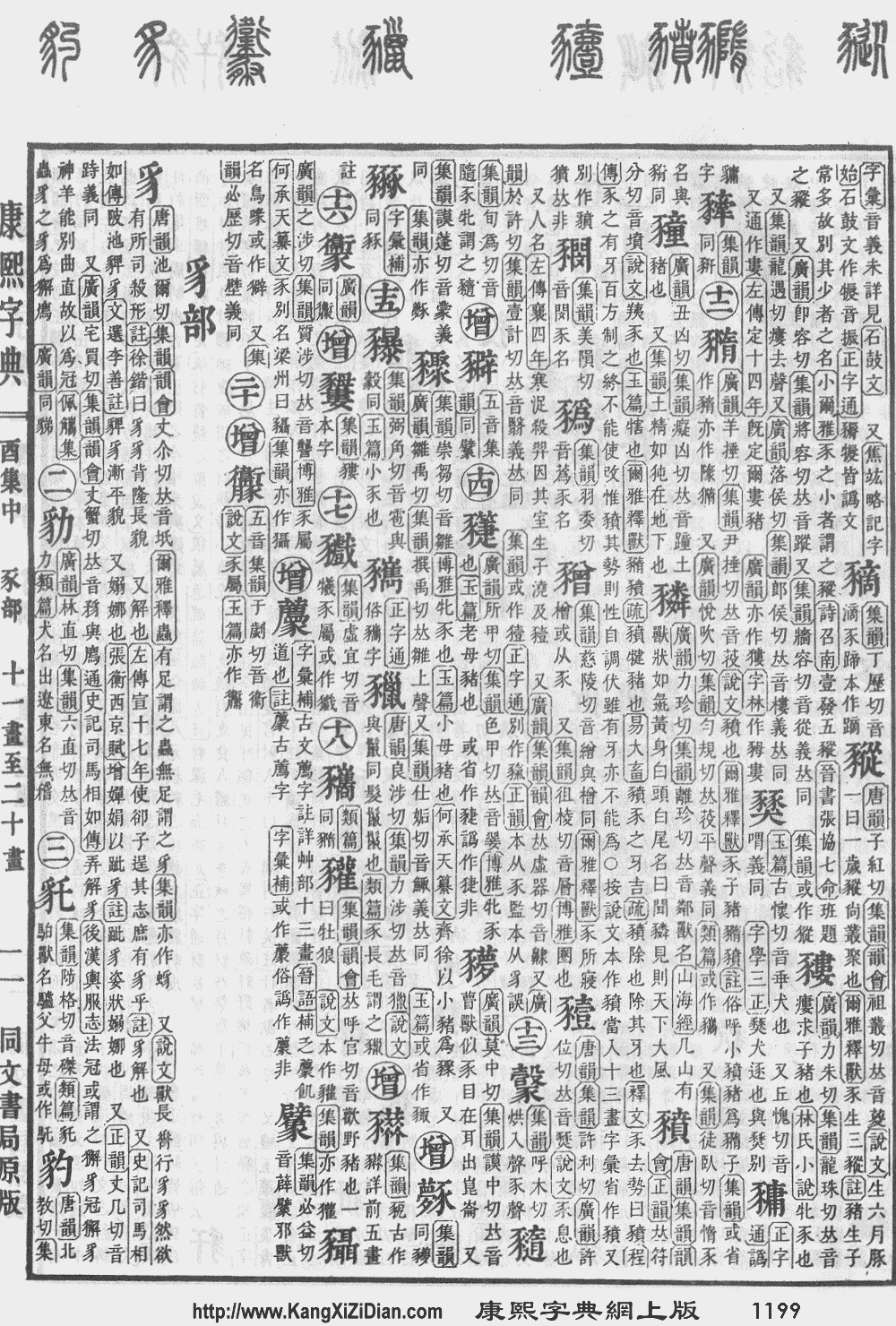
- Kangxi Dictionary: page 1199, character 36
- Dai Kanwa Jiten: character 36496
- Dae Jaweon: page 1661, character 32
- Hanyu Da Zidian (first edition): volume 6, page 3908, character 1
- Unihan data for U+8C78
Chinese[edit]
| simp. and trad. |
豸 | |
|---|---|---|
| 2nd round simp. | 犭 | |
| alternative forms | 廌 𢊁 | |
Glyph origin[edit]
| Historical forms of the character 豸 | ||||
|---|---|---|---|---|
| Shang | Western Zhou | Warring States | Shuowen Jiezi (compiled in Han) | Liushutong (compiled in Ming) |
| Oracle bone script | Bronze inscriptions | Qin slip script | Small seal script | Transcribed ancient scripts |

|

|

|

|

|
Pictogram (象形) – an animal.
Etymology[edit]
Variant of 廌 (OC dreʔ) (Guangyun; Schuessler, 2009). If true, see there for etymology.
Janhunen (2011) instead suggests that 豸 and 廌 possibly had denoted different animals, yet were confused so they would be used seemingly interchangeably to refer to the same range of vague folkloric and mythological beasts.
Pronunciation[edit]
Definitions[edit]
豸
- beast with long vertebral column
- legless insect
- Used in 獬豸 (xièzhì).
- (obsolete) to solve, solution
- 余將老,使郤子逞其志,庶有豸乎? [Classical Chinese, trad.]
- From: Commentary of Zuo, c. 4th century BCE
- Yú jiāng lǎo, shǐ xìzǐ chěng qí zhì, shù yǒu zhì hū? [Pinyin]
- I will declare myself too old, and let Master Xi achieve his wish, which may perhaps lead to the solution [to the present evil]?
余将老,使郤子逞其志,庶有豸乎? [Classical Chinese, simp.]
Compounds[edit]
References[edit]
Japanese[edit]
Kanji[edit]
豸
- This term needs a translation to English. Please help out and add a translation, then remove the text
{{rfdef}}.
Readings[edit]
Korean[edit]
Hanja[edit]
豸 • (chi) (hangeul 치, revised chi, McCune–Reischauer ch'i, Yale chi)
- This term needs a translation to English. Please help out and add a translation, then remove the text
{{rfdef}}.
Vietnamese[edit]
Han character[edit]
豸: Hán Nôm readings: trại, chạy, giải, giãi, trải, trãi, trễ, chải, giại, sải, trĩ
- This term needs a translation to English. Please help out and add a translation, then remove the text
{{rfdef}}.
Categories:
- CJK Unified Ideographs block
- Han script characters
- Kangxi Radicals block
- Han character radicals
- Translingual lemmas
- Translingual symbols
- Han pictograms
- Middle Chinese lemmas
- Old Chinese lemmas
- Chinese lemmas
- Mandarin lemmas
- Cantonese lemmas
- Hakka lemmas
- Hokkien lemmas
- Chinese nouns
- Mandarin nouns
- Cantonese nouns
- Hakka nouns
- Hokkien nouns
- Chinese terms with IPA pronunciation
- Chinese Han characters
- Chinese terms with obsolete senses
- Literary Chinese terms with quotations
- Japanese Han characters
- Uncommon kanji
- Japanese kanji with on reading ち
- Japanese kanji with on reading たい
- Japanese kanji with kun reading とける
- Japanese kanji with kun reading ゆるめる
- Korean lemmas
- Korean Han characters
- Vietnamese lemmas
- Vietnamese Han characters
- CJKV radicals