嘔
Jump to navigation
Jump to search
See also: 呕
| ||||||||
Translingual[edit]
Han character[edit]
嘔 (Kangxi radical 30, 口+11, 14 strokes, cangjie input 口尸口口 (RSRR), four-corner 61016, composition ⿰口區)
References[edit]
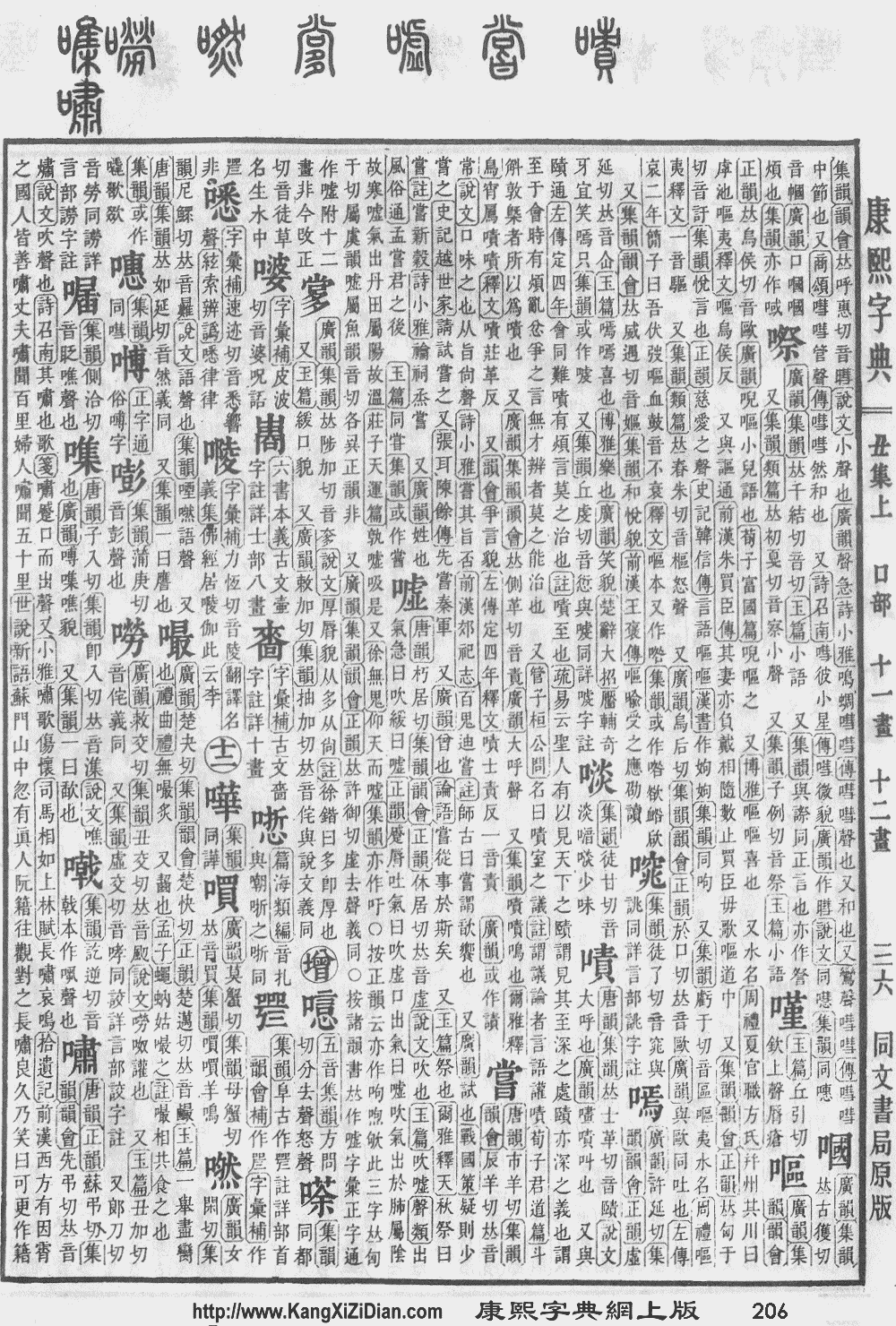
- Kangxi Dictionary: page 206, character 4
- Dai Kanwa Jiten: character 4200
- Dae Jaweon: page 429, character 2
- Hanyu Da Zidian (first edition): volume 1, page 674, character 12
- Unihan data for U+5614
Chinese[edit]
Glyph origin[edit]
Phono-semantic compound (形聲/形声, OC *qoː, *qoːʔ) : semantic 口 (“mouth”) + phonetic 區 (OC *qoː, *kʰo).
Etymology 1[edit]
| trad. | 嘔 | |
|---|---|---|
| simp. | 呕 | |
| alternative forms | 歐 original form 𠴰 㰶 𣢨 𧖼 | |

Ultimately onomatopoeic (Schuessler, 2007).
STEDT derives this from Proto-Sino-Tibetan *ʔaw (“to vomit”), comparing it to Burmese အော့ (au.).
Alternatively, it may be cognate with Tibetan སྐྱུག (skyug) (Schuessler, 2007) and Japhug qioʁ (Zhang, Jacques, and Lai, 2019).
Pronunciation[edit]
Definitions[edit]
嘔
- to vomit
Synonyms[edit]
Compounds[edit]
Etymology 2[edit]
| trad. | 嘔 | |
|---|---|---|
| simp. | 呕 | |
Pronunciation[edit]
Definitions[edit]
嘔
- Alternative form of 謳/讴 (ōu, “to sing”)
- (onomatopoeia) Used to describe orchestral music, cooing, etc.
- string instrument or wind instrument sound
- wheel-rolling sound
- scull-rowing sound
Compounds[edit]
Etymology 3[edit]
Pronunciation[edit]
Definitions[edit]
嘔
- to make someone angry
- to become angry
Compounds[edit]
Etymology 4[edit]
Pronunciation[edit]
Definitions[edit]
嘔
Compounds[edit]
Etymology 5[edit]
Pronunciation[edit]
Definitions[edit]
嘔
Etymology 6[edit]
Pronunciation[edit]
Definitions[edit]
嘔
- An informal greeting.
References[edit]
- Dictionary of Chinese Character Variants (教育部異體字字典), A00666
- Dictionary of Chinese Character Variants (教育部異體字字典), A02062-002-1
- “嘔”, in 漢語多功能字庫 (Multi-function Chinese Character Database)[1], 香港中文大學 (the Chinese University of Hong Kong), 2014–
Japanese[edit]
| 呕 | |
| 嘔 |
Kanji[edit]
嘔
(uncommon “Hyōgai” kanji, kyūjitai kanji, shinjitai form 呕)
Readings[edit]
- Go-on: う (u); く (ku)
- Kan-on: おう (ō); く (ku)
- Kun: うたう (utau, 嘔う)←うたふ (utafu, 嘔ふ, historical); はく (haku, 嘔く)
Definitions[edit]
| For pronunciation and definitions of 嘔 – see the following entry: 呕 |
(The following entry is uncreated: 呕.)
Korean[edit]
Hanja[edit]
嘔 • (gu, hu) (hangeul 구, 후, revised gu, hu, McCune–Reischauer ku, hu)
- This term needs a translation to English. Please help out and add a translation, then remove the text
{{rfdef}}.
Tày[edit]
Han character[edit]
嘔 (transliteration needed)
References[edit]
- Lục Văn Pảo, Hoàng Tuấn Nam (2003) Hoàng Triều Ân, editor, Từ điển chữ Nôm Tày [A Dictionary of (chữ) Nôm Tày][2] (in Vietnamese), Hanoi: Nhà xuất bản Khoa học Xã hội
Vietnamese[edit]
Han character[edit]
嘔: Hán Nôm readings: ẩu, xua, ẫu
- This term needs a translation to English. Please help out and add a translation, then remove the text
{{rfdef}}.
Categories:
- CJK Unified Ideographs block
- Han script characters
- Translingual lemmas
- Translingual symbols
- Han phono-semantic compounds
- Chinese onomatopoeias
- Chinese terms inherited from Proto-Sino-Tibetan
- Chinese terms derived from Proto-Sino-Tibetan
- Cantonese terms with audio links
- Middle Chinese lemmas
- Old Chinese lemmas
- Chinese lemmas
- Mandarin lemmas
- Cantonese lemmas
- Taishanese lemmas
- Hakka lemmas
- Hokkien lemmas
- Teochew lemmas
- Wu lemmas
- Chinese verbs
- Mandarin verbs
- Cantonese verbs
- Taishanese verbs
- Hakka verbs
- Hokkien verbs
- Teochew verbs
- Wu verbs
- Chinese terms with IPA pronunciation
- Chinese Han characters
- Chinese adjectives
- Mandarin adjectives
- Cantonese adjectives
- Chinese literary terms
- Chinese nouns
- Mandarin nouns
- Chinese terms with obsolete senses
- Chinese interjections
- Mandarin interjections
- Japanese Han characters
- Uncommon kanji
- Japanese kanji with goon reading う
- Japanese kanji with goon reading く
- Japanese kanji with kan'on reading おう
- Japanese kanji with kan'on reading く
- Japanese kanji with kun reading うた-う
- Japanese kanji with historical kun reading うた-ふ
- Japanese kanji with kun reading は-く
- Korean lemmas
- Korean Han characters
- Tày lemmas
- Tày Han characters
- Tày Nôm forms
- Vietnamese lemmas
- Vietnamese Han characters