謁
Jump to navigation
Jump to search
See also: 谒
| ||||||||
 | ||||||||
| ||||||||
Translingual[edit]
Han character[edit]
謁 (Kangxi radical 149, 言+9 in Chinese, 言+8 in Japanese, 16 strokes in Chinese, 15 strokes in Japanese, cangjie input 卜口日心女 (YRAPV), four-corner 06627, composition ⿰訁曷 or ⿰訁⿱日匂)
Derived characters[edit]
References[edit]
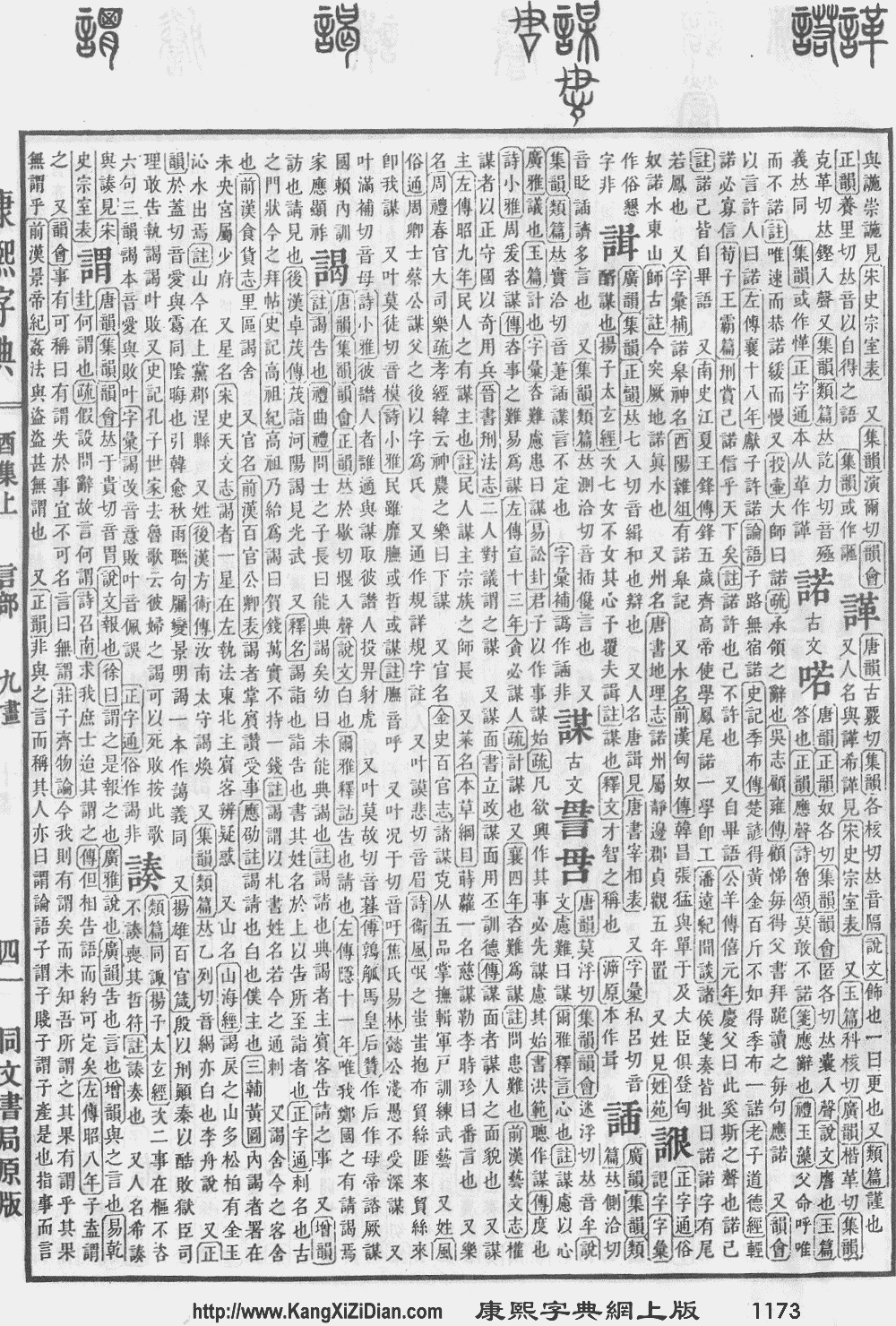
- Kangxi Dictionary: page 1173, character 10
- Dai Kanwa Jiten: character 35690
- Dae Jaweon: page 1638, character 5
- Hanyu Da Zidian (first edition): volume 6, page 3997, character 4
- Unihan data for U+8B01
Chinese[edit]
| trad. | 謁 | |
|---|---|---|
| simp. | 谒 | |
Glyph origin[edit]
| Historical forms of the character 謁 | |
|---|---|
| Shuowen Jiezi (compiled in Han) | Liushutong (compiled in Ming) |
| Small seal script | Transcribed ancient scripts |

|

|
| Old Chinese | |
|---|---|
| 愒 | *kʰaːds, *kʰrads, *kʰrad |
| 馤 | *qaːds |
| 靄 | *qaːds, *qaːd |
| 餲 | *qraːds, *qrads, *ɡaːd, *qaːd |
| 喝 | *qraːds, *qʰoːb, *qʰaːd |
| 揭 | *kʰrads, *ked, *kʰrad, *ɡrad, *kad, *ɡad |
| 偈 | *ɡrads, *ɡrad |
| 猲 | *kʰob, *qʰaːd, *qʰad |
| 葛 | *kaːd |
| 輵 | *kaːd |
| 獦 | *klaːd, *rab |
| 渴 | *kʰaːd, *ɡrad |
| 嵑 | *kʰaːd |
| 暍 | *qʰaːd, *qad |
| 曷 | *ɡaːd |
| 褐 | *ɡaːd |
| 鶡 | *ɡaːd |
| 毼 | *ɡaːd |
| 蝎 | *ɡaːd |
| 鞨 | *ɡaːd, *ɢljad |
| 遏 | *qaːd |
| 齃 | *qaːd |
| 堨 | *qaːd |
| 擖 | *kʰreːd, *kraːd, *r'aːb |
| 楬 | *kʰraːd, *ɡrad, *ɡad |
| 朅 | *kʰrad |
| 藒 | *kʰrad |
| 竭 | *ɡrad, *ɡad |
| 碣 | *ɡrad, *ɡad |
| 羯 | *kad |
| 鍻 | *kad |
| 歇 | *qʰad |
| 蠍 | *qʰad |
| 謁 | *qad |
Pronunciation[edit]
Definitions[edit]
謁
- (literary) to visit; to pay respects to
- † to state; to inform
- † to report; to accuse
- † to request
- † name card
Compounds[edit]
References[edit]
- “謁”, in 漢語多功能字庫 (Multi-function Chinese Character Database)[2], 香港中文大學 (the Chinese University of Hong Kong), 2014–
Japanese[edit]
| Shinjitai | 謁 | |
| Kyūjitai [1] |
謁 謁or 謁+ ︀?
|
|
| 謁󠄀 謁+ 󠄀?(Adobe-Japan1) | ||
| 謁󠄃 謁+ 󠄃?(Hanyo-Denshi) (Moji_Joho) | ||
| The displayed kanji may be different from the image due to your environment. See here for details. | ||
Kanji[edit]
謁
(common “Jōyō” kanji, shinjitai kanji, kyūjitai form 謁)
Readings[edit]
- Go-on: おち (ochi)
- Kan-on: えつ (etsu, Jōyō)
- Kun: つげる (tsugeru, 謁げる); まみえる (mamieru, 謁える)←まみゆ (mamyu, 謁ゆ, historical)
- Nanori: つく (tsuku); ゆく (yuku)
Etymology[edit]
| Kanji in this term |
|---|
| 謁 |
| えつ Grade: S |
| kan’on |
| Alternative spelling |
|---|
| 謁 (kyūjitai) |
From Middle Chinese 謁 (MC 'jot).
The kan'on pronunciation, so likely a later borrowing.
Pronunciation[edit]
Affix[edit]
- audience (with a noble)
Derived terms[edit]
Noun[edit]
Synonyms[edit]
References[edit]
- ^ “謁”, in 漢字ぺディア (Kanjipedia)[1] (in Japanese), 日本漢字能力検定協会, 2015–2024
- ^ Matsumura, Akira, editor (2006), 大辞林 (in Japanese), Third edition, Tōkyō: Sanseidō, →ISBN
Korean[edit]
Etymology[edit]
(This etymology is missing or incomplete. Please add to it, or discuss it at the Etymology scriptorium. Particularly: “Middle Korean readings, if any”)
Pronunciation[edit]
- (SK Standard/Seoul) IPA(key): [a̠ɭ]
- Phonetic hangul: [알]
Hanja[edit]

謁 • (al) (hangeul 알, revised al, McCune–Reischauer al, Yale al)
- This term needs a translation to English. Please help out and add a translation, then remove the text
{{rfdef}}.
Vietnamese[edit]
Han character[edit]
謁: Hán Việt readings: ét[1], yết
- This term needs a translation to English. Please help out and add a translation, then remove the text
{{rfdef}}.
References[edit]
Categories:
- CJK Unified Ideographs block
- Han script characters
- Character boxes with images
- CJK Compatibility Ideographs block
- Translingual lemmas
- Translingual symbols
- Middle Chinese lemmas
- Old Chinese lemmas
- Chinese lemmas
- Mandarin lemmas
- Cantonese lemmas
- Northern Min lemmas
- Hokkien lemmas
- Teochew lemmas
- Chinese verbs
- Mandarin verbs
- Cantonese verbs
- Northern Min verbs
- Hokkien verbs
- Teochew verbs
- Chinese nouns
- Mandarin nouns
- Cantonese nouns
- Northern Min nouns
- Hokkien nouns
- Teochew nouns
- Chinese terms with IPA pronunciation
- Chinese Han characters
- Chinese literary terms
- Chinese terms with obsolete senses
- Japanese Han characters
- Common kanji
- Japanese kanji with goon reading おち
- Japanese kanji with kan'on reading えつ
- Japanese kanji with kun reading つ-げる
- Japanese kanji with kun reading まみ-える
- Japanese kanji with historical kun reading まみ-ゆ
- Japanese kanji with nanori reading つく
- Japanese kanji with nanori reading ゆく
- Japanese terms spelled with 謁 read as えつ
- Japanese terms read with on'yomi
- Japanese terms derived from Middle Chinese
- Japanese terms with IPA pronunciation
- Japanese lemmas
- Japanese affixes
- Japanese terms spelled with secondary school kanji
- Japanese terms written with one Han script character
- Japanese terms spelled with 謁
- Japanese single-kanji terms
- Japanese nouns
- Japanese literary terms
- Korean lemmas
- Korean Han characters
- Vietnamese Chữ Hán
- Vietnamese lemmas
- Vietnamese Han characters