鐸
| ||||||||
Translingual[edit]
| Traditional | 鐸 |
|---|---|
| Shinjitai (extended) |
鈬 |
| Simplified | 铎 |
Han character[edit]
鐸 (Kangxi radical 167, 金+13, 21 strokes, cangjie input 金田中十 (CWLJ), four-corner 86141, composition ⿰釒睪)
Derived characters[edit]
References[edit]
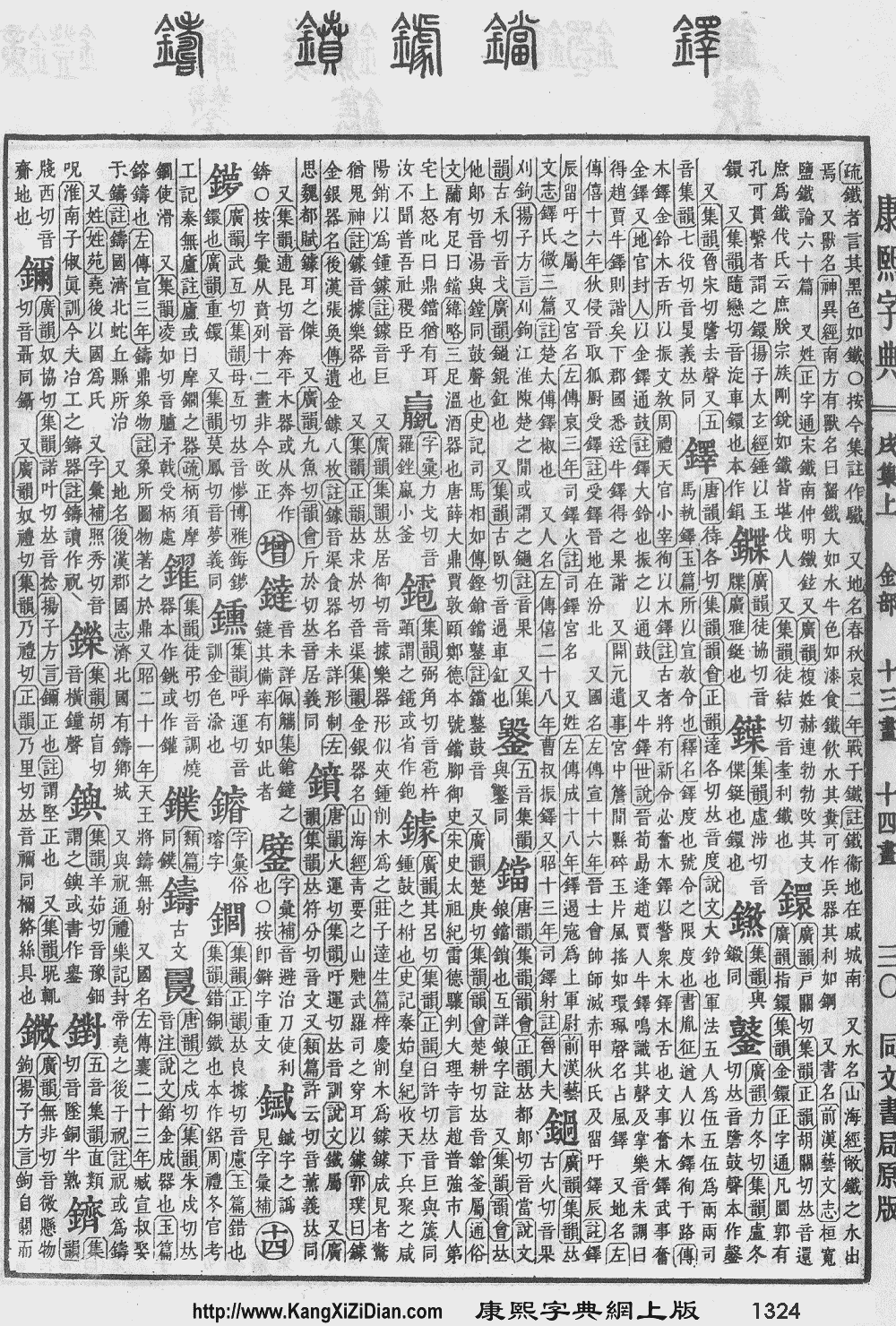
- Kangxi Dictionary: page 1324, character 6
- Dai Kanwa Jiten: character 40951
- Dae Jaweon: page 1825, character 5
- Hanyu Da Zidian (first edition): volume 6, page 4264, character 1
- Unihan data for U+9438
Chinese[edit]
| trad. | 鐸 | |
|---|---|---|
| simp. | 铎 | |

Glyph origin[edit]
Phono-semantic compound (形聲/形声, OC *l'aːɡ) : semantic 金 (“metal”) + phonetic 睪 (OC *neb, *laːɡ, *kuː).
Pronunciation[edit]
Definitions[edit]
鐸
- (historical) large bronze bell with a wooden or bronze clapper and a long handle, used for war and to announce proclamations
- a surname
Compounds[edit]
References[edit]
- Dictionary of Chinese Character Variants (教育部異體字字典), A04356
- “鐸”, in 漢語多功能字庫 (Multi-function Chinese Character Database)[3], 香港中文大學 (the Chinese University of Hong Kong), 2014–
Japanese[edit]
| 鈬 | |
| 鐸 |
Kanji[edit]
(uncommon “Hyōgai” kanji, kyūjitai kanji, shinjitai form 鈬)
- a bell used for signaling
- wind chime
Readings[edit]
- Go-on: だく (daku)
- Kan-on: たく (taku)
- Kun: おおすず (ōsuzu, 鐸)←おほすず (ofosuzu, 鐸, historical); さなき (sanaki, 鐸); すず (suzu, 鐸); ぬて (nute, 鐸); ぬりて (nurite, 鐸)
Compounds[edit]
Etymology 1[edit]
| Kanji in this term |
|---|
| 鐸 |
| ぬりて Hyōgaiji |
| kun’yomi |
Of unknown derivation. Listed in dictionaries as a compound of two parts, ぬり (nuri, of unknown meaning) + て (te, also with no meaning given; possibly 手 (te, “hand”)?).[1][2][3][4]
First cited in the Nihon Shoki of 720.[1]
Pronunciation[edit]
Noun[edit]
- [from 720] (historical) an ancient bell with a long handle used for signalling
Etymology 2[edit]
| Kanji in this term |
|---|
| 鐸 |
| ぬて Hyōgaiji |
| kun’yomi |
Derivation unknown. Appears to be related to the nurite pronunciation.
First cited in the Kojiki of 712.[1][2]
Pronunciation[edit]
Noun[edit]
- [from 712] (historical) an ancient bell with a long handle used for signalling
Etymology 3[edit]
| Kanji in this term |
|---|
| 鐸 |
| さなき Hyōgaiji |
| kun’yomi |
Appears to be a compound of さ (sa, uncertain, possibly “little, small, petty”?) + 鳴き (naki, the 連用形 (ren'yōkei, “stem or continuative form”) of the verb 鳴く (naku, “to make a sound”)).[1]
First cited to a text from 807.[1]
Pronunciation[edit]
Noun[edit]
- [from 807] (historical) an ancient large iron bell used in rituals
Etymology 4[edit]
| Kanji in this term |
|---|
| 鐸 |
| たく Hyōgaiji |
| kan’on |
Ultimately from Middle Chinese 鐸 (MC dak). First cited to a text from 1688.[1]
Pronunciation[edit]
Noun[edit]
Etymology 5[edit]
| Kanji in this term |
|---|
| 鐸 |
| すず Hyōgaiji |
| kun’yomi |
| For pronunciation and definitions of 鐸 – see the following entry. | ||
| ||
| (This term, 鐸, is an alternative spelling (wind chime) of the above term.) |
References[edit]
- ↑ 1.0 1.1 1.2 1.3 1.4 1.5 “鈴・鐸”, in 日本国語大辞典 (Nihon Kokugo Daijiten, “Nihon Kokugo Daijiten”)[1] (in Japanese), concise edition, Tōkyō: Shogakukan, 2000
- ↑ 2.0 2.1 “鐸”, in デジタル大辞泉[2] (in Japanese), Tōkyō: Shogakukan, updated roughly every four months
- ↑ 3.0 3.1 Matsumura, Akira, editor (2006), 大辞林 (in Japanese), Third edition, Tōkyō: Sanseidō, →ISBN
- ^ Shinmura, Izuru, editor (1998), 広辞苑 (in Japanese), Fifth edition, Tōkyō: Iwanami Shoten, →ISBN
- ^ NHK Broadcasting Culture Research Institute, editor (1998), NHK日本語発音アクセント辞典 [NHK Japanese Pronunciation Accent Dictionary] (in Japanese), Tōkyō: NHK Publishing, →ISBN
- Unknown (794) Yoshinori Kobayashi, editor, Shin'yaku Kegonkyō Ongi Shiki (Kojisho Ongi Shūsei) (in Japanese), volume 1, Kyūko Shoin, published 1978, →ISBN.
Korean[edit]
Etymology[edit]
From Middle Chinese 鐸 (MC dak).
Pronunciation[edit]
- (SK Standard/Seoul) IPA(key): [tʰa̠k̚]
- Phonetic hangul: [탁]
Hanja[edit]

Compounds[edit]
References[edit]
- 국제퇴계학회 대구경북지부 (國際退溪學會 大邱慶北支部) (2007). Digital Hanja Dictionary, 전자사전/電子字典. [4]
Vietnamese[edit]
Han character[edit]
- This term needs a translation to English. Please help out and add a translation, then remove the text
{{rfdef}}.
- CJK Unified Ideographs block
- Han script characters
- Translingual lemmas
- Translingual symbols
- Han phono-semantic compounds
- Middle Chinese lemmas
- Old Chinese lemmas
- Chinese lemmas
- Mandarin lemmas
- Cantonese lemmas
- Hakka lemmas
- Hokkien lemmas
- Teochew lemmas
- Chinese nouns
- Mandarin nouns
- Cantonese nouns
- Hakka nouns
- Hokkien nouns
- Teochew nouns
- Chinese terms with IPA pronunciation
- Chinese Han characters
- Chinese terms with historical senses
- Chinese surnames
- zh:Musical instruments
- Japanese Han characters
- Uncommon kanji
- Japanese kanji with goon reading だく
- Japanese kanji with kan'on reading たく
- Japanese kanji with kun reading おおすず
- Japanese kanji with historical kun reading おほすず
- Japanese kanji with kun reading さなき
- Japanese kanji with kun reading すず
- Japanese kanji with kun reading ぬて
- Japanese kanji with kun reading ぬりて
- Japanese terms spelled with 鐸
- Japanese terms read with kun'yomi
- Japanese terms with unknown etymologies
- Japanese compound terms
- Japanese terms with IPA pronunciation
- Japanese lemmas
- Japanese nouns
- Japanese terms with multiple readings
- Japanese terms spelled with hyōgaiji kanji
- Japanese terms written with one Han script character
- Japanese single-kanji terms
- Japanese terms with historical senses
- Japanese terms with quotations
- Japanese terms read with on'yomi
- Japanese terms derived from Middle Chinese
- Japanese proper nouns
- Korean terms derived from Middle Chinese
- Korean lemmas
- Korean Han characters
- Vietnamese lemmas
- Vietnamese Han characters