Germany
English[edit]


Etymology[edit]
From Middle English Germanie, from Old English Germanie & Germania, from Latin Germānia (“land of the Germans”), from Germānī, a people living around and east of the Rhine first attested in the 1st century B.C.E. works of Julius Caesar and of uncertain etymology. The exonym was said by Strabo to derive from germānus (“close kin; genuine”), making it cognate with germane and german, but this seems unsupported. Attempts to derive it from Germanic or Celtic roots since the 18th century[1] are all problematic,[2] although it is perhaps cognate with the Old Irish gair (“neighbour”).[3] Doublet of Germania.
In reference to a medieval kingdom, English Germany is usually an anachronism using the Roman name to describe the area or calquing various Latin terms like rex Teutonicorum ("king of the Teutons"), which were often derogatory exonyms rather than formal titles.
Pronunciation[edit]
- (UK) IPA(key): /ˈd͡ʒɜː.mə.ni/
Audio (UK) (file) - (US) IPA(key): /ˈd͡ʒɝ.mə.ni/
Audio (US) (file) Audio (file)
Proper noun[edit]
Germany (countable and uncountable, plural Germanies or Germanys)
- A nation or civilization occupying the country around the Rhine, Elbe, and upper Danube Rivers in Central Europe, taken as a whole under its various governments.
- 1776, Edward Gibbon, The History of the Decline and Fall of the Roman Empire[1], volume I, page 218:
- Ancient Germany, excluding from its independent limits the province weſtward of the Rhine, which had ſubmitted to the Roman yoke, extended itſelf over a third part of Europe. Almoſt the whole of modern Germany, Denmark, Norway, Sweden, Finland, Livonia, Pruſſia, and the greater part of Poland, were peopled by the various tribes of one great nation, whoſe complexion, manners, and language, denoted a common origin and preſerved a ſtriking reſemblance.
- 1872, John Fiske, editor, History of English Literature, abridgment of Henri van Laun's translation of Hippolyte Taine's Histoire de la littérature anglaise (1864), page 26:
- While the Germans of Gaul, Italy, and Spain became Romans, the Saxons retained their language, their genius, and manners, and created in Britain a Germany outside of Germany.
- 1944, Ludwig von Mises, Omnipotent Government, page 265:
- There have been in Germany, as in all other nations, eulogists of aggression, war, and conquest. But there have been other Germans too. The greatest are not to be found in the ranks of those glorifying tyranny and German world hegemony. Are Heinrich von Kleist, Richard Wagner, and Detlev von Liliencron more representative of the national character than Kant, Goethe, Schiller, Mozart, and Beethoven? The idea of a nation's character is obviously arbitrary. It is derived from a judgment which omits all unpleasant facts contradicting the preconceived dogma.
- The principal state in this country, including
- (historical) A nominal medieval kingdom forming part of the Carolingian and Holy Roman Empires; (metonymically, now uncommon) the Holy Roman Empire in its entirety; (metonymically, obsolete) the Austrian Habsburg empire in its entirety.
- 1759, A Military History of Germany; and of England. From the Year 1631 to the Year 1648. Being the Memoirs of an English Gentleman, who served in the army of Gustavus Adolphus; and afterwards in the Royal Army of King Charles I (1759)[2], page 33:
- There had been a long bloody war in the empire of Germany for twelve years, between the Emperor, the Duke of Bavaria, the King of Spain, and the Popiſh Princes and Electors, on the one side; and the Proteſtant Princes on the other; and both ſides having been exhauſted by the war, and even the Catholicks themſelves beginning to diſlike the growing power of the houſe of Auſtria, it was thought that all parties were willing to make peace.
- 1790, Thomas B. Clarke, A Statistical View of Germany, in respect to the Imperial and Territorial Constitutions, Forms of Government, Legislation, Administration of Justice, and Ecclesiastical State[4], page 13:
- When the race of Charlemagne ceaſed to govern in Germany, the princes and ſtates aſſociated to continue the empire; and that its majeſty might be viſible, and its laws enforced, they agreed to chooſe an emperor. From this emperor, all electors and princes, except thoſe before 1582, receive inveſtiture of their dominions; counts and free cities from the Aulic council. But this inveſtiture is no more than a ſign of ſubmiſſion to the majeſty of the empire, which is depoſited in the emperor. For as the conſtituted members of the empire are dependent on that collective union from which they derive protection, they therefore ſhew this dependence on the emperor, becauſe he repreſents the majeſty of that union, or of the empire; but in all other reſpects they are independent and free.
- 1797, Colin MacFarquhar, George Gleig, editors, Encyclopædia Britannica, 3rd edition, A. Bell & C. MacFarquhar, "Mentz", page 396:
- (historical) An empire formed by Prussia in 1871 with its capital at Berlin.
- (historical) A republic formed in 1918 with its capital at Berlin, inclusive of the Nazi regime who controlled it after 1933.
- 1996, Paul Bookbinder, Weimar Germany: The Republic of the Reasonable, →ISBN, page 90:
- Severing's belief that trade union workers were the most progressive and democratic element in Germany holds up well under investigation.
- (historical, uncommon) The socialist republic formed in 1949 with its capital at Berlin, more often known in English as East Germany.
- A country in Central Europe, formed in 1949 as West Germany, with its provisional capital Bonn until 1990, when it incorporated East Germany. Official name: Federal Republic of Germany. Capital and largest city: Berlin.
- 2014 July 13, Sam Borden, “Germans End Long Wait: 24 Years and a Bit Extra”, in The New York Times[5], archived from the original on 13 July 2014:
- The win made Germany the first European team to prevail in a World Cup in the Americas and gave the Germans, who have made it to the knockout stage in 16 consecutive World Cups, their first trophy since 1990.
- 2014 September 25, Michael Heise, “The Myth of the Stupid German Investor”, in The Wall Street Journal[6], archived from the original on 7 January 2015:
- (historical) A nominal medieval kingdom forming part of the Carolingian and Holy Roman Empires; (metonymically, now uncommon) the Holy Roman Empire in its entirety; (metonymically, obsolete) the Austrian Habsburg empire in its entirety.
- (countable, historical) The various states in this country either over time or during periods of disunity and division, sometimes (inexact) inclusive of the Holy Roman Empire and Austria-Hungary's other holdings.
- 2007, William Clark, Academic Charisma and the Origins of the Research University, →ISBN, page 84:
- The differences between England and the Germanies sprang from the absence or presence of ministerial interventions.
- 2010, Ilan Stavans, Gabriel García Márquez: The Early Years, →ISBN:
- In a Renault 14, they drove from one Germany to the other.
- 2010 September 29, Klaus Wiegrefe, “Germany's Unlikely Diplomatic Triumph: An Inside Look at the Reunification Negotiations”, in Spiegel Online[7], archived from the original on 27 June 2012:
- It is the fall of 1989, and two time zones farther to the west, thousands of people march through downtown Leipzig every Monday, while more than 6,000 East German citizens are camped out in the embassies of West Germany in Prague and Warsaw, hoping to be allowed to emigrate. The images have circled the globe, and it is clear to leaders Thatcher and Gorbachev that the two Germanys are on the verge of radical change.
- (uncommon) A male given name.
- (uncommon) A surname.
- A township in Adams County, Pennsylvania, United States.
- An unincorporated community in Clark County, Indiana, United States.
- An unincorporated community in Houston County, Texas, United States.
Gallery[edit]
-
![Expansion of early Germanic tribes into Central Europe (Roman "Germania"), 750–1 B.C.E.[4]](//upload.wikimedia.org/wikipedia/commons/thumb/0/03/Germanic_tribes_%28750BC-1AD%29.png/200px-Germanic_tribes_%28750BC-1AD%29.png)
-
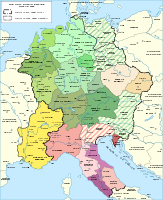 The Holy Roman Empire c. 1000, with the duchies comprising the notional 'Kingdom of the Germans' in green
 -

-
 Nazi Germany and its notional administrative divisions in 1944
 -
 Occupied areas of Germany in 1945: The Soviet territory became East Germany and the rest West Germany
![Expansion of early Germanic tribes into Central Europe (Roman "Germania"), 750–1 B.C.E.[4]](/wiki/File:Germanic_tribes_(750BC-1AD).png)

-en.png)


Usage notes[edit]
Presently, Germany usually refers to Federal Republic of Germany;[2] historical senses other than the German Empire, Weimar Germany, and Nazi Germany are usually distinguished. Historically, the extent of "Germany" was a contentious issue known in the 19th century as "The German Question". The area more often described an ethnic region than a polity into the 16th century, with Old English Germanie even occasionally being used to refer to the areas of England held by the Saxons, Angles, etc.[2] As late as the 19th century, the political area considered "Germany" might include or exclude areas such as Austria, Königsberg, Switzerland, or even non-German parts of the Austrian Empire depending on the speaker and context. During the period of division between 1949 and 1990, either West or East Germany might be referenced as simply "Germany" depending on context, although English use typically referenced the West. See also the continuing use of Korea to refer primarily to South Korea.
Synonyms[edit]
- (all): Deutschland, German Reich, Germania (uncommon or poetic); Dutchland, Germanland, Alemania (obs.)
- (present state): Federal Republic of Germany (FRG, BRD), German Republic
- (1949–1990): See West Germany and East Germany
- (1933–1945): Nazi Germany, Third Reich, Fascist Germany
- (1919–1933): Weimar Republic, Weimar Germany, German Republic
- (1871–1918): German Empire, Second Reich
- (early 19th century): North German Confederation, German Confederation, Confederation of the Rhine
- (earlier): Holy Roman Empire, First Reich, East Francia; see also Austria
Hypernyms[edit]
Hyponyms[edit]
- See also Thesaurus:Germany
- (states): Baden-Württemberg, Bavaria, Berlin, Brandenburg, Bremen, Hamburg, Hesse, Lower Saxony, North Rhine-Westphalia, Mecklenburg-Western Pomerania, Rhineland-Palatinate, Saarland, Saxony, Saxony-Anhalt, Schleswig-Holstein, Thuringia
- (historic divisions): Adriatic Littoral, Alpine Foothills, Alsace, Alsace-Lorraine, Anhalt, Anhalt-Dessau, Anhalt-Bernburg, Anhalt-Köthen, Austria, Baden, Bayreuth, Bohemia, Brunswick, Carinthia, Cisleithania, Cologne-Aachen, Danzig, Düsseldorf, East Prussia, East Hanover, Electoral Hesse, Essen, Franconia, Frankfurt, Galicia, General Government, Greater Berlin, Halle-Merseburg, Hesse-Darmstadt, Hesse-Homburg, Hesse-Kassel, Hesse-Nassau, Hohenzollern-Hechingen, Hohenzollern-Sigmaringen, Koblenz-Trier, Krakow, Liechtenstein, Limburg, Lippe, Lorraine, Lower Danube, Lower Silesia, Lübeck, Lublin, Luxembourg, Magdeburg-Anhalt, Main-Franconia, Mecklenburg, Mecklenburg-Strelitz, Mecklenburg-Schwerin, Moravia, Munich-Upper Bavaria, Nassau, Oldenburg, Palatinate, Pomerania, Prussia, Radom, Reuss-Gera, Reuss-Greiz, Rhineland, Saar-Palatinate, Salzburg, Saxe-Altenburg, Saxe-Coburg and Gotha, Saxe-Coburg-Saalfeld, Saxe-Gotha-Altenburg, Saxe-Hildburghausen, Saxe-Lauenburg, Saxe-Meiningen, Saxe-Weimar-Eisenach, Schaumburg-Lippe, Schwarzburg-Rudolstadt, Schwarzburg-Sondershausen, Silesia, South Hanover-Brunswick, Styria, Sudetenland, Swabia, Tyrol-Vorarlberg, Upper Danube, Upper Hesse, Upper Silesia, Vienna, Waldeck and Pyrmont, Warsaw, Weser-Ems, West Berlin, Westphalia, Westphalia-North, Westphalia-South, West Prussia, Württemberg, Württemberg-Hohenzollern, West Pomerania
Coordinate terms[edit]
- (countries of Europe) country of Europe; Albania, Andorra, Armenia, Austria, Azerbaijan, Belarus, Belgium, Bosnia and Herzegovina, Bulgaria, Croatia, Cyprus, Czechia (Czech Republic), Denmark, Estonia, Finland, France, Georgia, Germany, Greece, Hungary, Iceland, Ireland, Italy, Kazakhstan, Latvia, Liechtenstein, Lithuania, Luxembourg, Malta, Moldova, Monaco, Montenegro, Netherlands, North Macedonia, Norway, Poland, Portugal, Romania, Russia, San Marino, Serbia, Slovakia, Slovenia, Spain, Sweden, Switzerland, Turkey, Ukraine, United Kingdom, Vatican City
Derived terms[edit]
Related terms[edit]
Translations[edit]
|
See also[edit]
References[edit]
- ^ See, for example, the variety of derivations cited at "Germans" in the Rev. George William Lemon's English Etymology (1788).
- ↑ 2.0 2.1 2.2 "German, adj. and n", in: Oxford English Dictionary, 3rd ed.. Oxford University Press (Oxford), 2012.
- ^ "German", in: The Concise Oxford Dictionary of English Etymology. Oxford University Press (Oxford), 1996.
- ^ Herman Kinder, Penguin Atlas of World History, Vol. I, 1988, p. 108.
Anagrams[edit]
- English terms inherited from Middle English
- English terms derived from Middle English
- English terms inherited from Old English
- English terms derived from Old English
- English terms derived from Latin
- English doublets
- English 3-syllable words
- English terms with IPA pronunciation
- English terms with audio links
- English lemmas
- English proper nouns
- English uncountable nouns
- English countable nouns
- English terms with quotations
- English terms with historical senses
- English metonyms
- English terms with uncommon senses
- English terms with obsolete senses
- en:Germany
- en:Countries in Europe
- en:Countries
- English given names
- English male given names
- English surnames
- en:Townships
- en:Places in Pennsylvania, USA
- en:Places in the United States
- en:Unincorporated communities in Indiana, USA
- en:Unincorporated communities in the United States
- en:Places in Indiana, USA
- en:Unincorporated communities in Texas, USA
- en:Places in Texas, USA
- English exonyms