word
English
[edit]Alternative forms
[edit]Pronunciation
[edit]- (Received Pronunciation) IPA(key): /wɜːd/
- (General American) enPR: wûrd, IPA(key): /wɝd/
Audio (US): (file) - Rhymes: -ɜː(ɹ)d
- Homophone: whirred (accents with the wine-whine merger)
Etymology 1
[edit]From Middle English word, from Old English word, from Proto-West Germanic *word, from Proto-Germanic *wurdą, from Proto-Indo-European *wr̥dʰh₁om. Doublet of verb and verve; further related to vrata.
Noun
[edit]word (countable and uncountable, plural words)
- (semantics) The smallest unit of language that has a particular meaning and can be expressed by itself; the smallest discrete, meaningful unit of language. (contrast morpheme.)
- 1897, Ouida, “The New Woman”, in An Altruist and Four Essays, page 239:
- But every word, whether written or spoken, which urges the woman to antagonism against the man, every word which is written or spoken to try and make of her a hybrid, self-contained opponent of men, makes a rift in the lute to which the world looks for its sweetest music.
- 1986, David Barrat, Media Sociology, →ISBN, page 112:
- The word, whether written or spoken, does not look like or sound like its meaning — it does not resemble its signified. We only connect the two because we have learnt the code — language. Without such knowledge, 'Maggie' would just be a meaningless pattern of shapes or sounds.
- 2009, Jack Fitzgerald, Viva La Evolucin, →ISBN, page 233:
- Brian and Abby signed the word clothing, in which the thumbs brush down the chest as though something is hanging there. They both spoke the word clothing. Brian then signed the word for change, […]
- 2013 June 14, Sam Leith, “Where the profound meets the profane”, in The Guardian Weekly, volume 189, number 1, page 37:
- Swearing doesn't just mean what we now understand by "dirty words". It is entwined, in social and linguistic history, with the other sort of swearing: vows and oaths. Consider for a moment the origins of almost any word we have for bad language – "profanity", "curses", "oaths" and "swearing" itself.
- The smallest discrete unit of spoken language with a particular meaning, composed of one or more phonemes and one or more morphemes
- 1894, Alex. R. Mackwen, “The Samaritan Passover”, in Littell's Living Age, volume 1, number 6:
- Then all was silent save the voice of the high priest, whose words grew louder and louder, […]
- 1897 December (indicated as 1898), Winston Churchill, chapter IV, in The Celebrity: An Episode, New York, N.Y.: The Macmillan Company; London: Macmillan & Co., Ltd., →OCLC:
- Mr. Cooke at once began a tirade against the residents of Asquith for permitting a sandy and generally disgraceful condition of the roads. So roundly did he vituperate the inn management in particular, and with such a loud flow of words, that I trembled lest he should be heard on the veranda.
- 2006 Feb. 17, Graham Linehan, The IT Crowd, Season 1, Episode 4:
- I can't believe you want me back.
You've got Jen to thank for that. Her words the other day moved me deeply. Very deeply indeed.
Really? What did she say.
Like I remember! Point is it's the effect of her words that's important.
- I can't believe you want me back.
- The smallest discrete unit of written language with a particular meaning, composed of one or more letters or symbols and one or more morphemes
- c. 1599–1602 (date written), William Shakespeare, “The Tragedie of Hamlet, Prince of Denmarke”, in Mr. William Shakespeares Comedies, Histories, & Tragedies […] (First Folio), London: […] Isaac Iaggard, and Ed[ward] Blount, published 1623, →OCLC, [Act II, scene ii]:
- Polonius: What do you read, my lord?
Hamlet: Words, words, words.
- 2003, Jan Furman, Toni Morrison's Song of Solomon: A Casebook, →ISBN, page 194:
- The name was a confused gift of love from her father, who could not read the word but picked it out of the Bible for its visual shape, […]
- 2009, Stanislas Dehaene, Reading in the Brain: The New Science of How We Read, →ISBN:
- Well-meaning academics even introduced spelling absurdities such as the “s” in the word “island,” a misguided Renaissance attempt to restore the etymology of the [unrelated] Latin word insula.
- A discrete, meaningful unit of language approved by an authority or native speaker (compare non-word).
- 1896, Israel Zangwill, Without Prejudice, page 21:
- “Ain’t! How often am I to tell you ain’t ain’t a word?”
- 1999, Linda Greenlaw, The Hungry Ocean, Hyperion, page 11:
- Fisherwoman isn’t even a word. It’s not in the dictionary.
- Something like such a unit of language:
- Hypernym: syntagma
- A sequence of letters, characters, or sounds, considered as a discrete entity, though it does not necessarily belong to a language or have a meaning.
- 1974, Thinking Goes to School: Piaget's Theory in Practice, →ISBN, page 183:
- In still another variation, the nonsense word is presented and the teacher asks, "What sound was in the beginning of the word?" "In the middle?" and so on. The child should always respond with the phoneme; he should not use letter labels.
- 1999, Matt Ridley, Genome, Harper Collins, →ISBN, page 301:
- All 15.5 million ‘words’ (or so–the exact length depends on the repeat sequences, which vary greatly) in the twenty-second chapter of the human autobiography have been read and written down in English letters: 47 million As, Cs, Gs and Ts.
- 2003, How To Do Everything with Your Tablet PC, →ISBN, page 278:
- I wrote a nonsense word, "umbalooie," in the Input Panel's Writing Pad. Input Panel converted it to "cembalos" and displayed it in the Text Preview pane.
- 2006, Scribal Habits and Theological Influences in the Apocalypse, →ISBN, page 141:
- Here the scribe has dropped the με from καθημενος, thereby creating the nonsense word καθηνος.
- 2013, The Cognitive Neuropsychology of Language, →ISBN, page 91:
- If M. V. has sustained impairment to a phonological output process common to reading and repetition, we might anticipate that her mispronunciations will partially reflect the underlying phonemic form of the nonsense word.
- (telegraphy) A unit of text equivalent to five characters and one space. [from 19th c.]
- (computing) A fixed-size group of bits handled as a unit by a machine and which can be stored in or retrieved from a typical register (so that it has the same size as such a register). [from 20th c.]
- 1997, John L. Hennessy with David A. Patterson, Computer Organization and Design, 2nd edition, San Francisco, California: Morgan Kaufmann Publishers, Inc., §3.3, page 109:
- The size of a register in the MIPS architecture is 32 bits; groups of 32 bits occur so frequently that they are given the name word in the MIPS architecture.
- (computer science) A finite string that is not a command or operator. [from 20th or 21st c.]
- (group theory) A group element, expressed as a product of group elements.
- The fact or act of speaking, as opposed to taking action. [from 9th c].
- 1811, Jane Austen, Sense and Sensibility:
- […] she believed them still so very much attached to each other, that they could not be too sedulously divided in word and deed on every occasion.
- 2004 September 8, Richard Williams, The Guardian:
- As they fell apart against Austria, England badly needed someone capable of leading by word and example.
- (now rare outside certain phrases) Something that someone said; a comment, utterance; speech. [from 10th c.]
- 1611, The Holy Bible, […] (King James Version), London: […] Robert Barker, […], →OCLC, Matthew 26:75:
- And Peter remembered the word of Jesus, which said unto him, Before the cock crow, thou shalt deny me thrice.
- 1847, Alfred Tennyson, The Princess:
- She said; but at the happy word "he lives", / My father stooped, re-fathered, o'er my wound.
- 1853, Charles Dickens, Bleak House:
- There is only one other point on which I offer a word of remark.
- 1945 April 1, Sebastian Haffner, The Observer:
- "The Kaiser laid down his arms at a quarter to twelve. In me, however, they have an opponent who ceases fighting only at five minutes past twelve," said Hitler some time ago. He has never spoken a truer word.
- 2011, David Bellos, Is That a Fish in Your Ear?, Penguin, published 2012, page 126:
- Despite appearances to the contrary [...] dragomans stuck rigidly to their brief, which was not to translate the Sultan's words, but his word.
- 2011, John Lehew (senior), The Encouragement of Peter, →ISBN, page 108:
- In what sense is God's Word living? No other word, whether written or spoken, has the power that the Bible has to change lives.
- (obsolete outside certain phrases) A watchword or rallying cry, a verbal signal (even when consisting of multiple words).
- 1592, William Shakespeare, Richard III:
- Our ancient word of courage, fair Saint George, inspire us with the spleen of fiery dragons!
- c. 1623, John Fletcher, William Rowley, The Maid in the Mill, published in the first Beaumont and Fletcher folio), published 1647, scene 3:
- I have the word : sentinel, do thou stand; […]
- (obsolete) A proverb or motto.
- 1499, John Skelton, The Bowge of Court:
- 1599, Ben Jonson, Every Man out of His Humour:
- Let the word be 'Not without mustard'. Your crest is very rare, sir.
- 1646, Joseph Hall, The Balm of Gilead:
- The old word is, 'What the eye views not, the heart rues not.'
- (uncountable) News; tidings. [from 10th c.]
- 1943 November – 1944 February (date written; published 1945 August 17), George Orwell [pseudonym; Eric Arthur Blair], Animal Farm […], London: Secker & Warburg, published May 1962, →OCLC:
- Word had gone round during the day that old Major, the prize Middle White boar, had had a strange dream on the previous night and wished to communicate it to the other animals.
- Have you had any word from John yet?
- I've tried for weeks to get word, but I still don't know where she is or if she's all right.
- An order; a request or instruction; an expression of will. [from 10th c.]
- He sent word that we should strike camp before winter.
- Don't fire till I give the word
- Their mother's word was law.
- A promise; an oath or guarantee. [from 10th c.]
- I give you my word that I will be there on time.
- Synonym: promise
- A brief discussion or conversation. [from 15th c.]
- Can I have a word with you?
- (meiosis) A minor reprimand.
- I had a word with him about it.
- (in the plural) See words.
- There had been words between him and the secretary about the outcome of the meeting.
- (theology, sometimes Word) Communication from God; the message of the Christian gospel; the Bible, Scripture. [from 10th c.]
- Her parents had lived in Botswana, spreading the word among the tribespeople.
- Synonyms: word of God, Bible
- (theology, sometimes Word) Logos, Christ. [from 8th c.]
- 1526, [William Tyndale, transl.], The Newe Testamẽt […] (Tyndale Bible), [Worms, Germany: Peter Schöffer], →OCLC, John:
- And that worde was made flesshe, and dwelt amonge vs, and we sawe the glory off yt, as the glory off the only begotten sonne off the father, which worde was full of grace, and verite.
- 1850, [Alfred, Lord Tennyson], In Memoriam, London: Edward Moxon, […], →OCLC, Canto XXXVI, page 56:
- And so the Word had breath, and wrought
With human hands the creed of creeds
In loveliness of perfect deeds,
More strong than all poetic thought; […]
Usage notes
[edit]In English and other languages with a tradition of space-delimited writing, it is customary to treat "word" as referring to any sequence of characters delimited by spaces. However, this is not applicable to languages such as Chinese and Japanese, which are normally written without spaces, or to languages such as Vietnamese, which are written with spaces delimiting syllables.
In computing, the size (length) of a word, while being fixed in a particular machine or processor family design, can be different in different designs, for many reasons. See Word (computer architecture) for a full explanation.
Synonyms
[edit]- vocable; see also Thesaurus:word
Derived terms
[edit]- actions speak louder than words
- action word
- afterword
- all one word
- a picture is worth a thousand words
- a picture paints a thousand words
- arrowword
- at a loss for words
- a-word
- babble word
- babble-word
- backword
- bad word
- bag of words
- bandy words
- bareword
- baseword
- beyond words
- big word
- book of words
- book-word
- book word
- break one's word
- breathe a word
- brunch word
- bug-word
- buzz-word
- buzzword
- buzz word
- b-word
- byword
- catchword
- Champernowne word
- choice word
- code word
- codeword
- compound predicate word
- compound word
- connecting word
- content word
- continuous bag of words
- counterword
- cranberry word
- crossword
- crutch word
- curse word
- cuss word
- c-word
- C-word
- description word
- directed acyclic word graph
- dirty word
- doubleword
- drunk words are sober thoughts
- D-word
- dword
- d-word
- Dyck word
- eat one's words
- empty word
- empty words
- e-word
- eye-word
- facts speak louder than words
- famous last words
- famous last words
- fighting word, fighting words
- fighting words
- filler word
- final words
- fine words butter no parsnips
- five-dollar word
- foreword
- fossil word
- four-letter word
- frankenword
- from the word go
- function word
- fuzzword
- f word
- f-word
- F-word
- F word
- gainword
- gallipot word
- gamer word
- get a word in
- get a word in edgeways, get a word in edgewise
- get the word out
- ghostword
- ghost word
- give one's word
- give the word
- good as one's word
- good word
- guide word
- guideword
- g-word
- G-word
- halfword
- hang on every word
- hard word
- have a quiet word
- have a word
- have a word in someone's ear
- have a word with oneself
- have words
- have words
- headword
- honeyword
- hotword
- household word
- how do you pronounce this word
- how do you spell this word
- Humpty Dumpty word
- h-word
- H-word
- in a word
- in every sense of the word
- inkhorn word
- in other words
- in so many words
- in so many words
- interword
- in words of one syllable
- i-word
- Janus word
- joey word
- j-word
- kangaroo word
- keep one's word
- key word
- key-word
- keyword
- kiloword
- k-word
- last-wordism
- last word, last words
- last words
- loaded word
- loan word
- loanword
- longword
- lost for words
- l-word
- Lyndon word
- machine word
- magic word
- man of few words
- mark my word
- mark my words
- McWord
- measure word
- megaword
- metaword
- midword
- mince one's words
- mince words
- mince words
- mouth the words
- multi-word
- multi-word expression
- mum's the word
- M-word
- m-word
- my word, oh my word
- nameword
- naughty word
- noise word
- nonce word
- none of these words are in the Bible
- nonsense word
- non-word
- not a word of a lie
- not to put too fine a word on it
- no word of a lie
- no word of lie
- N-word
- n-word
- N-word pass
- n-word pass
- octoword
- of one's word
- one's word is law
- one-word
- one word leads to another
- operative word
- or words to that effect
- overword
- o-word
- oword
- partword
- pass one's word
- pass-word
- password
- patchword
- pattern word
- phantom word
- phoneword
- pillow word
- place word
- play of words
- play on words
- play upon words
- polyword
- portmanteau word
- power word
- procedure word, proword
- protoword
- pseudoword
- purr word
- put in a good word
- put in a word
- put into words
- put to words
- put words in someone's mouth
- put words in someone's mouth
- p-word
- P-word
- quadword
- question word
- q-word
- Q-word
- qword
- reserved word
- re-word
- root word
- r-word
- R-word
- safe word
- safeword
- SAT word
- say the word
- say word one
- semiword
- send word
- seven dirty words
- sight word
- single-word
- small words
- snarl word
- songword
- spelling word
- spellword
- spoken word
- spread the word
- startword
- starword
- stopword
- stop word
- subword
- suit the action to the word
- swallow one's words
- swear word
- s-word
- syncword
- tableword
- take someone at their word
- take someone's word for it
- take the words out of someone's mouth
- telescope word
- ten-cent word
- ten-dollar word
- there are no words to describe
- the word is go
- thunder word
- true to one's word
- turn of words
- twenty-five cent word
- twist someone's words
- two-dollar word
- T-word
- t-word
- underword
- upon my word
- ur-word
- urword
- u-word
- vocabulary word
- vogue word
- V-word
- v-word
- wake word
- wanderword
- war of words
- war of words
- watchword
- weasel word
- weigh one's words
- wh-word
- winged word
- without a word of a lie
- woman of few words
- Wonderword
- wordage
- wordaholic
- word art
- word association
- word balloon
- word-blind
- word blindness
- word-blindness
- wordbook
- word-bound
- word box
- word-break
- word break
- word bubble
- wordbuilding
- wordcel
- word chain
- word class
- word cloud
- word count
- wordcraft
- word-deafness
- word divider
- wordfact
- word family
- wordfast
- wordfest
- wordfilter
- wordfinal
- word-final
- wordfinding
- wordflow
- wordform
- word formation
- word-formation
- word-formational
- word-for-word
- word for word
- wordful
- word game
- word gets around
- word golf
- word has it
- word-hoard
- word hole
- wordhood
- wordie
- wording
- word-initial
- wordinitial
- word is
- word is bond
- wordish
- word ladder
- wordlength
- wordless
- wordlet
- wordlike
- wordline
- word line
- wordlist
- word list
- wordlore
- word-lover
- wordly
- wordmaker
- wordmaking
- wordmark
- word mark
- wordmaster
- wordmeal
- word method
- word-mincer
- wordmonger
- word music
- word name
- word nerd
- wordness
- WordNet
- wordnet
- wordnik
- Word of Allah
- word of faith
- word of finger
- Word of God, word of God, God's word
- word of honor
- word of honour
- word of life
- word-of-mouth
- word of mouth
- Word of Wisdom
- wordoid
- wordology
- word on the street
- word on the wire
- word order
- word painter
- word painting
- word-perfect
- word-picture
- word play
- wordplay
- wordpool
- word problem
- wordprocess
- word processing
- word processor
- word-salad
- word salad
- words cannot define
- wordscape
- words cut deep
- word search
- word-search
- words fail someone
- words fail someone
- wordshaping
- wordship
- wordsize
- word sketch
- wordsmith
- word snake
- words of institution
- words of institution
- words of one syllable
- words of one syllable
- wordsome
- word space
- word-spelling alphabet
- word square
- wordster
- word-stock
- wordstring
- word time
- word to conjure with
- word to the wise
- word vector
- word vomit
- word-wheeling
- wordwise
- word wrap
- wordy
- workword
- wow word
- write as separate words
- wug word
- W-word
- w-word
- x-word
- you get more with a kind word and a gun than you do with a kind word alone
- z-word
Descendants
[edit]Translations
[edit]
| |||||||


|
|
|
|
|
|
|
Verb
[edit]word (third-person singular simple present words, present participle wording, simple past and past participle worded)
- (transitive) To say or write (something) using particular words; to phrase (something).
- Synonyms: express, phrase, put into words, state
- I’m not sure how to word this letter to the council.
- (transitive, obsolete) To flatter with words, to cajole.
- 1607, William Shakespeare, Anthony and Cleopatra, act 5, scene 2:
- He words me, girls, he words me, that I should not / be noble to myself.
- (transitive) To ply or overpower with words.
- 1621 November 30, James Howell, letter to Francis Bacon, from Turin:
- […] if one were to be worded to death, Italian is the fittest Language [for that task]
- 1829 April, “Webster's Dictionary”, in The North American Review, volume 28, page 438:
- […] if a man were to be worded to death, or stoned to death by words, the High-Dutch were the fittest [language for that task].
- (transitive, rare) To conjure with a word.
- c. 1645-1715, Robert South, Sermon on Psalm XXXIX. 9:
- Against him […] who could word heaven and earth out of nothing, and can when he pleases word them into nothing again.
- 1994, “Liminal Postmodernisms”, in Postmodern Studies, volume 8, page 162:
- "Postcolonialism" might well be another linguistic construct, desperately begging for a referent that will never show up, simply because it never existed on its own and was literally worded into existence by the very term that pretends to be born from it.
- 2013, Carla Mae Streeter, Foundations of Spirituality: The Human and the Holy, →ISBN, page 92:
- The being of each person is worded into existence in the Word, […]
- (intransitive, archaic) To speak, to use words; to converse, to discourse.
- 1818–1819, John Keats, “Hyperion, a Fragment”, in Lamia, Isabella, the Eve of St. Agnes, and Other Poems, London: […] [Thomas Davison] for Taylor and Hessey, […], published 1820, →OCLC, page 181:
- Thus wording timidly among the fierce: / "O Father, I am here the simplest voice, […] "
Derived terms
[edit]Translations
[edit]
|
Interjection
[edit]word
- (slang) Truth, indeed, that is the truth! The shortened form of the statement "My word is my bond."
- "Yo, that movie was epic!" / "Word?" ("You speak the truth?") / "Word." ("I speak the truth.")
- (slang, emphatic, stereotypically, African-American Vernacular) An abbreviated form of word up; a statement of the acknowledgment of fact with a hint of nonchalant approval.
- 2004, Shannon Holmes, Never Go Home Again: A Novel, page 218:
- " […] Know what I'm sayin'?" / "Word!" the other man strongly agreed. "Let's do this — "
- 2007, Gabe Rotter, Duck Duck Wally: A Novel, page 105:
- " […] Not bad at all, man. Worth da wait, dawg. Word." / "You liked it?" I asked dumbly, stoned still, and feeling victorious. / "Yeah, man," said Oral B. "Word up. […] "
- 2007, Relentless Aaron, The Last Kingpin, page 34:
- " […] I mean, I don't blame you... Word! […] "
Quotations
[edit]- For quotations using this term, see Citations:word.
See also
[edit]- allomorph
- compound word
- grapheme
- idiomatic
- lexeme
- listeme
- morpheme
- orthographic
- phrase
- set phrase
- syllable
- term
Etymology 2
[edit]Variant of worth (“to become, turn into, grow, get”), from Middle English worthen, from Old English weorþan (“to turn into, become, grow”), from Proto-West Germanic *werþan, from Proto-Germanic *werþaną (“to turn, turn into, become”). More at worth § Verb.
Verb
[edit]word
- Alternative form of worth (“to become”).
See also
[edit]Further reading
[edit]
Anagrams
[edit]Afrikaans
[edit]Etymology
[edit]From Dutch worden, from Middle Dutch werden, from Old Dutch werthan, from Proto-Germanic *werþaną.
Pronunciation
[edit]Verb
[edit]word (present word, present participle wordende, past participle geword)
- to become; to get (to change one’s state)
- Ek het ryk geword.
- I became rich.
- Ek word ryk.
- I am becoming rich.
- Sy word beter.
- She is getting better.
- Forms the present passive voice when followed by a past participle
- Die kat word gevoer.
- The cat is being fed.
Usage notes
[edit]- The verb has an archaic preterite werd: Die kat werd gevoer. (“The cat was fed.”) In contemporary Afrikaans the perfect is used instead: Die kat is gevoer.
Chinese Pidgin English
[edit]Alternative forms
[edit]- 𭉉 (Chinese spelling)
Etymology
[edit]Noun
[edit]word
- word
- 1862, 唐景星 [Tong King-sing], 英語集全 [Chinese English Instructor], volume VI, marginalia, page 78; republished as “Pidgin English texts from the Chinese English Instructor”, in Michelle Li, Stephen Matthews, Geoff P. Smith, editors, Hong Kong Journal of Applied Linguistics[1], volume 10, number 1, 2005, pages 79-167:
- 挨仙[sic – meaning ⿰口仙]㕭𭉉
*aai1 sin1[sen1] ju1 wut3
I send you word.
I will send you word.
- 挨仙[sic – meaning ⿰口仙]㕭𭉉
Dutch
[edit]Pronunciation
[edit]Verb
[edit]word
- inflection of worden:
Middle English
[edit]Etymology 1
[edit]From Old English word, from Proto-West Germanic *word, from Proto-Germanic *wurdą, from Proto-Indo-European *werdʰh₁om. Doublet of verbe.
Alternative forms
[edit]Pronunciation
[edit]Noun
[edit]word (plural wordes or (early) word)
- A word (separable, discrete linguistic unit)
- a. 1400, Geoffrey Chaucer, “Book II”, in Troilus and Criseyde, lines 22–28:
- Ȝe knowe ek that in fourme of ſpeche is chaunge / With-inne a thousand ȝeer, and wordes tho / That hadden pris now wonder nyce and ſtraunge / Us thenketh hem, and ȝet thei ſpake hem so / And ſpedde as wel in loue as men now do
- You also know that the form of language is in flux; / within a thousand years, words / that had currency; really weird and bizarre / they seem to us now, but they still spoke them / and accomplished as much in love as men do now.
- A statement; a linguistic unit said or written by someone:
- A speech; a formal statement.
- A byword or maxim; a short expression of truth.
- A promise; an oath or guarantee.
- A motto; an expression associated with a person or people.
- A piece of news (often warning or recommending)
- An order or directive; something necessary.
- A religious precept, stricture, or belief.
- The act of speaking (especially as opposed to action):
- Discourse; the exchange of statements.
- (theology) The Logos (Jesus Christ)
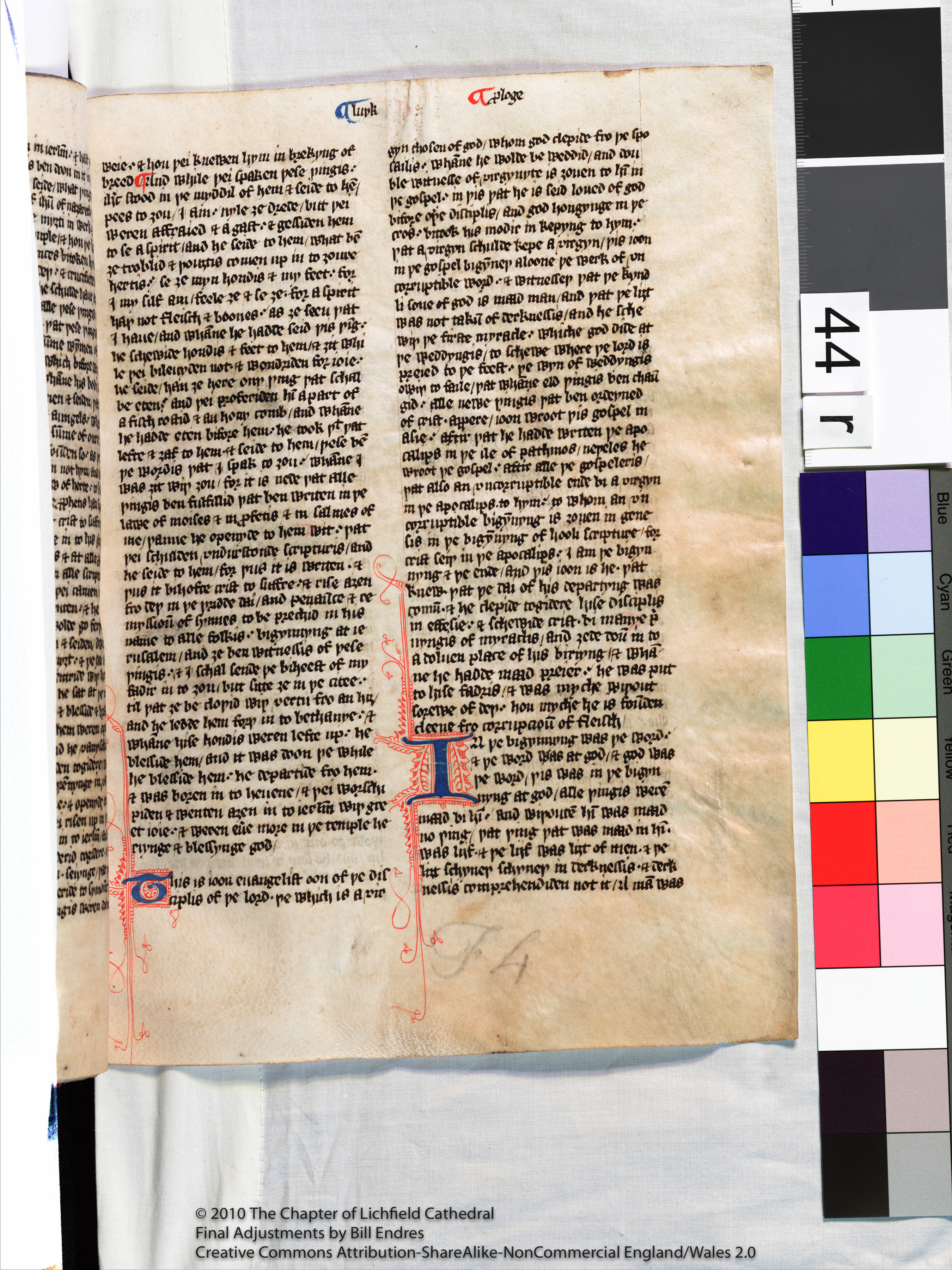
- c. 1395, John Wycliffe, John Purvey [et al.], transl., Bible (Wycliffite Bible (later version), MS Lich 10.)[2], published c. 1410, Joon 1:1, page 44r, column 2; republished as Wycliffe's translation of the New Testament, Lichfield: Bill Endres, 2010:
- IN þe bigynnyng was þe woꝛd .· ⁊ þe woꝛd was at god / ⁊ god was þe woꝛd
- In the beginning was the Word, and the Word was with God, and God was the Word.
- (rare) The human faculty of language as a whole.
Related terms
[edit]Descendants
[edit]References
[edit]- “wō̆rd, n.”, in MED Online, Ann Arbor, Mich.: University of Michigan, 2007, retrieved 27 February 2020.
Etymology 2
[edit]Noun
[edit]word
- Alternative form of werde
Old English
[edit]Alternative forms
[edit]- ƿord
- uord — Northumbrian
- wyrde
Pronunciation
[edit]Etymology 1
[edit]From Proto-West Germanic *word, from Proto-Germanic *wurdą.
Noun
[edit]word n (nominative plural word)
- word
- speech, utterance, statement
- (grammar) verb
- news, information, rumour
- c. 992, Ælfric, "Sermon on the Nativiity of Our Lord"
- Ðyllīce word María hēold ārǣfniġende on hire heortan.
- Such words Mary held, pondering them in her heart.
- c. 992, Ælfric, "Sermon on the Nativiity of Our Lord"
- command, request
Declension
[edit]Derived terms
[edit]Descendants
[edit]Etymology 2
[edit]Unknown. Perhaps ultimately from Proto-Indo-European *wr̥dʰos (“sweetbriar”). Compare Latin rubus (“bramble”), Persian گل (gol, “flower”).
Noun
[edit]word ?
Old Saxon
[edit]Etymology
[edit]From Proto-West Germanic *word, from Proto-Germanic *wurdą.
Pronunciation
[edit]Noun
[edit]word n
Declension
[edit]| singular | plural | |
|---|---|---|
| nominative | word | word |
| accusative | word | word |
| genitive | wordes | wordō |
| dative | worde | wordun |
| instrumental | — | — |
- English 1-syllable words
- English terms with IPA pronunciation
- English terms with audio links
- Rhymes:English/ɜː(ɹ)d
- Rhymes:English/ɜː(ɹ)d/1 syllable
- English terms with homophones
- English terms derived from Proto-Indo-European
- English terms derived from the Proto-Indo-European root *werh₁-
- English terms derived from the Proto-Indo-European root *dʰeh₁-
- English terms inherited from Middle English
- English terms derived from Middle English
- English terms inherited from Old English
- English terms derived from Old English
- English terms inherited from Proto-West Germanic
- English terms derived from Proto-West Germanic
- English terms inherited from Proto-Germanic
- English terms derived from Proto-Germanic
- English terms inherited from Proto-Indo-European
- English doublets
- English lemmas
- English nouns
- English uncountable nouns
- English countable nouns
- en:Semantics
- English terms with quotations
- en:Telegraphy
- en:Computing
- en:Computer science
- en:Group theory
- English terms with rare senses
- English terms with obsolete senses
- English terms with usage examples
- English meioses
- en:Theology
- English verbs
- English transitive verbs
- English intransitive verbs
- English terms with archaic senses
- English interjections
- English slang
- African-American Vernacular English
- English autological terms
- en:Communication
- Afrikaans terms inherited from Dutch
- Afrikaans terms derived from Dutch
- Afrikaans terms inherited from Middle Dutch
- Afrikaans terms derived from Middle Dutch
- Afrikaans terms inherited from Old Dutch
- Afrikaans terms derived from Old Dutch
- Afrikaans terms inherited from Proto-Germanic
- Afrikaans terms derived from Proto-Germanic
- Afrikaans terms with IPA pronunciation
- Afrikaans terms with audio links
- Afrikaans lemmas
- Afrikaans verbs
- Afrikaans terms with usage examples
- Afrikaans auxiliary verbs
- Afrikaans irregular verbs
- Chinese Pidgin English terms inherited from English
- Chinese Pidgin English terms derived from English
- Chinese Pidgin English lemmas
- Chinese Pidgin English nouns
- Dutch terms with IPA pronunciation
- Rhymes:Dutch/ɔrt
- Rhymes:Dutch/ɔrt/1 syllable
- Dutch terms with audio links
- Dutch non-lemma forms
- Dutch verb forms
- Middle English terms inherited from Old English
- Middle English terms derived from Old English
- Middle English terms inherited from Proto-West Germanic
- Middle English terms derived from Proto-West Germanic
- Middle English terms inherited from Proto-Germanic
- Middle English terms derived from Proto-Germanic
- Middle English terms inherited from Proto-Indo-European
- Middle English terms derived from Proto-Indo-European
- Middle English doublets
- Middle English terms with IPA pronunciation
- Middle English lemmas
- Middle English nouns
- Middle English terms with quotations
- enm:Theology
- Middle English terms with rare senses
- enm:Directives
- enm:Language
- enm:Religion
- enm:Talking
- Old English terms with IPA pronunciation
- Old English terms derived from Proto-Indo-European
- Old English terms derived from the Proto-Indo-European root *werh₁-
- Old English terms derived from the Proto-Indo-European root *dʰeh₁-
- Old English terms inherited from Proto-West Germanic
- Old English terms derived from Proto-West Germanic
- Old English terms inherited from Proto-Germanic
- Old English terms derived from Proto-Germanic
- Old English lemmas
- Old English nouns
- Old English neuter nouns
- ang:Grammar
- Old English terms with quotations
- Old English neuter a-stem nouns
- Old English terms derived from the Proto-Indo-European root *Hwerdʰ-
- Old English terms with unknown etymologies
- ang:Parts of speech
- Old Saxon terms derived from Proto-Indo-European
- Old Saxon terms derived from the Proto-Indo-European root *werh₁-
- Old Saxon terms inherited from Proto-West Germanic
- Old Saxon terms derived from Proto-West Germanic
- Old Saxon terms inherited from Proto-Germanic
- Old Saxon terms derived from Proto-Germanic
- Old Saxon terms with IPA pronunciation
- Old Saxon lemmas
- Old Saxon nouns
- Old Saxon neuter nouns
- Old Saxon a-stem nouns