笠
| ||||||||
| ||||||||
Translingual
[edit]Han character
[edit]笠 (Kangxi radical 118, 竹+5, 11 strokes, Cangjie input 竹卜廿 (HYT), four-corner 88108, composition ⿱𥫗立)
Derived characters
[edit]References
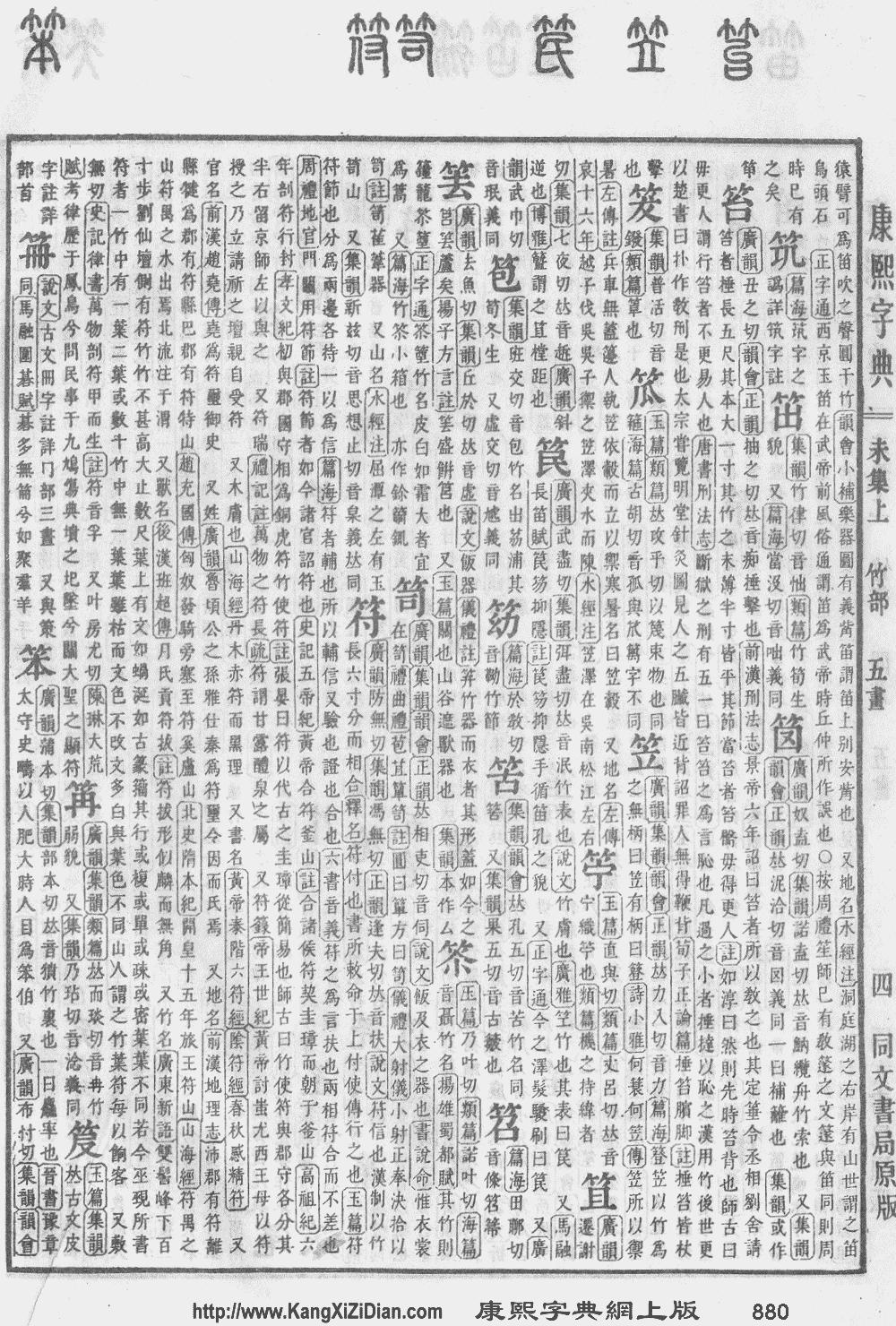
[edit]- Kangxi Dictionary: page 880, character 7
- Dai Kanwa Jiten: character 25924
- Dae Jaweon: page 1308, character 3
- Hanyu Da Zidian (first edition): volume 5, page 2959, character 2
- Unihan data for U+7B20
Chinese
[edit]| trad. | 笠 | |
|---|---|---|
| simp. # | 笠 | |
Glyph origin
[edit]| Historical forms of the character 笠 | |
|---|---|
| Shuowen Jiezi (compiled in Han) | Liushutong (compiled in Ming) |
| Small seal script | Transcribed ancient scripts |
Phono-semantic compound (形聲 / 形声, OC *ɡ·rɯb): semantic 竹 (“bamboo”) + phonetic 立 (OC *rɯb).
Etymology 1
[edit]Compare Proto-Tai *klɤpᴰ (“bamboo hat”) (Schuessler, 2007).
Pronunciation
[edit]- Mandarin
- (Standard)
- (Chengdu, Sichuanese Pinyin): ni2
- Cantonese
- Gan (Wiktionary): lit6
- Hakka
- Jin (Wiktionary): lieh4
- Northern Min (KCR): sā̤ / lĭ
- Eastern Min (BUC): lĭk
- Puxian Min (Pouseng Ping'ing): leh7 / lieh7 / lih7
- Southern Min
- Wu (Shanghai, Wugniu): 8liq
- Xiang (Changsha, Wiktionary): li4
- Mandarin
- (Standard Chinese)+
- Hanyu Pinyin: lì
- Zhuyin: ㄌㄧˋ
- Tongyong Pinyin: lì
- Wade–Giles: li4
- Yale: lì
- Gwoyeu Romatzyh: lih
- Palladius: ли (li)
- Sinological IPA (key): /li⁵¹/
- (Chengdu)
- Sichuanese Pinyin: ni2
- Scuanxua Ladinxua Xin Wenz: li
- Sinological IPA (key): /ni²¹/
- (Standard Chinese)+
- Cantonese
- (Standard Cantonese, Guangzhou–Hong Kong)
- Jyutping: lap1 / lap6
- Yale: lāp / lahp
- Cantonese Pinyin: lap7 / lap9
- Guangdong Romanization: leb1 / leb6
- Sinological IPA (key): /lɐp̚⁵/, /lɐp̚²/
- (Taishanese, Taicheng)
- Wiktionary: lap2
- Sinological IPA (key): /lap̚⁵⁵/
- (Standard Cantonese, Guangzhou–Hong Kong)
- Gan
- (Nanchang)
- Wiktionary: lit6
- Sinological IPA (key): /lit̚⁵/
- (Nanchang)
- Hakka
- (Sixian, incl. Miaoli and Neipu)
- Pha̍k-fa-sṳ: lip
- Hakka Romanization System: libˋ
- Hagfa Pinyim: lib5
- Sinological IPA: /lip̚²/
- (Hailu, incl. Zhudong)
- Hakka Romanization System: lib
- Sinological IPA: /lip⁵/
- (Meixian)
- (Sixian, incl. Miaoli and Neipu)
- Jin
- (Taiyuan)+
- Wiktionary: lieh4
- Sinological IPA (old-style): /liəʔ²/
- (Taiyuan)+
- Northern Min
- (Jian'ou)
- Kienning Colloquial Romanized: sā̤ / lĭ
- Sinological IPA (key): /sɛ⁵⁵/, /li²⁴/
- (Jian'ou)
- sā̤ - vernacular;
- lĭ - literary.
- Eastern Min
- (Fuzhou)
- Bàng-uâ-cê: lĭk
- Sinological IPA (key): /l̃iʔ⁵/
- (Fuzhou)
- Puxian Min
- (Putian, Jiangkou)
- Pouseng Ping'ing: leh7
- Báⁿ-uā-ci̍: le̍h
- Sinological IPA (key): /lɛʔ⁴/
- (Nanri)
- Pouseng Ping'ing: leh7
- Sinological IPA (key): /le̞ʔ⁴/
- (Putian, Xianyou, Youyang)
- Pouseng Ping'ing: lieh7
- Báⁿ-uā-ci̍: lia̍h
- Sinological IPA (key): /liɛʔ⁴/
- (Fengting)
- Pouseng Ping'ing: lieh7
- Sinological IPA (key): /lieʔ⁴/
- (Putian, Xianyou, Youyang, Fengting)
- Pouseng Ping'ing: lih7
- Báⁿ-uā-ci̍: li̍h
- Sinological IPA (key): /liʔ⁴/
- (Jiangkou)
- Pouseng Ping'ing: lih7
- Sinological IPA (key): /leʔ⁴/
- (Putian, Jiangkou)
- leh7/lieh7 - vernacular;
- lih7 - literary.
- Southern Min
- loe̍h/le̍h/lēre - vernacular;
- li̍p - literary.
- Middle Chinese: lip
- Old Chinese
- (Baxter–Sagart): /*k.rəp/
- (Zhengzhang): /*ɡ·rɯb/
Definitions
[edit]笠
Synonyms
[edit]Compounds
[edit]Etymology 2
[edit]Pronunciation
[edit]- Cantonese
- (Standard Cantonese, Guangzhou–Hong Kong)
- Jyutping: lap1
- Yale: lāp
- Cantonese Pinyin: lap7
- Guangdong Romanization: leb1
- Sinological IPA (key): /lɐp̚⁵/
- (Standard Cantonese, Guangzhou–Hong Kong)
Definitions
[edit]笠
- (Cantonese, Nanning Pinghua, Leizhou Min) basket (made from interwoven bamboo strips)
- (Cantonese, Leizhou Min) to cover (with); to slip on
- (Cantonese) to flatter; to fool
Compounds
[edit]References
[edit]- “笠”, in 漢語多功能字庫 (Multi-function Chinese Character Database)[2], 香港中文大學 (the Chinese University of Hong Kong), 2014–
- 李如龙 [Li, Ru-long]; 刘福铸 [Liu, Fu-zhu]; 吴华英 [Wu, Hua-ying]; 黄国城 [Huang, Guo-cheng] (2019), “笠”, in 莆仙方言调查报告 [Investigation Report on Puxian Dialect] (overall work in Mandarin and Puxian Min), Xiamen University Press, →ISBN, page 202.
Japanese
[edit]
Kanji
[edit]Readings
[edit]- Go-on: りゅう (ryū)←りふ (rifu, historical)
- Kan-on: りゅう (ryū)←りふ (rifu, historical)
- Kan’yō-on: りつ (ritsu)←りふ (rifu, historical)
- Kun: かさ (kasa, 笠)
Etymology 1
[edit]| Kanji in this term |
|---|
| 笠 |
| かさ Jinmeiyō |
| kun'yomi |
| Alternative spellings |
|---|
| 傘 暈 (uncommon) 仐 (rare) |


From Old Japanese. Attested in a gloss of the Nihon Shoki (720) and Man'yōshū (759) in the ideographic spelling 笠.[1] In turn, from reconstructed Proto-Japonic *kasa (“rain hat”). Possibly related to 重なる (kasanaru, “to overlap, to be layered”, intransitive), 重ねる (kasaneru, “to overlap, to layer”, transitive),[1].
The term originally refers to a bundle of reeds or sedges used as a rain hat.[1] Following the spread of folding umbrellas in the 900s after their introduction from Baekje or China, the sense gradually shifted to also mean "umbrella".
Pronunciation
[edit]Noun
[edit]- [from 720?/759] a traditional Japanese rain hat
- by extension, something of the same shape as a rain hat
- [date uncertain] the bell or umbrella of a jellyfish
- [from 759] the top or shade of a stone lantern or table lamp
- [from 934] the shell or husk of a fruit or nut, such as a pinecone
- [from early 1900s] the cap of a mushroom
- [from early 1400s] the lid of a bowl
- [from mid 1400s] the cap of a calligraphy brush
- (by extension) something protective, such as the authority of a professional organization, or the financial clout of a parent company
- a family crest with pictures of various rain hats
- [from 721] 暈: a halo: a ring of refracted light around the sun or moon from the way that the sun or moon would look like the center of a rain hat, with the ring viewed as the brim
- [from late 900s] 傘: a folding umbrella (cloth-covered frame used for protection against rain or sun)
- Synonyms: 洋傘 (yōgasa), 洋傘 (yōsan)
- 傘を差す、傘を広げる、傘をすぼめる、傘を巻く
- kasa o sasu, kasa o hirogeru, kasa o subomeru, kasa o maku
- hold an umbrella, open an umbrella, close an umbrella, roll up an umbrella
- 1999 February 20 [1994 December 15], Rumiko Takahashi, “PART.6 伝説の相合ガサ [Part 6: The Legendary Coupling Umbrella]”, in らんま½ [Ranma ½], 9th edition, volume 31 (fiction), Tokyo: Shogakukan, →ISBN, page 87:
- そのカサに一緒にはいった二人は必ず相思相愛の仲になるんですって、だから伝説の相合ガサ。
- Sono kasa ni issho ni haitta futari wa kanarazu sōshi sōai no naka ni naru n desu tte, da kara densetsu no aiaigasa.
- Legend has it that any two people who get under that umbrella together are bound to fall in love, and that’s why it's called the legendary coupling umbrella.
- そのカサに一緒にはいった二人は必ず相思相愛の仲になるんですって、だから伝説の相合ガサ。
- [from 1915] (thief cant, obsolete) the sun
Derived terms
[edit]- 笠貝 (kasagai)
- 笠雲 (kasagumo)
- 笠錏 (kasajikoro)
- 笠菅 (kasasuge)
- 笠縫 (kasanui)
- 笠の台 (kasa no dai)
- 笠百合 (kasayuri)
- 網代笠 (ajirogasa)
- 編み笠 (amigasa)
- 雨笠 (amegasa)
- 綾笠 (ayagasa)
- 市女笠 (ichimegasa)
- 隠笠 (kakuregasa)
- 衣笠 (kinugasa)
- 陣笠 (jingasa)
- 菅笠 (sugekasa)
- 田笠 (tagasa)
- 局笠 (tsubonegasa)
- 松笠 (matsugasa)
- 蓑笠 (minokasa)
- 紅葉笠 (momijigasa)
- 破れ笠 (yaburegasa)
- 山笠 (yamakasa)
Related terms
[edit]Etymology 2
[edit]| Kanji in this term |
|---|
| 笠 |
| りゅう Jinmeiyō |
| on'yomi |
*/ripu/ → /rifu/ → /riu/ → /rjuː/
From Middle Chinese 笠 (MC lip).
Only found in compounds.
Pronunciation
[edit]Affix
[edit]- a rain hat
Derived terms
[edit]- 蓑笠 (saryū, “straw rain cape and sedge rain hat”)
Etymology 3
[edit]| Kanji in this term |
|---|
| 笠 |
| りつ Jinmeiyō |
| kan'yōon |
/ripu/ → /ritu/ → /rit͡su/
Ultimately from Middle Chinese 笠 (MC lip). Shift in reading from the expected Old Japanese ripu to ritu.[5] Compare a similar shift in reading for the on'yomi of the kanji 立.
Pronunciation
[edit]Affix
[edit]- a rain hat
Derived terms
[edit]- 蓑笠 (saritsu, “straw rain cape and sedge rain hat”)
References
[edit]- ↑ 1.0 1.1 1.2 1.3 1.4 Nihon Kokugo Daijiten Dai-ni-han Henshū I'inkai (日本国語大辞典第二版編集委員会) (2001-2002), 日本国語大辞典 第二版 [Unabridged Japanese Dictionary: Second Edition], Tokyo (東京都): Shōgakukan (小学館), →ISBN
- ^ Matsumura, Akira, editor (2006), 大辞林 [Daijirin] (in Japanese), Third edition, Tokyo: Sanseidō, →ISBN
- ^ Yamada, Tadao et al., editors (2020), 新明解国語辞典 [Shin Meikai Kokugo Jiten] (in Japanese), Eighth edition, Tokyo: Sanseidō, →ISBN
- ^ NHK Broadcasting Culture Research Institute, editor (1998), NHK日本語発音アクセント辞典 [NHK Japanese Pronunciation Accent Dictionary] (in Japanese), Tokyo: NHK Publishing, Inc., →ISBN
- ^ “蓑笠”, in 日本国語大辞典 [Nihon Kokugo Daijiten][1] (in Japanese), concise edition, Tokyo: Shogakukan, 2006
- “▲笠”, in 漢字ぺディア [Kanjipedia][3] (in Japanese), The Japan Kanji Aptitude Testing Foundation, 2015–2026
Korean
[edit]Hanja
[edit]笠 (eumhun 삿갓 립 (satgat rip), word-initial (South Korea) 삿갓 입 (satgat ip))
- This term needs a translation to English. Please help out and add a translation, then remove the text
{{rfdef}}.
Vietnamese
[edit]Han character
[edit]笠: Hán Việt readings: lạp[1][2][3][4][5], lịp[6][7][8], liệp[6][7]
笠: Nôm readings: lợp[1][3][4][6][7][8], rập[1][3][6][7][8], lớp[1][2][3][8], lép[3][4], liếp[3][4], lụp[3][4], rạp[3][4], rấp[1], lấp[2], rợp[2], nập[3], lẹp[3], sập[3], sệp[3], sụp[3], tấp[3], lúp[8]
- chữ Nôm form of lớp (“layer”)
- 18th century, Đặng Trần Côn (鄧陳琨) (circa 1705–1745) (original Chinese), translated by Đoàn Thị Điểm (段氏點) (1705–1746/1748) (traditionally claimed), might actually be translated by Phan Huy Ích (潘輝益) (1751–1822), Chinh phụ ngâm khúc (征婦吟曲) [The Song of a Soldier's Wife], lines 143-144:
- 𦼔𣛟𱥯笠終扃
𨄹𡑝𠬠𨀈𤾓情艮魚- Rêu xanh mấy lớp chung quanh,
Dạo sân một bước, trăm tình ngẩn ngơ. - With patches of green moss around me,
Each step I take in the courtyard, hundred thoughts swirl in my heart.
- Rêu xanh mấy lớp chung quanh,
- chữ Nôm form of lợp (“to roof (to cover or furnish with a roof)”)
- chữ Nôm form of rấp (“to block up; to cover up”)
References
[edit]- ↑ 1.0 1.1 1.2 1.3 1.4 Nguyễn (2014).
- ↑ 2.0 2.1 2.2 2.3 Nguyễn et al. (2009).
- ↑ 3.00 3.01 3.02 3.03 3.04 3.05 3.06 3.07 3.08 3.09 3.10 3.11 3.12 3.13 Trần (2004).
- ↑ 4.0 4.1 4.2 4.3 4.4 4.5 Hồ (1976).
- ^ Thiều Chửu (1942).
- ↑ 6.0 6.1 6.2 6.3 Bonet (1899).
- ↑ 7.0 7.1 7.2 7.3 Génibrel (1898).
- ↑ 8.0 8.1 8.2 8.3 8.4 Taberd & Pigneau de Béhaine (1838).
- CJK Unified Ideographs block
- Han script characters
- CJK Compatibility Ideographs block
- Unspecified script characters
- Translingual lemmas
- Translingual symbols
- Han phono-semantic compounds
- Chinese lemmas
- Mandarin lemmas
- Sichuanese lemmas
- Cantonese lemmas
- Taishanese lemmas
- Gan lemmas
- Hakka lemmas
- Jin lemmas
- Northern Min lemmas
- Eastern Min lemmas
- Hokkien lemmas
- Teochew lemmas
- Puxian Min lemmas
- Wu lemmas
- Xiang lemmas
- Middle Chinese lemmas
- Old Chinese lemmas
- Chinese hanzi
- Mandarin hanzi
- Sichuanese hanzi
- Cantonese hanzi
- Taishanese hanzi
- Gan hanzi
- Hakka hanzi
- Jin hanzi
- Northern Min hanzi
- Eastern Min hanzi
- Hokkien hanzi
- Teochew hanzi
- Puxian Min hanzi
- Wu hanzi
- Xiang hanzi
- Middle Chinese hanzi
- Old Chinese hanzi
- Chinese nouns
- Mandarin nouns
- Sichuanese nouns
- Cantonese nouns
- Taishanese nouns
- Gan nouns
- Hakka nouns
- Jin nouns
- Northern Min nouns
- Eastern Min nouns
- Hokkien nouns
- Teochew nouns
- Puxian Min nouns
- Wu nouns
- Xiang nouns
- Middle Chinese nouns
- Old Chinese nouns
- Chinese verbs
- Cantonese verbs
- Chinese terms with IPA pronunciation
- Chinese terms spelled with 笠
- Cantonese Chinese
- Nanning Pinghua
- Leizhou Min Chinese
- Cantonese terms with collocations
- zh:Headwear
- Japanese kanji
- Japanese jinmeiyō kanji
- Japanese kanji with goon reading りゅう
- Japanese kanji with historical goon reading りふ
- Japanese kanji with kan'on reading りゅう
- Japanese kanji with historical kan'on reading りふ
- Japanese kanji with kan'yōon reading りつ
- Japanese kanji with historical kan'yōon reading りふ
- Japanese kanji with kun reading かさ
- Japanese terms spelled with 笠 read as かさ
- Japanese terms read with kun'yomi
- Japanese terms inherited from Old Japanese
- Japanese terms derived from Old Japanese
- Japanese terms inherited from Proto-Japonic
- Japanese terms derived from Proto-Japonic
- Japanese terms with IPA pronunciation
- Japanese terms with Atamadaka pitch accent (Tōkyō)
- Japanese terms with IPA pronunciation with pitch accent
- Japanese lemmas
- Japanese nouns
- Japanese terms with multiple readings
- Japanese terms spelled with jinmeiyō kanji
- Japanese terms with 1 kanji
- Japanese terms spelled with 笠
- Japanese single-kanji terms
- Japanese terms with usage examples
- Japanese cant
- Japanese terms with obsolete senses
- Japanese terms spelled with 笠 read as りゅう
- Japanese terms read with on'yomi
- Japanese terms derived from Middle Chinese
- Japanese affixes
- Japanese terms spelled with 笠 read as りつ
- Japanese terms read with kan'yōon
- ja:Headwear
- Korean lemmas
- Korean hanja
- Vietnamese Chữ Hán
- Vietnamese lemmas
- Vietnamese Han characters
- Vietnamese Nom
- Vietnamese terms with quotations