欄
Jump to navigation
Jump to search
See also: 栏
| ||||||||
 | ||||||||
Translingual[edit]
Han character[edit]
欄 (Kangxi radical 75, 木+17 in Chinese, 木+16 in Japanese, 21 strokes in Chinese, 20 strokes in Japanese, cangjie input 木日弓田 (DANW), four-corner 47920, composition ⿰木闌)
References[edit]
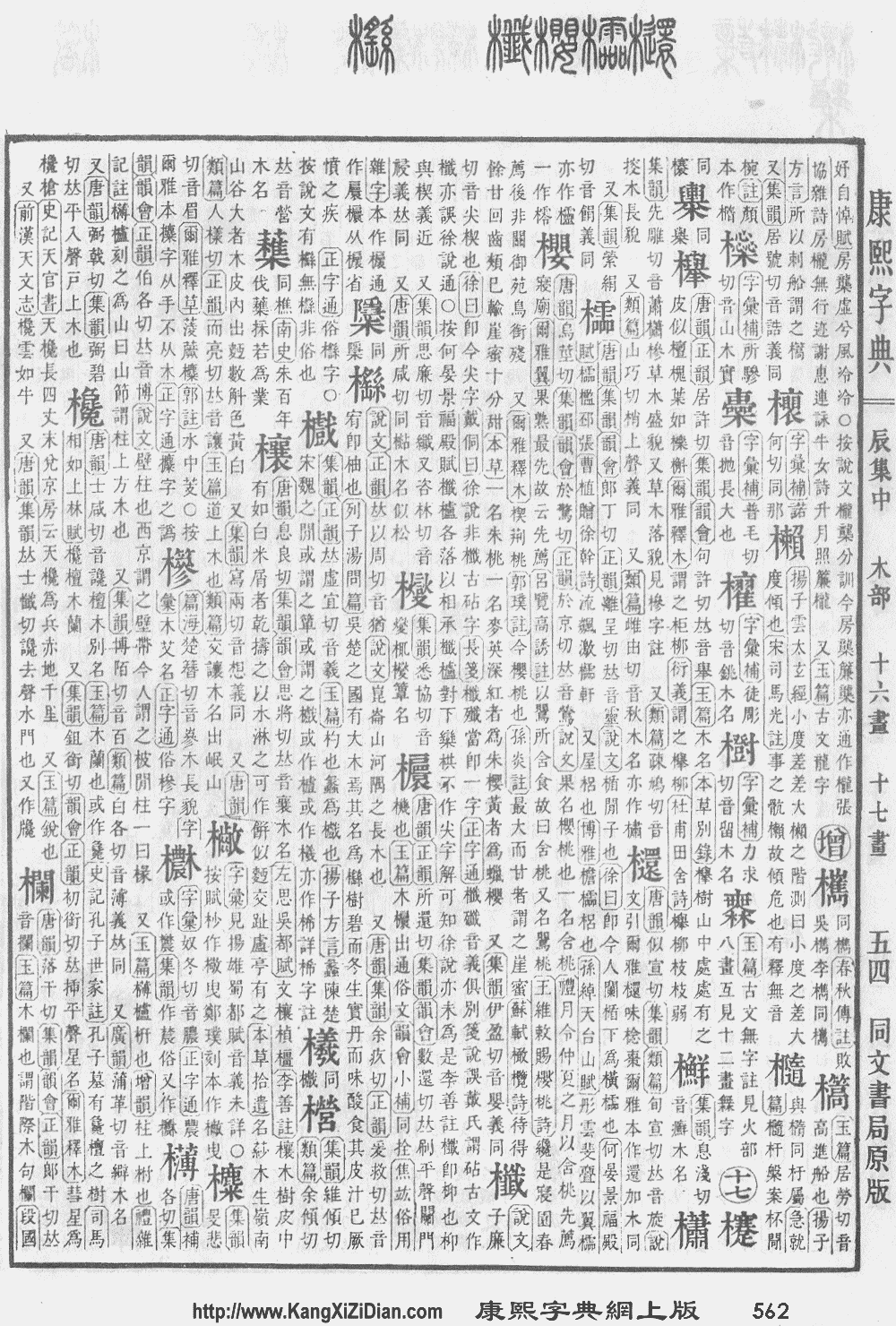
- Kangxi Dictionary: page 562, character 35
- Dai Kanwa Jiten: character 15880
- Dae Jaweon: page 951, character 14
- Hanyu Da Zidian (first edition): volume 2, page 1322, character 9
- Unihan data for U+6B04
Chinese[edit]
| trad. | 欄 | |
|---|---|---|
| simp. | 栏 | |
| alternative forms | 𣟬 | |
Glyph origin[edit]
| Old Chinese | |
|---|---|
| 蘭 | *ɡ·raːn |
| 攔 | *ɡ·raːn |
| 欄 | *ɡ·raːn |
| 瀾 | *ɡ·raːn, *ɡ·raːns |
| 讕 | *ɡ·raːn, *ɡ·raːnʔ, *ɡ·raːns |
| 闌 | *ɡ·raːn |
| 韊 | *ɡ·raːn |
| 幱 | *ɡ·raːn |
| 籣 | *ɡ·raːn |
| 躝 | *ɡ·raːn |
| 爛 | *ɡ·raːns |
| 爤 | *ɡ·raːns |
| 鑭 | *ɡ·raːns |
| 糷 | *ɡ·raːns |
| 斕 | *ɡ·reːn |
| 揀 | *kreːnʔ, *ɡ·reːns |
| 柬 | *kreːnʔ |
| 暕 | *kreːnʔ |
| 諫 | *kraːns |
| 練 | *ɡ·reːns |
| 鍊 | *ɡ·reːns |
| 煉 | *ɡ·reːns |
| 楝 | *ɡ·reːns |
| 萰 | *ɡ·reːns |
| 堜 | *ɡ·reːns |
| 湅 | *ɡ·reːns |
Phono-semantic compound (形聲/形声, OC *ɡ·raːn) : semantic 木 (“wood”) + phonetic 闌 (OC *ɡ·raːn).
Etymology 1[edit]
From Proto-Sinitic *lian.
Pronunciation[edit]
Definitions[edit]
欄
- railing; balustrade
- animal pen
- column or box
- (Cantonese) wholesaler
- lily magnolia (Magnolia liliiflora)
Compounds[edit]
Etymology 2[edit]
| For pronunciation and definitions of 欄 – see 楝 (“bead tree, formerly known as Melia japonica, a tree in the mahogany family”). (This character is a variant form of 楝). |
References[edit]
- “欄”, in 漢語多功能字庫 (Multi-function Chinese Character Database)[2], 香港中文大學 (the Chinese University of Hong Kong), 2014–
Japanese[edit]
| Shinjitai | 欄 | |
| Kyūjitai [1][2] |
欄 欄or 欄+ ︀?
|
|
| 欄󠄀 欄+ 󠄀?(Adobe-Japan1) | ||
| 欄󠄃 欄+ 󠄃?(Hanyo-Denshi) (Moji_Joho) | ||
| The displayed kanji may be different from the image due to your environment. See here for details. | ||
Kanji[edit]
欄
(common “Jōyō” kanji, shinjitai kanji, kyūjitai form 欄)
Readings[edit]
From Middle Chinese 欄 (MC lan):
From Middle Chinese 欄 (MC lenH):
From native Japanese roots:
Noun[edit]
References[edit]
Korean[edit]
Etymology[edit]
(This etymology is missing or incomplete. Please add to it, or discuss it at the Etymology scriptorium. Particularly: “Middle Korean readings, if any”)
Pronunciation[edit]
- (SK Standard/Seoul) IPA(key): [ɾa̠n]
- Phonetic hangul: [란]
Hanja[edit]

欄 (eumhun 난간 란 (nan'gan ran), South Korea 난간 난 (nan'gan nan))
Vietnamese[edit]
Han character[edit]
欄: Hán Nôm readings: lan, lang, lơn, lán, ràn
- This term needs a translation to English. Please help out and add a translation, then remove the text
{{rfdef}}.
References[edit]
Categories:
- CJK Unified Ideographs block
- Han script characters
- Character boxes with images
- CJK Compatibility Ideographs block
- Translingual lemmas
- Translingual symbols
- Han phono-semantic compounds
- Middle Chinese lemmas
- Old Chinese lemmas
- Chinese lemmas
- Mandarin lemmas
- Cantonese lemmas
- Hokkien lemmas
- Teochew lemmas
- Chinese nouns
- Mandarin nouns
- Cantonese nouns
- Hokkien nouns
- Teochew nouns
- Chinese terms with IPA pronunciation
- Chinese Han characters
- Cantonese Chinese
- Sichuanese lemmas
- Gan lemmas
- Hakka lemmas
- Jin lemmas
- Eastern Min lemmas
- Wu lemmas
- Xiang lemmas
- Sichuanese nouns
- Gan nouns
- Hakka nouns
- Jin nouns
- Eastern Min nouns
- Wu nouns
- Xiang nouns
- Chinese variant forms
- Japanese Han characters
- Common kanji
- Japanese terms derived from Middle Chinese
- Japanese kanji with goon reading らん
- Japanese kanji with kan'on reading らん
- Japanese kanji with goon reading れん
- Japanese kanji with kan'on reading れん
- Japanese kanji with kun reading おばしま
- Japanese kanji with kun reading おり
- Japanese kanji with kun reading てすり
- Japanese kanji with kun reading わく
- Japanese lemmas
- Japanese nouns
- Japanese terms spelled with secondary school kanji
- Japanese terms written with one Han script character
- Japanese terms spelled with 欄
- Japanese single-kanji terms
- Korean lemmas
- Korean Han characters
- Vietnamese lemmas
- Vietnamese Han characters