笨
Jump to navigation
Jump to search
See also: 苯
| ||||||||
Translingual[edit]
Han character[edit]
笨 (Kangxi radical 118, 竹+5, 11 strokes, cangjie input 竹木一 (HDM), four-corner 88234, composition ⿱𥫗本)
Derived characters[edit]
References[edit]
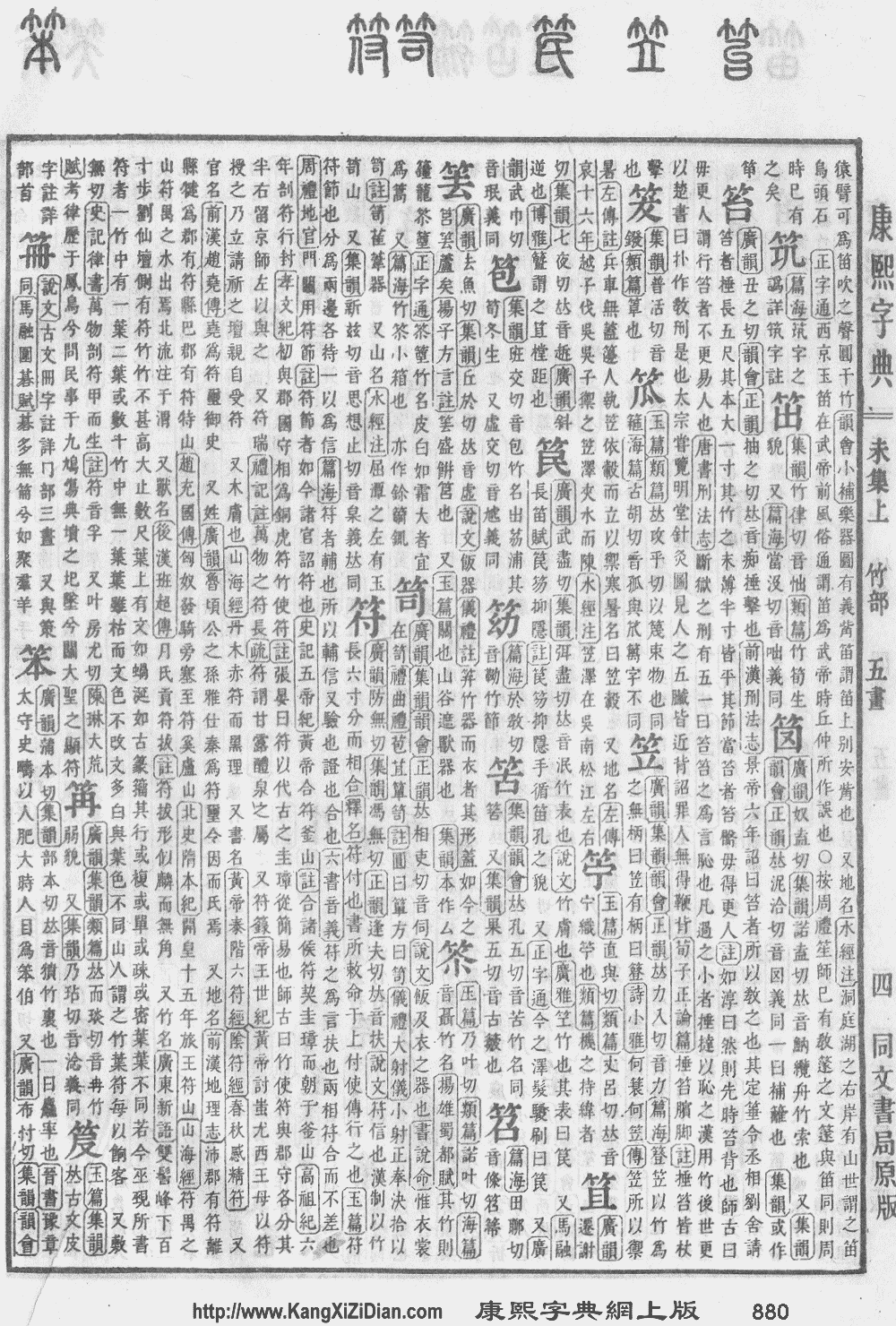
- Kangxi Dictionary: page 880, character 22
- Dai Kanwa Jiten: character 25939
- Dae Jaweon: page 1308, character 16
- Hanyu Da Zidian (first edition): volume 5, page 2953, character 12
- Unihan data for U+7B28
Chinese[edit]
Glyph origin[edit]
Phono-semantic compound (形聲/形声, OC *pɯːnʔ, *bɯːnʔ) : semantic 竹 + phonetic 本 (OC *pɯːnʔ).
Etymology 1[edit]
| trad. | 笨 | |
|---|---|---|
| simp. # | 笨 | |
| alternative forms | 体 㤓 𢜘 | |
Cognate with Tibetan བླུན (blun, “foolish; stupid; dull”) (Schuessler, 2007).
Pronunciation[edit]
Definitions[edit]
笨
- heavy; cumbersome; strenuous
- stupid; foolish; silly; slow-witted
- clumsy; awkward
- † inner part of bamboo
Synonyms[edit]
- (stupid):
- 呆
- 呆傻 (dāishǎ)
- 呆痴 (dāichī)
- 𡳞面 (Hokkien, vulgar)
- 𡳞鳥面/𡳞鸟面 (Hokkien, vulgar)
- 愚戇/愚戆 (Hokkien)
- 愚昧 (yúmèi)
- 愚笨 (yúbèn)
- 愚蠢 (yúchǔn)
- 愚鈍/愚钝 (yúdùn)
- 拙 (zhuō) (literary, or in compounds)
- 拙笨 (zhuōbèn)
- 撚樣/撚样 (lan2 joeng6-2) (Cantonese, vulgar)
- 暗昧 (ànmèi)
- 梢跤 (Zhangzhou Hokkien)
- 梢跤軟蹄/梢跤软蹄 (Zhangzhou Hokkien)
- 梢蹬 (Zhangzhou Hokkien)
- 棒槌 (bàngchuí)
- 海鱟/海鲎 (Hokkien)
- 混鈍/混钝 (Hokkien)
- 痴呆
- 發踱/发踱 (7faq 8doq) (Wu)
- 笨拙 (bènzhuō)
- 笨車車/笨车车 (Hokkien)
- 臭笨 (Hokkien)
- 菜瓜 (Quanzhou Hokkien)
- 蠢 (chǔn)
- 蠢氣/蠢气 (qyn3 qi4) (Xiang)
- 蠢笨 (chǔnbèn)
- 袋屎 (Hokkien)
- 袋屎袋尿 (Hokkien)
- 跤梢 (Xiamen Hokkien)
- 遲鈍/迟钝 (chídùn)
- 阿西 (Hokkien)
- 頇顢/顸颟 (Hokkien)
- 鱟/鲎 (Hokkien)
- 鳩拙/鸠拙 (jiūzhuó) (literary)
Dialectal synonyms of 笨 (“stupid; lacking intelligence”) [map]
| Variety | Location | Words |
|---|---|---|
| Formal (Written Standard Chinese) | 笨, 愚笨, 愚蠢 | |
| Mandarin | Beijing | 笨 |
| Taiwan | 笨 | |
| Jinan | 笨 | |
| Xi'an | 悶 | |
| Wuhan | 笨, 蠢 | |
| Chengdu | 笨, 蠢 | |
| Yangzhou | 笨 | |
| Hefei | 笨 | |
| Singapore | 笨 | |
| Cantonese | Guangzhou | 蠢, 笨 |
| Hong Kong | 蠢, 笨 | |
| Yangjiang | 吽, 塞督, 塞 | |
| Singapore (Guangfu) | 蠢 | |
| Gan | Nanchang | 笨, 蠢 |
| Hakka | Meixian | 笨 |
| Jin | Taiyuan | 笨 |
| Northern Min | Jian'ou | 笨 |
| Eastern Min | Fuzhou | 愚, 笨 |
| Southern Min | Xiamen | 笨 |
| Singapore (Teochew) | 白仁 | |
| Wu | Suzhou | 笨 |
| Wenzhou | 呆, 笨 | |
| Xiang | Changsha | 蠢 |
| Shuangfeng | 蠢 | |
Compounds[edit]
Etymology 2[edit]
| trad. | 笨 | |
|---|---|---|
| simp. # | 笨 | |
| alternative forms | 賁/贲 Hakka 朌 Hakka 坋 Hakka 蕡/𰱟 Hakka 厚 Hakka | |
(This etymology is missing or incomplete. Please add to it, or discuss it at the Etymology scriptorium.)
Pronunciation[edit]
Definitions[edit]
笨
- (dialectal Cantonese, Hakka, dated in standard Cantonese) thick
Synonyms[edit]
References[edit]
- “笨”, in 漢語多功能字庫 (Multi-function Chinese Character Database)[1], 香港中文大學 (the Chinese University of Hong Kong), 2014–
Japanese[edit]
Kanji[edit]
笨
- This term needs a translation to English. Please help out and add a translation, then remove the text
{{rfdef}}.
Readings[edit]
Korean[edit]
Hanja[edit]
笨 • (bun) (hangeul 분, revised bun, McCune–Reischauer pun, Yale pun)
Vietnamese[edit]
Han character[edit]
- This term needs a translation to English. Please help out and add a translation, then remove the text
{{rfdef}}.
Categories:
- CJK Unified Ideographs block
- Han script characters
- Translingual lemmas
- Translingual symbols
- Han phono-semantic compounds
- Mandarin terms with audio links
- Middle Chinese lemmas
- Old Chinese lemmas
- Chinese lemmas
- Mandarin lemmas
- Sichuanese lemmas
- Cantonese lemmas
- Hakka lemmas
- Hokkien lemmas
- Teochew lemmas
- Wu lemmas
- Xiang lemmas
- Chinese adjectives
- Mandarin adjectives
- Sichuanese adjectives
- Cantonese adjectives
- Hakka adjectives
- Hokkien adjectives
- Teochew adjectives
- Wu adjectives
- Xiang adjectives
- Chinese terms with IPA pronunciation
- Chinese Han characters
- Chinese terms with obsolete senses
- Cantonese Chinese
- Hakka Chinese
- Chinese dated terms
- Cantonese terms with quotations
- Elementary Mandarin
- Japanese Han characters
- Uncommon kanji
- Japanese kanji with goon reading ぼん
- Japanese kanji with kan'on reading ほん
- Japanese kanji with kun reading あら-い
- Japanese kanji with kun reading がさ
- Korean lemmas
- Korean Han characters
- Vietnamese lemmas
- Vietnamese Han characters