ring
English
[edit]Pronunciation
[edit]- (Received Pronunciation) enPR: rĭng; IPA(key): /ɹɪŋ/
- (General American) enPR: rēng; IPA(key): /ɹi(ː)ŋ/
- Rhymes: -ɪŋ, -iŋ
- Homophone: wring
Etymology 1
[edit]From Middle English ryng, from Old English hring (“ring, circle”), from Proto-West Germanic *hring, from Proto-Germanic *hringaz (“ring”), from Proto-Indo-European *(s)krengʰ-, extended nasalized form of *(s)ker- (“to turn, bend”). Doublet of rank and rink.
Noun
[edit]ring (plural rings)
- (physical) A solid object in the shape of a circle.
- A circumscribing object, (roughly) circular and hollow, looking like an annual ring, earring, finger ring etc.
- (jewelry) A round piece of (precious) metal worn around the finger or through the ear, nose, etc.
- c. 1596–1598 (date written), William Shakespeare, “The Merchant of Venice”, in Mr. William Shakespeares Comedies, Histories, & Tragedies […] (First Folio), London: […] Isaac Iaggard, and Ed[ward] Blount, published 1623, →OCLC, [Act IV, scene i]:
- The dearest ring in Venice will I give you.
- (UK) A bird band, a round piece of metal put around a bird's leg used for identification and studies of migration.
- (UK) A burner on a kitchen stove.
- In a jack plug, the connector between the tip and the sleeve.
- (historical) An instrument, formerly used for taking the sun's altitude, consisting of a brass ring suspended by a swivel, with a hole at one side through which a solar ray entering indicated the altitude on the graduated inner surface opposite.
- (botany) A flexible band partly or wholly encircling the spore cases of ferns.
- (physical) A group of objects arranged in a circle.
- A circular group of people or objects.
- a ring of mushrooms growing in the wood
- a. 1645, John Milton, “Il Penseroso”, in Poems of Mr. John Milton, […], London: […] Ruth Raworth for Humphrey Mosely, […], published 1646, →OCLC, page 39:
- And hears the Muſes in a ring, / Ay round about Joves Altar ſing.
- 1944, Miles Burton, chapter 5, in The Three Corpse Trick:
- The hovel stood in the centre of what had once been a vegetable garden, but was now a patch of rank weeds. Surrounding this, almost like a zareba, was an irregular ring of gorse and brambles, an unclaimed vestige of the original common.
- (astronomy) A formation of various pieces of material orbiting around a planet or young star.
- (British) A large circular prehistoric stone construction such as Stonehenge.
- A circular group of people or objects.
- A piece of food in the shape of a ring.
- onion rings
- (Internet) Short for webring.
- 2002, Feroz Khan, Information Society in Global Age, page 100:
- Individuals looking to add their own homepage to a particular ring are, however, more or less at the mercy of the ringmaster, who often maintains a ring homepage listing its acceptance (or membership) policies and an index of its member sites.
- A place where some sports or exhibitions take place; notably a circular or comparable arena, such as a boxing ring or a circus ring; hence the field of a political contest.
- 1707, Edmund Smith, Phaedra and Hippolitus:
- Place me, O, place me in the dusty ring, / Where youthful charioteers contend for glory.
- The open space in front of a racecourse stand, used for betting purposes.
- An exclusive group of people, usually involving some unethical or illegal practices.
- a crime ring; a prostitution ring; a bidding ring (at an auction sale)
- 1877, Edward Augustus Freeman, The History of the Norman Conquest of England:
- the ruling ring at Constantinople
- 1928, Upton Sinclair, Boston:
- It's a blackmail ring, and the district attorneys get a share of the loot.
- 2018 July 31, Julia Carrie Wong, “What is QAnon? Explaining the bizarre rightwing conspiracy theory”, in The Guardian[1]:
- In a thread called “Calm Before the Storm”, and in subsequent posts, Q established his legend as a government insider with top security clearance who knew the truth about a secret struggle for power involving Donald Trump, the “deep state”, Robert Mueller, the Clintons, pedophile rings, and other stuff.
- (chemistry) A group of atoms linked by bonds to form a closed chain in a molecule.
- a benzene ring
- (geometry) A planar geometrical figure included between two concentric circles.
- (typography) A diacritical mark in the shape of a hollow circle placed above or under the letter; a kroužek.
- (historical) An old English measure of corn equal to the coomb or half a quarter.
- 1866, James Edwin Thorold Rogers, A History of Agriculture and Prices in England, volume 1, page 168:
- The ring is common in the Huntingdonshire accounts of Ramsey Abbey. It was equal to half a quarter, i.e., is identical with the coomb of the eastern counties
- (computing theory) A hierarchical level of privilege in a computer system, usually at hardware level, used to protect data and functionality (also protection ring).
- 2007, Steve Anson, Steve Bunting, Mastering Windows Network Forensics and Investigation, page 70:
- Kernel Mode processes run in ring 0, and User Mode processes run in ring 3.
- (firearms) Either of the pair of clamps used to hold a telescopic sight to a rifle.
- (cartomancy) The twenty-fifth Lenormand card.
- (networking) A network topology where connected devices form a circular data channel. All computers on the ring can see every message, and there are no collisions, and a single point of failure will occur if any part of the ring breaks.
Derived terms
[edit]- abdominal inguinal ring
- abdominal ring
- abstinence ring
- algebra over a ring
- alternate ring hitching
- anchor ring
- annual ring
- A ring
- Artin ring
- bathtub ring
- belly button ring
- belly ring
- benzene ring
- betting ring
- big ring
- Borromean rings
- boxing ring
- brass ring
- bubble ring
- bull ring
- cake ring
- calamari ring
- captive bead ring
- chainring
- chastity ring
- chatter ring
- cinnamon ring
- circus ring
- Claddagh ring
- class ring
- claw ring
- cock ring
- coffee ring
- commitment ring
- common three-ring
- cornice ring
- cramp ring
- curtain ring
- decoder ring
- Dedekind ring
- diamond ring
- discrete valuation ring
- division ring
- dope-ring
- D ring
- D-ring
- drug ring
- earring
- egg ring
- Einstein ring
- engagement ring
- enringed
- eternity ring
- factor ring
- fairy ring
- fairy ring champignon
- finger ring
- fire ring
- fisherman's ring
- five-ring
- Flieringa ring
- Fomalhaut dust ring
- four-ring
- front ring
- gas ring
- Gibson ring
- go for the gold ring
- group ring
- growth ring
- heel ring
- Herman ring
- hogring
- hold the ring
- iron ring
- junk ring
- Kayser-Fleischer ring
- key ring/keyring
- kiss someone's ring
- Kummer ring
- Landolt broken ring
- Landolt ring
- Liesegang ring
- life ring
- limbal ring
- local ring
- mancude-ring system
- mangagement ring
- marriage ring
- Mickey Mouse ring
- mood ring
- mooring ring
- napkin ring
- near-ring
- neck ring
- Newton's rings
- Niven ring
- Nobili's rings
- Noetherian ring
- nose ring
- oath-ring
- oath ring
- Olympic Rings
- onion ring
- ordered ring
- O-ring
- party ring
- pedophile ring
- peg in the ring
- penis ring
- pinky ring
- piscatory ring
- piston ring
- pixie ring
- pixy ring
- planetary ring
- posie ring
- prime ring
- principal ideal ring
- prison ring
- prize ring
- product ring
- promise ring
- puke one's ring
- purity ring
- puzzle ring
- quotient ring
- Raschig ring
- red ring disease
- red ring of death
- red ring skirt
- reduced ring
- regard ring
- ring-a-levio
- Ring a Ring o' Roses
- ring armor
- ring-around-the-rosy
- ring bark/ringbark/ring-bark
- ringbearer
- ring bend
- ring-billed
- ring-billed gull
- ring binder
- ring-bone
- ring buoy
- ring-cake
- ring chart
- ring chromosome
- ring dance
- ring doughnut, ring donut
- ring dove/ringdove
- ring dropper
- ring-dropping
- ringed
- ring fence
- ring field
- ring finger
- ring flash
- ring gag
- ring game
- ring gauge
- ring homomorphism
- ring in one's nose
- ring isomorphism
- ring junction
- ring knocker
- ring lamp
- ring laser
- ringleader
- ringlet
- ring light
- ringlike
- ring-lock
- ring mail/ringmail
- ring modulation
- ring modulator
- ring name
- ringneck
- ring-neck/ring-necked
- ring-necked duck
- ring-necked parakeet
- ring-necked pheasant
- ring-oath
- ring of authenticity
- ring of bells
- ring of death
- Ring of Fire
- ring of fractions
- Ring of Solomon
- ring of steel
- ring of the fisherman
- ring of truth
- ring oscillator
- ring ouzel
- ring parrot
- ringpiece
- ring play
- ring plover
- ring-porous
- ring pull
- ring rain
- ring rat
- ring road
- ring rot
- ring-shaped
- ringside
- ring silicate
- ring singularity
- ring snake
- ring spanner
- ring species
- ring spinner
- ring spinning
- ring spot
- ring stand
- ring sting
- ringstraked
- ring sum normal form
- ring system
- ringtail/ring-tail
- ring-tailed/ringtailed
- ring-tailed coati
- ring-tailed lemur
- ring-tailed macauco
- ring-taw
- ring tennis
- ring-theoretic
- ring-theoretical
- ring theory
- ring thrush
- ring time
- ring topology
- ring toss
- ring wing
- ringworm
- ring wrench
- rod ring
- Roman ring
- rubber ring
- run rings around
- rush ring
- saddle ring
- sclerotic ring
- seal ring
- septum ring
- shen ring
- show ring
- signet ring
- simple ring
- six-ring
- slip ring
- smoke ring
- snap ring
- soap ring
- sovereign ring
- sovvy ring
- split-ring
- spy ring
- star ring
- steel ring
- synonym ring
- teething ring
- temple ring
- three-ring circus
- throw one's hat in the ring
- throw one's hat into the ring
- thumb-ring
- thumb ring
- toe ring
- token ring
- tongue ring
- toss one's hat in the ring
- toss one's hat into the ring
- total ring of fractions
- tow ring
- tree ring
- tympanic ring
- Ulloa's ring
- unique factorization ring
- vaginal ring
- valuation ring
- vortex ring
- v-ring
- Waldeyer's ring
- wedding-ring
- wedding ring
- wrestling ring
- X-ring
Related terms
[edit]Descendants
[edit]Translations
[edit]
|
| ||||||||


|
|
|
|
|
|
- The translations below need to be checked and inserted above into the appropriate translation tables. See instructions at Wiktionary:Entry layout § Translations.
Gallery
[edit]-
 A boxing ring.
 -
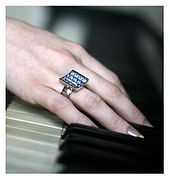 A ring on a finger.
 -
 The rings of a tree.
 -
 The circus ring.
 -
 A ring on a bird's leg.
 -
 The rings of Saturn.


Verb
[edit]ring (third-person singular simple present rings, present participle ringing, simple past and past participle ringed)
- (transitive) To enclose or surround.
- The inner city was ringed with dingy industrial areas.
- 2022 January 12, Paul Bigland, “Fab Four: the nation's finest stations: Eastbourne”, in RAIL, number 948, page 27:
- Today, when stepping off the train, you're presented with a bright and airy concourse that's ringed with a variety of facilities.
- (transitive, figuratively) To make an incision around; to girdle; to cut away a circular tract of bark from a tree in order to kill it.
- They ringed the trees to make the clearing easier next year.
- 1887, Harriet W. Daly, Digging, Squatting, and Pioneering Life in the Northern Territory of South Australia, page 50:
- The ironbark trees are "rung" at a certain height top and bottom, and the bark detached in one sheet; it is then wetted, and laid out flat on the ground, huge stones being placed to keep it from rolling up again.
- (transitive) To attach a ring to, especially for identification.
- We managed to ring 22 birds this morning.
- 1919, Popular Science, volume 95, number 4, page 31:
- Ringing a pig of ordinary size is easy, but special arrangements must be made for handling the big ones.
- (transitive) To surround or fit with a ring, or as if with a ring.
- to ring a pig’s snout
- c. 1596 (date written), William Shakespeare, “The Life and Death of King Iohn”, in Mr. William Shakespeares Comedies, Histories, & Tragedies […] (First Folio), London: […] Isaac Iaggard, and Ed[ward] Blount, published 1623, →OCLC, [Act III, scene iv]:
- Ring these fingers with thy household worms.
- (falconry) To rise in the air spirally.
- 1877 May 30, Gerard Manley Hopkins, “The Windhover: To Christ Our Lord”, in Robert Bridges, editor, Poems of Gerard Manley Hopkins: Now First Published […], London: Humphrey Milford, published 1918, →OCLC, stanza 1, page 29:
- […] how he rung upon the rein of a wimpling wing / In his ecstacy!
- (transitive) To steal and change the identity of (cars) in order to resell them.
- A. Woodley, Trio: 3 short stories
- Gabe said that as Derry had only caught part of the conversation, it's possible that they were discussing a film, it was bad enough that they'd unwittingly been brought into ringing cars, adding drugs into it was far more than either of them could ever be comfortable with.
- 2019 (10 December), Ross McCarthy, Digbeth chop shop gang jailed over £2m stolen car racket (in Birmingham Live) [2]
- They used two bases in Digbeth to break down luxury motors, some of which were carjacked or stolen after keys were taken in house raids. The parts were then fitted to salvaged cars bought online. […] Jailing the quartet, a judge at Birmingham Crown Court said it was a "car ringing on a commercial and substantial scale".
- A. Woodley, Trio: 3 short stories
- (Australia, transitive) To ride around (a group of animals, especially catle) to keep them milling in one place; hence (intransitive), to work as a drover, to muster cattle.
- 2002, Alex Miller, Journey to the Stone Country, Allen & Unwin, published 2003, page 289:
- ‘I was ringing for your dad out there at Haddon Hill the year you was born. It was a good year for calves.’
Derived terms
[edit]Translations
[edit]
|
|
Etymology 2
[edit]From Middle English ringen, from Old English hrinġan (“to ring”), from Proto-Germanic *hringijaną. Cognate with Dutch ringen, Swedish ringa. Of imitative origin.
Noun
[edit]ring (plural rings)
- The resonant sound of a bell, or a sound resembling it.
- The church bell's ring could be heard the length of the valley.
- The ring of hammer on anvil filled the air.
- (figuratively) A pleasant or correct sound.
- The name has a nice ring to it.
- (figuratively) A sound or appearance that is characteristic of something.
- Her statements in court had a ring of falsehood.
- (colloquial) A telephone call.
- I’ll give you a ring when the plane lands.
- Any loud sound; the sound of numerous voices; a sound continued, repeated, or reverberated.
- 1622, Francis, Lord Verulam, Viscount St. Alban [i.e. Francis Bacon], The Historie of the Raigne of King Henry the Seventh, […], London: […] W[illiam] Stansby for Matthew Lownes, and William Barret, →OCLC:
- the ring of acclamations fresh in his ears
- A chime, or set of bells harmonically tuned.
- St Mary's has a ring of eight bells.
- 1655, Thomas Fuller, The Church-history of Britain; […], London: […] Iohn Williams […], →OCLC, (please specify |book=I to XI):
- as great and tunable a ring of bells as any in the world
Derived terms
[edit]Translations
[edit]
|
|
- The translations below need to be checked and inserted above into the appropriate translation tables. See instructions at Wiktionary:Entry layout § Translations.
Verb
[edit]ring (third-person singular simple present rings, present participle ringing, simple past rang or (nonstandard) rung, past participle rung)
- (intransitive) Of a bell, etc., to produce a resonant sound.
- The bells were ringing in the town.
- (transitive) To make (a bell, etc.) produce a resonant sound.
- The deliveryman rang the doorbell to drop off a parcel.
- c. 1606 (date written), William Shakespeare, “The Tragedie of Macbeth”, in Mr. William Shakespeares Comedies, Histories, & Tragedies […] (First Folio), London: […] Isaac Iaggard, and Ed[ward] Blount, published 1623, →OCLC, [Act III, scene ii]:
- The shard-borne beetle, with his drowsy hums, / Hath rung night's yawning peal.
- (transitive) To produce (a sound) by ringing.
- They rang a Christmas carol on their handbells.
- (intransitive, figuratively) To produce the sound of a bell or a similar sound.
- Whose mobile phone is ringing?
- (intransitive, figuratively) Of something spoken or written, to appear to be, to seem, to sound.
- That does not ring true.
- (transitive, colloquial, British, Australia, New Zealand) To telephone (someone).
- I will ring you when we arrive.
- (intransitive) to resound, reverberate, echo.
- 1850, [Alfred, Lord Tennyson], In Memoriam, London: Edward Moxon, […], →OCLC, Canto XXIII, page 40:
- […] And many an old philosophy
On Argive heights divinely sang,
And round us all the thicket rang
To many a flute of Arcady.
- [1898], J[ohn] Meade Falkner, Moonfleet, London; Toronto, Ont.: Jonathan Cape, published 1934, →OCLC:
- So he spoke, and it seemed there was a little halting at first, as of men not liking to take Blackbeard's name in Blackbeard's place, or raise the Devil by mocking at him. But then some of the bolder shouted 'Blackbeard', and so the more timid chimed in, and in a minute there were a score of voices calling 'Blackbeard, Blackbeard', till the place rang again.
- 1919, Boris Sidis, The Source and Aim of Human Progress:
- It is instructive for us to learn as well as to ponder on the fact that "the very men who looked down with delight, when the sand of the arena reddened with human blood, made the arena ring with applause when Terence in his famous line: ‘Homo sum, Nihil humani alienum puto’ proclaimed the brotherhood of man."
- (intransitive) To produce music with bells.
- 1669, William Holder, Elements of Speech: An Essay of Inquiry into the Natural Production of Letters: […], London: […] T. N[ewcomb] for J[ohn] Martyn printer to the R[oyal] Society, […], →OCLC:
- Four Bells admit Twenty-four changes in Ringing
- To ring up (enter into a cash register or till)
- 1983, T.C. Knudsen, John Hempstead, A Man's Guide to Women:
- The checkout girl rang it into his total, and he paid the bill.
- 1990, The New Zealand Law Reports - Volume 3, page 75:
- On presentation of the item at the checkout the original price sticker was concealed from the checkout assistant and a sticker of $38.88 exhibited on the item. The checkout operator rang on the lesser sum, a mistake known to Dronjak. He was subsequently charged with theft.
- 2011, Tracy E Whipple, A Friend's Last Gift, page 88:
- . The new cashier rang something twice and had to call for the manager to fix the register.
- (dated) To repeat often, loudly, or earnestly.
Derived terms
[edit]- make the welkin ring
- ring a bell
- ring around
- ring back
- ring down the curtain
- ringer
- ring false
- ring hollow
- ring in
- ringing
- ring off
- ring off the hook
- ring one's bell
- ring out
- ring round
- ring someone's bell
- ring the changes
- ring the devil's doorbell
- ring the welkins
- ring through
- ring true
- ring up
- ring up the curtain
- unring
Translations
[edit]
|
|
|
- The translations below need to be checked and inserted above into the appropriate translation tables. See instructions at Wiktionary:Entry layout § Translations.
Etymology 3
[edit]From a shortening of German Zahlring (“number(s) ring”) (coined by German mathematician David Hilbert in 1892).[1] Apparently first used in English in 1930, E. T. Bell, “Rings whose elements are ideals,” Bulletin of the American Mathematical Society.[2]

Noun
[edit]ring (plural rings)
- (algebra) An algebraic structure which consists of a set with two binary operations: an additive operation and a multiplicative operation, such that the set is an abelian group under the additive operation, a monoid under the multiplicative operation, and such that the multiplicative operation is distributive with respect to the additive operation.
- The set of integers, , is the prototypical ring.
- (algebra) An algebraic structure as above, but only required to be a semigroup under the multiplicative operation, that is, there need not be a multiplicative identity element.
- The definition of ring without unity allows, for instance, the set of even integers to be a ring.Synonym: rng


Hypernyms
[edit]Hyponyms
[edit]Meronyms
[edit]Derived terms
[edit]Translations
[edit]
|
Etymology 4
[edit](This etymology is missing or incomplete. Please add to it, or discuss it at the Etymology scriptorium.)

Noun
[edit]ring (plural rings)
- (mathematical analysis, measure theory) A family of sets that is closed under finite unions and set-theoretic differences.[3]
- (mathematics, order theory) A family of sets closed under finite union and finite intersection.
Hyponyms
[edit]Translations
[edit]
|
References
[edit]- ^ 1962, Harvey Cohn, A Second Course in Number Theory, Wiley, 1980, Advanced Number Theory, Dover, Unabridged republication, page 49.
- ^ Earliest Known Uses of Some of the Words of Mathematics (R)
- ^ Gerald B. Folland (©1999) Real Analysis : Modern Techniques and Their Applications, Second edition, New York: John Wiley & Sons, Inc., →ISBN, →OCLC, §1.2, page 24
Anagrams
[edit]Afrikaans
[edit]Etymology
[edit]From Dutch ring, from Middle Dutch rinc, from Old Dutch ring, from Proto-West Germanic *hring, from Proto-Germanic *hringaz.
Pronunciation
[edit]Noun
[edit]ring (plural ringe)
- ring, hollow circular object
Atong (India)
[edit]Etymology
[edit](This etymology is missing or incomplete. Please add to it, or discuss it at the Etymology scriptorium.).
Noun
[edit]ring
References
[edit]- van Breugel, Seino. 2015. Atong-English dictionary, second edition. Available online: https://www.academia.edu/487044/Atong_English_Dictionary.
Balinese
[edit]Romanization
[edit]ring
- Romanization of ᬭᬶᬂ
Cimbrian
[edit]Adjective
[edit]ring
- (of weight) light
References
[edit]- Umberto Patuzzi, ed., (2013) Ünsarne Börtar, Luserna: Comitato unitario delle linguistiche storiche germaniche in Italia / Einheitskomitee der historischen deutschen Sprachinseln in Italien
Czech
[edit]Pronunciation
[edit]Noun
[edit]ring m inan
- ring (place where some sports take place; boxing ring and similar)
Declension
[edit]Further reading
[edit]- “ring”, in Příruční slovník jazyka českého (in Czech), 1935-1957
- “ring”, in Slovník spisovného jazyka českého (in Czech), 1960–1971, 1989
Danish
[edit]Etymology 1
[edit]From Old Norse hringr, from Proto-Germanic *hringaz.
Pronunciation
[edit]Noun
[edit]ring c (singular definite ringen, plural indefinite ringe)
Inflection
[edit]Derived terms
[edit]Etymology 2
[edit]Verbal noun to ringe (“to ring”).
Pronunciation
[edit]Noun
[edit]ring n (singular definite ringet, plural indefinite ring)
Inflection
[edit]Etymology 3
[edit]See ringe.
Pronunciation
[edit]Verb
[edit]ring
- imperative of ringe
Dutch
[edit]Etymology
[edit]From Middle Dutch rinc, from Old Dutch ring, from Proto-West Germanic *hring, from Proto-Germanic *hringaz.
Pronunciation
[edit]Noun
[edit]ring m (plural ringen, diminutive ringetje n)
- ring, hollow circular object
- (gymnastics) ring
- beltway, ring road
Derived terms
[edit]Descendants
[edit]- Afrikaans: ring
- Negerhollands: rink, riṅ
- →? Aukan: linga
- → Indonesian: ring
- → Papiamentu: renchi, ringtsje (from the diminutive)
See also
[edit]Estonian
[edit]Etymology
[edit]From Middle Low German rink. Compare German Ring. See also rõngas.
Noun
[edit]ring (genitive ringi, partitive ringi)
Declension
[edit]| Declension of ring (ÕS type 22e/riik, length gradation) | |||
|---|---|---|---|
| singular | plural | ||
| nominative | ring | ringid | |
| accusative | nom. | ||
| gen. | ringi | ||
| genitive | ringide | ||
| partitive | ringi | ringe ringisid | |
| illative | ringi ringisse |
ringidesse ringesse | |
| inessive | ringis | ringides ringes | |
| elative | ringist | ringidest ringest | |
| allative | ringile | ringidele ringele | |
| adessive | ringil | ringidel ringel | |
| ablative | ringilt | ringidelt ringelt | |
| translative | ringiks | ringideks ringeks | |
| terminative | ringini | ringideni | |
| essive | ringina | ringidena | |
| abessive | ringita | ringideta | |
| comitative | ringiga | ringidega | |
See also
[edit]French
[edit]Etymology
[edit]From English ring (sense 1) and Dutch ring (sense 2).
Pronunciation
[edit]Noun
[edit]ring m (plural rings)
Derived terms
[edit]Descendants
[edit]- → Romanian: ring
Further reading
[edit]- “ring”, in Trésor de la langue française informatisé [Digitized Treasury of the French Language], 2012.
Garo
[edit]Noun
[edit]ring
German
[edit]Pronunciation
[edit]Verb
[edit]ring
Hungarian
[edit]Pronunciation
[edit]Etymology 1
[edit]From an onomatopoeic (sound-imitative) root + -g (frequentative suffix).[1]
Verb
[edit]ring
- (intransitive) to swing, to rock
- Synonyms: billeg, inog, ingadozik, himbálózik, himbálódzik
- (intransitive, of a ship) to sway, to roll
- Synonyms: ringatózik, ringatódzik, dülöng, dülöngél, himbálódzik, himbálózik
Conjugation
[edit]| Click for archaic forms | 1st person sg | 2nd person sg informal |
3rd person sg, 2nd p. sg formal |
1st person pl | 2nd person pl informal |
3rd person pl, 2nd p. pl formal | |||
|---|---|---|---|---|---|---|---|---|---|
Indicative mood |
Present | Indef. | ringok | ringsz | ring | ringunk | ringtok | ringnak | |
| Def. | intransitive verb, definite forms are not used | ||||||||
| 2nd-p. o. | ― | ||||||||
| Past | Indef. | ringtam | ringtál | ringott | ringtunk | ringtatok | ringtak | ||
| Def. | ― | ||||||||
| 2nd-p. o. | ― | ||||||||
| Future | Future is expressed with a present-tense verb with a completion-marking prefix and/or a time adverb, or—more explicitly—with the infinitive plus the conjugated auxiliary verb fog, e.g. ringni fog. | ||||||||
| Archaic Preterit |
Indef. | ringék | ringál | ringa | ringánk | ringátok | ringának | ||
| Def. | ― | ||||||||
| 2nd-p. o. | ― | ||||||||
| Archaic Past | Two additional past tenses: the present and the (current) past forms followed by vala (volt), e.g. ring vala, ringott vala/volt. | ||||||||
| Archaic Future |
Indef. | ringandok | ringandasz | ringand | ringandunk | ringandotok | ringandanak | ||
| Def. | ― | ||||||||
| 2nd-p. o. | ― | ||||||||
| Conditional mood |
Present | Indef. | ringnék | ringnál | ringna | ringnánk | ringnátok | ringnának | |
| Def. | ― | ||||||||
| 2nd-p. o. | ― | ||||||||
| Past | Indicative past forms followed by volna, e.g. ringott volna | ||||||||
| Subjunctive mood |
Present | Indef. | ringjak | ringj or ringjál |
ringjon | ringjunk | ringjatok | ringjanak | |
| Def. | ― | ||||||||
| 2nd-p. o. | ― | ||||||||
| (Archaic) Past | Indicative past forms followed by légyen, e.g. ringott légyen | ||||||||
| Infinitive | ringni | ringnom | ringnod | ringnia | ringnunk | ringnotok | ringniuk | ||
| Other forms |
Verbal noun | Present part. | Past part. | Future part. | Adverbial participle | Causative | |||
| ringás | ringó | ringott | ― | ringva (ringván) | |||||
| Click for archaic forms | 1st person sg | 2nd person sg informal |
3rd person sg, 2nd p. sg formal |
1st person pl | 2nd person pl informal |
3rd person pl, 2nd p. pl formal | |||
|---|---|---|---|---|---|---|---|---|---|
| Indicative mood |
Present | Indef. | ringhatok | ringhatsz | ringhat | ringhatunk | ringhattok | ringhatnak | |
| Def. | intransitive verb, definite forms are not used | ||||||||
| 2nd-p. o. | ― | ||||||||
| Past | Indef. | ringhattam | ringhattál | ringhatott | ringhattunk | ringhattatok | ringhattak | ||
| Def. | ― | ||||||||
| 2nd-p. o. | ― | ||||||||
| Archaic Preterit |
Indef. | ringhaték | ringhatál | ringhata | ringhatánk | ringhatátok | ringhatának | ||
| Def. | ― | ||||||||
| 2nd-p. o. | ― | ||||||||
| Archaic Past | Two additional past tenses: the present and the (current) past forms followed by vala, e.g. ringhat vala, ringhatott vala/volt. | ||||||||
| Archaic Future |
Indef. | ringhatandok or ringandhatok |
ringhatandasz or ringandhatsz |
ringhatand or ringandhat |
ringhatandunk or ringandhatunk |
ringhatandotok or ringandhattok |
ringhatandanak or ringandhatnak | ||
| Def. | ― | ||||||||
| 2nd-p. o. | ― | ||||||||
| Conditional mood |
Present | Indef. | ringhatnék | ringhatnál | ringhatna | ringhatnánk | ringhatnátok | ringhatnának | |
| Def. | ― | ||||||||
| 2nd-p. o. | ― | ||||||||
| Past | Indicative past forms followed by volna, e.g. ringhatott volna | ||||||||
| Subjunctive mood |
Present | Indef. | ringhassak | ringhass or ringhassál |
ringhasson | ringhassunk | ringhassatok | ringhassanak | |
| Def. | ― | ||||||||
| 2nd-p. o. | ― | ||||||||
| (Archaic) Past | Indicative past forms followed by légyen, e.g. ringhatott légyen | ||||||||
| Inf. | (ringhatni) | (ringhatnom) | (ringhatnod) | (ringhatnia) | (ringhatnunk) | (ringhatnotok) | (ringhatniuk) | ||
| Positive adjective | ― | Neg. adj. | ― | Adv. part. | (ringhatva / ringhatván) | ||||
or
| Click for archaic forms | 1st person sg | 2nd person sg informal |
3rd person sg, 2nd p. sg formal |
1st person pl | 2nd person pl informal |
3rd person pl, 2nd p. pl formal | |||
|---|---|---|---|---|---|---|---|---|---|
Indicative mood |
Present | Indef. | ringok | ringasz | ring | ringunk | ringotok | ringanak | |
| Def. | intransitive verb, definite forms are not used | ||||||||
| 2nd-p. o. | ― | ||||||||
| Past | Indef. | ringottam | ringottál | ringott | ringottunk | ringottatok | ringottak | ||
| Def. | ― | ||||||||
| 2nd-p. o. | ― | ||||||||
| Future | Future is expressed with a present-tense verb with a completion-marking prefix and/or a time adverb, or—more explicitly—with the infinitive plus the conjugated auxiliary verb fog, e.g. ringani fog. | ||||||||
| Archaic Preterit |
Indef. | ringék | ringál | ringa | ringánk | ringátok | ringának | ||
| Def. | ― | ||||||||
| 2nd-p. o. | ― | ||||||||
| Archaic Past | Two additional past tenses: the present and the (current) past forms followed by vala (volt), e.g. ring vala, ringott vala/volt. | ||||||||
| Archaic Future |
Indef. | ringandok | ringandasz | ringand | ringandunk | ringandotok | ringandanak | ||
| Def. | ― | ||||||||
| 2nd-p. o. | ― | ||||||||
| Conditional mood |
Present | Indef. | ringanék | ringanál | ringana | ringanánk | ringanátok | ringanának | |
| Def. | ― | ||||||||
| 2nd-p. o. | ― | ||||||||
| Past | Indicative past forms followed by volna, e.g. ringott volna | ||||||||
| Subjunctive mood |
Present | Indef. | ringjak | ringj or ringjál |
ringjon | ringjunk | ringjatok | ringjanak | |
| Def. | ― | ||||||||
| 2nd-p. o. | ― | ||||||||
| (Archaic) Past | Indicative past forms followed by légyen, e.g. ringott légyen | ||||||||
| Infinitive | ringani | ringanom | ringanod | ringania | ringanunk | ringanotok | ringaniuk | ||
| Other forms |
Verbal noun | Present part. | Past part. | Future part. | Adverbial participle | Causative | |||
| ringás | ringó | ringott | ― | ringva (ringván) | |||||
| Click for archaic forms | 1st person sg | 2nd person sg informal |
3rd person sg, 2nd p. sg formal |
1st person pl | 2nd person pl informal |
3rd person pl, 2nd p. pl formal | |||
|---|---|---|---|---|---|---|---|---|---|
| Indicative mood |
Present | Indef. | ringhatok | ringhatsz | ringhat | ringhatunk | ringhattok | ringhatnak | |
| Def. | intransitive verb, definite forms are not used | ||||||||
| 2nd-p. o. | ― | ||||||||
| Past | Indef. | ringhattam | ringhattál | ringhatott | ringhattunk | ringhattatok | ringhattak | ||
| Def. | ― | ||||||||
| 2nd-p. o. | ― | ||||||||
| Archaic Preterit |
Indef. | ringhaték | ringhatál | ringhata | ringhatánk | ringhatátok | ringhatának | ||
| Def. | ― | ||||||||
| 2nd-p. o. | ― | ||||||||
| Archaic Past | Two additional past tenses: the present and the (current) past forms followed by vala, e.g. ringhat vala, ringhatott vala/volt. | ||||||||
| Archaic Future |
Indef. | ringhatandok or ringandhatok |
ringhatandasz or ringandhatsz |
ringhatand or ringandhat |
ringhatandunk or ringandhatunk |
ringhatandotok or ringandhattok |
ringhatandanak or ringandhatnak | ||
| Def. | ― | ||||||||
| 2nd-p. o. | ― | ||||||||
| Conditional mood |
Present | Indef. | ringhatnék | ringhatnál | ringhatna | ringhatnánk | ringhatnátok | ringhatnának | |
| Def. | ― | ||||||||
| 2nd-p. o. | ― | ||||||||
| Past | Indicative past forms followed by volna, e.g. ringhatott volna | ||||||||
| Subjunctive mood |
Present | Indef. | ringhassak | ringhass or ringhassál |
ringhasson | ringhassunk | ringhassatok | ringhassanak | |
| Def. | ― | ||||||||
| 2nd-p. o. | ― | ||||||||
| (Archaic) Past | Indicative past forms followed by légyen, e.g. ringhatott légyen | ||||||||
| Inf. | (ringhatni) | (ringhatnom) | (ringhatnod) | (ringhatnia) | (ringhatnunk) | (ringhatnotok) | (ringhatniuk) | ||
| Positive adjective | ― | Neg. adj. | ― | Adv. part. | (ringhatva / ringhatván) | ||||
Derived terms
[edit]Etymology 2
[edit]Noun
[edit]ring (plural ringek)
- (dated, boxing) ring, boxing ring (space in which a boxing match is contested)
- Synonym: szorító
Declension
[edit]| Inflection (stem in -e-, front unrounded harmony) | ||
|---|---|---|
| singular | plural | |
| nominative | ring | ringek |
| accusative | ringet | ringeket |
| dative | ringnek | ringeknek |
| instrumental | ringgel | ringekkel |
| causal-final | ringért | ringekért |
| translative | ringgé | ringekké |
| terminative | ringig | ringekig |
| essive-formal | ringként | ringekként |
| essive-modal | — | — |
| inessive | ringben | ringekben |
| superessive | ringen | ringeken |
| adessive | ringnél | ringeknél |
| illative | ringbe | ringekbe |
| sublative | ringre | ringekre |
| allative | ringhez | ringekhez |
| elative | ringből | ringekből |
| delative | ringről | ringekről |
| ablative | ringtől | ringektől |
| non-attributive possessive - singular |
ringé | ringeké |
| non-attributive possessive - plural |
ringéi | ringekéi |
| Possessive forms of ring | ||
|---|---|---|
| possessor | single possession | multiple possessions |
| 1st person sing. | ringem | ringjeim |
| 2nd person sing. | ringed | ringjeid |
| 3rd person sing. | ringje | ringjei |
| 1st person plural | ringünk | ringjeink |
| 2nd person plural | ringetek | ringjeitek |
| 3rd person plural | ringjük | ringjeik |
References
[edit]- ^ ring in Zaicz, Gábor (ed.). Etimológiai szótár: Magyar szavak és toldalékok eredete (‘Dictionary of Etymology: The origin of Hungarian words and affixes’). Budapest: Tinta Könyvkiadó, 2006, →ISBN. (See also its 2nd edition.)
- ^ Tótfalusi, István. Idegenszó-tár: Idegen szavak értelmező és etimológiai szótára (’A Storehouse of Foreign Words: an explanatory and etymological dictionary of foreign words’). Budapest: Tinta Könyvkiadó, 2005. →ISBN
Further reading
[edit]- (to roll, sway, swing): ring in Bárczi, Géza and László Országh. A magyar nyelv értelmező szótára (“The Explanatory Dictionary of the Hungarian Language”, abbr.: ÉrtSz.). Budapest: Akadémiai Kiadó, 1959–1962. Fifth ed., 1992: →ISBN
- (boxing ring): ring in Bárczi, Géza and László Országh. A magyar nyelv értelmező szótára (“The Explanatory Dictionary of the Hungarian Language”, abbr.: ÉrtSz.). Budapest: Akadémiai Kiadó, 1959–1962. Fifth ed., 1992: →ISBN
- (in economy, cf. cartel): ring in Bárczi, Géza and László Országh. A magyar nyelv értelmező szótára (“The Explanatory Dictionary of the Hungarian Language”, abbr.: ÉrtSz.). Budapest: Akadémiai Kiadó, 1959–1962. Fifth ed., 1992: →ISBN
Indonesian
[edit]Etymology 1
[edit]Pronunciation
[edit]Noun
[edit]ring (first-person possessive ringku, second-person possessive ringmu, third-person possessive ringnya)
- (onomatopoeia) sound of bell.
Etymology 2
[edit]From Dutch ring, from Middle Dutch rinc, from Old Dutch ring, from Proto-Germanic *hringaz. Doublet of langsir.
Pronunciation
[edit]Noun
[edit]ring
- ring,
- (colloquial) circle
- Synonym: lingkaran
Further reading
[edit]- “ring” in Kamus Besar Bahasa Indonesia, Jakarta: Agency for Language Development and Cultivation – Ministry of Education, Culture, Research, and Technology of the Republic of Indonesia, 2016.
Mizo
[edit]Adjective
[edit]ring
Norwegian Bokmål
[edit]Etymology 1
[edit]From Old Norse hringr, from Proto-Germanic *hringaz.
Noun
[edit]ring m (definite singular ringen, indefinite plural ringer, definite plural ringene)
Derived terms
[edit]Etymology 2
[edit]Verb
[edit]ring
- imperative of ringe
References
[edit]- “ring” in The Bokmål Dictionary.
Norwegian Nynorsk
[edit]Alternative forms
[edit]Etymology
[edit]From Old Norse hringr, from Proto-Germanic *hringaz.
Pronunciation
[edit]Noun
[edit]ring m (definite singular ringen, indefinite plural ringar, definite plural ringane)
Derived terms
[edit]Verb
[edit]ring
- imperative of ringja and ringa
References
[edit]- “ring” in The Nynorsk Dictionary.
Old Dutch
[edit]Etymology
[edit]From Proto-West Germanic *hring, from Proto-Germanic *hringaz.
Noun
[edit]ring m
Descendants
[edit]- Middle Dutch: rinc
Further reading
[edit]- “rink”, in Oudnederlands Woordenboek, 2012
Old High German
[edit]Alternative forms
[edit]Etymology
[edit]From Proto-West Germanic *hring.
Noun
[edit]ring m
- ring (object in the shape of a circle)
Declension
[edit]| case | singular | plural |
|---|---|---|
| nominative | ring | ringa |
| accusative | ring | ringa |
| genitive | ringes | ringo |
| dative | ringe | ringum |
| instrumental | ringu | — |
Descendants
[edit]Polish
[edit]Etymology
[edit]Borrowed from English ring. Doublet of ranga and rynek.
Pronunciation
[edit]Noun
[edit]ring m inan (related adjective ringowy)
Declension
[edit]Further reading
[edit]- ring in Wielki słownik języka polskiego, Instytut Języka Polskiego PAN
- ring in Polish dictionaries at PWN
Portuguese
[edit]Etymology
[edit]Unadapted borrowing from English ring.
Noun
[edit]ring m (plural rings)
- Alternative form of ringue
Serbo-Croatian
[edit]Etymology
[edit]Noun
[edit]rȉng m (Cyrillic spelling ри̏нг)
- the ring (place where some sports take place; boxing ring and similar)
Declension
[edit]This entry needs an inflection-table template.
Spanish
[edit]Etymology
[edit]Borrowed from English ring. Doublet of rancho.
Noun
[edit]ring m (plural rings)
Further reading
[edit]- “ring”, in Diccionario de la lengua española, Vigésima tercera edición, Real Academia Española, 2014
Swedish
[edit]Pronunciation
[edit]Audio; “en ring”: (file)
Etymology 1
[edit]From Old Swedish ringer, from Old Norse hringr, from Proto-Germanic *hringaz.
Noun
[edit]ring c
- ring; a circular piece of material
- The ring, place where sports such as boxing takes place
- (mathematics) A ring, algebraic structure
- (mathematics) A ring, planar geometrical figure
- (astronomy) A ring, collection of material orbiting some planets
- Each of the (usually three) years in a Swedish gymnasium (highschool)
- Ann började nyss andra ring.
- Ann recently began her second year at the gymnasium.
Declension
[edit]| Declension of ring | ||||
|---|---|---|---|---|
| Singular | Plural | |||
| Indefinite | Definite | Indefinite | Definite | |
| Nominative | ring | ringen | ringar | ringarna |
| Genitive | rings | ringens | ringars | ringarnas |
Derived terms
[edit]Etymology 2
[edit]See the etymology of the corresponding lemma form.
Verb
[edit]ring
- imperative of ringa
References
[edit]- ring in Svensk ordbok (SO)
- ring in Svenska Akademiens ordlista (SAOL)
- ring in Svenska Akademiens ordbok (SAOB)
West Frisian
[edit]Etymology
[edit]From Old Frisian hring, from Proto-West Germanic *hring. Cognate with English ring, Dutch ring, Saterland Frisian Ring.
Noun
[edit]ring c (plural ringen, diminutive rinkje)
Derived terms
[edit]Further reading
[edit]- “ring”, in Wurdboek fan de Fryske taal (in Dutch), 2011
Yola
[edit]Etymology
[edit]From Middle English ryng, from Old English hring, from Proto-West Germanic *hring.
Pronunciation
[edit]Noun
[edit]ring
- ring
- 1867, “THE WEDDEEN O BALLYMORE”, in SONGS, ETC. IN THE DIALECT OF FORTH AND BARGY, number 5, page 96:
- A peepeare struck ap; wough dansth aul in a ring;
- The piper struck up, we danced all in a ring,
References
[edit]- Jacob Poole (d. 1827) (before 1828) William Barnes, editor, A Glossary, With some Pieces of Verse, of the old Dialect of the English Colony in the Baronies of Forth and Bargy, County of Wexford, Ireland, London: J. Russell Smith, published 1867, page 96
- English 1-syllable words
- English terms with IPA pronunciation
- English terms with audio links
- Rhymes:English/ɪŋ
- Rhymes:English/ɪŋ/1 syllable
- Rhymes:English/iŋ
- Rhymes:English/iŋ/1 syllable
- English terms with homophones
- English terms derived from Proto-Indo-European
- English terms derived from the Proto-Indo-European root *(s)ker- (turn)
- English terms inherited from Middle English
- English terms derived from Middle English
- English terms inherited from Old English
- English terms derived from Old English
- English terms inherited from Proto-West Germanic
- English terms derived from Proto-West Germanic
- English terms inherited from Proto-Germanic
- English terms derived from Proto-Germanic
- English doublets
- English lemmas
- English nouns
- English countable nouns
- en:Jewelry
- English terms with quotations
- British English
- English terms with historical senses
- en:Botany
- English terms with usage examples
- en:Astronomy
- en:Internet
- English short forms
- en:Corruption
- en:Chemistry
- en:Geometry
- en:Typography
- en:Theory of computing
- en:Firearms
- en:Cartomancy
- en:Networking
- English verbs
- English transitive verbs
- en:Falconry
- Australian English
- English colloquialisms
- English intransitive verbs
- New Zealand English
- English dated terms
- English terms derived from German
- en:Algebra
- en:Mathematical analysis
- en:Measure theory
- en:Mathematics
- English irregular verbs
- en:Circus
- en:Collectives
- en:Diacritical marks
- en:Sounds
- en:Plant anatomy
- Afrikaans terms inherited from Dutch
- Afrikaans terms derived from Dutch
- Afrikaans terms inherited from Middle Dutch
- Afrikaans terms derived from Middle Dutch
- Afrikaans terms inherited from Old Dutch
- Afrikaans terms derived from Old Dutch
- Afrikaans terms inherited from Proto-West Germanic
- Afrikaans terms derived from Proto-West Germanic
- Afrikaans terms inherited from Proto-Germanic
- Afrikaans terms derived from Proto-Germanic
- Afrikaans terms with IPA pronunciation
- Afrikaans lemmas
- Afrikaans nouns
- Atong (India) lemmas
- Atong (India) nouns
- Atong (India) nouns in Latin script
- aot:Foods
- Balinese non-lemma forms
- Balinese romanizations
- Cimbrian lemmas
- Cimbrian adjectives
- Czech terms with IPA pronunciation
- Rhymes:Czech/ɪŋk
- Rhymes:Czech/ɪŋk/1 syllable
- Czech terms with homophones
- Czech lemmas
- Czech nouns
- Czech masculine nouns
- Czech inanimate nouns
- Czech masculine inanimate nouns
- Czech velar-stem masculine inanimate nouns
- Danish terms derived from Old Norse
- Danish terms derived from Proto-Germanic
- Danish terms with IPA pronunciation
- Danish lemmas
- Danish nouns
- Danish common-gender nouns
- Danish neuter nouns
- Danish terms with archaic senses
- Danish non-lemma forms
- Danish verb forms
- Dutch terms inherited from Middle Dutch
- Dutch terms derived from Middle Dutch
- Dutch terms inherited from Old Dutch
- Dutch terms derived from Old Dutch
- Dutch terms inherited from Proto-West Germanic
- Dutch terms derived from Proto-West Germanic
- Dutch terms inherited from Proto-Germanic
- Dutch terms derived from Proto-Germanic
- Dutch terms with IPA pronunciation
- Dutch terms with audio links
- Rhymes:Dutch/ɪŋ
- Rhymes:Dutch/ɪŋ/1 syllable
- Dutch lemmas
- Dutch nouns
- Dutch nouns with plural in -en
- Dutch masculine nouns
- nl:Gymnastics
- Estonian terms derived from Middle Low German
- Estonian lemmas
- Estonian nouns
- Estonian riik-type nominals
- French terms derived from English
- French terms derived from Dutch
- French 1-syllable words
- French terms with IPA pronunciation
- French lemmas
- French nouns
- French countable nouns
- French masculine nouns
- fr:Sports
- Belgian French
- Garo lemmas
- Garo nouns
- German terms with IPA pronunciation
- German terms with audio links
- German non-lemma forms
- German verb forms
- German colloquialisms
- Hungarian terms with IPA pronunciation
- Rhymes:Hungarian/iŋɡ
- Rhymes:Hungarian/iŋɡ/1 syllable
- Hungarian verbs suffixed with -g
- Hungarian onomatopoeias
- Hungarian lemmas
- Hungarian verbs
- Hungarian intransitive verbs
- Hungarian terms derived from English
- Hungarian nouns
- Hungarian dated terms
- hu:Boxing
- Hungarian terms with multiple lemma etymologies
- Hungarian terms with noun and verb etymologies
- Indonesian onomatopoeias
- Indonesian 1-syllable words
- Indonesian terms with IPA pronunciation
- Indonesian lemmas
- Indonesian nouns
- Indonesian terms borrowed from Dutch
- Indonesian terms derived from Dutch
- Indonesian terms derived from Middle Dutch
- Indonesian terms derived from Old Dutch
- Indonesian terms derived from Proto-Germanic
- Indonesian doublets
- Indonesian colloquialisms
- Mizo lemmas
- Mizo adjectives
- Norwegian Bokmål terms derived from Old Norse
- Norwegian Bokmål terms derived from Proto-Germanic
- Norwegian Bokmål lemmas
- Norwegian Bokmål nouns
- Norwegian Bokmål masculine nouns
- Norwegian Bokmål non-lemma forms
- Norwegian Bokmål verb forms
- Norwegian Nynorsk terms derived from Old Norse
- Norwegian Nynorsk terms derived from Proto-Germanic
- Norwegian terms with IPA pronunciation
- Norwegian Nynorsk lemmas
- Norwegian Nynorsk nouns
- Norwegian Nynorsk masculine nouns
- Norwegian Nynorsk non-lemma forms
- Norwegian Nynorsk verb forms
- Old Dutch terms inherited from Proto-West Germanic
- Old Dutch terms derived from Proto-West Germanic
- Old Dutch terms inherited from Proto-Germanic
- Old Dutch terms derived from Proto-Germanic
- Old Dutch lemmas
- Old Dutch nouns
- Old Dutch masculine nouns
- Old High German terms derived from Proto-Germanic
- Old High German terms inherited from Proto-Germanic
- Old High German terms inherited from Proto-West Germanic
- Old High German terms derived from Proto-West Germanic
- Old High German lemmas
- Old High German nouns
- Old High German masculine nouns
- Old High German a-stem nouns
- Polish terms derived from Middle English
- Polish terms derived from Old English
- Polish terms derived from Proto-West Germanic
- Polish terms derived from Proto-Germanic
- Polish terms derived from Proto-Indo-European
- Polish terms borrowed from English
- Polish terms derived from English
- Polish doublets
- Polish 1-syllable words
- Polish terms with IPA pronunciation
- Polish terms with audio links
- Rhymes:Polish/iŋk
- Rhymes:Polish/iŋk/1 syllable
- Polish lemmas
- Polish nouns
- Polish masculine nouns
- Polish inanimate nouns
- pl:Boxing
- Portuguese terms borrowed from English
- Portuguese unadapted borrowings from English
- Portuguese terms derived from English
- Portuguese lemmas
- Portuguese nouns
- Portuguese countable nouns
- Portuguese masculine nouns
- Serbo-Croatian terms derived from English
- Serbo-Croatian lemmas
- Serbo-Croatian nouns
- Serbo-Croatian masculine nouns
- Spanish terms borrowed from English
- Spanish terms derived from English
- Spanish doublets
- Spanish lemmas
- Spanish nouns
- Spanish countable nouns
- Spanish masculine nouns
- es:Boxing
- Swedish terms with audio links
- Swedish terms inherited from Old Swedish
- Swedish terms derived from Old Swedish
- Swedish terms inherited from Old Norse
- Swedish terms derived from Old Norse
- Swedish terms inherited from Proto-Germanic
- Swedish terms derived from Proto-Germanic
- Swedish lemmas
- Swedish nouns
- Swedish common-gender nouns
- sv:Mathematics
- sv:Astronomy
- Swedish terms with usage examples
- Swedish non-lemma forms
- Swedish verb forms
- West Frisian terms inherited from Old Frisian
- West Frisian terms derived from Old Frisian
- West Frisian terms inherited from Proto-West Germanic
- West Frisian terms derived from Proto-West Germanic
- West Frisian lemmas
- West Frisian nouns
- West Frisian common-gender nouns
- fy:Jewelry
- Yola terms inherited from Middle English
- Yola terms derived from Middle English
- Yola terms inherited from Old English
- Yola terms derived from Old English
- Yola terms inherited from Proto-West Germanic
- Yola terms derived from Proto-West Germanic
- Yola terms with IPA pronunciation
- Yola terms with homophones
- Yola lemmas
- Yola nouns
- Yola terms with quotations