我
| ||||||||

Translingual[edit]
| Stroke order | |||
|---|---|---|---|

| |||
| Stroke order | |||
|---|---|---|---|

| |||
| Stroke order (Taiwan) | |||
|---|---|---|---|

| |||
Han character[edit]
我 (Kangxi radical 62, 戈+3, 7 strokes, cangjie input 竹手戈 (HQI), four-corner 23550, composition ⿻𠂌戈)
Derived characters[edit]
- 俄, 哦, 娥, 峨, 㧴, 涐, 𫠰, 𣇕, 𬚾, 𪲘, 𤘋, 珴, 𫨎, 𤯫, 皒, 睋, 硪, 䄉, 𬓬, 𬚚, 𫇇, 𦩆, 蛾, 𧚄, 𪱤, 𬻪, 誐, 𧶕, 䞲, 𨁟, 𨉐, 鋨(锇), 𭔒, 𭭯, 餓(饿), 𭧦, 騀, 𩷦, 䳘, 𤄣, 𪘐
- 𬪂, 𨿍, 𡦛, 𢧲, 𩒰, 𩣣, 鵝(鹅), 𠩙, 𡱫, 峩, 莪, 𬕆, 義, 𡻍, 𩭝, 𦾒, 𡽥, 䳗, 𪭗, 𫪋, 𬐡, 䖸, 𩣨, 鵞, 𧒎, 𢐯, 𢐱, 𦏡, 𥪺
Descendants[edit]
- 𛀜 (Hentaigana)
References[edit]
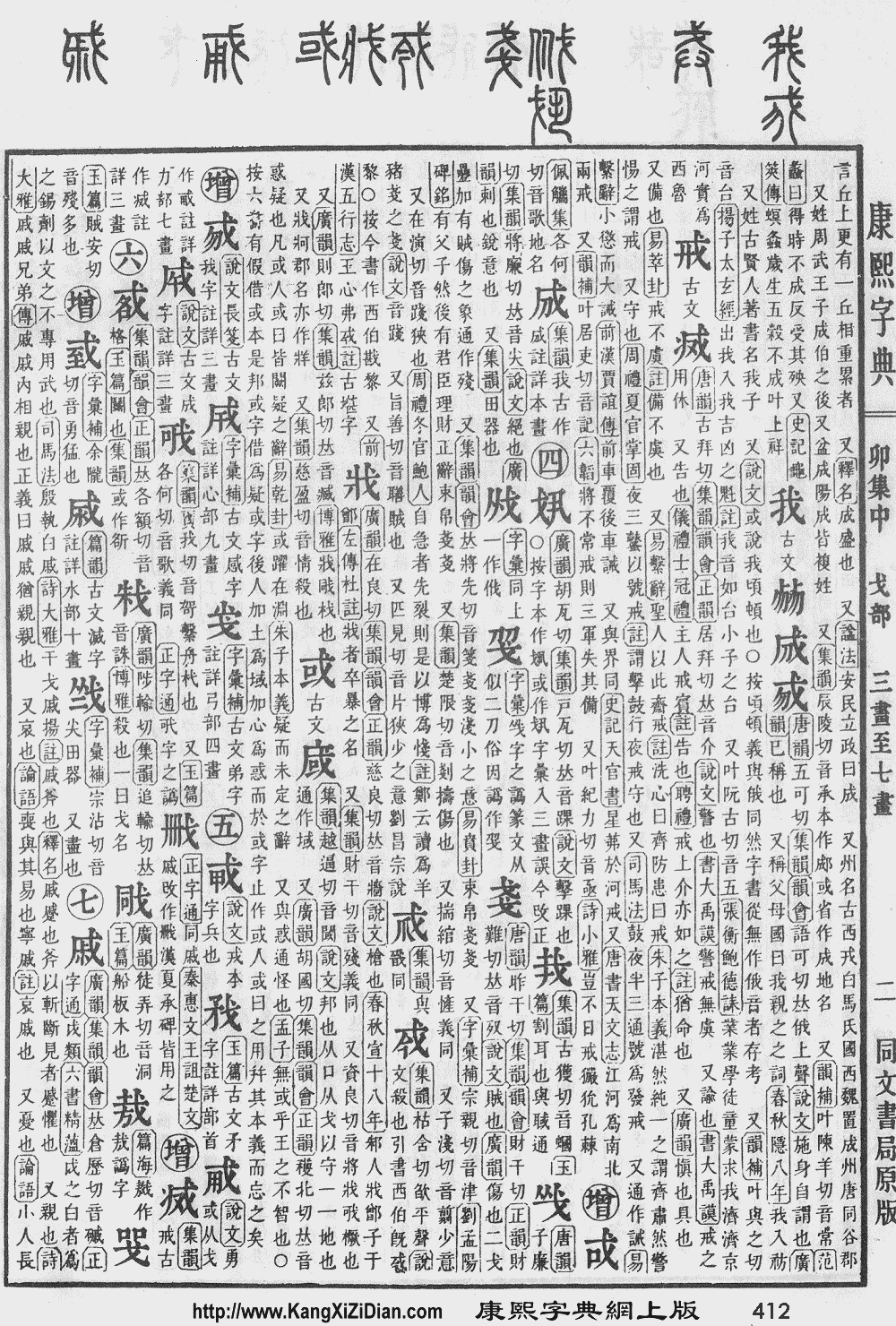
- Kangxi Dictionary: page 412, character 1
- Dai Kanwa Jiten: character 11545
- Hanyu Da Zidian (first edition): volume 2, page 1401, character 2
- Unihan data for U+6211
Further reading[edit]

Chinese[edit]
| simp. and trad. |
我 | |
|---|---|---|
| alternative forms | ||
Glyph origin[edit]
| Historical forms of the character 我 | ||||
|---|---|---|---|---|
| Shang | Western Zhou | Warring States | Shuowen Jiezi (compiled in Han) | Liushutong (compiled in Ming) |
| Oracle bone script | Bronze inscriptions | Chu slip and silk script | Small seal script | Transcribed ancient scripts |

|

|

|

|

|
A pictogram (象形) of a rake-like tool or weapon (note the oracle bone script form); Guo Moruo considers it to be the original character for 錡 (OC *ɡral, “a kind of axe or chisel”). Jao & Zeng (1985, pp. 289–290) conjecture about its similarity to a kind of three-bladed polearm found at archaeological sites; cf. 戈 (gē, “polearm with one blade”). It was already borrowed for sound to mean "I" (in the sense of "first-person subject") since the oracle bone script.
Folk etymology considers it to be an ideograph of a hand (手 (shǒu)) holding a weapon (戈 (gē)) to protect oneself.
Some have suggested a contrast with 爾/尔 (ěr), interpreting the latter as a weapon with tip pointing outward. (Can this(+) etymology be sourced?)
Etymology[edit]
From Proto-Sino-Tibetan *ŋa-j ~ ka. Cognate with 吾 (OC *ŋaː), Burmese ငါ (nga, “I”), Hakka 𠊎 (ngài). The expected Mandarin pronunciation is ě (now only found in a few Northern dialects); wǒ is "a col[loquial] archaism" (Schuessler, 2007).
Pronunciation[edit]
Definitions[edit]
我
- I; me; my
- (literary, formal or dialectal) we; us; our
- (obsolete) to stubbornly hold to one's own opinion
- (obsolete) to kill
- (obsolete) tilted
- a surname
Synonyms[edit]
- 予 (Classical)
- 余 (Classical)
- 俺 (dialectal Mandarin)
- 僕/仆 (pú) (literary, humble)
- 區區/区区 (qūqū) (literary, humble)
- 台 (Classical)
- 吾 (Classical)
- 妾 (qiè) (archaic, humble, use by women)
- 孤 (gū) (used by emperor)
- 我佬 (Mainland, internet slang)
- 朕 (zhèn) (Classical)
- 爺/爷 (yé) (colloquial, derogatory or familiar)
- 窩/窝 (wō) (Mainland, internet slang)
- 老子 (lǎozi) (colloquial male)
See also[edit]
| Standard Mandarin Chinese personal pronouns | |||
|---|---|---|---|
| Person | Singular | Plural | |
| 1st | — | 我 (wǒ) | 我們/我们 (wǒmen) |
| inclusive | 咱們/咱们 (zánmen) | ||
| 2nd | male/indefinite | 你 (nǐ) | 你們/你们 (nǐmen) |
| female | 妳/你 (nǐ) | 妳們/你们 (nǐmen) | |
| deity | 祢 (nǐ) | 祢們/祢们 (nǐmen) | |
| polite | 您 (nín) | 你們/你们 (nǐmen) 您們/您们 (nínmen) | |
| 3rd | male/indefinite | 他 (tā) | 他們/他们 (tāmen) |
| female | 她 (tā) | 她們/她们 (tāmen) | |
| deity | 祂 (tā) | 祂們/祂们 (tāmen) | |
| animal | 牠/它 (tā) | 牠們/它们 (tāmen) | |
| inanimate | 它 (tā) | 它們/它们 (tāmen) | |
Compounds[edit]
- 人我
- 人我是非
- 人棄我取/人弃我取
- 你三我四
- 你丟我撿/你丢我捡
- 你來我往/你来我往
- 你儂我儂/你侬我侬 (nǐnóngwǒnóng)
- 你我 (nǐwǒ)
- 你推我擠/你推我挤
- 你推我讓/你推我让
- 你東我西/你东我西
- 你死我活 (nǐsǐwǒhuó)
- 你爭我奪/你争我夺
- 你知我見/你知我见
- 你誇我逞/你夸我逞
- 你謙我讓/你谦我让
- 你追我趕/你追我赶
- 你長我短/你长我短
- 依然故我
- 做我不著
- 六經註我/六经注我
- 分我杯羹
- 助我張目/助我张目
- 勿忘我 (wùwàngwǒ)
- 匡我不逮
- 卿卿我我 (qīngqīngwǒwǒ)
- 唯我
- 唯我獨尊/唯我独尊 (wéiwǒdúzūn)
- 唯我論/唯我论 (wéiwǒlùn)
- 大我 (dàwǒ)
- 如是我聞/如是我闻 (rúshìwǒwén)
- 宰我
- 小我 (xiǎowǒ)
- 彼我
- 彼眾我寡/彼众我寡 (bǐzhòngwǒguǎ)
- 彼竭我盈 (bǐjiéwǒyíng)
- 彼長我消/彼长我消
- 忘我 (wàngwǒ)
- 惠子知我
- 惟我獨尊/惟我独尊
- 憐我憐卿/怜我怜卿
- 我丈
- 我人 (wǒrén)
- 我倆/我俩 (wǒliǎ)
- 我們/我们
- 我儀/我仪
- 我儂/我侬 (wǒnóng)
- 我咱
- 我國/我国 (wǒguó)
- 我執/我执
- 我家
- 我將/我将
- 我山
- 我師/我师
- 我師禽/我师禽
- 我慢 (wǒmàn)
- 我所
- 我方 (wǒfāng)
- 我曹 (wǒcáo)
- 我武維揚/我武维扬
- 我每 (wǒměi)
- 我生
- 我的天 (wǒ de tiān)
- 我相
- 我私
- 我肏 (wǒ cào)
- 我自
- 我行
- 我行其野
- 我行我素 (wǒxíngwǒsù)
- 我見/我见
- 我見猶憐/我见犹怜
- 我負子戴/我负子戴
- 我身
- 我躬
- 我軍/我军 (wǒjūn)
- 我輩/我辈 (wǒbèi)
- 我郎
- 我醉欲眠
- 我黼子佩
- 捨我其誰/舍我其谁 (shěwǒqíshéi)
- 操之在我
- 故我
- 敵眾我寡/敌众我寡 (dízhòngwǒguǎ)
- 日不我與/日不我与
- 是非人我
- 時不我待/时不我待 (shíbùwǒdài)
- 時不我與/时不我与 (shíbùwǒyǔ)
- 有你沒我/有你没我
- 有我無人/有我无人
- 梵我一如
- 正合我意
- 歲不我與/岁不我与 (suìbùwǒyǔ)
- 毋我
- 法我見/法我见
- 渾然忘我/浑然忘我
- 為我/为我
- 無奈我何/无奈我何
- 無我/无我 (wúwǒ)
- 爾虞我詐/尔虞我诈 (ěryúwǒzhà)
- 爾詐我虞/尔诈我虞
- 物我
- 物我無間/物我无间
- 生我劬勞/生我劬劳
- 盡其在我/尽其在我
- 真我
- 知我
- 知我罪我
- 神我
- 私我
- 給我記住/给我记住
- 老我
- 自我 (zìwǒ)
- 自我中心 (zìwǒ zhōngxīn)
- 自我介紹/自我介绍 (zìwǒ jièshào)
- 自我作古
- 自我作故
- 自我反省 (zìwǒ fǎnxǐng)
- 自我吹噓/自我吹嘘
- 自我實現/自我实现
- 自我批評/自我批评 (zìwǒ pīpíng)
- 自我教育
- 自我期許/自我期许
- 自我肯定
- 自我表現/自我表现 (zìwǒ biǎoxiàn)
- 自我解嘲
- 自我陶醉
- 至公無我/至公无我
- 舊我/旧我
- 舍我其誰/舍我其谁 (shěwǒqíshéi)
- 舍我復誰/舍我复谁
- 誤我/误我
- 超我 (chāowǒ)
- 還我河山/还我河山
- 非我
- 非我族類/非我族类
- 頗我/颇我
- 額我略曆/额我略历
- 鮑子知我/鲍子知我
Descendants[edit]
Others:
References[edit]
- “我”, in 漢語多功能字庫 (Multi-function Chinese Character Database)[2], 香港中文大學 (the Chinese University of Hong Kong), 2014–
- Dictionary of Chinese Character Variants (教育部異體字字典), A01473
- “Entry #3153”, in 臺灣閩南語常用詞辭典 (overall work in Mandarin and Hokkien), Ministry of Education, R.O.C., 2023.
Japanese[edit]
Kanji[edit]
Readings[edit]
Compounds[edit]
Etymology 1[edit]
| Kanji in this term |
|---|
| 我 |
| われ Grade: 6 |
| kun’yomi |
| Alternative spellings |
|---|
| 我 吾 |
From Old Japanese,[1] as the long form of 我 (wa) below.
Compound of 我 (wa, see below) + れ (-re, nominalizing suffix).
Pronunciation[edit]
Pronoun[edit]
- first person singular pronoun: I, me, oneself
- (usually vulgar) second person singular pronoun: you
Usage notes[edit]
- In modern Japanese, most often encountered in the plural forms 我等 (warera) and 我々 (wareware, “we, us”).
Derived terms[edit]
See also[edit]
| a-/wa- “I, we” (first person) |
na-/-ma- “you, ye, thou” (second person) |
k- “this” (close to speaker) |
s- “that” (close to listener) |
a-/ka- “that over there” (far from both) |
i-/ta-/nani- “who, what, where, how, when” (interrogative) |
ono- “oneself” (reflexive) | |
|---|---|---|---|---|---|---|---|
| Person | あ (a) あれ (are) わ (wa) われ (ware) まろ (maro) |
な (na) なれ (nare) なんぢ (nanji) まし (mashi) いまし (imashi) みまし (mimashi) きみ (kimi) |
こ (ko) これ (kore) |
そ (so) それ (sore) |
あ (a) あれ (are) か (ka) かれ (kare) |
た (ta) たれ (tare) なにがし (nanigashi) |
おの (ono) おのれ (onore) |
| Thing | こ (ko) これ (kore) |
そ (so) それ (sore) |
あ (a) あれ (are) か (ka) かれ (kare) |
いづれ (izure) なに (nani) |
|||
| Location | ここ (koko) | そこ (soko) | あしこ (ashiko) かしこ (kashiko) |
いづく (izuku) いづこ (izuko) いどこ (idoko) どこ (doko) |
|||
| Direction | こち (kochi) こなた (konata) |
そち (sochi) そなた (sonata) |
あち (achi) あなた (anata) かなた (kanata) |
いづち (izuchi) いづら (izura) いづかた (izukata) |
|||
| Manner | か (ka) かく (kaku) かくて (kakute) かう (kō) |
さ (sa) さて (sate) しか (shika) |
いか (ika) | ||||
| Time | いつ (itsu) |
Etymology 2[edit]
| Kanji in this term |
|---|
| 我 |
| わ Grade: 6 |
| kun’yomi |
| Alternative spellings |
|---|
| 我 吾 |
From Old Japanese 我 (wa).[1]
Pronunciation[edit]
Pronoun[edit]
- (obsolete or dialect) first-person personal pronoun: I, me
- 棟方志功
- わだばゴッホになる
- wa daba gohho ni naru
- (Aomori) I'll be a Gogh
- わだばゴッホになる
- 棟方志功
Usage notes[edit]
- In modern Japanese, most often encountered in fossilized phrases in combination with the Old Japanese possessive particle が (ga), such as 我が儘 (wagamama, “selfish; selfishness”, literally “just as I like”) or 我が国 (wagakuni, “my country, my homeland → Japan”).
Derived terms[edit]
See also[edit]
| a-/wa- “I, we” (first person) |
na-/-ma- “you, ye, thou” (second person) |
k- “this” (close to speaker) |
s- “that” (close to listener) |
a-/ka- “that over there” (far from both) |
i-/ta-/nani- “who, what, where, how, when” (interrogative) |
ono- “oneself” (reflexive) | |
|---|---|---|---|---|---|---|---|
| Person | あ (a) あれ (are) わ (wa) われ (ware) まろ (maro) |
な (na) なれ (nare) なんぢ (nanji) まし (mashi) いまし (imashi) みまし (mimashi) きみ (kimi) |
こ (ko) これ (kore) |
そ (so) それ (sore) |
あ (a) あれ (are) か (ka) かれ (kare) |
た (ta) たれ (tare) なにがし (nanigashi) |
おの (ono) おのれ (onore) |
| Thing | こ (ko) これ (kore) |
そ (so) それ (sore) |
あ (a) あれ (are) か (ka) かれ (kare) |
いづれ (izure) なに (nani) |
|||
| Location | ここ (koko) | そこ (soko) | あしこ (ashiko) かしこ (kashiko) |
いづく (izuku) いづこ (izuko) いどこ (idoko) どこ (doko) |
|||
| Direction | こち (kochi) こなた (konata) |
そち (sochi) そなた (sonata) |
あち (achi) あなた (anata) かなた (kanata) |
いづち (izuchi) いづら (izura) いづかた (izukata) |
|||
| Manner | か (ka) かく (kaku) かくて (kakute) かう (kō) |
さ (sa) さて (sate) しか (shika) |
いか (ika) | ||||
| Time | いつ (itsu) |
Etymology 3[edit]
| Kanji in this term |
|---|
| 我 |
| わ(が) Grade: 6 |
| kun’yomi |
| For pronunciation and definitions of 我 – see the following entry. | ||
| ||
| (This term, 我, is an alternative spelling of the above term.) |
Etymology 4[edit]
| Kanji in this term |
|---|
| 我 |
| あ Grade: 6 |
| kun’yomi |
| For pronunciation and definitions of 我 – see the following entry. | ||
| ||
| (This term, 我, is an alternative spelling of the above term.) |
Etymology 5[edit]
| Kanji in this term |
|---|
| 我 |
| あれ Grade: 6 |
| kun’yomi |
| For pronunciation and definitions of 我 – see the following entry. | ||
| ||
| (This term, 我, is an alternative spelling of the above term.) |
Etymology 6[edit]
| Kanji in this term |
|---|
| 我 |
| が Grade: 6 |
| on’yomi |
From Middle Chinese 我 (MC ngaX).
The Buddhist senses are a translation of Sanskrit आत्मन् (ātman, “self”).
Pronunciation[edit]
Noun[edit]
- the ego, self
- self-righteousness
- (Buddhism) obstinacy
- Antonym: 無我 (muga)
- (Hinduism) atman
- Synonym: アートマン (ātoman)
Derived terms[edit]
Affix[edit]
Derived terms[edit]
References[edit]
- ↑ 1.0 1.1 Shōgaku Tosho (1988) 国語大辞典(新装版) [Unabridged Dictionary of Japanese (Revised Edition)] (in Japanese), Tōkyō: Shogakukan, →ISBN
- ↑ 2.0 2.1 2.2 Matsumura, Akira, editor (2006), 大辞林 (in Japanese), Third edition, Tōkyō: Sanseidō, →ISBN
- ↑ 3.0 3.1 NHK Broadcasting Culture Research Institute, editor (1998), NHK日本語発音アクセント辞典 [NHK Japanese Pronunciation Accent Dictionary] (in Japanese), Tōkyō: NHK Publishing, →ISBN
Korean[edit]
Etymology[edit]
From Middle Chinese 我 (MC ngaX).
| Historical Readings | ||
|---|---|---|
| Dongguk Jeongun Reading | ||
| Dongguk Jeongun, 1448 | ᅌᅡᆼ〯 (Yale: ngǎ) | |
| Middle Korean | ||
| Text | Eumhun | |
| Gloss (hun) | Reading | |
| Hunmong Jahoe, 1527[3] | 나 (Yale: nà) | 아〯 (Yale: ǎ) |
Pronunciation[edit]
- (SK Standard/Seoul) IPA(key): [a̠(ː)]
- Phonetic hangul: [아(ː)]
- Though still prescribed in Standard Korean, most speakers in both Koreas no longer distinguish vowel length.
Hanja[edit]

Compounds[edit]
References[edit]
- 국제퇴계학회 대구경북지부 (國際退溪學會 大邱慶北支部) (2007). Digital Hanja Dictionary, 전자사전/電子字典. [4]
Okinawan[edit]
Kanji[edit]
Readings[edit]
Old Japanese[edit]
Alternative forms[edit]
Etymology 1[edit]
From Proto-Japonic *wa.
Pronoun[edit]
我 (wa) (kana わ)
Quotations[edit]
For quotations using this term, see Citations:我.
Derived terms[edit]
- 我が (waga)
Descendants[edit]
- Japanese: 我 (wa)
Etymology 2[edit]
From 我 (wa, see above) + れ (-re, “thing”, nominalizing suffix).
Pronoun[edit]
我 (ware) (kana われ)
Quotations[edit]
For quotations using this term, see Citations:我.
Descendants[edit]
- Japanese: 我 (ware)
Etymology 3[edit]
Likely a compound of 我 (wa, see above) + ろ (-ro, suffix indicating affection).
Pronoun[edit]
我 (waro2) (kana わろ)
- (regional, Southern Eastern Old Japanese) first person singular pronoun: I, me
Quotations[edit]
For quotations using this term, see Citations:我.
Etymology 4[edit]
The eastern variant of 我 (ware).[1] Appears to be 我 (wa) + ぬ (nu), appearing here not as the negative verb auxiliary but rather as a suffixing element of uncertain meaning. Appears in the Man'yōshū, volume 14 poem 3476.[2]
Pronoun[edit]
我 (wanu) (kana わぬ)
- (regional, Northern Eastern Old Japanese) first person personal pronoun: I, me, oneself
Quotations[edit]
For quotations using this term, see Citations:我.
Etymology 5[edit]
(This etymology is missing or incomplete. Please add to it, or discuss it at the Etymology scriptorium.)
Pronoun[edit]
我 (a) (kana あ)
Quotations[edit]
For quotations using this term, see Citations:我.
Derived terms[edit]
- 我が (aga)
Descendants[edit]
- Japanese: あ (a)
Etymology 6[edit]
From 我 (a, see above) + れ (-re, nominalizing suffix).
Pronoun[edit]
我 (are) (kana あれ)
Quotations[edit]
For quotations using this term, see Citations:我.
Descendants[edit]
- Japanese: あれ (are)
References[edit]
- ^ “我・吾”, in 日本国語大辞典 (Nihon Kokugo Daijiten, “Nihon Kokugo Daijiten”)[1] (in Japanese), concise edition, Tōkyō: Shogakukan, 2000
- ^ , text available online here
Vietnamese[edit]
Han character[edit]
我: Hán Việt readings: ngã[1][2][3][4], ngả (
我: Nôm readings: ngả[1][2][3][6][5][4][7], ngã[1][2][3][5][4][7]
- (Can we verify(+) this sense?) chữ Hán form of ngã, ngả (“(Vietnamese Literary Sinitic) I; me”).
- Nôm form of ngả (“way; direction”).
- Nôm form of ngã (“to fall; to slip”).
Compounds[edit]
References[edit]
- CJK Unified Ideographs block
- Han script characters
- Translingual lemmas
- Translingual symbols
- Han pictograms
- Chinese terms inherited from Proto-Sino-Tibetan
- Chinese terms derived from Proto-Sino-Tibetan
- Mandarin terms with audio links
- Cantonese terms with audio links
- Eastern Min terms with audio links
- Hokkien terms with audio links
- Mandarin terms with multiple pronunciations
- Middle Chinese lemmas
- Old Chinese lemmas
- Chinese lemmas
- Mandarin lemmas
- Sichuanese lemmas
- Dungan lemmas
- Cantonese lemmas
- Taishanese lemmas
- Gan lemmas
- Hakka lemmas
- Jin lemmas
- Northern Min lemmas
- Eastern Min lemmas
- Hokkien lemmas
- Teochew lemmas
- Wu lemmas
- Xiang lemmas
- Chinese pronouns
- Mandarin pronouns
- Sichuanese pronouns
- Dungan pronouns
- Cantonese pronouns
- Taishanese pronouns
- Gan pronouns
- Hakka pronouns
- Jin pronouns
- Northern Min pronouns
- Eastern Min pronouns
- Hokkien pronouns
- Teochew pronouns
- Wu pronouns
- Xiang pronouns
- Chinese verbs
- Mandarin verbs
- Sichuanese verbs
- Dungan verbs
- Cantonese verbs
- Taishanese verbs
- Gan verbs
- Hakka verbs
- Jin verbs
- Northern Min verbs
- Eastern Min verbs
- Hokkien verbs
- Teochew verbs
- Wu verbs
- Xiang verbs
- Chinese adjectives
- Mandarin adjectives
- Sichuanese adjectives
- Dungan adjectives
- Cantonese adjectives
- Taishanese adjectives
- Gan adjectives
- Hakka adjectives
- Jin adjectives
- Northern Min adjectives
- Eastern Min adjectives
- Hokkien adjectives
- Teochew adjectives
- Wu adjectives
- Xiang adjectives
- Chinese proper nouns
- Mandarin proper nouns
- Sichuanese proper nouns
- Dungan proper nouns
- Cantonese proper nouns
- Taishanese proper nouns
- Gan proper nouns
- Hakka proper nouns
- Jin proper nouns
- Northern Min proper nouns
- Eastern Min proper nouns
- Hokkien proper nouns
- Teochew proper nouns
- Wu proper nouns
- Xiang proper nouns
- Chinese terms with IPA pronunciation
- Chinese Han characters
- Mandarin terms with usage examples
- Cantonese terms with usage examples
- Wu terms with usage examples
- Chinese literary terms
- Chinese formal terms
- Chinese dialectal terms
- Mandarin terms with collocations
- Chinese terms with obsolete senses
- Chinese surnames
- Beginning Mandarin
- Japanese Han characters
- Grade 6 kanji
- Japanese kanji with goon reading が
- Japanese kanji with kan'on reading が
- Japanese kanji with kun reading わ
- Japanese kanji with kun reading われ
- Japanese terms spelled with 我 read as われ
- Japanese terms read with kun'yomi
- Japanese terms inherited from Old Japanese
- Japanese terms derived from Old Japanese
- Japanese terms suffixed with れ
- Japanese terms with IPA pronunciation
- Japanese lemmas
- Japanese pronouns
- Japanese terms with multiple readings
- Japanese terms spelled with sixth grade kanji
- Japanese terms written with one Han script character
- Japanese terms spelled with 我
- Japanese single-kanji terms
- Japanese vulgarities
- Japanese terms spelled with 我 read as わ
- Japanese terms with obsolete senses
- Japanese dialectal terms
- Japanese terms with usage examples
- Japanese adnominals
- Japanese terms spelled with 我 read as あ
- Japanese terms spelled with 我 read as あれ
- Japanese terms spelled with 我 read as が
- Japanese terms read with on'yomi
- Japanese terms derived from Middle Chinese
- Japanese terms derived from Sanskrit
- Japanese nouns
- ja:Buddhism
- ja:Hinduism
- Japanese affixes
- Korean terms derived from Middle Chinese
- Korean terms with long vowels in the first syllable
- Korean lemmas
- Korean Han characters
- Okinawan Han characters
- Okinawan kanji with on reading がー
- Okinawan kanji with kun reading わ-ん
- Old Japanese terms inherited from Proto-Japonic
- Old Japanese terms derived from Proto-Japonic
- Old Japanese lemmas
- Old Japanese pronouns
- Old Japanese terms suffixed with れ
- Old Japanese terms suffixed with ろ
- Regional Old Japanese
- Vietnamese Chữ Hán
- Vietnamese lemmas
- Vietnamese Han characters
- Vietnamese Nom