渚
| ||||||||
 | ||||||||
Translingual[edit]
| Traditional | 渚 |
|---|---|
| Simplified | 渚 |
| Japanese | 渚 |
| Korean | 渚 |
Han character[edit]
渚 (Kangxi radical 85, 水+8, 11 strokes, cangjie input 水十大日 (EJKA), four-corner 34160, composition ⿰氵者)
Derived characters[edit]
References[edit]
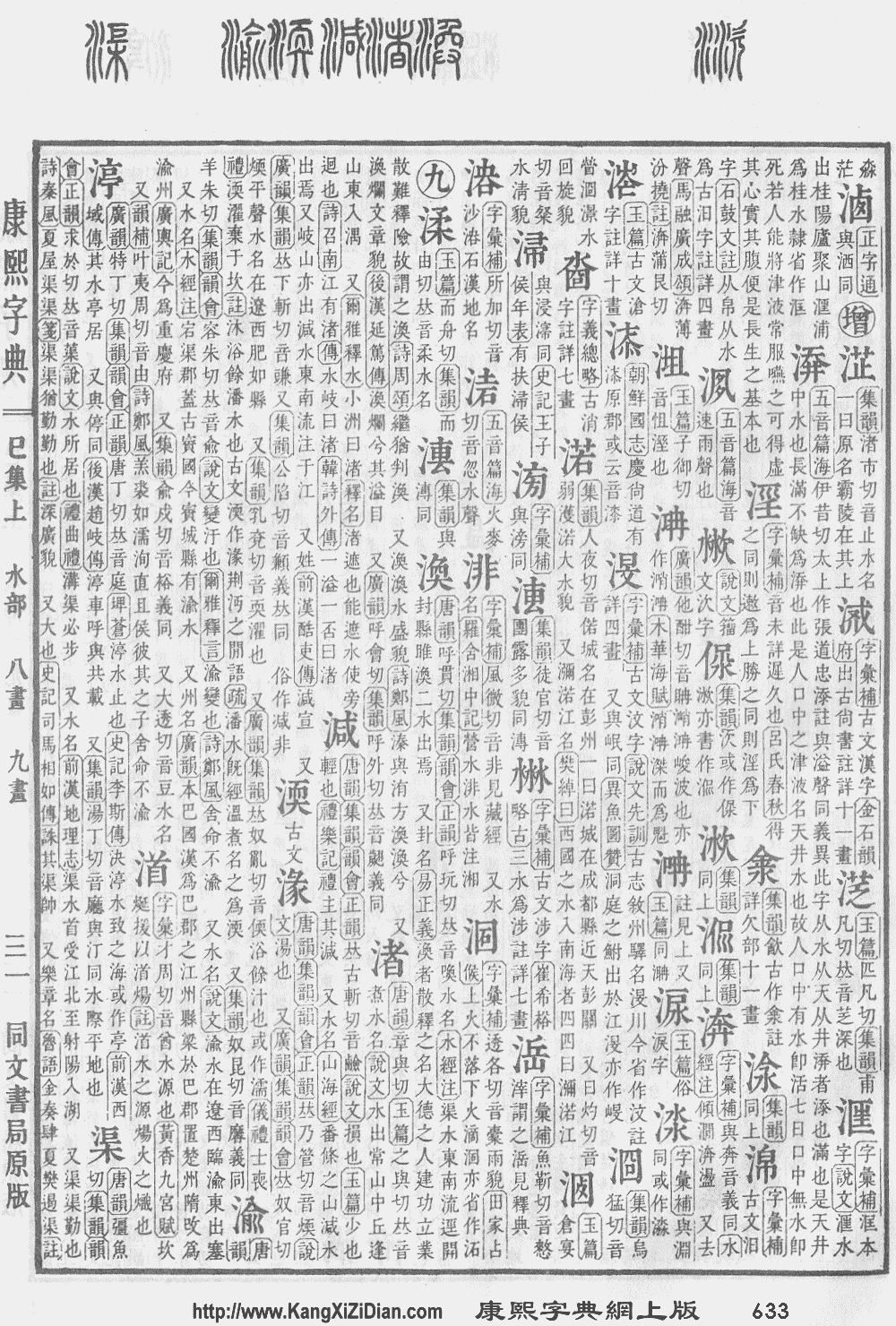
- Kangxi Dictionary: page 633, character 41
- Dai Kanwa Jiten: character 17758
- Dae Jaweon: page 1040, character 1
- Hanyu Da Zidian (first edition): volume 3, page 1640, character 4
- Unihan data for U+6E1A
Chinese[edit]
| simp. and trad. |
渚 | |
|---|---|---|
Glyph origin[edit]
| Old Chinese | |
|---|---|
| 觰 | *rtaːʔ, *rtaː |
| 諸 | *tjaː, *tja |
| 者 | *tjaːʔ |
| 堵 | *tjaːʔ, *taːʔ |
| 赭 | *tjaːʔ |
| 撦 | *l̥ʰjaːʔ |
| 扯 | *tʰjaːʔ |
| 闍 | *djaː, *taː |
| 奢 | *hljaː |
| 鍺 | *toːlʔ |
| 都 | *taː |
| 醏 | *taː |
| 覩 | *taːʔ |
| 睹 | *taːʔ |
| 暏 | *taːʔ |
| 賭 | *taːʔ |
| 帾 | *taːʔ |
| 楮 | *taːʔ, *tʰaʔ |
| 屠 | *daː, *da |
| 瘏 | *daː |
| 廜 | *daː |
| 鷵 | *daː |
| 緒 | *ljaʔ |
| 豬 | *ta |
| 猪 | *ta |
| 瀦 | *ta |
| 藸 | *ta, *da |
| 櫫 | *ta |
| 褚 | *taʔ, *tʰaʔ |
| 著 | *taʔ, *tas, *da, *taɡ, *daɡ |
| 箸 | *tas, *das |
| 儲 | *da |
| 躇 | *da |
| 櫧 | *tja |
| 藷 | *tja, *djas |
| 蠩 | *tja |
| 煮 | *tjaʔ |
| 渚 | *tjaʔ |
| 煑 | *tjaʔ |
| 陼 | *tjaʔ |
| 翥 | *tjas |
| 署 | *djas |
| 薯 | *djas |
| 曙 | *djas |
| 書 | *hlja |
| 暑 | *hjaʔ |
| 鐯 | *taɡ |
| 擆 | *taɡ |
| 櫡 | *taɡ |
Pronunciation[edit]
Definitions[edit]
渚
Compounds[edit]
Japanese[edit]
| Shinjitai | 渚 | |
| Kyūjitai [1] |
渚 渚or 渚+ ︀?
|
|
| 渚󠄀 渚+ 󠄀?(Adobe-Japan1) | ||
| 渚󠄃 渚+ 󠄃?(Hanyo-Denshi) (Moji_Joho) | ||
| The displayed kanji may be different from the image due to your environment. See here for details. | ||
Kanji[edit]
(“Jinmeiyō” kanji used for names, shinjitai kanji, kyūjitai form 渚)
Readings[edit]
- Go-on: しょ (sho)←しよ (syo, historical)
- Kan-on: しょ (sho)←しよ (syo, historical)
- Kun: なぎさ (nagisa, 渚); みぎわ (migiwa, 渚)←みぎは (migifa, 渚, historical)
- Nanori: すか (suka); なぎ (nagi); なぎさ (nagisa)
Compounds[edit]
Usage notes[edit]
Used in the Man'yōshū (c. 759 CE) as 借音 (shakuon) kana for ⟨su⟩.
Etymology 1[edit]
| Kanji in this term |
|---|
| 渚 |
| なぎさ Jinmeiyō |
| kun’yomi |
| Alternative spellings |
|---|
| 渚 (kyūjitai) 汀 |
⟨naɡi1sa⟩ → */naɡʲisa/ → /naɡisa/
From Old Japanese.[2]
Possibly a compound of 凪ぎ (nagi, “calming, dying down”, the 連用形 (ren'yōkei, “continuative or stem form”) of verb 凪ぐ (nagu, “to calm down, to die down”, as of waves or wind), cognate with 和やか (nagoyaka, “calm, quiet”)) + 磯 (sa, “rocky shore, pebble beach”), where sa is an ancient alternative for so, the abbreviated combining reading of modern 磯 (iso), cognate with 石 (ishi, “rock, stone”).
Pronunciation[edit]
Noun[edit]
- the water's edge:
- beach
- , text here
- 都乃久尓乃宇美能奈伎佐尓布奈餘曽比多志埿毛等伎尓阿母我米母我母 [Man'yōgana]
- 津の国の海の渚に船装ひ立し出も時に母が目もがも [Modern spelling]
- Tsu-no-kuni no umi no nagisa ni funayosoi tashide mo toki ni amo ga me mo ga mo
- (please add an English translation of this example)
- , text here
- shore
- , text here
- 大御舟竟而佐守布高嶋之三尾勝野之奈伎左思所念 [Man'yōgana]
- 大御船泊ててさもらふ高島の三尾の勝野の渚し思ほゆ [Modern spelling]
- ōmifune hatete samorau Takashima-no-mio no Kachino-no-nagisa shi omōyu
- (please add an English translation of this example)
- 1235, Shinchokusen Wakashū (book 8, poem 525; also Hyakunin Isshu, poem 93)
- , text here
- bank (as of a river or stream)
- beach
Synonyms[edit]
Derived terms[edit]
Proper noun[edit]
- a place name
- a surname
- a male or female given name
Etymology 2[edit]
| Kanji in this term |
|---|
| 渚 |
| みぎわ Jinmeiyō |
| kun’yomi |
| Alternative spellings |
|---|
| 渚 (kyūjitai) 汀 水際 |
⟨mi1 ki1pa⟩ → */mʲiɡʲipa/ → /miɡifa/ → /miɡiwa/
Compound of 水 (mi, “water”, combining form) + 際 (kiwa, “edge, boundary”).[2][3][6] The kiwa changes to giwa as an instance of rendaku (連濁).
Pronunciation[edit]
Noun[edit]
Derived terms[edit]
Proper noun[edit]
- a female given name
References[edit]
- ^ “渚”, in 漢字ぺディア (Kanjipedia)[1] (in Japanese), 日本漢字能力検定協会, 2015–2024
- ↑ 2.0 2.1 Shōgaku Tosho (1988) 国語大辞典(新装版) [Unabridged Dictionary of Japanese (Revised Edition)] (in Japanese), Tōkyō: Shogakukan, →ISBN
- ↑ 3.0 3.1 3.2 Matsumura, Akira, editor (2006), 大辞林 (in Japanese), Third edition, Tōkyō: Sanseidō, →ISBN
- ^ Matsuo Bashō, Hiroaki Sato (2013) Bashō's Narrow Road: Spring and Autumn Passages (Rock Spring Collection of Japanese Literature), Stone Bridge Press, Inc., →ISBN
- ^ Edwin A. Cranston (1998) The Gem-Glistening Cup, illustrated edition, Stanford University Press, →ISBN, page 306
- ^ Matsumura, Akira (1995) 大辞泉 (in Japanese), First edition, Tōkyō: Shogakukan, →ISBN
Korean[edit]
Etymology[edit]
From Middle Chinese 渚 (MC tsyoX). Recorded as Middle Korean 져〯 (cyě) (Yale: cyě) in Hunmong Jahoe (訓蒙字會 / 훈몽자회), 1527.
Pronunciation[edit]
- (SK Standard/Seoul) IPA(key): [t͡ɕʌ̹]
- Phonetic hangul: [저]
Hanja[edit]

References[edit]
- 국제퇴계학회 대구경북지부 (國際退溪學會 大邱慶北支部) (2007). Digital Hanja Dictionary, 전자사전/電子字典. [2]
Vietnamese[edit]
Han character[edit]
- This term needs a translation to English. Please help out and add a translation, then remove the text
{{rfdef}}.
- CJK Unified Ideographs block
- Han script characters
- Character boxes with images
- CJK Compatibility Ideographs block
- Translingual lemmas
- Translingual symbols
- Middle Chinese lemmas
- Chinese lemmas
- Mandarin lemmas
- Cantonese lemmas
- Hokkien lemmas
- Chinese nouns
- Mandarin nouns
- Cantonese nouns
- Hokkien nouns
- Chinese terms with IPA pronunciation
- Chinese Han characters
- Japanese Han characters
- Kanji used for names
- Japanese kanji with goon reading しょ
- Japanese kanji with historical goon reading しよ
- Japanese kanji with kan'on reading しょ
- Japanese kanji with historical kan'on reading しよ
- Japanese kanji with kun reading なぎさ
- Japanese kanji with kun reading みぎわ
- Japanese kanji with historical kun reading みぎは
- Japanese kanji with nanori reading すか
- Japanese kanji with nanori reading なぎ
- Japanese kanji with nanori reading なぎさ
- Japanese terms spelled with 渚
- Japanese terms read with kun'yomi
- Japanese terms inherited from Old Japanese
- Japanese terms derived from Old Japanese
- Japanese compound terms
- Japanese terms with IPA pronunciation
- Japanese lemmas
- Japanese nouns
- Japanese terms with multiple readings
- Japanese terms spelled with jinmeiyō kanji
- Japanese terms written with one Han script character
- Japanese single-kanji terms
- Japanese terms with usage examples
- Japanese proper nouns
- Japanese surnames
- Japanese given names
- Japanese male given names
- Japanese female given names
- Japanese terms with rendaku
- Korean terms derived from Middle Chinese
- Middle Korean Han characters
- Korean lemmas
- Korean Han characters
- Vietnamese lemmas
- Vietnamese Han characters